

From Louvain to Leiden: guaranteeing well-connected communities
Open accessThe DOI matches its Crossref record; 30 of the 30 references it cites were found in a registry or an index; 1 of the 26 sources its claims cite were checked for support.
Abstract
Community detection is often used to understand the structure of large and complex networks. One of the most popular algorithms for uncovering community structure is the so-called Louvain algorithm. We show that this algorithm has a major defect that largely went unnoticed until now: the Louvain algorithm may yield arbitrarily badly connected communities. In the worst case, communities may even be disconnected, especially when running the algorithm iteratively. In our experimental analysis, we observe that up to 25% of the communities are badly connected and up to 16% are disconnected. To address this problem, we introduce the Leiden algorithm. We prove that the Leiden algorithm yields communities that are guaranteed to be connected. In addition, we prove that, when the Leiden algorithm is applied iteratively, it converges to a partition in which all subsets of all communities are locally optimally assigned. Furthermore, by relying on a fast local move approach, the Leiden algorithm runs faster than the Louvain algorithm. We demonstrate the performance of the Leiden algorithm for several benchmark and real-world networks. We find that the Leiden algorithm is faster than the Louvain algorithm and uncovers better partitions, in addition to providing explicit guarantees.
Overview
CoChat Summary
TL;DR
The Louvain algorithm can yield arbitrarily badly connected communities, including disconnected ones, especially when iterated. The Leiden algorithm guarantees connected communities and, under iteration, converges to subset-optimal partitions while running faster and finding higher-quality partitions.
Key findings
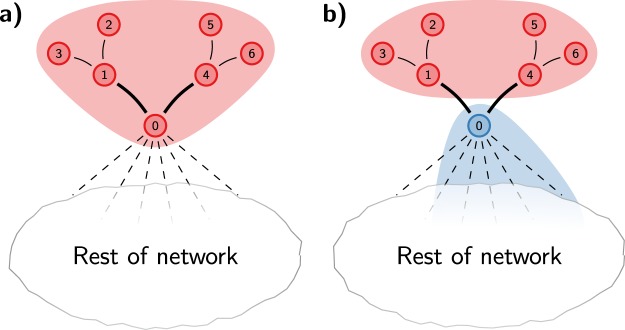
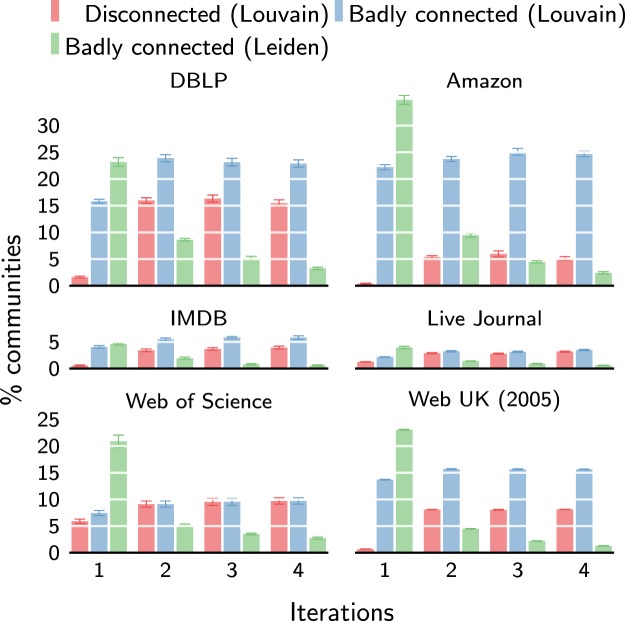
- Louvain may produce arbitrarily badly connected communities; in experiments up to 25% of communities were badly connected and up to 16% were disconnected. First-iteration badly connected percentages included Amazon 23%, DBLP 16%, and Web UK 14%; disconnected communities were usually around 1%, but exceeded 5% for Web of Science in the first iteration and jumped to 16% for DBLP in later iterations. After four iterations, Amazon had 5% disconnected but 25% badly connected communities.
- Leiden guarantees all communities are connected after each iteration, and also γ-separated and γ-connected. After a stable iteration, all nodes are locally optimally assigned and all communities are subpartition γ-dense; asymptotically, all communities are uniformly γ-dense and subset optimal.
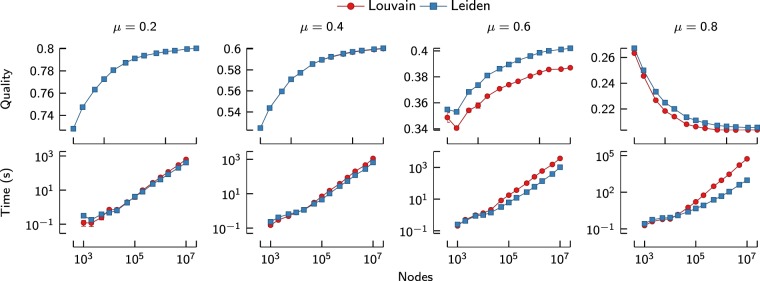
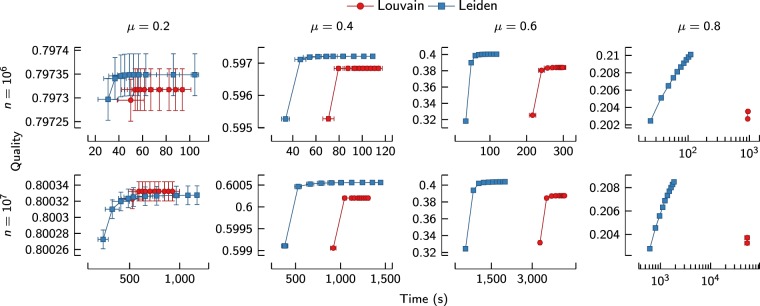
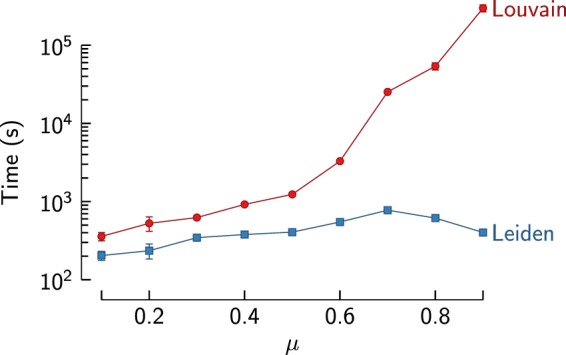
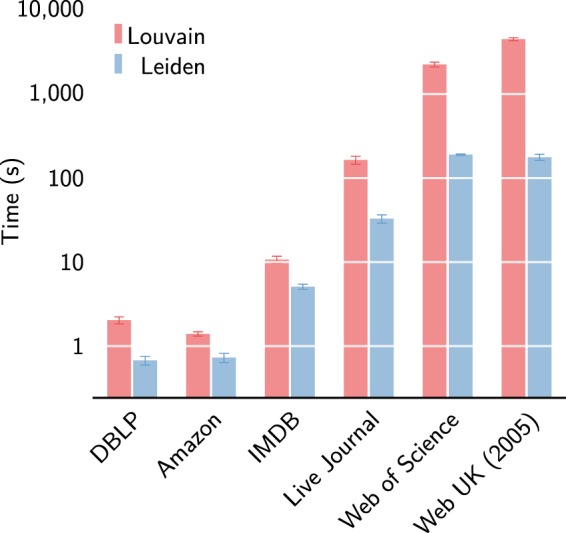
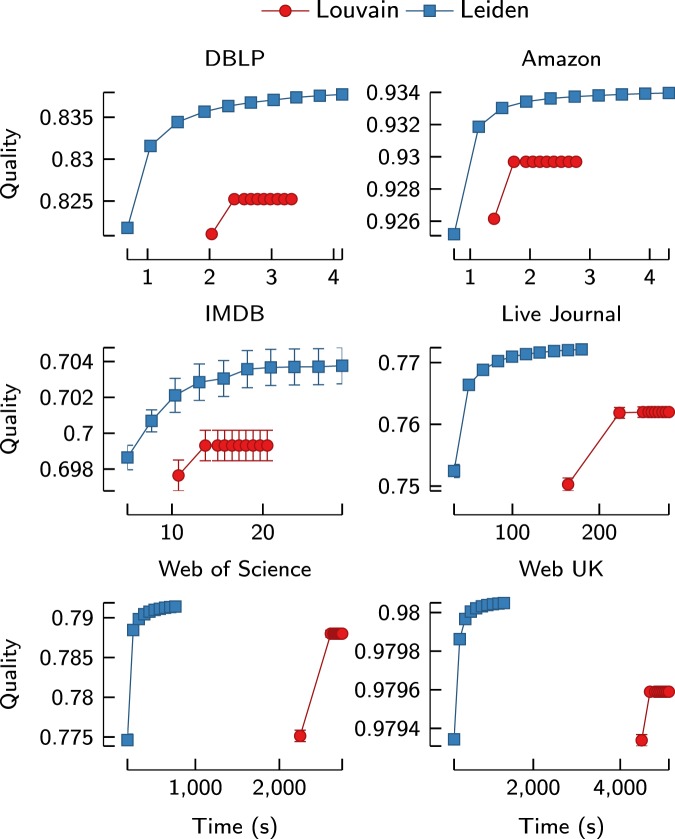
- Leiden was faster than Louvain: first iteration roughly 2–20 times faster on empirical networks, including more than 7× faster for Live Journal, more than 11× for Web of Science, and more than 20× for Web UK. On benchmark networks with difficult partitions (μ = 0.9), Louvain required almost 2.5 days while Leiden needed fewer than 10 minutes; for largest networks Leiden reached 10–100 times faster runtimes.
- Leiden found higher modularity on all six empirical networks: DBLP 0.8387 vs 0.8262, Amazon 0.9341 vs 0.9301, IMDB 0.7069 vs 0.7062, Live Journal 0.7739 vs 0.7653, Web of Science 0.7951 vs 0.7911, and Web UK 0.9801 vs 0.9796.
Methods
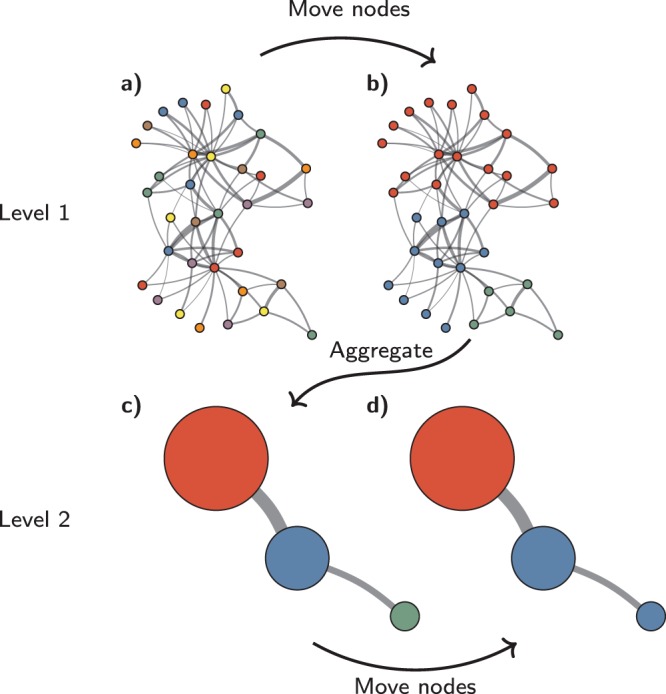
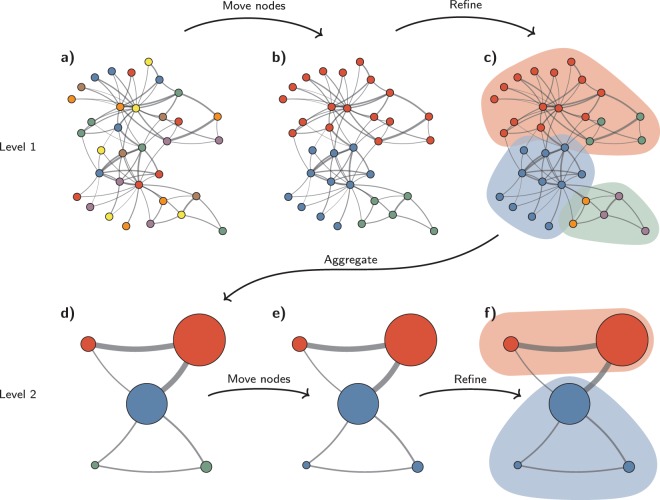
- The paper introduces the Leiden algorithm, which combines local moving, refinement of the partition, and aggregation; proofs of guarantees are relegated to Supplementary Information. It compares Leiden with Louvain on six empirical networks and on benchmark networks.
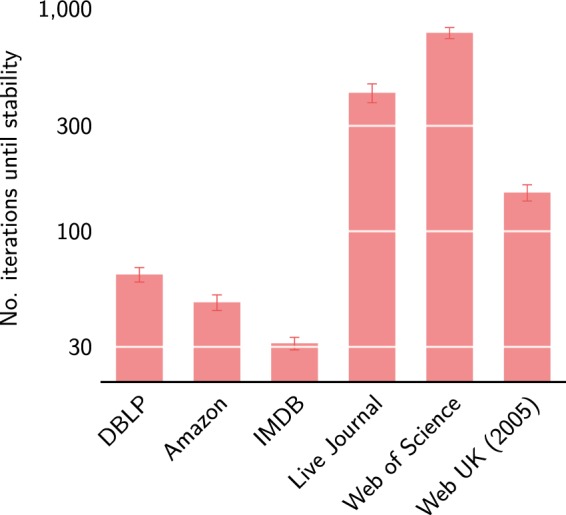
- Empirical networks: DBLP (317,080 nodes, degree 6.6), Amazon (334,863, 5.6), IMDB (374,511, 80.2), Live Journal (3,997,962, 17.4), Web of Science (9,811,130, 21.2), and Web UK (39,252,879, 39.8). Modularity was used with γ = 1; Table 2 reports maximal modularity after 10 replications of 10 iterations each. Badly connected community analysis was repeated 10 times, with Leiden run on each community’s subnetwork until a stable iteration.
- Benchmark networks ranged from n = 10^3 to n = 10^7 nodes, with community size 50 and CPM as the quality function; the mixing parameter μ varied, 10 iterations were performed, and each parameter set was repeated 10 times. The refinement randomness parameter was θ = 0.01.
Limitations
- The paper states that benchmark networks have only limited value because they are not representative of empirical real-world networks and have a rather simple structure.
- The paper states that counting communities split by Leiden gives only a lower bound on the number of badly connected communities; if Leiden does not find subcommunities, there is no guarantee that modularity cannot be increased by splitting the community.
- Evident from the text: there is no dedicated limitations section; technical details and proofs are relegated to Supplementary Information, and the experimental analysis fixes θ = 0.01 although values roughly in [0.0005, 0.1] are said to provide reasonable results.
Model-written summary. Check it against the paper before relying on it.
Integrity signals
Registry
Cites
Statistics
Figures
Verification
Claims the paper makes
1 Valid · 2 Not valid · 17 Not checked · 142 Own results and interpretations
The cited sources support only part of this claim — read each source’s verdict below.
In the paper
“Hence, the problem of Louvain outlined above is independent from the issue of the resolution limit.”
§ From Louvain to Leiden: guaranteeing well-connected communities > Louvain Algorithm > Badly connected communities
What the sources say
- Partly supportedcites [14] Fortunato S Barthélemy M Resolution Limit in Community Detection Proc. Natl. Acad. Sci. USA 2007 104 36 10.1073/pnas.0605965104 17190818 PMC1765466 sourceExperimental — accuracy not yet measured
Our copy supports the resolution-limit side of the sentence: the Conclusions (VI, p. 7) state that 'the resolution limit of modularity does not rely on particular network structures, but only on the comparison between the sizes of interconnected communities and that of the whole network', the Introduction (p. 1) calls it an 'intrinsic scale' of modularity, and Section V (pp. 5-6) shows the failure persists with simulated annealing, i.e. it is a property of the quality function rather than of one particular optimizer. What the source does not contain is the other term of the comparison: Louvain is never mentioned anywhere in the paper (the Introduction, p. 1, lists only generic greedy procedures [19,20], extremal optimization [21] and simulated annealing [22,23]), and no passage contrasts the resolution limit with an algorithm-specific defect. The independence claim is therefore the citing authors' own inference built on this paper's characterization of the resolution limit. (LLM, conf=0.70)
plain- Asserted: passes — The authors put it forward as true.
- Checkable: passes — It can be checked against evidence.
- Load-bearing: passes — The paper’s conclusions depend on it.
- Based: passes — The paper gives a reason why it holds.
- Partly supported
A result the paper states — it cites no source for it, so there is none to check. The quote shows it is in the paper.
In the paper
“The percentage of badly connected communities is less affected by the number of iterations of the Louvain algorithm.”
§ From Louvain to Leiden: guaranteeing well-connected communities > Experimental Analysis > Badly connected communities
plain- Asserted: passes — The authors put it forward as true.
- Checkable: passes — It can be checked against evidence.
- Load-bearing: unclear — It is unclear whether the paper’s conclusions depend on it.
- Based: passes — The paper gives a reason why it holds.
A result the paper states — it cites no source for it, so there is none to check. The quote shows it is in the paper.
In the paper
“In addition, we prove that, when the Leiden algorithm is applied iteratively, it converges to a partition in which all subsets of all communities are locally optimally assigned.”
- Also stated in: § Introduction · boosted
“In addition, we prove that the algorithm converges to an asymptotically stable partition in which all subsets of all communities are locally optimally assigned.”
§ From Louvain to Leiden: guaranteeing well-connected communities > Abstract
boostedstates a cause- Asserted: passes — The authors put it forward as true.
- Checkable: passes — It can be checked against evidence.
- Load-bearing: passes — The paper’s conclusions depend on it.
- Based: passes — The paper gives a reason why it holds.
- Also stated in: § Introduction · boosted
A result the paper reports from its own data — it cites no other source for it, so there is none to check. The quote shows it is in the paper.
In the paper
“The second iteration of Louvain shows a large increase in the percentage of disconnected communities.”
§ From Louvain to Leiden: guaranteeing well-connected communities > Experimental Analysis > Badly connected communities
plainstates a cause- Asserted: passes — The authors put it forward as true.
- Checkable: passes — It can be checked against evidence.
- Load-bearing: passes — The paper’s conclusions depend on it.
- Based: passes — The paper gives a reason why it holds.
A result the paper reports from its own data — it cites no other source for it, so there is none to check. The quote shows it is in the paper.
In the paper
“In terms of the percentage of badly connected communities in the first iteration, Leiden performs even worse than Louvain, as can be seen in Fig. 4.”
§ From Louvain to Leiden: guaranteeing well-connected communities > Experimental Analysis > Badly connected communities
plain- Asserted: passes — The authors put it forward as true.
- Checkable: passes — It can be checked against evidence.
- Load-bearing: unclear — It is unclear whether the paper’s conclusions depend on it.
- Based: passes — The paper gives a reason why it holds.
115 more claims
Create a free account to see all 162 claims and to verify the 24 references still open.
- Probably not a substantial claim. 23
- It may state two separate claims as one. 23
- The quote only partly states this claim. 1
Claims other papers make about this one
Each is checked against this paper’s own text: does it say what the citing paper says it does?
The cited source says what the claim attributes to it.
In the citing paper
“When compared to six common clustering algorithms, including Leiden25 and CellHarmony26, VFC was the top performing algorithm on every simulation on the T cell data and best performing, on average, on the zebrafish dataset, with a 57% increase in average performance over Louvain, which was the next best algorithm”
From Quantifying the effect of experimental perturbations at single-cell resolution (2021) · cites this paper as [25]
The cited source says what the claim attributes to it.
In the citing paper
“Louvain’s successor Leiden circumvents this issue by yielding guaranteed connected communities and is computationally more efficient52.”
From Best practices for single-cell analysis across modalities (2023) · cites this paper as [52]
The cited source says what the claim attributes to it.
In the citing paper
“However, the Louvain algorithm can lead to arbitrarily poorly connected communities52.”
From Best practices for single-cell analysis across modalities (2023) · cites this paper as [52]
The cited source says what the claim attributes to it.
In the citing paper
“We found that many t-types had total variance substantially above the variances of the k-means clusters (Fig. 5b) and an alternative analysis using entropies of Leiden clustering35 often highlighted the same t-types as variable (Extended Data Fig. 8).”
From Phenotypic variation of transcriptomic cell types in mouse motor cortex (2021) · cites this paper as [35]
The cited source says what the claim attributes to it.
In the citing paper
“Community detection uses the Leiden algorithm [28] with ModularityVertexPartition, producing hierarchical subclustering to depth 3.”
From SuperLocalMemory: Privacy-Preserving Multi-Agent Memory with Bayesian Trust Defense Against Memory Poisoning (2026) · cites this paper as [28]
6 more claims about this paper
Create a free account to see every claim other papers make about this one.
Citations
Cites
Fast unfolding of communities in large networks
Blondel, V. D., Guillaume, J.-L., Lambiotte, R., & Lefebvre, E. (2008) · Journal of Statistical Mechanics: Theory and Experiment · doi:10.1088/1742-5468/2008/10/p10008 · Cited by 21,424 · cited 3×
“The Louvain algorithm 10 is very simple and elegant.”
MethodFinding and evaluating community structure in networks
Newman, M. E. J., & Girvan, M. (2004) · Physical Review E · doi:10.1103/physreve.69.026113 · Cited by 13,931 · cited 2×
“The Leiden algorithm consists of three phases: (1) local moving of nodes, (2) refinement of the partition and (3) aggregation of the network based on the refined partition, using the non-refined partition to create an initial partition for the aggregate network.”
BackgroundMethodComplex brain networks: graph theoretical analysis of structural and functional systems
Bullmore, E., & Sporns, O. (2009) · Nature Reviews Neuroscience · doi:10.1038/nrn2575 · Cited by 11,820
Fortunato, S. (2010) · Physics Reports · doi:10.1016/j.physrep.2009.11.002 · Cited by 11,293 · cited 4×
“The Leiden algorithm consists of three phases: (1) local moving of nodes, (2) refinement of the partition and (3) aggregation of the network based on the refined partition, using the non-refined partition to create an initial partition for the aggregate network.”
BackgroundMethodInfluentialFinding community structure in very large networks
Clauset, A., Newman, M. E. J., & Moore, C. (2004) · Physical Review E · doi:10.1103/physreve.70.066111 · Cited by 7,390 · cited 1×
“Optimising modularity is NP-hard 5 , and consequentially many heuristic algorithms have been proposed, such as hierarchical agglomeration 6 , extremal optimisation 7 , simulated annealing 4,8 and spectral 9 algorithms.”
MethodFinding community structure in networks using the eigenvectors of matrices
Newman, M. E. J. (2006) · Physical Review E · doi:10.1103/physreve.74.036104 · Cited by 4,761
Functional cartography of complex metabolic networks
Guimerà, R., & Nunes Amaral, L. A. (2005) · Nature · doi:10.1038/nature03288 · Cited by 3,983 · cited 2×
“Optimising modularity is NP-hard 5 , and consequentially many heuristic algorithms have been proposed, such as hierarchical agglomeration 6 , extremal optimisation 7 , simulated annealing 4,8 and spectral 9 algorithms.”
MethodNear linear time algorithm to detect community structures in large-scale networks
Raghavan, U. N., Albert, R., & Kumara, S. (2007) · Physical Review E · doi:10.1103/physreve.76.036106 · Cited by 3,502 · cited 2×
“Trying to fix the problem by simply considering the connected components of communities 19–21 is unsatisfactory because it addresses only the most extreme case and does not resolve the more fundamental problem.”
BackgroundBenchmark graphs for testing community detection algorithms
Lancichinetti, A., Fortunato, S., & Radicchi, F. (2008) · Physical Review E · doi:10.1103/physreve.78.046110 · Cited by 3,051 · cited 1×
“To study the scaling of the Louvain and the Leiden algorithm, we rely on a variant of a well-known approach for constructing benchmark networks 28 .”
MethodResolution limit in community detection
Fortunato, S., & Barthélemy, M. (2007) · Proceedings of the National Academy of Sciences · doi:10.1073/pnas.0605965104 · Cited by 3,024 · cited 2×
“The algorithm may yield arbitrarily badly connected communities, over and above the well-known issue of the resolution limit 14 .”
Background
Research works printed but not linked: 2
- Porter MA Onnela J-P Mucha PJ Communities in Networks Not. AMS 2009 56 1082 1097
- Luecken, M. D. Application of multi-resolution partitioning of interaction networks to the study of complex disease. Ph.D. thesis, (University of Oxford, 2016).
Cited by
Items 5,601–5,700 of 7,288
A framework for model selection and interpretation in single-cell transcriptomic data
Nunes, F. V. M. (2026) · Lume (Universidade Federal do Rio Grande do Sul)
Securing Blockchain Networks and Applications Against DoS Attacks and Smart Contract Vulnerabilities
Erfan, F. (2025) · PolyPublie (École Polytechnique de Montréal)
Гайнутдинов, Т. Р. (2025) · Electronic scientific archive of UrFU (Ural Federal University)
Zhao, L., Huang, F. T., Kang, L., & Guo, Q. (2026) · arXiv (Cornell University) · doi:10.48550/arxiv.2607.14596
Dimensionality Reduction Meets Network Science: Sensemaking on UMAP's kNN GraphPreprint
Chau, D. H., Ren, D., Hohman, F., & Moritz, D. (2026) · arXiv (Cornell University) · doi:10.48550/arxiv.2607.08746
Improving Fine-Tuning with Latent Cluster CorrectionPreprint
Thanh, C. H. (2025) · arXiv (Cornell University) · doi:10.48550/arxiv.2501.11919
Why Neighborhoods Matter: Traversal Context and Provenance in Agentic GraphRAGPreprint
Terrenzi, R., von Zastrow, M., & Ayvaz, S. (2026) · arXiv (Cornell University) · doi:10.48550/arxiv.2605.15109
Energy Guided Geometric Flow MatchingPreprint
Zweig, A., Zhang, M., Azizi, E., & Knowles, D. A. (2025) · arXiv (Cornell University) · doi:10.48550/arxiv.2509.25230
Network Structures of Power and COVID-19 BailoutsPreprint
Gudiño, J. (2021) · SSRN Electronic Journal · doi:10.2139/ssrn.3950935
Brain-Inspired Perspective on Configurations: Unsupervised Similarity and Early Cognition
Wang, J., Wang, Y., Wu, H., Zou, D., & Xu, S. (2026) · Lecture notes in computer science · doi:10.1007/978-981-92-3586-5_4
A Generative Approach to Detecting Cybersquatting Using Large Language Models
Golz, R. (2026) · MOnAMi (Hochschule Mittweida Hochschulbibliothek)
The Fellowship of the Authors: Disambiguating Names from Social Network ContextPreprint
Muther, R., & Smith, D. (2022) · arXiv (Cornell University) · doi:10.48550/arxiv.2209.00133
Identifying Topics in the Community Related to Women’s Fashion Magazines Using the Topic Model
Iwanade, E., & Otake, K. (2024) · Lecture notes in computer science · doi:10.1007/978-3-031-61305-0_19
Latent associations in signed graphs
Pougué-Biyong, J. (2023) · Oxford University Research Archive (ORA) (University of Oxford) · doi:10.5287/ora-44apbbeam
ReservoirChat: Interactive Documentation Enhanced with LLM and Knowledge Graph for ReservoirPyPreprint
Boraud, V., Bendi-Ouis, Y., Bernard, P., & Hinaut, X. (2025) · arXiv (Cornell University) · doi:10.48550/arxiv.2507.05279
CoT-GraphPoison: A Novel Poisoning Attack Targeting Chain-of-Reasoning in GraphRAG
fei, Z., Fei, H., Wang, X., Gope, P., Sikdar, B., & Zhang, Y. (2026) · Lecture notes in computer science · doi:10.1007/978-3-032-42939-1_5
A Navigational Approach for Comprehensive RAG via Traversal over Proposition GraphsPreprint
Delmas, M., Xu, L., & Freitas, A. (2026) · arXiv (Cornell University) · doi:10.48550/arxiv.2601.04859
Iwashita, Y., Abbasi, A. F., Kise, K., Dengel, A. R., & Asim, M. N. (2026) · arXiv (Cornell University) · doi:10.48550/arxiv.2603.24626
Data from Senescence Rewires Microenvironment Sensing to Facilitate Antitumor Immunity
Chen, H.-A., Ho, Y.-J., Mezzadra, R., Adrover, J. M., Smolkin, R. M., Zhu, C., Woess, K., Bernstein, N., Schmitt, G., Fong, L. E., et al. (2023) · doi:10.1158/2159-8290.c.6549996
Multi-omics analysis of the ageing liver
Kleinenkuhnen, N. (2023) · Kölner Universitäts PublikationsServer (Universität zu Köln)
Mu, W.-C. (2023) · eScholarship (California Digital Library)
Üherakuline andmeanalüüs immunoloogias: tehnoloogiast rakendusteni
Filippov, I. (2025) · DSpace repository (University of Tartu)
Elucidating complex biological interactions using computational techniques
Fan, Z. (2023) · D-Scholarship@Pitt (University of Pittsburgh)
Computational approaches to study molecular signatures of brain aging and neurodegeneration
Soudy, M. (2026) · Open Repository and Bibliography (University of Luxembourg)
Qiu, M., Li, J., Guo, S., Li, D., Lu, C., Zhao, C., He, J., Wang, H., Bai, Q., Aimaier, A., et al. (2026) · Interdisciplinary medicine · doi:10.1002/inmd.70098
Annotation cellulaire automatique pour la construction d'un atlas cellulaire
Collin, A. (2024) · theses.fr (ABES) · doi:10.70675/f93fa9eezee4bz4a80zb895ze3545824fb5b
Le rôle de l’acide rétinoïque dans la formation des gamètes chez la souris
Condrea, D. (2023) · theses.fr (ABES) · doi:10.70675/8c2ba3a9zdb72z492cz9ae2z557f362cb395
Detection of evolving communities in node-attributed graphs for active modules identifications
Singlan, N. R. (2025) · theses.fr (ABES) · doi:10.70675/d0bc9646zaa0az49fcza899zbac3aa38b5bd
Mohammed, M. (2023) · DiVA (Stockholm University)
From tissue to single cell : the neural border and neural crest gene regulatory network
Kotov, A. (2023) · theses.fr (ABES) · doi:10.70675/f4b4296bz3415z4682zb270z4d17ae419443
Organisation et dynamique des génomes bactériens et viraux dans les populations microbiennes
Bignaud, A. (2023) · theses.fr (ABES) · doi:10.70675/ce570299z1714z4dbazb7daz7357e0747b31
Bonté, P. (2023) · theses.fr (ABES) · doi:10.70675/09ec678az281bz459ezadeez4acd7a68cdbb
Approaches for Mapping Unique Phenotype Screens To a Genetic Interaction Network
Pronk, B. (2023) · Research Repository (Delft University of Technology)
Self-supervised graph contrastive learning for scRNA-seq clustering
Wu, T. (2026) · Journal of Translational Medicine · doi:10.1186/s12967-026-08450-1
The Evolving Landscape of NeurosciencePreprint
Senden, M. (2025) · Qeios · doi:10.32388/srtds6
Díaz, S. L., & Duarte, J. S. R. (2026) · Repositorio Institucional Universidad El Bosque
Characterization of Tumor Immune Microenvironment in Human Diffuse Large B-cell Lymphoma
Herrero, A. D. (2024) · theses.fr (ABES) · doi:10.70675/0ce789b1zc06bz4c59z867ez2169b0149e1e
Detection of protein symmetry and structural rearrangements using secondary structure elements
Lin, R., & Ahnert, S. E. (2026) · Protein Science · doi:10.1002/pro.70576
Toney, J., Farnood, A., Darouich, S., & Kulik, H. J. (2026) · Chemical Science · doi:10.1039/d6sc06309h
K-Spheres: A Novel Methodology for Clustering Differentiating Stem Cells
Iyer, A. (2024) · Carolina Digital Repository (University of North Carolina at Chapel Hill) · doi:10.17615/18hh-b172
Exploring user needs in relation to algorithmically constructed classifications of publicationsPreprint
Sjögårde, P. (2022) · arXiv (Cornell University) · doi:10.48550/arxiv.2206.10888
A computational framework for large-scale cell lineage reconstruction
Kiyota, B. (2024) · cIRcle (University of British Columbia) · doi:10.14288/1.0441463
Methi, A. (2023) · eDiss (Georg-August-Universität Göttingen) · doi:10.53846/goediss-10259
DeepDoublet identifies neighboring cell-dependent gene expression
Liao, L., Kim, J., Cho, K., Kim, J., Lim, B.-K., & Won, K. (2024) · Genomics & Informatics · doi:10.1186/s44342-024-00031-2
Transcriptomic cellular diversity of the early human developing brain
Braun, E. (2023) · Open Archive (Karolinska Institutet)
(2026) · Digital Commons - University of South Florida (University of South Florida) · doi:10.5038/1911-9933.20.1
Maia, A. R., Silva, B. R. D. S., Parise, P. L., Simeoni, C. L., Meira, L. S., Proença‐Módena, J. L., ARAUJO, E. P. D., Velloso, L. A., Anhê, G. F., & Morari, J. (2025) · Food Science & Nutrition · doi:10.1002/fsn3.70529
Network Analysis of Liver Diseases Associated Drug Interactions
Gollapalli, G. S. S., Alaparthi, S. S., Kasim, S. R., Reddy, M. R., & Lakshmi, T. J. (2024) · International Conference on Cognitive, Green and Ubiquitous Computing (IC-CGU) · doi:10.1109/ic-cgu58078.2024.10530713
Solutyyppien annotointi Scanpy-ohjelmistolla
Paltemaa, L.-K. (2025) · Tampere University Institutional Repository (Tampere University)
Deciphering the genetic basis of systemic sclerosis
Villanueva-Martín, G. (2024) · Institutional Repository of the University of Granada (University of Granada)
Echo Chambers Are Defined by Conflict, Not Isolation
Keuchenius, A., Törnberg, P., & Uitermark, J. (2026) · Sociological Science · doi:10.15195/v13.a22
Approximating temporal modularity on graphs of small underlying treewidth
Agdur, V., Enright, J. A., Larios-Jones, L., Meeks, K., Skerman, F., & Yates, E. (2026) · Theoretical Computer Science · doi:10.1016/j.tcs.2026.116270
Bhasin, A., Na, Y., Lawler, J., & Nucera, C. (2025) · bioRxiv (Cold Spring Harbor Laboratory) · doi:10.64898/2025.12.07.692700
Explainable graph learning for multimodal single-cell data integration
Koca, M. B., & Sevilgen, F. E. (2026) · BMC Bioinformatics · doi:10.1186/s12859-026-06413-3
Exploring Endocrine Disrupting Pathways Using Knowledge Graph and Network Biology
Pais, M., Arif, A., AliCan, Feltham, J., Currie, R., Chung, D., López–Campos, G., & Hardiman, G. (2025) · Asilomar Conference on Signals, Systems and Computers (ACSSC) · doi:10.1109/ieeeconf67917.2025.11443930
Papakonstantinou, D. (2025) · theses.fr (ABES) · doi:10.70675/2876bd27z7b46z4402zb2a8zc3767c6a9b9a
Sallese, M. R. (2025) · Archivio Istituzionale della Ricerca (Universita Degli Studi Di Milano) · doi:10.13130/sallese-marta-rosa_phd2025
Yang, Y., Liu, Y., Li, X., An, Z., Li, S., & Lyu, Q. (2026) · Lipids in Health and Disease · doi:10.1186/s12944-026-03027-9
Silva, S., Procopio, P., Zinina, V. V., Turss, S., Muñoz, R. R. S., Segbefia, S., Bae, S., Lobel, L., Nardella, L. L., Sacchetti, A., et al. (2026) · bioRxiv (Cold Spring Harbor Laboratory) · doi:10.64898/2026.04.06.716383
Maas, D., Ruigrok, Y. M., & Bakker, M. K. (2025) · medRxiv · doi:10.1101/2025.11.06.25339724
scDisent: regulatory-aware disentangled representation learning for multi-omic single-cell analysisPreprint
Xi, G. (2026) · bioRxiv (Cold Spring Harbor Laboratory) · doi:10.64898/2026.04.12.717909
A latent factor framework to organize regulatory and metabolic programs inferred from scRNA-seq
Napoli, C., Bardozzo, F., Verma, S., Doan, L. M. T., Fiore, P., Faggiano, C., Angione, C., Occhipinti, A., & Tagliaferri, R. (2026) · Bioinformatics Advances · doi:10.1093/bioadv/vbag185
scLodestar: Scalable probabilistic clustering of single cells in a continuous probability spacePreprint
Pang, L., Xu, Y. N., Zhao, Y., Hou, X., Ma, Y. X., Liu, H., Liu, X., Wang, H., Yan, L., & Tian, C. (2026) · Research Square · doi:10.21203/rs.3.rs-10065460/v1
Evidence-Grounded Frontier Mapping and Agentic Hypothesis Generation in NanomedicinePreprint
Viviers, C. G. A., de Bruin, K., Trines, M. M., Hokke, A. M., van der Meel, R., Schroeder, A., Lammers, T., Mulder, W. J. M., & van der Sommen, F. (2026) · arXiv (Cornell University) · doi:10.48550/arxiv.2605.18144
An Intelligent Tree Planning Approach Using Location-Based Social Networks Data
van Staalduinen, J. H., Tetteroo, J., Gawehns, D., & Baratchi, M. (2021) · Communications in computer and information science · doi:10.1007/978-3-030-76640-5_10
A survey on adversarial attacks on community detection in complex networks
Lin, C., Shen, C. Q., Zhuoyan, Y. A. N. G., Yinghan, W. A. N. G., Wang, Q. H., Guan, X., & 管, 晓. (2026) · Scientia Sinica Informationis · doi:10.1360/ssi-2025-0354
Somatic mutation inference from single-cell transcriptomics: A survey in the esophagusPreprint
Méndez-Alejandre, A., González-Menéndez, D., Vidal-Notari, S., Skrupskelyte, G., Rodríguez-Rodríguez, M., Ajith, H., Torralba, A. S., Alcolea, M. P., & Piedrafita, G. (2026) · bioRxiv (Cold Spring Harbor Laboratory) · doi:10.64898/2026.07.07.737010
Snscep: Smart Network Splitting for Community Evolution PredictionPreprint
Faez, H., Keshvari, S., & Naderi, H. (2023) · SSRN Electronic Journal · doi:10.2139/ssrn.4679633
Dinamik Ağlarda Toplulukların Gelişiminin İzlenmesi ve Kestirimi
Karataş, A., & Şahin, S. (2021) · IYTE GCRIS Database (Izmir Institute of Technology)
Hsu, B.-Y., Sun, K.-C., & Yeh, C. C. (2026) · IEEE Transactions on Computational Social Systems · doi:10.1109/tcss.2026.3671811
Wang, X., Zhang, S.-Z., Fan, S., Zhang, W.-J., Ma, T., Fang, W., Liang, N., Wu, Y., Yang, S.-Q., Xia, C., et al. (2026) · bioRxiv (Cold Spring Harbor Laboratory) · doi:10.64898/2026.03.31.715151
Zhou, Z. (2026) · PFG – Journal of Photogrammetry Remote Sensing and Geoinformation Science · doi:10.21203/rs.3.rs-10238136/v1
Kopecky, F. (2025) · Repository KITopen (Karlsruhe Institute of Technology) · doi:10.5445/ir/1000183401
He, H., Streelman, J. T., & Qiu, P. (2026) · bioRxiv (Cold Spring Harbor Laboratory) · doi:10.64898/2026.03.24.713832
Large Scale Community-Aware Network GenerationPreprint
Ramavarapu, V., Lamy, J. A. C., Dindoost, M., & Bader, D. A. (2025) · arXiv · doi:10.48550/arxiv.2511.19717
Rajabal, V., Ghaly, T. M., Colombi, E., Russell, D. H., Sia, C., Shah, B. S., McPherson, V. J., Qi, Q., Coleman, N. V., Gillings, M. R., et al. (2026) · bioRxiv (Cold Spring Harbor Laboratory) · doi:10.64898/2026.03.15.711940
Ma, X. (2024) · Theoretical and Natural Science · doi:10.54254/2753-8818/57/20241249
Ju, S., Li, Z., Jin, L., Chen, Y., Shen, J., Liu, M., Lu, Y., He, Q., Lin, X., Chen, D., et al. (2026) · bioRxiv (Cold Spring Harbor Laboratory) · doi:10.64898/2026.08.10.744069
Szalai, M. (2023) · DiVA (Stockholm University)
Essays on Field Experiments in Behavioral Economics
Li, L. (2022) · Deep Blue (University of Michigan) · doi:10.7302/6271
Fu, Z. (2026) · bioRxiv (Cold Spring Harbor Laboratory) · doi:10.64898/2026.03.27.714791
Identification of a multipotent lung progenitor for lung regenerationPreprint
Rosen, C., Shetzen, E., Krentsis, I. M., Qi, Y., Orgad, R., Su, X., Yadav, R., Shemesh, M., Biram, A., Shulman, Z., et al. (2022) · bioRxiv (Cold Spring Harbor Laboratory) · doi:10.1101/2022.07.07.498730
Shi, L., Dai, M., Zhang, Y., Wu, S., Wang, M., & Wang, X. (2026) · bioRxiv (Cold Spring Harbor Laboratory) · doi:10.64898/2026.06.01.727775
In-situ glial cell-surface proteomics identifies pro-longevity factors in Drosophila
Marques, M., Sun, B., Park, Y.-J., Jackson, T., Lu, T., Qi, Y., Harrison, E. M., Wang, M. C., Pasha, O. M., Varanasi, A., et al. (2026) · eLife · doi:10.7554/elife.109422.3
Sutormin, D. A., Gaisser, K. D., Haring, J., Punniamoorthy, A., Arulraj, T., Perez, C., Diener, C., Sarmiento, K. R., Carr, A. V., Rappaport, N., et al. (2026) · bioRxiv (Cold Spring Harbor Laboratory) · doi:10.64898/2026.07.30.741866
Additional file 1 of Clustering biological sequences with dynamic sequence similarity threshold
Chiu, J. K. H., & Ong, R. T.-H. (2022) · Figshare · doi:10.6084/m9.figshare.19470490
Zubov, A., Vigre, H., Otani, S., Ling, M., Andersen, V. D., Steengaard, M., Geraldo, J. A., Aarestrup, F. M., Jahn, L. J., Santos, A., et al. (2026) · bioRxiv (Cold Spring Harbor Laboratory) · doi:10.64898/2026.07.24.740480
Dall’Olio, F. G., Zrafi, W., Blampey, Q., Danlos, F., Dugage, M. R., Roman, G., Naltet, C., Cournède, P.-H., Gautheret, D., Aldea, M. D., et al. (2024) · Journal for ImmunoTherapy of Cancer · doi:10.1136/jitc-2024-009931
Asimomitis, G. (2024) · DSpace - NTUA (National Technical University of Athens) · doi:10.26240/heal.ntua.27217
Metadata
- Authors
- Traag, V. A., Waltman, L., & van Eck, N. J.
- Affiliations
- Leiden University (NL)
- Corresponding author
- Traag, V. A.
- Venue
- Scientific Reports
- Published
- 2019-03-26
- Volume
- 9
- Issue
- 1
- Pages
- 5233-5233
- ISSN
- 2045-2322 (ISSN-L)
- PMC
- PMC6435756
- OpenAlex
- W2897249806
- Semantic Scholar
- 79cdbabb22ef80074f5659430fe6fc97932798f5
- Cited by
- 5,635
- References
- 27
- Citations by year
- 2026: 1250 · 2025: 1281 · 2024: 980 · 2023: 757 · 2022: 639 · 2021: 466 · 2020: 213 · 2019: 46
- FWCI
- 158.78
- Type
- journal article
- Language
- en
- Open access
- gold
- doi.org
- Licence
- cc-by
- creativecommons.org/licenses/by/4.0 (tdm)
- creativecommons.org/licenses/by/4.0 (vor)
- Locations
- Scientific Reports (publishedVersion, cc-by)
- Europe PMC (PubMed Central) (publishedVersion, other-oa)
- PubMed Central (publishedVersion, cc-by)
- PubMed (publishedVersion)
- arXiv (Cornell University) (submittedVersion)
- Leiden Repository (Leiden University) (submittedVersion, cc-by)
- Data Archiving and Networked Services (DANS) (submittedVersion, cc-by)
- DOAJ (DOAJ: Directory of Open Access Journals) (submittedVersion)
- Leiden Repository (Leiden University) (submittedVersion)
- arXiv (Cornell University)
- Topics
- Physical Sciences › Physics and Astronomy › Statistical and Nonlinear Physics › Complex Network Analysis Techniques
- Physical Sciences › Computer Science › Artificial Intelligence › Advanced Clustering Algorithms Research
- Life Sciences › Biochemistry, Genetics and Molecular Biology › Molecular Biology › Bioinformatics and Genomic Networks
- Keywords
- community detection, Louvain algorithm, Leiden algorithm, network partitioning, community connectivity, complex networks
About these checks
Registry, retraction, Cites and statistics results are computed, not judged, with one exception: a printed reference that no index lists is read once by a model before it counts as a citation error. Claims are extracted by a model and kept only when their quote appears verbatim in the text; each cited source is then checked, with a model’s help, for whether it says what the claim relies on. Those verdicts can be wrong — read the claim’s quote and the cited source before relying on one.
The claim verdicts this report counts are experimental: their accuracy is not yet measured.
A language model drew the claims from the paper on 2026-11-23, under version 3 of the claim definition (model deepseek-v4.1-flash, prompt extract-v3).
A second model labelled each claim on 2026-11-23 (model jev-1.13-20260917, definition revision gold-guideline-v0.2).
Cited sources are checked with a language model’s help (qwen3.8-omni-flash).
Statistics and arithmetic are recomputed, not judged.
Confidence bands are shown only for fields calibrated on our annotated test set. None is calibrated yet, so no band is shown.
What counts as a claim ›How we measure confidence ›How we check this ›
Are you an author, or do you see a problem with this page? Request a review
Data sources
Bibliographic data: Semantic Scholar, OpenAlex, Crossref.
Contains information from the Semantic Scholar Academic Graph Datasets, made available under the ODC Attribution License (ODC-BY 1.0).
Semantic Scholar’s data is described in: Kinney, R., et al. (2023). The Semantic Scholar Open Data Platform. arXiv:2301.10140.
