

From Louvain to Leiden: guaranteeing well-connected communities
Open accessThe DOI matches its Crossref record; 30 of the 30 references it cites were found in a registry or an index; 1 of the 26 sources its claims cite were checked for support.
Abstract
Community detection is often used to understand the structure of large and complex networks. One of the most popular algorithms for uncovering community structure is the so-called Louvain algorithm. We show that this algorithm has a major defect that largely went unnoticed until now: the Louvain algorithm may yield arbitrarily badly connected communities. In the worst case, communities may even be disconnected, especially when running the algorithm iteratively. In our experimental analysis, we observe that up to 25% of the communities are badly connected and up to 16% are disconnected. To address this problem, we introduce the Leiden algorithm. We prove that the Leiden algorithm yields communities that are guaranteed to be connected. In addition, we prove that, when the Leiden algorithm is applied iteratively, it converges to a partition in which all subsets of all communities are locally optimally assigned. Furthermore, by relying on a fast local move approach, the Leiden algorithm runs faster than the Louvain algorithm. We demonstrate the performance of the Leiden algorithm for several benchmark and real-world networks. We find that the Leiden algorithm is faster than the Louvain algorithm and uncovers better partitions, in addition to providing explicit guarantees.
Overview
CoChat Summary
TL;DR
The Louvain algorithm can yield arbitrarily badly connected communities, including disconnected ones, especially when iterated. The Leiden algorithm guarantees connected communities and, under iteration, converges to subset-optimal partitions while running faster and finding higher-quality partitions.
Key findings
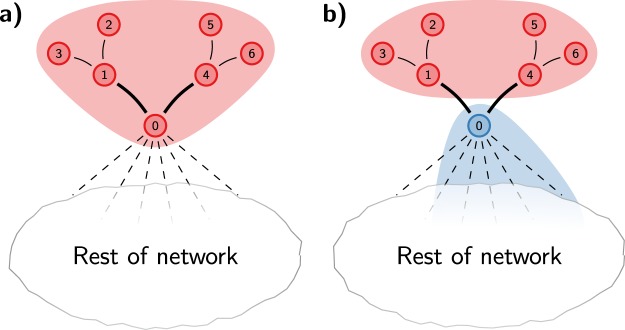
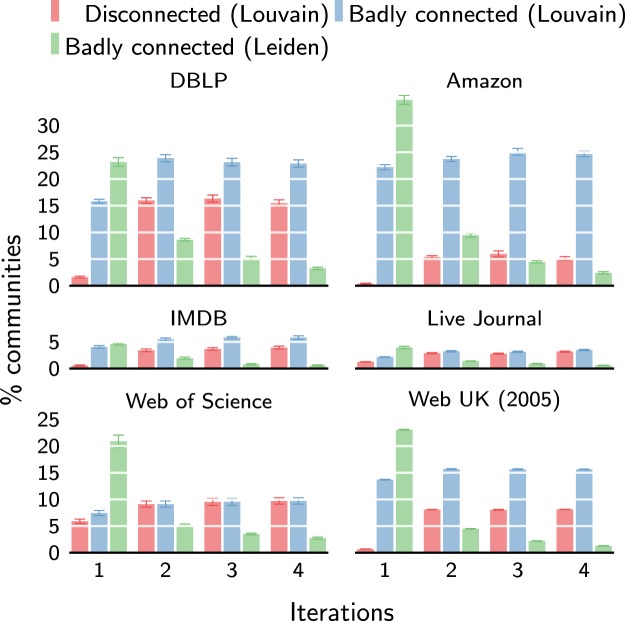
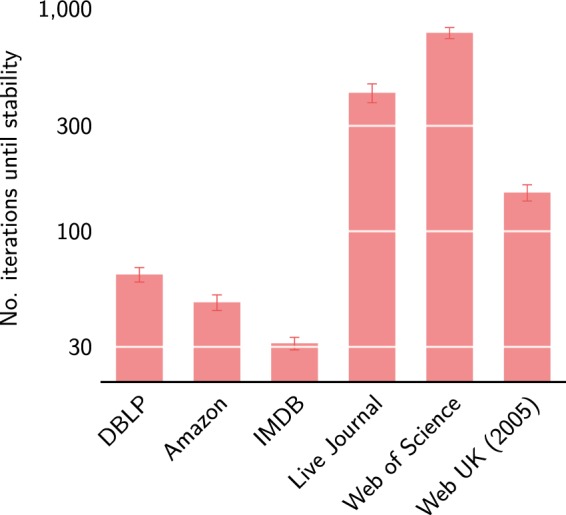
- Louvain may produce arbitrarily badly connected communities; in experiments up to 25% of communities were badly connected and up to 16% were disconnected. First-iteration badly connected percentages included Amazon 23%, DBLP 16%, and Web UK 14%; disconnected communities were usually around 1%, but exceeded 5% for Web of Science in the first iteration and jumped to 16% for DBLP in later iterations. After four iterations, Amazon had 5% disconnected but 25% badly connected communities.
- Leiden guarantees all communities are connected after each iteration, and also γ-separated and γ-connected. After a stable iteration, all nodes are locally optimally assigned and all communities are subpartition γ-dense; asymptotically, all communities are uniformly γ-dense and subset optimal.
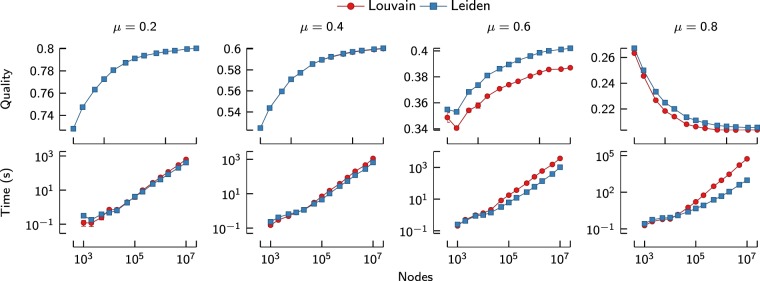
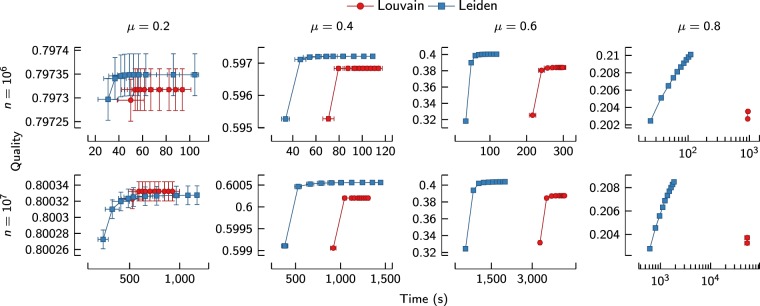
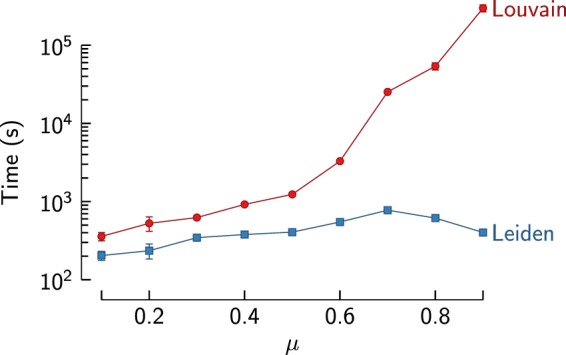
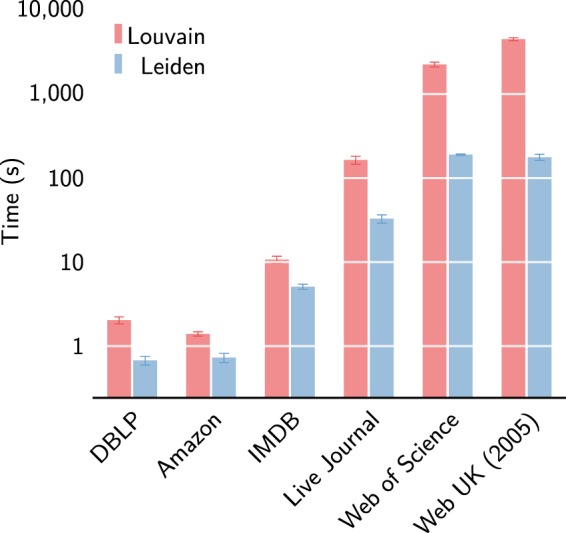
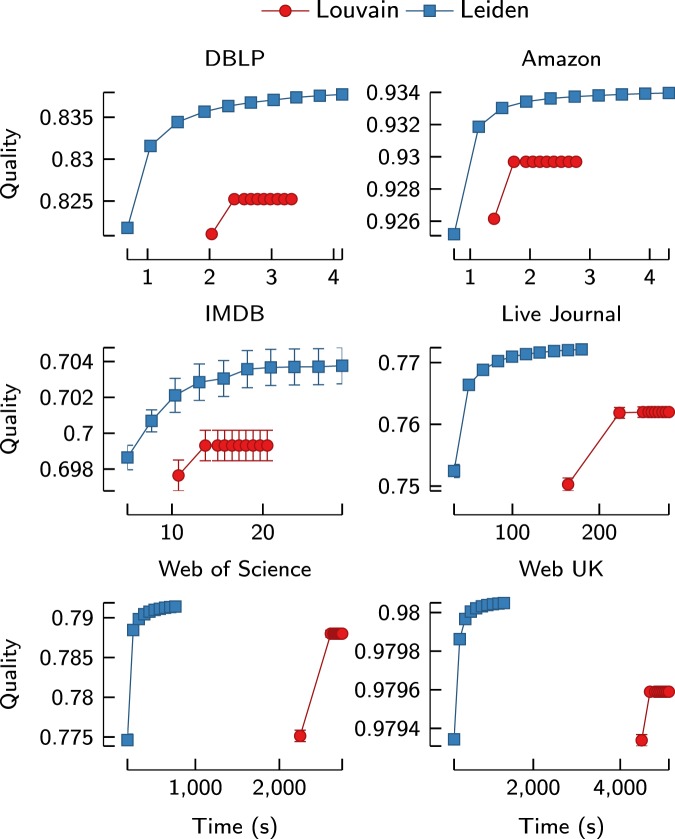
- Leiden was faster than Louvain: first iteration roughly 2–20 times faster on empirical networks, including more than 7× faster for Live Journal, more than 11× for Web of Science, and more than 20× for Web UK. On benchmark networks with difficult partitions (μ = 0.9), Louvain required almost 2.5 days while Leiden needed fewer than 10 minutes; for largest networks Leiden reached 10–100 times faster runtimes.
- Leiden found higher modularity on all six empirical networks: DBLP 0.8387 vs 0.8262, Amazon 0.9341 vs 0.9301, IMDB 0.7069 vs 0.7062, Live Journal 0.7739 vs 0.7653, Web of Science 0.7951 vs 0.7911, and Web UK 0.9801 vs 0.9796.
Methods
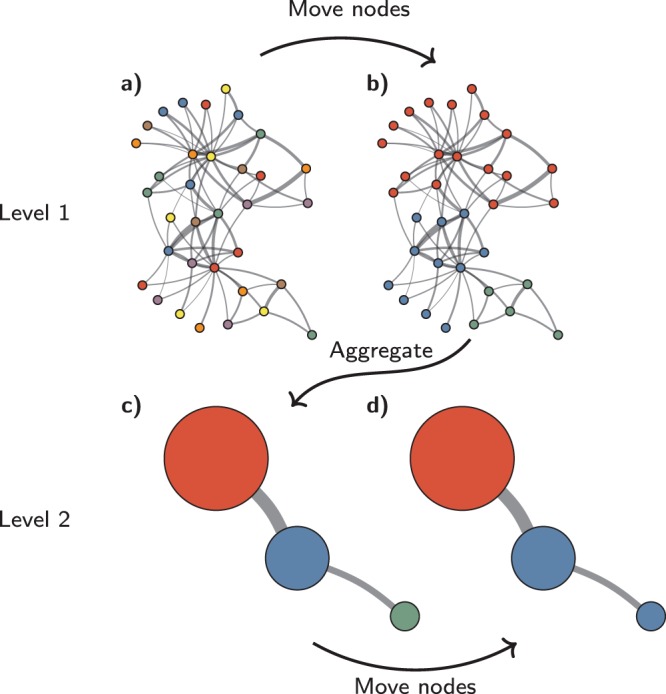
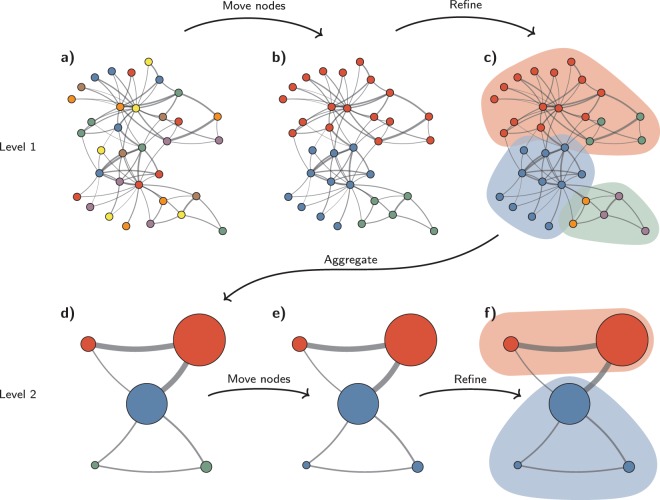
- The paper introduces the Leiden algorithm, which combines local moving, refinement of the partition, and aggregation; proofs of guarantees are relegated to Supplementary Information. It compares Leiden with Louvain on six empirical networks and on benchmark networks.
- Empirical networks: DBLP (317,080 nodes, degree 6.6), Amazon (334,863, 5.6), IMDB (374,511, 80.2), Live Journal (3,997,962, 17.4), Web of Science (9,811,130, 21.2), and Web UK (39,252,879, 39.8). Modularity was used with γ = 1; Table 2 reports maximal modularity after 10 replications of 10 iterations each. Badly connected community analysis was repeated 10 times, with Leiden run on each community’s subnetwork until a stable iteration.
- Benchmark networks ranged from n = 10^3 to n = 10^7 nodes, with community size 50 and CPM as the quality function; the mixing parameter μ varied, 10 iterations were performed, and each parameter set was repeated 10 times. The refinement randomness parameter was θ = 0.01.
Limitations
- The paper states that benchmark networks have only limited value because they are not representative of empirical real-world networks and have a rather simple structure.
- The paper states that counting communities split by Leiden gives only a lower bound on the number of badly connected communities; if Leiden does not find subcommunities, there is no guarantee that modularity cannot be increased by splitting the community.
- Evident from the text: there is no dedicated limitations section; technical details and proofs are relegated to Supplementary Information, and the experimental analysis fixes θ = 0.01 although values roughly in [0.0005, 0.1] are said to provide reasonable results.
Model-written summary. Check it against the paper before relying on it.
Integrity signals
Registry
Cites
Statistics
Figures
Verification
Claims the paper makes
1 Valid · 2 Not valid · 17 Not checked · 142 Own results and interpretations
The cited sources support only part of this claim — read each source’s verdict below.
In the paper
“Hence, the problem of Louvain outlined above is independent from the issue of the resolution limit.”
§ From Louvain to Leiden: guaranteeing well-connected communities > Louvain Algorithm > Badly connected communities
What the sources say
- Partly supportedcites [14] Fortunato S Barthélemy M Resolution Limit in Community Detection Proc. Natl. Acad. Sci. USA 2007 104 36 10.1073/pnas.0605965104 17190818 PMC1765466 sourceExperimental — accuracy not yet measured
Our copy supports the resolution-limit side of the sentence: the Conclusions (VI, p. 7) state that 'the resolution limit of modularity does not rely on particular network structures, but only on the comparison between the sizes of interconnected communities and that of the whole network', the Introduction (p. 1) calls it an 'intrinsic scale' of modularity, and Section V (pp. 5-6) shows the failure persists with simulated annealing, i.e. it is a property of the quality function rather than of one particular optimizer. What the source does not contain is the other term of the comparison: Louvain is never mentioned anywhere in the paper (the Introduction, p. 1, lists only generic greedy procedures [19,20], extremal optimization [21] and simulated annealing [22,23]), and no passage contrasts the resolution limit with an algorithm-specific defect. The independence claim is therefore the citing authors' own inference built on this paper's characterization of the resolution limit. (LLM, conf=0.70)
plain- Asserted: passes — The authors put it forward as true.
- Checkable: passes — It can be checked against evidence.
- Load-bearing: passes — The paper’s conclusions depend on it.
- Based: passes — The paper gives a reason why it holds.
- Partly supported
A result the paper states — it cites no source for it, so there is none to check. The quote shows it is in the paper.
In the paper
“The percentage of badly connected communities is less affected by the number of iterations of the Louvain algorithm.”
§ From Louvain to Leiden: guaranteeing well-connected communities > Experimental Analysis > Badly connected communities
plain- Asserted: passes — The authors put it forward as true.
- Checkable: passes — It can be checked against evidence.
- Load-bearing: unclear — It is unclear whether the paper’s conclusions depend on it.
- Based: passes — The paper gives a reason why it holds.
A result the paper states — it cites no source for it, so there is none to check. The quote shows it is in the paper.
In the paper
“In addition, we prove that, when the Leiden algorithm is applied iteratively, it converges to a partition in which all subsets of all communities are locally optimally assigned.”
- Also stated in: § Introduction · boosted
“In addition, we prove that the algorithm converges to an asymptotically stable partition in which all subsets of all communities are locally optimally assigned.”
§ From Louvain to Leiden: guaranteeing well-connected communities > Abstract
boostedstates a cause- Asserted: passes — The authors put it forward as true.
- Checkable: passes — It can be checked against evidence.
- Load-bearing: passes — The paper’s conclusions depend on it.
- Based: passes — The paper gives a reason why it holds.
- Also stated in: § Introduction · boosted
A result the paper reports from its own data — it cites no other source for it, so there is none to check. The quote shows it is in the paper.
In the paper
“The second iteration of Louvain shows a large increase in the percentage of disconnected communities.”
§ From Louvain to Leiden: guaranteeing well-connected communities > Experimental Analysis > Badly connected communities
plainstates a cause- Asserted: passes — The authors put it forward as true.
- Checkable: passes — It can be checked against evidence.
- Load-bearing: passes — The paper’s conclusions depend on it.
- Based: passes — The paper gives a reason why it holds.
A result the paper reports from its own data — it cites no other source for it, so there is none to check. The quote shows it is in the paper.
In the paper
“In terms of the percentage of badly connected communities in the first iteration, Leiden performs even worse than Louvain, as can be seen in Fig. 4.”
§ From Louvain to Leiden: guaranteeing well-connected communities > Experimental Analysis > Badly connected communities
plain- Asserted: passes — The authors put it forward as true.
- Checkable: passes — It can be checked against evidence.
- Load-bearing: unclear — It is unclear whether the paper’s conclusions depend on it.
- Based: passes — The paper gives a reason why it holds.
115 more claims
Create a free account to see all 162 claims and to verify the 24 references still open.
- Probably not a substantial claim. 23
- It may state two separate claims as one. 23
- The quote only partly states this claim. 1
Claims other papers make about this one
Each is checked against this paper’s own text: does it say what the citing paper says it does?
The cited source says what the claim attributes to it.
In the citing paper
“When compared to six common clustering algorithms, including Leiden25 and CellHarmony26, VFC was the top performing algorithm on every simulation on the T cell data and best performing, on average, on the zebrafish dataset, with a 57% increase in average performance over Louvain, which was the next best algorithm”
From Quantifying the effect of experimental perturbations at single-cell resolution (2021) · cites this paper as [25]
The cited source says what the claim attributes to it.
In the citing paper
“Louvain’s successor Leiden circumvents this issue by yielding guaranteed connected communities and is computationally more efficient52.”
From Best practices for single-cell analysis across modalities (2023) · cites this paper as [52]
The cited source says what the claim attributes to it.
In the citing paper
“However, the Louvain algorithm can lead to arbitrarily poorly connected communities52.”
From Best practices for single-cell analysis across modalities (2023) · cites this paper as [52]
The cited source says what the claim attributes to it.
In the citing paper
“We found that many t-types had total variance substantially above the variances of the k-means clusters (Fig. 5b) and an alternative analysis using entropies of Leiden clustering35 often highlighted the same t-types as variable (Extended Data Fig. 8).”
From Phenotypic variation of transcriptomic cell types in mouse motor cortex (2021) · cites this paper as [35]
The cited source says what the claim attributes to it.
In the citing paper
“Community detection uses the Leiden algorithm [28] with ModularityVertexPartition, producing hierarchical subclustering to depth 3.”
From SuperLocalMemory: Privacy-Preserving Multi-Agent Memory with Bayesian Trust Defense Against Memory Poisoning (2026) · cites this paper as [28]
6 more claims about this paper
Create a free account to see every claim other papers make about this one.
Citations
Cites
Fast unfolding of communities in large networks
Blondel, V. D., Guillaume, J.-L., Lambiotte, R., & Lefebvre, E. (2008) · Journal of Statistical Mechanics: Theory and Experiment · doi:10.1088/1742-5468/2008/10/p10008 · Cited by 21,424 · cited 3×
“The Louvain algorithm 10 is very simple and elegant.”
MethodFinding and evaluating community structure in networks
Newman, M. E. J., & Girvan, M. (2004) · Physical Review E · doi:10.1103/physreve.69.026113 · Cited by 13,931 · cited 2×
“The Leiden algorithm consists of three phases: (1) local moving of nodes, (2) refinement of the partition and (3) aggregation of the network based on the refined partition, using the non-refined partition to create an initial partition for the aggregate network.”
BackgroundMethodComplex brain networks: graph theoretical analysis of structural and functional systems
Bullmore, E., & Sporns, O. (2009) · Nature Reviews Neuroscience · doi:10.1038/nrn2575 · Cited by 11,820
Fortunato, S. (2010) · Physics Reports · doi:10.1016/j.physrep.2009.11.002 · Cited by 11,293 · cited 4×
“The Leiden algorithm consists of three phases: (1) local moving of nodes, (2) refinement of the partition and (3) aggregation of the network based on the refined partition, using the non-refined partition to create an initial partition for the aggregate network.”
BackgroundMethodInfluentialFinding community structure in very large networks
Clauset, A., Newman, M. E. J., & Moore, C. (2004) · Physical Review E · doi:10.1103/physreve.70.066111 · Cited by 7,390 · cited 1×
“Optimising modularity is NP-hard 5 , and consequentially many heuristic algorithms have been proposed, such as hierarchical agglomeration 6 , extremal optimisation 7 , simulated annealing 4,8 and spectral 9 algorithms.”
MethodFinding community structure in networks using the eigenvectors of matrices
Newman, M. E. J. (2006) · Physical Review E · doi:10.1103/physreve.74.036104 · Cited by 4,761
Functional cartography of complex metabolic networks
Guimerà, R., & Nunes Amaral, L. A. (2005) · Nature · doi:10.1038/nature03288 · Cited by 3,983 · cited 2×
“Optimising modularity is NP-hard 5 , and consequentially many heuristic algorithms have been proposed, such as hierarchical agglomeration 6 , extremal optimisation 7 , simulated annealing 4,8 and spectral 9 algorithms.”
MethodNear linear time algorithm to detect community structures in large-scale networks
Raghavan, U. N., Albert, R., & Kumara, S. (2007) · Physical Review E · doi:10.1103/physreve.76.036106 · Cited by 3,502 · cited 2×
“Trying to fix the problem by simply considering the connected components of communities 19–21 is unsatisfactory because it addresses only the most extreme case and does not resolve the more fundamental problem.”
BackgroundBenchmark graphs for testing community detection algorithms
Lancichinetti, A., Fortunato, S., & Radicchi, F. (2008) · Physical Review E · doi:10.1103/physreve.78.046110 · Cited by 3,051 · cited 1×
“To study the scaling of the Louvain and the Leiden algorithm, we rely on a variant of a well-known approach for constructing benchmark networks 28 .”
MethodResolution limit in community detection
Fortunato, S., & Barthélemy, M. (2007) · Proceedings of the National Academy of Sciences · doi:10.1073/pnas.0605965104 · Cited by 3,024 · cited 2×
“The algorithm may yield arbitrarily badly connected communities, over and above the well-known issue of the resolution limit 14 .”
Background
Research works printed but not linked: 2
- Porter MA Onnela J-P Mucha PJ Communities in Networks Not. AMS 2009 56 1082 1097
- Luecken, M. D. Application of multi-resolution partitioning of interaction networks to the study of complex disease. Ph.D. thesis, (University of Oxford, 2016).
Cited by
Items 5,501–5,600 of 7,288
Temporal Gatekeeping Role of Lmx1 during chordate neural tube morphogenesisPreprint
Pérez-Benítez, J., Levine, M., & Lemaire, L. A. (2026) · bioRxiv (Cold Spring Harbor Laboratory) · doi:10.64898/2026.03.04.709676
ReacNetwork: A method for large-scale reaction network analysis of energetic materials
Chen, Z., Tong, C., Gan, Q., Li, J., Tao, Y., Li, G., Wang, Y., & Feng, C. (2025) · Defence Technology · doi:10.1016/j.dt.2025.09.031
Korah, M. M., Agolia, J. P., Reddy, B., Flojo, R. A. B., Gonçalves, A. C., Wang, L., Bethi, R., Bobst, W., Liang, B., Yip, K. A., et al. (2025) · bioRxiv (Cold Spring Harbor Laboratory) · doi:10.1101/2025.11.17.688894
A Data-Driven Framework for Identifying Influential ResearchersPreprint
Hasan, S. M., Paul, A. K., Chatterjee, K., Dey, P., & Ray, R. S. (2026) · Research Square · doi:10.21203/rs.3.rs-9446863/v1
Gomes, G. B. (2020) · Digital Library of Theses and Dissertations (Universidade de São Paulo) · doi:10.11606/d.42.2020.tde-13012022-181211
Li, T., Zou, Y., Li, X., Wong, T. K. F., & Rodrigo, A. G. (2024) · Figshare · doi:10.6084/m9.figshare.27123947
Li, T., Zou, Y., Li, X., Wong, T. K. F., & Rodrigo, A. G. (2024) · Figshare · doi:10.6084/m9.figshare.27123950
Li, T., Zou, Y., Li, X., Wong, T. K. F., & Rodrigo, A. G. (2024) · Figshare · doi:10.6084/m9.figshare.27123944
Hossain, G., Shin, M., Whaley, B., Afrose, M., & Hassan, E. (2026) · Research Square · doi:10.21203/rs.3.rs-10107954/v1
Social Sciences and Humanities in post- soviet period in Russia: Bibliometric analysis, 1993-2022
Markusova, V. A., Tsvetkova, V. A., Zolotova, A., Kotel’nikova, N., & Libkind, A. (2023) · DLINE eBooks · doi:10.6025/stm/2023/4/83-92
Statistical Network Analysis for LLMs via Knowledge GraphsPreprint
Lin, T., Zhang, X., Zhang, X., Yu, X., & Cheng, H. (2025) · TechRxiv · doi:10.36227/techrxiv.176157891.17942553/v2
Xiong, L., Wang, X., & Liu, Q. (2026) · IEEE PES International Meeting (PES IM) · doi:10.1109/pesim67009.2026.11438397
Arkadopoulou, E., Mandilara, I., Androna, C. M., Fotopoulou, E., Zafeiropoulos, A., Dechouniotis, D., & Papavassiliou, S. (2026) · Sustainability · doi:10.3390/su18126193
Wen, T., Shao, S., Ke, P., Han, X., Zou, J., Li, G., Tian, T., Qiu, J., Wang, L., & Qin, K. (2026) · International ACM SIGIR Conference on Research and Development in Information Retrieval (SIGIR) · doi:10.1145/3805712.3808607
Ma, K., & Ho, J. W. K. (2024) · Elsevier eBooks · doi:10.1016/b978-0-323-95502-7.00045-2
Yu, N., Han, J., Li, W., Zhang, D., Wang, S., Fen, L., Gao, R., Liu, Z., & Zhang, W. (2025) · Lecture notes in computer science · doi:10.1007/978-981-95-0027-7_20
Image-based unsupervised learning of tumor regions in spatial omics
Lehner, L., Cheong, I. J., Tang, W., Tan, W. K., Liang, R. C. W., Rötzschke, O., Väyrynen, J. P., Ogino, S., & Lau, M. C. (2025) · Journal for ImmunoTherapy of Cancer · doi:10.1136/jitc-2025-sitc2025.1102
Qin, H., Hu, Y., Zhu, Y., Baek, J., Yuan, W., Meltzer, S., & Zhou, X. M. (2025) · bioRxiv (Cold Spring Harbor Laboratory) · doi:10.64898/2025.12.01.691603
Graph-Regularized Embedding Refinement for Spatial Domain Identification
Mo, B., Chen, Z., & Li, H. (2026) · Communications in computer and information science · doi:10.1007/978-3-032-26028-4_19
Sha, J., Wei, Q., 朱传统, Li, F. S., Zhao, Q., & Yuan, L. (2026) · Lecture notes in computer science · doi:10.1007/978-981-92-3498-1_37
Comparative Experiments on Natural Language Querying of Knowledge Graphs Using a Graph RAG Approach
Nemțoc, T. C., Buchmann, R. A., & Silaghi, G. C. (2025) · Lecture notes in computer science · doi:10.1007/978-3-032-08623-5_16
ALMASI, M., Pereira, J. G. N., Dandekar, T., Dandekar, G., & Balkenhol, J. (2025) · Research Square · doi:10.21203/rs.3.rs-7825090/v1
Zagaria, N., Tini, G., Bonetti, E., & Mazzarella, L. (2026) · bioRxiv (Cold Spring Harbor Laboratory) · doi:10.64898/2026.06.16.732539
Cross-batch concordant clustering for comprehensive single-cell transcriptomic stratification
Zhao, J., Jiang, X., 毛冲霄, & Xin, H. (2026) · ACM International Conference on Bioinformatics, Computational Biology, and Health Informatics (ACM-BCB) · doi:10.1145/3807503.3819485
Martínez, J. M. M., Leyva, S. L., Vargas‐Quesada, B., & Chinchilla‐Rodríguez, Z. (2026) · Research Square · doi:10.21203/rs.3.rs-10046939/v1
MicroSC: A Tiny, Performant Single-Cell Foundation ModelPreprint
Denvis, O. (2026) · SSRN Electronic Journal · doi:10.21203/rs.3.rs-10410549/v1
Yang, Y., Pengfei, W. A. N. G., Liu, X., Mingtang, L. I. U., & Dong, F. (2026) · Shuili Xuebao · doi:10.3724/j.slxb.20250227
Extracting software modules as communities
Sas, C., & Capiluppi, A. (2020) · University of Groningen research database (University of Groningen / Centre for Information Technology)
Mitigating data imbalance in scholarly networks using topic models and social network analysis
Noor, M. A., Sheppard, J. W., & Clark, J. A. (2026) · Social Network Analysis and Mining · doi:10.1007/s13278-026-01630-3
Liu, R. G., Liu, Z., Wang, P., Zhang, Y., Hou, S., Zhang, C., Guan, W., Wang, S., Sun, X., Zhao, C., et al. (2026) · Research Square · doi:10.21203/rs.3.rs-10121104/v1
[Identifying spatial domains from spatial transcriptome by graph attention network].
HanWen, W., & Gao, J. (2024) · PubMed Central · doi:10.7507/1001-5515.202304030
Multinomial Regression with Group Structure for Screening Biomarkers of Breast Cancer
Xi, C., Gao, F., & Li, J. (2023) · Lecture notes in electrical engineering · doi:10.1007/978-981-99-6882-4_49
Hänisch, B., Hansen, J. Y., Bernhardt, B. C., Eickhoff, S. B., Dukart, J., Mišić, B., & Valk, S. L. (2023) · eLife · doi:10.7554/elife.83843.sa2
Potter’s Signal in Ceramic Vessel Forms: A Pairwise Morphometric Approach
SUKHANOV, E. (2026) · Journal of Archaeological Method and Theory · doi:10.21203/rs.3.rs-9287704/v1
So, E. (2024) · TSpace (University of Toronto)
Leo, V. D., Puliga, M., Erba, M., Scalia, C., Filetti, A., & Chessa, A. (2026) · Complexities · doi:10.3390/complexities2020015
Liu, N., Hu, X., Goh, Y. M., & Chua, D. K. H. (2026) · Advanced Engineering Informatics · doi:10.1016/j.aei.2026.104865
Quantum Computing for Insurance Fraud Detection
Bai, Y., Jiao, W., Ju, C., Feng, X., Lu, J., Qian, N., Kong, L., Ao, Q., Zhang, J., Zhu, F., et al. (2026) · IEEE Access · doi:10.1109/access.2026.3702708
Aylard, D. A. (2024) · eScholarship (California Digital Library)
Dumeaux, V., Massahi, S., Bettauer, V., Mottola, A., Dukovny, A., Khurdia, S. S., Costa, A. C. B. P., Omran, R. P., Simpson, S., Xie, J. L., et al. (2023) · eLife · doi:10.7554/elife.81406.sa2
Domínguez, A. S., & Perez, C. B. (2026) · McGill Journal of Global Health · doi:10.26443/mjgh.v15i1.1926
Jorssen, J. (2025) · ORBi (University of Liège)
Perraud, E. (2023) · theses.fr (ABES) · doi:10.70675/fc6fdb92z2853z44c3za9c0zadb5fbfeeba9
RedditPersona: A Modular Framework for Community-Conditioned LLM Adaptation from Reddit
Ghaffari, A., Goodarzi, A., Nguyen, H., Hosio, S. J., Lovén, L., & Gilman, E. (2026) · ACM International Conference on Information and Knowledge Management (CIKM) · doi:10.1145/3799682.3840182
Nerve net formation in Hydra embryos - novel approaches and insights
Noack, C. (2025) · MACAU: Open Access Repository of Kiel University
Developing approaches to using knowledge graphs in RAG
Измалкин, А. А. (2025) · Electronic scientific archive of UrFU (Ural Federal University)
Blampey, Q. (2024) · theses.fr (ABES) · doi:10.70675/7c4a51efz122dz4a0ez9b43z475abe412a88
Gut, C. (2025) · Digital Library of Theses and Dissertations (Universidade de São Paulo) · doi:10.11606/t.45.2025.tde-01092025-084702
Vafaii, H. (2023) · arXiv (Cornell University) · doi:10.13016/i1ah-cyjy
Hantula, O. (2024) · Tampere University Institutional Repository (Tampere University)
Gómez‐Pérez, D., Raguideau, S., Warring, S. D., James, R. S., Hildebrand, F., & Quince, C. (2026) · bioRxiv (Cold Spring Harbor Laboratory) · doi:10.64898/2026.03.05.709928
Demirdizen, M. (2024) · Bilkent University Institutional Repository (Bilkent University)
Velocity-Weighted Gene Regulatory Modeling Identifies Drivers of Drug-Induced Plasticity
Prabantu, V. M., Wang, M., Verma, S., Wang, L., Grama, A. Y., & Lanman, N. A. (2026) · ACM International Conference on Bioinformatics, Computational Biology, and Health Informatics (ACM-BCB) · doi:10.1145/3807503.3819486
kMMI: Minimization of intergroup interference in networked experiments
Saarinen, V. (2022) · Aaltodoc (Aalto University)
Aging and memory effects in social and economic dynamics
Bujalance, D. A. (2024) · Tesis Doctorals en Xarxa (Consorci de Serveis Universitaris de Catalunya) · doi:10.48550/arxiv.2410.18898
Knowledgeable Language Models as Black-Box Optimizers for Personalized Medicine
Yao, M. S., Bastani, O., Andersson, A., Biancalani, T., BenTaieb, A., & Iriondo, C. (2026) · International Conference on Learning Representations · doi:10.48550/arxiv.2509.20975
EQDSC: Embedded Quantum Density-Based Spatial Clustering for Community Detection
He, S., Ai, B., Gao, P., Liu, H., Tang, T., & Wu, J. (2025) · IEEE Access · doi:10.1109/access.2025.3640210
Labarca, I. M. M. (2023) · New University of Lisbon's Repository (New University of Lisbon)
Raees, M., Papangelis, K., & Khan, V.-J. (2026) · arXiv (Cornell University) · doi:10.48550/arxiv.2605.17151
McDonald, I. M., Socas, L. B. P., Walton-Raaby, M., Liu, X., Dasari, S., Emmanuel, B. G., Butt, M. S., Kalyaanamoorthy, S., Brooks, C. L., & Meiering, E. M. (2026) · bioRxiv (Cold Spring Harbor Laboratory) · doi:10.64898/2026.07.16.738941
Author response: Lack of evidence for increased transcriptional noise in aged tissues
Ibáñez-Solé, O., Ascensión, A. M., Araúzo-Bravo, M. J., & Izeta, A. (2022) · eLife · doi:10.7554/elife.80380.sa2
Robinson‐García, N., Vargas‐Quesada, B., Torres‐Salinas, D., Chinchilla‐Rodríguez, Z., & Gorraiz, J. I. (2024) · Institutional Repository of the University of Granada (University of Granada) · doi:10.5281/zenodo.13752257
Robinson‐García, N., Vargas‐Quesada, B., Torres-Salinas, D., Chinchilla‐Rodríguez, Z., & Gorraiz, J. I. (2024) · DIGITAL.CSIC (Spanish National Research Council (CSIC)) · doi:10.20350/digitalcsic/16544
Kosztyán, Z. T., Hosznyák, A., Király, T., Katona, A. I., Dénes, K. M., & Hornak, G. (2026) · Research Square · doi:10.21203/rs.3.rs-9148720/v1
Impact of a reclassification of Web of Science articles on bibliometric indicators
Lahatte, A., & de Turckheim, É. (2026) · Quantitative Science Studies · doi:10.1162/qss.a.485
TGDK, Volume 3, Issue 2, Complete Issue
Informatik, S. D. L.-Z. F. (2025) · DROPS (Schloss Dagstuhl – Leibniz Center for Informatics) · doi:10.4230/tgdk.3.2
Robocalls: A Worldwide or US-only Problem? Analyzing Spam and Fraud in International Phone CallsPreprint
Altwlkany, K., Merćep, A., Đuričić, T., Kapetanović, A. L., & Lacić, E. (2026) · SSRN Electronic Journal · doi:10.2139/ssrn.7079425
Resolving phenotyping discordance with SPACEMAP, an integrated machine learning frameworkPreprint
Dawod, B., Rodriguez, A. P., Diegeler, S., Elghonaimy, E. A., Wachsmann, M., Gopal, P., Hein, D., Acosta, P. H., Jamieson, A., Danuser, G. M., et al. (2025) · bioRxiv (Cold Spring Harbor Laboratory) · doi:10.1101/2025.11.27.690631
Understanding the role of CD4+ T cells in common immune-mediated diseases
Cano-Gamez, E. (2021) · Apollo (University of Cambridge) · doi:10.17863/cam.70885
Yuan, S., Zhu, Y., Zheng, Z., Yip, H. M., Chan, M. S. W., Zhang, Z., Chai, Y., Jenks, K. R., Tsimring, K., Heller, G. R., et al. (2026) · bioRxiv (Cold Spring Harbor Laboratory) · doi:10.64898/2026.04.03.716270
Behavioral Signals of Echo Chamber Risk Around Misleading AI-Generated VideosPreprint
Gao, Y., Harrigan, P., Wang, Y., & Liu, F. (2026) · Research Square · doi:10.21203/rs.3.rs-10367677/v1
Réseaux de communication au sein de communautés microbiennes environnementales
Bernard, C. (2022) · theses.fr (ABES) · doi:10.70675/165de9b0z3cfbz416dz91a5zb86f8cdd5f70
Miyashita, H. (2026) · arXiv (Cornell University) · doi:10.48550/arxiv.2605.22005
MULTI-MODAL DOCUMENT CONTEXT SEARCH with LLMs for MANUFACTURING INDUSTRIES
Barua, S. (2025) · DiVA (Mälardalen University College)
Semantic Think-on-Graph (SemToG) : Enhancing GraphRAG through Semantic Community Detection
Mishra, S. (2025) · Open PRAIRIE (South Dakota State University)
Ramadan, Z. (2025) · KTH Publication Database DiVA (KTH Royal Institute of Technology)
Yksisolusekvensointidatan hierarkinen annotaatio käyttäen suuria kielimalleja
Kreivi, N. (2025) · Aaltodoc (Aalto University)
Tandoğan, O. S. (2024) · OpenMETU (Middle East Technical University)
Metadata
- Authors
- Traag, V. A., Waltman, L., & van Eck, N. J.
- Affiliations
- Leiden University (NL)
- Corresponding author
- Traag, V. A.
- Venue
- Scientific Reports
- Published
- 2019-03-26
- Volume
- 9
- Issue
- 1
- Pages
- 5233-5233
- ISSN
- 2045-2322 (ISSN-L)
- PMC
- PMC6435756
- OpenAlex
- W2897249806
- Semantic Scholar
- 79cdbabb22ef80074f5659430fe6fc97932798f5
- Cited by
- 5,635
- References
- 27
- Citations by year
- 2026: 1250 · 2025: 1281 · 2024: 980 · 2023: 757 · 2022: 639 · 2021: 466 · 2020: 213 · 2019: 46
- FWCI
- 158.78
- Type
- journal article
- Language
- en
- Open access
- gold
- doi.org
- Licence
- cc-by
- creativecommons.org/licenses/by/4.0 (tdm)
- creativecommons.org/licenses/by/4.0 (vor)
- Locations
- Scientific Reports (publishedVersion, cc-by)
- Europe PMC (PubMed Central) (publishedVersion, other-oa)
- PubMed Central (publishedVersion, cc-by)
- PubMed (publishedVersion)
- arXiv (Cornell University) (submittedVersion)
- Leiden Repository (Leiden University) (submittedVersion, cc-by)
- Data Archiving and Networked Services (DANS) (submittedVersion, cc-by)
- DOAJ (DOAJ: Directory of Open Access Journals) (submittedVersion)
- Leiden Repository (Leiden University) (submittedVersion)
- arXiv (Cornell University)
- Topics
- Physical Sciences › Physics and Astronomy › Statistical and Nonlinear Physics › Complex Network Analysis Techniques
- Physical Sciences › Computer Science › Artificial Intelligence › Advanced Clustering Algorithms Research
- Life Sciences › Biochemistry, Genetics and Molecular Biology › Molecular Biology › Bioinformatics and Genomic Networks
- Keywords
- community detection, Louvain algorithm, Leiden algorithm, network partitioning, community connectivity, complex networks
About these checks
Registry, retraction, Cites and statistics results are computed, not judged, with one exception: a printed reference that no index lists is read once by a model before it counts as a citation error. Claims are extracted by a model and kept only when their quote appears verbatim in the text; each cited source is then checked, with a model’s help, for whether it says what the claim relies on. Those verdicts can be wrong — read the claim’s quote and the cited source before relying on one.
The claim verdicts this report counts are experimental: their accuracy is not yet measured.
A language model drew the claims from the paper on 2026-11-23, under version 3 of the claim definition (model deepseek-v4.1-flash, prompt extract-v3).
A second model labelled each claim on 2026-11-23 (model jev-1.13-20260917, definition revision gold-guideline-v0.2).
Cited sources are checked with a language model’s help (qwen3.8-omni-flash).
Statistics and arithmetic are recomputed, not judged.
Confidence bands are shown only for fields calibrated on our annotated test set. None is calibrated yet, so no band is shown.
What counts as a claim ›How we measure confidence ›How we check this ›
Are you an author, or do you see a problem with this page? Request a review
Data sources
Bibliographic data: Semantic Scholar, OpenAlex, Crossref.
Contains information from the Semantic Scholar Academic Graph Datasets, made available under the ODC Attribution License (ODC-BY 1.0).
Semantic Scholar’s data is described in: Kinney, R., et al. (2023). The Semantic Scholar Open Data Platform. arXiv:2301.10140.
