

From Louvain to Leiden: guaranteeing well-connected communities
Open accessThe DOI matches its Crossref record; 30 of the 30 references it cites were found in a registry or an index; 1 of the 26 sources its claims cite were checked for support.
Abstract
Community detection is often used to understand the structure of large and complex networks. One of the most popular algorithms for uncovering community structure is the so-called Louvain algorithm. We show that this algorithm has a major defect that largely went unnoticed until now: the Louvain algorithm may yield arbitrarily badly connected communities. In the worst case, communities may even be disconnected, especially when running the algorithm iteratively. In our experimental analysis, we observe that up to 25% of the communities are badly connected and up to 16% are disconnected. To address this problem, we introduce the Leiden algorithm. We prove that the Leiden algorithm yields communities that are guaranteed to be connected. In addition, we prove that, when the Leiden algorithm is applied iteratively, it converges to a partition in which all subsets of all communities are locally optimally assigned. Furthermore, by relying on a fast local move approach, the Leiden algorithm runs faster than the Louvain algorithm. We demonstrate the performance of the Leiden algorithm for several benchmark and real-world networks. We find that the Leiden algorithm is faster than the Louvain algorithm and uncovers better partitions, in addition to providing explicit guarantees.
Overview
CoChat Summary
TL;DR
The Louvain algorithm can yield arbitrarily badly connected communities, including disconnected ones, especially when iterated. The Leiden algorithm guarantees connected communities and, under iteration, converges to subset-optimal partitions while running faster and finding higher-quality partitions.
Key findings
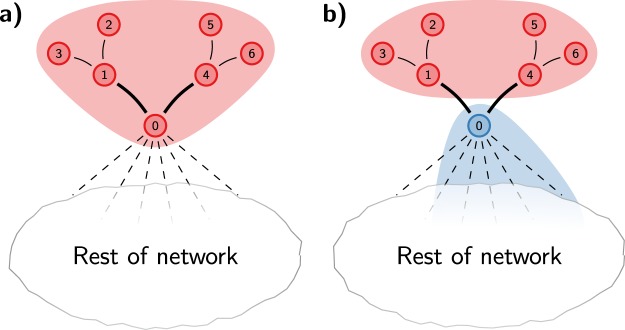
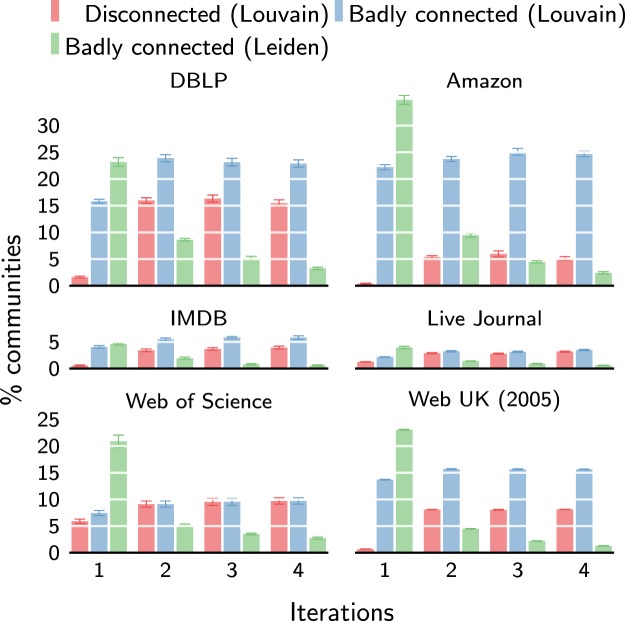
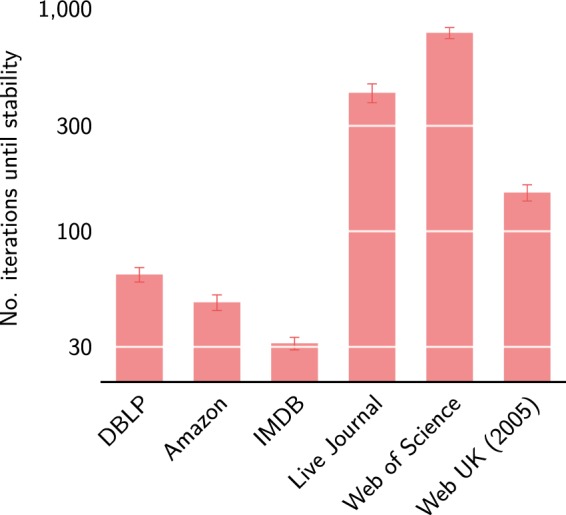
- Louvain may produce arbitrarily badly connected communities; in experiments up to 25% of communities were badly connected and up to 16% were disconnected. First-iteration badly connected percentages included Amazon 23%, DBLP 16%, and Web UK 14%; disconnected communities were usually around 1%, but exceeded 5% for Web of Science in the first iteration and jumped to 16% for DBLP in later iterations. After four iterations, Amazon had 5% disconnected but 25% badly connected communities.
- Leiden guarantees all communities are connected after each iteration, and also γ-separated and γ-connected. After a stable iteration, all nodes are locally optimally assigned and all communities are subpartition γ-dense; asymptotically, all communities are uniformly γ-dense and subset optimal.
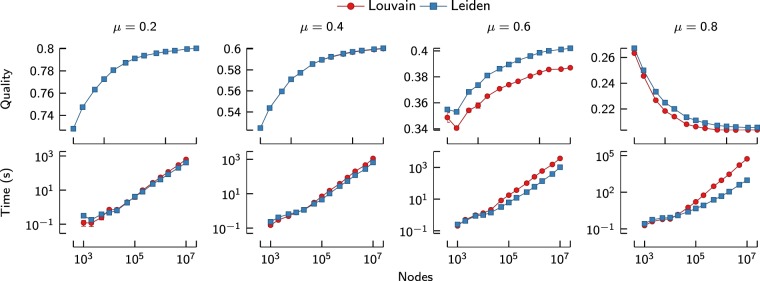
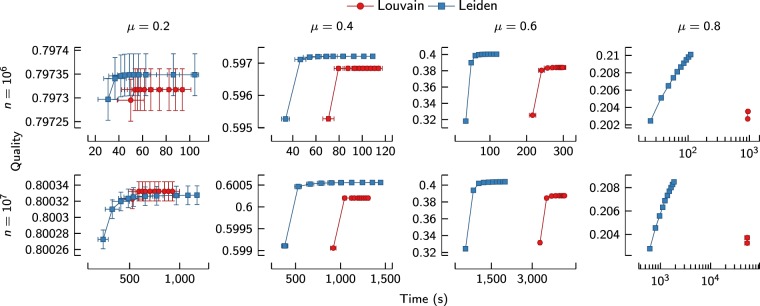
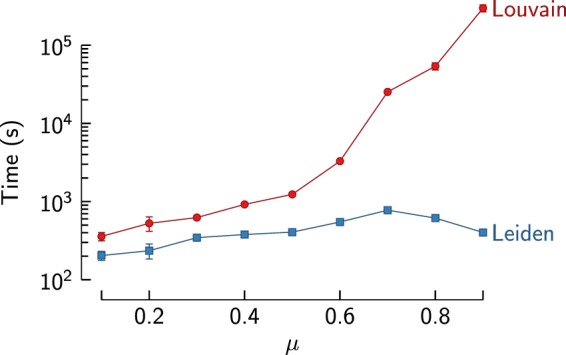
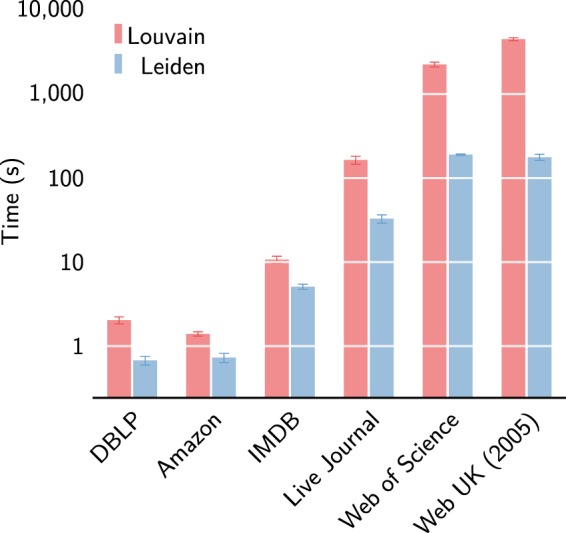
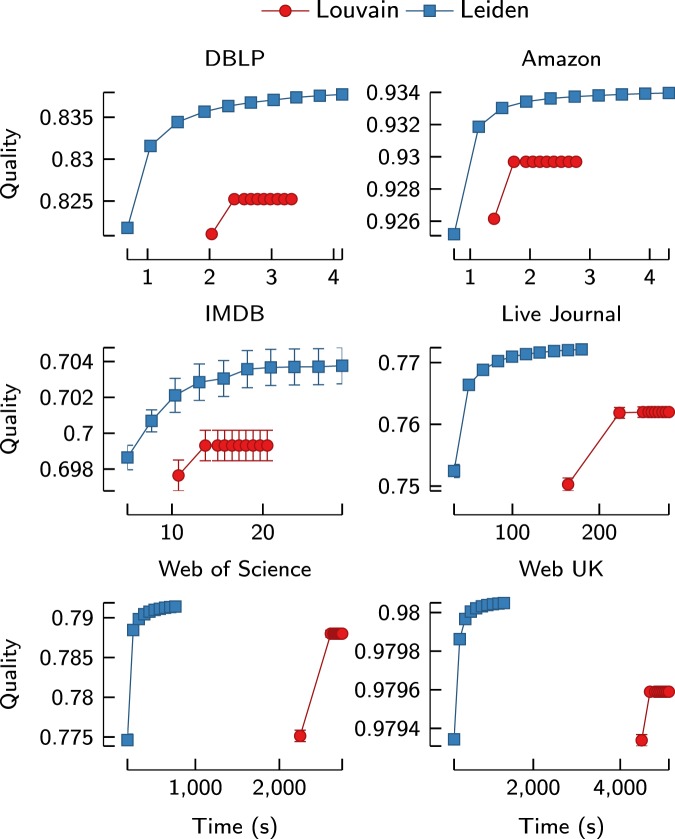
- Leiden was faster than Louvain: first iteration roughly 2–20 times faster on empirical networks, including more than 7× faster for Live Journal, more than 11× for Web of Science, and more than 20× for Web UK. On benchmark networks with difficult partitions (μ = 0.9), Louvain required almost 2.5 days while Leiden needed fewer than 10 minutes; for largest networks Leiden reached 10–100 times faster runtimes.
- Leiden found higher modularity on all six empirical networks: DBLP 0.8387 vs 0.8262, Amazon 0.9341 vs 0.9301, IMDB 0.7069 vs 0.7062, Live Journal 0.7739 vs 0.7653, Web of Science 0.7951 vs 0.7911, and Web UK 0.9801 vs 0.9796.
Methods
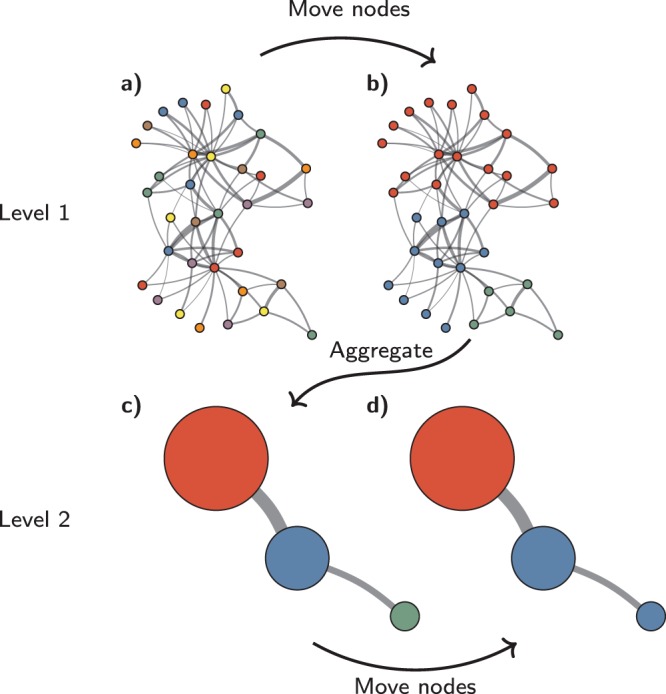
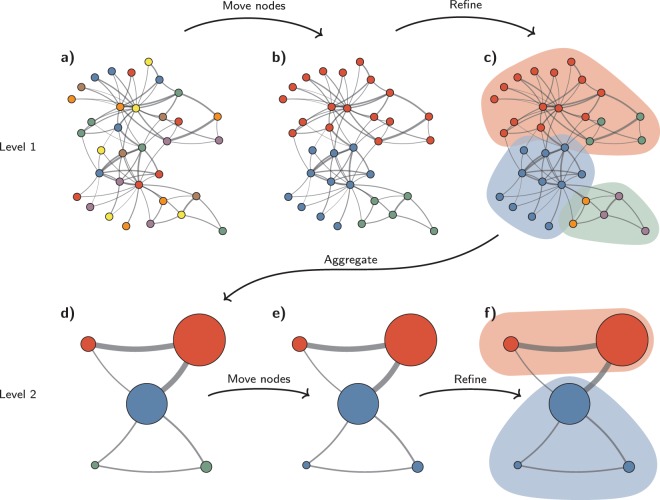
- The paper introduces the Leiden algorithm, which combines local moving, refinement of the partition, and aggregation; proofs of guarantees are relegated to Supplementary Information. It compares Leiden with Louvain on six empirical networks and on benchmark networks.
- Empirical networks: DBLP (317,080 nodes, degree 6.6), Amazon (334,863, 5.6), IMDB (374,511, 80.2), Live Journal (3,997,962, 17.4), Web of Science (9,811,130, 21.2), and Web UK (39,252,879, 39.8). Modularity was used with γ = 1; Table 2 reports maximal modularity after 10 replications of 10 iterations each. Badly connected community analysis was repeated 10 times, with Leiden run on each community’s subnetwork until a stable iteration.
- Benchmark networks ranged from n = 10^3 to n = 10^7 nodes, with community size 50 and CPM as the quality function; the mixing parameter μ varied, 10 iterations were performed, and each parameter set was repeated 10 times. The refinement randomness parameter was θ = 0.01.
Limitations
- The paper states that benchmark networks have only limited value because they are not representative of empirical real-world networks and have a rather simple structure.
- The paper states that counting communities split by Leiden gives only a lower bound on the number of badly connected communities; if Leiden does not find subcommunities, there is no guarantee that modularity cannot be increased by splitting the community.
- Evident from the text: there is no dedicated limitations section; technical details and proofs are relegated to Supplementary Information, and the experimental analysis fixes θ = 0.01 although values roughly in [0.0005, 0.1] are said to provide reasonable results.
Model-written summary. Check it against the paper before relying on it.
Integrity signals
Registry
Cites
Statistics
Figures
Verification
Claims the paper makes
1 Valid · 2 Not valid · 17 Not checked · 142 Own results and interpretations
The cited sources support only part of this claim — read each source’s verdict below.
In the paper
“Hence, the problem of Louvain outlined above is independent from the issue of the resolution limit.”
§ From Louvain to Leiden: guaranteeing well-connected communities > Louvain Algorithm > Badly connected communities
What the sources say
- Partly supportedcites [14] Fortunato S Barthélemy M Resolution Limit in Community Detection Proc. Natl. Acad. Sci. USA 2007 104 36 10.1073/pnas.0605965104 17190818 PMC1765466 sourceExperimental — accuracy not yet measured
Our copy supports the resolution-limit side of the sentence: the Conclusions (VI, p. 7) state that 'the resolution limit of modularity does not rely on particular network structures, but only on the comparison between the sizes of interconnected communities and that of the whole network', the Introduction (p. 1) calls it an 'intrinsic scale' of modularity, and Section V (pp. 5-6) shows the failure persists with simulated annealing, i.e. it is a property of the quality function rather than of one particular optimizer. What the source does not contain is the other term of the comparison: Louvain is never mentioned anywhere in the paper (the Introduction, p. 1, lists only generic greedy procedures [19,20], extremal optimization [21] and simulated annealing [22,23]), and no passage contrasts the resolution limit with an algorithm-specific defect. The independence claim is therefore the citing authors' own inference built on this paper's characterization of the resolution limit. (LLM, conf=0.70)
plain- Asserted: passes — The authors put it forward as true.
- Checkable: passes — It can be checked against evidence.
- Load-bearing: passes — The paper’s conclusions depend on it.
- Based: passes — The paper gives a reason why it holds.
- Partly supported
A result the paper states — it cites no source for it, so there is none to check. The quote shows it is in the paper.
In the paper
“The percentage of badly connected communities is less affected by the number of iterations of the Louvain algorithm.”
§ From Louvain to Leiden: guaranteeing well-connected communities > Experimental Analysis > Badly connected communities
plain- Asserted: passes — The authors put it forward as true.
- Checkable: passes — It can be checked against evidence.
- Load-bearing: unclear — It is unclear whether the paper’s conclusions depend on it.
- Based: passes — The paper gives a reason why it holds.
A result the paper states — it cites no source for it, so there is none to check. The quote shows it is in the paper.
In the paper
“In addition, we prove that, when the Leiden algorithm is applied iteratively, it converges to a partition in which all subsets of all communities are locally optimally assigned.”
- Also stated in: § Introduction · boosted
“In addition, we prove that the algorithm converges to an asymptotically stable partition in which all subsets of all communities are locally optimally assigned.”
§ From Louvain to Leiden: guaranteeing well-connected communities > Abstract
boostedstates a cause- Asserted: passes — The authors put it forward as true.
- Checkable: passes — It can be checked against evidence.
- Load-bearing: passes — The paper’s conclusions depend on it.
- Based: passes — The paper gives a reason why it holds.
- Also stated in: § Introduction · boosted
A result the paper reports from its own data — it cites no other source for it, so there is none to check. The quote shows it is in the paper.
In the paper
“The second iteration of Louvain shows a large increase in the percentage of disconnected communities.”
§ From Louvain to Leiden: guaranteeing well-connected communities > Experimental Analysis > Badly connected communities
plainstates a cause- Asserted: passes — The authors put it forward as true.
- Checkable: passes — It can be checked against evidence.
- Load-bearing: passes — The paper’s conclusions depend on it.
- Based: passes — The paper gives a reason why it holds.
A result the paper reports from its own data — it cites no other source for it, so there is none to check. The quote shows it is in the paper.
In the paper
“In terms of the percentage of badly connected communities in the first iteration, Leiden performs even worse than Louvain, as can be seen in Fig. 4.”
§ From Louvain to Leiden: guaranteeing well-connected communities > Experimental Analysis > Badly connected communities
plain- Asserted: passes — The authors put it forward as true.
- Checkable: passes — It can be checked against evidence.
- Load-bearing: unclear — It is unclear whether the paper’s conclusions depend on it.
- Based: passes — The paper gives a reason why it holds.
115 more claims
Create a free account to see all 162 claims and to verify the 24 references still open.
- Probably not a substantial claim. 23
- It may state two separate claims as one. 23
- The quote only partly states this claim. 1
Claims other papers make about this one
Each is checked against this paper’s own text: does it say what the citing paper says it does?
The cited source says what the claim attributes to it.
In the citing paper
“When compared to six common clustering algorithms, including Leiden25 and CellHarmony26, VFC was the top performing algorithm on every simulation on the T cell data and best performing, on average, on the zebrafish dataset, with a 57% increase in average performance over Louvain, which was the next best algorithm”
From Quantifying the effect of experimental perturbations at single-cell resolution (2021) · cites this paper as [25]
The cited source says what the claim attributes to it.
In the citing paper
“Louvain’s successor Leiden circumvents this issue by yielding guaranteed connected communities and is computationally more efficient52.”
From Best practices for single-cell analysis across modalities (2023) · cites this paper as [52]
The cited source says what the claim attributes to it.
In the citing paper
“However, the Louvain algorithm can lead to arbitrarily poorly connected communities52.”
From Best practices for single-cell analysis across modalities (2023) · cites this paper as [52]
The cited source says what the claim attributes to it.
In the citing paper
“We found that many t-types had total variance substantially above the variances of the k-means clusters (Fig. 5b) and an alternative analysis using entropies of Leiden clustering35 often highlighted the same t-types as variable (Extended Data Fig. 8).”
From Phenotypic variation of transcriptomic cell types in mouse motor cortex (2021) · cites this paper as [35]
The cited source says what the claim attributes to it.
In the citing paper
“Community detection uses the Leiden algorithm [28] with ModularityVertexPartition, producing hierarchical subclustering to depth 3.”
From SuperLocalMemory: Privacy-Preserving Multi-Agent Memory with Bayesian Trust Defense Against Memory Poisoning (2026) · cites this paper as [28]
6 more claims about this paper
Create a free account to see every claim other papers make about this one.
Citations
Cites
Fast unfolding of communities in large networks
Blondel, V. D., Guillaume, J.-L., Lambiotte, R., & Lefebvre, E. (2008) · Journal of Statistical Mechanics: Theory and Experiment · doi:10.1088/1742-5468/2008/10/p10008 · Cited by 21,424 · cited 3×
“The Louvain algorithm 10 is very simple and elegant.”
MethodFinding and evaluating community structure in networks
Newman, M. E. J., & Girvan, M. (2004) · Physical Review E · doi:10.1103/physreve.69.026113 · Cited by 13,931 · cited 2×
“The Leiden algorithm consists of three phases: (1) local moving of nodes, (2) refinement of the partition and (3) aggregation of the network based on the refined partition, using the non-refined partition to create an initial partition for the aggregate network.”
BackgroundMethodComplex brain networks: graph theoretical analysis of structural and functional systems
Bullmore, E., & Sporns, O. (2009) · Nature Reviews Neuroscience · doi:10.1038/nrn2575 · Cited by 11,820
Fortunato, S. (2010) · Physics Reports · doi:10.1016/j.physrep.2009.11.002 · Cited by 11,293 · cited 4×
“The Leiden algorithm consists of three phases: (1) local moving of nodes, (2) refinement of the partition and (3) aggregation of the network based on the refined partition, using the non-refined partition to create an initial partition for the aggregate network.”
BackgroundMethodInfluentialFinding community structure in very large networks
Clauset, A., Newman, M. E. J., & Moore, C. (2004) · Physical Review E · doi:10.1103/physreve.70.066111 · Cited by 7,390 · cited 1×
“Optimising modularity is NP-hard 5 , and consequentially many heuristic algorithms have been proposed, such as hierarchical agglomeration 6 , extremal optimisation 7 , simulated annealing 4,8 and spectral 9 algorithms.”
MethodFinding community structure in networks using the eigenvectors of matrices
Newman, M. E. J. (2006) · Physical Review E · doi:10.1103/physreve.74.036104 · Cited by 4,761
Functional cartography of complex metabolic networks
Guimerà, R., & Nunes Amaral, L. A. (2005) · Nature · doi:10.1038/nature03288 · Cited by 3,983 · cited 2×
“Optimising modularity is NP-hard 5 , and consequentially many heuristic algorithms have been proposed, such as hierarchical agglomeration 6 , extremal optimisation 7 , simulated annealing 4,8 and spectral 9 algorithms.”
MethodNear linear time algorithm to detect community structures in large-scale networks
Raghavan, U. N., Albert, R., & Kumara, S. (2007) · Physical Review E · doi:10.1103/physreve.76.036106 · Cited by 3,502 · cited 2×
“Trying to fix the problem by simply considering the connected components of communities 19–21 is unsatisfactory because it addresses only the most extreme case and does not resolve the more fundamental problem.”
BackgroundBenchmark graphs for testing community detection algorithms
Lancichinetti, A., Fortunato, S., & Radicchi, F. (2008) · Physical Review E · doi:10.1103/physreve.78.046110 · Cited by 3,051 · cited 1×
“To study the scaling of the Louvain and the Leiden algorithm, we rely on a variant of a well-known approach for constructing benchmark networks 28 .”
MethodResolution limit in community detection
Fortunato, S., & Barthélemy, M. (2007) · Proceedings of the National Academy of Sciences · doi:10.1073/pnas.0605965104 · Cited by 3,024 · cited 2×
“The algorithm may yield arbitrarily badly connected communities, over and above the well-known issue of the resolution limit 14 .”
Background
Research works printed but not linked: 2
- Porter MA Onnela J-P Mucha PJ Communities in Networks Not. AMS 2009 56 1082 1097
- Luecken, M. D. Application of multi-resolution partitioning of interaction networks to the study of complex disease. Ph.D. thesis, (University of Oxford, 2016).
Cited by
Items 5,901–6,000 of 7,288
Gao, Y., & Zhao, C. (2025) · Authorea · doi:10.22541/au.176120685.51888935/v1
Multi-omics of C9orf72 spinal cord organoids reveal convergent molecular signatures and targetsPreprint
Rizzuti, M., Galli, N., Galvani, G., Brambilla, L., Ripolone, M., Napoli, L., Sebastiani, E., Maeda, A., Bolli, N., Bo, R. D., et al. (2026) · Research Square · doi:10.21203/rs.3.rs-10053820/v1
VEGFA Sex-Specific Signature is Associated to Long COVID Symptom PersistencePreprint
Farré, X., Blay, N., Iraola‐Guzmán, S., Fernández-Jiménez, F., Alzate-Piñol, S., Llucià‐Carol, L., Espinosa, A., Castaño‐Vinyals, G., Dobaño, C., Moncunill, G., et al. (2025) · SSRN Electronic Journal · doi:10.2139/ssrn.5242670
On interoperability and trajectory analysis of single-cell transcriptomics data
Deconinck, L. (2025) · Ghent University Academic Bibliography (Ghent University)
ClusterGraph: a new tool for visualisation and compression of multidimensional data
Dłotko, P., Gurnari, D., Hallier, M., & Jurek, A. (2026) · GigaScience · doi:10.1093/gigascience/giag070
Wei, W. R., & Wu, H. (2026) · Wiley eBooks · doi:10.1002/9781394374717.ch05
Computational workflows and data infrastructures for spatial omics analysis
Alexander, M., Liu, Y., Dezem, F. S., Chasteen, H., & Plummer, J. (2026) · doi:10.70401/exo.2026.0010
Ostwal, R., & Natarajan, E. (2026) · bioRxiv (Cold Spring Harbor Laboratory) · doi:10.64898/2026.07.01.735754
Meng, F., He, S., Shen, J., & Li, H. (2026) · Research Square · doi:10.21203/rs.3.rs-10122771/v1
Gao, Y., Li, F., Jin, C., de Ridder, D., Immink, R. G. H., Sun, Y., Hu, P., Cao, Y., Shao, H., van Dijk, A. D. J., et al. (2026) · bioRxiv (Cold Spring Harbor Laboratory) · doi:10.64898/2026.07.05.736605
Hevapathige, A. (2026) · ANU Open Research (Australian National University) · doi:10.25911/se1m-5s38
Combinatorial Methods for Graph Pooling
Landolfi, F. (2023) · Electronic Theses and Dissertations Repository (University of Pisa)
TOPol: Reconstructing and Interpreting Multidimensional Semantic Polarity FieldsPreprint
Gomez, L., Taibi, G., & Kooistra, J. S. (2025) · arXiv (Cornell University) · doi:10.48550/arxiv.2510.25069
Burstein, D. E., Fullard, J. F., & Roussos, P. (2020) · bioRxiv (Cold Spring Harbor Laboratory) · doi:10.1101/2020.11.19.390542
Information-Theoretic Multi-Model Fusion for Target-Oriented Adaptive Sampling in Materials DesignPreprint
Zhang, Y., Li, Z., He, W., Dai, M., Shen, C., Long, T., & Zhang, H. (2026) · arXiv (Cornell University) · doi:10.48550/arxiv.2602.03319
Kulathilaka, G. (2026) · Research Square · doi:10.21203/rs.3.rs-9226186/v1
A Systematic Study of Graph Construction and Parameter Sensitivity in Clustering
(2025) · International journal of intelligent engineering and systems · doi:10.22266/ijies2025.0930.54
Using Psycholinguistic Features for Multiplex Community Detection in Temporal Social Networks
Sliwa, K., Kušen, E., & Strembeck, M. (2026) · International World Wide Web Conference (WWW) · doi:10.1145/3774905.3795447
Sreedar, A., Deepak, P., & Vinod, D. (2025) · SSRN Electronic Journal · doi:10.2139/ssrn.5238558
Discovering Technology Opportunities Based on Large Language Model and Bibliometric Indicators
Lee, J., Hwang, J., & Kim, S. (2025) · IEEE International Conference on Collaborative Advances in Software and Computing (CASCON) · doi:10.1109/cascon66301.2025.00099
Towards Measuring Scientific Impact Using Network Science
Silva, J. M. B. D. (2021) · Portuguese National Funding Agency for Science, Research and Technology (RCAAP Project by FCT) · doi:10.34626/48cd-4f31
CBERR: Community-based effective resistance graph rewiring
Xu, X., Zhang, Y., Li, J., Li, Z., & Zhang, Z. (2026) · Neurocomputing · doi:10.1016/j.neucom.2026.133016
Leveraging Cell-level Spatial Transcriptomics as Weak Supervision for Nuclei ClassificationPreprint
Nishimura, K., Bise, R., Hirose, H., & Kojima, Y. (2026) · arXiv (Cornell University) · doi:10.48550/arxiv.2604.23481
Ji, D., Zhang, M., & Lou, Y. (2025) · CoDesign · doi:10.1080/15710882.2025.2555334
Computational Methods for Analyzing Decentralized Finance Ecosystems
Kitzler, S. (2026) · reposiTUm (TU Wien) · doi:10.34726/hss.2026.139200
Transcriptional monitoring of endothelial development at the single-cell level
Rosowski, S., Sattler, M., & München, T. U. (2023)
Robocalls: A worldwide or US-only problem? Analyzing spam and fraud in international phone calls
Altwlkany, K., Merćep, A., Đuričić, T., Kapetanović, A. L., & Lacić, E. (2026) · Computers & Security · doi:10.1016/j.cose.2026.105222
Topic Modelling for Forensic Communication Data
Felser, J. (2023) · MOnAMi (Hochschule Mittweida Hochschulbibliothek)
Febtriko, A., Giatman, M., Irfan, D., Syafrijon, S., & Rahayuningsih, T. (2026) · Jurnal RESTI (Rekayasa Sistem dan Teknologi Informasi) · doi:10.29207/resti.v10i2.7250
Mapping Smart Education as a Digital Service System: A Bibliometric and Dynamic Topic Graph Analysis
Zhang, X., & Low, J. H. (2026) · Journal of Logistics Informatics and Service Science · doi:10.33168/jliss.2026.0704
A Multilayer Network Approach for Longitudinal Frame Detection in Newspaper and Press Language
Aria, M., Cobo, M. J., D’Aniello, L., Misuraca, M., & Spano, M. (2026) · Springer eBooks · doi:10.1007/978-3-032-30877-1_17
1-COSTA: a database for spatial transcriptome atlas of cotton 1-DPA ovule
Zhao, S., Pan, Y., Wang, L., Wu, H., Yu, L., Feng, S., Zhao, T., & Guan, X. (2026) · Journal of Experimental Botany · doi:10.1093/jxb/erag071
netmem: Social Network Measures using Matrices
Espinosa‐Rada, A. (2026) · doi:10.32614/cran.package.netmem
Happy and Immersive Clustering Segmentations of Biological Co-Expression PatternsPreprint
Tjörnhammar, R. O. (2024) · arXiv (Cornell University) · doi:10.48550/arxiv.2402.06928
Zhang, Z. S., Shi, T., Liu, F., Wang, Y., Wan, N., Hu, H., Ma, X., Qin, W., Wang, R., Zhao, X., et al. (2025) · Research Square · doi:10.21203/rs.3.rs-7033863/v1
Liang, K., Song, M., & Cheng, H. (2026) · Heliyon · doi:10.20944/preprints202601.1727.v1
Pasimeni, F. (2021) · Sussex Research Online (University of Sussex)
Cross-Organization Single-cell RNA-seq Data Clustering Methods
Liang, D., & Zhu, X. (2025) · International Conference on Intelligent Control and Information Processing · doi:10.1109/icicip64458.2025.10898096
James, B. T. (2023) · DSpace@MIT (Massachusetts Institute of Technology)
Siyu, Y., Nanchang, J., Yao, T., & LuSheng, H. (2026) · 动物学研究 · doi:10.24272/j.issn.2095-8137.2025.543
GROUNDEDKG-RAG: Grounded Knowledge Graph Index for Long-document Question Answering
Zhang, T., & Marfurt, A. (2026) · Language Resources and Evaluation Conference (LREC) · doi:10.63317/3zwghvxm2rqk
Fındık, B. (2024) · OpenMETU (Middle East Technical University)
Who Controls the Narrative? The Dual Role of Contributors and Amplifiers in Online Activism
Bae, & DeFranza (2025) · The Paris Journal on AI & Digital Ethics · doi:10.65701/r8z1p3t6c9
Sasvári, P., & Hajdú, N. (2025) · Multidiszciplináris Tudományok · doi:10.35925/j.multi.2025.2.4
Scalable Amortized GPLVMs for Single Cell Transcriptomics DataPreprint
Zhao, S., Ravuri, A., Lalchand, V., & Lawrence, N. D. (2024) · arXiv (Cornell University) · doi:10.48550/arxiv.2405.03879
Mai, T. T. (2022) · Dublin City University Open Access Institutional Repository (Dublin City University)
Multiomic analysis of T cells in response to cancers and microbes
Tan, Z. (2024) · Open Archive (Karolinska Institutet)
Dagilis, A. J., Lee, S., DiAngelis, B., & Matute, D. R. (2026) · bioRxiv (Cold Spring Harbor Laboratory) · doi:10.64898/2026.05.21.726714
Evaluating runtime in Binary clustering of Single-cell RNA Sequencing data
de Koning, M. (. (2023) · Research Repository (Delft University of Technology)
Reconfiguration of Hybrid Systems
Balzereit, K. (2023) · doi:10.24405/15094
Calderón-Fajardo, V. (2024) · Repositorio Institucional de la Universidad de Málaga (University of Málaga)
Liu, W., Zhang, W., Zheng, X., & Li, Y. (2026) · International Journal of Molecular Sciences · doi:10.3390/ijms27135819
Additional file 1 of Extracting complements and substitutes from sales data: a network perspective
Tian, Y., Lautz, S., Wallis, A. O. G., & Lambiotte, R. (2021) · Figshare · doi:10.6084/m9.figshare.16442075
Hilman, R. M., & Koltai, J. (2026) · arXiv (Cornell University) · doi:10.48550/arxiv.2607.28798
A Small-World Mind: Towards a General Computational Principle of Social Cognition across ContextsPreprint
Lu, J., & Lin, C. (2025) · PsyArXiv (OSF Preprints) · doi:10.31234/osf.io/zsh6u_v1
Community detection in subject-subject networks from psychometrics dataPreprint
Armanetti, A., Cecchetti, L., Fried, E. I., Garlaschelli, D., & Ibáñez-Berganza, M. (2026) · arXiv (Cornell University) · doi:10.48550/arxiv.2605.29749
Obaid, B. M., & Fatlawi, H. K. (2026) · Journal of Al-Qadisiyah for Computer Science and Mathematics · doi:10.29304/jqcsm.2026.18.12452
Skilled Nursing Facility Network Capacity and Hospital Length of Stay
Prusynski, R. A., Yan, Z., Zachrison, K. S., Mroz, T. M., Hsia, R. Y.-J., & Sabbatini, A. K. (2026) · JAMA Network Open · doi:10.1001/jamanetworkopen.2026.9930
Computational methods for analysis and visualization of spatially resolved transcriptomes
Navarro, J. F. (2019) · KTH Publication Database DiVA (KTH Royal Institute of Technology)
Lee, S., & Gu, Y. (2026) · arXiv (Cornell University) · doi:10.48550/arxiv.2606.29631
Koylu, C., Torkashvand, M., Kwon, H., & Kasakoff, A. B. (2022) · ACM SIGSPATIAL International Workshop on Geospatial Humanities (GeoHumanities) · doi:10.1145/3557919.3565814
Mattonet, K. (2021) · Publication Server of Goethe University Frankfurt am Main (Goethe University Frankfurt) · doi:10.21248/gups.64584
Mapping the Web of Science, a large-scale graph and text-based dataset with LLM embeddingsPreprint
Kunt, T., Buchholz, A., Khebouri, I., Koch, T., Litzel, I., & Vu, T. H. (2026) · arXiv (Cornell University) · doi:10.48550/arxiv.2602.04630
Reconnecting Fragmented Citation Networks with Semantic AugmentationPreprint
Huong, V. T., Buchholz, A., Khebouri, I., Koch, T., Kunt, T., Peters‐Kottig, W., Stompor, T., & Zittel, J. (2026) · arXiv (Cornell University) · doi:10.48550/arxiv.2605.12263
Zeng, D. (2023) · Digital Access to Scholarship at Harvard (DASH) (Harvard University)
Making Multi-Axis Models Robust to Multiplicative Noise: How, and Why?Preprint
Andrew, B., Westhead, D. R., & Cutillo, L. (2026) · arXiv (Cornell University) · doi:10.48550/arxiv.2603.26327
Boltz, L., Kelble, K., Tsogbe, J., & Matta, J. (2026) · PLoS ONE · doi:10.1371/journal.pone.0348053
Mechanisms of genetic risk in Alzheimer’s disease
von Maydell, D. K. (2025) · DSpace@MIT (Massachusetts Institute of Technology)
Kwantitatieve geletterdheid voor verantwoord onderzoeksbeleid
Waltman, L. (2019) · Leiden Repository (Leiden University)
Self-citationTranscriptional profiling of mouse projection neurons with VECTORseq
Cheung, V., Chung, P., & Feinberg, E. H. (2022) · STAR Protocols · doi:10.1016/j.xpro.2022.101625
Graph Clustering for Long Term Twitter Observations
Tumanis, A. (2021) · NORA - Norwegian Open Research Archives
Quelques problématiques autour du clustering : robustesse, grande dimension et détection d'intrusion
Genetay, E. (2022) · theses.fr (ABES) · doi:10.70675/9366a7dez659ez4a72zbf64z7b8f34418a63
Puerta-Díaz, M., Martínez‐Ávila, D., & Ovalle-Perandones, M.-A. (2024) · Investigación Bibliotecológica Archivonomía Bibliotecología e Información · doi:10.22201/iibi.24488321xe.2024.100.58903
Coarse-graining directed networks with ergodic sets preserving diffusive dynamics
Hörmann, E., & Lambiotte, R. (2026) · Physical review. E · doi:10.1103/g5ch-1hdg
Determinação empírica do ponto ótimo de fragmentação para redes modulares
Pereira, C. D. A. (2020) · LA Referencia (Red Federada de Repositorios Institucionales de Publicaciones Científicas)
Gupta, D., & Gupta, A. (2026) · bioRxiv (Cold Spring Harbor Laboratory) · doi:10.64898/2026.01.12.699092
Social learning community detection with nonlinear interactionPreprint
Couthures, A., Jayakumar, A. V., Varma, V. S., Morărescu, I., Lasaulce, S., & Girard, A. (2026) · arXiv (Cornell University) · doi:10.48550/arxiv.2606.00268
How to fold a flag: Untangling the #nexit movement on Twitter
Bakker, J. J. (2020) · Utrecht University Repository (Utrecht University)
Network structure and bridging nodes in the global shipping sector
Sanyal, S. K., & Atray, V. (2026) · The Asian Journal of Shipping and Logistics · doi:10.1016/j.ajsl.2026.06.001
A Community Detection Method based on Formal Concept Lattice
Wang, T., Qi, Z., & Ding, Z. (2025) · Frontiers in Computing and Intelligent Systems · doi:10.54097/7zkzbv75
Gara, A., Adenidji, E. M. C., Ounalli, N., & Salem, M. B. (2026) · Frontiers in Climate · doi:10.3389/fclim.2026.1848645
Pap, A. (2020) · RECERCAT (Consorci de Serveis Universitaris de Catalunya)
Systems and Network-based Approaches to Complex Metabolic Diseases
Arif, M. (2021) · KTH Publication Database DiVA (KTH Royal Institute of Technology)
Compound Network Power: India’s Minilateral Diplomacy under Modi
Deng, Z. (2026) · International Studies Perspectives · doi:10.1093/isp/ekag012
Visualizing Coalition Formation: From Hedonic Games to Image SegmentationPreprint
França, P. H. D. P., Felipe, L. L., & Menasché, D. S. (2026) · arXiv · doi:10.48550/arxiv.2603.07890
Dynamic pattern recognition in large-scale graphs with applications to social networks
Miz, V. (2020) · Infoscience (Ecole Polytechnique Fédérale de Lausanne) · doi:10.5075/epfl-thesis-7633
Zero-Day Vulnerabilities, Cartography, and Quantification Initiative
Ouraou, M. (2026) · European Conference on Cyber Warfare and Security · doi:10.34190/eccws.25.1.4570
Many ligands, many signals: The diverse transduction landscape of the 5-HT receptor 2APreprint
Shahraki, A., Avet, C., Gaitonde, S. A., Monteleone, S., Heydenreich, F. M., Rother, D., Garcia, D. A., Dieguez-Eceolaza, M., Persechino, M., Roth, A., et al. (2026) · ChemRxiv · doi:10.26434/chemrxiv.15007284/v1
Liang, J., Tian, J., Yang, Y., Zhang, R., Zhang, Z., Wang, M., Wang, P., Gan, Y., Cai, X. D., Feng, D., et al. (2026) · ChemRxiv · doi:10.26434/chemrxiv.15001038/v1
Pal, A., Mimoun, A., Thiébaut, R., & Hejblum, B. P. (2026) · arXiv (Cornell University) · doi:10.48550/arxiv.2601.21106
The Cartesian Gaussian additive noise model for directed network inference in omics data
Andrew, B., Westhead, D. R., & Cutillo, L. (2026) · BMC Medical Research Methodology · doi:10.1186/s12874-026-02849-6
SPHENIC: Topology-Aware Multi-View Clustering for Spatial TranscriptomicsPreprint
Guo, C., Zhu, Y., Guan, R., Ma, J., Wang, S., Liang, K., Peng, G., & Hu, D. (2025) · arXiv (Cornell University) · doi:10.48550/arxiv.2508.10646
Makowski, D., Neves, A. B., Benn, E. L., Bennett, M., & Poerio, G. L. (2025) · PsyArXiv (OSF Preprints) · doi:10.31234/osf.io/8qrht
Metadata
- Authors
- Traag, V. A., Waltman, L., & van Eck, N. J.
- Affiliations
- Leiden University (NL)
- Corresponding author
- Traag, V. A.
- Venue
- Scientific Reports
- Published
- 2019-03-26
- Volume
- 9
- Issue
- 1
- Pages
- 5233-5233
- ISSN
- 2045-2322 (ISSN-L)
- PMC
- PMC6435756
- OpenAlex
- W2897249806
- Semantic Scholar
- 79cdbabb22ef80074f5659430fe6fc97932798f5
- Cited by
- 5,635
- References
- 27
- Citations by year
- 2026: 1250 · 2025: 1281 · 2024: 980 · 2023: 757 · 2022: 639 · 2021: 466 · 2020: 213 · 2019: 46
- FWCI
- 158.78
- Type
- journal article
- Language
- en
- Open access
- gold
- doi.org
- Licence
- cc-by
- creativecommons.org/licenses/by/4.0 (tdm)
- creativecommons.org/licenses/by/4.0 (vor)
- Locations
- Scientific Reports (publishedVersion, cc-by)
- Europe PMC (PubMed Central) (publishedVersion, other-oa)
- PubMed Central (publishedVersion, cc-by)
- PubMed (publishedVersion)
- arXiv (Cornell University) (submittedVersion)
- Leiden Repository (Leiden University) (submittedVersion, cc-by)
- Data Archiving and Networked Services (DANS) (submittedVersion, cc-by)
- DOAJ (DOAJ: Directory of Open Access Journals) (submittedVersion)
- Leiden Repository (Leiden University) (submittedVersion)
- arXiv (Cornell University)
- Topics
- Physical Sciences › Physics and Astronomy › Statistical and Nonlinear Physics › Complex Network Analysis Techniques
- Physical Sciences › Computer Science › Artificial Intelligence › Advanced Clustering Algorithms Research
- Life Sciences › Biochemistry, Genetics and Molecular Biology › Molecular Biology › Bioinformatics and Genomic Networks
- Keywords
- community detection, Louvain algorithm, Leiden algorithm, network partitioning, community connectivity, complex networks
About these checks
Registry, retraction, Cites and statistics results are computed, not judged, with one exception: a printed reference that no index lists is read once by a model before it counts as a citation error. Claims are extracted by a model and kept only when their quote appears verbatim in the text; each cited source is then checked, with a model’s help, for whether it says what the claim relies on. Those verdicts can be wrong — read the claim’s quote and the cited source before relying on one.
The claim verdicts this report counts are experimental: their accuracy is not yet measured.
A language model drew the claims from the paper on 2026-11-23, under version 3 of the claim definition (model deepseek-v4.1-flash, prompt extract-v3).
A second model labelled each claim on 2026-11-23 (model jev-1.13-20260917, definition revision gold-guideline-v0.2).
Cited sources are checked with a language model’s help (qwen3.8-omni-flash).
Statistics and arithmetic are recomputed, not judged.
Confidence bands are shown only for fields calibrated on our annotated test set. None is calibrated yet, so no band is shown.
What counts as a claim ›How we measure confidence ›How we check this ›
Are you an author, or do you see a problem with this page? Request a review
Data sources
Bibliographic data: Semantic Scholar, OpenAlex, Crossref.
Contains information from the Semantic Scholar Academic Graph Datasets, made available under the ODC Attribution License (ODC-BY 1.0).
Semantic Scholar’s data is described in: Kinney, R., et al. (2023). The Semantic Scholar Open Data Platform. arXiv:2301.10140.
