

Long-term trends, current status, and transitions of water quality in Chesapeake Bay.
Open accessThe DOI matches its Crossref record; 55 of the 55 references it cites were found in a registry or an index.
Abstract
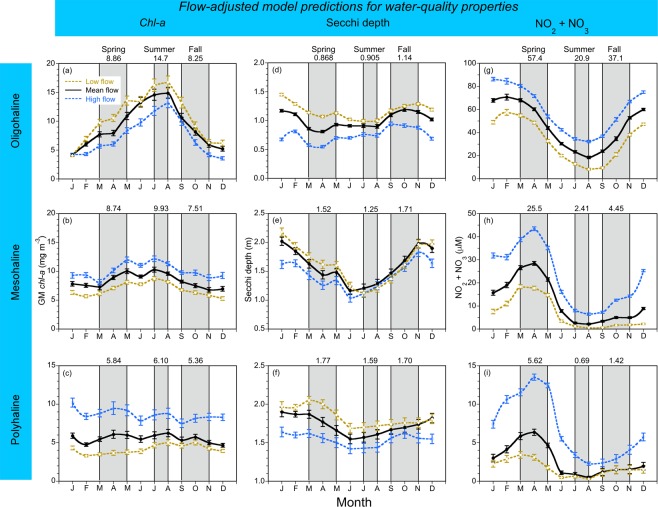
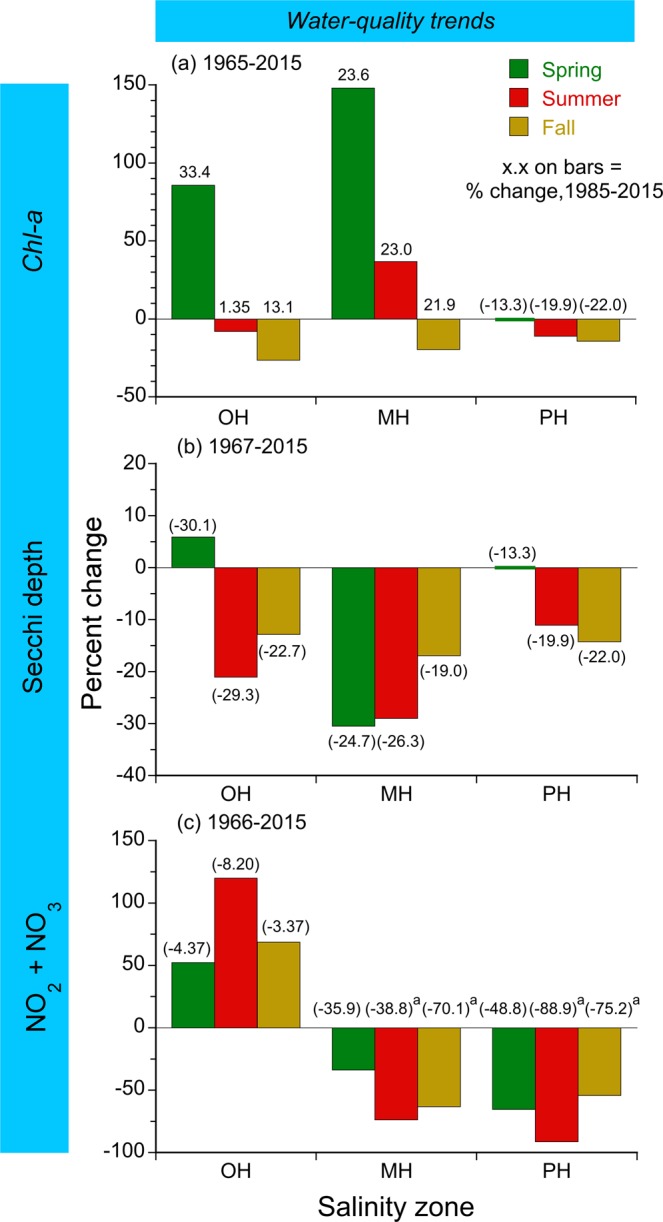
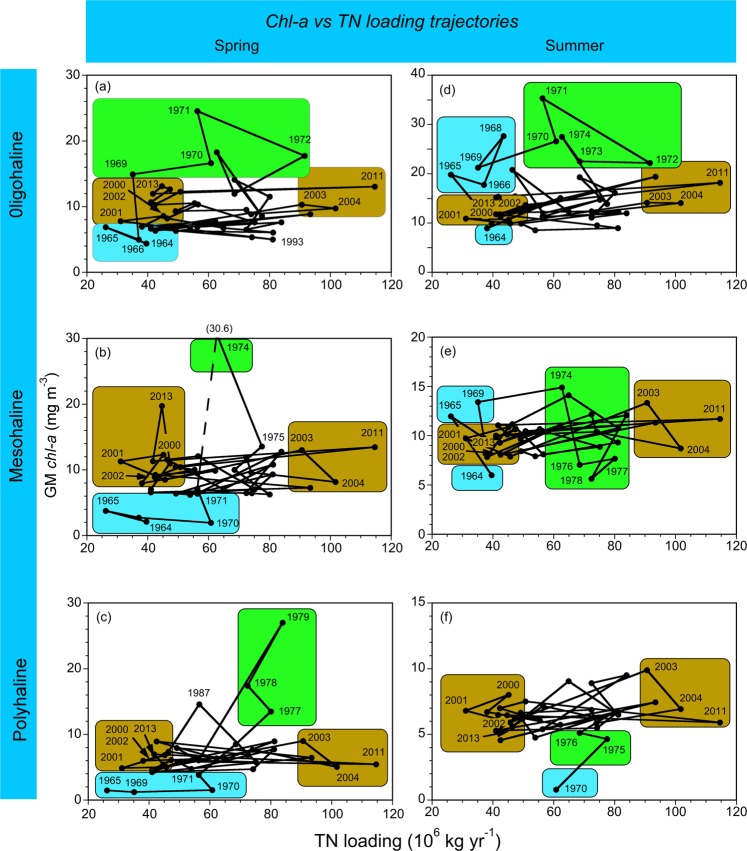
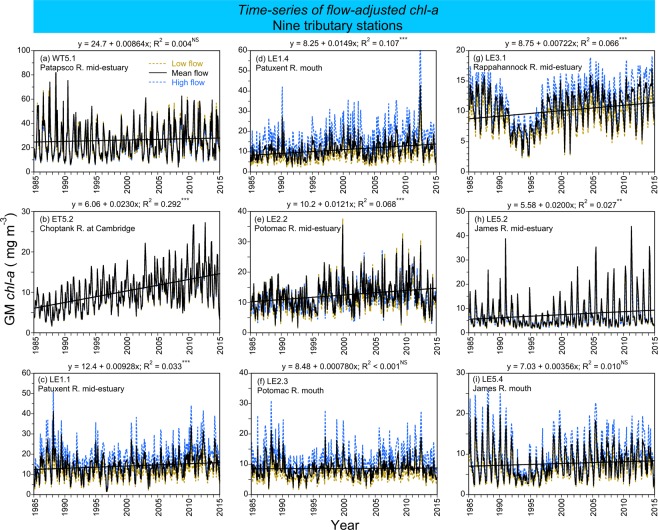
Coincident climatic and human effects strongly influence water-quality properties in estuarine-coastal ecosystems around the world. Time-series data for a number of ecosystems reveal high spatio-temporal variability superimposed on secular trends traceable to nutrient over-enrichment. In this paper, we present new analyses of long-term data for Chesapeake Bay directed at several goals: (1) to distinguish trends from spatio-temporal variability imposed by climatic effects; (2) to assess long-term trends of water-quality properties reflecting degradation and recovery; (3) to propose numerical water-quality criteria as targets for restoration; (4) to assess progress toward attainment of these targets. The bay has experienced multiple impairments associated with nutrient over-enrichment since World War II, e.g., low dissolved oxygen (DO), decreased water clarity, and harmful algal blooms (HAB). Anthropogenic eutrophication has been expressed as increased chlorophyll-a (chl-a) driven by accelerated nutrient loading from 1945 to 1980. Management intervention led to decreased loading thereafter, but deleterious symptoms of excess nutrients persist. Climatic effects exemplified by irregular “dry” and “wet” periods in the last 30+ years largely explain high inter-annual variability of water-quality properties, requiring adjustments to resolve long-term trends. Here, we extend these analyses at a finer temporal scale to six decades of chl-a, Secchi depth, and nitrite plus nitrate (NO 2 + NO 3) data to support trend analyses and the development of numerical water-quality criteria. The proposed criteria build on a conceptual model emphasizing the need to distinguish climatic and human effects in gauging progress to reverse eutrophication in estuarine-coastal ecosystems.
Overview
The claims and statistics of this paper haven’t been checked yet.
Free: it reads the open-access text and checks the first 5 claims that cite a source we can check. Create a free account to check every claim.
Integrity signals
Registry
Cites
Statistics
Figures
Verification
Claims the paper makes
The claims and statistics of this paper haven’t been checked yet.
Free: it reads the open-access text and checks the first 5 claims that cite a source we can check. Create a free account to check every claim.
Claims other papers make about this one
Each is checked against this paper’s own text: does it say what the citing paper says it does?
The source backs part of the claim, not all of it — or backs it for a different population, condition or comparison.
In the citing paper
“over the past 15-20 years oyster populations have been additionally stressed by reduced water quality and habitat loss (Kemp et al., 2005;Harding et al., 2019) and episodic harmful algal blooms (HABs) (Tango et al., 2005;Glibert et al., 2007;Mulholland et al., 2009;May et al., 2010;Griffith and Gobler, 2020).”
From Current and Future Remote Sensing of Harmful Algal Blooms in the Chesapeake Bay to Support the Shellfish Industry (2020) · cites this paper as Harding et al., 2019
Experimental — accuracy not yet measured
Self-check
Percentages, sums and reported differences re-computed from the paper’s own numbers.
The self-check needs the paper’s full text.
Citations
Cites
Generalized Additive Models: An Introduction with R
Wood, S. N. (2017) · doi:10.1201/9781315370279 · Cited by 13,852
Odum, E. P. (1969) · Science · doi:10.1126/science.164.3877.262 · Cited by 5,433
Our evolving conceptual model of the coastal eutrophication problem
Cloern, J. (2001) · Marine Ecology Progress Series · doi:10.3354/meps210223 · Cited by 2,895 · cited 8×
“instrumental for assessing estuarine health, including: (1) chlorophyll-a (chl-a) as a measure of phytoplankton biomass; (2) Secchi depth as a proxy for water clarity; (3) nitrite plus nitrate (NO2 + NO3) as a measure of nutrient loading/concentrations.”
BackgroundMethodResultInfluentialCoastal marine eutrophication: A definition, social causes, and future concerns
Nixon, S. W. (1995) · Ophelia · doi:10.1080/00785236.1995.10422044 · Cited by 2,672 · cited 8×
“instrumental for assessing estuarine health, including: (1) chlorophyll-a (chl-a) as a measure of phytoplankton biomass; (2) Secchi depth as a proxy for water clarity; (3) nitrite plus nitrate (NO2 + NO3) as a measure of nutrient loading/concentrations.”
BackgroundMethodResultInfluentialStable and Efficient Multiple Smoothing Parameter Estimation for Generalized Additive Models
Wood, S. N. (2004) · Journal of the American Statistical Association · doi:10.1198/016214504000000980 · Cited by 2,295
Eutrophication of Chesapeake Bay: historical trends and ecological interactions.
Kemp, W., Boynton, W., Adolf, J., Boesch, D., Boicourt, W., Brush, G., Cornwell, J., Fisher, T., Glibert, P., Hagy, J., et al. (2005) · Marine Ecology Progress Series · doi:10.3354/meps303001 · Cited by 1,468
Self-citationEffects of nutrient enrichment in the nation's estuaries: A decade of change
Bricker, S. B., Longstaff, B., Dennison, W., Jones, A., Boicourt, K., Wicks, C., & Woerner, J. (2008) · Harmful Algae · doi:10.1016/j.hal.2008.08.028 · Cited by 921
Return to Neverland: Shifting Baselines Affect Eutrophication Restoration Targets
Duarte, C. M., Conley, D. J., Carstensen, J., & Sánchez-Camacho, M. (2009) · Estuaries and Coasts · doi:10.1007/s12237-008-9111-2 · Cited by 627
Hagy, J. D., Boynton, W. R., Keefe, C. W., & Wood, K. V. (2004) · Estuaries · doi:10.1007/bf02907650 · Cited by 623
Low‐Rank Scale‐Invariant Tensor Product Smooths for Generalized Additive Mixed Models
Wood, S. N. (2006) · Biometrics · doi:10.1111/j.1541-0420.2006.00574.x · Cited by 616
Cloern, J. E., Abreu, P. C., Carstensen, J., Chauvaud, L., Elmgren, R., Grall, J., Greening, H., Johansson, J. O. R., Kahru, M., Sherwood, E. T., et al. (2016) · Global Change Biology · doi:10.1111/gcb.13059 · Cited by 591
Boynton, W. R., Garber, J. H., Summers, R., & Kemp, W. M. (1995) · Estuaries · doi:10.2307/1352640 · Cited by 588
Hirsch, R. M., Moyer, D. L., & Archfield, S. A. (2010) · JAWRA Journal of the American Water Resources Association · doi:10.1111/j.1752-1688.2010.00482.x · Cited by 570
Nutrient limitation of phytoplankton in Chesapeake Bay
Fisher, T., Peele, E., Ammerman, J., & Harding, L. (1992) · Marine Ecology Progress Series · doi:10.3354/meps082051 · Cited by 541
Self-citationCloern, J. E., & Jassby, A. D. (2012) · Reviews of Geophysics · doi:10.1029/2012rg000397 · Cited by 378
Anthropogenic and climatic influences on the eutrophication of large estuarine ecosystems
Paerl, H. W., Valdes, L. M., Peierls, B. L., Adolf, J. E., & Harding, L. J. W. (2006) · Limnology and Oceanography · doi:10.4319/lo.2006.51.1_part_2.0448 · Cited by 355
Self-citationMalone, T., Crocker, L., Pike, S., & Wendler, B. (1988) · Marine Ecology Progress Series · doi:10.3354/meps048235 · Cited by 348
Patterns and Scales of Phytoplankton Variability in Estuarine–Coastal Ecosystems
Cloern, J. E., & Jassby, A. D. (2010) · Estuaries and Coasts · doi:10.1007/s12237-009-9195-3 · Cited by 342
Phytoplankton community ecology: principles applied in San Francisco Bay
Cloern, J., & Dufford, R. (2005) · Marine Ecology Progress Series · doi:10.3354/meps285011 · Cited by 319
Scales of Nutrient-Limited Phytoplankton Productivity in Chesapeake Bay
Malone, T. C., Conley, D. J., Fisher, T. R., Glibert, P. M., Harding, L. W., & Sellner, K. G. (1996) · Estuaries · doi:10.2307/1352457 · Cited by 280
Self-citationRiver discharge controls phytoplankton dynamics in the northern San Francisco Bay estuary
Cloern, J. E., Alpine, A. E., Cole, B. E., Wong, R. L. J., Arthur, J. F., & Ball, M. D. (1983) · Estuarine, Coastal and Shelf Science · doi:10.1016/0272-7714(83)90103-8 · Cited by 258
Riemann, B., Carstensen, J., Dahl, K., Fossing, H., Hansen, J. W., Jakobsen, H. H., Josefson, A. B., Krause-Jensen, D., Markager, S., Stæhr, P. A., et al. (2016) · Estuaries and Coasts · doi:10.1007/s12237-015-9980-0 · Cited by 251
Mozetič, P., Solidoro, C., Cossarini, G., Socal, G., Precali, R., Francé, J., Bianchi, F., De Vittor, C., Smodlaka, N., & Fonda Umani, S. (2010) · Estuaries and Coasts · doi:10.1007/s12237-009-9191-7 · Cited by 226
Greening, H., & Janicki, A. (2006) · Environmental Management · doi:10.1007/s00267-005-0079-4 · Cited by 217
Coastal eutrophication and trend reversal: A Danish case study
Carstensen, J., Conley, D. J., Andersen, J. H., & Ærtebjerg, G. (2006) · Limnology and Oceanography · doi:10.4319/lo.2006.51.1_part_2.0398 · Cited by 201
Rapid Communication: Climatic Control on Eutrophication of the Hudson River Estuary
Howarth, R. W., Swaney, D. P., Butler, T. J., & Marino, R. (2000) · Ecosystems · doi:10.1007/s100210000020 · Cited by 200
Long-term increase of phytoplankton biomass in Chesapeake Bay, 1950-1994
Harding, L., & Perry, E. (1997) · Marine Ecology Progress Series · doi:10.3354/meps157039 · Cited by 196
Self-citationLehman, P. W., Boyer, G., Hall, C., Waller, S., & Gehrts, K. (2005) · Hydrobiologia · doi:10.1007/s10750-004-4670-0 · Cited by 195
A cold phase of the East Pacific triggers new phytoplankton blooms in San Francisco Bay
Cloern, J. E., Jassby, A. D., Thompson, J. K., & Hieb, K. A. (2007) · Proceedings of the National Academy of Sciences · doi:10.1073/pnas.0706151104 · Cited by 185
Gallegos, C. L. (2001) · Estuaries · doi:10.2307/1353240 · Cited by 173
Self-citationHarding, L. W., Mallonee, M. E., & Perry, E. S. (2002) · Estuarine, Coastal and Shelf Science · doi:10.1006/ecss.2001.0917 · Cited by 170
Self-citationChlorophyll distributions in the Delaware estuary: Regulation by light-limitation
Pennock, J. R. (1985) · Estuarine, Coastal and Shelf Science · doi:10.1016/0272-7714(85)90068-x · Cited by 166
Long-Term Trends of Nutrients and Phytoplankton in Chesapeake Bay
Harding, L. W., Gallegos, C. L., Perry, E. S., Miller, W. D., Adolf, J. E., Mallonee, M. E., & Paerl, H. W. (2015) · Estuaries and Coasts · doi:10.1007/s12237-015-0023-7 · Cited by 156
Self-citationConnecting the Dots: Responses of Coastal Ecosystems to Changing Nutrient Concentrations
Carstensen, J., Sánchez-Camacho, M., Duarte, C. M., Krause-Jensen, D., & Marbà, N. (2011) · Environmental Science & Technology · doi:10.1021/es202351y · Cited by 152
Patterns of variability characterizing marine phytoplankton, with examples from Narragansett Bay
Smayda, T. (1998) · ICES Journal of Marine Science · doi:10.1006/jmsc.1998.0385 · Cited by 132
SeaWiFS retrievals of chlorophyll in Chesapeake Bay and the mid-Atlantic bight
Harding, L. W., Magnuson, A., & Mallonee, M. E. (2004) · Estuarine Coastal and Shelf Science · doi:10.1016/j.ecss.2004.08.011 · Cited by 131
Self-citationAdolf, J. E., Yeager, C. L. J., Miller, W. D., Mallonee, M. E., & Harding, L. W. (2006) · Estuarine Coastal and Shelf Science · doi:10.1016/j.ecss.2005.11.030 · Cited by 130
Self-citationClimate anomalies generate an exceptional dinoflagellate bloom in San Francisco Bay
Cloern, J. E., Schraga, T. S., Lopez, C. B., Knowles, N., Grover Labiosa, R., & Dugdale, R. (2005) · Geophysical Research Letters · doi:10.1029/2005gl023321 · Cited by 115
Limits to top-down control of phytoplankton by oysters in Chesapeake Bay
Pomeroy, L., DElia, C., & Schaffner, L. (2006) · Marine Ecology Progress Series · doi:10.3354/meps325301 · Cited by 114
Paerl, H. W., Hall, N. S., Peierls, B. L., Rossignol, K. L., & Joyner, A. R. (2013) · Estuaries and Coasts · doi:10.1007/s12237-013-9686-0 · Cited by 105
Self-citationGallegos, C. L., Werdell, P. J., & McClain, C. R. (2011) · Journal of Geophysical Research Atmospheres · doi:10.1029/2011jc007160 · Cited by 94
Self-citationBricker, S. B., Rice, K. C., & Bricker, O. P. (2014) · Aquatic Geochemistry · doi:10.1007/s10498-014-9226-y · Cited by 90
Climate effects on phytoplankton floral composition in Chesapeake Bay
Harding, L. W., Adolf, J. E., Mallonee, M. E., Miller, W. D., Gallegos, C. L., Perry, E. S., Johnson, J. M., Sellner, K. G., & Paerl, H. W. (2015) · Estuarine Coastal and Shelf Science · doi:10.1016/j.ecss.2014.12.030 · Cited by 72
Self-citationAcker, J. G., Harding, L. W., Leptoukh, G. G., Zhu, T., & Shen, S. (2005) · Geophysical Research Letters · doi:10.1029/2004gl021852 · Cited by 71
Self-citationClimate forcing of the spring bloom in Chesapeake Bay.
Miller, W., & Harding Jr, L. (2007) · Marine Ecology Progress Series · doi:10.3354/meps331011 · Cited by 70
Self-citationVariable climatic conditions dominate recent phytoplankton dynamics in Chesapeake Bay
Harding, Mallonee, M. E., Perry, E. S., Miller, W. D., Adolf, J. E., Gallegos, C. L., & Paerl, H. W. (2016) · Scientific Reports · doi:10.1038/srep23773 · Cited by 66
Self-citationStates., U., & States., U. (2003) · doi:10.5962/bhl.title.149634 · Cited by 63
Estuarine Ecosystem Response Captured Using a Synoptic Climatology
Kimmel, D. G., Miller, W. D., Harding, L. W., Houde, E. D., & Roman, M. R. (2009) · Estuaries and Coasts · doi:10.1007/s12237-009-9147-y · Cited by 52
Self-citationEutrophication in coastal marine ecosystems: towards better understanding and management strategies
Andersen, J. H., & Conley, D. J. (2009) · Hydrobiologia · doi:10.1007/s10750-009-9758-0 · Cited by 51
Miller, W. D., Kimmel, D. G., & Harding, L. W. (2006) · Water Resources Research · doi:10.1029/2005wr004270 · Cited by 45
Self-citationScientific Bases for Numerical Chlorophyll Criteria in Chesapeake Bay
Harding, L. W., Batiuk, R. A., Fisher, T. R., Gallegos, C. L., Malone, T. C., Miller, W. D., Mulholland, M. R., Paerl, H. W., Perry, E. S., & Tango, P. J. (2013) · Estuaries and Coasts · doi:10.1007/s12237-013-9656-6 · Cited by 39
Self-citationSutula, M. A., Kudela, R. M., Hagy, J. D., Harding, L. W., Senn, D. B., Cloern, J. E., Bricker, S. B., Berg, G. M., & Beck, M. W. (2017) · Estuarine Coastal and Shelf Science · doi:10.1016/j.ecss.2017.07.009 · Cited by 39
Self-citationBeck, M. W., & Murphy, R. R. (2016) · JAWRA Journal of the American Water Resources Association · doi:10.1111/1752-1688.12489 · Cited by 24
Langland, M. J., Blomquist, J. D., Moyer, D., & Hyer, K. (2012) · Scientific investigations report · doi:10.3133/sir20125093 · Cited by 19
Shellenbarger, G. G., Schoellhamer, D. H., Morgan, T. L., Takekawa, J. Y., Athearn, N. D., & Henderson, K. D. (2008) · Antarctica A Keystone in a Changing World · doi:10.3133/ofr20081097 · Cited by 5
Research works printed but not linked: 3
- Boynton, W. R. & Kemp, W. M. Influence of river flow and nutrient loads on selected ecosystem processes: A synthesis of Chesapeake Bay data. In Estuarine science, a synthetic approach to research and practice, ed. Hobbie, J. E., 269–298 (Washington, D. C.: Island Press, 2000).
- Malone T. C. Effects of water column processes on dissolved oxygen: nutrients, phytoplankton and zooplankton. In: Smith, D., Leffler, M., Mackiernan, G. (Eds), Oxygen dynamics in Chesapeake Bay: A synthesis of research, pp. 61–112 (University of Maryland Sea Grant, College Park, Maryland, USA, 1992).
- Jaworski, N. A., Romano, B. & Buchanan, C. The Potomac River basin and its estuary: Landscape loadings and water quality trends 1895–2005. In: Jaworski, C. L. (Ed.), Report, Interstate Commission on the Potomac River Basin, Rockville, Maryland, USA (2007).
Cited by
The Globalization of Cultural Eutrophication in the Coastal Ocean: Causes and Consequences
Malone, T. C., & Newton, A. (2020) · Frontiers in Marine Science · doi:10.3389/fmars.2020.00670 · Cited by 531
“These decreases persisted through the 1990s (Orth et al., 2010; Harding et al., 2019) but show signs of increasing since ∼2006 during a sustained low-flow period (Testa et al.”
BackgroundInteractions of microalgae-bacteria consortia for nutrient removal from wastewater: A review
Fallahi, A., Rezvani, F., Asgharnejad, H., Khorshidi Nazloo, E., Hajinajaf, N., & Higgins, B. (2021) · Chemosphere · doi:10.1016/j.chemosphere.2021.129878 · Cited by 404
Persistent eutrophication and hypoxia in the coastal ocean
Dai, M., Zhao, Y., Chai, F., Chen, M., Chen, N., Chen, Y., Cheng, D., Gan, J., Guan, D., Hong, Y., et al. (2023) · Cambridge Prisms: Coastal Futures · doi:10.1017/cft.2023.7 · Cited by 179
“…including climatic effects (e.g., irregular dry and we periods), weather (e.g., precipitation), nutrient loading, physical conditions (e.g., river discharge, water temperature, wind speed and wind direction), and biological activities (e.g., respiration) (Du et al., 2018; Harding et al., 2019).”
Byrnes, D., Meter, K. J. V., & Basu, N. B. (2020) · Global Biogeochemical Cycles · doi:10.1029/2020gb006626 · Cited by 108
“Problems of nutrient‐induced hypoxia have been noted for decades along the Louisiana continental shelf in the Gulf of Mexico and in the Chesapeake Bay (Harding et al., 2019; Rabalais et al., 2002; Van Meter et al., 2017).”
BackgroundCosta, D. D. A., de Azevedo, J. P. S., dos Santos, M. A., & Assumpção, R. D. S. F. V. (2020) · Scientific Reports · doi:10.1038/s41598-020-78563-0 · Cited by 101
Metadata
- Authors
- Harding, L. W., Mallonee, M. E., Perry, E. S., Miller, W. D., Adolf, J. E., Gallegos, C. L., & Paerl, H. W.
- Affiliations
- University of California, Los Angeles (US)
- Environmental Protection Agency (US)
- United States Naval Research Laboratory (US)
- Monmouth University (US)
- Smithsonian Environmental Research Center (US)
- University of North Carolina at Chapel Hill (US)
- Corresponding author
- Harding, Lawrence W.
- Venue
- Scientific Reports
- Published
- 2019-04-30
- Volume
- 9
- Issue
- 1
- Pages
- 6709-6709
- ISSN
- 2045-2322 (ISSN-L)
- PMC
- PMC6491606
- OpenAlex
- W2943517255
- Cited by
- 98
- References
- 55
- Citations by year
- 2026: 12 · 2025: 13 · 2024: 11 · 2023: 16 · 2022: 18 · 2021: 13 · 2020: 13 · 2019: 2
- FWCI
- 6.35
- Type
- journal article
- Language
- en
- Open access
- gold
- doi.org
- Licence
- cc-by
- creativecommons.org/licenses/by/4.0 (tdm)
- creativecommons.org/licenses/by/4.0 (vor)
- Locations
- Scientific Reports (publishedVersion, cc-by)
- Europe PMC (PubMed Central) (publishedVersion, cc-by)
- PubMed Central (publishedVersion, cc-by)
- PubMed (publishedVersion)
- Carolina Digital Repository (University of North Carolina at Chapel Hill) (submittedVersion)
- eScholarship (California Digital Library) (submittedVersion, cc-by)
- NOAA Institutional Repository (submittedVersion)
- UNC Libraries
- Funders
- National Science Foundation
- National Aeronautics and Space Administration
- U.S. Environmental Protection Agency
- National Oceanic and Atmospheric Administration
- Topics
- Physical Sciences › Earth and Planetary Sciences › Oceanography › Marine Plankton and Biogeochemistry
- Physical Sciences › Environmental Science › Environmental Chemistry › Aquatic Ecosystems and Phytoplankton Dynamics
- Physical Sciences › Earth and Planetary Sciences › Oceanography › Oceanographic and Atmospheric Processes
- Keywords
- Chesapeake Bay, water quality trends, eutrophication, chlorophyll a, Secchi depth, nitrate, dissolved oxygen, harmful algal blooms, water transparency, climate variability, long-term monitoring, water quality criteria, estuarine restoration, anthropogenic nutrient loading
About these checks
Registry, retraction, Cites and statistics results are computed, not judged, with one exception: a printed reference that no index lists is read once by a model before it counts as a citation error. Claims are extracted by a model and kept only when their quote appears verbatim in the text; each cited source is then checked, with a model’s help, for whether it says what the claim relies on. Those verdicts can be wrong — read the claim’s quote and the cited source before relying on one.
Statistics and arithmetic are recomputed, not judged.
Confidence bands are shown only for fields calibrated on our annotated test set. None is calibrated yet, so no band is shown.
What counts as a claim ›How we measure confidence ›How we check this ›
Are you an author, or do you see a problem with this page? Request a review
Data sources
Bibliographic data: Semantic Scholar, OpenAlex, Crossref.
Contains information from the Semantic Scholar Academic Graph Datasets, made available under the ODC Attribution License (ODC-BY 1.0).
Semantic Scholar’s data is described in: Kinney, R., et al. (2023). The Semantic Scholar Open Data Platform. arXiv:2301.10140.
