

Misophonia is associated with altered brain activity in the auditory cortex and salience network
Open accessThe DOI matches its Crossref record; 41 of the 42 references it cites were found in a registry or an index.
Abstract
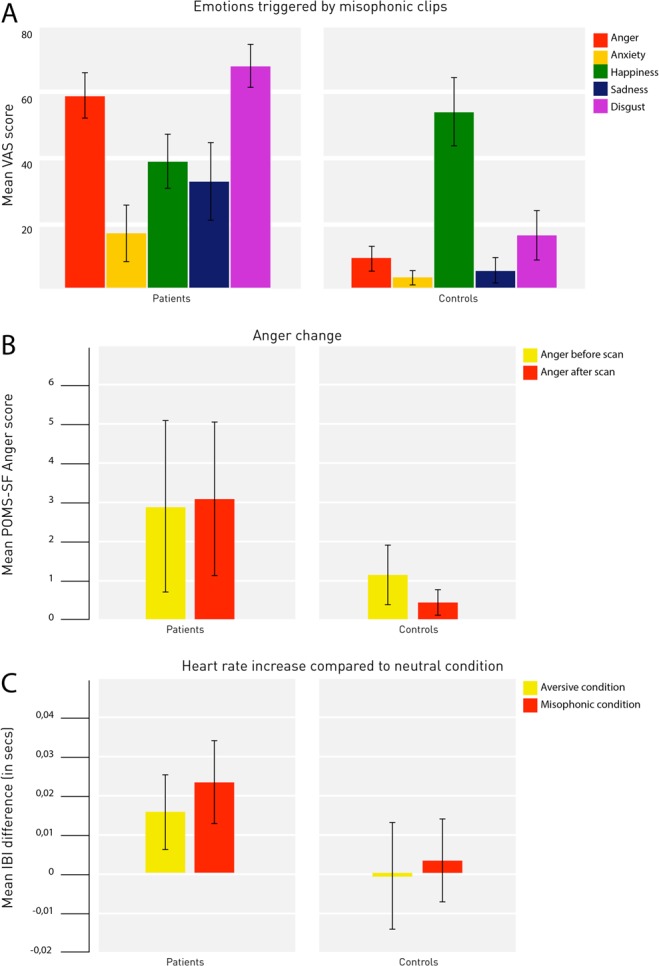
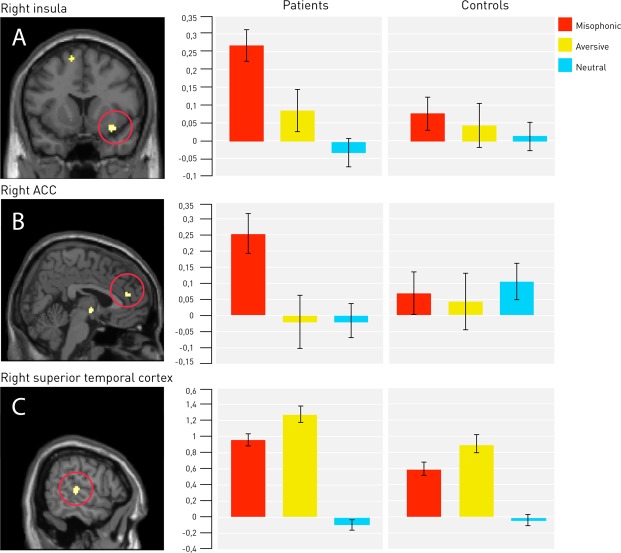
Misophonia is characterized by intense rage and disgust provoked by hearing specific human sounds resulting in social isolation due to avoidance. We exposed patients with symptom provoking audiovisual stimuli to investigate brain activity of emotional responses. 21 patients with misophonia and 23 matched healthy controls were recruited at the psychiatry department of the Amsterdam UMC. Participants were presented with three different conditions, misophonia related cues (video clips with e.g. lip smacking and loud breathing), aversive cues (violent or disgusting clips from movies), and neutral cues (video clips of e.g. someone meditating) during fMRI. Electrocardiography was recorded to determine physiological changes and self-report measures were used to assess emotional changes. Misophonic cues elicited anger, disgust and sadness in patients compared to controls. Emotional changes were associated with increases in heart rate. The neuroimaging data revealed increased activation of the right insula, right anterior cingulate cortex and right superior temporal cortex during viewing of the misophonic video clips compared to neutral clips. Our results demonstrate that audiovisual stimuli trigger anger and physiological arousal in patients with misophonia, associated with activation of the auditory cortex and salience network.
Overview
The claims and statistics of this paper haven’t been checked yet.
Free: it reads the open-access text and checks the first 5 claims that cite a source we can check. Create a free account to check every claim.
Integrity signals
Registry
Cites
Statistics
Figures
Verification
Claims the paper makes
The claims and statistics of this paper haven’t been checked yet.
Free: it reads the open-access text and checks the first 5 claims that cite a source we can check. Create a free account to check every claim.
Claims other papers make about this one
Each is checked against this paper’s own text: does it say what the citing paper says it does?
The check wasn’t confident either way, so it gives no verdict — never disputed.
In the citing paper
“Although it appears that this system functions adequately in misophonic patients, there are cases in which a neurological disorder coexists and overlaps the symptoms [2,44,46].”
From Misophonia: A Systematic Review of Current and Future Trends in This Emerging Clinical Field (2022) · cites this paper as [46]
Experimental — accuracy not yet measured
Self-check
Percentages, sums and reported differences re-computed from the paper’s own numbers.
The self-check needs the paper’s full text.
Citations
Cites
Hamilton, M. (1960) · Journal of Neurology, Neurosurgery & Psychiatry · doi:10.1136/jnnp.23.1.56 · Cited by 32,817
Tzourio-Mazoyer, N., Landeau, B., Papathanassiou, D., Crivello, F., Etard, O., Delcroix, N., Mazoyer, B., & Joliot, M. (2002) · NeuroImage · doi:10.1006/nimg.2001.0978 · Cited by 16,319
The assessment of anxiety states by rating
HAMILTON, M. (1959) · British Journal of Medical Psychology · doi:10.1111/j.2044-8341.1959.tb00467.x · Cited by 11,455
Dissociable intrinsic connectivity networks for salience processing and executive control
Seeley, W. W., Menon, V., Schatzberg, A. F., Keller, J., Glover, G. H., Kenna, H., Reiss, A. L., & Greicius, M. D. (2007) · The Journal of Neuroscience · doi:10.1523/jneurosci.5587-06.2007 · Cited by 7,426
How do you feel? Interoception: The sense of the physiological condition of the body
Craig, A. D. (2002) · Nature Reviews Neuroscience · doi:10.1038/nrn894 · Cited by 6,006
Saliency, switching, attention and control: a network model of insula function
Menon, V., & Uddin, L. Q. (2010) · Brain Structure and Function · doi:10.1007/s00429-010-0262-0 · Cited by 5,592
Buss, A. H., & Perry, M. (1992) · Journal of Personality and Social Psychology · doi:10.1037/0022-3514.63.3.452 · Cited by 4,693
SCL-90: an outpatient psychiatric rating scale--preliminary report.
Derogatis, L. R., Lipman, R. S., & Covi, L. (1973) · PubMed · Cited by 4,633
Functional neuroanatomy of emotion: A meta-analysis of emotion activation studies in PET and fMRI
Phan, K. L., Wager, T., Taylor, S. F., & Liberzon, I. (2002) · NeuroImage · doi:10.1006/nimg.2002.1087 · Cited by 3,502
A cortical area selective for visual processing of the human body
Downing, P. E., Jiang, Y., Shuman, M., & Kanwisher, N. (2001) · Science · doi:10.1126/science.1063414 · Cited by 2,043
Cited by
Items 101–178 of 178
Exacerbation of paranoia-like thoughts following exposure to common misophonia trigger sounds
Bagrowska, P., Siepsiak, M., Nalberczak‐Skóra, M., & Gawęda, Ł. (2024) · Schizophrenia Research · doi:10.1016/j.schres.2024.10.005 · Cited by 2
Aazh, H., & Kula, F. B. (2025) · PLoS ONE · doi:10.1371/journal.pone.0324726 · Cited by 2
“Several imaging studies shown that the individuals with misophonia have abnormal activation and functional connectivity of certain areas of their brain (namely the anterior insular cortex) when exposed to the trigger sounds [9,10].”
Zumbrunn, N. M., McGovern, D. P., & Boran, L. (2023) · PsyArXiv (OSF Preprints) · doi:10.31234/osf.io/swpbd · Cited by 2
Multichannel auditory cortical responses in misophonia: A neurophysiological investigation
Karupaiah, K., Trinesh, R., Uppunda, A. K., & Prabhu, P. (2025) · Hearing Research · doi:10.1016/j.heares.2025.109458 · Cited by 2
Misophonia Symptoms Severity is Attributed to Impaired Flexibility and Heightened RuminationPreprint
Black, V., Allen, J. D., Aazh, H., Johnson, S. L., & Erfanian, M. (2025) · bioRxiv (Cold Spring Harbor Laboratory) · doi:10.1101/2025.01.13.632542 · Cited by 2
When Everyday Sounds Become Barriers: The Effect of Misophonia on Speech Perception
Özdeş, N. Ö., & Tokgöz-Yılmaz, S. (2025) · Brain and Behavior · doi:10.1002/brb3.70924 · Cited by 2
“Neuroimaging studies reveal atypical activation patterns in brain areas such as the anterior insula and anterior cingulate cortex, which play essential roles in emotional processing, interoception, and salience detection (Kumar et al. 2021; Schröder et al. 2019).”
Examining Physiological Responses to Misophonic TriggersPreprint
O’Reilly, C., Yang, X., Oh, S., Wedell, D. H., & Shinkareva, S. V. (2025) · PsyArXiv (OSF Preprints) · doi:10.31234/osf.io/q6gwm_v1 · Cited by 2
Sound-evoked pupil dilation quantifies misophonic symptomsPreprint
de Gee, J. W., Marmelstein, L. A., Schwarz-Roman, K., & Rouw, R. (2024) · Authorea · doi:10.22541/au.173020525.52263774/v1 · Cited by 2
Psychometric Properties of a Self-Perception Questionnaire for Adults with Suspected Misophonia
Castillo, B., Muñoz-Quezada, M. T., & Lucero, B. A. (2024) · SAGE Open · doi:10.1177/21582440241287097 · Cited by 1
“Schro¨der et al. (2019) and Dozier and Morrison (2017) propose that misophonia involves involuntary physical and emotional responses to trigger stimuli.”
Neacsiu, A. D., Gerlus, N., Graner, J. L., Bukhari‐Parlakturk, N., Choi, J., Rosenthal, M. Z., & LaBar, K. S. (2026) · BMC Psychiatry · doi:10.1186/s12888-026-08331-3 · Cited by 1
“Adults with misophonia exposed to misophonic (or trigger) sounds show hyperactivity in the insula [20–22], ACC [21], midcingulate cortex (MCC) [22], amygdala [23], ventral premotor cortex (PMv) [22], supplementary motor area (SMA) [22], and superior temporal cortex (STC) [6, 21, 24].”
Misophonie im Kindes- und Jugendalter: Eine narrative Übersichtsarbeit
Pfeiffer, E., Allroggen, M., & Sachser, C. (2022) · Zeitschrift für Kinder- und Jugendpsychiatrie und Psychotherapie · doi:10.1024/1422-4917/a000885 · Cited by 1
İletmiş, G., & Yaman, G. B. (2025) · Nordic Journal of Psychiatry · doi:10.1080/08039488.2025.2511068 · Cited by 1
“In individuals with misophonia, these trigger sounds have been associated with increased activation in the salience network, particularly in the anterior insular cortex [19,65,66].”
Sparse machine learning of resting-state fMRI reveals brain-wide dysconnectivity in hyperacusis
Ajmera, S., Khan, R. A., Jain, N., Kim, G., Castro, A. A., Berenbaum, H., & Husain, F. T. (2025) · Communications Medicine · doi:10.1038/s43856-025-01313-8 · Cited by 2
Misophonia Symptoms in Autistic Adults
Smit, D. J. A., Koyuncu, Z., Vulink, N. C. C., & Begeer, S. (2026) · Journal of Autism and Developmental Disorders · doi:10.1007/s10803-025-07184-1 · Cited by 1
Self-citationRosenthal, M. Z., Annarumma, M., Sessa, F., Consalvo, I., Masi, V. D., & Pagano, L. (2022) · Problems of Psychology in the 21st Century · doi:10.33225/ppc/22.16.36 · Cited by 1
Schubert, C., & Zillien, N. (2023) · Zeitschrift für Literaturwissenschaft und Linguistik · doi:10.1007/s41244-023-00320-3 · Cited by 1
Apaydın, Z. K., Demir, N., & Tarhan, R. (2026) · Medical Science Monitor · doi:10.12659/msm.950938 · Cited by 1
“Misophonia is a recently identified sensory condition causing intense negative reactions to specific sounds [1,2].”
A case of acquired amusia and misophonia following right temporal resection
Dappen, E. R., Berger, J. I., Belfi, A. M., Bruss, J., Griffiths, T. D., Billig, A. J., Rhone, A. E., Nourski, K. V., Tranel, D., & Dlouhy, B. J. (2025) · Hearing Research · doi:10.1016/j.heares.2025.109483 · Cited by 1
Wybrane problemy współczesnej diagnostyki klinicznej w psychologii
(2024) · Wydawnictwo Liberi Libri eBooks · doi:10.47943/lib.9788363487676 · Cited by 1
Sadeghi, A., & Daneshmand, M. (2025) · Rooyesh Psychological Journal · doi:10.66224/rooyesh.14.3.11 · Cited by 1
The sound of rage : the perceived impact of misophonia on daily life and relationships
Morales Gutiérrez, S. E. (2023) · DiVA at Umeå University (Umeå University) · Cited by 1
Analyzing Sensory Gating Capacity in Misophonia
Lodol, F. F. (2024) · Scholarship@Western (Western University) · Cited by 1
Mechanisms and outcomes of Autonomous Sensory Meridian Response
Swart, T. R. (2023) · Goldsmiths (University of London) · doi:10.25602/gold.00033976 · Cited by 1
Estimation of prevalence and severity of misophonia in adults from India
Valsa, P., Majeed, N. P. V. V. A., Vinod, N. K., Karupaiah, K., & Prabhu, P. (2025) · Neuroscience Research Notes · doi:10.31117/neuroscirn.v8i3.417 · Cited by 1
“Research using fMRI indicates that individuals with misophonia exhibit heightened activity in the AIC, amygdala, and prefrontal cortex when exposed to trigger sounds (Neacsiu et al., 2022; Kumar et al., 2017, 2021; Schröder et al., 2015, 2019).”
Zhou, S., Cunningham, A., Miller-Laquerre, J., Kirby, B. J., & Gao, Y. (2026) · bioRxiv (Cold Spring Harbor Laboratory) · doi:10.64898/2026.08.30.748122 · Cited by 1
Assessment for Sleep, Feeding, Sensory Issues, and Motor Skills in Females with Autism
Gabrielsen, T. P., Begay, K. K., Campbell, K. M., Hahn, K., & Harrington, L. T. (2023) · Springer eBooks · doi:10.1007/978-3-031-33969-1_4
New psychoacoustic tools for the assessment and diagnosis of hyperacusis and misophonia
Enzler, F. (2021) · theses.fr (ABES) · doi:10.70675/8e6f4a0bz1cd6z4d74z832az294335319bb5
PRELIMINARY STUDIES ON THE MISOPHONIC SYNDROME IN ITALY: TRIGGER SOUNDS AND FREQUENCY
Annarumma, M., Ruggia, C., Soldivieri, F., & Truono, S. (2024) · Problems of Psychology in the 21st Century · doi:10.33225/24.18.07
Cherchi, M. (2025) · Springer eBooks · doi:10.1007/978-3-031-94841-1_108
Raymond, K. E., Butler, B. E., Tremblay, P. F., Bodell, L. P., & Stevenson, R. A. (2025) · Research Square · doi:10.21203/rs.3.rs-7768960/v1
Attention and physiological responses to task-irrelevant sounds in misophonia
Rinaldi, L. J., Agbude, R., Andermane, N., Makowski, D., Forster, S., Simner, J., & Ward, J. (2026) · Journal of Clinical and Experimental Neuropsychology · doi:10.1080/13803395.2026.2633236
“…alpha = 0.05) published effect sizes relating to attention alerting ( d = 0.61, Frank et al., 2019), attention flexibility ( d = 0.51, Simner et al., 2022), heart rate difference ( d > 0.9 in both Kumar et al., 2017; Schröder et al., 2019), and skin conductance ( d = 1.14 in Kumar et al., 2017).”
InfluentialDevelopmental plasticity and network-level mechanisms in misophonia: A theory-building review
Sevmez, H. S. (2026) · Behavioural Brain Research · doi:10.1016/j.bbr.2026.116248
Watson, L. (2022) · FHSU Scholars Repository (Fort Hays State University) · doi:10.58809/myid1761
Social-Cognitive Dysregulation Model of Misophonia: Perspective from a Behavioural StudyPreprint
Erfanian, M., & Kumar, S. (2026) · bioRxiv (Cold Spring Harbor Laboratory) · doi:10.64898/2026.09.03.749152
“This is particularly pertinent to misophonia, where trigger exposure has been shown to elicit exaggerated anterior-insula responsivity (Kumar et al., 2017; Schroder et al., 2019).”
Autonomic responses to trigger sounds persist despite attentional redirection in misophonia
Savard, M., Brooks, M., Coffey, E. B. J., & Deroche, M. L. D. (2026) · International Journal of Psychophysiology · doi:10.1016/j.ijpsycho.2026.113476
Does Misophonia Affect Spatial Hearing? A Study Using Closed-Field Assessment Tools
Roy, U., Prabhu, P., & Nisha, K. V. (2026) · American Journal of Audiology · doi:10.1044/2025_aja-25-00058
Loudness recruitment and hyperacusis
Eggermont, J. J. (2022) · Elsevier eBooks · doi:10.1016/b978-0-323-91912-8.00003-7
Cognitive Behavioural Therapy for Misophonia: A Systematic Narrative Review of Clinical Studies
Aazh, H. (2026) · Journal of Disability Research · doi:10.57197/jdr-2026-0910
Gerçek, H. G., Özgür, B. G., Hayta, Z., Sapanca, A., & Aksu, H. (2025) · Annals of General Psychiatry · doi:10.1186/s12991-025-00583-9
“This avoidance behavior can result in functional impairments in work, school, and family or social relationships [3].”
The proximal and distal causes of misophonia
Ward, J. (2026) · Cortex · doi:10.1016/j.cortex.2026.06.001
Decrease of ARC protein expression in the striatum after tone fear conditioning
Antonio, B. D. B., Lee, K. S., Domingues, L. P., Daldegan‐Bueno, D., Ferreira, T. L., Soares, J. C. K., & Oliveira, M. G. M. (2021) · Revista Neurociências · doi:10.34024/rnc.2021.v29.11344
Rasouli, A., Rahimi, V., Fatahi, F., Zaree, M., & Aazh, H. (2026) · International Journal of Audiology · doi:10.1080/14992027.2026.2642751 · Cited by 1
Weiss, H. V., & Werff, K. R. V. (2026) · American Journal of Audiology · doi:10.1044/2026_aja-25-00333
Psychophysiological and psychological correlates of misophonia
Siepsiak, M. (2023) · ReIn UW (University of Warsaw)
Моделирование природоохранных технологий в теплоэнергетике с учетом макрокинетических процессов
Ростунцева, И. А. (2011) · Вестник Саратовского государственного технического университета
Urs, B. R. S., Nisha, K. V., Mohamad, A., & Prabhu, P. (2025) · Hearing Research · doi:10.1016/j.heares.2025.109435
Evaluation of extended high frequency thresholds in individuals with misophonia
Chalotra, S., Chauhan, N., & Valame, D. A. (2025) · The Egyptian Journal of Otolaryngology · doi:10.1186/s43163-025-00912-5
“Such perceptual changes might be driven by cognitive and neural processes that preferentially amplify certain auditory stimuli, reinforcing the individual’s adverse reactions [3, 14].”
InfluentialA misophonia case: psychotic patient with tactile hallucinations triggered by misophonia
Kokaçya, M. H., & Timur, Ç. (2025) · Interdisciplinary Medical Journal · doi:10.17944/interdiscip.1541628
Jain, N., Ajmera, S., Shahsavarani, S., Khan, R. A., Kim, G., Berenbaum, H., & Husain, F. T. (2026) · Cognitive Affective & Behavioral Neuroscience · doi:10.3758/s13415-026-01435-z
“Most prior work has examined either misophonia (Eijsker et al., 2021; Hansen et al., 2022; Kumar et al., 2017; 2021; Schröder et al., 2019) or hypera-cusis (Chen et al., 2015; Hofmeier et al., 2021; Koops & van Dijk, 2021; Makani et al., 2023) in isolation, without accounting for comorbidity…”
InfluentialRahimi, V. (2026) · Scientific Journal of Rehabilitation Medicine · doi:10.32598/sjrm.15.1.3432
Auditory affective experiences as a window into the neural basis of consciousnessPreprint
Snyder, J. S., Kondo, H. M., & Hannon, E. E. (2025) · PsyArXiv (OSF Preprints) · doi:10.31234/osf.io/v9rbd_v1
Hyperacusis and Misophonia Discrimination Scale (HMDS): a Validation Study
van Tussenbroek, F., & Morales Gutiérrez, S. E. (2024) · DiVA at Umeå University (Umeå University)
MDMA-Assisted Therapy for Treatment of PTSD and Beyond
(2023) · Frontiers research topics · doi:10.3389/978-2-8325-3023-8
Zawadzki, B., Barciś, S., & Cyniak‐Cieciura, M. (2024) · Wydawnictwo Liberi Libri eBooks · doi:10.47943/lib.9788363487676.rozdzial08
Cyniak‐Cieciura, M., Popiel, A., Bielak, P., Camino, V., Cha, E. J., Cho, Y., Cremeans‐Smith, J. K., Fruehstorfer, D. B., Galarregui, M. S., Goldfarb, R., et al. (2024) · Wydawnictwo Liberi Libri eBooks · doi:10.47943/lib.9788363487676.rozdzial07
Zastosowanie modeli psychiatrii obliczeniowej do badań nad PTSD
Jędraszkiewicz, A. (2024) · Wydawnictwo Liberi Libri eBooks · doi:10.47943/lib.9788363487676.rozdzial03
Zawadzki, B., Fronczyk, K., & Bargiel-Matusiewicz, K. M. (2024) · Wydawnictwo Liberi Libri eBooks · doi:10.47943/lib.9788363487676.rozdzial00
Żarnecka, D., & Łojek, E. (2024) · Wydawnictwo Liberi Libri eBooks · doi:10.47943/lib.9788363487676.rozdzial05
Łyś, A. E., & Bargiel-Matusiewicz, K. M. (2024) · Wydawnictwo Liberi Libri eBooks · doi:10.47943/lib.9788363487676.rozdzial02
Łojek, E. (2024) · Wydawnictwo Liberi Libri eBooks · doi:10.47943/lib.9788363487676.rozdzial01
Nuda: opis zjawiska, konotacje kliniczne i pomiar
Chruszczewski, M. (2024) · Wydawnictwo Liberi Libri eBooks · doi:10.47943/lib.9788363487676.rozdzial04
Siepsiak, M., Dragan, W. Ł., & Uglik‐Marucha, N. (2024) · Wydawnictwo Liberi Libri eBooks · doi:10.47943/lib.9788363487676.rozdzial06
The Woven Sensorium : An Examination of Aberrant Cross-Sensory Experiences in Hyperexcitable Cortex
Farrelly, H., Braithwaite, J. J., & Nuttall, H. E. (2026) · Lancaster EPrints (Lancaster University)
Misokinesia : exploring sensitivity to others' movements and its impact on attention and emotions
Jaswal, S. M. (2024) · cIRcle (University of British Columbia) · doi:10.14288/1.0445083
Niven, E. C. (2023) · UCL Discovery (University College London)
Turğut, F. S., Öztürk, M., Akan, Z., & Yılmaz, E. D. (2026) · Turkish Journal of Psychiatry · doi:10.5080/u27720
Neural Indicators of Misophonia Related Cognitive Load
Tollefsrud, M. A., & Wisniewski, M. G. (2026) · K-State Research Exchange (Kansas State University) · doi:10.18112/openneuro.ds008003.v1.0.0
Tan, J. S., Osorio, S., Levine, G., Nayal, Z., Ahlfors, S. P., Arenberg, J. G., Mercaldo, N. D., Ahveninen, J., Raij, T., & Kenet, T. (2026) · bioRxiv (Cold Spring Harbor Laboratory) · doi:10.64898/2026.09.14.751161
“…between auditory cortex and limbic structures in misophonia (Kumar et al 2017), and resting-state fMRI work has revealed atypical connectivity involving the anterior insular cortex, suggesting a role for interoceptive and salience processing networks (Eijsker et al 2019, Schroder et al 2019).”
Misophonia revised: New insights in phenomenology and psychotherapy
Jager, I. (2022) · Pure Amsterdam UMC
Hernández-Gómez, L., Martínez-Wbaldo, M. D. C., Calderón-Medrano, M. G., & Martínez-Cabrera, M. A. (2025) · Anales Médicos de la Asociación Médica del Centro Médico ABC · doi:10.24875/amh.m25000102
I Hear You: The Everyday Struggle Living with Misophonia
Jones, A. (2021) · TopSCHOLAR (Western Kentucky University)
Adline, P. D., Nisha, K. V., Prabhu, P., & Uppunda, A. K. (2026) · Journal of the American Academy of Audiology · doi:10.3766/jaaa.240058
Rinaldi, L. J., Rebecca Smees, Ward, J., & Simner, J. (2022) · doi:10.3389/fpsyg.2022.808379.s001
Savard, M.-A., Sares, A. G., Coffey, E. B. J., & Deroche, M. L. D. (2022) · doi:10.3389/fnins.2022.879583.s002
Digital ACT Intervention for Adults With Misophonia: A Randomized Waitlist-Controlled Trial
Bowers, E. M. (2026) · Digital Commons - USU (Utah State University) · doi:10.26076/h01x-qw54
Working Memory Disruption and Altered Alpha Dynamics in Misophonics
Tollefsrud, M. A., & Wisniewski, M. G. (2026) · Brain Sciences · doi:10.3390/brainsci16111199
Anterior insula hyperreactivity to trigger and disgust sounds in misophonia: An fMRI study
Gertler, J., Bradley, M. M., Keil, A., Ebner, N. C., Tanner, J. J., & Bowers, D. (2026) · Psychiatry Research Neuroimaging · doi:10.1016/j.pscychresns.2026.112395
Metadata
- Authors
- Schröder, A., van Wingen, G., Eijsker, N., San Giorgi, R., Vulink, N. C., Turbyne, C., & Denys, D.
- Affiliations
- Amsterdam Neuroscience (NL)
- Netherlands Institute for Neuroscience (NL)
- Corresponding author
- Schröder, Arjan
- Denys, Damiaan
- Venue
- Scientific Reports
- Published
- 2019-05-17
- Volume
- 9
- Issue
- 1
- Pages
- 7542-7542
- ISSN
- 2045-2322 (ISSN-L)
- PMC
- PMC6525165
- OpenAlex
- W2945711062
- Semantic Scholar
- dcdff831259ac273b036283779d626d4159185a4
- Cited by
- 141
- References
- 42
- Citations by year
- 2026: 22 · 2025: 30 · 2024: 16 · 2023: 22 · 2022: 30 · 2021: 12 · 2020: 7 · 2019: 1
- FWCI
- 7.14
- Type
- journal article
- Language
- en
- Update notices
- correction (2020-02-28)
- Open access
- gold
- doi.org
- Licence
- cc-by
- creativecommons.org/licenses/by/4.0 (tdm)
- creativecommons.org/licenses/by/4.0 (vor)
- Locations
- Scientific Reports (publishedVersion, cc-by)
- PubMed Central (publishedVersion, cc-by)
- PubMed (publishedVersion)
- KNAW Research Portal (The Royal Netherlands Academy of Arts and Sciences) (publishedVersion, other-oa)
- Pure Amsterdam UMC (submittedVersion, cc-by)
- Data Archiving and Networked Services (DANS) (submittedVersion, other-oa)
- DOAJ (DOAJ: Directory of Open Access Journals) (submittedVersion)
- KNAW research portal (Royal Academy of Art and Sciences (KNAW)) (submittedVersion, other-oa)
- Topics
- Life Sciences › Neuroscience › Sensory Systems › Hearing, Cochlea, Tinnitus, Genetics
- Life Sciences › Neuroscience › Cognitive Neuroscience › Neuroscience and Music Perception
- Physical Sciences › Physics and Astronomy › Acoustics and Ultrasonics › Noise Effects and Management
- Keywords
- misophonia, auditory cortex, salience network, insula, anterior cingulate cortex, superior temporal cortex, audiovisual stimuli, anger, disgust, heart rate, emotional arousal, social isolation, avoidance behavior
- MeSH terms
- Disgust, Adult, Affective Symptoms, Aggression, Auditory Cortex, Electrocardiography, Emotions, Female, Gyrus Cinguli, Heart Rate, Humans, Magnetic Resonance Imaging, Male, Surveys and Questionnaires, Rage, Hyperacusis, Temporal Lobe
About these checks
Registry, retraction, Cites and statistics results are computed, not judged, with one exception: a printed reference that no index lists is read once by a model before it counts as a citation error. Claims are extracted by a model and kept only when their quote appears verbatim in the text; each cited source is then checked, with a model’s help, for whether it says what the claim relies on. Those verdicts can be wrong — read the claim’s quote and the cited source before relying on one.
Statistics and arithmetic are recomputed, not judged.
Confidence bands are shown only for fields calibrated on our annotated test set. None is calibrated yet, so no band is shown.
What counts as a claim ›How we measure confidence ›How we check this ›
Are you an author, or do you see a problem with this page? Request a review
Data sources
Bibliographic data: Semantic Scholar, OpenAlex, Crossref.
Contains information from the Semantic Scholar Academic Graph Datasets, made available under the ODC Attribution License (ODC-BY 1.0).
Semantic Scholar’s data is described in: Kinney, R., et al. (2023). The Semantic Scholar Open Data Platform. arXiv:2301.10140.
