

Misophonia is associated with altered brain activity in the auditory cortex and salience network
Open accessThe DOI matches its Crossref record; 41 of the 42 references it cites were found in a registry or an index.
Abstract
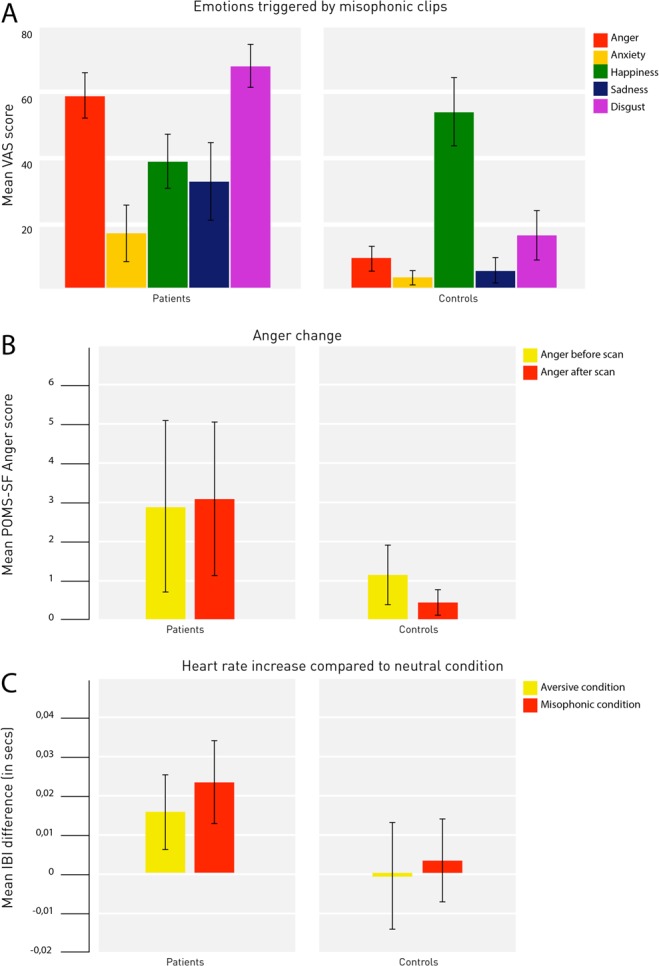
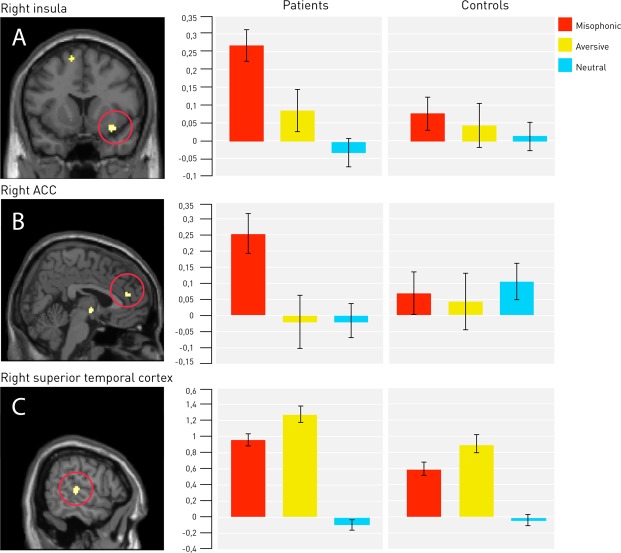
Misophonia is characterized by intense rage and disgust provoked by hearing specific human sounds resulting in social isolation due to avoidance. We exposed patients with symptom provoking audiovisual stimuli to investigate brain activity of emotional responses. 21 patients with misophonia and 23 matched healthy controls were recruited at the psychiatry department of the Amsterdam UMC. Participants were presented with three different conditions, misophonia related cues (video clips with e.g. lip smacking and loud breathing), aversive cues (violent or disgusting clips from movies), and neutral cues (video clips of e.g. someone meditating) during fMRI. Electrocardiography was recorded to determine physiological changes and self-report measures were used to assess emotional changes. Misophonic cues elicited anger, disgust and sadness in patients compared to controls. Emotional changes were associated with increases in heart rate. The neuroimaging data revealed increased activation of the right insula, right anterior cingulate cortex and right superior temporal cortex during viewing of the misophonic video clips compared to neutral clips. Our results demonstrate that audiovisual stimuli trigger anger and physiological arousal in patients with misophonia, associated with activation of the auditory cortex and salience network.
Overview
The claims and statistics of this paper haven’t been checked yet.
Free: it reads the open-access text and checks the first 5 claims that cite a source we can check. Create a free account to check every claim.
Integrity signals
Registry
Cites
Statistics
Figures
Verification
Claims the paper makes
The claims and statistics of this paper haven’t been checked yet.
Free: it reads the open-access text and checks the first 5 claims that cite a source we can check. Create a free account to check every claim.
Claims other papers make about this one
Each is checked against this paper’s own text: does it say what the citing paper says it does?
The check wasn’t confident either way, so it gives no verdict — never disputed.
In the citing paper
“Although it appears that this system functions adequately in misophonic patients, there are cases in which a neurological disorder coexists and overlaps the symptoms [2,44,46].”
From Misophonia: A Systematic Review of Current and Future Trends in This Emerging Clinical Field (2022) · cites this paper as [46]
Experimental — accuracy not yet measured
Self-check
Percentages, sums and reported differences re-computed from the paper’s own numbers.
The self-check needs the paper’s full text.
Citations
Cites
Hamilton, M. (1960) · Journal of Neurology, Neurosurgery & Psychiatry · doi:10.1136/jnnp.23.1.56 · Cited by 32,817
Tzourio-Mazoyer, N., Landeau, B., Papathanassiou, D., Crivello, F., Etard, O., Delcroix, N., Mazoyer, B., & Joliot, M. (2002) · NeuroImage · doi:10.1006/nimg.2001.0978 · Cited by 16,319
The assessment of anxiety states by rating
HAMILTON, M. (1959) · British Journal of Medical Psychology · doi:10.1111/j.2044-8341.1959.tb00467.x · Cited by 11,455
Dissociable intrinsic connectivity networks for salience processing and executive control
Seeley, W. W., Menon, V., Schatzberg, A. F., Keller, J., Glover, G. H., Kenna, H., Reiss, A. L., & Greicius, M. D. (2007) · The Journal of Neuroscience · doi:10.1523/jneurosci.5587-06.2007 · Cited by 7,426
How do you feel? Interoception: The sense of the physiological condition of the body
Craig, A. D. (2002) · Nature Reviews Neuroscience · doi:10.1038/nrn894 · Cited by 6,006
Saliency, switching, attention and control: a network model of insula function
Menon, V., & Uddin, L. Q. (2010) · Brain Structure and Function · doi:10.1007/s00429-010-0262-0 · Cited by 5,592
Buss, A. H., & Perry, M. (1992) · Journal of Personality and Social Psychology · doi:10.1037/0022-3514.63.3.452 · Cited by 4,693
SCL-90: an outpatient psychiatric rating scale--preliminary report.
Derogatis, L. R., Lipman, R. S., & Covi, L. (1973) · PubMed · Cited by 4,633
Functional neuroanatomy of emotion: A meta-analysis of emotion activation studies in PET and fMRI
Phan, K. L., Wager, T., Taylor, S. F., & Liberzon, I. (2002) · NeuroImage · doi:10.1006/nimg.2002.1087 · Cited by 3,502
A cortical area selective for visual processing of the human body
Downing, P. E., Jiang, Y., Shuman, M., & Kanwisher, N. (2001) · Science · doi:10.1126/science.1063414 · Cited by 2,043
LeDoux, J. (2007) · Current Biology · doi:10.1016/j.cub.2007.08.005 · Cited by 1,281
Neural mechanisms of autonomic, affective, and cognitive integration
Critchley, H. D. (2005) · Journal of Comparative Neurology · doi:10.1002/cne.20749 · Cited by 1,214
The conditioning theory of fearacquisition: A critical examination
Rachman, S. (1977) · Behaviour Research and Therapy · doi:10.1016/0005-7967(77)90041-9 · Cited by 1,191
Functional neuroanatomy of emotions: A meta-analysis
MURPHY, F. C., NIMMO-SMITH, I., & LAWRENCE, A. D. (2003) · Cognitive, Affective, & Behavioral Neuroscience · doi:10.3758/cabn.3.3.207 · Cited by 1,135
Vigilance, alertness, or sustained attention: physiological basis and measurement
Oken, B. S., Salinsky, M. C., & Elsas, S. M. (2006) · Clinical Neurophysiology · doi:10.1016/j.clinph.2006.01.017 · Cited by 887
Short Form of the Profile of Mood States (POMS-SF): Psychometric information.
Curran, S. L., Andrykowski, M. A., & Studts, J. L. (1995) · Psychological Assessment · doi:10.1037//1040-3590.7.1.80 · Cited by 808
Fear, Vigilance, and Ambiguity: Initial Neuroimaging Studies of the Human Amygdala
Whalen, P. J. (1998) · Current Directions in Psychological Science · doi:10.1111/1467-8721.ep10836912 · Cited by 788
Specific long-term memory traces in primary auditory cortex
Weinberger, N. M. (2004) · Nature Reviews Neuroscience · doi:10.1038/nrn1366 · Cited by 599
Paus, T., Zatorre, R. J., Hofle, N., Caramanos, Z., Gotman, J., Petrides, M., & Evans, A. C. (1997) · Journal of Cognitive Neuroscience · doi:10.1162/jocn.1997.9.3.392 · Cited by 514
Misophonia: Diagnostic Criteria for a New Psychiatric Disorder
Schröder, A., Vulink, N., & Denys, D. (2013) · PLoS ONE · doi:10.1371/journal.pone.0054706 · Cited by 410 · cited 2×
“Discussion Our results show that specific audiovisual cues may elicit [1] anger, disgust, and sadness in patients with misophonia, and that they are accompanied by [2] increased physiological arousal, and [3] increased activity in the right insula, right ACC, and right superior temporal cortex.”
BackgroundSelf-citationJabbi, M., Bastiaansen, J., & Keysers, C. (2008) · PLoS ONE · doi:10.1371/journal.pone.0002939 · Cited by 362
Misophonia: Physiological investigations and case descriptions
Edelstein, M., Brang, D., Rouw, R., & Ramachandran, V. S. (2013) · Frontiers in Human Neuroscience · doi:10.3389/fnhum.2013.00296 · Cited by 330
Defining the face processing network: Optimization of the functional localizer in fMRI
Fox, C. J., Iaria, G., & Barton, J. J. S. (2009) · Human Brain Mapping · doi:10.1002/hbm.20630 · Cited by 329
The brain basis for misophonia
Kumar, S., Tansley-Hancock, O., Sedley, W., Winston, J. S., Callaghan, M. F., Allen, M., Cope, T. E., Gander, P. E., Bamiou, D.-E., & Griffiths, T. D. (2017) · Current Biology · doi:10.1016/j.cub.2016.12.048 · Cited by 290
Selective Imitation in Domestic Dogs
Range, F., Viranyi, Z., & Huber, L. (2007) · Current Biology · doi:10.1016/j.cub.2007.04.026 · Cited by 282
Infection, Incest, and Iniquity: Investigating the Neural Correlates of Disgust and Morality
Schaich Borg, J., Lieberman, D., & Kiehl, K. A. (2008) · Journal of Cognitive Neuroscience · doi:10.1162/jocn.2008.20109 · Cited by 252
Functional MRI of brain activation induced by scanner acoustic noise
Bandettini, P. A., Jesmanowicz, A., van Kylen, J., Birn, R. M., & Hyde, J. S. (1998) · Magnetic Resonance in Medicine · doi:10.1002/mrm.1910390311 · Cited by 235
The sound of emotions—Towards a unifying neural network perspective of affective sound processing
Frühholz, S., Trost, W., & Kotz, S. A. (2016) · Neuroscience & Biobehavioral Reviews · doi:10.1016/j.neubiorev.2016.05.002 · Cited by 201
Plichta, M. M., Gerdes, A. B. M., Alpers, G. W., Harnisch, W., Brill, S. M., Wieser, M. J., & Fallgatter, A. J. (2011) · NeuroImage · doi:10.1016/j.neuroimage.2011.01.011 · Cited by 183
Psychometric evaluation of the Dutch version of the Aggression Questionnaire
Meesters, C., Muris, P., Bosma, H., Schouten, E., & Beuving, S. (1996) · Behaviour Research and Therapy · doi:10.1016/0005-7967(96)00065-4 · Cited by 177
De verkorte versie van de Nederlandse vertaling van de Profile of Mood States (POMS).
Wald, F., & Mellenbergh, G. J. (1990) · Nederlands tijdschrift voor de psychologie en haar grensgebieden · Cited by 176
Cognitive behavioral therapy is effective in misophonia: An open trial
Schröder, A. E., Vulink, N. C., van Loon, A. J., & Denys, D. A. (2017) · Journal of Affective Disorders · doi:10.1016/j.jad.2017.04.017 · Cited by 139
Self-citationHow to push someone's buttons: A comparison of four anger-induction methods
Lobbestael, J., Arntz, A., & Wiers, R. W. (2008) · Cognition & Emotion · doi:10.1080/02699930701438285 · Cited by 136
Misophonia: Current perspectives
Cavanna, A. E., & Seri, S. (2015) · Neuropsychiatric Disease and Treatment · doi:10.2147/ndt.s81438 · Cited by 135
Network for auditory intrinsic alertness: a PET study
Sturm, W., Longoni, F., Fimm, B., Dietrich, T., Weis, S., Kemna, S., Herzog, H. R., & Willmes, K. (2004) · Neuropsychologia · doi:10.1016/j.neuropsychologia.2003.11.004 · Cited by 134
How does morality work in the brain? A functional and structural perspective of moral behavior
Pascual, L., Rodrigues, P., & Gallardo-Pujol, D. (2013) · Frontiers in Integrative Neuroscience · doi:10.3389/fnint.2013.00065 · Cited by 119
Diminished N1 Auditory Evoked Potentials to Oddball Stimuli in Misophonia Patients
Schröder, A., van Diepen, R., Mazaheri, A., Petropoulos-Petalas, D., Soto de Amesti, V., Vulink, N., & Denys, D. (2014) · Frontiers in Behavioral Neuroscience · doi:10.3389/fnbeh.2014.00123 · Cited by 74
Self-citationJastreboff, P. J. (2010) · Springer eBooks · doi:10.1007/978-1-60761-145-5_73 · Cited by 60
Impact of brain networks involved in vigilance on processing irrelevant visual motion
Breckel, T. P. K., Gießing, C., & Thiel, C. M. (2011) · NeuroImage · doi:10.1016/j.neuroimage.2011.01.025 · Cited by 58
EEG reveals the effect of fMRI scanner noise on noise-sensitive subjects
Pripfl, J., Robinson, S., Leodolter, U., Moser, E., & Bauer, H. (2006) · NeuroImage · doi:10.1016/j.neuroimage.2005.11.031 · Cited by 36
McFall, M., Murburg, M. M., Roszell, D. K., & Veith, R. C. (1989) · Journal of Anxiety Disorders · doi:10.1016/0887-6185(89)90017-0 · Cited by 25
Cited by
Consensus Definition of Misophonia: A Delphi Study
Swedo, S. E., Baguley, D. M., Denys, D., Dixon, L. J., Erfanian, M., Fioretti, A., Jastreboff, P. J., Kumar, S., Rosenthal, M. Z., Rouw, R., et al. (2022) · Frontiers in Neuroscience · doi:10.3389/fnins.2022.841816 · Cited by 249
Self-citationWilliams, Z. J., He, J. L., Cascio, C. J., & Woynaroski, T. G. (2021) · Neuroscience & Biobehavioral Reviews · doi:10.1016/j.neubiorev.2020.11.030 · Cited by 175
“Furthermore, preliminary neuroimaging studies of misophonia indicate that misophonic triggers elicit intense emotional responses that are coupled with hyperactivation of anterior insular cortex (Kumar et al., 2017; Schröder et al., 2019), a key node of the brain’s salience network (Menon & Uddin, 2010; Uddin, 2015).”
BackgroundDevelopment and Psychometric Properties of MisoQuest—A New Self-Report Questionnaire for Misophonia
Siepsiak, M., Śliwerski, A., & Łukasz Dragan, W. (2020) · International Journal of Environmental Research and Public Health · doi:10.3390/ijerph17051797 · Cited by 103
“At the same time, the data shows that most cases of misophonia develop in childhood [5,8,9,11,37].”
BackgroundRinaldi, L. J., Simner, J., Koursarou, S., & Ward, J. (2022) · Journal of Autism and Developmental Disorders · doi:10.1007/s10803-022-05623-x · Cited by 86
“For people with misophonia, trigger-sounds are associated with increased activation in anterior insular cortex (Kumar et al., 2017; Schroder et al., 2019), within the brain’s “salience network” (Menon and Uddin, 2010; Uddin 2015).”
BackgroundThe Motor Basis for Misophonia
Kumar, S., Dheerendra, P., Erfanian, M., Benzaquén, E., Sedley, W., Gander, P. E., Lad, M., Bamiou, D. E., & Griffiths, T. D. (2021) · The Journal of Neuroscience · doi:10.1523/jneurosci.0261-21.2021 · Cited by 85
“Using a similar paradigm with video clips as stimuli, Schroder et al. (2019) replicated the findings of hyperactivity in anterior insula to trigger stimuli in subjects with misophonia.”
Method
Metadata
- Authors
- Schröder, A., van Wingen, G., Eijsker, N., San Giorgi, R., Vulink, N. C., Turbyne, C., & Denys, D.
- Affiliations
- Amsterdam Neuroscience (NL)
- Netherlands Institute for Neuroscience (NL)
- Corresponding author
- Schröder, Arjan
- Denys, Damiaan
- Venue
- Scientific Reports
- Published
- 2019-05-17
- Volume
- 9
- Issue
- 1
- Pages
- 7542-7542
- ISSN
- 2045-2322 (ISSN-L)
- PMC
- PMC6525165
- OpenAlex
- W2945711062
- Semantic Scholar
- dcdff831259ac273b036283779d626d4159185a4
- Cited by
- 141
- References
- 42
- Citations by year
- 2026: 22 · 2025: 30 · 2024: 16 · 2023: 22 · 2022: 30 · 2021: 12 · 2020: 7 · 2019: 1
- FWCI
- 7.14
- Type
- journal article
- Language
- en
- Update notices
- correction (2020-02-28)
- Open access
- gold
- doi.org
- Licence
- cc-by
- creativecommons.org/licenses/by/4.0 (tdm)
- creativecommons.org/licenses/by/4.0 (vor)
- Locations
- Scientific Reports (publishedVersion, cc-by)
- PubMed Central (publishedVersion, cc-by)
- PubMed (publishedVersion)
- KNAW Research Portal (The Royal Netherlands Academy of Arts and Sciences) (publishedVersion, other-oa)
- Pure Amsterdam UMC (submittedVersion, cc-by)
- Data Archiving and Networked Services (DANS) (submittedVersion, other-oa)
- DOAJ (DOAJ: Directory of Open Access Journals) (submittedVersion)
- KNAW research portal (Royal Academy of Art and Sciences (KNAW)) (submittedVersion, other-oa)
- Topics
- Life Sciences › Neuroscience › Sensory Systems › Hearing, Cochlea, Tinnitus, Genetics
- Life Sciences › Neuroscience › Cognitive Neuroscience › Neuroscience and Music Perception
- Physical Sciences › Physics and Astronomy › Acoustics and Ultrasonics › Noise Effects and Management
- Keywords
- misophonia, auditory cortex, salience network, insula, anterior cingulate cortex, superior temporal cortex, audiovisual stimuli, anger, disgust, heart rate, emotional arousal, social isolation, avoidance behavior
- MeSH terms
- Disgust, Adult, Affective Symptoms, Aggression, Auditory Cortex, Electrocardiography, Emotions, Female, Gyrus Cinguli, Heart Rate, Humans, Magnetic Resonance Imaging, Male, Surveys and Questionnaires, Rage, Hyperacusis, Temporal Lobe
About these checks
Registry, retraction, Cites and statistics results are computed, not judged, with one exception: a printed reference that no index lists is read once by a model before it counts as a citation error. Claims are extracted by a model and kept only when their quote appears verbatim in the text; each cited source is then checked, with a model’s help, for whether it says what the claim relies on. Those verdicts can be wrong — read the claim’s quote and the cited source before relying on one.
Statistics and arithmetic are recomputed, not judged.
Confidence bands are shown only for fields calibrated on our annotated test set. None is calibrated yet, so no band is shown.
What counts as a claim ›How we measure confidence ›How we check this ›
Are you an author, or do you see a problem with this page? Request a review
Data sources
Bibliographic data: Semantic Scholar, OpenAlex, Crossref.
Contains information from the Semantic Scholar Academic Graph Datasets, made available under the ODC Attribution License (ODC-BY 1.0).
Semantic Scholar’s data is described in: Kinney, R., et al. (2023). The Semantic Scholar Open Data Platform. arXiv:2301.10140.
