

The DOI matches its Crossref record; 4 of the 4 references it cites were found in a registry or an index.
Large-scale mitogenomic analysis of the phylogeography of the Late Pleistocene cave bear
Abstract
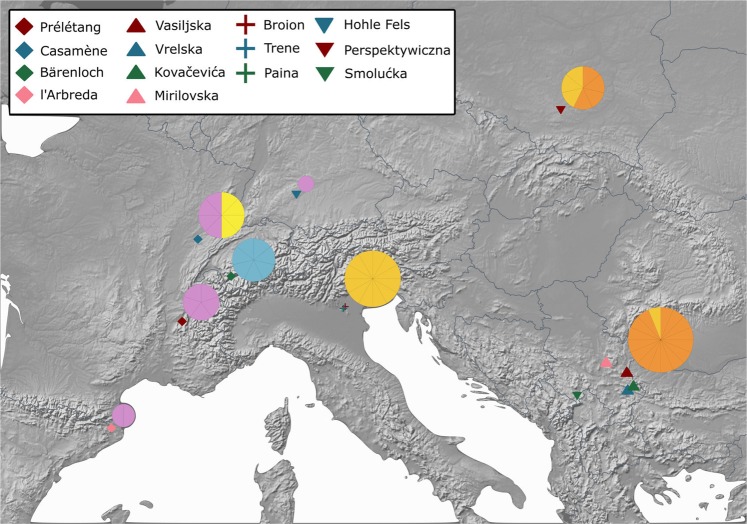
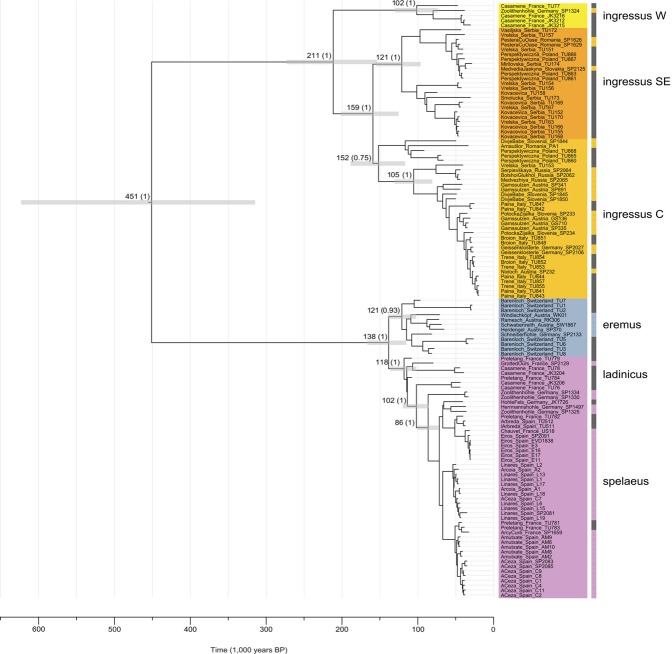
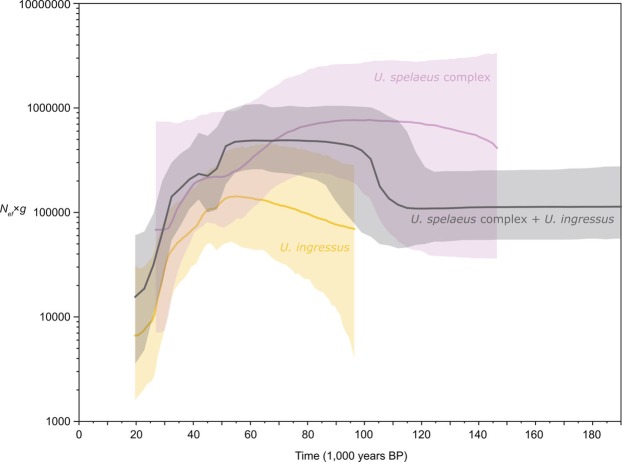
The cave bear (Ursus spelaeus) is one of the Late Pleistocene megafauna species that faced extinction at the end of the last ice age. Although it is represented by one of the largest fossil records in Europe and has been subject to several interdisciplinary studies including palaeogenetic research, its fate remains highly controversial. Here, we used a combination of hybridisation capture and next generation sequencing to reconstruct 59 new complete cave bear mitochondrial genomes (mtDNA) from 14 sites in Western, Central and Eastern Europe. In a Bayesian phylogenetic analysis, we compared them to 64 published cave bear mtDNA sequences to reconstruct the population dynamics and phylogeography during the Late Pleistocene. We found five major mitochondrial DNA lineages resulting in a noticeably more complex biogeography of the European lineages during the last 50,000 years than previously assumed. Furthermore, our calculated effective female population sizes suggest a drastic cave bear population decline starting around 40,000 years ago at the onset of the Aurignacian, coinciding with the spread of anatomically modern humans in Europe. Thus, our study supports a potential significant human role in the general extinction and local extirpation of the European cave bear and illuminates the fate of this megafauna species.
Overview
The claims and statistics of this paper haven’t been checked yet.
Run the check — free, no account needed. It reads the open-access text and checks the sources it cites.
Integrity signals
Registry
Cites
Statistics
Figures
Verification
Claims the paper makes
The claims and statistics of this paper haven’t been checked yet.
Run the check — free, no account needed. It reads the open-access text and checks the sources it cites.
Claims other papers make about this one
Each is checked against this paper’s own text: does it say what the citing paper says it does?
The source backs part of the claim, not all of it — or backs it for a different population, condition or comparison.
In the citing paper
“For example, the occupation of caves by Aurignacian humans competed with the natural homing behavior of cave bears for places in which they could hibernate to survive the winter 23,24 .”
From Ancient DNA analysis (2021) · cites this paper as [24]
Experimental — accuracy not yet measured
Self-check
Percentages, sums and reported differences re-computed from the paper’s own numbers.
The self-check needs the paper’s full text.
Citations
Cites
ModelFinder: fast model selection for accurate phylogenetic estimates
Kalyaanamoorthy, S., Minh, B. Q., Wong, T. K. F., von Haeseler, A., & Jermiin, L. S. (2017) · Nature Methods · doi:10.1038/nmeth.4285 · Cited by 18,449
Posterior summarization in Bayesian phylogenetics using tracer 1.7
Rambaut, A., Drummond, A. J., Xie, D., Baele, G., & Suchard, M. A. (2018) · Systematic Biology · doi:10.1093/sysbio/syy032 · Cited by 11,159
Dabney, J., Knapp, M., Glocke, I., Gansauge, M.-T., Weihmann, A., Nickel, B., Valdiosera, C., García, N., Pääbo, S., Arsuaga, J.-L., et al. (2013) · Proceedings of the National Academy of Sciences · doi:10.1073/pnas.1314445110 · Cited by 1,443
Double indexing overcomes inaccuracies in multiplex sequencing on the Illumina platform
Kircher, M., Sawyer, S., & Meyer, M. (2012) · Nucleic Acids Research · doi:10.1093/nar/gkr771 · Cited by 1,106
Research works printed but not linked: 71
- Barnosky, A. D., Koch, P. L., Feranec, R. S., Wing, S. L. & Shabel, A. B. Assessing the causes of late Pleistocene extinctions on the continents. Science 306, 70–75, https://doi.org/10.1126/science.1101476 (2004). · DOI · Paper page
- Stuart, A. J. & Lister, A. M. Patterns of Late Quaternary megafaunal extinctions in Europe and northern Asia. Courier Forschungsinstitut Senckenberg 259, 287–297 (2007).
- Lorenzen, E. D. et al. Species-specific responses of Late Quaternary megafauna to climate and humans. Nature 479, 359–364, https://doi.org/10.1038/nature10574 (2011). · DOI · Paper page
- Doughty, C. E. et al. Megafauna extinction, tree species range reduction, and carbon storage in Amazonian forests. Ecography 39(2), 194–203, https://doi.org/10.1111/ecog.01587 (2016). · DOI
- Malhi, Y. et al. Megafauna and ecosystem function from the Pleistocene to the Anthropocene. Proc Natl Acad Sci USA 113, 838–846, https://doi.org/10.1073/pnas.1502540113 (2016). · DOI
- Bocherens, H. The rise of the anthroposphere since 50,000 years: an ecological replacement of megaherbivores by humans in terrestrial ecoystems? Frontiers in Ecology and Evolution 6, 3, https://doi.org/10.3389/fevo.2018.00003 (2018). · DOI
- Cooper, A. et al. Abrupt warming events drove Late Pleistocene Holarctic megafaunal turnover. Science 349, 602–606, https://doi.org/10.1126/science.aac4315 (2015). · DOI
- Wan, X. & Zhang, Z. Climate warming and humans played different roles in triggering Late Quaternary extinctions in east and west Eurasia. Proc. R. Soc. B 284, 20162438, https://doi.org/10.1098/rspb.2016.2438 (2017). · DOI
- Lyons, S. K. et al. The changing role of mammal life histories in Late Quaternary extinction vulnerability on continents and islands. Biol. Lett. 12, 20160342, https://doi.org/10.1098/rsbl.2016.0342 (2016). · DOI
- Barnett, R., Yamaguchi, N., Barnes, I. & Cooper, A. The origin, current diversity, and future conservation of the modern lion (Panthera leo). Proc. R. Soc. B 273, 2159–2168, https://doi.org/10.1098/rspb.2006.3555 (2006). · DOI
- Stiller, M. et al. Withering away–25,000 years of genetic decline preceded cave bear extinction. Mol Biol Evol. 27, 975–978, https://doi.org/10.1093/molbev/msq083 (2010). · DOI
- Bocherens, H. et al. The last of its kind? Radiocarbon, ancient DNA and stable isotope evidence from a late cave bear (Ursus spelaeus ROSENMÜLLER, 1794) from Rochedane (France). Quaternary International Volumes 339–340, 179–188, https://doi.org/10.1016/j.quaint.2013.05.021 (2014). · DOI
- Knapp, M. et al. First DNA sequences from Asian cave bear fossils reveal deep divergences and complex phylogeographic patterns. Mol Ecol. 18, 1225–1238, https://doi.org/10.1111/j.1365-294X.2009.04088.x (2009). · DOI
- Sher, A. V. et al. The first record of “spelaeoid” bears in Arctic Siberia. Quaternary Science Reviews 30(17–18), 2238–2249, https://doi.org/10.1016/j.quascirev.2010.10.016 (2011). · DOI
- Baryshnikov, G. F. & Foronova, I. Pleistocene small cave bear (Ursus rossicus) from the South Siberia, Russia. CAD. LAB. XEOL. LAXE 26, 373–398 (2001).
- Baryshnikov, G. F. & Puzachenko, A. Y. Craniometrical variability in the cave bears (Carnivora, Ursidae): Multivariate comparative analysis. Quaternary International 245, 350–368, https://doi.org/10.1016/j.quaint.2011.02.035 (2011). · DOI
- Rabeder, G., Hofreiter, M., Nagel, D. & Withalm, G. New Taxa of Alpine Cave Bears (Ursidae, Carnivora). Proceedings of the 9th International Cave Bear Conference, Cahiers scientifiques du Centre de Conservation et d’Etude des Collections (Muséum d’Histoire naturelle de Lyon)/Hors Série 2, 49–67 (2004).
- Münzel, S. C. & Athen, K. Correlating genetic results with Biometric analysis on metapodial bones. Slovenký Kras, Acta Carsologica Slovaca 47, 47–56 (2009).
- Barlow, A. et al. Partial genomic survival of cave bears in living brown bears. Nat Ecol Evol. 2, 1563–1570, https://doi.org/10.1038/s41559-018-0654-8 (2018). · DOI
- Pacher, M. & Stuart, A. J. Extinction chronology and palaeobiology of the cave bear (Ursus spelaeus). Boreas 38, 189–206, https://doi.org/10.1111/j.1502-3885.2007.00071.x (2009). · DOI
- Baca, M. et al. Retreat and extinction of the Late Pleistocene cave bear (Ursus spelaeus sensu lato). Die. Naturwissenschaften 103, 92, https://doi.org/10.1007/s00114-016-1414-8 (2016). · DOI
- Terlato, G., et al Chronological and Isotopic data support a revision for the timing of cave bear extinction in Mediterranean Europe. Historical Biology 1–11, https://doi.org/10.1080/08912963.2018.1448395 (2018). · DOI
- Bocherens, H., Fizet, M. & Mariotti, A. Diet, physiology and ecology of fossil mammals as inferred from stable carbon and nitrogen isotope biogeochemistry: implications for Pleistocene bears. Palaeogeography, Palaeoclimatology, Palaeoecology 107, 213–225, https://doi.org/10.1016/0031-0182(94)90095-7 (1994). · DOI
- Bocherens, H. et al. Niche partitioning between two sympatric genetically distinct cave bears (Ursus spelaeus and Ursus ingressus) and brown bear (Ursus arctos) from Austria: Isotopic evidence from fossil bones. Quaternary International 245, 238–248, https://doi.org/10.1016/j.quaint.2010.12.020 (2013). · DOI
- Naito, Y. I. et al. Evidence for herbivorous cave bears (Ursus spelaeus) in Goyet Cave, Belgium: implications for palaeodietary reconstruction of fossil bears using amino acid δ15N approaches. J. Quaternary Sci. 31, 598–606, https://doi.org/10.1002/jqs.2883 (2016). · DOI
- Krajcarz, M. et al. Isotopic variability of cave bears (δ15N, δ13C) across Europe during MIS 3. Quaternary Science Reviews 131, 51–72, https://doi.org/10.1016/j.quascirev.2015.10.028 (2016). · DOI
- Münzel, S. C. et al. Pleistocene bears in the Swabian Jura (Germany): Genetic replacement, ecological displacement, extinctions and survival. Quaternary International 245, 225–237, https://doi.org/10.1016/j.quaint.2011.03.060 (2011). · DOI
- Clark, P. U. et al. The Last Glacial Maximum. Science 325, 710–714, https://doi.org/10.1126/science.1172873 (2009). · DOI · Paper page
- Monegato, G., Scardia, G., Hajdas, I., Rizzini, F. & Piccin, A. The Alpine LGM in the boreal ice-sheets game. Nature Scientific Reports 7, 2078 (2017). · DOI
- Romandini, M. et al. Bears and humans, a Neanderthal tale. Reconstructing uncommon behaviors from zooarchaeological evidence in southern Europe. Journal of Archaeological Science 90, 71–91, https://doi.org/10.1016/j.jas.2017.12.004 (2018). · DOI
- Kurtén, B. Life and death of the Pleistocene cave bear. Acta Zoologica Fennica 95, 1–59 (1958).
- Grayson, D. K & Delpech, F. The Upper Paleolithic at Grotte XVI (Dordogne, France): richness, evenness, and cave bears, in: Hays, M. A. & Thacker, P. (Eds), Questioning the Answers: Resolving Fundamental Problems of the Early Upper Paleolithic. British Archaeological Reports 1005, 187–197 (2001). · DOI
- Grayson, D. K. & Delpech, F. Ungulates and the Middle-to-Upper Paleolithic transition at Grotte XVI (Dordogne, France). J Archaeol Sci. 30, 1633–1648, https://doi.org/10.1016/S0305-4403(03)00064-5 (2003). · DOI
- Münzel, S. C. & Conard, N. J. Cave Bear Hunting in the Hohle Fels, a Cave Site in the Ach Valley, Swabian Jura. Rev Paleobiol. 23, 877–885 (2004).
- Withalm, G. New Evidence for Cave Bear Hunting from Potočka zijalka (Slovenia). Mitt. Komm. Quartärforsch. Österr. Akad. Wiss. 13, 219–234 (2004).
- Romandini, M. & Nannini, N. Epigravettians hunters in the territory of the bear of caves: The case of Covolo Fortificato di Trene (Vicenza, Italy). Anthropologie 116, 39–56 (2012). · DOI
- Ramakrishnan, U. & Hadly, E. A. Using phylochronology to reveal cryptic population histories: review and synthesis of 29 ancient DNA studies. Mol Ecol. 18, 1310–1330, https://doi.org/10.1111/j.1365-294X.2009.04092.x (2009). · DOI
- Stiller, M., Knapp, M., Stenzel, U., Hofreiter, M. & Meyer, M. Direct multiplex sequencing (DMPS)–a novel method for targeted high-throughput sequencing of ancient and highly degraded DNA. Genome Res. 19, 1843–1848, https://doi.org/10.1101/gr.095760.109 (2009). · DOI
- Fortes, G. G. et al. Ancient DNA reveals differences in behaviour and sociality between brown bears and extinct cave bears. Mol Ecol. 25, 4907–4918, https://doi.org/10.1111/mec.13800 (2016). · DOI · Paper page
- Stiller, M. et al. diversity and evolution of the Pleistocene cave bear complex. Quaternary International 339–340, 224–231, https://doi.org/10.1016/j.quaint.2013.09.023 (2014). · DOI
- Subramanian, S. et al. High mitogenomic evolutionary rates and time dependency. Trends Genet. 11, 482–486, https://doi.org/10.1016/j.tig.2009.09.005 (2009). · DOI
- Knaus, B. J., Cronn, E., Liston, A., Pilgrim, K. & Schwartz, M. Mitochondrial genome sequences illuminate maternal lineages of conservation concern in a rare carnivore. BMC Ecology 11, 10, https://doi.org/10.1186/1472-6785-11-10 (2011). · DOI
- Rabeder, G. & Hofreiter, M. Der neue Stammbaum der alpinen Höhlenbären. Die Höhle 55(1–4), 58–77 (2004).
- Hofreiter, M. et al. Sudden replacement of cave bear mitochondrial DNA in the late Pleistocene. Curr Biol. 17, R122–123, https://doi.org/10.1016/j.cub.2007.01.026 (2007). · DOI
- Baca, M. et al. Genetic analysis of cave bear specimens from Niedźwiedzia Cave, Sudetes, Poland. Palaeontologia. Electronica 15 2;21A, palaeo-electronica.org/content/2012-issue-2-articles/263-cave-bears-from-poland (2012). · DOI
- Soubrier, J. et al. Early cave art and ancient DNA record the origin of European bison. Nature. Communications 7, 13158, https://doi.org/10.1038/ncomms13158 (2016). · DOI
- Baca, M. et al. Ancient DNA and dating of cave bear remains from Niedźwiedzia Cave suggest early appearance of Ursus ingressus in Sudetes. Quaternary International 339–340, 217–223, https://doi.org/10.1016/j.quaint.2013.08.033 (2014). · DOI
- Baryshnikov, G. F & Puzachenko A. Y. Morphometry of upper cheek teeth of cave bears (Carnivora, Ursidae). Boreas, https://doi.org/10.1111/bor.12360 (2018). · DOI
- Bocherens, H. Isotopic insights on cave bear palaeodiet. Historical Biology, 1–12, https://doi.org/10.1080/08912963.2018.14465419 (2018). · DOI
- Conard, N. J. The Demise of the Neanderthal Cultural Niche and the Beginning of the Upper Paleolithic in Southwestern Germany. In: Neanderthal Lifeways, Subsistence and Technology: One Hundred Fifty Years of Neanderthal Study, Vertebrate Paleobiology and Paleoanthropology (eds Conard, N. J. & Richter, J.) 223–240 (Springer Science + Business Media B.V. 2011). · DOI
- Nigst, P. et al. Early modern human settlement of Europe north of the Alps occurred 43,500 years ago in a cold steppe-type environment. Proceedings of the National Academy of Sciences 111(40), 14394–14399, https://doi.org/10.1073/pnas.1412201111 (2014). · DOI
- Hublin, J. J. The modern human colonization of western Eurasia: when and where? Quaternary Science Reviews 118, 194–210, https://doi.org/10.1016/j.quascirev.2014.08.011 (2015). · DOI
- Benazzi, S. et al. The makers of the Protoaurignacian and implications for Neandertal extinction. Science 348, 793–796, https://doi.org/10.1126/science.aaa2773 (2015). · DOI
- Wojtal, P., Wilczyński, J., Nadachowski, A. & Münzel, S. C. Gravettian hunting and exploitation of bears in Central Europe. Quat Int 359–360, 58–71, https://doi.org/10.1016/j.quaint.2014.10.017 (2015). · DOI
- Meyer, M. & Kircher, M. Illumina sequencing library preparation for highly multiplexed target capture and sequencing. Cold Spring Harb Protoc. https://doi.org/10.1101/pdb.prot5448 (2010). · DOI
- Furtwängler, A. et al. Ratio of mitochondrial to nuclear DNA affects contamination estimates in ancient DNA analysis. Sci Rep. 8, 14075, https://doi.org/10.1038/s41598-018-32083-0DO (2018). · DOI
- Peltzer, A. et al. EAGER: efficient ancient genome reconstruction. Genome Biol. 17, 60, https://doi.org/10.1186/s13059-016-0918-z (2016). · DOI · Paper page
- Chang, D. et al. The evolutionary and phylogeographic history of woolly mammoths: a comprehensive mitogenomic analysis. Scientific Reports 7, 44585, https://doi.org/10.1038/srep44585 (2017). · DOI
- Fellows Yates, J. A. et al. Central European Woolly Mammoth Population Dynamics: Insights from Late Pleistocene Mitochondrial Genomes. Scientific Reports 7, 17714, https://doi.org/10.1038/s41598-017-17723-1 (2017). · DOI
- Bon, C. et al. Deciphering the complete mitochondrial genome and phylogeny of the extinct cave bear in the Paleolithic painted cave of Chauvet. Proc Natl Acad Sci U A. 105, 17447–17452, https://doi.org/10.1073/pnas.0806143105 (2008). · DOI
- Katoh, K., Misawa, K., Kuma, K. & Miyata, T. MAFFT: a novel method for rapid multiple sequence alignment based on fast Fourier transform. Nucleic Acids Res. 30, 3059–3066 (2002). · DOI · Paper page
- Katoh, K. & Standley, D. M. MAFFT multiple sequence alignment software version 7: improvements in performance and usability. Mol Biol Evol. 30, 772–780, https://doi.org/10.1093/molbev/mst010 (2013). · DOI · Paper page
- Kumar, S., Stecher, G. & Tamura, K. MEGA7: Molecular Evolutionary Genetics Analysis Version 7.0 for Bigger Datasets. Mol Biol Evol 33, 1870–1874, https://doi.org/10.1093/molbev/msw054 (2016). · DOI
- Hoang, D. T., Chernomor, O., von Haeseler, A., Minh, B. Q. & Vinh, L. S. UFBoot2: Improving the ultrafast bootstrap approximation. Mol. Biol. Evol. 35, 518–522, https://doi.org/10.1093/molbev/msx281 (2018). · DOI · Paper page
- Huson, D. H. & Scornavacca, C. Dendroscope 3: an interactive tool for rooted phylogenetic trees and networks. Syst Biol. 61, 1061–1067, https://doi.org/10.1093/sysbio/sys062 (2012). · DOI
- Drummond, A. J., Suchard, M. A., Xie, D. & Rambaut, A. Bayesian phylogenetics with BEAUti and the BEAST 1.7. Mol Biol Evol. 29, 1969–1973, https://doi.org/10.1093/molbev/mss075 (2012). · DOI
- Lanfear, R., Frandsen, P. B., Wright, A. M., Senfeld, T. & Calcott, B. PartitionFinder 2: New Methods for Selecting Partitioned Models of Evolution for Molecular and Morphological Phylogenetic Analyses. Mol Biol Evol. 34, 772–773, https://doi.org/10.1093/molbev/msw260 (2017). · DOI
- Reimer, P. J. et al. IntCal13 and marine13 radiocarbon age calibration curves 0–50,000 years cal BP. Radiocarbon 55, 1869–1887, https://doi.org/10.2458/azu_js_rc.55.16947 (2013). · DOI · Paper page
- Bevan, A. & Crema, E. R. rcarbon: Methods for calibrating and analysing radiocarbon dates. R package version 1.2.0, https://CRAN.R-project.org/package=rcarbon (2018). · DOI
- Blant, M. et al. Le gisement à faune würmienne du Bärenloch (Préalpes fribourgeoises, Suisse). Bull. Soc. Frib. Sc. Nat. 99, 149–170 (2010).
- Bocherens, H. Isotopic tracking of large carnivore palaeoecology in the mammoth steppe. Quaternary Science Reviews 117, 42–7, https://doi.org/10.1016/j.quascirev.2015.03.018 (2015). · DOI
Cited by
Sorted by citations
Orlando, L., Allaby, R., Skoglund, P., Der Sarkissian, C., Stockhammer, P. W., Ávila-Arcos, M. C., Fu, Q., Krause, J., Willerslev, E., Stone, A. C., et al. (2021) · Nature Reviews Methods Primers · doi:10.1038/s43586-020-00011-0 · Cited by 411
Self-citation
Metadata
- Authors
- Gretzinger, J., Molak, M., Reiter, E., Pfrengle, S., Urban, C., Neukamm, J., Blant, M., Conard, N. J., Cupillard, C., Dimitrijević, V., Drucker, D. G., Hofman-Kamińska, E., Kowalczyk, R., Krajcarz, M. T., Krajcarz, M., Münzel, S. C., Peresani, M., Romandini, M., Rufí, I., Soler, J., Terlato, G., Krause, J., Bocherens, H., & Schuenemann, V. J.
- ORCID
- Venue
- Scientific Reports
- Published
- 2019-08-15
- Volume
- 9
- Issue
- 1
- ISSN
- 2045-2322
- PMC
- PMC6695494
- Cited by
- 41
- References
- 4
- Language
- en
About these checks
Registry, retraction, Cites and statistics results are computed, not judged, with one exception: a printed reference that no index lists is read once by a model before it counts as a citation error. Claims are extracted by a model and kept only when their quote appears verbatim in the text; each cited source is then checked, with a model’s help, for whether it says what the claim relies on. Those verdicts can be wrong — read the claim’s quote and the cited source before relying on one.
Statistics and arithmetic are recomputed, not judged.
Confidence bands are shown only for fields calibrated on our annotated test set. None is calibrated yet, so no band is shown.
What counts as a claim ›How we measure confidence ›How we check this ›
Are you an author, or do you see a problem with this page? Request a review
