

Modeling the binding of diverse ligands within the Ah receptor ligand binding domain
Open accessThe DOI matches its Crossref record; 73 of the 74 references it cites were found in a registry or an index; 29 of the 35 sources its claims cite were checked for support.
Abstract
The Ah receptor (AhR) is a ligand-dependent transcription factor belonging to the basic helix-loop-helix Per-Arnt-Sim (bHLH-PAS) superfamily. Binding to and activation of the AhR by a variety of chemicals results in the induction of expression of diverse genes and production of a broad spectrum of biological and toxic effects. The AhR also plays important roles in several physiological responses, which has led it to become a novel target for the development of therapeutic drugs. Differences in the interactions of various ligands within the AhR ligand binding domain (LBD) may contribute to differential modulation of AhR functionality. We combined computational and experimental analyses to investigate the binding modes of a group of chemicals representative of major classes of AhR ligands. On the basis of a novel computational approach for molecular docking to the homology model of the AhR LBD that includes the receptor flexibility, we predicted specific residues within the AhR binding cavity that play a critical role in binding of three distinct groups of chemicals. The prediction was validated by site-directed mutagenesis and evaluation of the relative ligand binding affinities for the mutant AhRs. These results provide an avenue for understanding ligand modulation of the AhR functionality and for rational drug design.
Overview
CoChat Summary
## TL;DR
This paper combines ensemble molecular docking, molecular dynamics, MM-GBSA, and mutagenesis to explain how diverse Ah receptor (AhR) ligands bind in different ways within the mouse AhR ligand-binding domain. The authors classify 10 agonists into three binding groups and validate several predicted residue–ligand interactions experimentally.
## Key findings
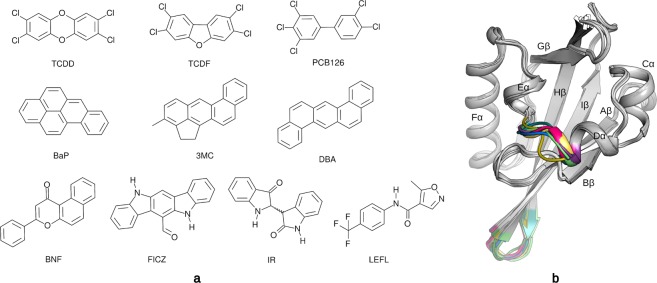
- All 10 test ligands competed with \[3H\]TCDD for binding to mouse AhR and stimulated AhR transformation/DNA binding.
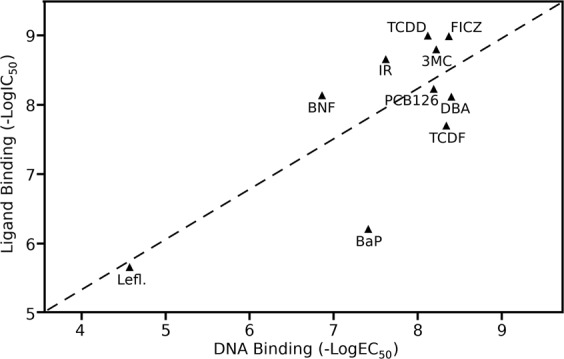
- Relative binding affinities (IC50) ranged from 1 nM for TCDD and FICZ to 2190 nM for LEFL; relative potencies to stimulate DNA binding (EC50) ranged from 4 nM for DBA to 26,800 nM for LEFL.
- The ligands fell into three binding groups:
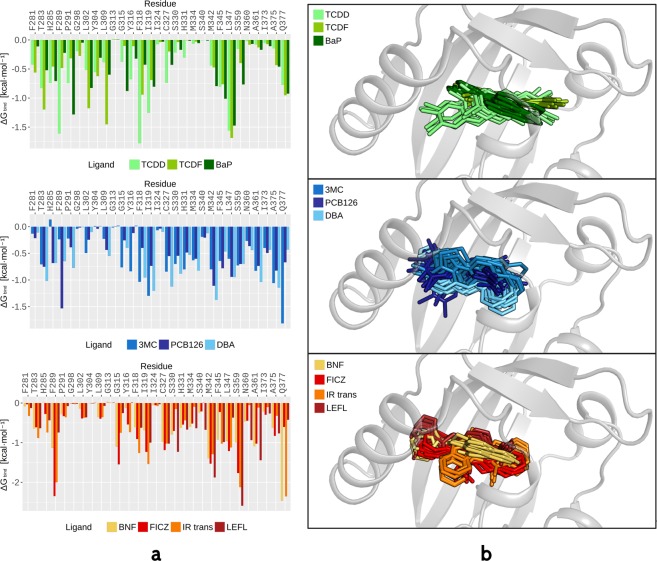
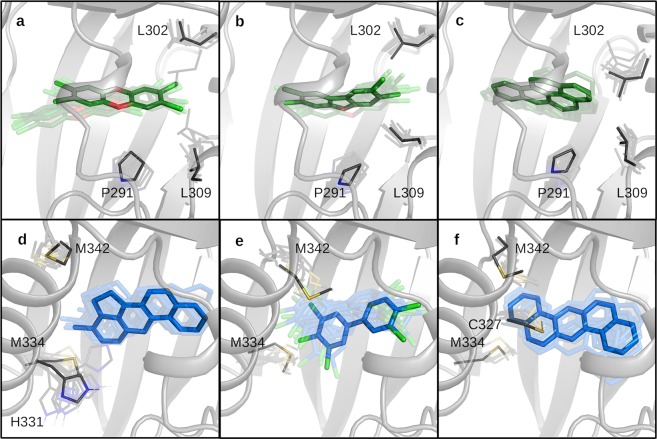
- Group 1: TCDD, TCDF, BaP bind at the bottom of the cavity and are stabilized mainly by hydrophobic interactions, especially with L302 and L309.
- Group 2: 3MC, PCB126, DBA bind nearer the Fα/Gβ site with hydrophobic stabilization, involving M334 and M342.
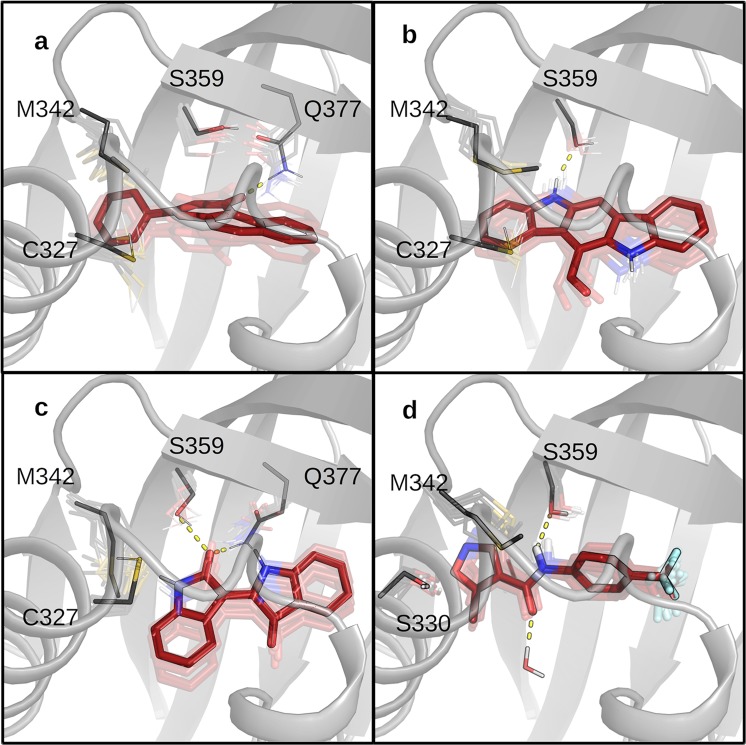
- Group 3: BNF, FICZ, IR, LEFL also bind near the Fα/Gβ site, but are additionally stabilized by polar interactions/H-bonds with C327, S330, S359, Q377.
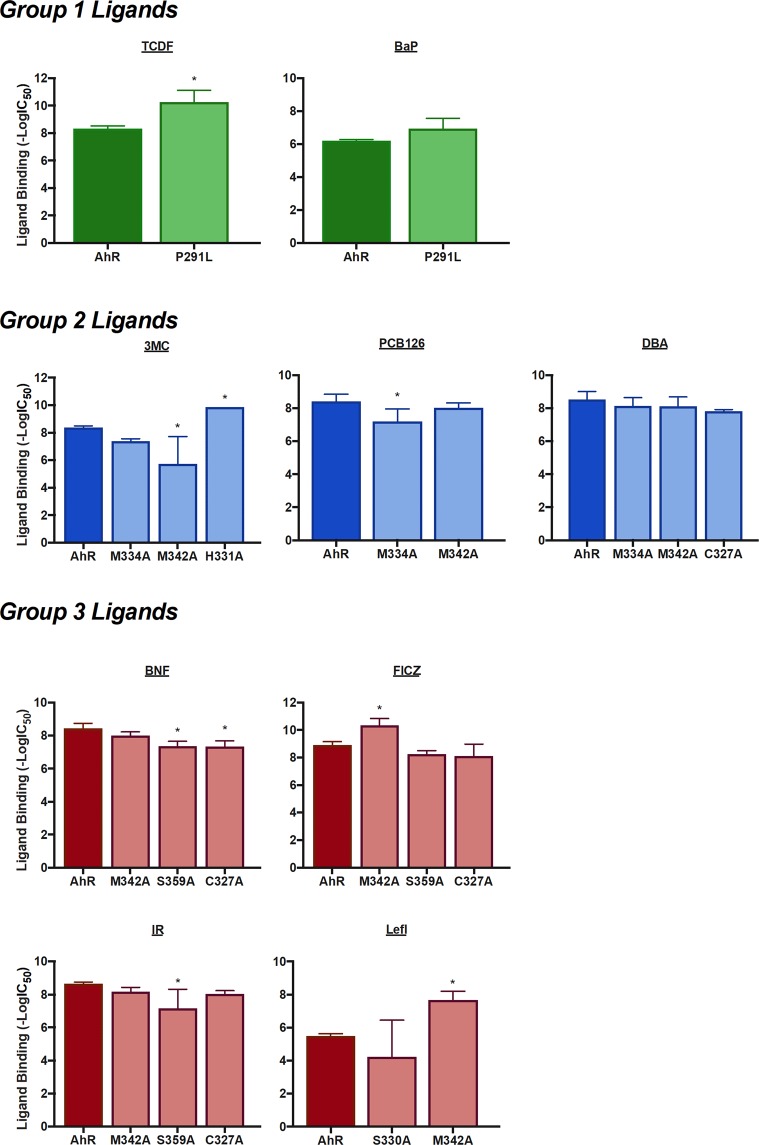
- Mutagenesis supported many predictions: L302A eliminated ligand-stimulated DNA binding, L309A strongly reduced binding, and other substitutions changed ligand affinities in ligand-specific ways (for example, P291L increased TCDF affinity from 20 nM to 0.04 nM).
## Methods
- The study combined computational and experimental approaches using 10 representative AhR ligands from several chemical classes.
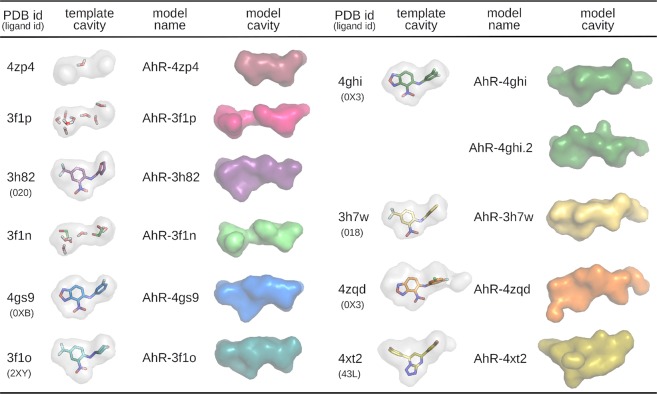
- Computational work used 11 homology models of the mouse AhR LBD built from different HIF-2α PAS-B templates, followed by ensemble docking, molecular dynamics simulations (10 or 20 ns production runs), and MM-GBSA binding free-energy calculations.
- Experimental validation used site-directed mutagenesis of mouse AhR plus \[3H\]TCDD competitive binding assays and gel retardation DNA-binding assays; mutant effects were quantified by IC50 and EC50 estimates.
## Limitations
- The paper states that quantitative prediction of binding free energy was beyond the aim of the work, and computed energies showed only a weak trend with experiment (Pearson R² = 0.37; Spearman ρ = 0.64).
- The authors note that some modeled AhR conformations did not completely describe binding-site flexibility, and that this may have prevented some ligands from reaching the bottom of the cavity.
- Evidence evident from the text: the work relies on homology models rather than an experimentally determined AhR LBD structure, so conclusions about poses are model-dependent.
Model-written summary. Check it against the paper before relying on it.
Integrity signals
Registry
Cites
Statistics
Figures
Verification
Claims the paper makes
16 Valid · 2 Not valid · 2 Not checked · 95 Own results and interpretations
Every source the paper cites for this claim was checked and supports it.
In the paper
“By analyzing the different profiles obtained by per-residue decomposition of the ΔGbind for the best pose (the one with the lowest ΔGbind, Table S5) for each of the ligands under study (Fig. 5a) it was possible to identify a set of residues that stabilize all the ligands, with most of them belonging to the previously published “TCDD-binding fingerprint”21.”
§ Modeling the binding of diverse ligands within the Ah receptor ligand binding domain > Results > Characterization of binding modes and interactions of the different ligands
What the sources say
- Supportedcites [21] Pandini A Detection of the TCDD binding-fingerprint within the Ah receptor ligand binding domain by structurally driven mutagenesis and functional analysis Biochemistry 2009 48 5972 83 10.1021/bi900259z 19456125 PMC2859071 source
The citation attaches to the previously published “TCDD-binding fingerprint,” not to the citing authors’ per-residue analysis of multiple ligands. The source paper’s Discussion identifies seven residues as the TCDD binding-fingerprint for mammalian AhRs. (LLM, conf=0.94)
plainstates a cause- Asserted: passes — The authors put it forward as true.
- Checkable: passes — It can be checked against evidence.
- Load-bearing: passes — The paper’s conclusions depend on it.
- Based: passes — The paper gives a reason why it holds.
- Supported
The cited sources support only part of this claim — read each source’s verdict below.
In the paper
“It has been demonstrated that repeating ligand docking to multiple homology models based on different template structures greatly improves docking predictions40.”
§ Modeling the binding of diverse ligands within the Ah receptor ligand binding domain > Results > Molecular modeling protocol to investigate the molecular determinants of binding
What the sources say
- Partly supportedcites [40] Fan H Molecular Docking Screens Using Comparative Models of Proteins J. Chem. Inf. Model. 2009 49 2512 2527 10.1021/ci9003706 19845314 PMC2790034 sourceExperimental — accuracy not yet measured
The Results section ('Ligand enrichment for multiple models'; page unavailable) reports that combining docking results from models based on different templates significantly improved ligand enrichment over the best-assessed single model. But the Conclusions section reports only modest gains in the proportion of targets performing at least as well as X-ray structures, so 'greatly improves' overstates the general result. (LLM, conf=0.86)
boostedstates a cause- Asserted: passes — The authors put it forward as true.
- Checkable: passes — It can be checked against evidence.
- Load-bearing: passes — The paper’s conclusions depend on it.
- Based: passes — The paper gives a reason why it holds.
- Partly supported
Every source the paper cites for this claim was checked and supports it.
In the paper
“All these compounds are known to be AhR agonists18.”
§ Modeling the binding of diverse ligands within the Ah receptor ligand binding domain > Results
What the sources say
- Supportedcites [18] Soshilov AA Denison MS Ligand promiscuity of aryl hydrocarbon receptor agonists and antagonists revealed by site-directed mutagenesis Mol. Cell. Biol. 2014 34 1707 19 10.1128/MCB.01183-13 24591650 PMC3993610 source
In “Mutations of Ile319 demonstrate ligand-selective properties,” the paper calls the tested compounds an “AhR agonist panel” and describes its groups as classifications of AhR agonists. The supplied citing sentence does not identify the ten compounds individually, but the source supports the attributed description of the compounds it examines as AhR agonists. (LLM, conf=0.87)
boosted- Asserted: passes — The authors put it forward as true.
- Checkable: passes — It can be checked against evidence.
- Load-bearing: passes — The paper’s conclusions depend on it.
- Based: passes — The paper gives a reason why it holds.
- Supported
The cited sources support only part of this claim — read each source’s verdict below.
In the paper
“The accuracy of the binding geometries predicted by molecular docking to homology models strongly depends on the quality of the model, particularly in the binding site22,40,41.”
§ Modeling the binding of diverse ligands within the Ah receptor ligand binding domain > Results > Molecular modeling protocol to investigate the molecular determinants of binding
What the sources say
- Supportedcites [22] Bordogna A Pandini A Bonati L Predicting the accuracy of protein-ligand docking on homology models J. Comput. Chem. 2010 32 81 98 10.1002/jcc.21601 PMC3057020 20607693 source
The Conclusions state that docking accuracy is related to model quality and that correlations with binding-site quality are stronger. They also say successful docking requires accurate modeling of the binding site, directly supporting the paraphrase. (LLM, conf=0.94)
- Partly supportedcites [40] Fan H Molecular Docking Screens Using Comparative Models of Proteins J. Chem. Inf. Model. 2009 49 2512 2527 10.1021/ci9003706 19845314 PMC2790034 sourceExperimental — accuracy not yet measured
The Results section, under “Accuracy of the docking geometry in modeled binding sites” (page unavailable), reports several relatively accurate predicted ligand poses. It also says the study did not focus on predicting complex conformations. The paper therefore supports the point that docking to comparative models can reproduce binding geometries, but does not establish that geometry accuracy strongly depends on model quality, particularly binding-site quality. (LLM, conf=0.83)
- Not checked — no full text of the sourcecites [41] McGovern SL Shoichet BK Information Decay in Molecular Docking Screens against Holo, Apo, and Modeled Conformations of Enzymes J. Med. Chem. 2003 46 2895 2907 10.1021/jm0300330 12825931 source
boostedstates a cause- Asserted: passes — The authors put it forward as true.
- Checkable: passes — It can be checked against evidence.
- Load-bearing: passes — The paper’s conclusions depend on it.
- Based: passes — The paper gives a reason why it holds.
- Supported
The cited sources support only part of this claim — read each source’s verdict below.
In the paper
“A confirmation of the role of this reduction on differential binding was provided by the evidence that mutation of these residues in zfAhR1a to those present in mouse AhR restored the zfAhR1a ability to bind TCDD46.”
§ Modeling the binding of diverse ligands within the Ah receptor ligand binding domain > Discussion
What the sources say
- Partly supportedcites [46] Fraccalvieri D Comparative analysis of homology models of the Ah receptor ligand binding domain: Verification of structure-function predictions by site-directed mutagenesis of a nonfunctional receptor Biochemistry 2013 52 714 725 10.1021/bi301457f 23286227 PMC3568667 sourceExperimental — accuracy not yet measured
The Results and Discussion section reports that the Y296H/T386A double mutation restored TCDD binding in zfAHR1a. It identifies the substituted residues as those present in zebrafish AHR2, not mouse AhR; that part of the citing sentence is not supported. (LLM, conf=0.90)
boostedstates a cause- Asserted: passes — The authors put it forward as true.
- Checkable: passes — It can be checked against evidence.
- Load-bearing: passes — The paper’s conclusions depend on it.
- Based: passes — The paper gives a reason why it holds.
- Partly supported
57 more claims · 1 with their cited sources checked
Create a free account to see all 115 claims and every source verdict.
- It may state two separate claims as one. 49
- Probably not a substantial claim. 5
- The quote only partly states this claim. 1
Citations
Cites
VMD: visual molecular dynamics
Humphrey, W., Dalke, A., & Schulten, K. (1996) · Journal of Molecular Graphics · doi:10.1016/0263-7855(96)00018-5 · Cited by 66,952
MUSCLE: multiple sequence alignment with high accuracy and high throughput
Edgar, R. C. (2004) · Nucleic Acids Research · doi:10.1093/nar/gkh340 · Cited by 44,662
PROCHECK: a program to check the stereochemical quality of protein structures
Laskowski, R. A., MacArthur, M. W., Moss, D. S., & Thornton, J. M. (1993) · Journal of Applied Crystallography · doi:10.1107/s0021889892009944 · Cited by 24,581
Development and testing of a general amber force field
Wang, J., Wolf, R. M., Caldwell, J. W., Kollman, P. A., & Case, D. A. (2004) · Journal of Computational Chemistry · doi:10.1002/jcc.20035 · Cited by 19,506
ff14SB: Improving the Accuracy of Protein Side Chain and Backbone Parameters from ff99SB
Maier, J. A., Martinez, C., Kasavajhala, K., Wickstrom, L., Hauser, K. E., & Simmerling, C. (2015) · Journal of Chemical Theory and Computation · doi:10.1021/acs.jctc.5b00255 · Cited by 10,830
Friesner, R. A., Murphy, R. B., Repasky, M. P., Frye, L. L., Greenwood, J. R., Halgren, T. A., Sanschagrin, P. C., & Mainz, D. T. (2006) · Journal of Medicinal Chemistry · doi:10.1021/jm051256o · Cited by 6,851
Wiederstein, M., & Sippl, M. J. (2007) · Nucleic Acids Research · doi:10.1093/nar/gkm290 · Cited by 5,909
Kollman, P. A., Massova, I., Reyes, C., Kuhn, B., Huo, S., Chong, L., Lee, M., Lee, T., Duan, Y., Wang, W., et al. (2000) · Accounts of Chemical Research · doi:10.1021/ar000033j · Cited by 4,978
Comparative Protein Structure Modeling Using Modeller
Eswar, N., Webb, B., Marti‐Renom, M. A., Madhusudhan, M. S., Eramian, D., Shen, M., Pieper, U., & Sali, A. (2006) · Current Protocols in Bioinformatics · doi:10.1002/0471250953.bi0506s15 · Cited by 4,478
Comparative Protein Structure Modeling Using MODELLER
Webb, B., & Sali, A. (2016) · Current Protocols in Bioinformatics · doi:10.1002/cpbi.3 · Cited by 4,316
Research works printed but not linked: 1
- Denison, M. S. et al. Natural and synthetic ligands for the Ah receptor. in Molecular Biology of the Toxic Response (eds Puga, A. & Wallace, K.) 393–410 (Taylor & Francis, 1998).
Cited by
AHR in the intestinal microenvironment: safeguarding barrier function
Stockinger, B., Shah, K., & Wincent, E. (2021) · Nature Reviews Gastroenterology & Hepatology · doi:10.1038/s41575-021-00430-8 · Cited by 403
Tryptophan and its metabolites in normal physiology and cancer etiology
Perez‐Castro, L., Garcia, R., Venkateswaran, N., Barnes, S. D., & Conacci‐Sorrell, M. (2021) · FEBS Journal · doi:10.1111/febs.16245 · Cited by 122
Zhang, W., Xie, H. Q., Li, Y., Zhou, M., Zhou, Z., Wang, R., Hahn, M. E., & Zhao, B. (2021) · Journal of Hazardous Materials · doi:10.1016/j.jhazmat.2021.128084 · Cited by 103
Ghiboub, M., Verburgt, C. M., Sovran, B., Benninga, M. A., de Jonge, W. J., & Limbergen, J. V. (2020) · Nutrients · doi:10.3390/nu12092846 · Cited by 101
“The AhR is capable of binding diverse groups of ligands that display varying levels of affinity and reactivity [48].”
BackgroundThe aryl hydrocarbon receptor: a rehabilitated target for therapeutic immune modulation
Polonio, C. M., McHale, K. A., Sherr, D. H., Rubenstein, D., & Quintana, F. J. (2025) · Nature Reviews Drug Discovery · doi:10.1038/s41573-025-01172-x · Cited by 116
“…provide important structural insights into the reported ligand-dependent biological effects of AHR activation, and should assist drug developers in refining structure–activity relationships and optimizing drug candidates by using structure-based drug design and virtual screening 61,62 .”
Tapinarof validates the aryl hydrocarbon receptor as a therapeutic target: A clinical review
Silverberg, J. I., Boguniewicz, M., Quintana, F. J., Clark, R. A., Gross, L., Hirano, I., Tallman, A. M., Brown, P. M., Fredericks, D., Rubenstein, D. S., et al. (2023) · Journal of Allergy and Clinical Immunology · doi:10.1016/j.jaci.2023.12.013 · Cited by 103
The aryl hydrocarbon receptor: structure, signaling, physiology and pathology
Coumoul, X., Barouki, R., Esser, C., Haarmann‐Stemmann, T., Lawrence, B. P., Lehmann, J., Moura‐Alves, P., Murray, I. A., Opitz, C. A., Perdew, G. H., et al. (2026) · Signal Transduction and Targeted Therapy · doi:10.1038/s41392-025-02500-8 · Cited by 124
“Recent advances in understanding the structure ‒ function relationship of AHR ligands on the basis of in silico modeling 478 and studying the structure of the human ligand-bound AHR cytosolic complex as a snapshot of the fi rst step of AHR activation via high-resolution cryo-EM 54 have accelerated…”
Structural insight into the ligand binding mechanism of aryl hydrocarbon receptor
Dai, S., Qu, L., Li, J., Zhang, Y., Jiang, L., Wei, H., Guo, M., Chen, X., & Chen, Y. (2022) · Nature Communications · doi:10.1038/s41467-022-33858-w · Cited by 67
Dvořák, Z., Sokol, H., & Mani, S. (2020) · Trends in Pharmacological Sciences · doi:10.1016/j.tips.2020.09.013 · Cited by 66
“If the receptor per se influences a biological phenomenon, then there is theoretical potential to develop more potent small molecules mimicking that chemical space (2, 3).”
BackgroundHan, H., Safe, S. H., Jayaraman, A., & Chapkin, R. S. (2021) · Annual Review of Nutrition · doi:10.1146/annurev-nutr-043020-090050 · Cited by 75
“AhR ligands do not exhibit these tight interactions with the AhR, and computer modeling studies do not sufficiently resolve the issue of the ligand promiscuity of the AhR (8, 40, 127).”
BackgroundShi, M., Meng, X., Fontugne, J., Chen, C.-L., Radvanyi, F., & Bernard‐Pierrot, I. (2020) · Genome Medicine · doi:10.1186/s13073-020-00781-y · Cited by 66
Li, L., Dai, Y., & Xia, Y. (2022) · European Journal of Medicinal Chemistry · doi:10.1016/j.ejmech.2022.114845 · Cited by 65
A decade with the juvenile hormone receptor
Jindra, M., Tumova, S., Miláček, M., & Bittova, L. (2021) · Advances in insect physiology · doi:10.1016/bs.aiip.2021.03.001 · Cited by 58
“It is thus likely that some JH agonists interact with the JHR in distinct modes, as has been predicted for binding of diverse agonists to the ligand-binding pocket of AhR (Tagliabue et al., 2019).”
InfluentialHigh-Throughput Screening for Drug Discovery
(2022) · IntechOpen eBooks · doi:10.5772/intechopen.91075 · Cited by 45
Poulíková, K., Bartoňková, I., Vyhlídalová, B., Krasulová, K., Miková, E., Vrzal, R., Nádvorník, P., Nepal, B., Kortagere, S., Kopečná, M., et al. (2023) · Nature Communications · doi:10.1038/s41467-023-38478-6 · Cited by 44
Escherichia coli small molecule metabolism at the host–microorganism interface
Gatsios, A., Kim, C. S., & Crawford, J. M. (2021) · Nature Chemical Biology · doi:10.1038/s41589-021-00807-5 · Cited by 46
Wei, Y., Peng, N., Deng, C., Zhao, F., Tian, J., Tang, Y., Yu, S., Chen, Y., Xue, Y., Xiao, F., et al. (2022) · Cellular and Molecular Immunology · doi:10.1038/s41423-022-00943-5 · Cited by 45
Recent advances in the development of AHR antagonists in immuno-oncology
Sun, L. (2021) · RSC Medicinal Chemistry · doi:10.1039/d1md00015b · Cited by 42
Modulating tumor immunity using advanced microbiome therapeutics producing an indole metabolite
Vaaben, T. H., Lützhøft, D. O., Koulouktsis, A., Dawoodi, I. M., Stavnsbjerg, C., Kvich, L., Gögenür, I., Vazquez-Uribe, R., & Sommer, M. O. A. (2025) · EMBO Reports · doi:10.1038/s44319-025-00386-9 · Cited by 41
“AhR is a promiscuous receptor capable of interacting with a broad spectrum of ligands (Larigot et al, 2022; Giani Tagliabue et al, 2019).”
Soshilov, A. A., Motta, S., Bonati, L., & Denison, M. S. (2020) · International Journal of Molecular Sciences · doi:10.3390/ijms21072474 · Cited by 36
“Although the three-dimensional structure of the AhR PASB domain has been obtained by homology modeling [30], and both ligand binding [31] and dimerization with ARNT [32,33] have been computationally simulated, to date, the molecular effects of ligand binding on the mechanism of AhR transformation are not yet well unde…”
MethodSelf-citationGhashghaei, O., Pedrola, M., Seghetti, F., Martin, V. V., Zavarce, R., Babiak, M., Nováček, J., Hartung, F., Rolfes, K. M., Haarmann‐Stemmann, T., et al. (2020) · Angewandte Chemie International Edition · doi:10.1002/anie.202011253 · Cited by 38
Deciphering the roles of aryl hydrocarbon receptor (AHR) in regulating carcinogenesis
Chong, Z. X., Yong, C. Y., Ong, H. K., Yeap, S. K., & Ho, W. Y. (2023) · Toxicology · doi:10.1016/j.tox.2023.153596 · Cited by 37
The AhR Signaling Mechanism: A Structural Point of View
Bonati, L., Motta, S., & Callea, L. (2023) · Journal of Molecular Biology · doi:10.1016/j.jmb.2023.168296 · Cited by 37
Self-citationRegulation of neuroinflammation by B cells and plasma cells
Wang, A. A., Rojas, O. L., Lee, D. S. W., & Gommerman, J. L. (2020) · Immunological Reviews · doi:10.1111/imr.12929 · Cited by 42
Curcumin Facilitates Aryl Hydrocarbon Receptor Activation to Ameliorate Inflammatory Astrogliosis
Lin, C.-H., Chou, C.-C., Lee, Y., & Hung, C. (2022) · Molecules · doi:10.3390/molecules27082507 · Cited by 33
“Previous reports indicated that human AhR recognized the TCDD, PAH, and tryptophanderived FICZ using the same classical ligand-binding site [53,54].”
BackgroundIsoflavones as Ah Receptor Agonists in Colon-Derived Cell Lines: Structure–Activity Relationships
Park, H., Jin, U.-H., Orr, A. A., Echegaray, S. P., Davidson, L. A., Allred, C. D., Chapkin, R. S., Jayaraman, A., Lee, K., Tamamis, P., et al. (2019) · Chemical Research in Toxicology · doi:10.1021/acs.chemrestox.9b00352 · Cited by 29
Fang, J., Dong, S., Boogaard, P. J., Rietjens, I. M. C. M., & Kamelia, L. (2022) · Toxicology in Vitro · doi:10.1016/j.tiv.2022.105312 · Cited by 28
Zablon, H. A., Ko, C., & Puga, A. (2021) · Toxicological Sciences · doi:10.1093/toxsci/kfab050 · Cited by 27
“It is likely that the unique cell-specific interaction patterns established between ligands and the ligand-binding domain of the Ah receptor may dictate its differential functionality in regulating tissue homeostasis and cancer stemness (Giani Tagliabue et al., 2019).”
BackgroundMetadynamics-Based Approaches for Modeling the Hypoxia-Inducible Factor 2α Ligand Binding Process
Callea, L., Bonati, L., & Motta, S. (2021) · Journal of Chemical Theory and Computation · doi:10.1021/acs.jctc.1c00114 · Cited by 25
Self-citationThe Highly Potent AhR Agonist Picoberin Modulates Hh-Dependent Osteoblast Differentiation
Flegel, J., Shaaban, S., Jia, Z. J., Schulte, B., Lian, Y., Krzyzanowski, A., Metz, M., Schneidewind, T., Wesseler, F., Flegel, A., et al. (2022) · Journal of Medicinal Chemistry · doi:10.1021/acs.jmedchem.2c00956 · Cited by 29
Mixture Effects of Tryptophan Intestinal Microbial Metabolites on Aryl Hydrocarbon Receptor Activity
Vrzalová, A., Pečinková, P., Illéš, P., Gurská, S., Džubák, P., Szotkowski, M., Hajdúch, M., Mani, S., & Dvořák, Z. (2022) · International Journal of Molecular Sciences · doi:10.3390/ijms231810825 · Cited by 31
Ah receptor ligands and their impacts on gut resilience: structure–activity effects
Safe, S. H., Jayaraman, A., & Chapkin, R. S. (2020) · Critical Reviews in Toxicology · doi:10.1080/10408444.2020.1773759 · Cited by 28
“A uthor M anuscript A uthor M anuscript A uthor M anuscript A uthor M anuscript Denison 2014; Giani Tagliabue et al. 2019).”
BackgroundMethodThe aryl hydrocarbon receptor: A diagnostic and therapeutic target in glioma
Lim, T. X., Ahamed, M., & Reutens, D. C. (2021) · Drug Discovery Today · doi:10.1016/j.drudis.2021.09.021 · Cited by 20
Predictive modeling of aryl hydrocarbon receptor (AhR) agonism
Goya‐Jorge, E., Giner, R. M., Veitía, M. S., Gozalbes, R., & Barigye, S. J. (2020) · Chemosphere · doi:10.1016/j.chemosphere.2020.127068 · Cited by 22
Hedin, K. A., Mirhakkak, M. H., Vaaben, T. H., Sands, C., Pedersen, M., Baker, A., Vazquez-Uribe, R., Schäuble, S., Panagiotou, G., Wellejus, A., et al. (2024) · The ISME Journal · doi:10.1093/ismejo/wrae212 · Cited by 17
“The lack of a strong correlation between tryptophan metabolic derivatives and AhR activation suggests that IAA is not the only ligand activating AhR, aligning with the broad range of ligands described in the literature capable of interacting with this receptor [64, 75, 76].”
Elias, A., McBain, A. J., Aldehalan, F. A., Taylor, G., & O’Neill, C. A. (2024) · Journal of Applied Microbiology · doi:10.1093/jambio/lxae273 · Cited by 22
Mexia, N., Koutrakis, S., He, G., Skaltsounis, A., Denison, M. S., & Magiatis, P. (2019) · Chemical Research in Toxicology · doi:10.1021/acs.chemrestox.9b00270 · Cited by 18
Self-citationTargeting the aryl hydrocarbon receptor with a novel set of triarylmethanes
Goya‐Jorge, E., Rampal, C., Loones, N., Barigye, S. J., Carpio, L. E., Gozalbes, R., Ferroud, C., Veitía, M. S., & Giner, R. M. (2020) · European Journal of Medicinal Chemistry · doi:10.1016/j.ejmech.2020.112777 · Cited by 20
Daood, N. J., Russo, D. P., Chung, E., Qin, X., & Zhu, H. (2024) · Environment & Health · doi:10.1021/envhealth.4c00026 · Cited by 17
Hitzman, R. T., Dunlap, T. L., Howell, C. E., Chen, S., Vollmer, G., Pauli, G. F., Bolton, J. L., & Dietz, B. M. (2020) · Chemical Research in Toxicology · doi:10.1021/acs.chemrestox.0c00194 · Cited by 17
Faber, S., Lahoti, T., Taylor, E., Lewis, L., Sapiro, J., Toledo Sales, V., Dragan, Y., & Jeffy, B. (2022) · Cells · doi:10.3390/cells11101708 · Cited by 16
Self-citationBenzo[a]pyrene induces NLRP1 expression and promotes prolonged inflammasome signaling
Kohno, R., Nagata, Y., Ishihara, T., Amma, C., Inomata, Y., Seto, T., & Suzuki, R. (2023) · Frontiers in Immunology · doi:10.3389/fimmu.2023.1154857 · Cited by 17
Schmidt, J. R., Haupt, J., Riemschneider, S., Kämpf, C., Löffler, D., Blumert, C., Reiche, K., Koehl, U., Kalkhof, S., & Lehmann, J. (2023) · Frontiers in Immunology · doi:10.3389/fimmu.2023.1156493 · Cited by 17
“Thus, the stronger effect of BaP in terms of the high number of affected genes found in our study might be due to its higher binding affinity and EC50 values compared to I3C, and thus to its higher relative concentration applied in this study.”
BackgroundInfluentialSellami, A., Réau, M. F., Montès, M., & Lagarde, N. (2022) · Frontiers in Endocrinology · doi:10.3389/fendo.2022.986016 · Cited by 14
No dance, no partner! A tale of receptor flexibility in docking and virtual screening
Basciu, A., Callea, L., Motta, S., Bonvin, A. M. J. J., Bonati, L., & Vargiu, A. V. (2022) · Annual reports in medicinal chemistry · doi:10.1016/bs.armc.2022.08.006 · Cited by 19
Self-citationAryl Hydrocarbon Receptor as an Anticancer Target: An Overview of Ten Years Odyssey
Hanieh, H., Ismail, M. B., Alfwuaires, M. A., Ibrahim, H.-I. M., & Farhan, M. (2023) · Molecules · doi:10.3390/molecules28103978 · Cited by 15
TCDD-Induced Allosteric Perturbation of the AhR:ARNT Binding to DNA
Motta, S., & Bonati, L. (2023) · International Journal of Molecular Sciences · doi:10.3390/ijms24119339 · Cited by 16
Self-citationThe role of aryl hydrocarbon receptor in antiviral immunity: a focus on RNA viruses
Grycová, A., Vyhlídalová, B., & Dvořák, Z. (2025) · Critical Reviews in Microbiology · doi:10.1080/1040841x.2025.2497789 · Cited by 11
“…ligand binding within the AhR binding cavity, different interactions of the AhR with cofactors influencing intracellular signaling pathways or direct interplay of the AhR and other intracellular pathways (Denison et al. 2011; Procházková et al. 2011; Boule et al. 2018; Giani tagliabue et al. 2019).”
Chen, C., Zhang, D., Yuan, A., Shen, J., Wang, L., & Wang, S. (2022) · The Science of The Total Environment · doi:10.1016/j.scitotenv.2022.157052 · Cited by 11
Mosa, F. E. S., El‐Kadi, A. O. S., & Barakat, K. (2022) · Journal of Molecular Graphics and Modelling · doi:10.1016/j.jmgm.2022.108339 · Cited by 10
Lin, L., Liu, Y., Chen, L., Dai, Y., & Xia, Y. (2023) · Journal of Medicinal Chemistry · doi:10.1021/acs.jmedchem.3c00287 · Cited by 10
Identification of aryl hydrocarbon receptor allosteric antagonists from clinically approved drugs
Mosa, F. E. S., Alqahtani, M. A., El‐Ghiaty, M. A., Dyck, J. R. B., Barakat, K., & El‐Kadi, A. O. S. (2024) · Drug Development Research · doi:10.1002/ddr.22232 · Cited by 9
“…significant 0.5 fold decrease in the signal compared with the B[a]P group as Figure 10a. encompassing the repurposing of clinically approved drugs such as omeprazole and luliconazole, and the screening of chemical libraries (Giani Tagliabue et al., 2019; Gruszczyk et al., 2022; Mosa et al., 2024).”
InfluentialAarts, J. M. M. J. G., Alink, G. M., Franssen, H., & Roebroeks, W. (2020) · Molecular Biology and Evolution · doi:10.1093/molbev/msaa287 · Cited by 12
Kim, D., Shin, D., Liu, J., Jeong, N.-R., Koh, Y., Hong, J., Huang, X., Broxmeyer, H. E., & Yoon, S.-S. (2022) · Stem Cell Reviews and Reports · doi:10.1007/s12015-022-10386-0 · Cited by 11
“An in silico mechanistic study with mouse AhR analogs revealed that the diverse structures of AhR ligands and associated different ligandbinding avidities produced variation in the DNA-binding efficiency of AhR complexes [14].”
BackgroundLiu, Y., Wei, Y., Zhang, S., Yan, X., Zhu, H., Xu, S. L., Zhao, B., Xie, H. Q., & Yan, B. (2019) · Chemical Research in Toxicology · doi:10.1021/acs.chemrestox.9b00431 · Cited by 9
Aryl hydrocarbon receptor: A bridge linking immuno-inflammation and metabolism in atherosclerosis
Li, K., Li, K., He, Y. Z., Liang, S., Shui, X., & Lei, W. (2023) · Biochemical Pharmacology · doi:10.1016/j.bcp.2023.115744 · Cited by 11
Lenich, A.-K., & Ruez, S. (2025) · Archives of Toxicology · doi:10.1007/s00204-025-04135-8 · Cited by 12
“Out of the various compounds, which are present in cigarette smoke, polycyclic aromatic hydrocarbons (PAHs) are described as AhR ligands and are known to induce gene (Beischlag et al. 2008; Tagliabue et al. 2019).”
AhR in biological processes of adipocytes and lipid metabolism in obesity: Friend and foe
Li, X., Wang, S., Mao, X., Fang, M., Liu, X., Jiang, J., & Jin, W. L. (2025) · Life Sciences · doi:10.1016/j.lfs.2025.123996 · Cited by 9
Ghashghaei, O., Pedrola, M., Seghetti, F., Martin, V. V., Zavarce, R., Babiak, M., Nováček, J., Hartung, F., Rolfes, K. M., Haarmann‐Stemmann, T., et al. (2020) · Angewandte Chemie · doi:10.1002/ange.202011253 · Cited by 8
Vyhlídalová, B., Krasulová, K., Pečinková, P., Poulíková, K., Vrzal, R., Andrysík, Z., Chandran, A., Mani, S., & Dvořák, Z. (2020) · International Journal of Molecular Sciences · doi:10.3390/ijms21082799 · Cited by 9
“In accordance with previous modelling approaches [13,27], I-TASSER also identified PAS structures as the best template for hAhR modelling, with about 50% of sequence similarity.”
MethodHaupt, J., Keminer, O., Neser, C., Windshügel, B., Wiltzsch, V., Schmidt, J. R., Pliushcheuskaya, P., Künze, G., Scholz, U., Müller, C., et al. (2025) · Biochemical Pharmacology · doi:10.1016/j.bcp.2025.117066 · Cited by 13
Jasmone Is a Ligand-Selective Allosteric Antagonist of Aryl Hydrocarbon Receptor (AhR)
Vrzal, R., Marcalíková, A., Krasulová, K., Zemánková, L., & Dvořák, Z. (2023) · International Journal of Molecular Sciences · doi:10.3390/ijms242115655 · Cited by 8
“Since both ligands, TCDD and BaP, interact with the same amino acid residues in the ligand-binding pocket (LBD) of AhR [25] and the induced luciferase activity was inhibited similarly, we further excluded BaP from our investigations.”
BackgroundDimerization Rules of Mammalian PAS Proteins
Rojas, B. L., Vazquez-Rivera, E., Partch, C. L., & Bradfield, C. A. (2023) · Journal of Molecular Biology · doi:10.1016/j.jmb.2023.168406 · Cited by 8
Zhong, H., Yu, L., Lv, X., Yu, Y., & Hu, J. (2024) · Ecotoxicology and Environmental Safety · doi:10.1016/j.ecoenv.2024.116466 · Cited by 8
Molecular shape as a key source of prebiotic information
Cruz‐Rosas, H. I., Riquelme, F., Ramírez-Padrón, A., Buhse, T., Cocho, G., & Miramóntes, P. (2020) · Journal of Theoretical Biology · doi:10.1016/j.jtbi.2020.110316 · Cited by 10
Kim, T., Zhen, J., Lee, J., Bauer, R. P. C., Lee, C., Kwon, B.-O., Chae, K. H., Hong, S., Giesy, J. P., Chang, G. S., et al. (2020) · Scientific Reports · doi:10.1038/s41598-020-70704-9 · Cited by 7
Jonić, N., Koprivica, I., Chatzigiannis, C., Tsiailanis, A. D., Kyrkou, S. G., Tzakos, E. P., Pavić, A., Dimitrijević, M., Jovanović, A., Jovanović, M. B., et al. (2024) · Molecules · doi:10.3390/molecules29132988 · Cited by 7
“Recently, many efforts have been directed toward the synthesis of novel AHR ligands that can exert anti-inflammatory effects and that may be produced at a large scale [18].”
BackgroundComputational discovery of novel aryl hydrocarbon receptor modulators for psoriasis therapy
Santini, G., Bonati, L., & Motta, S. (2025) · Scientific Reports · doi:10.1038/s41598-025-03626-z · Cited by 8
Self-citationKazzaz, S. A., Tagliabue, S. G., Franks, D. G., Denison, M. S., Hahn, M. E., Bonati, L., & Powell, W. H. (2020) · General and Comparative Endocrinology · doi:10.1016/j.ygcen.2020.113592 · Cited by 6
Self-citationModulation of aryl hydrocarbon receptor activity by halogenated indoles
Vrzalová, A., Vrzal, R., Nádvorník, P., Šebela, M., & Dvořák, Z. (2024) · Bioorganic & Medicinal Chemistry · doi:10.1016/j.bmc.2024.117964 · Cited by 5
Silva-Parra, J., Ramírez-Martínez, L., Palafox-Gómez, C., Sandu, C., López‐Bayghen, E., Vega, L., Elizondo, G., Loaeza‐Loaeza, J., Hernández‐Sotelo, D., Hernández‐Kelly, L. C., et al. (2024) · ACS Chemical Neuroscience · doi:10.1021/acschemneuro.4c00046 · Cited by 6
A Multicomponent Reaction-Based Platform Opens New Avenues in Aryl Hydrocarbon Receptor Modulation
Rodríguez, P. N., Hartung, F., Pedrola, M., Coomar, S., Diaz-Moreno, A., Hätälä, A. M., Rolfes, K. M., Sánchez‐Vera, I., Gil, J., Molins, E., et al. (2025) · ACS Central Science · doi:10.1021/acscentsci.5c00194 · Cited by 6
Rosales‐Hernández, M. C., Bello, M., Toledano, J. V., Feregrino, B. C. E., Correa‐Basurto, J., Morales, L. G. F., & Torres-Ramos, M. (2023) · Journal of Biomolecular Structure and Dynamics · doi:10.1080/07391102.2023.2171132 · Cited by 7
“Additionally, there are reports with computational methods that depict the ligand binding site in the AhR PAS A and PAS B domains (Cao et al., 2013; Giani Tagliabue et al., 2019; Goya-Jorge et al., 2021).”
BackgroundMethodThe Role of Lactylation in Mental Illness: Emphasis on Microglia
Sfera, A., Klein, C. A., Anton, J. J., Kozlakidis, Z., & Andronescu, C. V. (2023) · Neuroglia · doi:10.3390/neuroglia4020009 · Cited by 6
“Novel studies have shown that AhR functions in a tissue-specific manner, dependent on the ligand affinity, likely accounting for the variable, often opposite, responses elicited in one organ vs. another [158,159].”
BackgroundMosa, F. E. S., El‐Kadi, A. O. S., & Barakat, K. (2022) · IntechOpen eBooks · doi:10.5772/intechopen.99228 · Cited by 8
Yang, D., Wang, X., Liu, J., Gong, Y., Nair, P., Sun, J., Qian, X., Cui, J., Zeng, H., Dong, A., et al. (2026) · Proceedings of the National Academy of Sciences · doi:10.1073/pnas.2515940123 · Cited by 7
Kim, Y., Bereketoğlu, C., Serçinoğlu, O., & Pradhan, A. (2024) · Chemical Research in Toxicology · doi:10.1021/acs.chemrestox.3c00371 · Cited by 4
Lungu-Mitea, S., Han, Y., & Lundqvist, J. (2021) · Cell Biology and Toxicology · doi:10.1007/s10565-021-09659-0 · Cited by 5
Dvořák, Z., & Přikryl, J. (2026) · Frontiers in Pharmacology · doi:10.3389/fphar.2026.1823615 · Cited by 3
Aftabı, Y., Rafei, S., Zarredar, H., Amiri‐Sadeghan, A., Akbari-Shahpar, M., Khoshkam, Z., Seyedrezazadeh, E., Khalili, M., Mehrnejad, F., Fereidouni, S., et al. (2020) · Computational Biology and Chemistry · doi:10.1016/j.compbiolchem.2020.107416 · Cited by 4
“Therefore, receptor function could be affected since of its altered structure and/or interactions due to AA substitutions resulted from cSNPs in certain sequences of protein (Tagliabue et al., 2019).”
BackgroundFang, J. (2023) · doi:10.18174/630082 · Cited by 4
Hajizadeh, N., Dolatabad, F. A., Ekhtiyardar, N., Ahmadi, F., & Mohammadi‐Bardbori, A. (2025) · Future Journal of Pharmaceutical Sciences · doi:10.1186/s43094-025-00889-1 · Cited by 2
Functional significance of the aryl hydrocarbon receptor in oncogenic signaling pathways
Arciga, B. M., Katepalli, A., Natesh, N. S., Teixeiro, E., Kaifi, J. T., & Rachagani, S. (2025) · Carcinogenesis · doi:10.1093/carcin/bgaf068 · Cited by 2
Abduh, M. S., Alwassil, O. I., Aldaqal, S. M., Alfwuaires, M. A., Farhan, M., & Hanieh, H. (2024) · Biochemical Pharmacology · doi:10.1016/j.bcp.2024.116079 · Cited by 2
Pratama, I. S., Nurcahyo, W., Istyastono, E. P., & Hertiani, T. (2025) · Veterinary Parasitology · doi:10.1016/j.vetpar.2025.110522 · Cited by 2
AHR: The Overlooked Mediator in Skincare─Bridging Environmental Sensing and Skin Physiology
Hu, X., Zhu, R., Zhen, Y., Li, Q., Liu, Y., Xu, T., Yang, G., Chen, Y., Xie, H. Q., Xu, S. L., et al. (2026) · Environment & Health · doi:10.1021/envhealth.5c00424 · Cited by 1
Karabogdan, I., Yanqui-Rivera, F., Sayeeram, D., Sadik, A., Miller, A. K., Trump, S., Röhrig, U. F., & Opitz, C. A. (2026) · ACS Omega · doi:10.1021/acsomega.5c10598 · Cited by 1
“…of the AHR and application of computer-aided drug discovery methods have offered relevant insights about the transcription factor’s ligand-binding properties, 46 − 51 the absence of an experimental PAS-B structure limited the precise understanding of the molecular mechanism of ligand interactions.”
Nishino, K., Someya, K., Tsukano, C., Ishikawa, T., & Nagao, M. (2023) · Results in Chemistry · doi:10.1016/j.rechem.2023.100912 · Cited by 1
da Silva, C. L. V. (2022) · Digital Library of Theses and Dissertations (Universidade de São Paulo) · doi:10.11606/d.9.2022.tde-29072022-220603 · Cited by 1
Dietary Monoterpenoids As a New Class of Allosteric Human Aryl Hydrocarbon Receptor AntagonistsPreprint
Poulíková, K., Bartoňková, I., Vyhlídalová, B., Krasulová, K., Jiskrová, E., Vrzal, R., Kortagere, S., Kopečná, M., Kopečný, D., Šebela, M., et al. (2020) · bioRxiv (Cold Spring Harbor Laboratory) · doi:10.1101/2020.11.30.404178
What Makes a Good Antagonist: Lessons Learned from the Estrogen and Aryl Hydrocarbon Receptors
Swanson, H. I. (2021) · Springer eBooks · doi:10.1007/978-3-030-78315-0_9
Prediction of Cytotoxicity of Polycyclic Aromatic Hydrocarbons from First PrinciplesPreprint
Kim, T., Zhen, J., Lee, J., et al. (2024) · SSRN Electronic Journal · doi:10.2139/ssrn.4801205
Sathyamoorthy, J. L., Vankadoth, U. N., Siddiraju, U. R., et al. (2024) · SSRN Electronic Journal · doi:10.2139/ssrn.4855308
Prediction of cytotoxicity of polycyclic aromatic hydrocarbons from first principles
Kim, T., Zhen, J., Lee, J., Park, S. Y., Lee, C., Kwon, B.-O., Hong, S., Shin, H., Giesy, J. P., Chang, G. S., et al. (2024) · The Science of The Total Environment · doi:10.1016/j.scitotenv.2024.177145 · Cited by 1
Overview of Receptor Systems and their Interaction With Endogenous and Exogenous Ligands
Ramos, K. S., & Hoden, B. (2024) · Elsevier eBooks · doi:10.1016/b978-0-323-95488-4.00207-2
Gardeniae Fructus Enhances Skin Barrier Function via AHR-Mediated FLG/LOR/IVL Expression
Zong, K., Zhou, F., Xu, K., Dong, J., Huang, Q., & Wu, J. (2025) · Molecules · doi:10.3390/molecules30183764 · Cited by 1
“The aryl hydrocarbon receptor (AHR) is a ligand-activated transcription factor found in the cytoplasm, responsive to diverse exogenous and endogenous ligands, which elicits varied biological effects [18].”
Weyer-Nichols, C. E., Al-Adhami, A., Carter, T. H., Wilson, K. M., Thada, S., Nagarkatti, P. S., & Nagarkatti, M. (2025) · The Journal of Immunology · doi:10.1093/jimmun/vkaf295 · Cited by 3
Renzullo, L. P., Arcadio, F., Bencivenga, D., Capasso, F., Pitruzzella, R., Borriello, A., Zeni, L., & Cennamo, N. (2025) · Photonics Research · doi:10.1364/prj.580999
Castro, V. D. (2024) · theses.fr (ABES) · doi:10.70675/21fe1180zedcez41e6z84f6z171e779c807e
Metadata
- Authors
- Giani Tagliabue, S., Faber, S. C., Motta, S., Denison, M. S., & Bonati, L.
- Affiliations
- University of North Carolina at Chapel Hill (US)
- University of Milano-Bicocca (IT)
- University of California, Davis (US)
- Corresponding author
- Bonati, Laura
- Venue
- Scientific Reports
- Published
- 2019-07-23
- Volume
- 9
- Issue
- 1
- Pages
- 10693-10693
- ISSN
- 2045-2322 (ISSN-L)
- PMC
- PMC6650409
- OpenAlex
- W2963940223
- Cited by
- 106
- References
- 73
- Citations by year
- 2026: 10 · 2025: 14 · 2024: 14 · 2023: 16 · 2022: 16 · 2021: 14 · 2020: 19 · 2019: 3
- FWCI
- 9.00
- Type
- journal article
- Language
- en
- Open access
- gold
- doi.org
- Licence
- cc-by
- creativecommons.org/licenses/by/4.0 (tdm)
- creativecommons.org/licenses/by/4.0 (vor)
- Locations
- Scientific Reports (publishedVersion, cc-by)
- PubMed Central (publishedVersion, cc-by)
- PubMed (publishedVersion)
- BOA (University of Milano-Bicocca) (submittedVersion, other-oa)
- DOAJ (DOAJ: Directory of Open Access Journals) (submittedVersion)
- Funders
- U.S. Department of Health & Human Services | NIH | National Institute of Environmental Health Sciences (R01ES007685, T32ES007059)
- Topics
- Life Sciences › Pharmacology, Toxicology and Pharmaceutics › Drug Discovery › Computational Drug Discovery Methods
- Life Sciences › Biochemistry, Genetics and Molecular Biology › Molecular Biology › Protein Structure and Dynamics
- Physical Sciences › Environmental Science › Health, Toxicology and Mutagenesis › Toxic Organic Pollutants Impact
- Keywords
- Ah receptor, ligand-binding domain, ligand binding modes, receptor flexibility, homology modeling, site-directed mutagenesis, binding affinity, transcription factor activation, rational drug design, environmental chemicals
- MeSH terms
- Binding Sites, Humans, Ligands, Models, Molecular, Protein Binding, Receptors, Aryl Hydrocarbon, Molecular Docking Simulation
About these checks
Registry, retraction, Cites and statistics results are computed, not judged, with one exception: a printed reference that no index lists is read once by a model before it counts as a citation error. Claims are extracted by a model and kept only when their quote appears verbatim in the text; each cited source is then checked, with a model’s help, for whether it says what the claim relies on. Those verdicts can be wrong — read the claim’s quote and the cited source before relying on one.
The claim verdicts this report counts are experimental: their accuracy is not yet measured.
A language model drew the claims from the paper on 2026-10-11, under version 3 of the claim definition (model deepseek-v4.1-flash, prompt extract-v3).
A second model labelled each claim on 2026-10-11 (model jev-1.13-20260917, definition revision gold-guideline-v0.2).
Cited sources are checked with a language model’s help (gpt-6-sol).
Statistics and arithmetic are recomputed, not judged.
Confidence bands are shown only for fields calibrated on our annotated test set. None is calibrated yet, so no band is shown.
What counts as a claim ›How we measure confidence ›How we check this ›
Are you an author, or do you see a problem with this page? Request a review
Data sources
Bibliographic data: Semantic Scholar, OpenAlex, Crossref.
Contains information from the Semantic Scholar Academic Graph Datasets, made available under the ODC Attribution License (ODC-BY 1.0).
Semantic Scholar’s data is described in: Kinney, R., et al. (2023). The Semantic Scholar Open Data Platform. arXiv:2301.10140.
