

Classification of Articulator Movements and Movement Direction from Sensorimotor Cortex Activity
Open accessThe DOI matches its Crossref record; 50 of the 51 references it cites were found in a registry or an index.
Abstract
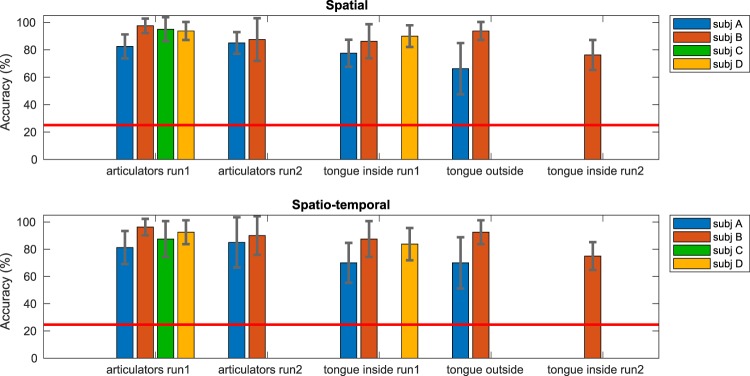
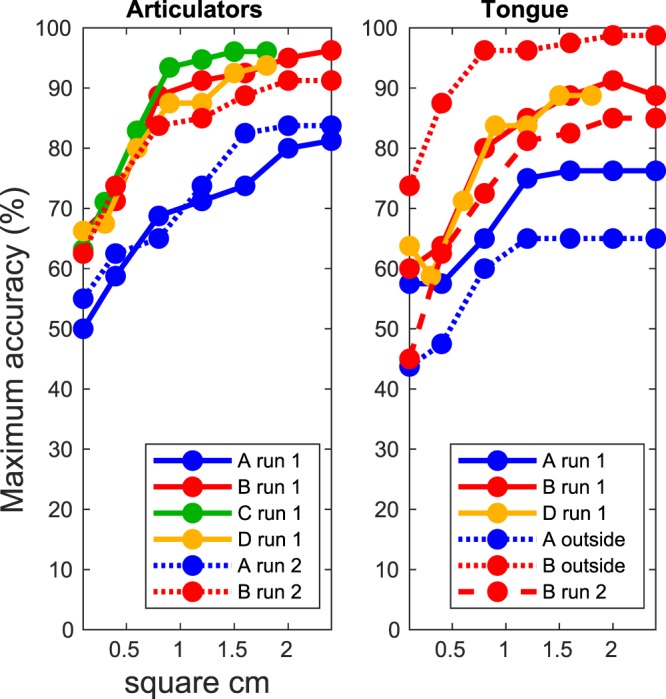
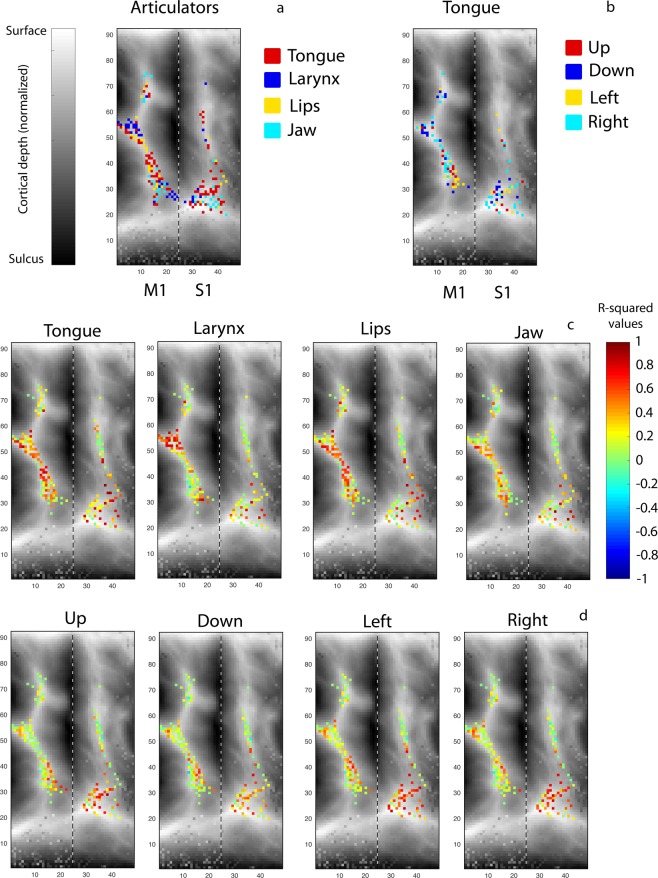
For people suffering from severe paralysis, communication can be difficult or nearly impossible. Technology systems called brain-computer interfaces (BCIs) are being developed to assist these people with communication by using their brain activity to control a computer without any muscle activity. To benefit the development of BCIs that employ neural activity related to speech, we investigated if neural activity patterns related to different articulator movements can be distinguished from each other. We recorded with electrocorticography (ECoG), the neural activity related to different articulator movements in 4 epilepsy patients and classified which articulator participants moved based on the sensorimotor cortex activity patterns. The same was done for different movement directions of a single articulator, the tongue. In both experiments highly accurate classification was obtained, on average 92% for different articulators and 85% for different tongue directions. Furthermore, the data show that only a small part of the sensorimotor cortex is needed for classification (ca. 1 cm 2 ). We show that recordings from small parts of the sensorimotor cortex contain information about different articulator movements which might be used for BCI control. Our results are of interest for BCI systems that aim to decode neural activity related to (actual or attempted) movements from a contained cortical area.
Overview
The claims and statistics of this paper haven’t been checked yet.
Free: it reads the open-access text and checks the first 5 claims that cite a source we can check. Create a free account to check every claim.
Integrity signals
Registry
Cites
Statistics
Figures
Verification
Claims the paper makes
The claims and statistics of this paper haven’t been checked yet.
Free: it reads the open-access text and checks the first 5 claims that cite a source we can check. Create a free account to check every claim.
Claims other papers make about this one
Each is checked against this paper’s own text: does it say what the citing paper says it does?
The source backs part of the claim, not all of it — or backs it for a different population, condition or comparison.
In the citing paper
“In addition, articulatory features may be useful as a standalone output space for both speech and non-speech orofacial gestures14,52,113,114 (Fig. 3d).”
From The speech neuroprosthesis (2024) · cites this paper as [113]
Experimental — accuracy not yet measured
Self-check
Percentages, sums and reported differences re-computed from the paper’s own numbers.
The self-check needs the paper’s full text.
Citations
Cites
Brain–computer interfaces for communication and control
Wolpaw, J. R., Birbaumer, N., McFarland, D. J., Pfurtscheller, G., & Vaughan, T. M. (2002) · Clinical Neurophysiology · doi:10.1016/s1388-2457(02)00057-3 · Cited by 7,927
Speaking: From Intention to Articulation
Levelt, W. J. M. (1989) · doi:10.7551/mitpress/6393.001.0001 · Cited by 4,804
PENFIELD, W., & BOLDREY, E. (1937) · Brain · doi:10.1093/brain/60.4.389 · Cited by 4,188
Reach and grasp by people with tetraplegia using a neurally controlled robotic arm
Hochberg, L. R., Bacher, D., Jarosiewicz, B., Masse, N. Y., Simeral, J. D., Vogel, J., Haddadin, S., Liu, J., Cash, S. S., van der Smagt, P., et al. (2012) · Nature · doi:10.1038/nature11076 · Cited by 2,719
High-performance neuroprosthetic control by an individual with tetraplegia
Collinger, J. L., Wodlinger, B., Downey, J. E., Wang, W., Tyler-Kabara, E. C., Weber, D. J., McMorland, A. J., Velliste, M., Boninger, M. L., & Schwartz, A. B. (2013) · The Lancet · doi:10.1016/s0140-6736(12)61816-9 · Cited by 1,848
Direct Cortical Control of 3D Neuroprosthetic Devices
Taylor, D. M., Tillery, S. I. H., & Schwartz, A. B. (2002) · Science · doi:10.1126/science.1070291 · Cited by 1,540
Crone, N. (1998) · Brain · doi:10.1093/brain/121.12.2301 · Cited by 1,044
Different Origins of Gamma Rhythm and High-Gamma Activity in Macaque Visual Cortex
Ray, S., & Maunsell, J. H. R. (2011) · PLoS Biology · doi:10.1371/journal.pbio.1000610 · Cited by 1,012
Manning, J. R., Jacobs, J., Fried, I., & Kahana, M. J. (2009) · The Journal of Neuroscience · doi:10.1523/jneurosci.2041-09.2009 · Cited by 973
Speech synthesis from neural decoding of spoken sentences
Anumanchipalli, G. K., Chartier, J., & Chang, E. F. (2019) · Nature · doi:10.1038/s41586-019-1119-1 · Cited by 883
Power-Law Scaling in the Brain Surface Electric Potential
Miller, K. J., Sorensen, L. B., Ojemann, J. G., & den Nijs, M. (2009) · PLoS Computational Biology · doi:10.1371/journal.pcbi.1000609 · Cited by 742
Functional organization of human sensorimotor cortex for speech articulation
Bouchard, K. E., Mesgarani, N., Johnson, K., & Chang, E. F. (2013) · Nature · doi:10.1038/nature11911 · Cited by 686
Fully Implanted Brain–Computer Interface in a Locked-In Patient with ALS
Vansteensel, M. J., Pels, E. G. M., Bleichner, M. G., Branco, M. P., Denison, T., Freudenburg, Z. V., Gosselaar, P., Leinders, S., Ottens, T. H., Van Den Boom, M. A., et al. (2016) · New England Journal of Medicine · doi:10.1056/nejmoa1608085 · Cited by 578
Self-citationWiltshire, C. R., & Booij, G. (1996) · Language · doi:10.2307/416139 · Cited by 507
Fourier-, Hilbert- and wavelet-based signal analysis: are they really different approaches?
Bruns, A. (2004) · Journal of Neuroscience Methods · doi:10.1016/j.jneumeth.2004.03.002 · Cited by 489
Smith, E., & Delargy, M. (2005) · BMJ · doi:10.1136/bmj.330.7488.406 · Cited by 437
Speaking: From Intention to Articulation
Berg, T., & Levelt, W. J. M. (1990) · The American Journal of Psychology · doi:10.2307/1423219 · Cited by 432
The Essential Role of Premotor Cortex in Speech Perception
Meister, I. G., Wilson, S. M., Deblieck, C., Wu, A. D., & Iacoboni, M. (2007) · Current Biology · doi:10.1016/j.cub.2007.08.064 · Cited by 397
Plum and Posner's Diagnosis of Stupor and Coma
Posner, J. B., Saper, C. B., Schiff, N., & Plum, F. (2008) · Oxford University Press eBooks · doi:10.1093/med/9780195321319.001.0001 · Cited by 358
Brain-to-text: decoding spoken phrases from phone representations in the brain
Herff, C., Heger, D., de Pesters, A., Telaar, D., Brunner, P., Schalk, G., & Schultz, T. (2015) · Frontiers in Neuroscience · doi:10.3389/fnins.2015.00217 · Cited by 297
Medicine, A. C. O. R. (1995) · Archives of Physical Medicine and Rehabilitation · doi:10.1016/s0003-9993(95)80031-x · Cited by 283
Automated electrocorticographic electrode localization on individually rendered brain surfaces
Hermes, D., Miller, K. J., Noordmans, H. J., Vansteensel, M. J., & Ramsey, N. F. (2010) · Journal of Neuroscience Methods · doi:10.1016/j.jneumeth.2009.10.005 · Cited by 262
Self-citationPei, X., Barbour, D. L., Leuthardt, E. C., & Schalk, G. (2011) · Journal of Neural Engineering · doi:10.1088/1741-2560/8/4/046028 · Cited by 237
Decoding spoken words using local field potentials recorded from the cortical surface
Kellis, S., Miller, K., Thomson, K., Brown, R., House, P., & Greger, B. (2010) · Journal of Neural Engineering · doi:10.1088/1741-2560/7/5/056007 · Cited by 235
Speech synthesis from ECoG using densely connected 3D convolutional neural networks
Angrick, M., Herff, C., Mugler, E., Tate, M. C., Slutzky, M. W., Krusienski, D. J., & Schultz, T. (2019) · Journal of Neural Engineering · doi:10.1088/1741-2552/ab0c59 · Cited by 225
Encoding of Articulatory Kinematic Trajectories in Human Speech Sensorimotor Cortex
Chartier, J., Anumanchipalli, G. K., Johnson, K., & Chang, E. F. (2018) · Neuron · doi:10.1016/j.neuron.2018.04.031 · Cited by 208
Mugler, E. M., Patton, J. L., Flint, R. D., Wright, Z. A., Schuele, S. U., Rosenow, J., Shih, J. J., Krusienski, D. J., & Slutzky, M. W. (2014) · Journal of Neural Engineering · doi:10.1088/1741-2560/11/3/035015 · Cited by 192
Neurophysiologic correlates of fMRI in human motor cortex
Hermes, D., Miller, K. J., Vansteensel, M. J., Aarnoutse, E. J., Leijten, F. S. S., & Ramsey, N. F. (2012) · Human Brain Mapping · doi:10.1002/hbm.21314 · Cited by 188
Self-citationGrabski, K., Lamalle, L., Vilain, C., Schwartz, J., Vallée, N., Tropres, I., Baciu, M., Le Bas, J., & Sato, M. (2012) · Human Brain Mapping · doi:10.1002/hbm.21363 · Cited by 170
Wong, C., Birkett, J., Byth, K., Dexter, M. A. J., Somerville, E. R., Gill, D. S., Chaseling, R., Fearnside, M. R., & Bleasel, A. (2009) · Acta Neurochirurgica · doi:10.1007/s00701-008-0171-7 · Cited by 151
Siero, J. C. W., Hermes, D., Hoogduin, H. M., Luijten, P. R., Ramsey, N. F., & Petridou, N. (2014) · NeuroImage · doi:10.1016/j.neuroimage.2014.07.002 · Cited by 127
Self-citationDecoding hand gestures from primary somatosensory cortex using high-density ECoG
Branco, M. P., Freudenburg, Z. V., Aarnoutse, E. J., Bleichner, M. G., Vansteensel, M. J., & Ramsey, N. F. (2017) · NeuroImage · doi:10.1016/j.neuroimage.2016.12.004 · Cited by 126
Self-citationDecoding spoken phonemes from sensorimotor cortex with high-density ECoG grids
Ramsey, N. F., Salari, E., Aarnoutse, E. J., Vansteensel, M. J., Bleichner, M. G., & Freudenburg, Z. V. (2018) · NeuroImage · doi:10.1016/j.neuroimage.2017.10.011 · Cited by 124
Self-citationBrumberg (2011) · Frontiers in Neuroscience · doi:10.3389/fnins.2011.00065 · Cited by 114
Role of the auditory system in speech production
Guenther, F. H., & Hickok, G. S. (2015) · Handbook of clinical neurology · doi:10.1016/b978-0-444-62630-1.00009-3 · Cited by 111 · cited 2×
“The movements were (1) pursing the lips, (2) clenching the teeth, (3) moving the tongue from left to right behind the teeth, (4) making a ‘mmm’ sound.”
BackgroundYao, D., Yamamura, K., Narita, N., Martin, R. E., Murray, G. M., & Sessle, B. J. (2002) · Journal of Neurophysiology · doi:10.1152/jn.2002.87.5.2531 · Cited by 84
Speech versus Nonspeech: Different Tasks, Different Neural Organization
Bunton, K. (2008) · Seminars in Speech and Language · doi:10.1055/s-0028-1103390 · Cited by 82
Real-time detection of event-related brain activity
Schalk, G., Leuthardt, E. C., Brunner, P., Ojemann, J. G., Gerhardt, L. A., & Wolpaw, J. R. (2008) · NeuroImage · doi:10.1016/j.neuroimage.2008.07.037 · Cited by 79
Preservation of hand movement representation in the sensorimotor areas of amputees
Bruurmijn, M. L. C. M., Pereboom, I. P. L., Vansteensel, M. J., Raemaekers, M. A. H., & Ramsey, N. F. (2017) · Brain · doi:10.1093/brain/awx274 · Cited by 75
Self-citationMurray, G. M., & Sessle, B. J. (1992) · Journal of Neurophysiology · doi:10.1152/jn.1992.67.3.775 · Cited by 54
Branco, M. P., Gaglianese, A., Glen, D., Hermes, D., Saad, Z. S., Petridou, N., & Ramsey, N. F. (2017) · Journal of Neuroscience Methods · doi:10.1016/j.jneumeth.2017.10.022 · Cited by 49
Self-citationZhang, D., Song, H., Xu, R., Zhou, W., Ling, Z., & Hong, B. (2013) · NeuroImage · doi:10.1016/j.neuroimage.2012.12.069 · Cited by 47
Individual articulator's contribution to phoneme production
Wang, J., Green, J. R., & Samal, A. K. (2013) · IEEE International Conference on Acoustics Speech and Signal Processing · doi:10.1109/icassp.2013.6639179 · Cited by 27
Classification of mouth movements using 7 T fMRI
Bleichner, M. G., Jansma, J. M., Salari, E., Freudenburg, Z. V., Raemaekers, M., & Ramsey, N. F. (2015) · Journal of Neural Engineering · doi:10.1088/1741-2560/12/6/066026 · Cited by 23
Self-citationBlokland, Y., Vlek, R. J., Karaman, B., Ozin, F., Thijssen, D. H. J., Eijsvogels, T. M. H., Colier, W. N. J. M., Floor, M., Bruhn, J., & Farquhar, J. D. R. (2012) · Annual International Conference of the IEEE Engineering in Medicine and Biology Society (EMBC) · doi:10.1109/embc.2012.6346835 · Cited by 20
GridLoc: An automatic and unsupervised localization method for high-density ECoG grids
Branco, M. P., Leibbrand, M., Vansteensel, M. J., Freudenburg, Z. V., & Ramsey, N. F. (2018) · NeuroImage · doi:10.1016/j.neuroimage.2018.06.050 · Cited by 19
Self-citationSpatial-Temporal Dynamics of the Sensorimotor Cortex: Sustained and Transient Activity
Salari, E., Freudenburg, Z. V., Vansteensel, M. J., & Ramsey, N. F. (2018) · IEEE Transactions on Neural Systems and Rehabilitation Engineering · doi:10.1109/tnsre.2018.2821058 · Cited by 18
Self-citationBranco, M. P., Freudenburg, Z. V., Aarnoutse, E. J., Vansteensel, M. J., & Ramsey, N. F. (2018) · Biomedical Physics & Engineering Express · doi:10.1088/2057-1976/aac3ac · Cited by 8
Self-citationSalari, E., Freudenburg, Z. V., Vansteensel, M. J., & Ramsey, N. F. (2018) · Journal of Neural Engineering · doi:10.1088/1741-2552/aae329 · Cited by 8
Self-citationA Novel 2D Standard Cartesian Representation for the Human Sensorimotor Cortex
Bruurmijn, M., Schellekens, W., Raemaekers, M. A. H., & Ramsey, N. F. (2019) · Neuroinformatics · doi:10.1007/s12021-019-09441-y · Cited by 5
Self-citation
Cited by
Neuroprosthesis for Decoding Speech in a Paralyzed Person with Anarthria
Moses, D. A., Metzger, S. L., Liu, J. R., Anumanchipalli, G. K., Makin, J. G., Sun, P. F., Chartier, J., Dougherty, M. E., Liu, P. M., Abrams, G. M., et al. (2021) · New England Journal of Medicine · doi:10.1056/nejmoa2027540 · Cited by 582
“Our understanding of how the area of the sensorimotor cortex that controls speech orchestrates the rapid articulatory movements of the vocal tract has expanded.(9-14) Engineering efforts have used these neurobiologic findings, together with advances in machine learning, to show that speech can be decoded from brain ac…”
BackgroundFlexible Electrodes for Brain–Computer Interface System
Wang, J., Wang, T., Liu, H., Wang, K., Kumi, M., Feng, Z., Li, P., & Huang, W. (2023) · Advanced Materials · doi:10.1002/adma.202211012 · Cited by 158
The state of clinical trials of implantable brain–computer interfaces
Patrick-Krueger, K. M., Burkhart, I., & Contreras-Vidal, J. L. (2024) · Nature Reviews Bioengineering · doi:10.1038/s44222-024-00239-5 · Cited by 125
“This Review focuses on long-term iBCIs; therefore, short-term studies on speech, tactile feedback and motor control in humans using diagnostic electrocorticography (ECoG) for diseases such as epilepsy were not included 18–20 .”
Silva, A. B., Littlejohn, K. T., Liu, J. R., Moses, D. A., & Chang, E. F. (2024) · Nature Reviews Neuroscience · doi:10.1038/s41583-024-00819-9 · Cited by 103
“In addition, articulatory features may be useful as a standalone output space for both speech and non-speech orofacial gestures 14,52,113,114 (Fig.”
Implantable hydrogels as pioneering materials for next-generation brain–computer interfaces
Khan, W. U., Shen, Z., Mugo, S. M., Wang, H., & Zhang, Q. M. (2025) · Chemical Society Reviews · doi:10.1039/d4cs01074d · Cited by 79
Metadata
- Authors
- Salari, E., Freudenburg, Z. V., Branco, M. P., Aarnoutse, E. J., Vansteensel, M. J., & Ramsey, N. F.
- Affiliations
- University Medical Center Utrecht (NL)
- Corresponding author
- Ramsey, N. F.
- Venue
- Scientific Reports
- Published
- 2019-10-02
- Volume
- 9
- Issue
- 1
- Pages
- 14165-14165
- ISSN
- 2045-2322 (ISSN-L)
- PMC
- PMC6775133
- OpenAlex
- W2977914667
- Cited by
- 26
- References
- 51
- Citations by year
- 2026: 2 · 2025: 3 · 2024: 3 · 2023: 4 · 2022: 4 · 2021: 5 · 2020: 5
- FWCI
- 2.04
- Type
- journal article
- Language
- en
- Open access
- gold
- doi.org
- Licence
- cc-by
- creativecommons.org/licenses/by/4.0 (tdm)
- creativecommons.org/licenses/by/4.0 (vor)
- Locations
- Scientific Reports (publishedVersion, cc-by)
- Europe PMC (PubMed Central) (publishedVersion, cc-by)
- PubMed Central (publishedVersion, cc-by)
- PubMed (publishedVersion)
- DOAJ (DOAJ: Directory of Open Access Journals) (submittedVersion)
- Utrecht University Repository (Utrecht University) (submittedVersion, other-oa)
- Funders
- European Commission (320708)
- Topics
- Life Sciences › Neuroscience › Cognitive Neuroscience › EEG and Brain-Computer Interfaces
- Physical Sciences › Engineering › Biomedical Engineering › Muscle activation and electromyography studies
- Life Sciences › Neuroscience › Cognitive Neuroscience › Tactile and Sensory Interactions
- Keywords
- articulator movement, sensorimotor cortex, brain-computer interface, electrocorticography, epilepsy patients, movement classification, severe paralysis, communication aids
- MeSH terms
- Electrocorticography, Adult, Articulation Disorders, Epilepsy, Female, Humans, Male, Movement, Tongue, Voice, Brain-Computer Interfaces, Sensorimotor Cortex
About these checks
Registry, retraction, Cites and statistics results are computed, not judged, with one exception: a printed reference that no index lists is read once by a model before it counts as a citation error. Claims are extracted by a model and kept only when their quote appears verbatim in the text; each cited source is then checked, with a model’s help, for whether it says what the claim relies on. Those verdicts can be wrong — read the claim’s quote and the cited source before relying on one.
Statistics and arithmetic are recomputed, not judged.
Confidence bands are shown only for fields calibrated on our annotated test set. None is calibrated yet, so no band is shown.
What counts as a claim ›How we measure confidence ›How we check this ›
Are you an author, or do you see a problem with this page? Request a review
Data sources
Bibliographic data: Semantic Scholar, OpenAlex, Crossref.
Contains information from the Semantic Scholar Academic Graph Datasets, made available under the ODC Attribution License (ODC-BY 1.0).
Semantic Scholar’s data is described in: Kinney, R., et al. (2023). The Semantic Scholar Open Data Platform. arXiv:2301.10140.
