

Integration in emerging social networks explains academic failure and success
Open accessThe DOI matches its Crossref record; 43 of the 44 references it cites were found in a registry or an index.
Abstract
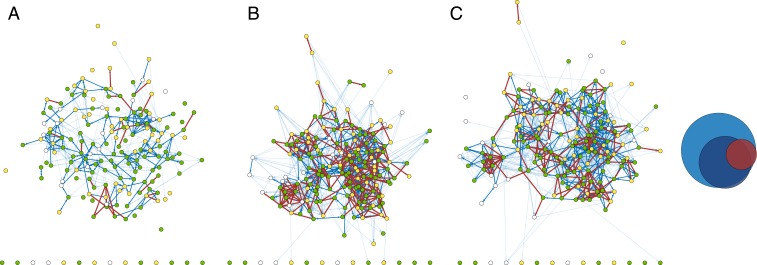
Significance: Understanding the factors that explain academic failure and success of university students is a core interest of educational researchers, teachers, and managers. We demonstrate how the dynamic social networks that informally evolve between students can affect their academic performance. We closely followed the emergence of multiple social networks within a cohort of 226 undergraduate university students. They were strangers to each other on their first day at university, but developed densely knit social networks through time. We show that functional studying relationships tended to evolve from informal friendship relations. In a critical examination period after one year, these networks proved to be crucial: Socially isolated students had significantly lower examination grades and were more likely to drop out of university.
Overview
The claims and statistics of this paper haven’t been checked yet.
Free: it reads the open-access text and checks the first 5 claims that cite a source we can check. Create a free account to check every claim.
Integrity signals
Registry
Cites
Statistics
Figures
Verification
Claims the paper makes
The claims and statistics of this paper haven’t been checked yet.
Free: it reads the open-access text and checks the first 5 claims that cite a source we can check. Create a free account to check every claim.
Claims other papers make about this one
Each is checked against this paper’s own text: does it say what the citing paper says it does?
The source backs part of the claim, not all of it — or backs it for a different population, condition or comparison.
In the citing paper
“The social networks of students have been argued to be an important factor in buffering stress and helping them to be more effective [5].”
From Students under lockdown: Comparisons of students’ social networks and mental health before and during the COVID-19 crisis in Switzerland (2020) · cites this paper as [5]
Experimental — accuracy not yet measuredThe source backs part of the claim, not all of it — or backs it for a different population, condition or comparison.
In the citing paper
“Friendship, interaction, social support, and studying with others have been argued to impact their well-being and academic success, but they often require meeting opportunities and informal settings to develop [5, 13].”
From Students under lockdown: Comparisons of students’ social networks and mental health before and during the COVID-19 crisis in Switzerland (2020) · cites this paper as [5]
Experimental — accuracy not yet measuredThe check wasn’t confident either way, so it gives no verdict — never disputed.
In the citing paper
“and concerns about their social networks [20, 21].”
From Psychological correlates of perceived loneliness in college students before and during the COVID-19 stay-at-home period: a longitudinal study (2023) · cites this paper as [21]
Experimental — accuracy not yet measured
Self-check
Percentages, sums and reported differences re-computed from the paper’s own numbers.
The self-check needs the paper’s full text.
Citations
Cites
Granovetter, M. S. (1973) · American Journal of Sociology · doi:10.1086/225469 · Cited by 40,491
Birds of a Feather: Homophily in Social Networks
McPherson, M., Smith-Lovin, L., & Cook, J. M. (2001) · Annual Review of Sociology · doi:10.1146/annurev.soc.27.1.415 · Cited by 18,567 · cited 1×
“To take into account that observations in the sample are not independent, but could be dependent through processes of homophily (27)—for example, high-achieving individuals choosing each other as study partners—or social influence (28)— individuals becoming more similar to their study partners—we additionally fit netw…”
(1990) · Choice Reviews Online · doi:10.5860/choice.27-6637 · Cited by 16,594
Gamst, F. C. (1991) · Anthropology of Work Review · doi:10.1525/awr.1991.12.3.19 · Cited by 7,932
Structural Holes and Good Ideas
Burt, R. S. (2004) · American Journal of Sociology · doi:10.1086/421787 · Cited by 5,642
Network Analysis in the Social Sciences
Borgatti, S. P., Mehra, A., Brass, D. J., & Labianca, G. (2009) · Science · doi:10.1126/science.1165821 · Cited by 4,254
Skill formation and the economics of investing in disadvantaged children
Heckman, J. J. (2006) · Science · doi:10.1126/science.1128898 · Cited by 3,559
Lazer, D., Pentland, A., Adamic, L., Aral, S., Barabási, A.-L., Brewer, D., Christakis, N., Contractor, N., Fowler, J., Gutmann, M., et al. (2009) · Science · doi:10.1126/science.1167742 · Cited by 3,365
A SOCIAL CAPITAL THEORY OF CAREER SUCCESS.
Seibert, S. E., Kraimer, M. L., & Liden, R. C. (2001) · Academy of Management Journal · doi:10.2307/3069452 · Cited by 2,414
Springer, L., Stanne, M. E., & Donovan, S. S. (1999) · Review of Educational Research · doi:10.3102/00346543069001021 · Cited by 1,943 · cited 1×
“Educational interventions therefore often focus on enforcing teamwork and collaboration within the classroom (32).”
Research works printed but not linked: 2
- Robins G 2015 Doing Social Network Research SAGE London
- Ripley RM Snijders TAB Boda Z Vörös A Preciado Lopez P 2018 Manual for SIENA Version 4.0 (Nuffield College and Department of Statistics, University of Oxford, Oxford), Accessed May 24, 2018
Cited by
Elmer, T., Mepham, K., & Stadtfeld, C. (2020) · PLOS ONE · doi:10.1371/journal.pone.0236337 · Cited by 1,658
“Data were collected (a) prior to the COVID-19 outbreak as part of the Swiss StudentLife study (September 2017 to September 2019) [5], and (b) two weeks after the university and Swiss public life were largely shut down in response to the crisis (April 2020).”
BackgroundMethodSelf-citationDepressive symptoms are associated with social isolation in face-to-face interaction networks
Elmer, T., & Stadtfeld, C. (2020) · Scientific Reports · doi:10.1038/s41598-020-58297-9 · Cited by 266
Self-citationAqeel, M., Rehna, T., Shuja, K. H., & Abbas, J. (2022) · Frontiers in Psychiatry · doi:10.3389/fpsyt.2022.835585 · Cited by 142
Tülübaş, T., Karakose, T., & Papadakis, S. (2023) · European Journal of Investigation in Health, Psychology and Education · doi:10.3390/ejihpe13100143 · Cited by 90
“…cacy [90] Behavior-al-Intention [90], Problematic-Internet-Use [79], Mobile-Device-Use [77], Emotional Intelligence [79], Gender-Di ff erences [77], Academic-Success [93], and Communica-tion-Skill [90] illustrate the sub-themes in the Self-E ffi cacy cluster network. determine the relevant sub-themes.”
BackgroundBoda, Z., Elmer, T., Vörös, A., & Stadtfeld, C. (2020) · Scientific Reports · doi:10.1038/s41598-020-59594-z · Cited by 87
Self-citation
Metadata
- Authors
- Stadtfeld, C., Vörös, A., Elmer, T., Boda, Z., & Raabe, I. J.
- Affiliations
- ETH Zurich (CH)
- University of Zurich (CH)
- Corresponding author
- Stadtfeld, Christoph
- Venue
- Proceedings of the National Academy of Sciences
- Publisher
- National Academy of Sciences
- Published
- 2018-12-24
- Volume
- 116
- Issue
- 3
- Pages
- 792-797
- ISSN
- 0027-8424 (ISSN-L)
- 1091-6490
- PMC
- PMC6338824
- OpenAlex
- W2906675977
- Cited by
- 212
- References
- 42
- Citations by year
- 2026: 17 · 2025: 28 · 2024: 33 · 2023: 36 · 2022: 37 · 2021: 28 · 2020: 27 · 2019: 5
- FWCI
- 48.74
- Type
- journal article
- Language
- en
- Open access
- hybrid
- doi.org
- Licence
- Locations
- Proceedings of the National Academy of Sciences (publishedVersion, cc-by-nc-nd)
- Europe PMC (PubMed Central) (publishedVersion, cc-by-nc-nd)
- PubMed Central (publishedVersion, cc-by-nc-nd)
- PubMed (publishedVersion)
- Zurich Open Repository and Archive (University of Zurich) (acceptedVersion)
- RePEc: Research Papers in Economics (submittedVersion)
- University of Birmingham Research Portal (University of Birmingham) (submittedVersion)
- Research Explorer (The University of Manchester) (submittedVersion)
- Repository for Publications and Research Data (ETH Zurich) (submittedVersion, cc-by-nc-nd)
- Zurich Open Repository and Archive (University of Zurich) (submittedVersion)
- ETH Zürich Research Collection
- Funders
- Swiss National Science Foundation (10001A_169965)
- Topics
- Social Sciences › Education › Educational Outcomes and Influences
- Social Sciences › Education › Higher Education Research Studies
- Physical Sciences › Physics and Astronomy › Statistical and Nonlinear Physics › Complex Network Analysis Techniques
- Keywords
- social networks, academic performance, network integration, friendship formation, study groups, social ties, dynamic networks, undergraduate engineering students, university students, socioeconomic background, perceived intelligence
- MeSH terms
- Academic Failure, Academic Success, Humans, Students, Switzerland, Universities, Social Networking
About these checks
Registry, retraction, Cites and statistics results are computed, not judged, with one exception: a printed reference that no index lists is read once by a model before it counts as a citation error. Claims are extracted by a model and kept only when their quote appears verbatim in the text; each cited source is then checked, with a model’s help, for whether it says what the claim relies on. Those verdicts can be wrong — read the claim’s quote and the cited source before relying on one.
Statistics and arithmetic are recomputed, not judged.
Confidence bands are shown only for fields calibrated on our annotated test set. None is calibrated yet, so no band is shown.
What counts as a claim ›How we measure confidence ›How we check this ›
Are you an author, or do you see a problem with this page? Request a review
How to cite
Cite CoChat for the checks on this page, and the paper for its own findings.
- This page
- CoChat. (2026). Citation check: Integration in emerging social networks explains academic failure and success. https://app.cochat.ai/papers/10.1073/pnas.1811388115
- The paper
- Stadtfeld, C., Vörös, A., Elmer, T., Boda, Z., & Raabe, I. J. (2019). Integration in emerging social networks explains academic failure and success. Proceedings of the National Academy of Sciences. https://doi.org/10.1073/pnas.1811388115
Data sources
Bibliographic data: Semantic Scholar, OpenAlex, Crossref.
Contains information from the Semantic Scholar Academic Graph Datasets, made available under the ODC Attribution License (ODC-BY 1.0).
Semantic Scholar’s data is described in: Kinney, R., et al. (2023). The Semantic Scholar Open Data Platform. arXiv:2301.10140.
