

A cognitive profile of multi-sensory imagery, memory and dreaming in aphantasia
Open accessThe DOI matches its Crossref record; 31 of the 32 references it cites were found in a registry or an index; 10 of the 24 sources its claims cite were checked for support.
Abstract
For most people, visual imagery is an innate feature of many of our internal experiences, and appears to play a critical role in supporting core cognitive processes. Some individuals, however, lack the ability to voluntarily generate visual imagery altogether – a condition termed “aphantasia”. Recent research suggests that aphantasia is a condition defined by the absence of visual imagery, rather than a lack of metacognitive awareness of internal visual imagery. Here we further illustrate a cognitive “fingerprint” of aphantasia, demonstrating that compared to control participants with imagery ability, aphantasic individuals report decreased imagery in other sensory domains, although not all report a complete lack of multi-sensory imagery. They also report less vivid and phenomenologically rich autobiographical memories and imagined future scenarios, suggesting a constructive role for visual imagery in representing episodic events. Interestingly, aphantasic individuals report fewer and qualitatively impoverished dreams compared to controls. However, spatial abilities appear unaffected, and aphantasic individuals do not appear to be considerably protected against all forms of trauma symptomatology in response to stressful life events. Collectively, these data suggest that imagery may be a normative representational tool for wider cognitive processes, highlighting the large inter-individual variability that characterises our internal mental representations.
Overview
CoChat Summary
TL;DR
In a large online questionnaire study, self-identified aphantasic individuals reported reduced imagery across visual and non-visual sensory domains, less vivid episodic memory and future prospection, fewer and qualitatively impoverished dreams, but largely preserved spatial abilities and no overall trauma-symptom protection. The authors conclude that visual imagery may be a normative representational tool for wider cognition, with substantial heterogeneity within aphantasia.
Key findings
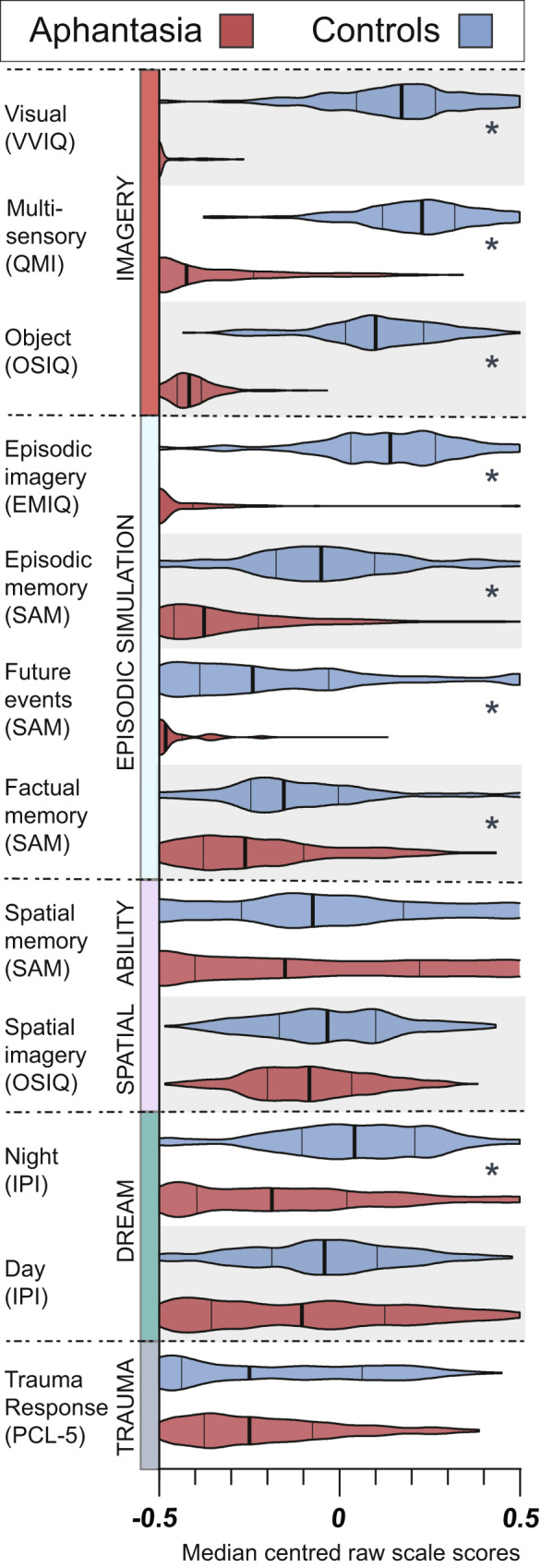
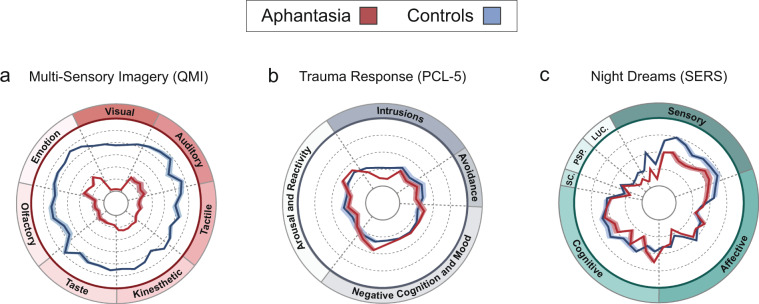
- Aphantasic participants (n = 267) scored far lower on the VVIQ than control group 1 (n = 203): 17.94 vs 58.12 (Mann-Whitney U = 427.5, p < 0.0002, r = 0.87, BF10 = 1.41e12), with 70% at the floor score of 16. They also reported reduced imagery in auditory, tactile, kinesthetic, taste, olfactory, and emotion domains on the QMI (all p < 0.0002, r = 0.65–0.78), but only 26.22% reported a complete lack of multi-sensory imagery altogether.
- Aphantasic individuals reported lower episodic memory and future prospection: SAM Event Memory (U = 8,865, p < 0.0002, r = 0.58), EMIQ memory vividness (U = 2,186.5, p < 0.0002, r = 0.81), SAM Future Events (U = 7,469.5, p < 0.0002, r = 0.63), and SAM Factual Memory (U = 18,601.5, p < 0.0002, r = 0.27). Spatial abilities appeared largely unaffected: OSIQ spatial imagery was slightly lower (U = 24,462, p = 0.001, r = 0.15) but did not survive Bonferroni correction, and SAM Spatial Memory did not differ significantly (U = 24,720, p = 0.1, r = 0.08).
- Trauma symptomatology was not globally reduced: total PCL-5 scores did not differ from control group 1 (U = 27,515, p = 0.776, r = 0.01, BF10 = 0.12). Some subcomponents showed differences—lower intrusions (U = 22,739, p = 0.002, r = 0.14, BF10 = 14.85), lower avoidance (U = 23,164.5, p = 0.006, r = 0.13, BF10 = 2.13), and greater negative cognition/mood (U = 30,960, p = 0.008, r = 0.12, BF10 = 12.99)—but none survived Bonferroni correction.
- Aphantasic participants reported fewer night dreams (IPI: U = 15,828.5, p < 0.0002, r = 0.37, BF10 = 4.24e6) and less sensory dream content (SERS Sensory: U = 15,087.5, p < 0.0002, r = 0.38, BF10 = 5.46e6), plus lower dream lucidity (U = 19,473, p < 0.0002, r = 0.25, BF10 = 1902.01). They did not differ significantly from control group 1 on within-dream cognition or spatial complexity, though they scored higher on one cognitive item about time spent thinking during dreams (U = 34,401.5, p < 0.0002, BF10 = 3.53e3).
Methods
- Online Qualtrics questionnaires (206 questions across eight questionnaires, presented in random order) compared self-identified aphantasic participants recruited from online community platforms with two control groups: MTurk participants matched on mean age (control group 1) and first-year undergraduate psychology students (control group 2). Final analyzed samples were 267 aphantasic, 203 control group 1, and 193 control group 2 in the replication analysis (the Method also reports n = 197 for control group 2 after cleaning).
- Measures included the VVIQ, QMI, OSIQ, EMIQ, SAM, IPI, SERS, and PCL-5, covering multi-sensory imagery, episodic memory and future prospection, spatial abilities, mind-wandering and dreaming, and trauma response.
- Main analyses used Mann-Whitney U tests in SPSS 25 with Bonferroni-adjusted alpha of 0.0002 (0.05/206), effect sizes r, and supplementary Bayesian analyses in JASP with a Cauchy prior of 0.707.
Limitations
- Stated by the authors: neither control group was perfectly matched demographically—control group 1 had a lower proportion of females (35%) than the aphantasic sample (48%), while control group 2 was younger (mean age 19.33 vs 33.97 years) and had more females (73%). Self-report outcomes may be influenced by response bias or demand characteristics and need objective validation. The PCL-5 does not assess responses to specific traumatic events or imagery-based re-experiencing well, and self-report cannot objectively separate remembering from visual representation in episodic memory.
- Evident from the text: the design is cross-sectional and questionnaire-only, so it cannot establish causality or objective cognitive performance. The sample was predominantly English-first-language (83%), White/Caucasian (88%), and mostly from the United States, limiting generalizability. The conservative Bonferroni correction may miss small effects, and several group differences were supported only by Bayesian evidence or did not survive correction.
Model-written summary. Check it against the paper before relying on it.
Integrity signals
Registry
Cites
Statistics
Figures
Verification
Claims the paper makes
7 Valid · 0 Not valid · 10 Not checked · 84 Own results and interpretations
Every source the paper cites for this claim was checked and supports it.
In the paper
“certain individuals lack the ability to visualise altogether – a condition recently termed “aphantasia”9.”
§ A cognitive profile of multi-sensory imagery, memory and dreaming in aphantasia > Introduction
What the sources say
- Supportedcites [9] Zeman A Dewar M Della Sala S Lives without imagery - Congenital aphantasia Cortex. 2015 73 378 80 10.1016/j.cortex.2015.05.019 26115582 source
The Results section of Zeman, Dewar & Della Sala (2015) states 'We propose the use of the term "aphantasia" to refer to a condition of reduced or absent voluntary imagery,' and reports 21 individuals contacted them because of a lifelong reduction/absence of visual imagery whose VVIQ vividness ratings were significantly lower than 121 controls. The Introduction likewise describes these participants as lacking the 'mind's eye' and coins the name for the phenomenon, supporting both the existence of such individuals and the recent naming of the condition. (LLM, conf=0.92)
plain- Asserted: passes — The authors put it forward as true.
- Checkable: passes — It can be checked against evidence.
- Load-bearing: passes — The paper’s conclusions depend on it.
- Based: passes — The paper gives a reason why it holds.
- Supported
The cited sources support only part of this claim — read each source’s verdict below.
In the paper
“This is a pattern of results which accords well with findings of age-related decline in spontaneous mind-wandering32 and subjective dream phenomenology24, respectively.”
§ A cognitive profile of multi-sensory imagery, memory and dreaming in aphantasia > Discussion
What the sources say
- Partly supportedcites [32] Maillet D Schacter DL From mind wandering to involuntary retrieval: Age-related differences in spontaneous cognitive processes Neuropsychologia 2016 8 142 156 10.1016/j.neuropsychologia.2015.11.017 PMC4698179 26617263 sourceExperimental — accuracy not yet measured
Section 2.5 reports that laboratory studies generally find less mind-wandering with increasing age, supporting the age-related decline attributed to this source. Section 2.1 says the studies did not distinguish spontaneous from deliberate mind-wandering in older adults, so the source does not establish a decline specifically in spontaneous mind-wandering. The separate claim about dream phenomenology is attached to citation 24, not this source. (LLM, conf=0.86)
- Partly supportedcites [24] Mangiaruga A Scarpelli S Bartolacci C De Gennaro L Spotlight on dream recall: The ages of dreams Nat. Sci. Sleep 2018 10 1 12 10.2147/NSS.S135762 29391838 PMC5768288 sourceExperimental — accuracy not yet measured
The review’s “Dreaming in elderly” section reports reduced dream salience and fewer dream themes with age, supporting a decline in some aspects of dream experience. But it says findings on qualitative and quantitative features do not follow a coherent trend; the cited paper does not establish a general decline in subjective dream phenomenology. The separate mind-wandering finding is attributed to another citation. (LLM, conf=0.83)
boostedstates an association- Asserted: passes — The authors put it forward as true.
- Checkable: passes — It can be checked against evidence.
- Load-bearing: unclear — It is unclear whether the paper’s conclusions depend on it.
- Based: passes — The paper gives a reason why it holds.
- Partly supported
The sources with a verdict support this claim; the rest weren’t checked yet, have no full text we could read, or their verdicts aren’t rated yet.
In the paper
“For example, our finding that undergraduate participants reported significantly more frequent memory intrusions and avoidance behaviours than aphantasic participants in response to stressful life events may be explained by the typically higher prevalence of PTSD diagnosis and symptomatology amongst females30 (and younger females in particular31).”
§ A cognitive profile of multi-sensory imagery, memory and dreaming in aphantasia > Discussion
What the sources say
- Not checked — no full text of the sourcecites [30] Tolin DF Foa EB Sex differences in trauma and posttraumatic stress disorder: A quantitative review of 25 years of research Psychol. Bull. 2006 132 959 992 10.1037/0033-2909.132.6.959 17073529 source
- Supportedcites [31] Ditlevsen DN Elklit A The combined effect of gender and age on post traumatic stress disorder: Do men and women show differences in the lifespan distribution of the disorder? Ann. Gen. Psychiatry 2010 9 32 10.1186/1744-859X-9-32 20663164 PMC2917414 source
Split into 2 atoms — 2 confirmed, 0 partially supported, 0 disputed, 0 misattributed, 0 unverifiable. Expand the claim to see per-atom verdicts.
hedgedstates a possible cause- Asserted: passes — The authors put it forward as true.
- Checkable: passes — It can be checked against evidence.
- Load-bearing: unclear — It is unclear whether the paper’s conclusions depend on it.
- Based: passes — The paper gives a reason why it holds.
The cited sources support only part of this claim — read each source’s verdict below.
In the paper
“However, these findings may be partially explained by age-related decline in dream frequency and subjective recall24.”
§ A cognitive profile of multi-sensory imagery, memory and dreaming in aphantasia > Results > Control Group 2: Replication Analysis
What the sources say
- Partly supportedcites [24] Mangiaruga A Scarpelli S Bartolacci C De Gennaro L Spotlight on dream recall: The ages of dreams Nat. Sci. Sleep 2018 10 1 12 10.2147/NSS.S135762 29391838 PMC5768288 sourceExperimental — accuracy not yet measured
The “Dreaming in elderly” section reports an age-related reduction in dream recall frequency, and the conclusion describes a decline in recall rates from early to late adulthood. The paper does not establish a separate decline in how often dreams occur, as distinct from how often they are recalled. It does not examine the aphantasic and control groups; the proposed explanation for their differences is the citing authors’ inference. (LLM, conf=0.82)
hedgedstates a possible cause- Asserted: passes — The authors put it forward as true.
- Checkable: passes — It can be checked against evidence.
- Load-bearing: unclear — It is unclear whether the paper’s conclusions depend on it.
- Based: passes — The paper gives a reason why it holds.
- Partly supported
The cited sources support only part of this claim — read each source’s verdict below.
In the paper
“suggest that visual imagery may be an essential and unifying representational format potentiating these processes.”
§ A cognitive profile of multi-sensory imagery, memory and dreaming in aphantasia > Discussion
What the sources say
- Partly supportedcites [25] Schacter DL The future of memory: Remembering, imagining, and the brain Neuron 2012 76 677 694 10.1016/j.neuron.2012.11.001 23177955 PMC3815616 sourceExperimental — accuracy not yet measured
In “Neural and cognitive similarities: A brief summary” (page unavailable), the paper describes scene construction as a critical component of remembering and imagining. It distinguishes that process from simple visual imagery, however, and does not identify visual imagery itself as an essential, unifying representational format that potentiates episodic simulation. (LLM, conf=0.84)
hedgedstates a possible cause- Asserted: passes — The authors put it forward as true.
- Checkable: passes — It can be checked against evidence.
- Load-bearing: passes — The paper’s conclusions depend on it.
- Based: passes — The paper gives a reason why it holds.
- Partly supported
65 more claims
Create a free account to see all 101 claims and every source verdict.
- Probably not a substantial claim. 14
- It may state two separate claims as one. 22
Claims other papers make about this one
Each is checked against this paper’s own text: does it say what the citing paper says it does?
The source backs part of the claim, not all of it — or backs it for a different population, condition or comparison.
In the citing paper
“In humans, recent evidence shows that mental time travel and dreaming may be generated through similar networks in the brain [194,195], share parallels in their (re)constructive processes [196–199] as well as deficits owing to injury and disease [200,201].”
From Is episodic-like memory like episodic memory? (2024) · cites this paper as [201]
Experimental — accuracy not yet measuredThe source backs part of the claim, not all of it — or backs it for a different population, condition or comparison.
In the citing paper
“This observation has been borne out by subsequent reports [3”
From Aphantasia and hyperphantasia: exploring imagery vividness extremes (2024) · cites this paper as [55]
Experimental — accuracy not yet measured
Self-check
Percentages, sums and reported differences re-computed from the paper’s own numbers.
Each contradiction between two passages listed here was confirmed by an independent check.
Rated minor: it would not touch a result — a value no result rests on, a p-value that stays on the same side of the significance level, or a conflict that is clerical, resolved elsewhere in the paper, or outside its own findings.
In the paper
§ A cognitive profile of multi-sensory imagery, memory and dreaming in aphantasia > Results > Control Group 1: Main Comparisons
“rating each question in each QMI domain as “1: No sensory experience at all””
§ A cognitive profile of multi-sensory imagery, memory and dreaming in aphantasia > Method > Materials
“on a 7-point scale ranging from 1 (“I think of it, but do not have an image before me”) to 7 (“Very vivid and as clear as reality”).”
Rated minor: it would not touch a result — a value no result rests on, a p-value that stays on the same side of the significance level, or a conflict that is clerical, resolved elsewhere in the paper, or outside its own findings.
In the paper
§ A cognitive profile of multi-sensory imagery, memory and dreaming in aphantasia > Results > Control Group 1: Main Comparisons
“Radar plots for (a) multi-sensory imagery; (b) trauma response; and (c) dreaming scales”
§ A cognitive profile of multi-sensory imagery, memory and dreaming in aphantasia > Results > Control Group 1: Main Comparisons
“radial dashed lines denote item grouping for scale sub-components (e.g. c; Intrusions, Avoidance, Negative Cognition and Mood, Arousal and Reactivity)”
Rated minor: it would not touch a result — a value no result rests on, a p-value that stays on the same side of the significance level, or a conflict that is clerical, resolved elsewhere in the paper, or outside its own findings.
In the paper
§ A cognitive profile of multi-sensory imagery, memory and dreaming in aphantasia > Results > Control Group 2: Replication Analysis
“Aphantasic participants scored significantly lower than control group 2 on all outcomes of the imagery and episodic memory questionnaires (all p < 0.0002, all r > 0.52, all BF10 > 1.42e8) with the exception of the factual memory component of the SAM”
§ A cognitive profile of multi-sensory imagery, memory and dreaming in aphantasia > Results > Control Group 2: Replication Analysis
“Lastly, there were no significant differences in reported spatial imagery ability on the OSIQ (Mann-Whitney U = 22,635.5, p = 0.03, r = 0.10, BF10 = 0.88, 2-tailed) or spatial navigation ability on the SAM (Mann-Whitney U = 23,760.5, p = 0.15, r = 0.07, BF10 = 0.23, 2-tailed)”
Rated minor: it would not touch a result — a value no result rests on, a p-value that stays on the same side of the significance level, or a conflict that is clerical, resolved elsewhere in the paper, or outside its own findings.
In the paper
§ A cognitive profile of multi-sensory imagery, memory and dreaming in aphantasia > Method > Participants
“Sample sizes for the aphantasia group, control group 1 and control group 2 were approximately equal after data cleaning and exclusions (n = 267, n = 203 and n = 197, respectively).”
§ A cognitive profile of multi-sensory imagery, memory and dreaming in aphantasia > Method > Participants
“A second control group of 193 first-year undergraduate psychology students were tested using the same experimental design.”
Citations
Cites
Separate visual pathways for perception and action
Goodale, M. A., & Milner, A. D. (1992) · Trends in Neurosciences · doi:10.1016/0166-2236(92)90344-8 · Cited by 6,519
Parametric measures of effect size.
Rosenthal, R. (1994) · Cited by 2,604
Remembering the past to imagine the future: the prospective brain
Schacter, D. L., Addis, D. R., & Buckner, R. L. (2007) · Nature Reviews Neuroscience · doi:10.1038/nrn2213 · Cited by 2,394
Tolin, D. F., & Foa, E. B. (2006) · Psychological Bulletin · doi:10.1037/0033-2909.132.6.959 · Cited by 2,197
VISUAL IMAGERY DIFFERENCES IN THE RECALL OF PICTURES
MARKS, D. F. (1973) · British Journal of Psychology · doi:10.1111/j.2044-8295.1973.tb01322.x · Cited by 1,778 · cited 2×
“The Vividness of Visual Imagery Questionnaire (VVIQ11; Marks, 1973) is a 16-item scale which asks participants to imagine a person as well as several scenes and rate the vividness of these mental images using a 5-point scale ranging from 1 (“No image at all, you only ‘know’ that you are thinking of…”
The future of memory: remembering, imagining, and the brain
Schacter, D. L., Addis, D. R., Hassabis, D., Martin, V. C., Spreng, R. N., & Szpunar, K. K. (2012) · Neuron · doi:10.1016/j.neuron.2012.11.001 · Cited by 1,398
JEFFREYS, H. (1922) · Nature · doi:10.1038/109132a0 · Cited by 1,217
Mental Imagery: Functional Mechanisms and Clinical Applications
Pearson, J., Naselaris, T., Holmes, E. A., & Kosslyn, S. M. (2015) · Trends in Cognitive Sciences · doi:10.1016/j.tics.2015.08.003 · Cited by 1,087
Self-citationLives without imagery – Congenital aphantasia
Zeman, A., Dewar, M., & Della Sala, S. (2015) · Cortex · doi:10.1016/j.cortex.2015.05.019 · Cited by 621
Neural decoding of visual imagery during sleep
Horikawa, T., Tamaki, M., Miyawaki, Y., & Kamitani, Y. (2013) · Science · doi:10.1126/science.1234330 · Cited by 498
Research works printed but not linked: 1
- Jeffreys, H. Theory of Probability. (Clarendon Press, 1961).
Cited by
Items 101–200 of 313
Pounder, Z., Eardley, A. F., Loveday, C., & Evans, S. (2024) · PLoS ONE · doi:10.1371/journal.pone.0300219 · Cited by 13
Neurocognitive dynamics of spontaneous offline simulations: Re-conceptualizing (dream)bizarreness
Kirberg, M. (2022) · Philosophical Psychology · doi:10.1080/09515089.2022.2042231 · Cited by 12
Visual imagery vividness correlates with afterimage conscious perception
Kronemer, S. I., Holness, M., Morgan, A., Teves, J., González-Castillo, J., Handwerker, D. A., & Bandettini, P. A. (2024) · Neuroscience of Consciousness · doi:10.1093/nc/niae032 · Cited by 10
A Systematic Review of Aphantasia: Concept, Measurement, Neural Basis, and Theory Development
Jin, F., Hsu, S., & Li, Y. (2024) · Vision · doi:10.3390/vision8030056 · Cited by 21
Dissociating voluntary mental imagery and mental simulation: Evidence from aphantasia
Speed, L. J., Geraerds, E. M. E., & McRae, K. (2025) · Memory & Cognition · doi:10.3758/s13421-025-01731-y · Cited by 11
Nánay, B. (2025) · Trends in Cognitive Sciences · doi:10.1016/j.tics.2025.06.008 · Cited by 12
Give your ideas a hand: the role of iconic hand gestures in enhancing divergent creative thinking
Hyusein, G., & Göksun, T. (2024) · Psychological Research · doi:10.1007/s00426-024-01932-1 · Cited by 16
Aphantasia and the Language of Imagination: A Wittgensteinian Exploration
Fox-Muraton, M. (2021) · Analiza i Egzystencja · doi:10.18276/aie.2021.55-01 · Cited by 8
Molokopoy, V., & D’Angiulli, A. (2022) · Brain Sciences · doi:10.3390/brainsci12111495 · Cited by 8
Spielmann, V., Burke, H. K., McCulloch, S., Mason, A., & Lane, S. J. (2023) · American Journal of Occupational Therapy · doi:10.5014/ajot.2023.050127 · Cited by 15
Phillips, I. B. (2025) · Noûs · doi:10.1111/nous.12551 · Cited by 18
The role of subjective interoception in autobiographical deficits in aphantasia
Monzel, M., Nagai, Y., & Silvanto, J. (2025) · Scientific Reports · doi:10.1038/s41598-025-23270-x · Cited by 12
Comparative effects of hypnotic suggestion and imagery instruction on bodily awarenessPreprint
Apelian, C., de Vignemont, F., & Terhune, D. B. (2022) · PsyArXiv (OSF Preprints) · doi:10.1016/j.concog.2023.103473 · Cited by 11
Nánay, B. (2023) · Oxford University Press eBooks · doi:10.1093/oso/9780198809500.003.0013 · Cited by 7
Liu, J., & Bartolomeo, P. (2023) · doi:10.31234/osf.io/wzy5b · Cited by 7
Hippocampal-occipital connectivity reflects autobiographical memory deficits in aphantasiaPreprint
Monzel, M., Leelaarporn, P., Lutz, T., Schultz, J., Brunheim, S., Reuter, M., & McCormick, C. (2023) · bioRxiv (Cold Spring Harbor Laboratory) · doi:10.1101/2023.08.11.552915 · Cited by 7
Functional activity and connectivity during ideation in professional product design engineers
Campbell, G., Hay, L., Gilbert, S. J., McTeague, C. P., Coyle, D., & Grealy, M. (2024) · Design Studies · doi:10.1016/j.destud.2024.101247 · Cited by 9
Baade, L., Kartsonaki, E., Khosravi, H., & Lawrie, G. A. (2025) · Chemistry Education Research and Practice · doi:10.1039/d4rp00234b · Cited by 11
The Experience of Music in Aphantasia: Emotion, Reward, and Everyday Functions
Hashim, S., Pulcini, C., Jansari, A. S., Küssner, M. B., & Omigie, D. (2024) · Music & Science · doi:10.1177/20592043231216259 · Cited by 13
Autobiographical MemoryPreprint
Fan, C. L., Simpson, S., Sokolowski, H. M., et al. (2022) · doi:10.31234/osf.io/9c6b8 · Cited by 6
Motor imagery in individuals with congenital aphantasia
Kwaśniak, R., Zapała, D., Augustynowicz, P., & Szubielska, M. (2025) · Scientific Reports · doi:10.1038/s41598-025-20168-6 · Cited by 10
Analysis on Aphantasia’s Symptom
Yang, Y. (2022) · Advances in Social Science, Education and Humanities Research/Advances in social science, education and humanities research · doi:10.2991/assehr.k.220105.192 · Cited by 6
Some Contributions from Embodied Cognition to Psychonarratology
Reali, F., Cevasco, J., & Marmolejo‐Ramos, F. (2024) · Journal of Psycholinguistic Research · doi:10.1007/s10936-024-10110-8 · Cited by 6
Bilzer, M., & Monzel, M. (2025) · Vision · doi:10.3390/vision9020037 · Cited by 7
Cabbai, G., Dance, C., Dienes, Z. P., et al. (2023) · doi:10.31234/osf.io/7qmfj · Cited by 5
Hippocampal-occipital connectivity reflects autobiographical memory deficits in aphantasiaPreprint
Monzel, M., Leelaarporn, P., Lutz, T., Schultz, J., Brunheim, S., Reuter, M., & McCormick, C. (2024) · eLife · doi:10.7554/elife.94916.1 · Cited by 10
Simulation in the ‘Blind’ mind: Examining unconscious mental imagery in aphantasia
Muraki, E. J., & Pexman, P. M. (2025) · Neuropsychologia · doi:10.1016/j.neuropsychologia.2025.109218 · Cited by 7
Savarimuthu, A., & Ponniah, R. J. (2024) · Psychological Studies · doi:10.1007/s12646-024-00789-z · Cited by 7
Lifting the veil: probing altered visual perception in derealization
Kusztor, A., Mulay, N. N., Yamada, M., Hohwy, J., & Tsuchiya, N. (2025) · Neuroscience of Consciousness · doi:10.1093/nc/niaf045 · Cited by 5
The role of dopamine in visual imagery—An experimental pharmacological study
Monzel, M., Karneboge, J., & Reuter, M. (2023) · Journal of Neuroscience Research · doi:10.1002/jnr.25262 · Cited by 5
Contemori, G., Oletto, C. M., Battaglini, L., & Bertamini, M. (2024) · Proceedings of the Royal Society B Biological Sciences · doi:10.1098/rspb.2023.2867 · Cited by 5
Fan, C. L., Simpson, S., Sokolowski, H. M., & Levine, B. (2024) · Oxford University Press eBooks · doi:10.1093/oxfordhb/9780190917982.013.39 · Cited by 13
El viaje mental en el tiempo en la filosofía y la ciencia cognitiva de la memoria
Trakas, M. (2022) · Revista de Humanidades de Valparaíso · doi:10.22370/rhv2022iss20pp141-163 · Cited by 5
Raffaelli, Q., Andrews, E. S., Cegavske, C. C., Abraham, F. F., Edgin, J. O., & Andrews‐Hanna, J. R. (2023) · Scientific Reports · doi:10.1038/s41598-023-33767-y · Cited by 7
Arnold, D. H., Saurels, B. W., Anderson, N., Andresen, I., & Schwarzkopf, D. S. (2024) · Scientific Reports · doi:10.1038/s41598-023-50760-7 · Cited by 5
Armson, M. J., Diamond, N. B., Levesque, L., Ryan, J. D., & Levine, B. (2019) · PsyArXiv (OSF Preprints) · doi:10.31234/osf.io/pztv4 · Cited by 4
Gouveia, L. A. (2023) · Themes focused on interdisciplinarity and sustainable development worldwide V.1 · doi:10.56238/tfisdwv1-057 · Cited by 4
The vividness of visualisations and autistic trait expression are not strongly associated
Bouyer, L. N., Pellicano, E., Saurels, B. W., Schwarzkopf, D. S., & Arnold, D. H. (2025) · Consciousness and Cognition · doi:10.1016/j.concog.2025.103821 · Cited by 3
Seeing Is Feeling: How Aphantasia Alters Emotional Engagement With Stories
Abdelrahman, N., Melcher, D., & Ripollés, P. (2025) · Psychophysiology · doi:10.1111/psyp.70100 · Cited by 7
Nánay, B. (2026) · Oxford University Press eBooks · doi:10.1093/9780197744208.003.0012 · Cited by 3
Individual differences in mental imagery do not moderate the animacy advantage in memory
Serra, M. J., Keiner, J. N., Villalobos, N. C., Kortenhoeven, A., & Scolari, M. (2025) · Journal of Memory and Language · doi:10.1016/j.jml.2025.104638 · Cited by 3
Mental rotation is a weak measure of people’s propensity to visualise
Arnold, D. H., Bouyer, L. N., Saurels, B. W., Pellicano, E., & Schwarzkopf, D. S. (2025) · Consciousness and Cognition · doi:10.1016/j.concog.2025.103907 · Cited by 3
Aphantasia, hyperphantasia and sensory imagery in a multi-cultural sample
Bruder, J., & Zehra, M. (2025) · Journal of Cultural Cognitive Science · doi:10.1007/s41809-025-00184-8 · Cited by 5
Visual mental imagery of atypical color objects attracts attention to an imagery-matching object
Moriya, J. (2023) · Attention Perception & Psychophysics · doi:10.3758/s13414-023-02804-3 · Cited by 4
A computational account of conflict processing during mental imagery
Wang, M., & Nie, Q.-Y. (2024) · Cognitive, Affective, & Behavioral Neuroscience · doi:10.3758/s13415-024-01201-z · Cited by 3
Simulating the best and worst of times: The powers and perils of emotional simulationPreprint
Wardell, V., Grilli, M. D., & Palombo, D. J. (2021) · doi:10.31219/osf.io/btvrf · Cited by 3
Metacognitive Awareness and the Subjective Experience of Remembering in AphantasiaPreprint
Siena, M. J., & Simons, J. S. (2023) · doi:10.31234/osf.io/gx4yw · Cited by 3
Lambert, A. J., Schelp, Z. M., Quigley-Tump, G., & Purdy, S. C. (2026) · SSRN Electronic Journal · doi:10.2139/ssrn.6466269 · Cited by 3
Argueta, P., Dominguez, J., Zachman, J., Worthington, P., & Kana, R. K. (2024) · Consciousness and Cognition · doi:10.1016/j.concog.2024.103790 · Cited by 3
Aphantasia does not affect veridical and false memory: Evidence from the DRM paradigm
Pauly‐Takacs, K., Younus, S., Sigala, N., & Pfeifer, G. (2025) · Consciousness and Cognition · doi:10.1016/j.concog.2025.103888 · Cited by 3
The role of mental imagery in worry: Insights from aphantasia
Dance, C., Meeten, F., & Simner, J. (2025) · Behaviour Research and Therapy · doi:10.1016/j.brat.2025.104838 · Cited by 8
A decade of aphantasia research – and still going!
Zeman, A. Z. (2025) · Neuropsychologia · doi:10.1016/j.neuropsychologia.2025.109278 · Cited by 3
Pounder, Z., Agosto, G., Mackenzie, J., & Cheshire, A. (2025) · Cogent Psychology · doi:10.1080/23311908.2025.2574255 · Cited by 3
Living and learning with a blind mind’s eye: college students with aphantasia
Cavazos, J. T., Baskin, H. M., Mashigian, T. M., & Cavazos, M. A. (2025) · Frontiers in Psychology · doi:10.3389/fpsyg.2025.1615860 · Cited by 3
Noble, C., Taylor, N. L., Milton, F., Fulford, J., Tan, J. B., O’Callaghan, C., Zeman, A. Z., & Shine, J. M. (2025) · Neuropsychologia · doi:10.1016/j.neuropsychologia.2025.109322 · Cited by 5
Aphantasia, Unsymbolized Thinking and Conscious Thought
Krempel, R. (2023) · Erkenntnis · doi:10.1007/s10670-023-00706-2 · Cited by 6
Shaping the Space: A Role for the Hippocampus in Mental Imagery Formation
Blomkvist, A. (2025) · Vision · doi:10.3390/vision9010002 · Cited by 3
Action Understanding Promoted by Interoception in Children: A Developmental Model
Zhou, H. X., Gao, Q., Chen, W., & Wei, Q. (2022) · Frontiers in Psychology · doi:10.3389/fpsyg.2022.724677 · Cited by 5
Nánay, B. (2023) · Oxford University Press eBooks · doi:10.1093/oso/9780198809500.003.0031 · Cited by 2
Nánay, B. (2023) · Oxford University Press eBooks · doi:10.1093/oso/9780198809500.003.0004 · Cited by 2
Königsmark, V., Bergmann, J., & Reeder, R. (2020) · doi:10.31234/osf.io/8gz4m · Cited by 2
The impact of aphantasia on mental healthcare experiences: Quantitative resultsPreprint
Mawtus, B., Thomas, B. R., & Reeder, R. (2024) · PsyArXiv (OSF Preprints) · doi:10.31234/osf.io/zkcr4 · Cited by 3
Characterizations of Voluntary and Involuntary Imagery in AphantasiaPreprint
Duan, S., Yang, Y., Li, K., & Zhao, B. (2024) · OSF Preprints (OSF Preprints) · doi:10.31219/osf.io/n6xpr · Cited by 2
Hippocampal-occipital connectivity reflects autobiographical memory deficits in aphantasiaPreprint
Monzel, M., Leelaarporn, P., Lutz, T., Schultz, J., Brunheim, S., Reuter, M., & McCormick, C. (2024) · eLife · doi:10.7554/elife.94916.2 · Cited by 21
Measuring the factors impact on firm performance recovery in coffee chain in Vietnam
Manh, P. T. (2024) · Asian Journal of Economic Modelling · doi:10.55493/5009.v12i2.5045 · Cited by 1
Missing images: autobiographical memory in Aphantasia and blindness
McCormick, C., & Lange, S. (2025) · Frontiers in Cognition · doi:10.3389/fcogn.2025.1644533 · Cited by 1
Sabel, I., Kay, L., Pearson, J., & Grisham, J. R. (2026) · Psychological Reports · doi:10.1177/00332941261425581
Self-citationTaylor, R., Sumner, P., Singh, K. D., & Jones, C. R. G. (2026) · Scientific Reports · doi:10.1038/s41598-026-38574-9 · Cited by 2
The role of load reduction instruction in assisting students with weak mental imagery
Martin, A. J., Ginns, P., Pearson, J., Kennett, R., & Burns, E. C. (2026) · Learning and Individual Differences · doi:10.1016/j.lindif.2026.102913 · Cited by 1
Self-citationNew, B., Barra, J., Chauvin, A., Huson, N., & Lœvenbruck, H. (2026) · Cortex · doi:10.1016/j.cortex.2026.04.019 · Cited by 3
Aphantasia and the Mechanisms of Visual Mental Imagery
Bartolomeo, P. (2026) · Annual Review of Vision Science · doi:10.1146/annurev-vision-110425-105103 · Cited by 5
The perspective-simulating mind: internal representations in moral judgment and action
Ernst, M., Kronbichler, M., & Meyer, P. (2026) · Scientific Reports · doi:10.1038/s41598-026-53224-w · Cited by 2
Arnold, D. H., Bouyer, L. N., Saurels, B. W., Schwarzkopf, D. S., & Pellicano, E. (2026) · Consciousness and Cognition · doi:10.1016/j.concog.2026.104085 · Cited by 3
Similar eye movements in aphantasia and visualizers during mental map exploration
Takamura, Y., Coustaty, S., Liu, J., Razzak, E., Pouget, P., Spagna, A., & Bartolomeo, P. (2026) · Cortex · doi:10.1016/j.cortex.2026.06.010 · Cited by 4
Gemstone of analysis: Significance of interpretation of dreams in analytic process
Blazhina, I. (2021) · Psychosomatic Medicine and General Practice · doi:10.26766/pmgp.v6i1.300 · Cited by 1
Mental Imagery versus Imagination
Nánay, B. (2023) · Oxford University Press eBooks · doi:10.1093/oso/9780198809500.003.0022 · Cited by 2
New ways of studying subjective experience
Keogh, R., & Lau, H. C. (2024) · Neuroscience Research · doi:10.1016/j.neures.2024.01.010 · Cited by 5
Self-citationSensory Profiles and Technological Deficits: Classification, Relevance, and Gaps
Hutson, J., Hutson, P., & Harper-Nichols, M. (2024) · Springer eBooks · doi:10.1007/978-3-031-58045-1_3 · Cited by 1
Mid-level Characteristics of Drawings Made by Observers with Aphantasia
Balas, B. (2024) · Journal of Perceptual Imaging · doi:10.2352/j.percept.imaging.2024.7.000402 · Cited by 1
Impoverished recall of sensory details along infrequently travelled routes in aphantasia
Li, A., Arrieta, M., Levine, B., & Rosenbaum, R. S. (2025) · Memory · doi:10.1080/09658211.2025.2507948 · Cited by 3
How people estimate the prevalence of aphantasia and hyperphantasia in the population
Blazhenkova, O., Kotov, A., & Kotova, T. (2025) · Consciousness and Cognition · doi:10.1016/j.concog.2025.103906 · Cited by 2
Comparative effects of hypnotic suggestion and imagery on bodily awarenessPreprint
Apelian, C., de Vignemont, F., & Terhune, D. B. (2022) · doi:10.31234/osf.io/ph8cy · Cited by 1
Measuring the Factors Impact on Firm Performance Recovery in Coffee Chain in VietnamPreprint
Manh, P. T. (2024) · Preprints.org · doi:10.20944/preprints202401.0110.v1 · Cited by 1
Perception and navigation: What is the interface?
Palermo, L., & Boccia, M. (2024) · Elsevier eBooks · doi:10.1016/b978-0-12-820480-1.00072-3 · Cited by 1
Yeung, R. C., Sokolowski, H. M., Fan, C. L., Fernandes, M. A., & Levine, B. (2024) · doi:10.31234/osf.io/6fp9w · Cited by 1
Toftness, A. R. (2022) · doi:10.31274/td-20240329-151 · Cited by 1
A Systematic Review of Aphantasia: Concept, Measurement, Neural Basis, and Theory DevelopmentPreprint
Jin, F., Hsu, S., & Li, Y. (2024) · Preprints.org · doi:10.20944/preprints202407.0680.v1 · Cited by 3
The representational theory of mind and common sense psychology
Krempel, R. (2021) · Aufklärung journal of philosophy · doi:10.18012/arf.v8iesp.60021 · Cited by 1
Bourque, T. (2021) · Carleton University's Institutional Repository (MacOdrum Library, Carleton University) · doi:10.22215/etd/2021-14685 · Cited by 2
Patterns of episodic content and specificity predicting subjective memory vividnessPreprint
Cooper, R. A., & Ritchey, M. (2022) · doi:10.31234/osf.io/gux43
Thinking about thinking: the diversity of people’s inner worlds
Burrows, J. (2022) · Probation Quarterly · doi:10.54006/ovol3159
Does Counterfactual Reasoning Hold the Key to Artificial General Intelligence?
Vorster, E. (2022) · Communications in computer and information science · doi:10.1007/978-3-031-22321-1_26
Van képünk hozzá? Nyelv – jelentés – vizualitás • Picture This: Language—Meaning—Visuality
Kenesei, I. (2023) · Magyar Tudomány · doi:10.1556/2065.184.2023.3.8
Pounder, Z., Eardley, A. F., Loveday, C., et al. (2023) · doi:10.31234/osf.io/n6m5r
Emotion in the mind’s eye: Imagination for adaptive cognitionPreprint
Cocquyt, C. M., & Palombo, D. J. (2023) · doi:10.31219/osf.io/7w2na
Peter, B. (2023) · Psychotherapie: Praxis · doi:10.1007/978-3-662-64968-8_40
Peter, B. (2023) · Psychotherapie: Praxis · doi:10.1007/978-3-662-64968-8_11 · Cited by 1
Nánay, B. (2023) · Oxford University Press eBooks · doi:10.1093/oso/9780198809500.003.0002 · Cited by 1
Nánay, B. (2023) · Oxford University Press eBooks · doi:10.1093/oso/9780198809500.003.0008
Metadata
- Authors
- Dawes, A. J., Keogh, R., Andrillon, T., & Pearson, J.
- Affiliations
- UNSW Sydney (AU)
- Corresponding author
- Dawes, Alexei J.
- Venue
- Scientific Reports
- Published
- 2020-06-22
- Volume
- 10
- Issue
- 1
- Pages
- 10022-10022
- ISSN
- 2045-2322 (ISSN-L)
- PMC
- PMC7308278
- OpenAlex
- W3036039130
- Cited by
- 357
- References
- 32
- Citations by year
- 2026: 88 · 2025: 50 · 2024: 67 · 2023: 83 · 2022: 34 · 2021: 26 · 2020: 8
- FWCI
- 18.04
- Type
- journal article
- Language
- en
- Open access
- gold
- doi.org
- Licence
- cc-by
- creativecommons.org/licenses/by/4.0 (tdm)
- creativecommons.org/licenses/by/4.0 (vor)
- Locations
- Scientific Reports (publishedVersion, cc-by)
- PubMed Central (publishedVersion, cc-by)
- PubMed (publishedVersion)
- Monash University Research Portal (Monash University) (submittedVersion, other-oa)
- Funders
- Australian Government
- International Brain Research Organization
- Australian Research Council (DP140101560)
- National Health and Medical Research Council (1049596, 1046198, 1085404)
- Topics
- Life Sciences › Neuroscience › Cognitive Neuroscience › Memory Processes and Influences
- Social Sciences › Arts and Humanities › Philosophy › Philosophy and Theoretical Science
- Life Sciences › Neuroscience › Cognitive Neuroscience › Hallucinations in medical conditions
- Keywords
- aphantasia, visual imagery, multisensory imagery, autobiographical memory, dream vividness, spatial ability, trauma symptoms, interindividual variability, mental representation, metacognition
- MeSH terms
- Adolescent, Adult, Aged, Cognition, Cognition Disorders, Dreams, Female, Humans, Imagination, Male, Memory, Middle Aged, Surveys and Questionnaires, Stress Disorders, Post-Traumatic, Case-Control Studies, Young Adult
About these checks
Registry, retraction, Cites and statistics results are computed, not judged, with one exception: a printed reference that no index lists is read once by a model before it counts as a citation error. Claims are extracted by a model and kept only when their quote appears verbatim in the text; each cited source is then checked, with a model’s help, for whether it says what the claim relies on. Those verdicts can be wrong — read the claim’s quote and the cited source before relying on one.
The claim verdicts this report counts are experimental: their accuracy is not yet measured.
A language model drew the claims from the paper on 2026-10-10, under version 3 of the claim definition (model deepseek-v4.1-flash, prompt extract-v3).
A second model labelled each claim on 2026-10-10 (model jev-1.13-20260917, definition revision gold-guideline-v0.2).
Cited sources are checked with a language model’s help (qwen3.8-omni-flash and gpt-6-sol).
Statistics and arithmetic are recomputed, not judged.
Confidence bands are shown only for fields calibrated on our annotated test set. None is calibrated yet, so no band is shown.
What counts as a claim ›How we measure confidence ›How we check this ›
Are you an author, or do you see a problem with this page? Request a review
Data sources
Bibliographic data: Semantic Scholar, OpenAlex, Crossref.
Contains information from the Semantic Scholar Academic Graph Datasets, made available under the ODC Attribution License (ODC-BY 1.0).
Semantic Scholar’s data is described in: Kinney, R., et al. (2023). The Semantic Scholar Open Data Platform. arXiv:2301.10140.
