

The effect of social media on well-being differs from adolescent to adolescent
Open accessThe DOI matches its Crossref record; 40 of the 42 references it cites were found in a registry or an index, and 1 are not checked yet; 19 of the 42 sources its claims cite were checked for support.
Abstract
The question whether social media use benefits or undermines adolescents' well-being is an important societal concern. Previous empirical studies have mostly established across-the-board effects among (sub)populations of adolescents. As a result, it is still an open question whether the effects are unique for each individual adolescent. We sampled adolescents' experiences six times per day for one week to quantify differences in their susceptibility to the effects of social media on their momentary affective well-being. Rigorous analyses of 2,155 real-time assessments showed that the association between social media use and affective well-being differs strongly across adolescents: While 44% did not feel better or worse after passive social media use, 46% felt better, and 10% felt worse. Our results imply that person-specific effects can no longer be ignored in research, as well as in prevention and intervention programs.
Verified 2026-11-25 · 1 reference not checked yet
Overview
CoChat Summary
TL;DR
This preregistered week-long experience sampling study found that the association between social media use and adolescents’ momentary affective well-being differs strongly across individuals. While average effects were mostly small or absent, person-specific effects ranged from negative to positive, especially for passive social media use.
Key findings
- Across 2,155 real-time assessments from 63 adolescents, passive overall social media use was unrelated to well-being for 44.26% of adolescents, positively related for 45.90% (8.20% weak, 22.95% moderate, 14.75% strong), and negatively related for 9.84% (6.56% weak, 3.28% moderate); person-specific effect sizes ranged from −0.24 to 0.68.
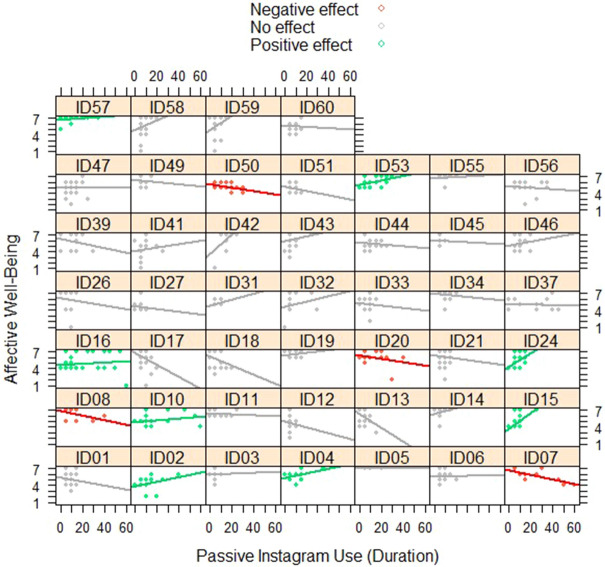
- For passive Instagram dose–response associations, 73.91% showed non-existent-to-small associations, 17.39% positive associations, and 8.70% negative associations; effect sizes ranged from −0.48 to 0.27.
- On average, there was no categorical association between overall social media use and well-being, but passive Instagram and passive WhatsApp use were associated with higher well-being at moments of use; active overall use and passive WhatsApp duration were positively associated with well-being in dose–response models.
- Active social media use generally did not show person-specific associations with well-being, whereas passive use did for overall social media and Instagram.
Methods
- Participants were 63 adolescents (M = 15.12 years, SD = 0.51; 54% girls) recruited from a secondary school in the south of the Netherlands; they completed a baseline survey and a 7-day experience sampling study with 42 surveys per adolescent (six 2-min surveys per day), yielding 2,155 assessments and 83.2% average compliance.
- Social media use was personalized to each adolescent’s three most frequently used platforms; active and passive use were measured for overall use and separately for Instagram and WhatsApp, with duration in the past hour and use/no-use dummy variables.
- Analyses used preregistered multilevel models with fixed effects for average categorical and dose–response associations, then random slopes to test heterogeneity; models were run in Mplus with MLR, predictors were person-mean centered, and a detrending covariate controlled for assessment number.
Limitations
- Stated: participants felt relatively happy overall, so more vulnerable or clinical samples may show different patterns; the study measured affective well-being as happiness, and other well-being types may relate differently; a week-long ESM is only a snapshot and cannot address longer-term consequences; passive use is broad and future work should separate passive public versus private use.
- Evident from the text: the sample was small (63 adolescents), from one school and one country, and all participants self-identified as Dutch, limiting generalizability.
- Evident from the text: social media use and well-being were self-reported, well-being was measured with a single item, and the observational ESM design cannot establish causality.
Model-written summary. Check it against the paper before relying on it.
Integrity signals
Registry
Cites
Statistics
Figures
Verification
Claims the paper makes
13 Valid · 2 Not valid · 11 Not checked · 64 Own results and interpretations
The cited sources support only part of this claim — read each source’s verdict below.
In the paper
“Orben and colleagues6 found a small negative reciprocal within-person association between the time spent using social media and life satisfaction.”
§ The effect of social media on well-being differs from adolescent to adolescent > Introduction > Person-specific effects
What the sources say
- Partly supportedcites [6] Orben A Dienlin T Przybylski AK Social media's enduring effect on adolescent life satisfaction Proc. Natl. Acad. Sci. USA 2019 116 10226 10228 10.1073/pnas.1902058116 31061122 PMC6534991 sourceExperimental — accuracy not yet measured
The Abstract reports negative within-person effects in both directions, but describes their median sizes as trivial (β = −0.05 and −0.02). It concludes that small reciprocal effects might occur in females, while emphasizing that the findings are inconsistent, gender-specific, and sensitive to analytic choices. The claim omits those qualifications. (LLM, conf=0.84)
states an association- Asserted: passes — The authors put it forward as true.
- Checkable: passes — It can be checked against evidence.
- Load-bearing: passes — The paper’s conclusions depend on it.
- Based: passes — The paper gives a reason why it holds.
- Partly supported
The cited sources support only part of this claim — read each source’s verdict below.
In the paper
“After all, adolescents often seek positive content on social media, such as humorous posts or memes32.”
§ The effect of social media on well-being differs from adolescent to adolescent > Discussion
What the sources say
- Partly supportedcites [32] Radovic A Gmelin T Stein BD Miller E Depressed adolescents' positive and negative use of social media J. Adolesc. 2017 55 5 15 10.1016/j.adolescence.2016.12.002 27997851 PMC5485251 sourceExperimental — accuracy not yet measured
Results §§3.2–3.3 report that adolescents in this study sought humorous posts and, when in a bad mood, positive or humorous content on social media. The study concerns depressed adolescents, so it does not establish that adolescents generally often do this; the cited passages also do not mention memes specifically. (LLM, conf=0.86)
plain- Asserted: passes — The authors put it forward as true.
- Checkable: passes — It can be checked against evidence.
- Load-bearing: passes — The paper’s conclusions depend on it.
- Based: passes — The paper gives a reason why it holds.
- Partly supported
The sources with a verdict support this claim; the rest weren’t checked yet, have no full text we could read, or their verdicts aren’t rated yet.
In the paper
“To our knowledge, four recent studies have investigated within-person associations of social media use with different indicators of adolescent well-being (i.e., life satisfaction, depression), again with mixed results6, 11–13.”
§ The effect of social media on well-being differs from adolescent to adolescent > Introduction > Person-specific effects
What the sources say
- Supportedcites [6] Orben A Dienlin T Przybylski AK Social media's enduring effect on adolescent life satisfaction Proc. Natl. Acad. Sci. USA 2019 116 10226 10228 10.1073/pnas.1902058116 31061122 PMC6534991 source
The Abstract identifies this as a study of within-person associations between adolescent social media use and life satisfaction. It describes the effects as inconsistent and dependent on gender and analytic method, supporting its inclusion among studies with mixed results. The sentence attributes depression findings to the group of four studies, not specifically to this paper. (LLM, conf=0.90)
- Not checked — no full text of the sourcecites [11] Coyne SM Rogers AA Zurcher JD Stockdale L Booth M Does time spent using social media impact mental health? An eight year longitudinal study Comput. Hum. Behav. 2020 104 106160 10.1016/j.chb.2019.106160 source
- Supportedcites [12] Boers E Afzali MH Newton N Conrod P Association of screen time and depression in adolescence JAMA 2019 173 853 859 10.1001/jamapediatrics.2019.1759 PMC6632122 31305878 source
The Results report a within-person association between adolescents’ social media use and depressive symptoms, so this paper is one of the studies the citing sentence identifies. “Mixed results” describes the four studies collectively, not a finding attributed to this paper alone. (LLM, conf=0.91)
- Supportedcites [13] Jensen M George MJ Russell MR Odgers CL Young adolescents’ digital technology use and mental health symptoms: Little evidence of longitudinal or daily linkages Clin. Psychol. Sci. 2019 10.1177/2167702619859336 31929951 PMC6953732 source
The Methods (Measures; page not supplied) describe daily measures that include browsing and posting on social media, alongside measures of adolescent mental-health symptoms. The Discussion (page not supplied) reports no significant daily linkages in this study and contrasts its findings with other daily-use studies, supporting its inclusion among studies with mixed results. (LLM, conf=0.88)
hedged- Asserted: passes — The authors put it forward as true.
- Checkable: passes — It can be checked against evidence.
- Load-bearing: passes — The paper’s conclusions depend on it.
- Based: passes — The paper gives a reason why it holds.
- Supported
The cited sources support only part of this claim — read each source’s verdict below.
In the paper
“Because middle adolescents typically use different social media platforms, in a complementary way25–27, each adolescent reported on his/her use of the three social media platforms that s/he used most frequently out of the five most popular social media platforms among adolescents: WhatsApp, followed by Instagram, Snapchat, YouTube, and, finally, the chat function of games28.”
§ The effect of social media on well-being differs from adolescent to adolescent > Introduction > Social media and affective well-being
What the sources say
- Not matchedcites [25] Rideout V Fox S Digital Health Practices, Social Media Use, and Mental Well-being Among Teens and Young Adults in the US 2018 San Francisco HopeLab
We searched by its title and found no matching paper.
- Partly supportedcites [26] Waterloo SF Baumgartner SE Peter J Valkenburg PM Norms of online expressions of emotion: Comparing Facebook, Twitter, Instagram, and WhatsApp New Media Soc. 2017 20 1813 1831 10.1177/1461444817707349 30581358 PMC6256717 sourceExperimental — accuracy not yet measured
The Results (Descriptive statistics; page unavailable) show that participants used about five social media platforms on average, and the section on normative differences describes distinct contexts for different platforms. But the study includes late adolescents aged 15–18 and emerging adults, not specifically middle adolescents, and does not establish that their use of platforms is complementary. (LLM, conf=0.84)
- Not matchedcites [27] Rideout V Robb MB Social Media, Social Life: Teens Reveal their Experiences 2018 San Fransico Common Sense Media
We searched by its title and found no matching paper.
plainstates an association- Asserted: passes — The authors put it forward as true.
- Checkable: passes — It can be checked against evidence.
- Load-bearing: passes — The paper’s conclusions depend on it.
- Based: passes — The paper gives a reason why it holds.
- Not matched
The cited sources support only part of this claim — read each source’s verdict below.
In the paper
“In addition, while earlier within-person studies have focused on associations with trait-like conceptualizations of well-being11–13, that is, adolescents’ average well-being across specific time periods18, there is a lack of studies that focus on well-being as a momentary affective state.”
§ The effect of social media on well-being differs from adolescent to adolescent > Introduction > Social media and affective well-being
What the sources say
- Not checked — no full text of the sourcecites [11] Coyne SM Rogers AA Zurcher JD Stockdale L Booth M Does time spent using social media impact mental health? An eight year longitudinal study Comput. Hum. Behav. 2020 104 106160 10.1016/j.chb.2019.106160 source
- Supportedcites [12] Boers E Afzali MH Newton N Conrod P Association of screen time and depression in adolescence JAMA 2019 173 853 859 10.1001/jamapediatrics.2019.1759 PMC6632122 31305878 source
The Measures and Results sections describe annual assessments of depressive symptoms and self-esteem and analyze within-person changes across years, supporting the citation’s use as an example of a study of well-being over longer periods rather than momentary affect. The statement that momentary-affect studies are lacking is the citing authors’ broader observation, not a finding attributed specifically to this paper. (LLM, conf=0.88)
- Partly supportedcites [13] Jensen M George MJ Russell MR Odgers CL Young adolescents’ digital technology use and mental health symptoms: Little evidence of longitudinal or daily linkages Clin. Psychol. Sci. 2019 10.1177/2167702619859336 31929951 PMC6953732 sourceExperimental — accuracy not yet measured
The Introduction’s “Daily Associations between Technology and Mental Health” section says few studies have used momentary assessment in this domain, supporting a general research gap. But it also describes studies of momentary positive and negative affect, so it does not establish a lack of studies specifically focused on well-being as a momentary affective state. No page number is available in our copy. (LLM, conf=0.78)
- Not checked — no full text of the sourcecites [18] Eid M Diener E Global judgments of subjective well-being: Situational variability and long-term stability Soc. Indic. Res. 2004 65 245 277 10.1023/B:SOCI.0000003801.89195.bc source
plain- Asserted: passes — The authors put it forward as true.
- Checkable: passes — It can be checked against evidence.
- Load-bearing: passes — The paper’s conclusions depend on it.
- Based: passes — The paper gives a reason why it holds.
45 more claims
Create a free account to see all 90 claims and to verify the 2 references still open.
- Probably not a substantial claim. 33
- It may state two separate claims as one. 12
Claims other papers make about this one
Each is checked against this paper’s own text: does it say what the citing paper says it does?
The cited source says what the claim attributes to it.
In the citing paper
“From a theoretical point of view, social media can thus have both positive and negative effects on adolescents, and its impact can vary between individuals [14].”
From Long-Term Consequences of Time Spent on Social Media in Adolescence on Mental Health in Young Adulthood: A Cohort Study From Sweden. (2026) · cites this paper as [14]
The cited source says what the claim attributes to it.
In the citing paper
“However, fndings regarding these outcomes remain inconsistent, and not all adolescents appear equally afected by these experiences [14, 15].”
From The Complex and Multifaceted Nature of Social Media: Perspectives From Young Adolescents, Parents and Experts (2026) · cites this paper as [14]
The cited source says what the claim attributes to it.
In the citing paper
“In contrast, studies have reported neutral, context-dependent or even positive associations [14, 15].”
From The Complex and Multifaceted Nature of Social Media: Perspectives From Young Adolescents, Parents and Experts (2026) · cites this paper as [14]
Citations
Cites
A new look at the statistical model identification
Akaike, H. (1974) · IEEE Transactions on Automatic Control · doi:10.1109/tac.1974.1100705 · Cited by 51,879
Estimating the Dimension of a Model
Schwarz, G. (1978) · The Annals of Statistics · doi:10.1214/aos/1176344136 · Cited by 47,033
Multilevel analysis techniques and applications
Hox, J. J., Moerbeek, M., & van de Schoot, R. (2002) · Cited by 6,886
Hox, J., Moerbeek, M., & van de Schoot, R. (2010) · doi:10.4324/9780203852279 · Cited by 3,469
Ensuring Positiveness of the Scaled Difference Chi-square Test Statistic
Satorra, A., & Bentler, P. M. (2010) · Psychometrika · doi:10.1007/s11336-009-9135-y · Cited by 2,695
Handbook of research methods for studying daily life
(2012) · Choice Reviews Online · doi:10.5860/choice.50-1159 · Cited by 2,111
Multilevel Analysis: Techniques and Applications
Hox, J. J., Moerbeek, M., & van de Schoot, R. (2017) · Routledge eBooks · doi:10.4324/9781315650982 · Cited by 1,671
Facebook Use Predicts Declines in Subjective Well-Being in Young Adults
Kross, E., Verduyn, P., Demiralp, E., Park, J., Lee, D. S., Lin, N., Shablack, H., Jonides, J., & Ybarra, O. (2013) · PLoS ONE · doi:10.1371/journal.pone.0069841 · Cited by 1,596
Friend networking sites and their relationship to adolescents’ well-being and social self-esteem
Valkenburg, P. M., Peter, J., & Schouten, A. P. (2006) · CyberPsychology & Behavior · doi:10.1089/cpb.2006.9.584 · Cited by 1,531
Self-citationThe Differential Susceptibility to Media Effects Model
Valkenburg, P. M., & Peter, J. (2013) · Journal of Communication · doi:10.1111/jcom.12024 · Cited by 1,340
Self-citation
Research works printed but not linked: 4
- Keijsers, L. & van Roekel, E. In Reframing Adolescent Research (eds Hendry, L. B. & Kloep, M.) (Routledge, 2018).
- Steinberg, L. Adolescence. Vol. 9 (McGraw-Hill, 2011).
- Rideout V Robb MB Social Media, Social Life: Teens Reveal their Experiences 2018 San Fransico Common Sense Media
- Muthén LK Muthén BO Mplus User's Guide 2017 8 Los Angeles Muthén & Muthén
Cited by
Items 101–200 of 522
Idiographic Network Models of Social Media Use and Depression Symptoms
Rodriguez, M., Aalbers, G., & McNally, R. J. (2021) · Cognitive Therapy and Research · doi:10.1007/s10608-021-10236-2 · Cited by 34
(2023) · doi:10.21203/rs.3.rs-3642834/v1 · Cited by 28
Petalas, D. P., Konijn, E. A., Johnson, B. K., Veldhuis, J., de Vaate, N. A. J. D. B., Burgers, C. F., Droog, E., Międzobrodzka, E., Bálint, K., & van de Schoot, R. (2021) · Social Media + Society · doi:10.1177/20563051211035353 · Cited by 34
Septiana, N. Z. (2021) · Nusantara of Research Jurnal Hasil-hasil Penelitian Universitas Nusantara PGRI Kediri · doi:10.29407/nor.v8i1.15632 · Cited by 69
Norbury, A., Liu, S. H., Campaña-Montes, J. J., Romero-Medrano, L., Barrigón, M. L., Smith, E. C., MEmind Study Group, Aroca, F., Artés-Rodríguez, A., Baca‐García, E., et al. (2020) · Molecular Psychiatry · doi:10.1038/s41380-020-00963-5 · Cited by 37
Lyyra, N., Junttila, N., Gustafsson, J., Lahti, H., & Paakkari, L. T. (2022) · Frontiers in Psychiatry · doi:10.3389/fpsyt.2022.976404 · Cited by 56
Different Types of Screen Behavior and Depression in Children and Adolescents
Kidokoro, T., Shikano, A., Tanaka, R., Tanabe, K., Imai, N., & Noi, S. (2022) · Frontiers in Pediatrics · doi:10.3389/fped.2021.822603 · Cited by 26
Impact of COVID-19 for people living and working with ADHD: A brief review of the literature
Hollingdale, J., Adamo, N., & Tierney, K. J. (2021) · AIMS Public Health · doi:10.3934/publichealth.2021047 · Cited by 30
Marciano, L., Schulz, P. J., & Camerini, A.-L. (2021) · Computers in Human Behavior · doi:10.1016/j.chb.2021.106731 · Cited by 34
Who benefits most from using social media, the socially rich or the socially poor?
Pouwels, J. L., Keijsers, L., & Odgers, C. L. (2022) · Current Opinion in Psychology · doi:10.1016/j.copsyc.2022.101351 · Cited by 48
Self-citationDeterminants of digital well-being
Mayiwar, L., Asutay, E., Tinghög, G., Västfjäll, D., & Barrafrem, K. (2024) · AI & Society · doi:10.1007/s00146-024-02071-2 · Cited by 90
The Accuracy and Validity of Self-Reported Social Media Use Measures Among Adolescents
Verbeij, T., Pouwels, J. L., Beyens, I., & Valkenburg, P. (2021) · Computers in Human Behavior Reports · doi:10.31234/osf.io/p4yb2 · Cited by 149
Self-citationMaksniemi, E., Hietajärvi, L., Ketonen, E. E., Lonka, K., Puukko, K., & Salmela‐Aro, K. (2022) · Journal of Adolescence · doi:10.1002/jad.12033 · Cited by 25
The Effects of Social Media Consumption on Adolescent Psychological Well-Being
Fumagalli, E., Shrum, L. J., & Lowrey, T. M. (2023) · Journal of the Association for Consumer Research · doi:10.1086/728739 · Cited by 38
Dietvorst, E., Legerstee, J. S., Vreeker, A., Koval, S., Mens, M. M., Keijsers, L., & Hillegers, M. H. J. (2023) · European Child & Adolescent Psychiatry · doi:10.1007/s00787-022-01982-z · Cited by 24
“The single item measure of cognitive well-being has been demonstrated to have good reliabilities that are comparable to multiple-item scales [20].”
MethodSelf-citationSiebers, T., Beyens, I., Pouwels, J. L., & Valkenburg, P. M. (2023) · Current Psychology · doi:10.1007/s12144-022-03844-y · Cited by 24
“However, when comparing the results of the distraction and procrastination studies with those of studies on well-being (Beyens et al., 2020; Table 2 Model parameters of the fixed and random effects models Note. b s are unstandardized effects. βs are standardized effects using STDY for the…”
ResultSelf-citationMasur, P. K., Veldhuis, J., & de Vaate, N. A. J. D. B. (2022) · Routledge eBooks · doi:10.4324/9781003171270-12 · Cited by 21
Donoso, G., Casas, F., Rubio, A., & Céspedes, C. (2021) · Frontiers in Psychology · doi:10.3389/fpsyg.2021.641178 · Cited by 36
Social media use in the context of the Personal Social Media Ecosystem Framework
Carter, M. C., Cingel, D. P., Ruiz, J. B., & Wartella, E. A. (2022) · Journal of Communication · doi:10.1093/joc/jqac038 · Cited by 32
Social Media and Adolescent Mental Health
Yue, Z., & Rich, M. (2023) · Current Pediatrics Reports · doi:10.1007/s40124-023-00298-z · Cited by 37
Choi, J. (2022) · Cyberpsychology Journal of Psychosocial Research on Cyberspace · doi:10.5817/cp2022-1-2 · Cited by 38
Digital Engagement and Academic Functioning: A Developmental-Contextual Approach
Hietajärvi, L., Maksniemi, E., & Salmela-Aro, K. (2022) · European Psychologist · doi:10.1027/1016-9040/a000480 · Cited by 23
“…underlying assumption is that beyond qualitative effects in the media engagement content, the resulting media effects differ between individuals (Beyens et al., 2020) because of different developmental dispositions and goals, as well as individual psychological conditions and social contexts…”
InfluentialSiebers, T., Beyens, I., Baumgartner, S. E., & Valkenburg, P. M. (2024) · Communication Research · doi:10.1177/00936502241276793 · Cited by 51
Self-citationSocial media use, sleep, and psychopathology in psychiatrically hospitalized adolescents.
Nesi, J., Burke, T. A., Extein, J., Kudinova, A. Y., Fox, K. A., Hunt, J., & Wolff, J. C. (2021) · Journal of Psychiatric Research · doi:10.1016/j.jpsychires.2021.10.014 · Cited by 22
A Manifesto for More Productive Psychological Games Research
Ballou, N. (2023) · Games Research and Practice · doi:10.1145/3582929 · Cited by 34
Mental health profiles of Finnish adolescents before and after the peak of the COVID-19 pandemic
Gustafsson, J., Lyyra, N., Jasinskaja‐Lahti, I., Simonsen, N., Lahti, H., Kulmala, M., Ojala, K., & Paakkari, L. T. (2023) · Child and Adolescent Psychiatry and Mental Health · doi:10.1186/s13034-023-00591-1 · Cited by 41
Social Media Use and Health-Related Quality of Life Among Adolescents: Cross-sectional Study
You, Y., Yang‐Huang, J., Raat, H., & van Grieken, A. (2022) · JMIR Mental Health · doi:10.2196/39710 · Cited by 31
The Kids Are / Not / Sort of All Right*
Pitt, C. R., Hock, A., Zelnick, L. R., & Davis, K. S. (2021) · CHI Conference on Human Factors in Computing Systems · doi:10.1145/3411764.3445541 · Cited by 32
Garrett, S. L., Burnell, K., Armstrong‐Carter, E., Prinstein, M. J., & Telzer, E. H. (2023) · Journal of Research on Adolescence · doi:10.1111/jora.12871 · Cited by 28
Digital Well-Being Theory and Research
(2020) · doi:10.31219/osf.io/k3e2j · Cited by 20
Nereim, C., Bickham, D. S., & Rich, M. (2022) · JMIR Formative Research · doi:10.2196/30900 · Cited by 24
Exercise or lie down? The impact of fitness app use on users' wellbeing
Cai, J., & Li, G. (2024) · Frontiers in Public Health · doi:10.3389/fpubh.2023.1281323 · Cited by 29
Vanherle, R., Kurten, S., Achterhof, R., Myin‐Germeys, I., & Beullens, K. (2021) · Substance Use & Misuse · doi:10.1080/10826084.2021.1990336 · Cited by 25
Dumas, T. M., Tremblay, P. F., Ellis, W. E., Millett, G., & Maxwell-Smith, M. A. (2022) · Computers in Human Behavior · doi:10.1016/j.chb.2022.107591 · Cited by 25
Ten Myths About the Effect of Social Media Use on Well-Being
Hall, J. A. (2024) · Journal of Medical Internet Research · doi:10.2196/59585 · Cited by 26
The importance of high quality real-life social interactions during the COVID-19 pandemic
Monninger, M., Aggensteiner, P., Pollok, T. M., Kaiser, A., Reinhard, I., Hermann, A., Reichert, M., Ebner-Priemer, U., Meyer-Lindenberg, A., Brandeis, D., et al. (2023) · Scientific Reports · doi:10.1038/s41598-023-30803-9 · Cited by 20
Risks and opportunities of digitally mediated interactions: young people’s meanings and experiences
Setty, E. (2023) · Journal of Youth Studies · doi:10.1080/13676261.2023.2211929 · Cited by 42
Teen Talk: The Good, the Bad, and the Neutral of Adolescent Social Media Use
Alluhidan, A., Akter, M., Alsoubai, A., Park, J., & Wiśniewski, P. (2024) · Proceedings of the ACM on Human-Computer Interaction · doi:10.1145/3686961 · Cited by 60
Digital White Racial Socialization: Social Media and the Case of Whiteness
Frey, W. R., Ward, L. M., Weiss, A., & Cogburn, C. D. (2022) · Journal of Research on Adolescence · doi:10.1111/jora.12775 · Cited by 27
Instagram engagement and well-being: the mediating role of appearance anxiety
Ryding, C., Harkin, L., & Kuss, D. J. (2024) · Behaviour and Information Technology · doi:10.1080/0144929x.2024.2323078 · Cited by 25
Positive Youth Development in the Digital Age: Expanding PYD to Include Digital Settings
Ross, K. M., & Tolan, P. H. (2021) · Springer series on child and family studies · doi:10.1007/978-3-030-70262-5_35 · Cited by 33
Morality in the anthropocene: The perversion of compassion and punishment in the online world
Robertson, C. E., Shariff, A., & Bavel, J. J. V. (2024) · PNAS Nexus · doi:10.1093/pnasnexus/pgae193 · Cited by 38
Chung, W. J., & Jeong, C. (2024) · Asia Pacific Journal of Tourism Research · doi:10.1080/10941665.2024.2308850 · Cited by 30
The mental health and well-being profile of young adults using social media
Cara, N. H. D., Winstone, L., Sloan, L., Davis, O. S. P., & Haworth, C. M. A. (2022) · npj Mental Health Research · doi:10.1038/s44184-022-00011-w · Cited by 30
Old Strategies, New Environments: Reinforcement Learning on Social Media
Turner, G., Ferguson, A. M., Katiyar, T., Palminteri, S., & Orben, A. C. (2024) · Biological Psychiatry · doi:10.1016/j.biopsych.2024.12.012 · Cited by 37
Tan, C. Y., Pan, Q., Tao, S., Liang, Q., Lan, M., Feng, S., Cheung, H. S., & Liu, D. (2024) · Educational Research Review · doi:10.1016/j.edurev.2024.100647 · Cited by 54
Youth online activity and distress: The role of social media rumination
Lannin, D. G., Parris, L. N., Yazedjian, A., & Hynes, K. (2021) · The Social Science Journal · doi:10.1080/03623319.2021.1985329 · Cited by 22
Reyes, M. E. S., Morales, B. C. C., Javier, G. E., Ng, R. A. E., & Zsila, Á. (2022) · Journal of Technology in Behavioral Science · doi:10.1007/s41347-022-00262-6 · Cited by 17
Rahmat, W., Tiawati, R. L., Kemal, E., Tatalia, R. G., Azri, H., & Wulandari, Y. (2023) · Journal of Communication Inquiry · doi:10.1177/01968599231174848 · Cited by 34
Unruh-Dawes, E. L., Smith, L. M., Marks, C. P. K., & Wells, T. T. (2022) · Social Media + Society · doi:10.1177/20563051221077027 · Cited by 18
Paquin, V., Ackerman, R. A., Depp, C. A., Moore, R. C., Harvey, P. D., & Pinkham, A. E. (2024) · JMIR Mental Health · doi:10.2196/59198 · Cited by 17
Happiness and Sadness in Adolescents’ Instagram Direct Messaging: A Neural Topic Modeling Approach
Verbeij, T., Beyens, I., Trilling, D., & Valkenburg, P. M. (2024) · Social Media + Society · doi:10.1177/20563051241229655 · Cited by 32
Self-citationCross‐sectional and longitudinal associations of screen time with adolescent depression and anxiety
Li, S., Batterham, P. J., Whitton, A. E., Maston, K., Khan, A., Christensen, H. M., & Werner‐Seidler, A. (2025) · British Journal of Clinical Psychology · doi:10.1111/bjc.12547 · Cited by 36
Social media wellbeing: Perceived wellbeing amidst social media use in Norway
Dutt, B. (2023) · Social Sciences & Humanities Open · doi:10.1016/j.ssaho.2023.100436 · Cited by 34
Santoro, G., Costanzo, A., Franceschini, C., Lenzo, V., Musetti, A., & Schimmenti, A. (2024) · International Journal of Environmental Research and Public Health · doi:10.3390/ijerph21030255 · Cited by 27
Schreurs, L., Lee, A. Y., Liu, X. “., & Hancock, J. T. (2024) · Communication Research · doi:10.1177/00936502241233787 · Cited by 16
“Given that media effects are conventionally theorized as taking place within individuals (Beyens et al., 2020; Valkenburg et al., 2022b), additional research is essential to investigate whether a rise in an adolescent’s reliance on social media feedback for self-worth is subsequently followed by an…”
InfluentialMeinhardt, L.-M., Elhaidary, M., Colley, M., Rietzler, M., Rixen, J. O., Purohit, A. K., & Rukzio, E. (2025) · Proceedings of the 2025 CHI Conference on Human Factors in Computing Systems · doi:10.1145/3706598.3713187 · Cited by 16
Taibi, D., Scifo, L., Bruno, N., & Fulantelli, G. (2023) · Sustainability · doi:10.3390/su151712726 · Cited by 44
What is digital parenting? A systematic review of past measurement and blueprint for the futurePreprint
Modecki, K. L., Goldberg, R., Wiśniewski, P., & Orben, A. C. (2022) · doi:10.31234/osf.io/7zng6 · Cited by 15
Relationship between digital development and subjective well-being in chilean school children
Donoso, G., Casas, F., Oyanedel, J. C., & López-Tapia, M. (2020) · Computers & Education · doi:10.1016/j.compedu.2020.104027 · Cited by 21
Tracking the temporal flows of mobile communication in daily life
Ross, M. Q., Bayer, J., Rhee, L., Potti, I., & Chang, Y.-J. (2023) · New Media & Society · doi:10.1177/14614448231158646 · Cited by 18
Effects of Social Media Use on Adolescent Psychological Well-Being: A Systematic Literature Review
Dharejo, N., Alivi, M. A., Rahamad, M. S., Jiaqing, X., & Brony, M. (2023) · International Journal of Interactive Mobile Technologies (iJIM) · doi:10.3991/ijim.v17i20.44663 · Cited by 31
Digital and Computational DemographyPreprint
Kashyap, R., Rinderknecht, R. G., Akbaritabar, A., et al. (2022) · doi:10.31235/osf.io/7bvpt · Cited by 15
Digital Media, Cognition, and Brain Development in Adolescence
Marciano, L., Dubicka, B., Magis‐Weinberg, L., Morese, R., Viswanath, K., & Weber, R. (2024) · Springer eBooks · doi:10.1007/978-3-031-69362-5_4 · Cited by 34
The Media Psychology of Boredom and Mobile Media Use: Theoretical and Methodological Innovations
Poels, K., Rudnicki, K., & Vandebosch, H. (2022) · Journal of Media Psychology Theories Methods and Applications · doi:10.1027/1864-1105/a000340 · Cited by 13
Adolescents’ Augmented Reality Filter Usage on Social Media, Developmental Process, and Well-Being
Szambolics, J., Maloș, S., & Balaban, D. C. (2023) · Media and Communication · doi:10.17645/mac.v11i4.7016 · Cited by 30
Shi, J., & Khoo, Z. (2023) · Frontiers in Psychology · doi:10.3389/fpsyg.2023.1092884 · Cited by 21
Mobile Instant Messaging Uses and Technostress: A Qualitative Approach
Ardèvol‐Abreu, A., Macchione, P. A. D., Bonache, H., & Wangüemert, C. R. (2022) · International Journal of Human-Computer Interaction · doi:10.1080/10447318.2022.2090525 · Cited by 15
Zhan, Y., Luo, L., & Hu, X. (2025) · BMC Psychology · doi:10.1186/s40359-025-03675-z · Cited by 31
Perlmutter, E., Dwyer, B., & Torous, J. (2024) · Current Treatment Options in Psychiatry · doi:10.1007/s40501-024-00312-1 · Cited by 14
Impacts of digital media on children’s well-being: A bibliometric analysis
Gui, J., Xu, J., Alivi, M. A., Zhewen, F., Dharejo, N., & Brony, M. (2024) · Online Journal of Communication and Media Technologies · doi:10.30935/ojcmt/15696 · Cited by 20
Social Media and Well-being: A Methodological PerspectivePreprint
Parry, D. A., Fisher, J. T., Mieczkowski, H., Sewall, C. J. R., & Davidson, B. I. (2021) · PsyArXiv (OSF Preprints) · doi:10.31234/osf.io/exhru · Cited by 16
In Their Own Words: How Adolescents Differ in Their Social Media Use and How it Affects ThemPreprint
van der Wal, A., Valkenburg, P. M., & van Driel, I. I. (2022) · doi:10.31234/osf.io/mvrpn · Cited by 13
Self-citationThe mnemonic consequences associated with sharing personal photographs on social media
Stone, C. B., & Zwolinski, A. (2022) · Memory, Mind & Media · doi:10.1017/mem.2022.6 · Cited by 13
Media literacy and digital citizenship
Hunt, E. A. (2022) · Elsevier eBooks · doi:10.1016/b978-0-12-818872-9.00144-8 · Cited by 22
García‐Manglano, J., López-Madrigal, C., Sádaba, C., Serrano, C., & López-Fernández, O. (2021) · International Journal of Environmental Research and Public Health · doi:10.3390/ijerph19010358 · Cited by 16
Psychological perspectives on mobile media: A flyover review
Bayer, J., Reinecke, L., & Abeele, M. V. (2022) · Mobile Media & Communication · doi:10.1177/20501579221134369 · Cited by 12
Bodroža, B., Obradović, V., & Ivanović, S. (2022) · Cyberpsychology: Journal of Psychosocial Research on Cyberspace · doi:10.5817/cp2022-2-3 · Cited by 11
Desjarlais, M. (2024) · Journal of Computer-Mediated Communication · doi:10.1093/jcmc/zmae004 · Cited by 26
Connected but at Risk: Social Media Exposure and Psychiatric and Psychological Outcomes in Youth
Marano, G., Lisci, F. M., Rossi, S., Marzo, E. M., Boggio, G., Brisi, C., Traversi, G., Mazza, O., Pola, R., Gaetani, E., et al. (2025) · Children · doi:10.3390/children12101322 · Cited by 39
Real-time personalized feedback in mHealth for adolescents
Dietvorst, E., Hillegers, M. H. J., Legerstee, J. S., de Vries, L. P., Vreeker, A., & Keijsers, L. (2024) · Digital Health · doi:10.1177/20552076241247937 · Cited by 19
Self-citationLee, J. S., & Chiu, M. M. (2024) · Studies in Second Language Learning and Teaching · doi:10.14746/ssllt.37541 · Cited by 27
Mayen, S., Reinhardt, A., & Wilhelm, C. (2025) · Journal of Children and Media · doi:10.1080/17482798.2024.2443662 · Cited by 21
Zhang, W., Yu, G., & Fu, W. (2022) · Sustainability · doi:10.3390/su14159734 · Cited by 17
Derbaix, M., Masciantonio, A., Balbo, L., Lao, A., Camus, S., Tafraouti, S. I., & Bourguignon, D. (2025) · Psychology and Marketing · doi:10.1002/mar.22194 · Cited by 39
Bidirectional Associations of Adolescents’ Momentary Social Media Use and Negative Emotions
Colasante, T., Faulkner, K., Kharbotli, D., Malti, T., & Hollenstein, T. (2024) · Affective Science · doi:10.1007/s42761-024-00244-2 · Cited by 18
de Casteele, M. V., Soenens, B., Ponnet, K. S., Perneel, S., Flamant, N., & Vansteenkiste, M. (2024) · Interacting with Computers · doi:10.1093/iwc/iwad055 · Cited by 28
Methodological and Conceptual Issues in Digital Media Research
Subrahmanyam, K., & Michikyan, M. (2022) · Cambridge University Press eBooks · doi:10.1017/9781108976237.003 · Cited by 24
Stević, A. (2024) · Social Media + Society · doi:10.1177/20563051241239282 · Cited by 25
Zheng, J., Li, E., & Liu, T. (2023) · International Journal of Human-Computer Interaction · doi:10.1080/10447318.2023.2260979 · Cited by 17
Hamilton, J. L., Dreier, M. J., Caproni, B., Fedor, J., Durica, K. C., & Low, C. A. (2024) · Journal of Technology in Behavioral Science · doi:10.1007/s41347-024-00443-5 · Cited by 24
Changing or stable? The effects of adolescents' social media use on psychosocial functioning
Pouwels, J. L., Beyens, I., Keijsers, L., & Valkenburg, P. M. (2025) · Child Development · doi:10.1111/cdev.14207 · Cited by 24
Self-citationLiang, E., Kutok, E. R., Rosen, R. K., Burke, T. A., & Ranney, M. L. (2023) · JMIR Mental Health · doi:10.2196/37711 · Cited by 23
Foubister, C., Jago, R., Sharp, S. J., & van Sluijs, E. M. F. (2023) · Pediatric Obesity · doi:10.1111/ijpo.13017 · Cited by 16
Three objections to a novel paradigm in social media effects researchPreprint
Vuorre, M., Johannes, N., & Przybylski, A. K. (2022) · PsyArXiv (OSF Preprints) · doi:10.31234/osf.io/dpuya · Cited by 12
Jütte, D., Hennig‐Thurau, T., Cziehso, G. P., & Sattler, H. (2024) · PLoS ONE · doi:10.1371/journal.pone.0296423 · Cited by 16
Ranganath, P., Hjetland, G. J., Finserås, T. R., Brunborg, G. S., Hesse, M., & Skogen, J. C. (2022) · BMC Public Health · doi:10.1186/s12889-022-14679-4 · Cited by 13
Denecker, F., Marez, L. D., Ponnet, K. S., & Abeele, M. V. (2022) · Mobile Media & Communication · doi:10.1177/20501579221134168 · Cited by 16
Trangenstein, P. J., Combs, K. G., Whitehill, J. M., Jenkins, M. C., Jernigan, D. H., & Moreno, M. A. (2022) · Prevention Science · doi:10.1007/s11121-022-01378-0 · Cited by 14
Metadata
- Authors
- Beyens, I., Pouwels, J. L., van Driel, I. I., Keijsers, L., & Valkenburg, P. M.
- Affiliations
- University of Amsterdam (NL)
- Tilburg University (NL)
- Corresponding author
- Beyens, Ine
- Venue
- Scientific Reports
- Published
- 2020-07-01
- Volume
- 10
- Issue
- 1
- Pages
- 10763-10763
- ISSN
- 2045-2322 (ISSN-L)
- PMC
- PMC7329840
- OpenAlex
- W3039124223
- Semantic Scholar
- f10462273193a69b68928d60ae76fb90e31f7ac8
- Cited by
- 497
- References
- 42
- Citations by year
- 2026: 86 · 2025: 75 · 2024: 81 · 2023: 94 · 2022: 86 · 2021: 62 · 2020: 12
- FWCI
- 84.88
- Type
- journal article
- Language
- en
- Open access
- gold
- doi.org
- Licence
- cc-by
- creativecommons.org/licenses/by/4.0 (tdm)
- creativecommons.org/licenses/by/4.0 (vor)
- Locations
- Scientific Reports (publishedVersion, cc-by)
- PubMed Central (publishedVersion, cc-by)
- Research portal (Tilburg University) (publishedVersion, other-oa)
- PubMed (publishedVersion)
- UvA-DARE (University of Amsterdam) (publishedVersion, cc-by)
- Data Archiving and Networked Services (DANS) (submittedVersion, other-oa)
- Lirias (KU Leuven) (submittedVersion, cc-by)
- Funders
- Nederlandse Organisatie voor Wetenschappelijk Onderzoek (VIDI grant (NWO VIDI Grant 452.17.011), Spinoza Prize)
- Topics
- Social Sciences › Sociology and Political Science › Impact of Technology on Adolescents
- Social Sciences › Psychology › Social Psychology › Mental Health via Writing
- Social Sciences › Education › Child Development and Digital Technology
- Keywords
- social media use, youth welfare, emotional well-being, passive social media use, within-person variability, momentary affect
- MeSH terms
- Adolescent, Adolescent Behavior, Affect, Female, Humans, Individuality, Interpersonal Relations, Male, Netherlands, Social Behavior, Social Media
About these checks
Registry, retraction, Cites and statistics results are computed, not judged, with one exception: a printed reference that no index lists is read once by a model before it counts as a citation error. Claims are extracted by a model and kept only when their quote appears verbatim in the text; each cited source is then checked, with a model’s help, for whether it says what the claim relies on. Those verdicts can be wrong — read the claim’s quote and the cited source before relying on one.
The claim verdicts this report counts are experimental: their accuracy is not yet measured.
A language model drew the claims from the paper on 2026-10-10, under version 3 of the claim definition (model deepseek-v4.1-flash, prompt extract-v3).
A second model labelled each claim on 2026-10-10 (model jev-1.13-20260917, definition revision gold-guideline-v0.2).
Cited sources are checked with a language model’s help (gpt-6-sol).
Statistics and arithmetic are recomputed, not judged.
Confidence bands are shown only for fields calibrated on our annotated test set. None is calibrated yet, so no band is shown.
What counts as a claim ›How we measure confidence ›How we check this ›
Are you an author, or do you see a problem with this page? Request a review
Data sources
Bibliographic data: Semantic Scholar, OpenAlex, Crossref.
Contains information from the Semantic Scholar Academic Graph Datasets, made available under the ODC Attribution License (ODC-BY 1.0).
Semantic Scholar’s data is described in: Kinney, R., et al. (2023). The Semantic Scholar Open Data Platform. arXiv:2301.10140.
