

Federated learning in medicine: facilitating multi-institutional collaborations without sharing patient data
Open accessThe DOI matches its Crossref record; 36 of the 36 references it cites were found in a registry or an index.
Abstract
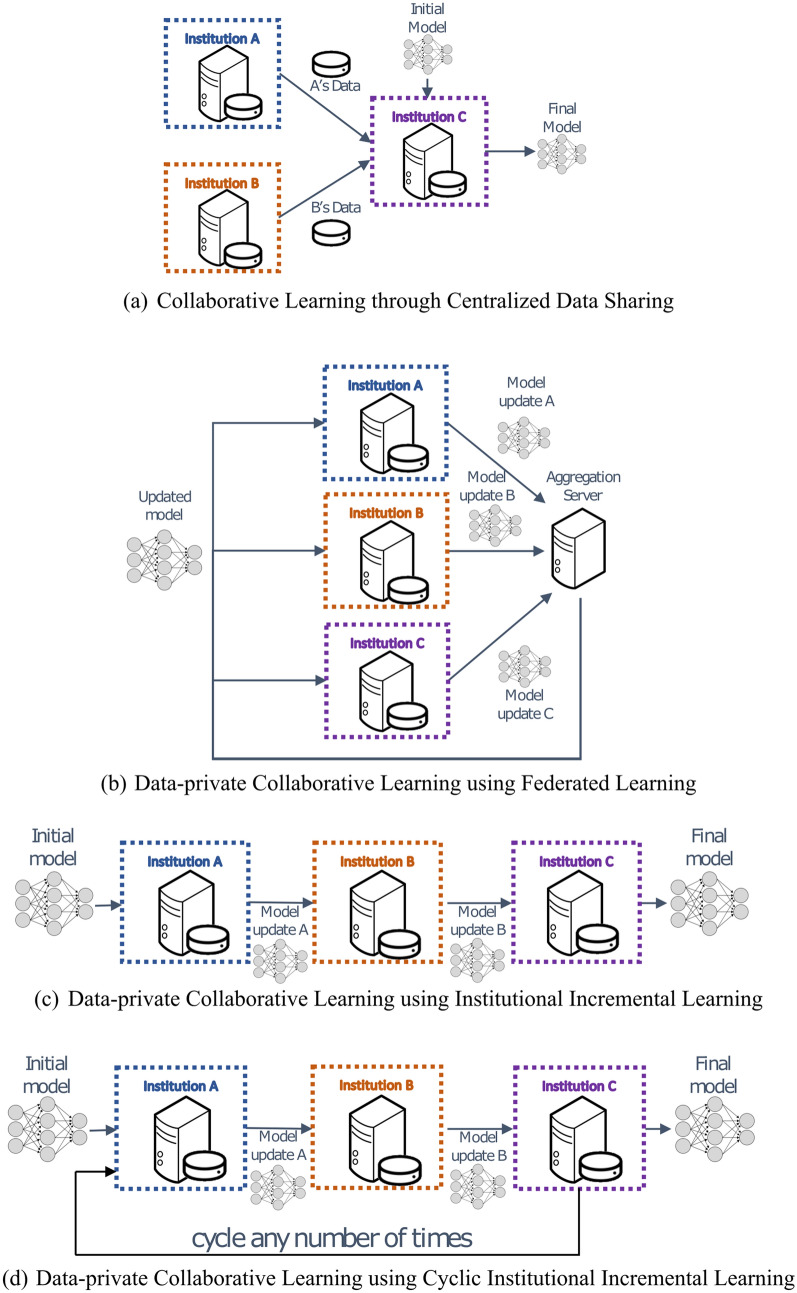
Several studies underscore the potential of deep learning in identifying complex patterns, leading to diagnostic and prognostic biomarkers. Identifying sufficiently large and diverse datasets, required for training, is a significant challenge in medicine and can rarely be found in individual institutions. Multi-institutional collaborations based on centrally-shared patient data face privacy and ownership challenges. Federated learning is a novel paradigm for data-private multi-institutional collaborations, where model-learning leverages all available data without sharing data between institutions, by distributing the model-training to the data-owners and aggregating their results. We show that federated learning among 10 institutions results in models reaching 99% of the model quality achieved with centralized data, and evaluate generalizability on data from institutions outside the federation. We further investigate the effects of data distribution across collaborating institutions on model quality and learning patterns, indicating that increased access to data through data private multi-institutional collaborations can benefit model quality more than the errors introduced by the collaborative method. Finally, we compare with other collaborative-learning approaches demonstrating the superiority of federated learning, and discuss practical implementation considerations. Clinical adoption of federated learning is expected to lead to models trained on datasets of unprecedented size, hence have a catalytic impact towards precision/personalized medicine.
Overview
The claims and statistics of this paper haven’t been checked yet.
Free: it reads the open-access text and checks the first 5 claims that cite a source we can check. Create a free account to check every claim.
Integrity signals
Registry
Cites
Statistics
Figures
Verification
Claims the paper makes
The claims and statistics of this paper haven’t been checked yet.
Free: it reads the open-access text and checks the first 5 claims that cite a source we can check. Create a free account to check every claim.
Claims other papers make about this one
Each is checked against this paper’s own text: does it say what the citing paper says it does?
The source backs part of the claim, not all of it — or backs it for a different population, condition or comparison.
In the citing paper
“Findings from these studies supported the superiority of the FL workflow used in the present study (i.e., based on an aggregation server10,14), which had almost identical performance to CL, for this use-case.”
From Federated learning enables big data for rare cancer boundary detection (2022) · cites this paper as [11]
Experimental — accuracy not yet measuredThe source backs part of the claim, not all of it — or backs it for a different population, condition or comparison.
In the citing paper
“We have identified this FL workflow (based on a central aggregation server) as the optimal for this use-case, following a performance evaluation11 for this very same task, i.e., detecting glioblastoma sub-compartment boundaries.”
From Federated learning enables big data for rare cancer boundary detection (2022) · cites this paper as [11]
Experimental — accuracy not yet measuredThe source backs part of the claim, not all of it — or backs it for a different population, condition or comparison.
In the citing paper
“However, works that examine the practical application of FL in radiological applications are still limited.20,21”
From Federated learning improves site performance in multicenter deep learning without data sharing (2021) · cites this paper as [21]
Experimental — accuracy not yet measuredThe source backs part of the claim, not all of it — or backs it for a different population, condition or comparison.
In the citing paper
“FL allows training of AI models through averaging of local updates from numerous healthcare facilities and smart devices, such as IoMT, despite the lack of local data.”
From Federated learning-based AI approaches in smart healthcare: Concepts, taxonomies, challenges and open issues (2023) · cites this paper as [12]
Experimental — accuracy not yet measuredThe source backs part of the claim, not all of it — or backs it for a different population, condition or comparison.
In the citing paper
“Federated Learning has presented itself as a viable method for implementing economic, innovative healthcare systems while ensuring privacy [11–15].”
From Federated learning-based AI approaches in smart healthcare: Concepts, taxonomies, challenges and open issues (2023) · cites this paper as [12]
Experimental — accuracy not yet measured
12 more claims about this paper
Create a free account to see every claim other papers make about this one.
Self-check
Percentages, sums and reported differences re-computed from the paper’s own numbers.
The self-check needs the paper’s full text.
Citations
Cites
Adam: A Method for Stochastic Optimization
Kingma, D. P., & Ba, J. (2014) · arXiv · doi:10.48550/arxiv.1412.6980 · Cited by 98,946
Measures of the Amount of Ecologic Association Between Species
Dice, L. R. (1945) · Ecology · doi:10.2307/1932409 · Cited by 11,874
The multimodal brain tumor image segmentation benchmark (BRATS)
Menze, B. H., Jakab, A., Bauer, S., Kalpathy-Cramer, J., Farahani, K., Kirby, J., Burren, Y., Porz, N., Slotboom, J., Wiest, R., et al. (2015) · IEEE Transactions on Medical Imaging · doi:10.1109/tmi.2014.2377694 · Cited by 6,781 · cited 10×
“The binarized whole tumor (WT) labels for the BraTS 2017 validation data and the additional 22 BraTS 2017 test cases that were moved to BraTS 2019 validation set, were provided to the lead author Micah Sheller after the conclusion of the BraTS 2018 competition and under a signed Non-Disclosure Agreement.”
MethodInfluentialThe Cancer Imaging Archive (TCIA): Maintaining and Operating a Public Information Repository
Clark, K., Vendt, B., Smith, K., Freymann, J., Kirby, J., Koppel, P., Moore, S., Phillips, S., Maffitt, D., Pringle, M., et al. (2013) · Journal of Digital Imaging · doi:10.1007/s10278-013-9622-7 · Cited by 4,599 · cited 4×
“The additional experiments conducted here attempt to evaluate model generalization under various training schemes comprising (1) single institution training, (2) LOO validation, and importantly (3) exhaustively evaluating performance differences between FL, IIL, and CIIL, by exploring convergence, “model selection”, a…”
BackgroundMethodInfluentialBakas, S., Akbari, H., Sotiras, A., Bilello, M., Rozycki, M., Kirby, J. S., Freymann, J. B., Farahani, K., & Davatzikos, C. (2017) · Scientific Data · doi:10.1038/sdata.2017.117 · Cited by 3,049
Self-citationThe EU General Data Protection Regulation (GDPR)
Voigt, P., & von dem Bussche, A. (2017) · doi:10.1007/978-3-319-57959-7 · Cited by 3,001 · cited 2×
“This study shows that data-private collaborative learning approaches, and particularly FL, can achieve the full learning capacity of the data while obviating the need to share patient data, and hence facilitate large-scale multi-institutional collaborations, while overcoming technical and data ownership concerns and a…”
BackgroundCatastrophic forgetting in connectionist networks
French, R. (1999) · Trends in Cognitive Sciences · doi:10.1016/s1364-6613(99)01294-2 · Cited by 2,311 · cited 1×
“We see this behavior as indicative of catastrophic forgetting 18 .”
BackgroundFederated Learning with Non-IID Data
Zhao, Y., Li, M., Lai, L., Suda, N., Civin, D., & Chandra, V. (2018) · arXiv · doi:10.48550/arxiv.1806.00582 · Cited by 2,077
Zech, J. R., Badgeley, M. A., Liu, M., Costa, A. B., Titano, J. J., & Oermann, E. K. (2018) · PLOS Medicine · doi:10.1371/journal.pmed.1002683 · Cited by 1,719
Bakas, S., Reyes, M., Jakab, A., Bauer, S., Rempfler, M., Crimi, A., Shinohara, R. T., Berger, C., Ha, S. M., Rozycki, M., et al. (2018) · Apollo - University of Cambridge Repository · doi:10.17863/cam.38755 · Cited by 1,441
Self-citationBakas, S., Reyes, M., Jakab, A., Bauer, S., Rempfler, M., Crimi, A., Shinohara, R. T., Berger, C., Ha, S. M., Rozycki, M., et al. (2018) · arXiv · doi:10.48550/arxiv.1811.02629 · Cited by 1,441
Self-citationThe Liver Tumor Segmentation Benchmark (LiTS)
Bilic, P., Christ, P., Li, H. B., Vorontsov, E., Ben-Cohen, A., Kaissis, G., Szeskin, A., Jacobs, C., Mamani, G. E. H., Chartrand, G., et al. (2023) · Medical Image Analysis · doi:10.1016/j.media.2022.102680 · Cited by 1,412
Self-citationThe Liver Tumor Segmentation Benchmark (LiTS)
Bilic, P., Christ, P., Li, H. B., Vorontsov, E., Ben-Cohen, A., Kaissis, G., Szeskin, A., Jacobs, C., Mamani, G. E. H., Chartrand, G., et al. (2019) · arXiv · doi:10.48550/arxiv.1901.04056 · Cited by 1,412
Self-citationFederated learning of predictive models from federated Electronic Health Records
Brisimi, T. S., Chen, R., Mela, T., Olshevsky, A., Paschalidis, I. C., & Shi, W. (2018) · International Journal of Medical Informatics · doi:10.1016/j.ijmedinf.2018.01.007 · Cited by 997 · cited 1×
“…we acknowledge that the synchronization used in this study (1 epoch per synchronization, i.e., federated round) may be insufficient for data such as electronic health records 28,29 and clinical notes, as well as genomics, where more variance might be present across international institutions.”
Simpson, A. L., Antonelli, M., Bakas, S., Bilello, M., Farahani, K., van Ginneken, B., Kopp‐Schneider, A., Landman, B. A., Litjens, G. J. S., Menze, B. H., et al. (2019) · arXiv (Cornell University) · doi:10.48550/arxiv.1902.09063 · Cited by 643
Self-citationThe Secret Sharer: Evaluating and Testing Unintended Memorization in Neural Networks
Carlini, N., Liu, C., Erlingsson, Ú., Kos, J., & Song, D. (2018) · arXiv · doi:10.48550/arxiv.1802.08232 · Cited by 629
Sheller, M. J., Reina, G. A., Edwards, B., Martin, J., & Bakas, S. (2019) · Lecture Notes in Computer Science · doi:10.1007/978-3-030-11723-8_9 · Cited by 609
Self-citationPrivacy-Preserving Federated Brain Tumour Segmentation
Li, W., Milletarì, F., Xu, D., Rieke, N., Hancox, J., Zhu, W., Baust, M., Cheng, Y., Ourselin, S., Cardoso, M. J., et al. (2019) · Lecture Notes in Computer Science · doi:10.1007/978-3-030-32692-0_16 · Cited by 578
The SRI24 multichannel atlas of normal adult human brain structure
Rohlfing, T., Zahr, N. M., Sullivan, E. V., & Pfefferbaum, A. (2010) · Human Brain Mapping · doi:10.1002/hbm.20906 · Cited by 486
HIPAA regulations - a new era of medical-record privacy?
Annas, G. J. (2003) · New England Journal of Medicine · doi:10.1056/nejmlim035027 · Cited by 402 · cited 2×
“This study shows that data-private collaborative learning approaches, and particularly FL, can achieve the full learning capacity of the data while obviating the need to share patient data, and hence facilitate large-scale multi-institutional collaborations, while overcoming technical and data ownership concerns and a…”
BackgroundDistributed deep learning networks among institutions for medical imaging
Chang, K., Balachandar, N., Lam, C., Yi, D., Brown, J., Beers, A., Rosen, B., Rubin, D. L., & Kalpathy-Cramer, J. (2018) · Journal of the American Medical Informatics Association · doi:10.1093/jamia/ocy017 · Cited by 340 · cited 9×
“We stress that CIIL “best local” requires more communication between institutions than was originally designed for 14 .”
BackgroundMethodResultInfluentialSegmentation Labels for the Pre-operative Scans of the TCGA-GBM collection
Bakas, S., Akbari, H., Sotiras, A., Bilello, M., Rozycki, M., Kirby, J., Freymann, J., Farahani, K., & Davatzikos, C. (2017) · The Cancer Imaging Archive · doi:10.7937/k9/tcia.2017.klxwjj1q · Cited by 316
Self-citationHeller, N. E., Sathianathen, N. J., Kalapara, A. A., Walczak, E. G., Moore, K., Kaluzniak, H., Rosenberg, J. E., Blake, P., Rengel, Z., Oestreich, M., et al. (2019) · arXiv (Cornell University) · doi:10.48550/arxiv.1904.00445 · Cited by 300
Segmentation Labels for the Pre-operative Scans of the TCGA-LGG collection
Bakas, S., Akbari, H., Sotiras, A., Bilello, M., Rozycki, M., Kirby, J., Freymann, J., Farahani, K., & Davatzikos, C. (2017) · The Cancer Imaging Archive · doi:10.7937/k9/tcia.2017.gjq7r0ef · Cited by 290
Self-citationVoigt, P., & von dem Bussche, A. (2017) · The EU General Data Protection Regulation (GDPR) · doi:10.1007/978-3-319-57959-7_1 · Cited by 264
Sharing Clinical Trial Data: A Proposal From the International Committee of Medical Journal Editors
Taichman, D. B., Backus, J., Baethge, C., Bauchner, H., de Leeuw, P. W., Drazen, J. M., Fletcher, J., Frizelle, F. A., Groves, T., Haileamlak, A., et al. (2016) · JAMA · doi:10.1001/jama.2015.18164 · Cited by 254
Sharing Clinical Trial Data — A Proposal from the International Committee of Medical Journal Editors
Taichman, D. B., Backus, J., Baethge, C., Bauchner, H., de Leeuw, P. W., Drazen, J. M., Fletcher, J., Frizelle, F. A., Groves, T., Haileamlak, A., et al. (2016) · New England Journal of Medicine · doi:10.1056/nejme1515172 · Cited by 190
The GLASS Consortium, Aldape, K., Amin, S. B., Ashley, D. M., Barnholtz-Sloan, J. S., Bates, A. J., Beroukhim, R., Bock, C., Brat, D. J., Claus, E. B., et al. (2018) · Neuro-Oncology · doi:10.1093/neuonc/noy020 · Cited by 180
Going Digital: A Survey on Digitalization and Large-Scale Data Analytics in Healthcare
Tresp, V., Marc Overhage, J., Bundschus, M., Rabizadeh, S., Fasching, P. A., & Yu, S. (2016) · Proceedings of the IEEE · doi:10.1109/jproc.2016.2615052 · Cited by 149
ANHIR: Automatic Non-Rigid Histological Image Registration Challenge
Borovec, J., Kybic, J., Arganda-Carreras, I., Sorokin, D. V., Bueno, G., Khvostikov, A. V., Bakas, S., Chang, E. I.-C., Heldmann, S., Kartasalo, K., et al. (2020) · IEEE Transactions on Medical Imaging · doi:10.1109/tmi.2020.2986331 · Cited by 149
Self-citationThe Secret Sharer: Measuring Unintended Neural Network Memorization & Extracting SecretsPreprint
Carlini, N., Liu, C., Kos, J., Erlingsson, Ú., & Song, D. X. (2018) · arXiv (Cornell University) · Cited by 124
Privacy Protection and Intrusion Avoidance for Cloudlet-Based Medical Data Sharing
Chen, M., Qian, Y., Chen, J., Hwang, K., Mao, S., & Hu, L. (2020) · IEEE Transactions on Cloud Computing · doi:10.1109/tcc.2016.2617382 · Cited by 110
Racial Differences in Quantitative Measures of Area and Volumetric Breast Density
McCarthy, A. M., Keller, B. M., Pantalone, L., Hsieh, M.-K., Synnestvedt, M. B., Conant, E. F., Armstrong, K., & Kontos, D. (2016) · JNCI Journal of the National Cancer Institute · doi:10.1093/jnci/djw104 · Cited by 103
Data Sharing from Clinical Trials — A Research Funder’s Perspective
Kiley, R., Peatfield, T., Hansen, J., & Reddington, F. (2017) · New England Journal of Medicine · doi:10.1056/nejmsb1708278 · Cited by 85 · cited 1×
“In contrast, data from more controlled environments (such as clinical trials) are more suitable 26,27 .”
AI-based prognostic imaging biomarkers for precision neuro-oncology: the ReSPOND consortium
Davatzikos, C., Barnholtz-Sloan, J. S., Bakas, S., Colen, R., Mahajan, A., Quintero, C. B., Capellades Font, J., Puig, J., Jain, R., Sloan, A. E., et al. (2020) · Neuro-Oncology · doi:10.1093/neuonc/noaa045 · Cited by 57
Self-citationDistributed learning from multiple EHR databases: Contextual embedding models for medical events
Li, Z., Roberts, K., Jiang, X., & Long, Q. (2019) · Journal of Biomedical Informatics · doi:10.1016/j.jbi.2019.103138 · Cited by 44
Research works printed but not linked: 3
- Fredrikson, M., Jha, S. & Ristenpart, T. in Proceedings of the 22nd ACM SIGSAC Conference on Computer and Communications Security 1322–1333 (ACM, Denver, Colorado, USA, 2015).
- Hitaj, B., Ateniese, G. & Perez-Cruz, F. in Proceedings of the 2017 ACM SIGSAC Conference on Computer and Communications Security 603–618 (ACM, Dallas, Texas, USA, 2017).
- Ronneberger, O., Fischer, P. & Brox, T. in International Conference on Medical Image Computing and Computer-Assisted Intervention. 234–241 (Springer).
Cited by
The Liver Tumor Segmentation Benchmark (LiTS)
Bilic, P., Christ, P., Li, H. B., Vorontsov, E., Ben-Cohen, A., Kaissis, G., Szeskin, A., Jacobs, C., Mamani, G. E. H., Chartrand, G., et al. (2023) · Medical Image Analysis · doi:10.1016/j.media.2022.102680 · Cited by 1,412
Self-citationThe Liver Tumor Segmentation Benchmark (LiTS)
Bilic, P., Christ, P., Li, H. B., Vorontsov, E., Ben-Cohen, A., Kaissis, G., Szeskin, A., Jacobs, C., Mamani, G. E. H., Chartrand, G., et al. (2019) · arXiv · doi:10.48550/arxiv.1901.04056 · Cited by 1,412
Self-citationTowards Personalized Federated Learning
Tan, A. Z., Yu, H., Cui, L., & Yang, Q. (2023) · IEEE Transactions on Neural Networks and Learning Systems · doi:10.1109/tnnls.2022.3160699 · Cited by 1,182
Deep learning in histopathology: the path to the clinic
van der Laak, J., Litjens, G., & Ciompi, F. (2021) · Nature Medicine · doi:10.1038/s41591-021-01343-4 · Cited by 902
Federated learning for smart healthcare: A survey
Nguyen, D. C., Pham, Q.-V., Pathirana, P. N., Ding, M., Seneviratne, A., Lin, Z., Dobre, O., & Hwang, W.-J. (2023) · ACM Computing Surveys · doi:10.1145/3501296 · Cited by 827
Metadata
- Authors
- Sheller, M. J., Edwards, B., Reina, G. A., Martin, J., Pati, S., Kotrotsou, A., Milchenko, M., Xu, W., Marcus, D., Colen, R. R., & Bakas, S.
- Affiliations
- Intel (United States) (US)
- University of Pennsylvania (US)
- The University of Texas MD Anderson Cancer Center (US)
- Washington University in St. Louis (US)
- Corresponding author
- Bakas, Spyridon
- ORCID
- Venue
- Scientific Reports
- Published
- 2020-07-28
- Volume
- 10
- Issue
- 1
- Pages
- 12598-12598
- ISSN
- 2045-2322 (ISSN-L)
- PMC
- PMC7387485
- OpenAlex
- W3045674654
- Cited by
- 1,646
- References
- 33
- Citations by year
- 2026: 482 · 2025: 401 · 2024: 227 · 2023: 215 · 2022: 201 · 2021: 110 · 2020: 10
- FWCI
- 52.64
- Type
- journal article
- Language
- en
- Open access
- gold
- doi.org
- Licence
- cc-by
- creativecommons.org/licenses/by/4.0 (tdm)
- creativecommons.org/licenses/by/4.0 (vor)
- Locations
- Scientific Reports (publishedVersion, cc-by)
- PubMed Central (publishedVersion, cc-by)
- PubMed (publishedVersion)
- Digital Commons@Becker (Washington University School of Medicine) (submittedVersion, cc-by)
- Funders
- National Cancer Institute (U24CA189523)
- UPMC CCSG (P30 CA047904)
- National Institute of Neurological Disorders and Stroke (R01NS042645)
- Topics
- Physical Sciences › Computer Science › Artificial Intelligence › Privacy-Preserving Technologies in Data
- Health Sciences › Medicine › Health Informatics › Artificial Intelligence in Healthcare and Education
- Physical Sciences › Computer Science › Artificial Intelligence › Domain Adaptation and Few-Shot Learning
- Keywords
- federated learning, multi-institutional collaboration, data privacy, patient data sharing, data ownership, model generalization, cooperative learning, precision medicine, deep learning in healthcare, biomarker discovery
- MeSH terms
- Humans, Interinstitutional Relations, Learning, Medicine, Patients, Privacy, Information Dissemination
About these checks
Registry, retraction, Cites and statistics results are computed, not judged, with one exception: a printed reference that no index lists is read once by a model before it counts as a citation error. Claims are extracted by a model and kept only when their quote appears verbatim in the text; each cited source is then checked, with a model’s help, for whether it says what the claim relies on. Those verdicts can be wrong — read the claim’s quote and the cited source before relying on one.
Statistics and arithmetic are recomputed, not judged.
Confidence bands are shown only for fields calibrated on our annotated test set. None is calibrated yet, so no band is shown.
What counts as a claim ›How we measure confidence ›How we check this ›
Are you an author, or do you see a problem with this page? Request a review
Data sources
Bibliographic data: Semantic Scholar, OpenAlex, Crossref.
Contains information from the Semantic Scholar Academic Graph Datasets, made available under the ODC Attribution License (ODC-BY 1.0).
Semantic Scholar’s data is described in: Kinney, R., et al. (2023). The Semantic Scholar Open Data Platform. arXiv:2301.10140.
