

COVID-19 predictability in the United States using Google Trends time series
Open accessPublished version of a preprint
The DOI matches its Crossref record; 48 of the 48 references it cites were found in a registry or an index.
Abstract
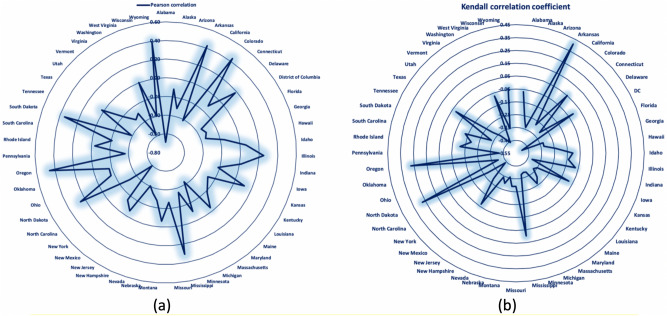
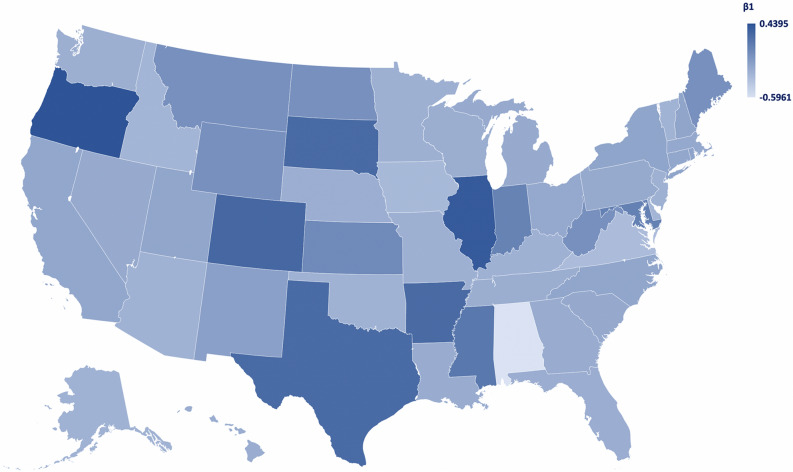
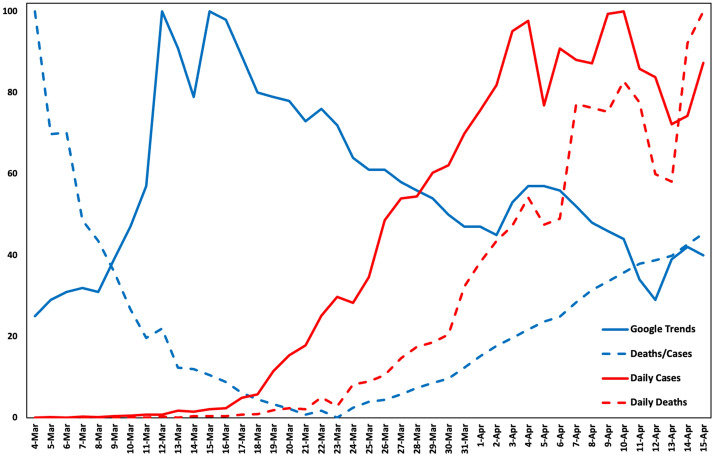
During the unprecedented situation that all countries around the globe are facing due to the Coronavirus disease 2019 (COVID-19) pandemic, which has also had severe socioeconomic consequences, it is imperative to explore novel approaches to monitoring and forecasting regional outbreaks as they happen or even before they do so. To that end, in this paper, the role of Google query data in the predictability of COVID-19 in the United States at both national and state level is presented. As a preliminary investigation, Pearson and Kendall rank correlations are examined to explore the relationship between Google Trends data and COVID-19 data on cases and deaths. Next, a COVID-19 predictability analysis is performed, with the employed model being a quantile regression that is bias corrected via bootstrap simulation, i.e., a robust regression analysis that is the appropriate statistical approach to taking against the presence of outliers in the sample while also mitigating small sample estimation bias. The results indicate that there are statistically significant correlations between Google Trends and COVID-19 data, while the estimated models exhibit strong COVID-19 predictability. In line with previous work that has suggested that online real-time data are valuable in the monitoring and forecasting of epidemics and outbreaks, it is evident that such infodemiology approaches can assist public health policy makers in addressing the most crucial issues: flattening the curve, allocating health resources, and increasing the effectiveness and preparedness of their respective health care systems.
Overview
The claims and statistics of this paper haven’t been checked yet.
Free: it reads the open-access text and checks the first 5 claims that cite a source we can check. Create a free account to check every claim.
Integrity signals
Registry
Cites
Statistics
Figures
Verification
Claims the paper makes
The claims and statistics of this paper haven’t been checked yet.
Free: it reads the open-access text and checks the first 5 claims that cite a source we can check. Create a free account to check every claim.
Claims other papers make about this one
Each is checked against this paper’s own text: does it say what the citing paper says it does?
The cited source says what the claim attributes to it.
In the citing paper
“Google Trends is a valuable tool for investigating the level of interest of the general public in a specific topic.”
From Public and Research Interest in Telemedicine From 2017 to 2022: Infodemiology Study of Google Trends Data and Bibliometric Analysis of Scientific Literature (2024) · cites this paper as [30]
Self-check
Percentages, sums and reported differences re-computed from the paper’s own numbers.
The self-check needs the paper’s full text.
Citations
Cites
Testing for a unit root in time series regression
PHILLIPS, P. C. B., & PERRON, P. (1988) · Biometrika · doi:10.1093/biomet/75.2.335 · Cited by 19,155
Koenker, R., & Bassett, G. (1978) · Econometrica · doi:10.2307/1913643 · Cited by 13,316
Efron, B., & Tibshirani, R. (1986) · Statistical Science · doi:10.1214/ss/1177013815 · Cited by 6,033
Unconditional Quantile Regressions
(2009) · Econometrica · doi:10.3982/ecta6822 · Cited by 2,226
Digital technology and COVID-19
Ting, D. S. W., Carin, L., Dzau, V., & Wong, T. Y. (2020) · Nature Medicine · doi:10.1038/s41591-020-0824-5 · Cited by 1,413
Eysenbach, G. (2009) · Journal of Medical Internet Research · doi:10.2196/jmir.1157 · Cited by 1,351 · cited 1×
“Infodemiology, i.e., information epidemiology, is a concept that was introduced by Gunther Eysenbach 11,12 .”
BackgroundCoronavirus Goes Viral: Quantifying the COVID-19 Misinformation Epidemic on Twitter
Kouzy, R., Abi Jaoude, J., Kraitem, A., El Alam, M. B., Karam, B., Adib, E., Zarka, J., Traboulsi, C., Akl, E., & Baddour, K. (2020) · Cureus · doi:10.7759/cureus.7255 · Cited by 899
Top concerns of tweeters during the COVID-19 pandemic: Infoveillance study
Abd-Alrazaq, A., Alhuwail, D., Househ, M., Hamdi, M., & Shah, Z. (2020) · Journal of Medical Internet Research · doi:10.2196/19016 · Cited by 774
Quantile regression: applications and current research areas
Yu, K., Lu, Z., & Stander, J. (2003) · Journal of the Royal Statistical Society: Series D (The Statistician) · doi:10.1111/1467-9884.00363 · Cited by 686
Google Trends in Infodemiology and Infoveillance: Methodology Framework
Mavragani, A., & Ochoa, G. (2019) · JMIR Public Health and Surveillance · doi:10.2196/13439 · Cited by 520
Self-citationBootstrap tests: how many bootstraps?
Davidson, R., & MacKinnon, J. G. (2000) · Econometric Reviews · doi:10.1080/07474930008800459 · Cited by 460
Social media for rapid knowledge dissemination: early experience from the COVID ‐19 pandemic
Chan, A. K. M., Nickson, C. P., Rudolph, J. W., Lee, A., & Joynt, G. M. (2020) · Anaesthesia · doi:10.1111/anae.15057 · Cited by 459
Infodemiology and Infoveillance
Eysenbach, G. (2011) · American Journal of Preventive Medicine · doi:10.1016/j.amepre.2011.02.006 · Cited by 414
Mavragani, A., Ochoa, G., & Tsagarakis, K. P. (2018) · Journal of Medical Internet Research · doi:10.2196/jmir.9366 · Cited by 390
Self-citationAyyoubzadeh, S. M., Ayyoubzadeh, S. M., Zahedi, H., Ahmadi, M., & R Niakan Kalhori, S. (2020) · JMIR Public Health and Surveillance · doi:10.2196/18828 · Cited by 378
Rosenberg, H., Syed, S., & Rezaie, S. (2020) · CJEM · doi:10.1017/cem.2020.361 · Cited by 342
Li, C., Chen, L. J., Chen, X., Zhang, M., Pang, C. P., & Chen, H. (2020) · Eurosurveillance · doi:10.2807/1560-7917.es.2020.25.10.2000199 · Cited by 313
World leaders' usage of twitter in response to the COVID-19 pandemic: A content analysis
Rufai, S. R., & Bunce, C. (2020) · Journal of Public Health · doi:10.1093/pubmed/fdaa049 · Cited by 308 · cited 1×
“Note that for Twitter publications related to the COVID-19 pandemic, eight papers (8) published from March 13, 2020 to April 20, 2020 31–38 are available online (PubMed advanced search: covid AND twitter 23 ).”
BackgroundAssociation of the COVID-19 pandemic with internet search volumes: a Google Trends™ analysis
Effenberger, M., Kronbichler, A., Shin, J. I., Mayer, G., Tilg, H., & Perco, P. (2020) · International Journal of Infectious Diseases · doi:10.1016/j.ijid.2020.04.033 · Cited by 270
Husnayain, A., Fuad, A., & Su, E. C.-Y. (2020) · International Journal of Infectious Diseases · doi:10.1016/j.ijid.2020.03.021 · Cited by 249
Hong, Y.-R., Lawrence, J., Williams Jr, D., & Mainous III, A. (2020) · JMIR Public Health and Surveillance · doi:10.2196/18961 · Cited by 236 · cited 1×
“…April 20, 2020, seven (7) papers on the topic of monitoring, tracking, and forecasting COVID-19 using Google Trends data had already appeared online in PubMed (advanced search: covid AND google trends) 23 for several regions: Taiwan 24 , China 25,26 , Europe 27,28 , the US 28,29 , and Iran 28,30 .”
BackgroundCOVID-19: Global radiation oncology’s targeted response for pandemic preparedness
Simcock, R., Thomas, T. V., Estes, C., Filippi, A. R., Katz, M. S., Pereira, I. J., & Saeed, H. (2020) · Clinical and Translational Radiation Oncology · doi:10.1016/j.ctro.2020.03.009 · Cited by 230
Infodemiology and Infoveillance: Scoping Review
Mavragani, A. (2020) · Journal of Medical Internet Research · doi:10.2196/16206 · Cited by 229
Self-citationUse of Google Trends to investigate loss-of-smell-related searches during the COVID-19 outbreak
Walker, A., Hopkins, C., & Surda, P. (2020) · International Forum of Allergy & Rhinology · doi:10.1002/alr.22580 · Cited by 216
Wang, P., Lu, W.-H., Ko, N., Chen, Y., Li, D., Chang, Y., & Yen, C. (2020) · Journal of Medical Internet Research · doi:10.2196/20021 · Cited by 174
Bootrapping robust estimates of regression
Salibian-Barrera, M., & Zamar, R. H. (2002) · The Annals of Statistics · doi:10.1214/aos/1021379865 · Cited by 172
Bernardo, T. M., Rajic, A., Young, I., Robiadek, K., Pham, M. T., & Funk, J. A. (2013) · Journal of Medical Internet Research · doi:10.2196/jmir.2740 · Cited by 163
Eghtesadi, M., & Florea, A. (2020) · Canadian Journal of Public Health · doi:10.17269/s41997-020-00343-0 · Cited by 155
Tracking COVID-19 in Europe: infodemiology approach
Mavragani, A. (2020) · JMIR Public Health and Surveillance · doi:10.2196/18941 · Cited by 145
Self-citationSelf-reported COVID-19 symptoms on Twitter: an analysis and a research resource
Sarker, A., Lakamana, S., Hogg-Bremer, W., Xie, A., Al-Garadi, M. A., & Yang, Y.-C. (2020) · Journal of the American Medical Informatics Association · doi:10.1093/jamia/ocaa116 · Cited by 133
From the Help Desk: Bootstrapped Standard Errors
Guan, W. (2003) · The Stata Journal: Promoting communications on statistics and Stata · doi:10.1177/1536867x0300300105 · Cited by 119
Finite sample inference for quantile regression models
Chernozhukov, V., Hansen, C., & Jansson, M. (2009) · Journal of Econometrics · doi:10.1016/j.jeconom.2009.01.004 · Cited by 106
A Rank Correlation Coefficient Resistant to Outliers
Gideon, R. A., & Hollister, R. A. (1987) · Journal of the American Statistical Association · doi:10.1080/01621459.1987.10478480 · Cited by 98
Too Far to Care? Measuring Public Attention and Fear for Ebola Using Twitter
van Lent, L. G., Sungur, H., Kunneman, F. A., van de Velde, B., & Das, E. (2017) · Journal of Medical Internet Research · doi:10.2196/jmir.7219 · Cited by 92
Hou, Z., Du, F., Zhou, X., Jiang, H., Martin, S., Larson, H., & Lin, L. (2020) · Journal of Medical Internet Research · doi:10.2196/21143 · Cited by 92
SARS and Population Health Technology
Eysenbach, G. (2003) · Journal of Medical Internet Research · doi:10.2196/jmir.5.2.e14 · Cited by 88
Effects of Social Grooming on Incivility in COVID-19
Kim, B. (2020) · Cyberpsychology, Behavior, and Social Networking · doi:10.1089/cyber.2020.0201 · Cited by 63
Perceptions of public on the COVID-19 outbreak in Singapore: a qualitative content analysis
Shorey, S., Ang, E. N. K., Yamina, A., & Tam, C. C. (2020) · Journal of Public Health · doi:10.1093/pubmed/fdaa105 · Cited by 62
Dost, B., Koksal, E., Terzi, Ö., Bilgin, S., Ustun, Y. B., & Arslan, H. N. (2020) · Surgical Infections · doi:10.1089/sur.2020.097 · Cited by 61
Comparing Social media and Google to detect and predict severe epidemics
Samaras, L., García‐Barriocanal, E., & Sicilia, M. (2020) · Scientific Reports · doi:10.1038/s41598-020-61686-9 · Cited by 59
Poletto, C., Boëlle, P.-Y., & Colizza, V. (2016) · BMC Infectious Diseases · doi:10.1186/s12879-016-1787-5 · Cited by 58
Du, J., Tang, L., Xiang, Y., Zhi, D., Xu, J., Song, H.-Y., & Tao, C. (2018) · Journal of Medical Internet Research · doi:10.2196/jmir.9413 · Cited by 53
The Internet and the Anti-Vaccine Movement: Tracking the 2017 EU Measles Outbreak
Mavragani, A., & Ochoa, G. (2018) · Big Data and Cognitive Computing · doi:10.3390/bdcc2010002 · Cited by 48
Self-citationFarhadloo, M., Winneg, K., Chan, M.-P. S., Hall Jamieson, K., & Albarracin, D. (2018) · JMIR Public Health and Surveillance · doi:10.2196/publichealth.8186 · Cited by 42
Nikitina, L., Paidi, R., & Furuoka, F. (2019) · PLoS ONE · doi:10.1371/journal.pone.0210668 · Cited by 40
Karlsson, A. (2009) · Journal of Statistical Computation and Simulation · doi:10.1080/00949650802221180 · Cited by 29
Principles of quantile regression and an application
Chen, F., & Chalhoub-Deville, M. B. (2013) · Language Testing · doi:10.1177/0265532213493623 · Cited by 24
Hou, Z., Du, F., Zhou, X., et al. (2020) · SSRN Electronic Journal · doi:10.2139/ssrn.3586661 · Cited by 3
Research works printed but not linked: 3
- Google Trends & COVID Advanced Search. Pubmed. https://www.ncbi.nlm.nih.gov/pubmed/ (2020).
- Koenker R Hallock KF Quantile regression J. Econ. Percepct. 2001 15 4 143 156
- Rufai RS Bunce C World leaders’ usage of Twitter in response to the COVID-19 pandemic: A content analysis J. Public Health. 2020 42 3 510 516 10.1093/pubmed/fdaa049 PMC7188178 32309854 · DOI · Paper page
Cited by
Rovetta, A. (2021) · Frontiers in Research Metrics and Analytics · doi:10.3389/frma.2021.670226 · Cited by 162
Mangono, T., Smittenaar, P., Caplan, Y., Huang, V., Sutermaster, S., Kemp, H., & Sgaier, S. K. (2021) · Journal of Medical Internet Research · doi:10.2196/22933 · Cited by 108
Addressing bias in artificial intelligence for public health surveillance
Flores, L., Kim, S., & Young, S. D. (2023) · Journal of Medical Ethics · doi:10.1136/jme-2022-108875 · Cited by 75
Characterizing all-cause excess mortality patterns during COVID-19 pandemic in Mexico
Dahal, S., Banda, J. M., Bento, A. I., Mizumoto, K., & Chowell, G. (2021) · BMC Infectious Diseases · doi:10.1186/s12879-021-06122-7 · Cited by 52
van Kessel, R., Kyriopoulos, I., Wong, B. L. H., & Mossialos, E. (2023) · Journal of Medical Internet Research · doi:10.2196/42401 · Cited by 49
Metadata
- Authors
- Mavragani, A., & Gkillas, K.
- Affiliations
- University of Stirling (GB)
- Corresponding author
- Mavragani, Amaryllis
- ORCID
- Mavragani, Amaryllis
- Venue
- Scientific Reports
- Published
- 2020-11-26
- Volume
- 10
- Issue
- 1
- Pages
- 20693-20693
- ISSN
- 2045-2322 (ISSN-L)
- PMC
- PMC7692493
- OpenAlex
- W3108491385
- Cited by
- 140
- References
- 48
- Citations by year
- 2026: 7 · 2025: 14 · 2024: 21 · 2023: 31 · 2022: 31 · 2021: 32 · 2020: 4
- FWCI
- 17.55
- Type
- journal article
- Language
- en
- Open access
- gold
- doi.org
- Licence
- cc-by
- creativecommons.org/licenses/by/4.0 (tdm)
- creativecommons.org/licenses/by/4.0 (vor)
- Locations
- Scientific Reports (publishedVersion, cc-by)
- Research Square (acceptedVersion, cc-by)
- PubMed Central (publishedVersion, cc-by)
- PubMed (publishedVersion)
- Stirling Online Research Repository (University of Stirling) (submittedVersion, cc-by)
- Informationszentrum Lebenswissenschaften (ZB MED) (submittedVersion, cc-by)
- Topics
- Health Sciences › Medicine › Epidemiology › Data-Driven Disease Surveillance
- Physical Sciences › Mathematics › Modeling and Simulation › COVID-19 epidemiological studies
- Social Sciences › Transportation › Human Mobility and Location-Based Analysis
- Keywords
- COVID-19 pandemic, Google Trends, search data, infodemiology, epidemic forecasting, quantile regression, bootstrap bias correction, COVID-19 case counts, COVID-19 mortality, United States
- MeSH terms
- COVID-19, SARS-CoV-2, Forecasting, Humans, Prognosis, Public Health, United States, Models, Statistical, Information Dissemination, Search Engine, Pandemics, Social Media, Public Health Surveillance
About these checks
Registry, retraction, Cites and statistics results are computed, not judged, with one exception: a printed reference that no index lists is read once by a model before it counts as a citation error. Claims are extracted by a model and kept only when their quote appears verbatim in the text; each cited source is then checked, with a model’s help, for whether it says what the claim relies on. Those verdicts can be wrong — read the claim’s quote and the cited source before relying on one.
Statistics and arithmetic are recomputed, not judged.
Confidence bands are shown only for fields calibrated on our annotated test set. None is calibrated yet, so no band is shown.
What counts as a claim ›How we measure confidence ›How we check this ›
Are you an author, or do you see a problem with this page? Request a review
Data sources
Bibliographic data: Semantic Scholar, OpenAlex, Crossref.
Contains information from the Semantic Scholar Academic Graph Datasets, made available under the ODC Attribution License (ODC-BY 1.0).
Semantic Scholar’s data is described in: Kinney, R., et al. (2023). The Semantic Scholar Open Data Platform. arXiv:2301.10140.
