

Obstructive sleep apnoea increases lipolysis and deteriorates glucose homeostasis in patients with type 2 diabetes mellitus
Open accessThe DOI matches its Crossref record; 74 of the 74 references it cites were found in a registry or an index.
Abstract
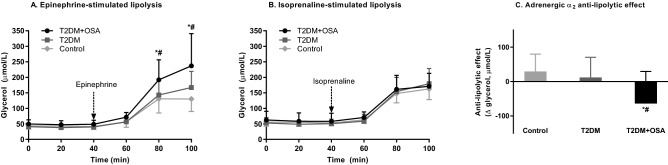
Obstructive sleep apnoea (OSA) is associated with type 2 diabetes mellitus (T2DM). However, mechanisms mediating association between these two conditions remain unclear. This study investigated, whether the OSA-associated changes in adipose tissue lipolysis might contribute to impaired glucose homeostasis in patient with T2DM. Thirty-five matched subjects were recruited into three groups: T2DM + severe OSA (T2DM + OSA, n = 11), T2DM with mild/no OSA (T2DM, n = 10) and healthy controls (n = 14). Subcutaneous abdominal adipose tissue microdialysis assessed spontaneous, epinephrine- and isoprenaline-stimulated lipolysis. Glucose metabolism was assessed by intravenous glucose tolerance test. Spontaneous lipolysis was higher in the T2DM + OSA compared with the T2DM (60.34 ± 23.40 vs. 42.53 ± 10.16 μmol/L, p = 0.013), as well as epinephrine-stimulated lipolysis (236.84 ± 103.90 vs. 167.39 ± 52.17 µmol/L, p < 0.001). Isoprenaline-stimulated lipolysis was unaffected by the presence of OSA (p = 0.750). The α 2 anti-lipolytic effect was decreased in T2DM + OSA by 59% and 315% compared with T2DM and controls (p = 0.045 and p = 0.007, respectively). The severity of OSA (AHI) was positively associated with spontaneous (p = 0.037) and epinephrine-stimulated (p = 0.026) lipolysis. The α 2-adrenergic anti-lipolytic effect (p = 0.043) decreased with increasing AHI. Spontaneous lipolysis was positively associated with Insulin resistance (r = 0.50, p = 0.002). Epinephrine-stimulated lipolysis was negatively associated with the Disposition index (r = − 0.34, p = 0.048). AHI was positively associated with Insulin resistance (p = 0.017) and negatively with the Disposition index (p = 0.038). Severe OSA in patients with T2DM increased adipose tissue lipolysis, probably due to inhibition of the α 2-adrenergic anti-lipolytic effect. We suggest that dysregulated lipolysis might contribute to OSA-associated impairments in insulin secretion and sensitivity.
Overview
The claims and statistics of this paper haven’t been checked yet.
Free: it reads the open-access text and checks the first 5 claims that cite a source we can check. Create a free account to check every claim.
Integrity signals
Registry
Cites
Statistics
Figures
Verification
Claims the paper makes
The claims and statistics of this paper haven’t been checked yet.
Free: it reads the open-access text and checks the first 5 claims that cite a source we can check. Create a free account to check every claim.
Claims other papers make about this one
Each is checked against this paper’s own text: does it say what the citing paper says it does?
The source backs part of the claim, not all of it — or backs it for a different population, condition or comparison.
In the citing paper
“In humans, OSA was associated with increased spontaneous lipolysis that correlated with the severity of OSA as well as insulin resistance and impaired insulin secretion in patients with type 2 DM.”
From International Consensus Statement on Obstructive Sleep Apnea (2023) · cites this paper as [817]
Experimental — accuracy not yet measuredThe source backs part of the claim, not all of it — or backs it for a different population, condition or comparison.
In the citing paper
“Several authors have outlined a role for episodic hypoxia during apneic events promoting increased adipose lipolysis and levels of free fatty acids systemically which have a pro-inflammatory effects leading to dysregulated glucose homeostasis and reduced insulin sensitivity.”
From International Consensus Statement on Obstructive Sleep Apnea (2023) · cites this paper as [817]
Experimental — accuracy not yet measured
Self-check
Percentages, sums and reported differences re-computed from the paper’s own numbers.
The self-check needs the paper’s full text.
Citations
Cites
Global aetiology and epidemiology of type 2 diabetes mellitus and its complications
Zheng, Y., Ley, S. H., & Hu, F. B. (2018) · Nature Reviews Endocrinology · doi:10.1038/nrendo.2017.151 · Cited by 5,697
Cosentino, F., Grant, P. J., Aboyans, V., Bailey, C. J., Ceriello, A., Delgado, V., Federici, M., Filippatos, G., Grobbee, D. E., Hansen, T. B., et al. (2020) · European Heart Journal · doi:10.1093/eurheartj/ehz486 · Cited by 4,763
(2013) · European Heart Journal · doi:10.1093/eurheartj/eht108 · Cited by 1,955
Jung, U., & Choi, M.-S. (2014) · International Journal of Molecular Sciences · doi:10.3390/ijms15046184 · Cited by 1,880
Mechanisms of Pancreatic β-Cell Death in Type 1 and Type 2 Diabetes
Cnop, M., Welsh, N., Jonas, J.-C., Jörns, A., Lenzen, S., & Eizirik, D. L. (2005) · Diabetes · doi:10.2337/diabetes.54.suppl_2.s97 · Cited by 1,491
Adipose tissue dysfunction in obesity, diabetes, and vascular diseases
Hajer, G. R., van Haeften, T. W., & Visseren, F. L. J. (2008) · European Heart Journal · doi:10.1093/eurheartj/ehn387 · Cited by 1,410
Lipid-induced insulin resistance: unravelling the mechanism
Samuel, V. T., Petersen, K. F., & Shulman, G. I. (2010) · The Lancet · doi:10.1016/s0140-6736(10)60408-4 · Cited by 1,189
Kelley, D. E., Goodpaster, B., Wing, R. R., & Simoneau, J.-A. (1999) · American Journal of Physiology-Endocrinology and Metabolism · doi:10.1152/ajpendo.1999.277.6.e1130 · Cited by 1,096
Fuel selection in human skeletal muscle in insulin resistance: a reexamination.
Kelley, D. E., & Mandarino, L. J. (2000) · Diabetes · doi:10.2337/diabetes.49.5.677 · Cited by 1,017
Boden, G. (2008) · Endocrinology and Metabolism Clinics of North America · doi:10.1016/j.ecl.2008.06.007 · Cited by 853
Fat cell adrenergic receptors and the control of white and brown fat cell function
Lafontan, M., & Berlan, M. (1993) · Journal of Lipid Research · doi:10.1016/s0022-2275(20)37695-1 · Cited by 641
Free Fatty Acids and Pathogenesis of Type 2 Diabetes Mellitus
BERGMAN, R., & ADER, M. (2000) · Trends in Endocrinology and Metabolism · doi:10.1016/s1043-2760(00)00323-4 · Cited by 622
Emerging role of adipose tissue hypoxia in obesity and insulin resistance
Ye, J. (2009) · International Journal of Obesity · doi:10.1038/ijo.2008.229 · Cited by 543
Nauck, M. A., & Meier, J. J. (2016) · The Lancet Diabetes & Endocrinology · doi:10.1016/s2213-8587(15)00482-9 · Cited by 503
Adipocyte lipolysis and insulin resistance
Morigny, P., Houssier, M., Mouisel, E., & Langin, D. (2016) · Biochimie · doi:10.1016/j.biochi.2015.10.024 · Cited by 469
Impact of untreated obstructive sleep apnea on glucose control in type 2 diabetes
Aronsohn, R. S., Whitmore, H., Van Cauter, E., & Tasali, E. (2010) · American Journal of Respiratory and Critical Care Medicine · doi:10.1164/rccm.200909-1423oc · Cited by 453
Boston, R. C., Stefanovski, D., Moate, P. J., Sumner, A. E., Watanabe, R. M., & Bergman, R. N. (2003) · Diabetes Technology & Therapeutics · doi:10.1089/152091503322641060 · Cited by 431
Relevance of Sympathetic Nervous System Activation in Obesity and Metabolic Syndrome
Thorp, A. A., & Schlaich, M. P. (2015) · Journal of Diabetes Research · doi:10.1155/2015/341583 · Cited by 425
Sympathetic nerve activity in obstructive sleep apnoea
Narkiewicz, K., & Somers, V. K. (2003) · Acta Physiologica Scandinavica · doi:10.1046/j.1365-201x.2003.01091.x · Cited by 416
Intermittent Hypoxia Increases Insulin Resistance in Genetically Obese Mice
Polotsky, V. Y., Li, J., Punjabi, N. M., Rubin, A. E., Smith, P. L., Schwartz, A. R., & O'Donnell, C. P. (2003) · The Journal of Physiology · doi:10.1113/jphysiol.2003.048173 · Cited by 376
Intermittent Hypoxia Causes Insulin Resistance in Lean Mice Independent of Autonomic Activity
Iiyori, N., Alonso, L. C., Li, J., Sanders, M. H., Garcia-Ocana, A., O'Doherty, R. M., Polotsky, V. Y., & O'Donnell, C. P. (2007) · American Journal of Respiratory and Critical Care Medicine · doi:10.1164/rccm.200610-1527oc · Cited by 373
Obstructive Sleep Apnea and Type 2 Diabetes
Tasali, E., Mokhlesi, B., & Van Cauter, E. (2008) · Chest · doi:10.1378/chest.07-0828 · Cited by 371
Obstructive sleep apnea and type 2 diabetes
Rasche, K., Keller, T., Tautz, B., Hader, C., Hergenç, G., Antosiewicz, J., Di Giulio, C., & Pokorski, M. (2010) · European Journal of Medical Research · doi:10.1186/2047-783x-15-s2-152 · Cited by 369
Boden, G. (2003) · Experimental and Clinical Endocrinology & Diabetes · doi:10.1055/s-2003-39781 · Cited by 348
Obstructive Sleep Apnea and Heart Failure
Kasai, T., & Bradley, T. D. (2011) · Journal of the American College of Cardiology · doi:10.1016/j.jacc.2010.08.627 · Cited by 345
Effects of acute intermittent hypoxia on glucose metabolism in awake healthy volunteers.
Louis, M., & Punjabi, N. M. (2009) · Journal of Applied Physiology · doi:10.1152/japplphysiol.91523.2008 · Cited by 342
The impact of sleep disorders on glucose metabolism: endocrine and molecular mechanisms
Briançon-Marjollet, A., Weiszenstein, M., Henri, M., Thomas, A., Godin-Ribuot, D., & Polak, J. (2015) · Diabetology & Metabolic Syndrome · doi:10.1186/s13098-015-0018-3 · Cited by 311
Self-citationGender differences in obstructive sleep apnea syndrome: a clinical study of 1166 patients
Quintana-Gallego, E., Carmona-Bernal, C., Capote, F., Sánchez-Armengol, Á., Botebol-Benhamou, G., Polo-Padillo, J., & Castillo-Gómez, J. (2004) · Respiratory Medicine · doi:10.1016/j.rmed.2004.03.002 · Cited by 304
Invited Review: Physiological and pathophysiological responses to intermittent hypoxia
Neubauer, J. A. (2001) · Journal of Applied Physiology · doi:10.1152/jappl.2001.90.4.1593 · Cited by 302
Obstructive sleep apnoea and type 2 diabetes mellitus: a bidirectional association
Aurora, R. N., & Punjabi, N. M. (2013) · The Lancet Respiratory Medicine · doi:10.1016/s2213-2600(13)70039-0 · Cited by 273
Girousse, A., Tavernier, G., Valle, C., Moro, C., Mejhert, N., Dinel, A.-L., Houssier, M., Roussel, B., Besse-Patin, A., Combes, M., et al. (2013) · PLoS Biology · doi:10.1371/journal.pbio.1001485 · Cited by 221
β-adrenoceptor signaling networks in adipocytes for recruiting stored fat and energy expenditure
Collins, S. (2011) · Frontiers in Endocrinology · doi:10.3389/fendo.2011.00102 · Cited by 221
Martínez-Cerón, E., Barquiel, B., Bezos, A.-M., Casitas, R., Galera, R., García-Benito, C., Hernanz, A., Alonso-Fernández, A., & Garcia-Rio, F. (2016) · American Journal of Respiratory and Critical Care Medicine · doi:10.1164/rccm.201510-1942oc · Cited by 214
Winkler, G., Kiss, S., Keszthelyi, L., Sapi, Z., Ory, I., Salamon, F., Kovacs, M., Vargha, P., Szekeres, O., Speer, G., et al. (2003) · European Journal of Endocrinology · doi:10.1530/eje.0.1490129 · Cited by 213
Heterogeneity of pig intestinal d-glucose transport systems
Halaihel, N., Gerbaud, D., Vasseur, M., & Alvarado, F. (1999) · American Journal of Physiology-Cell Physiology · doi:10.1152/ajpcell.1999.277.6.c1130 · Cited by 199
Tahrani, A. A., Ali, A., Raymond, N. T., Begum, S., Dubb, K., Mughal, S., Jose, B., Piya, M. K., Barnett, A. H., & Stevens, M. J. (2012) · American Journal of Respiratory and Critical Care Medicine · doi:10.1164/rccm.201112-2135oc · Cited by 196
Spaak, J., Egri, Z. J., Kubo, T., Yu, E., Ando, S.-I., Kaneko, Y., Usui, K., Bradley, T. D., & Floras, J. S. (2005) · Hypertension · doi:10.1161/01.hyp.0000193497.45200.66 · Cited by 190
Boden, G., Chen, X., Capulong, E., & Mozzoli, M. (2001) · Diabetes · doi:10.2337/diabetes.50.4.810 · Cited by 175
Effects of different acute hypoxic regimens on tissue oxygen profiles and metabolic outcomes
Reinke, C., Bevans-Fonti, S., Drager, L. F., Shin, M.-K., & Polotsky, V. Y. (2011) · Journal of Applied Physiology · doi:10.1152/japplphysiol.00492.2011 · Cited by 174
Adipose triglyceride lipase regulates basal lipolysis and lipid droplet size in adipocytes
Miyoshi, H., Perfield, J. W., Obin, M. S., & Greenberg, A. S. (2008) · Journal of Cellular Biochemistry · doi:10.1002/jcb.21964 · Cited by 169
Pagnon, J., Matzaris, M., Stark, R., Meex, R. C. R., Macaulay, S. L., Brown, W., O'Brien, P. E., Tiganis, T., & Watt, M. J. (2012) · Endocrinology · doi:10.1210/en.2012-1127 · Cited by 163
The Effect of Treatment of Obstructive Sleep Apnea on Glycemic Control in Type 2 Diabetes
Shaw, J. E., Punjabi, N. M., Naughton, M. T., Willes, L., Bergenstal, R. M., Cistulli, P. A., Fulcher, G. R., Richards, G. N., & Zimmet, P. Z. (2016) · American Journal of Respiratory and Critical Care Medicine · doi:10.1164/rccm.201511-2260oc · Cited by 150
Mechanisms of sympathetic activation and blood pressure elevation by intermittent hypoxia
Prabhakar, N. R., & Kumar, G. K. (2010) · Respiratory Physiology & Neurobiology · doi:10.1016/j.resp.2010.08.021 · Cited by 144
β-cell death and proliferation after intermittent hypoxia: Role of oxidative stress
Xu, J., Long, Y., Gozal, D., & Epstein, P. N. (2008) · Free Radical Biology and Medicine · doi:10.1016/j.freeradbiomed.2008.11.026 · Cited by 133
Effects of Dietary Fatty Acids in Pancreatic Beta Cell Metabolism, Implications in Homeostasis
Acosta-Montaño, P., & García‐González, V. (2018) · Nutrients · doi:10.3390/nu10040393 · Cited by 131
Polak, J., Shimoda, L. A., Drager, L. F., Undem, C., McHugh, H., Polotsky, V. Y., & Punjabi, N. M. (2013) · Sleep · doi:10.5665/sleep.3040 · Cited by 126
Self-citationYokoe, T., Alonso, L. C., Romano, L. C., Rosa, T. C., O'Doherty, R. M., Garcia‐Ocana, A., Minoguchi, K., & O'Donnell, C. P. (2008) · The Journal of Physiology · doi:10.1113/jphysiol.2007.143586 · Cited by 123
The sympathetic nervous system and catecholamines metabolism in obstructive sleep apnoea.
Bisogni, V., Pengo, M. F., Maiolino, G., & Rossi, G. P. (2016) · PubMed Central · doi:10.3978/j.issn.2072-1439.2015.11.14 · Cited by 123
Chopra, S., Rathore, A., Younas, H., Pham, L. V., Gu, C., Beselman, A., Kim, I.-Y., Wolfe, R. R., Perin, J., Polotsky, V. Y., et al. (2017) · The Journal of Clinical Endocrinology & Metabolism · doi:10.1210/jc.2017-00619 · Cited by 121
Pereira, S., Park, E., Mori, Y., Haber, C. A., Han, P., Uchida, T., Stavar, L., Oprescu, A. I., Koulajian, K., Ivovic, A., et al. (2014) · American Journal of Physiology-Endocrinology and Metabolism · doi:10.1152/ajpendo.00436.2013 · Cited by 107
Impairment of pancreatic β‐cell function by chronic intermittent hypoxia
Wang, N., Khan, S. A., Prabhakar, N. R., & Nanduri, J. (2013) · Experimental Physiology · doi:10.1113/expphysiol.2013.072454 · Cited by 97
Pugliese, G., Barrea, L., Laudisio, D., Salzano, C., Aprano, S., Colao, A., Savastano, S., & Muscogiuri, G. (2020) · Current Obesity Reports · doi:10.1007/s13679-020-00369-y · Cited by 94
Adipose tissue and fatty acid metabolism in humans.
Jensen, M. D. (2002) · Journal of the Royal Society of Medicine · Cited by 80
Berlan, M., & Lafontan, M. (1985) · European Journal of Clinical Investigation · doi:10.1111/j.1365-2362.1985.tb00282.x · Cited by 66
Lofgren, P. (2002) · Journal of Clinical Endocrinology & Metabolism · doi:10.1210/jc.87.2.764 · Cited by 64
Effects of Sleep Apnea on Nocturnal Free Fatty Acids in Subjects with Heart Failure
Jun, J. C., Drager, L. F., Najjar, S. S., Gottlieb, S. S., Brown, C. D., Smith, P. L., Schwartz, A. R., & Polotsky, V. Y. (2011) · Sleep · doi:10.5665/sleep.1240 · Cited by 63
Adipocyte Pseudohypoxia Suppresses Lipolysis and Facilitates Benign Adipose Tissue Expansion
Michailidou, Z., Morton, N. M., Moreno Navarrete, J. M., West, C. C., Stewart, K. J., Fernández-Real, J. M., Schofield, C. J., Seckl, J. R., & Ratcliffe, P. J. (2015) · Diabetes · doi:10.2337/db14-0233 · Cited by 60
Gharib, S. A., Hayes, A. L., Rosen, M. J., & Patel, S. R. (2013) · SLEEP · doi:10.5665/sleep.2294 · Cited by 56
Pallayová, M., Steele, K. E., Magnuson, T. H., Schweitzer, M., Hill, N. R., Bevans‐Fonti, S., & Schwartz, A. R. (2010) · Cardiovascular Diabetology · doi:10.1186/1475-2840-9-83 · Cited by 54
Loffler, K. A., Heeley, E., Freed, R., Meng, R., Bittencourt, L. R., Gonzaga Carvalho, C. C., Chen, R., Hlavac, M., Liu, Z., Lorenzi-Filho, G., et al. (2020) · Diabetes Care · doi:10.2337/dc19-2006 · Cited by 52
Effects of acute hypoxia on human adipose tissue lipoprotein lipase activity and lipolysis
Mahat, B., Chassé, É., Mauger, J., & Imbeault, P. (2016) · Journal of Translational Medicine · doi:10.1186/s12967-016-0965-y · Cited by 49
Štich, V., Pelikánová, T., Wohl, P., Sengenès, C., Zakaroff‐Girard, A., Lafontan, M., & Berlan, M. (2003) · American Journal of Physiology-Endocrinology and Metabolism · doi:10.1152/ajpendo.00502.2002 · Cited by 46
Adipose Tissue: A Key Target for Diabetes Pathophysiology and Treatment?
Frayn, K. N., Tan, G., & Karpe, F. (2007) · Hormone and Metabolic Research · doi:10.1055/s-2007-990270 · Cited by 45
de Glisezinski, I., Crampes, F., Harant, I., Havlik, P., Gardette, B., Jammes, Y., Souberbielle, J., Richalet, J., & Rivière, D. (1999) · Pflügers Archiv - European Journal of Physiology · doi:10.1007/s004249900167 · Cited by 42
Adipogenesis, lipogenesis and lipolysis is stimulated by mild but not severe hypoxia in 3T3-L1 cells
Weiszenstein, M., Musutova, M., Plíhalová, A., Westlake, K., Elkalaf, M., Koc, M., Procházka, A., Pala, J., Gulati, S., Trnka, J., et al. (2016) · Biochemical and Biophysical Research Communications · doi:10.1016/j.bbrc.2016.08.015 · Cited by 41
Self-citationInhibition of Lipolysis Ameliorates Diabetic Phenotype in a Mouse Model of Obstructive Sleep Apnea
Weiszenstein, M., Shimoda, L. A., Koc, M., Šeda, O., & Polak, J. (2016) · American Journal of Respiratory Cell and Molecular Biology · doi:10.1165/rcmb.2015-0315oc · Cited by 39
Self-citationMusutova, M., Elkalaf, M., Klubíčková, N., Koc, M., Povysil, S., Rambousek, J., Volckaert, B., Duška, F., Trinh, M. D., Kalous, M., et al. (2018) · Frontiers in Endocrinology · doi:10.3389/fendo.2018.00616 · Cited by 20
Self-citationThe effect of hypoxia and re-oxygenation on adipose tissue lipolysis in COPD patients
Plíhalová, A., Bartáková, H., Vašáková, M., Gulati, S., de Glisezinski, I., Štich, V., & Polak, J. (2016) · European Respiratory Journal · doi:10.1183/13993003.00602-2016 · Cited by 17
Self-citationObstructive Sleep Apnea Aggravates Glycemic Control across the Continuum of Glucose Homeostasis
Steiropoulos, P., Papanas, N., Bouros, D. E., & Maltezos, E. S. (2010) · American Journal of Respiratory and Critical Care Medicine · doi:10.1164/ajrccm.182.2.286 · Cited by 15
Weiszenstein, M., Pavlíková, N., Elkalaf, M., Halada, P., Šeda, O., Trnka, J., Kovár̆, J., & Polak, J. (2016) · PLoS ONE · doi:10.1371/journal.pone.0152382 · Cited by 15
Self-citationMusutova, M., Weiszenstein, M., Koc, M., & Polak, J. (2020) · Metabolic Syndrome and Related Disorders · doi:10.1089/met.2019.0112 · Cited by 15
Self-citationSleep-Disordered Breathing and Free Fatty Acid Metabolism
Stefanovski, D., Boston, R., & Punjabi, N. M. (2020) · CHEST Journal · doi:10.1016/j.chest.2020.05.600 · Cited by 13
Freedom Fighters and Rebels: The Rules of Civil War
Rowe, P. J. (2002) · Journal of the Royal Society of Medicine · doi:10.1258/jrsm.95.1.3 · Cited by 13
Interactions of Sleep Apnea, the Autonomic Nervous System, and Its Impact on Cardiac Arrhythmias
Roder, F., Strotmann, J., Fox, H., Bitter, T., Horstkotte, D., & Oldenburg, O. (2018) · Current Sleep Medicine Reports · doi:10.1007/s40675-018-0117-4 · Cited by 9
Cited by
International Consensus Statement on Obstructive Sleep Apnea
Chang, J. L., Goldberg, A. N., Alt, J. A., Mohammed, A., Ashbrook, L., Auckley, D., Ayappa, I., Bakhtiar, H., Barrera, J. E., Bartley, B. L., et al. (2023) · International Forum of Allergy & Rhinology · doi:10.1002/alr.23079 · Cited by 350
Caturano, A., Rocco, M. P., Tagliaferri, G., Piacevole, A., Nilo, D., Lorenzo, G. D., Iadicicco, I., Donnarumma, M., Galiero, R., Acierno, C., et al. (2025) · Antioxidants · doi:10.3390/antiox14010072 · Cited by 211
Obesity and Obstructive Sleep Apnea
Bonsignore, M. R. (2021) · Handbook of experimental pharmacology · doi:10.1007/164_2021_558 · Cited by 128
Approach the Patient With Obstructive Sleep Apnea and Obesity
Meyer, E. J., & Wittert, G. (2023) · The Journal of Clinical Endocrinology & Metabolism · doi:10.1210/clinem/dgad572 · Cited by 69
Su, X., Li, J. H., Gao, Y., Chen, K., Gao, Y., Guo, J. J., Shi, M., Zou, X., Xu, W., Zhao, L., et al. (2021) · BMC Geriatrics · doi:10.1186/s12877-021-02461-x · Cited by 38
Metadata
- Authors
- Trinh, M. D., Plihalova, A., Gojda, J., Westlake, K., Spicka, J., Lattova, Z., Pretl, M., & Polak, J.
- Affiliations
- Charles University (CZ)
- Corresponding author
- Polak, Jan
- Venue
- Scientific Reports
- Published
- 2021-02-11
- Volume
- 11
- Issue
- 1
- Pages
- 3567-3567
- ISSN
- 2045-2322 (ISSN-L)
- PMC
- PMC7878919
- OpenAlex
- W3126448857
- Cited by
- 20
- References
- 74
- Citations by year
- 2025: 4 · 2024: 2 · 2023: 2 · 2022: 7 · 2021: 5
- FWCI
- 2.51
- Type
- journal article
- Language
- en
- Open access
- gold
- doi.org
- Licence
- cc-by
- creativecommons.org/licenses/by/4.0 (tdm)
- creativecommons.org/licenses/by/4.0 (vor)
- Locations
- Scientific Reports (publishedVersion, cc-by)
- PubMed Central (publishedVersion, cc-by)
- PubMed (publishedVersion)
- DOAJ (DOAJ: Directory of Open Access Journals) (submittedVersion, cc-by-sa)
- Funders
- Univerzita Karlova v Praze (Progres Q36)
- Topics
- Health Sciences › Medicine › Physiology (medical) › Obstructive Sleep Apnea Research
- Health Sciences › Medicine › Endocrinology, Diabetes and Metabolism › Adipokines, Inflammation, and Metabolic Diseases
- Life Sciences › Biochemistry, Genetics and Molecular Biology › Biochemistry › Lipid metabolism and biosynthesis
- Keywords
- obstructive sleep apnea, type 2 diabetes, adipose tissue lipolysis, glucose homeostasis, insulin resistance, disposition index, apnea-hypopnea index
- MeSH terms
- Adipose Tissue, Aged, Diabetes Mellitus, Type 2, Epinephrine, Female, Glucose, Homeostasis, Humans, Insulin, Insulin Resistance, Isoproterenol, Lipolysis, Male, Middle Aged, Sleep Apnea, Obstructive
About these checks
Registry, retraction, Cites and statistics results are computed, not judged, with one exception: a printed reference that no index lists is read once by a model before it counts as a citation error. Claims are extracted by a model and kept only when their quote appears verbatim in the text; each cited source is then checked, with a model’s help, for whether it says what the claim relies on. Those verdicts can be wrong — read the claim’s quote and the cited source before relying on one.
Statistics and arithmetic are recomputed, not judged.
Confidence bands are shown only for fields calibrated on our annotated test set. None is calibrated yet, so no band is shown.
What counts as a claim ›How we measure confidence ›How we check this ›
Are you an author, or do you see a problem with this page? Request a review
Data sources
Bibliographic data: Semantic Scholar, OpenAlex, Crossref.
Contains information from the Semantic Scholar Academic Graph Datasets, made available under the ODC Attribution License (ODC-BY 1.0).
Semantic Scholar’s data is described in: Kinney, R., et al. (2023). The Semantic Scholar Open Data Platform. arXiv:2301.10140.
