

The DOI matches its Crossref record; 59 of the 59 references it cites were found in a registry or an index.
A systematic review and meta-analysis of geographic differences in comorbidities and associated severity and mortality among individuals with COVID-19
Open accessAbstract
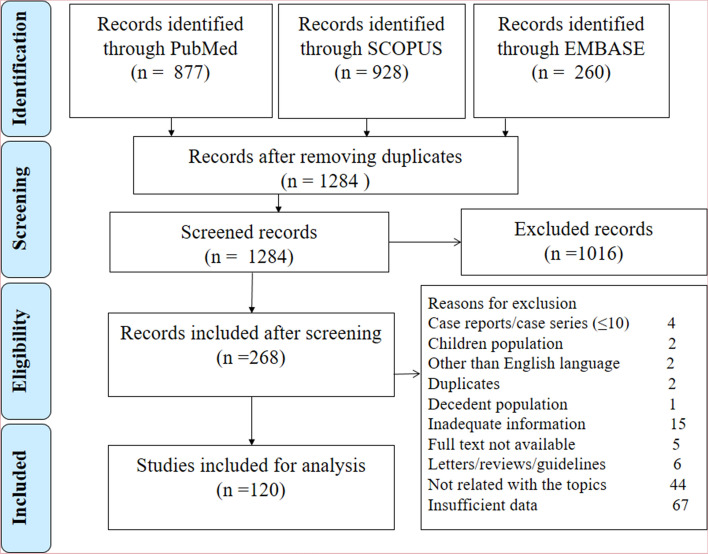
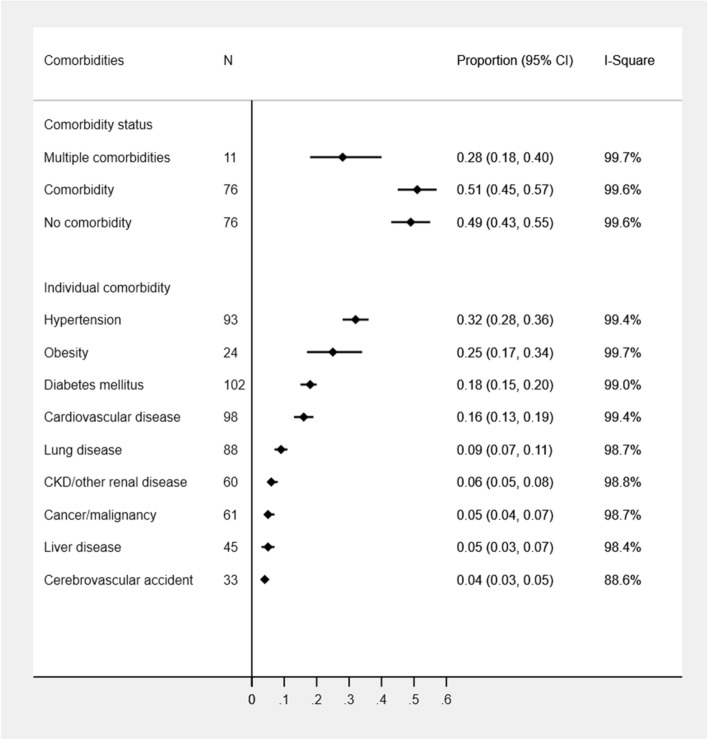
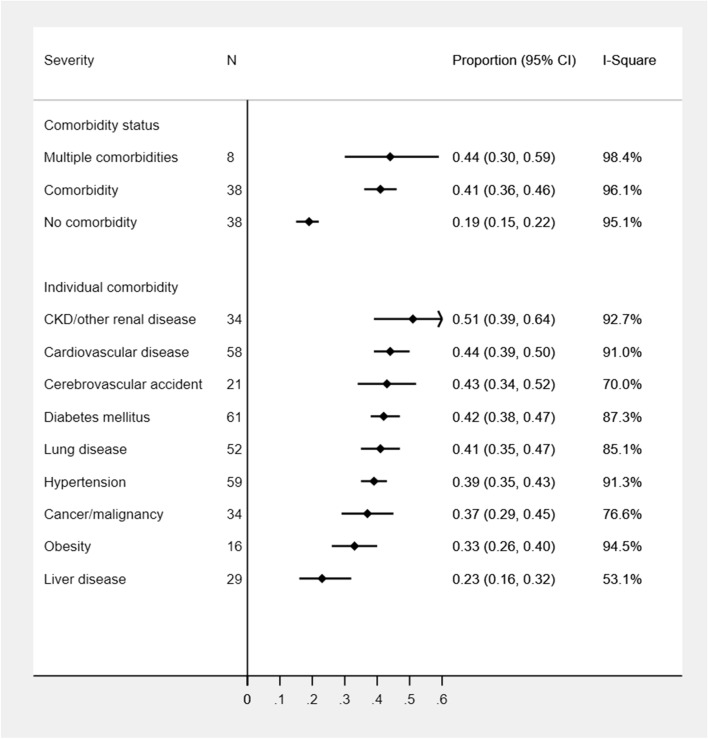
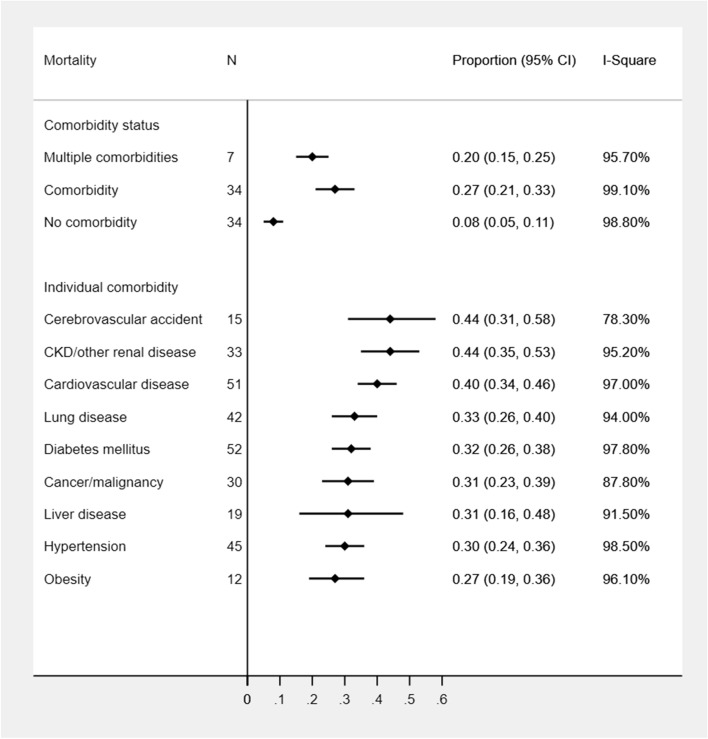
Several comorbidities have been shown to be associated with coronavirus disease 2019 (COVID-19) related severity and mortality. However, considerable variation in the prevalence estimates of comorbidities and their effects on COVID-19 morbidity and mortality have been observed in prior studies. This systematic review and meta-analysis aimed to determine geographical, age, and gender related differences in the prevalence of comorbidities and associated severity and mortality rates among COVID-19 patients. We conducted a search using PubMed, Scopus, and EMBASE to include all COVID-19 studies published between January 1st, 2020 to July 24th, 2020 reporting comorbidities with severity or mortality. We included studies reporting the confirmed diagnosis of COVID-19 on human patients that also provided information on comorbidities or disease outcomes. We used DerSimonian and Laird random effects method for calculating estimates. Of 120 studies with 125,446 patients, the most prevalent comorbidity was hypertension (32%), obesity (25%), diabetes (18%), and cardiovascular disease (16%) while chronic kidney or other renal diseases (51%, 44%), cerebrovascular accident (43%, 44%), and cardiovascular disease (44%, 40%) patients had more COVID-19 severity and mortality respectively. Considerable variation in the prevalence of comorbidities and associated disease severity and mortality in different geographic regions was observed. The highest mortality was observed in studies with Latin American and European patients with any medical condition, mostly older adults (≥ 65 years), and predominantly male patients. Although the US studies observed the highest prevalence of comorbidities in COVID-19 patients, the severity of COVID-19 among each comorbid condition was highest in Asian studies whereas the mortality was highest in the European and Latin American countries. Risk stratification and effective control strategies for the COVID-19 should be done according to comorbidities, age, and gender differences specific to geographical location.
Overview
The claims and statistics of this paper haven’t been checked yet.
Run the check — free, no account needed. It reads the open-access text and checks the sources it cites.
Integrity signals
Registry
Cites
Statistics
Figures
Verification
Claims the paper makes
The claims and statistics of this paper haven’t been checked yet.
Run the check — free, no account needed. It reads the open-access text and checks the sources it cites.
Self-check
Percentages, sums and reported differences re-computed from the paper’s own numbers.
The self-check needs the paper’s full text.
Citations
Cites
Preferred Reporting Items for Systematic Reviews and Meta-Analyses: the PRISMA statement
Moher, D., Liberati, A., Tetzlaff, J., Altman, D. G., & for the PRISMA Group (2009) · BMJ · doi:10.1136/bmj.b2535 · Cited by 83,823
Preferred Reporting Items for Systematic Reviews and Meta-Analyses: The PRISMA Statement
Moher, D., Liberati, A., Tetzlaff, J., Altman, D. G., & The PRISMA Group (2009) · PLoS Medicine · doi:10.1371/journal.pmed.1000097 · Cited by 64,042
Preferred reporting items for systematic reviews and meta-analyses: the PRISMA Statement.
(2009) · PubMed Central · Cited by 44,859
Meta-analysis in clinical trials
DerSimonian, R., & Laird, N. (1986) · Controlled Clinical Trials · doi:10.1016/0197-2456(86)90046-2 · Cited by 39,552
Wang, G., Ma, R., Qiao, G., Wada, K., Aizawa, Y., & Satoh, T. (2015) · Integrative Medicine International · doi:10.1159/000368408 · Cited by 18,762
Yang, X., Yu, Y., Xu, J., Shu, H., Xia, J., Liu, H., Wu, Y., Zhang, L., Yu, Z., Fang, M., et al. (2020) · The Lancet Respiratory Medicine · doi:10.1016/s2213-2600(20)30079-5 · Cited by 10,066
Wu, C., Chen, X., Cai, Y., Xia, J., Zhou, X., Xu, S., Huang, H., Zhang, L., Zhou, X., Du, C., et al. (2020) · JAMA Internal Medicine · doi:10.1001/jamainternmed.2020.0994 · Cited by 8,249
Slim, K., Nini, E., Forestier, D., Kwiatkowski, F., Panis, Y., & Chipponi, J. (2003) · ANZ Journal of Surgery · doi:10.1046/j.1445-2197.2003.02748.x · Cited by 7,603
Sex differences in immune responses
Klein, S. L., & Flanagan, K. L. (2016) · Nature Reviews Immunology · doi:10.1038/nri.2016.90 · Cited by 6,370
Ruan, Q., Yang, K., Wang, W., Jiang, L., & Song, J. (2020) · Intensive Care Medicine · doi:10.1007/s00134-020-05991-x · Cited by 4,898
Cited by
Sorted by citations
Oral Nirmatrelvir for High-Risk, Nonhospitalized Adults with Covid-19
Hammond, J., Leister-Tebbe, H., Gardner, A., Abreu, P., Bao, W., Wisemandle, W., Baniecki, M., Hendrick, V. M., Damle, B., Simón-Campos, A., et al. (2022) · New England Journal of Medicine · doi:10.1056/nejmoa2118542 · Cited by 2,323
The Lancet Commission on lessons for the future from the COVID-19 pandemic
Sachs, J. D., Karim, S. S. A., Aknin, L., Allen, J., Brosbøl, K., Colombo, F., Barron, G. C., Espinosa, M. F., Gaspar, V., Gaviria, A., et al. (2022) · The Lancet · doi:10.1016/s0140-6736(22)01585-9 · Cited by 842
Life expectancy changes since COVID-19
Schöley, J., Aburto, J. M., Kashnitsky, I., Kniffka, M. S., Zhang, L., Jaadla, H., Dowd, J. B., & Kashyap, R. (2022) · Nature Human Behaviour · doi:10.1038/s41562-022-01450-3 · Cited by 282
COVID-19 and metabolic disease: mechanisms and clinical management
Steenblock, C., Schwarz, P. E. H., Ludwig, B., Linkermann, A., Zimmet, P., Kulebyakin, K. Y., Va, T., Markov, A. G., Lehnert, H., de Angelis, M. H., et al. (2021) · The Lancet Diabetes & Endocrinology · doi:10.1016/s2213-8587(21)00244-8 · Cited by 256
Mahamat‐Saleh, Y., Fiolet, T., Rebeaud, M. E., Mulot, M., Guihur, A., Fatouhi, D. E., Laouali, N., Peiffer‐Smadja, N., Aune, D., & Severi, G. (2021) · BMJ Open · doi:10.1136/bmjopen-2021-052777 · Cited by 205
Metadata
- Authors
- Thakur, B., Dubey, P., Benitez, J., Torres, J. P., Reddy, S., Shokar, N., Aung, K., Mukherjee, D., & Dwivedi, A. K.
- Affiliations
- Texas Tech University Health Sciences Center (US)
- Texas Tech University (US)
- Corresponding author
- Dwivedi, Alok Kumar
- ORCID
- Venue
- Scientific Reports
- Published
- 2021-04-20
- Volume
- 11
- Issue
- 1
- Pages
- 8562-8562
- ISSN
- 2045-2322 (ISSN-L)
- PMC
- PMC8058064
- OpenAlex
- W3152572687
- Cited by
- 284
- References
- 59
- Citations by year
- 2026: 11 · 2025: 17 · 2024: 53 · 2023: 66 · 2022: 95 · 2021: 41
- FWCI
- 7.45
- Type
- journal article
- Language
- en
- Open access
- gold
- doi.org
- Locations
- Scientific Reports (publishedVersion, cc-by)
- PubMed Central (publishedVersion, cc-by)
- PubMed (publishedVersion)
- DOAJ (DOAJ: Directory of Open Access Journals) (submittedVersion, cc-by-sa)
- Topics
- Health Sciences › Medicine › Infectious Diseases › COVID-19 Clinical Research Studies
- Physical Sciences › Mathematics › Modeling and Simulation › COVID-19 epidemiological studies
- Health Sciences › Medicine › Clinical Neurology › Long-Term Effects of COVID-19
- Keywords
- COVID-19 pandemic, comorbidities, disease severity, mortality, regional variation, hypertension, obesity, diabetes mellitus, cardiovascular disease, chronic kidney disease, cerebrovascular disease, age differences, sex differences, risk stratification
- MeSH terms
- COVID-19, Age Factors, Aged, Aged, 80 and over, Asia, Europe, Female, Humans, Latin America, Male, Severity of Illness Index, Sex Factors, Comorbidity, Prevalence
About these checks
Registry, retraction, Cites and statistics results are computed, not judged, with one exception: a printed reference that no index lists is read once by a model before it counts as a citation error. Claims are extracted by a model and kept only when their quote appears verbatim in the text; each cited source is then checked, with a model’s help, for whether it says what the claim relies on. Those verdicts can be wrong — read the claim’s quote and the cited source before relying on one.
Statistics and arithmetic are recomputed, not judged.
Confidence bands are shown only for fields calibrated on our annotated test set. None is calibrated yet, so no band is shown.
What counts as a claim ›How we measure confidence ›How we check this ›
Are you an author, or do you see a problem with this page? Request a review
