

Polygenic risk for obsessive-compulsive disorder (OCD) predicts brain response during working memory task in OCD, unaffected relatives, and healthy controls
Open accessThe DOI matches its Crossref record; 56 of the 56 references it cites were found in a registry or an index.
Abstract
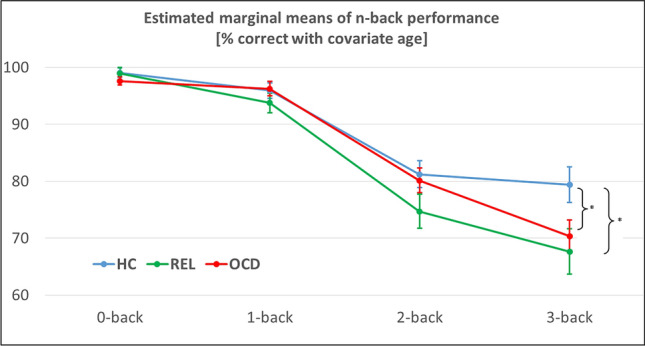
Alterations in frontal and parietal neural activations during working memory task performance have been suggested as a candidate endophenotype of obsessive-compulsive disorder (OCD) in studies involving first-degree relatives. However, the direct link between genetic risk for OCD and neuro-functional alterations during working memory performance has not been investigated to date. Thus, the aim of the current functional magnetic resonance imaging (fMRI) study was to test the direct association between polygenic risk for OCD and neural activity during the performance of a numeric n-back task with four working memory load conditions in 128 participants, including patients with OCD, unaffected first-degree relatives of OCD patients, and healthy controls. Behavioral results show a significant performance deficit at high working memory load in both patients with OCD and first-degree relatives (p < 0.05). A whole-brain analysis of the fMRI data indicated decreased neural activity in bilateral inferior parietal lobule and dorsolateral prefrontal cortex in both patients and relatives. Most importantly, OCD polygenic risk scores predicted neural activity in orbitofrontal cortex. Results indicate that genetic risk for OCD can partly explain alterations in brain response during working memory performance, supporting the notion of a neuro-functional endophenotype for OCD.
Overview
The claims and statistics of this paper haven’t been checked yet.
Free: it reads the open-access text and checks the first 5 claims that cite a source we can check. Create a free account to check every claim.
Integrity signals
Registry
Cites
Statistics
Figures


Verification
Claims the paper makes
The claims and statistics of this paper haven’t been checked yet.
Free: it reads the open-access text and checks the first 5 claims that cite a source we can check. Create a free account to check every claim.
Claims other papers make about this one
Each is checked against this paper’s own text: does it say what the citing paper says it does?
The source backs part of the claim, not all of it — or backs it for a different population, condition or comparison.
In the citing paper
“Heinzel et al (62, 63) found reduced activation in the SMA, bilateral inferior parietal lobule (IPL), and dlPFC during high working memory load conditions (2-back and 3-back).”
From Neural mechanisms underlying cognitive inflexibility in obsessive-compulsive disorder: a review (2026) · cites this paper as [63]
Experimental — accuracy not yet measuredThe source backs part of the claim, not all of it — or backs it for a different population, condition or comparison.
In the citing paper
“In the n-back task, OCD patients display reduced dlPFC activity, manifesting as decreased working memory capacity (63) and slower information processing speed.”
From Neural mechanisms underlying cognitive inflexibility in obsessive-compulsive disorder: a review (2026) · cites this paper as [63]
Experimental — accuracy not yet measuredThe source backs part of the claim, not all of it — or backs it for a different population, condition or comparison.
In the citing paper
“Dysfunction in the PFC appears to lead to a range of parietal changes in OCD patients. In the n-back test, it may lead to reduced parietal activation, contributing to decreased working memory capacity and impaired ability to manage increasing cognitive load (63). In the SST, it can affect parietal cortex activity involved in sensory signals processing (49). In the RL task it impacts on the role of”
From Neural mechanisms underlying cognitive inflexibility in obsessive-compulsive disorder: a review (2026) · cites this paper as [63]
Experimental — accuracy not yet measured
Self-check
Percentages, sums and reported differences re-computed from the paper’s own numbers.
The self-check needs the paper’s full text.
Citations
Cites
PLINK: a tool set for whole-genome association and population-based linkage analyses.
Purcell, S., Neale, B., Todd-Brown, K., Thomas, L., Ferreira, M. A. R., Bender, D., Maller, J., Sklar, P., de Bakker, P. I. W., Daly, M. J., et al. (2007) · The American Journal of Human Genetics · doi:10.1086/519795 · Cited by 34,089
Principal components analysis corrects for stratification in genome-wide association studies
Price, A. L., Patterson, N. J., Plenge, R. M., Weinblatt, M. E., Shadick, N. A., & Reich, D. (2006) · Nature Genetics · doi:10.1038/ng1847 · Cited by 10,248
Insel, T., Cuthbert, B., Garvey, M., Heinssen, R., Pine, D. S., Quinn, K., Sanislow, C., & Wang, P. (2010) · American Journal of Psychiatry · doi:10.1176/appi.ajp.2010.09091379 · Cited by 7,067
The Endophenotype Concept in Psychiatry: Etymology and Strategic Intentions
Gottesman, I. I., & Gould, T. D. (2003) · American Journal of Psychiatry · doi:10.1176/appi.ajp.160.4.636 · Cited by 5,615
N-back working memory paradigm: a meta-analysis of normative functional neuroimaging studies.
Owen, A. M., McMillan, K. M., Laird, A. R., & Bullmore, E. (2005) · Human Brain Mapping · doi:10.1002/hbm.20131 · Cited by 3,560
The epidemiology of obsessive-compulsive disorder in the National Comorbidity Survey Replication
Ruscio, A. M., Stein, D. J., Chiu, W. T., & Kessler, R. C. (2010) · Molecular Psychiatry · doi:10.1038/mp.2008.94 · Cited by 2,771 · cited 1×
“038) and a significant main effect of age (F(1, 124) = 19.”
BackgroundNeurocognitive Aging and the Compensation Hypothesis
Reuter-Lorenz, P. A., & Cappell, K. A. (2008) · Current Directions in Psychological Science · doi:10.1111/j.1467-8721.2008.00570.x · Cited by 1,639
Menzies, L., Chamberlain, S. R., Laird, A. R., Thelen, S. M., Sahakian, B. J., & Bullmore, E. T. (2008) · Neuroscience & Biobehavioral Reviews · doi:10.1016/j.neubiorev.2007.09.005 · Cited by 1,190
Quality of Life in Individuals With Anxiety Disorders
Mendlowicz, M. V., & Stein, M. B. (2000) · American Journal of Psychiatry · doi:10.1176/appi.ajp.157.5.669 · Cited by 955
Modelling neural correlates of working memory: A coordinate-based meta-analysis
Rottschy, C., Langner, R., Dogan, I., Reetz, K., Laird, A. R., Schulz, J. B., Fox, P. T., & Eickhoff, S. B. (2012) · NeuroImage · doi:10.1016/j.neuroimage.2011.11.050 · Cited by 951
Research works printed but not linked: 1
- First, M. B., Spitzer, R. L., Gibbon, M. & Williams, J. B. W. Structured Clinical Interview for DSM-IV Axis I Disorders-Patient Edition (Biometrics Research Department, New York State Psychiatric Institute, 1995).
Cited by
Neural mechanisms underlying cognitive inflexibility in obsessive-compulsive disorder: a review
Guo, W., Neo, P. S.-H., & McNaughton, N. (2026) · Frontiers in Psychiatry · doi:10.3389/fpsyt.2026.1795436
“In the n-back task, OCD patients display reduced dlPFC activity, manifesting as decreased working memory capacity (63) and slower information processing speed.”
Metadata
- Authors
- Heinzel, S., Kaufmann, C., Grützmann, R., Klawohn, J., Riesel, A., Bey, K., Heilmann-Heimbach, S., Weinhold, L., Ramirez, A., Wagner, M., & Kathmann, N.
- Affiliations
- Humboldt-Universität zu Berlin (DE)
- Universität Hamburg (DE)
- University Hospital Bonn (DE)
- University of Bonn (DE)
- Corresponding author
- Heinzel, Stephan
- ORCID
- Venue
- Scientific Reports
- Published
- 2021-09-23
- Volume
- 11
- Issue
- 1
- Pages
- 18914-18914
- ISSN
- 2045-2322 (ISSN-L)
- PMC
- PMC8460640
- OpenAlex
- W3199880973
- Cited by
- 23
- References
- 56
- Citations by year
- 2026: 3 · 2025: 8 · 2024: 5 · 2023: 4 · 2022: 2
- FWCI
- 1.87
- Type
- journal article
- Language
- en
- Open access
- gold
- doi.org
- Licence
- cc-by
- creativecommons.org/licenses/by/4.0 (tdm)
- creativecommons.org/licenses/by/4.0 (vor)
- Locations
- Scientific Reports (publishedVersion, cc-by)
- Europe PMC (PubMed Central) (publishedVersion, other-oa)
- PubMed Central (publishedVersion, cc-by)
- PubMed (publishedVersion)
- Kölner Universitäts PublikationsServer (Universität zu Köln) (publishedVersion)
- DOAJ (DOAJ: Directory of Open Access Journals) (submittedVersion, cc-by-sa)
- edoc Publication server (Humboldt University of Berlin) (submittedVersion, cc-by)
- DZNE Pub (submittedVersion, other-oa)
- Refubium (Universitätsbibliothek der Freien Universität Berlin) (submittedVersion, cc-by)
- Universitätsbibliothek der FU Berlin Hochschulschriftenstelle u. Dokumentenserver (cc-by)
- edoc Publication server (Humboldt University of Berlin) (cc-by)
- Funders
- Deutsche Forschungsgemeinschaft (HE 7464/4-1, GR 4901/2-1, WA 731/10-1, KA 815/6-1)
- Freie Universität Berlin
- Topics
- Social Sciences › Psychology › Clinical Psychology › Obsessive-Compulsive Spectrum Disorders
- Life Sciences › Neuroscience › Cognitive Neuroscience › Neural and Behavioral Psychology Studies
- Health Sciences › Medicine › Psychiatry and Mental health › Schizophrenia research and treatment
- Keywords
- obsessive-compulsive disorder, polygenic risk score, working memory, endophenotypes, first-degree relatives, orbitofrontal cortex, dorsolateral prefrontal cortex, inferior parietal lobule, n-back task, working memory load
- MeSH terms
- Dorsolateral Prefrontal Cortex, Adolescent, Adult, Aged, Brain Mapping, Family, Female, Humans, Magnetic Resonance Imaging, Male, Memory, Short-Term, Middle Aged, Nerve Net, Obsessive-Compulsive Disorder, Parietal Lobe, Risk Assessment, Genetic Predisposition to Disease, Multifactorial Inheritance, Young Adult, Healthy Volunteers
About these checks
Registry, retraction, Cites and statistics results are computed, not judged, with one exception: a printed reference that no index lists is read once by a model before it counts as a citation error. Claims are extracted by a model and kept only when their quote appears verbatim in the text; each cited source is then checked, with a model’s help, for whether it says what the claim relies on. Those verdicts can be wrong — read the claim’s quote and the cited source before relying on one.
Statistics and arithmetic are recomputed, not judged.
Confidence bands are shown only for fields calibrated on our annotated test set. None is calibrated yet, so no band is shown.
What counts as a claim ›How we measure confidence ›How we check this ›
Are you an author, or do you see a problem with this page? Request a review
How to cite
Cite CoChat for the checks on this page, and the paper for its own findings.
- This page
- CoChat. (2026). Citation check: Polygenic risk for obsessive-compulsive disorder (OCD) predicts brain response during working memory task in OCD, unaffected relatives, and healthy controls. https://app.cochat.ai/papers/10.1038/s41598-021-98333-w
- The paper
- Heinzel, S., Kaufmann, C., Grützmann, R., Klawohn, J., Riesel, A., Bey, K., Heilmann-Heimbach, S., Weinhold, L., Ramirez, A., Wagner, M., & Kathmann, N. (2021). Polygenic risk for obsessive-compulsive disorder (OCD) predicts brain response during working memory task in OCD, unaffected relatives, and healthy controls. Scientific Reports. https://doi.org/10.1038/s41598-021-98333-w
Data sources
Bibliographic data: Semantic Scholar, OpenAlex, Crossref.
Contains information from the Semantic Scholar Academic Graph Datasets, made available under the ODC Attribution License (ODC-BY 1.0).
Semantic Scholar’s data is described in: Kinney, R., et al. (2023). The Semantic Scholar Open Data Platform. arXiv:2301.10140.
