

Polygenic risk for obsessive-compulsive disorder (OCD) predicts brain response during working memory task in OCD, unaffected relatives, and healthy controls
Open accessThe DOI matches its Crossref record; 56 of the 56 references it cites were found in a registry or an index.
Abstract
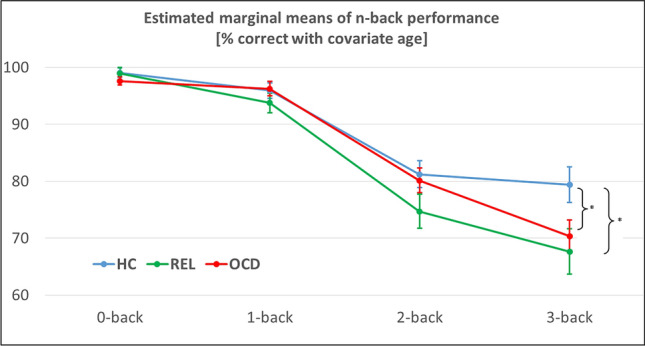
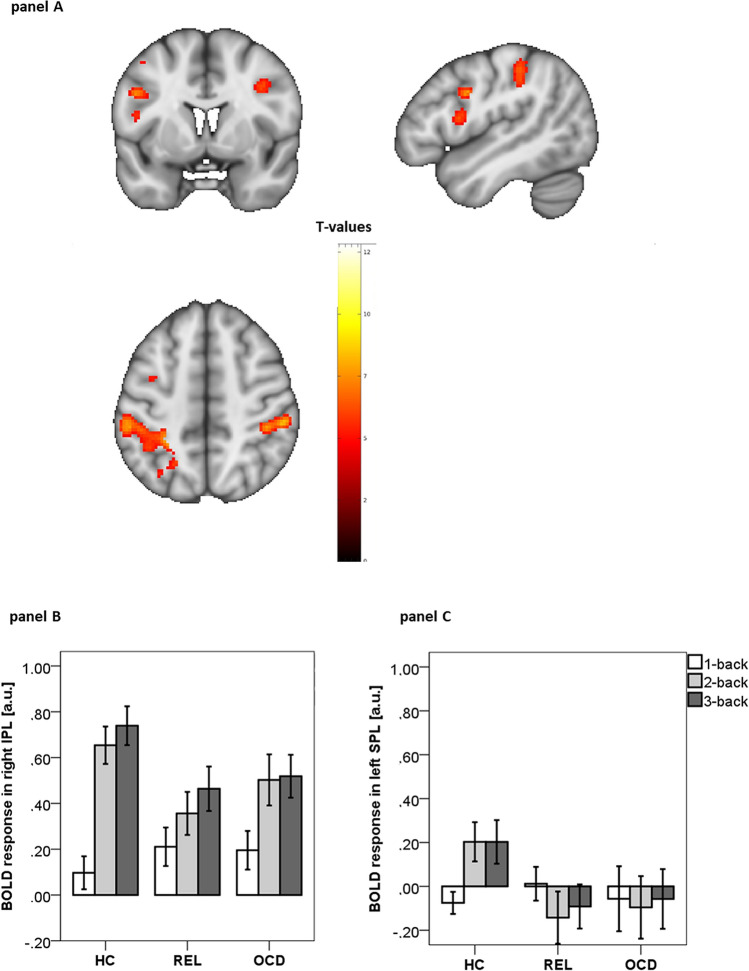
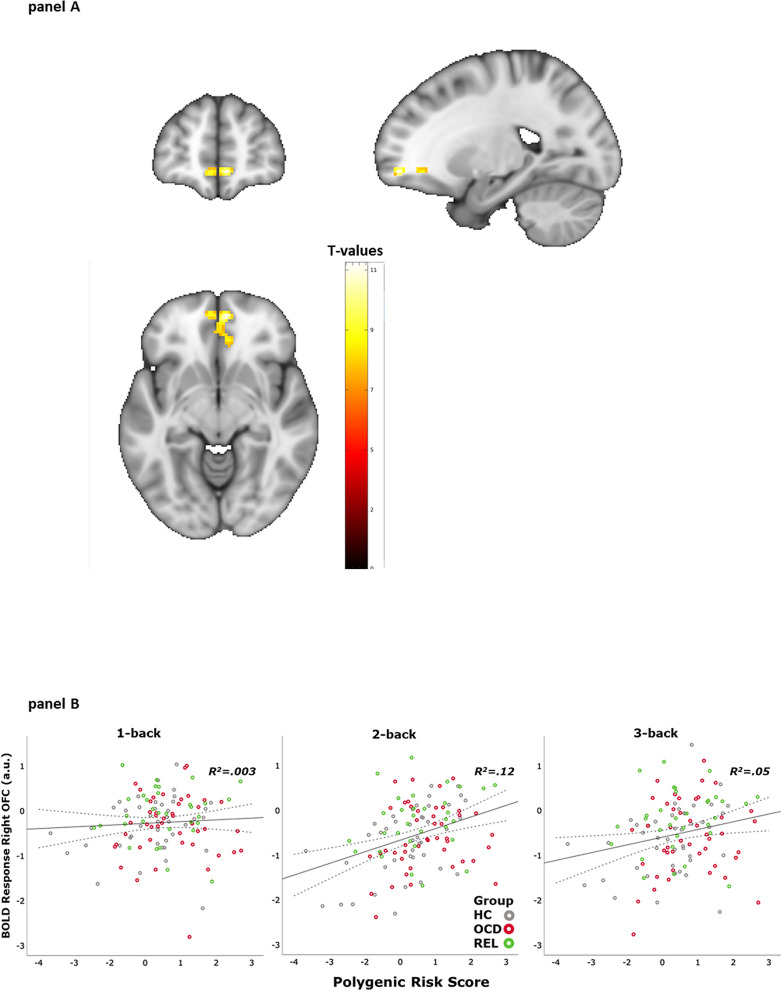
Alterations in frontal and parietal neural activations during working memory task performance have been suggested as a candidate endophenotype of obsessive-compulsive disorder (OCD) in studies involving first-degree relatives. However, the direct link between genetic risk for OCD and neuro-functional alterations during working memory performance has not been investigated to date. Thus, the aim of the current functional magnetic resonance imaging (fMRI) study was to test the direct association between polygenic risk for OCD and neural activity during the performance of a numeric n-back task with four working memory load conditions in 128 participants, including patients with OCD, unaffected first-degree relatives of OCD patients, and healthy controls. Behavioral results show a significant performance deficit at high working memory load in both patients with OCD and first-degree relatives (p < 0.05). A whole-brain analysis of the fMRI data indicated decreased neural activity in bilateral inferior parietal lobule and dorsolateral prefrontal cortex in both patients and relatives. Most importantly, OCD polygenic risk scores predicted neural activity in orbitofrontal cortex. Results indicate that genetic risk for OCD can partly explain alterations in brain response during working memory performance, supporting the notion of a neuro-functional endophenotype for OCD.
Overview
The claims and statistics of this paper haven’t been checked yet.
Free: it reads the open-access text and checks the first 5 claims that cite a source we can check. Create a free account to check every claim.
Integrity signals
Registry
Cites
Statistics
Figures
Verification
Claims the paper makes
The claims and statistics of this paper haven’t been checked yet.
Free: it reads the open-access text and checks the first 5 claims that cite a source we can check. Create a free account to check every claim.
Claims other papers make about this one
Each is checked against this paper’s own text: does it say what the citing paper says it does?
The source backs part of the claim, not all of it — or backs it for a different population, condition or comparison.
In the citing paper
“Heinzel et al (62, 63) found reduced activation in the SMA, bilateral inferior parietal lobule (IPL), and dlPFC during high working memory load conditions (2-back and 3-back).”
From Neural mechanisms underlying cognitive inflexibility in obsessive-compulsive disorder: a review (2026) · cites this paper as [63]
Experimental — accuracy not yet measuredThe source backs part of the claim, not all of it — or backs it for a different population, condition or comparison.
In the citing paper
“In the n-back task, OCD patients display reduced dlPFC activity, manifesting as decreased working memory capacity (63) and slower information processing speed.”
From Neural mechanisms underlying cognitive inflexibility in obsessive-compulsive disorder: a review (2026) · cites this paper as [63]
Experimental — accuracy not yet measuredThe source backs part of the claim, not all of it — or backs it for a different population, condition or comparison.
In the citing paper
“Dysfunction in the PFC appears to lead to a range of parietal changes in OCD patients. In the n-back test, it may lead to reduced parietal activation, contributing to decreased working memory capacity and impaired ability to manage increasing cognitive load (63). In the SST, it can affect parietal cortex activity involved in sensory signals processing (49). In the RL task it impacts on the role of”
From Neural mechanisms underlying cognitive inflexibility in obsessive-compulsive disorder: a review (2026) · cites this paper as [63]
Experimental — accuracy not yet measured
Self-check
Percentages, sums and reported differences re-computed from the paper’s own numbers.
The self-check needs the paper’s full text.
Citations
Cites
PLINK: a tool set for whole-genome association and population-based linkage analyses.
Purcell, S., Neale, B., Todd-Brown, K., Thomas, L., Ferreira, M. A. R., Bender, D., Maller, J., Sklar, P., de Bakker, P. I. W., Daly, M. J., et al. (2007) · The American Journal of Human Genetics · doi:10.1086/519795 · Cited by 34,089
Principal components analysis corrects for stratification in genome-wide association studies
Price, A. L., Patterson, N. J., Plenge, R. M., Weinblatt, M. E., Shadick, N. A., & Reich, D. (2006) · Nature Genetics · doi:10.1038/ng1847 · Cited by 10,248
Insel, T., Cuthbert, B., Garvey, M., Heinssen, R., Pine, D. S., Quinn, K., Sanislow, C., & Wang, P. (2010) · American Journal of Psychiatry · doi:10.1176/appi.ajp.2010.09091379 · Cited by 7,067
The Endophenotype Concept in Psychiatry: Etymology and Strategic Intentions
Gottesman, I. I., & Gould, T. D. (2003) · American Journal of Psychiatry · doi:10.1176/appi.ajp.160.4.636 · Cited by 5,615
N-back working memory paradigm: a meta-analysis of normative functional neuroimaging studies.
Owen, A. M., McMillan, K. M., Laird, A. R., & Bullmore, E. (2005) · Human Brain Mapping · doi:10.1002/hbm.20131 · Cited by 3,560
The epidemiology of obsessive-compulsive disorder in the National Comorbidity Survey Replication
Ruscio, A. M., Stein, D. J., Chiu, W. T., & Kessler, R. C. (2010) · Molecular Psychiatry · doi:10.1038/mp.2008.94 · Cited by 2,771 · cited 1×
“038) and a significant main effect of age (F(1, 124) = 19.”
BackgroundNeurocognitive Aging and the Compensation Hypothesis
Reuter-Lorenz, P. A., & Cappell, K. A. (2008) · Current Directions in Psychological Science · doi:10.1111/j.1467-8721.2008.00570.x · Cited by 1,639
Menzies, L., Chamberlain, S. R., Laird, A. R., Thelen, S. M., Sahakian, B. J., & Bullmore, E. T. (2008) · Neuroscience & Biobehavioral Reviews · doi:10.1016/j.neubiorev.2007.09.005 · Cited by 1,190
Quality of Life in Individuals With Anxiety Disorders
Mendlowicz, M. V., & Stein, M. B. (2000) · American Journal of Psychiatry · doi:10.1176/appi.ajp.157.5.669 · Cited by 955
Modelling neural correlates of working memory: A coordinate-based meta-analysis
Rottschy, C., Langner, R., Dogan, I., Reetz, K., Laird, A. R., Schulz, J. B., Fox, P. T., & Eickhoff, S. B. (2012) · NeuroImage · doi:10.1016/j.neuroimage.2011.11.050 · Cited by 951
Neuroimaging and frontal–subcortical circuitry in obsessive–compulsive disorder
Saxena, S., Brody, A. L., Schwartz, J. M., & Baxter, L. R. (1998) · British Journal of Psychiatry · doi:10.1192/s0007125000297870 · Cited by 831
Obsessive-compulsive disorder: An integrative genetic and neurobiological perspective
Pauls, D. L., Abramovitch, A., Rauch, S. L., & Geller, D. A. (2014) · Nature Reviews Neuroscience · doi:10.1038/nrn3746 · Cited by 793
Aging, Training, and the Brain: A Review and Future Directions
Lustig, C., Shah, P., Seidler, R., & Reuter-Lorenz, P. A. (2009) · Neuropsychology Review · doi:10.1007/s11065-009-9119-9 · Cited by 682
A Family Study of Obsessive-compulsive Disorder
Nestadt, G., Samuels, J., Riddle, M., Bienvenu, O. J., Liang, K.-Y., LaBuda, M., Walkup, J., Grados, M., & Hoehn-Saric, R. (2000) · Archives of General Psychiatry · doi:10.1001/archpsyc.57.4.358 · Cited by 657 · cited 1×
“136), as well as a significant interaction of working memory load by age (F(3, 372) = 10.”
BackgroundRevealing the complex genetic architecture of obsessive–compulsive disorder using meta-analysis
International Obsessive Compulsive Disorder Foundation Genetics Collaborative (IOCDF-GC) and OCD Collaborative Genetics Association Studies (OCGAS) (2018) · Molecular Psychiatry · doi:10.1038/mp.2017.154 · Cited by 618
Brief Screening for Family Psychiatric History: The Family History Screen
Weissman, M. M. (2000) · Archives of General Psychiatry · doi:10.1001/archpsyc.57.7.675 · Cited by 601
A Meta-analysis of Executive Components of Working Memory
Nee, D. E., Brown, J. W., Askren, M. K., Berman, M. G., Demiralp, E., Krawitz, A., & Jonides, J. (2013) · Cerebral Cortex · doi:10.1093/cercor/bhs007 · Cited by 544
The neuropsychology of adult obsessive–compulsive disorder: A meta-analysis
Abramovitch, A., Abramowitz, J. S., & Mittelman, A. (2013) · Clinical Psychology Review · doi:10.1016/j.cpr.2013.09.004 · Cited by 444
Genome-wide association study of obsessive-compulsive disorder
Stewart, S. E., Yu, D., Scharf, J. M., Neale, B. M., Fagerness, J. A., Mathews, C. A., Arnold, P. D., Evans, P. D., Gamazon, E. R., Osiecki, L., et al. (2013) · Molecular Psychiatry · doi:10.1038/mp.2012.85 · Cited by 384
Self-citationCognitive functioning in obsessive-compulsive disorder: A meta-analysis
Shin, N. Y., Lee, T. Y., Kim, E., & Kwon, J. S. (2014) · Psychological Medicine · doi:10.1017/s0033291713001803 · Cited by 334
Functional dissociations within the inferior parietal cortex in verbal working memory
Ravizza, S. M., Delgado, M. R., Chein, J. M., Becker, J. T., & Fiez, J. A. (2004) · NeuroImage · doi:10.1016/j.neuroimage.2004.01.039 · Cited by 321
de Wit, S. J., de Vries, F. E., van der Werf, Y. D., Cath, D. C., Heslenfeld, D. J., Veltman, E. M., van Balkom, A. J. L. M., Veltman, D. J., & van den Heuvel, O. A. (2012) · American Journal of Psychiatry · doi:10.1176/appi.ajp.2012.12010073 · Cited by 303
Vaghi, M. M., Vértes, P. E., Kitzbichler, M. G., Apergis-Schoute, A. M., van der Flier, F. E., Fineberg, N. A., Sule, A., Zaman, R., Voon, V., Kundu, P., et al. (2017) · Biological Psychiatry · doi:10.1016/j.biopsych.2016.08.009 · Cited by 290
Abnormally high degree connectivity of the orbitofrontal cortex in obsessive-compulsive disorder
Beucke, J. C., Sepulcre, J., Talukdar, T., Linnman, C., Zschenderlein, K., Endrass, T., Kaufmann, C., & Kathmann, N. (2013) · JAMA Psychiatry · doi:10.1001/jamapsychiatry.2013.173 · Cited by 280
Self-citationBoedhoe, P. S. W., Schmaal, L., Abe, Y., Alonso, P., Ameis, S. H., Anticevic, A., Arnold, P. D., Batistuzzo, M. C., Benedetti, F., Beucke, J. C., et al. (2018) · American Journal of Psychiatry · doi:10.1176/appi.ajp.2017.17050485 · Cited by 271
Self-citationBasal ganglia circuit loops, dopamine and motivation: a review and enquiry
Ikemoto, S., Yang, C., & Tan, A. (2015) · Behavioural Brain Research · doi:10.1016/j.bbr.2015.04.018 · Cited by 226
Nakao, T., Nakagawa, A., Nakatani, E., Nabeyama, M., Sanematsu, H., Yoshiura, T., Togao, O., Tomita, M., Masuda, Y., Yoshioka, K., et al. (2008) · Journal of Psychiatric Research · doi:10.1016/j.jpsychires.2008.10.013 · Cited by 180
Yaple, Z. A., Stevens, W. D., & Arsalidou, M. (2019) · NeuroImage · doi:10.1016/j.neuroimage.2019.03.074 · Cited by 179
de Vries, F. E., de Wit, S. J., Cath, D. C., van der Werf, Y. D., van der Borden, V., van Rossum, T. B., van Balkom, A. J. L. M., van der Wee, N. J. A., Veltman, D. J., & van den Heuvel, O. A. (2014) · Biological Psychiatry · doi:10.1016/j.biopsych.2013.11.021 · Cited by 177
Cavedini, P., Zorzi, C., Piccinni, M., Cavallini, M. C., & Bellodi, L. (2010) · Biological Psychiatry · doi:10.1016/j.biopsych.2010.02.012 · Cited by 167
VANDERWEE, N., Ramsey, N. F., Jansma, J. M., Denys, D. A. J. P., van Megen, H. J. G. M., Westenberg, H. G. M., & Kahn, R. S. (2003) · NeuroImage · doi:10.1016/j.neuroimage.2003.05.001 · Cited by 162
Eng, G. K., Sim, K., & Chen, S.-H. A. (2015) · Neuroscience & Biobehavioral Reviews · doi:10.1016/j.neubiorev.2015.03.002 · Cited by 148
Symptom Dimensions in OCD: Item-Level Factor Analysis and Heritability Estimates
Katerberg, H., Delucchi, K. L., Stewart, S. E., Lochner, C., Denys, D. A. J. P., Stack, D. E., Andresen, J. M., Grant, J. E., Kim, S. W., Williams, K. A., et al. (2010) · Behavior Genetics · doi:10.1007/s10519-010-9339-z · Cited by 134
Working Memory Load-Dependent Brain Response Predicts Behavioral Training Gains in Older Adults
Heinzel, S., Lorenz, R. C., Brockhaus, W.-R., Wüstenberg, T., Kathmann, N., Heinz, A., & Rapp, M. A. (2014) · The Journal of Neuroscience · doi:10.1523/jneurosci.2463-13.2014 · Cited by 129
Self-citationChanging views of basal ganglia circuits and circuit disorders
DeLong, M., & Wichmann, T. (2010) · Clinical EEG and Neuroscience · doi:10.1177/155005941004100204 · Cited by 128
Riesel, A., Klawohn, J., Grützmann, R., Kaufmann, C., Heinzel, S., Bey, K., Lennertz, L., Wagner, M., & Kathmann, N. (2019) · Psychological Medicine · doi:10.1017/s0033291719000199 · Cited by 126
Self-citationMelloni, M., Urbistondo, C., Sedeño, L., Gelormini, C., Kichic, R., & Ibanez, A. (2012) · Frontiers in Human Neuroscience · doi:10.3389/fnhum.2012.00259 · Cited by 109
Harkin, B., & Kessler, K. (2011) · Clinical Psychology Review · doi:10.1016/j.cpr.2011.06.004 · Cited by 97
Rajender, G., Bhatia, M. S., Kanwal, K., Malhotra, S., Singh, T. B., & Chaudhary, D. (2011) · Acta Psychiatrica Scandinavica · doi:10.1111/j.1600-0447.2011.01733.x · Cited by 84
den Braber, A., Zilhão, N. R., Fedko, I. O., Hottenga, J.-J., Pool, R., Smit, D. J. A., Cath, D. C., & Boomsma, D. I. (2016) · Translational Psychiatry · doi:10.1038/tp.2015.223 · Cited by 78
Ranlund, S. M., Calafato, S., Thygesen, J. H., Lin, K., Cahn, W., Crespo‐Facorro, B., de Zwarte, S. M. C., Díez, Á., Forti, M. D., GROUP, et al. (2017) · American Journal of Medical Genetics Part B Neuropsychiatric Genetics · doi:10.1002/ajmg.b.32581 · Cited by 72
Lennertz, L., Rampacher, F., Vogeley, A., Schulze-Rauschenbach, S., Pukrop, R., Ruhrmann, S., Klosterkötter, J., Maier, W., Falkai, P., & Wagner, M. (2012) · European Archives of Psychiatry and Clinical Neuroscience · doi:10.1007/s00406-012-0311-1 · Cited by 62
Self-citationHeinzel, S., Kaufmann, C., Grützmann, R., Hummel, R., Klawohn, J., Riesel, A., Bey, K., Lennertz, L., Wagner, M., & Kathmann, N. (2018) · NeuroImage: Clinical · doi:10.1016/j.nicl.2017.10.039 · Cited by 55
Self-citationBurton, C. L., Lemire, M., Xiao, B., Corfield, E. C., Erdman, L., Bralten, J., Poelmans, G., Yu, D., Shaheen, S. ‐., Goodale, T., et al. (2021) · Translational Psychiatry · doi:10.1038/s41398-020-01121-9 · Cited by 52
Self-citationGenetic meta‐analysis of obsessive–compulsive disorder and self‐report compulsive symptoms
Smit, D. J. A., Cath, D. C., Zilhäo, N. R., Ip, H. F., Denys, D. A. J. P., den Braber, A., de Geus, E. J. C., Verweij, K. J. H., Hottenga, J., & Boomsma, D. I. (2019) · American Journal of Medical Genetics Part B Neuropsychiatric Genetics · doi:10.1002/ajmg.b.32777 · Cited by 51
Zarantonello, L., Schiff, S., Amodio, P., & Bisiacchi, P. S. (2019) · Aging Neuropsychology and Cognition · doi:10.1080/13825585.2019.1608900 · Cited by 50
Grünblatt, E., Hauser, T. U., & Walitza, S. (2014) · Progress in Neurobiology · doi:10.1016/j.pneurobio.2014.07.003 · Cited by 49
Hibar, D. P., Cheung, J. W., Medland, S. E., Mufford, M. S., Jahanshad, N., Dalvie, S., Ramesar, R., Stewart, S. E., van den Heuvel, O. A., Pauls, D. L., et al. (2018) · The British Journal of Psychiatry · doi:10.1192/bjp.2018.62 · Cited by 47
Koch, K., Wagner, G., Schachtzabel, C., Peikert, G., Schultz, C. C., Sauer, H., & Schlösser, R. G. (2012) · Neuropsychologia · doi:10.1016/j.neuropsychologia.2012.02.002 · Cited by 45
Bey, K., Lennertz, L., Riesel, A., Klawohn, J., Kaufmann, C., Heinzel, S., Grützmann, R., Kathmann, N., & Wagner, M. (2017) · Acta Psychiatrica Scandinavica · doi:10.1111/acps.12707 · Cited by 45
Self-citationNew insights and perspectives on the genetics of obsessive-compulsive disorder
Zai, G. C., Barta, C., Cath, D. C., Eapen, V., GELLER, D. A., & Grünblatt, E. (2019) · Psychiatric Genetics · doi:10.1097/ypg.0000000000000230 · Cited by 38
Endophenotypes of obsessive–compulsive disorder: Current status and future directions
Taylor, S. J. (2012) · Journal of Obsessive-Compulsive and Related Disorders · doi:10.1016/j.jocrd.2012.06.004 · Cited by 36
Shin, Y. ‐., Kwon, J. S., Kim, J. ‐., Kang, D. ‐., Youn, T., Kang, K. W., Kang, E., Lee, D. S., & Lee, M. C. (2006) · Acta Psychiatrica Scandinavica · doi:10.1111/j.1600-0447.2005.00709.x · Cited by 32
Ozcan, H., Ozer, S., & Yagcioglu, S. (2016) · Psychiatry Research · doi:10.1016/j.psychres.2016.04.013 · Cited by 31
Bey, K., Weinhold, L., Grützmann, R., Heinzel, S., Kaufmann, C., Klawohn, J., Riesel, A., Lennertz, L., Schmid, M. C., Ramírez, A., et al. (2020) · Acta Psychiatrica Scandinavica · doi:10.1111/acps.13226 · Cited by 24
Self-citationFrontal alpha asymmetry in OCD patients and unaffected first-degree relatives.
Grützmann, R., Riesel, A., Klawohn, J., Heinzel, S., Kaufmann, C., Bey, K., Lennertz, L., Wagner, M., & Kathmann, N. (2017) · Journal of Abnormal Psychology · doi:10.1037/abn0000283 · Cited by 15
Self-citation
Research works printed but not linked: 1
- First MB Spitzer RL Gibbon M Williams JBW Structured Clinical Interview for DSM-IV Axis I Disorders-Patient Edition 1995 Biometrics Research Department, New York State Psychiatric Institute
Cited by
The next 10 years of behavioural genomic research
Plomin, R. J. (2022) · JCPP Advances · doi:10.1002/jcv2.12112 · Cited by 20
Yin, L., Yu, Y., Han, F., & Wang, Q. (2024) · Cerebral Cortex · doi:10.1093/cercor/bhae258 · Cited by 18
Postma, T. S., Fitzsimmons, S., Vriend, C., Batelaan, N. M., van der Werf, Y. D., & van den Heuvel, O. A. (2024) · Biological Psychiatry · doi:10.1016/j.biopsych.2024.09.005 · Cited by 17
Yin, L., Han, F., & Wang, Q. (2023) · Cognitive Neurodynamics · doi:10.1007/s11571-023-09999-z · Cited by 16
Memory Functions in Obsessive–Compulsive Disorder
Gurrieri, R., Gambini, M., Pescini, E., Mastrogiacomo, D., Russomanno, G., & Marazziti, D. (2025) · Brain Sciences · doi:10.3390/brainsci15050492 · Cited by 13
Metadata
- Authors
- Heinzel, S., Kaufmann, C., Grützmann, R., Klawohn, J., Riesel, A., Bey, K., Heilmann-Heimbach, S., Weinhold, L., Ramirez, A., Wagner, M., & Kathmann, N.
- Affiliations
- Humboldt-Universität zu Berlin (DE)
- Universität Hamburg (DE)
- University Hospital Bonn (DE)
- University of Bonn (DE)
- Corresponding author
- Heinzel, Stephan
- ORCID
- Venue
- Scientific Reports
- Published
- 2021-09-23
- Volume
- 11
- Issue
- 1
- Pages
- 18914-18914
- ISSN
- 2045-2322 (ISSN-L)
- PMC
- PMC8460640
- OpenAlex
- W3199880973
- Cited by
- 23
- References
- 56
- Citations by year
- 2026: 3 · 2025: 8 · 2024: 5 · 2023: 4 · 2022: 2
- FWCI
- 1.87
- Type
- journal article
- Language
- en
- Open access
- gold
- doi.org
- Licence
- cc-by
- creativecommons.org/licenses/by/4.0 (tdm)
- creativecommons.org/licenses/by/4.0 (vor)
- Locations
- Scientific Reports (publishedVersion, cc-by)
- Europe PMC (PubMed Central) (publishedVersion, other-oa)
- PubMed Central (publishedVersion, cc-by)
- PubMed (publishedVersion)
- Kölner Universitäts PublikationsServer (Universität zu Köln) (publishedVersion)
- DOAJ (DOAJ: Directory of Open Access Journals) (submittedVersion, cc-by-sa)
- edoc Publication server (Humboldt University of Berlin) (submittedVersion, cc-by)
- DZNE Pub (submittedVersion, other-oa)
- Refubium (Universitätsbibliothek der Freien Universität Berlin) (submittedVersion, cc-by)
- Universitätsbibliothek der FU Berlin Hochschulschriftenstelle u. Dokumentenserver (cc-by)
- edoc Publication server (Humboldt University of Berlin) (cc-by)
- Funders
- Deutsche Forschungsgemeinschaft (HE 7464/4-1, GR 4901/2-1, WA 731/10-1, KA 815/6-1)
- Freie Universität Berlin
- Topics
- Social Sciences › Psychology › Clinical Psychology › Obsessive-Compulsive Spectrum Disorders
- Life Sciences › Neuroscience › Cognitive Neuroscience › Neural and Behavioral Psychology Studies
- Health Sciences › Medicine › Psychiatry and Mental health › Schizophrenia research and treatment
- Keywords
- obsessive-compulsive disorder, polygenic risk score, working memory, endophenotypes, first-degree relatives, orbitofrontal cortex, dorsolateral prefrontal cortex, inferior parietal lobule, n-back task, working memory load
- MeSH terms
- Dorsolateral Prefrontal Cortex, Adolescent, Adult, Aged, Brain Mapping, Family, Female, Humans, Magnetic Resonance Imaging, Male, Memory, Short-Term, Middle Aged, Nerve Net, Obsessive-Compulsive Disorder, Parietal Lobe, Risk Assessment, Genetic Predisposition to Disease, Multifactorial Inheritance, Young Adult, Healthy Volunteers
About these checks
Registry, retraction, Cites and statistics results are computed, not judged, with one exception: a printed reference that no index lists is read once by a model before it counts as a citation error. Claims are extracted by a model and kept only when their quote appears verbatim in the text; each cited source is then checked, with a model’s help, for whether it says what the claim relies on. Those verdicts can be wrong — read the claim’s quote and the cited source before relying on one.
Statistics and arithmetic are recomputed, not judged.
Confidence bands are shown only for fields calibrated on our annotated test set. None is calibrated yet, so no band is shown.
What counts as a claim ›How we measure confidence ›How we check this ›
Are you an author, or do you see a problem with this page? Request a review
Data sources
Bibliographic data: Semantic Scholar, OpenAlex, Crossref.
Contains information from the Semantic Scholar Academic Graph Datasets, made available under the ODC Attribution License (ODC-BY 1.0).
Semantic Scholar’s data is described in: Kinney, R., et al. (2023). The Semantic Scholar Open Data Platform. arXiv:2301.10140.
