

Targeted clearance of senescent cells using an antibody-drug conjugate against a specific membrane marker
Open accessThe DOI matches its Crossref record; 77 of the 77 references it cites were found in a registry or an index.
Abstract
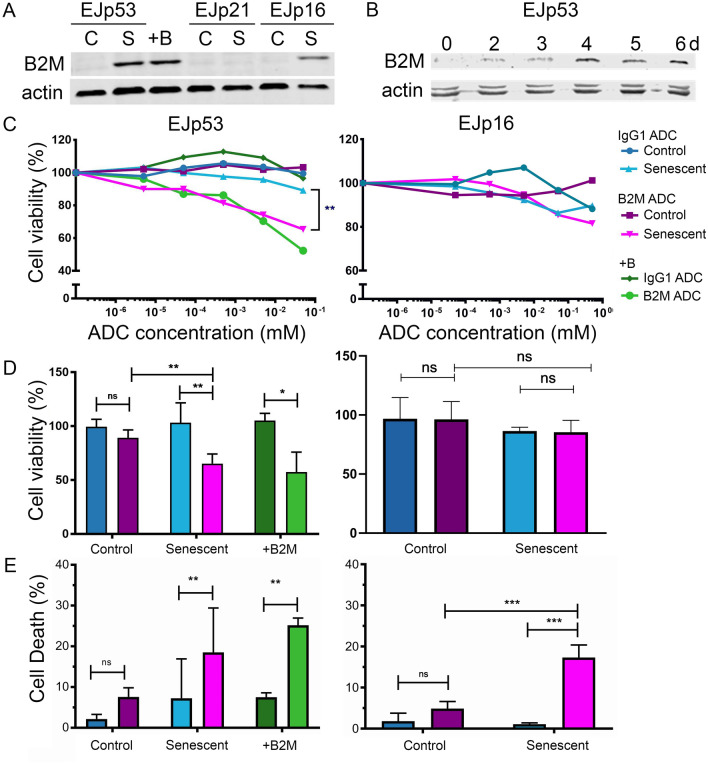
A wide range of diseases have been shown to be influenced by the accumulation of senescent cells, from fibrosis to diabetes, cancer, Alzheimer’s and other age-related pathologies. Consistent with this, clearance of senescent cells can prolong healthspan and lifespan in in vivo models. This provided a rationale for developing a new class of drugs, called senolytics, designed to selectively eliminate senescent cells in human tissues. The senolytics tested so far lack specificity and have significant off-target effects, suggesting that a targeted approach could be more clinically relevant. Here, we propose to use an extracellular epitope of B2M, a recently identified membrane marker of senescence, as a target for the specific delivery of toxic drugs into senescent cells. We show that an antibody–drug conjugate (ADC) against B2M clears senescent cells by releasing duocarmycin into them, while an isotype control ADC was not toxic for these cells. This effect was dependent on p53 expression and therefore more evident in stress-induced senescence. Non-senescent cells were not affected by either antibody, confirming the specificity of the treatment. Our results provide a proof-of-principle assessment of a novel approach for the specific elimination of senescent cells using a second generation targeted senolytic against proteins of their surfaceome, which could have clinical applications in pathological ageing and associated diseases.
Overview
The claims and statistics of this paper haven’t been checked yet.
Free: it reads the open-access text and checks the first 5 claims that cite a source we can check. Create a free account to check every claim.
Integrity signals
Registry
Cites
Statistics
Figures
Verification
Claims the paper makes
The claims and statistics of this paper haven’t been checked yet.
Free: it reads the open-access text and checks the first 5 claims that cite a source we can check. Create a free account to check every claim.
Claims other papers make about this one
Each is checked against this paper’s own text: does it say what the citing paper says it does?
The source backs part of the claim, not all of it — or backs it for a different population, condition or comparison.
In the citing paper
“Each of these approaches eliminates senescent cells, although in some cases, activated macrophages and other non-senescent cell types are also affected96–99.”
From Cellular senescence and senolytics: the path to the clinic (2022) · cites this paper as [99]
Experimental — accuracy not yet measuredThe source backs part of the claim, not all of it — or backs it for a different population, condition or comparison.
In the citing paper
“Certain cell surface proteins tend to be more highly expressed by senescent cells than most other cell types, which prompted development of engineered chimeric antigen receptor (CAR) T cells, vaccines and antibody–drug conjugates targeting these cell surface markers.”
From Cellular senescence and senolytics: the path to the clinic (2022) · cites this paper as [99]
Experimental — accuracy not yet measured
Self-check
Percentages, sums and reported differences re-computed from the paper’s own numbers.
The self-check needs the paper’s full text.
Citations
Cites
A biomarker that identifies senescent human cells in culture and in aging skin in vivo.
Dimri, G. P., Lee, X., Basile, G., Acosta, M., Scott, G., Roskelley, C., Medrano, E. E., Linskens, M., Rubelj, I., & Pereira-Smith, O. (1995) · Proceedings of the National Academy of Sciences · doi:10.1073/pnas.92.20.9363 · Cited by 7,477
Clearance of p16Ink4a-positive senescent cells delays ageing-associated disorders
Baker, D. J., Wijshake, T., Tchkonia, T., LeBrasseur, N. K., Childs, B. G., van de Sluis, B., Kirkland, J. L., & van Deursen, J. M. (2011) · Nature · doi:10.1038/nature10600 · Cited by 3,670
Cellular Senescence: Defining a Path Forward
Gorgoulis, V., Adams, P. D., Alimonti, A., Bennett, D. C., Bischof, O., Bishop, C., Campisi, J., Collado, M., Evangelou, K., Ferbeyre, G., et al. (2019) · Cell · doi:10.1016/j.cell.2019.10.005 · Cited by 3,225
Naturally occurring p16Ink4a-positive cells shorten healthy lifespan
Baker, D. J., Childs, B. G., Durik, M., Wijers, M. E., Sieben, C. J., Zhong, J., A. Saltness, R., Jeganathan, K. B., Verzosa, G. C., Pezeshki, A., et al. (2016) · Nature · doi:10.1038/nature16932 · Cited by 2,876
Cellular senescence: from physiology to pathology
Muñoz-Espín, D., & Serrano, M. (2014) · Nature Reviews Molecular Cell Biology · doi:10.1038/nrm3823 · Cited by 2,818
The role of senescent cells in ageing
van Deursen, J. M. (2014) · Nature · doi:10.1038/nature13193 · Cited by 2,623
Senescence and tumour clearance is triggered by p53 restoration in murine liver carcinomas
Xue, W., Zender, L., Miething, C., Dickins, R. A., Hernando, E., Krizhanovsky, V., Cordon-Cardo, C., & Lowe, S. W. (2007) · Nature · doi:10.1038/nature05529 · Cited by 2,473
Senescent cells, tumor suppression, and organismal aging: good citizens, bad neighbors
Campisi, J. (2005) · Cell · doi:10.1016/j.cell.2005.02.003 · Cited by 2,379
Senolytics improve physical function and increase lifespan in old age
Xu, M., Pirtskhalava, T., Farr, J. N., Weigand, B. M., Palmer, A. K., Weivoda, M. M., Inman, C. L., Ogrodnik, M. B., Hachfeld, C. M., Fraser, D. G., et al. (2018) · Nature Medicine · doi:10.1038/s41591-018-0092-9 · Cited by 2,287
Strategies and challenges for the next generation of antibody–drug conjugates
Beck, A., Goetsch, L., Dumontet, C., & Corvaïa, N. (2017) · Nature Reviews Drug Discovery · doi:10.1038/nrd.2016.268 · Cited by 2,271
An Essential Role for Senescent Cells in Optimal Wound Healing through Secretion of PDGF-AA
Demaria, M., Ohtani, N., Youssef, S. A., Rodier, F., Toussaint, W., Mitchell, J. R., Laberge, R.-M., Vijg, J., Van Steeg, H., Dollé, M. E. T., et al. (2014) · Developmental Cell · doi:10.1016/j.devcel.2014.11.012 · Cited by 2,045
Senescence of Activated Stellate Cells Limits Liver Fibrosis
Krizhanovsky, V., Yon, M., Dickins, R. A., Hearn, S., Simon, J., Miething, C., Yee, H., Zender, L., & Lowe, S. W. (2008) · Cell · doi:10.1016/j.cell.2008.09.015 · Cited by 2,027
Chemokine signaling via the CXCR2 receptor reinforces senescence
Acosta, J. C., O'Loghlen, A., Banito, A., Guijarro, M. V., Augert, A., Raguz, S., Fumagalli, M., Da Costa, M., Brown, C., Popov, N., et al. (2008) · Cell · doi:10.1016/j.cell.2008.03.038 · Cited by 1,801
Senescence in Health and Disease
He, S., & Sharpless, N. E. (2017) · Cell · doi:10.1016/j.cell.2017.05.015 · Cited by 1,766
Krtolica, A., Parrinello, S., Lockett, S., Desprez, P.-Y., & Campisi, J. (2001) · Proceedings of the National Academy of Sciences · doi:10.1073/pnas.211053698 · Cited by 1,730
Senescence surveillance of pre-malignant hepatocytes limits liver cancer development
Kang, T.-W., Yevsa, T., Woller, N., Hoenicke, L., Wuestefeld, T., Dauch, D., Hohmeyer, A., Gereke, M., Rudalska, R., Potapova, A., et al. (2011) · Nature · doi:10.1038/nature10599 · Cited by 1,621
Cellular senescence mediates fibrotic pulmonary disease
Schafer, M. J., White, T. A., Iijima, K., Haak, A. J., Ligresti, G., Atkinson, E. J., Oberg, A. L., Birch, J., Salmonowicz, H., Zhu, Y., et al. (2017) · Nature Communications · doi:10.1038/ncomms14532 · Cited by 1,613
Jeon, O. H., Kim, C., Laberge, R.-M., Demaria, M., Rathod, S., Vasserot, A. P., Chung, J. W., Kim, D. H., Poon, Y., David, N., et al. (2017) · Nature Medicine · doi:10.1038/nm.4324 · Cited by 1,515
Baar, M. P., Brandt, R. M. C., Putavet, D. A., Klein, J. D. D., Derks, K. W. J., Bourgeois, B. R. M., Stryeck, S., Rijksen, Y., van Willigenburg, H., Feijtel, D. A., et al. (2017) · Cell · doi:10.1016/j.cell.2017.02.031 · Cited by 1,454
Programmed cell senescence during mammalian embryonic development
Muñoz-Espín, D., Cañamero, M., Maraver, A., Gómez-López, G., Contreras, J., Murillo-Cuesta, S., Rodríguez-Baeza, A., Varela-Nieto, I., Ruberte, J., Collado, M., et al. (2013) · Cell · doi:10.1016/j.cell.2013.10.019 · Cited by 1,428
Hickson, L. J., Langhi Prata, L. G. P., Bobart, S. A., Evans, T. K., Giorgadze, N., Hashmi, S. K., Herrmann, S. M., Jensen, M. D., Jia, Q., Jordan, K. L., et al. (2019) · EBioMedicine · doi:10.1016/j.ebiom.2019.08.069 · Cited by 1,383
Cellular senescence promotes adverse effects of chemotherapy and cancer relapse
Demaria, M., O'Leary, M. N., Chang, J., Shao, L., Liu, S., Alimirah, F., Koenig, K., Le, C., Mitin, N., Deal, A. M., et al. (2017) · Cancer Discovery · doi:10.1158/2159-8290.cd-16-0241 · Cited by 1,338
Senescent cells: an emerging target for diseases of ageing
Childs, B. G., Gluscevic, M., Baker, D. J., Laberge, R.-M., Marquess, D., Dananberg, J., & van Deursen, J. M. (2017) · Nature Reviews Drug Discovery · doi:10.1038/nrd.2017.116 · Cited by 1,284
Senolytics in idiopathic pulmonary fibrosis: Results from a first-in-human, open-label, pilot study
Justice, J. N., Nambiar, A. M., Tchkonia, T., LeBrasseur, N. K., Pascual, R., Hashmi, S. K., Prata, L., Masternak, M. M., Kritchevsky, S. B., Musi, N., et al. (2019) · EBioMedicine · doi:10.1016/j.ebiom.2018.12.052 · Cited by 1,261
Mechanisms and functions of cellular senescence
Herranz, N., & Gil, J. (2018) · Journal of Clinical Investigation · doi:10.1172/jci95148 · Cited by 1,232
Targeting cellular senescence prevents age-related bone loss in mice
Farr, J. N., Xu, M., Weivoda, M. M., Monroe, D. G., Fraser, D. G., Onken, J. L., Negley, B. A., Sfeir, J. G., Ogrodnik, M. B., Hachfeld, C. M., et al. (2017) · Nature Medicine · doi:10.1038/nm.4385 · Cited by 1,182
Senescence in tumours: evidence from mice and humans
Collado, M., & Serrano, M. (2010) · Nature Reviews Cancer · doi:10.1038/nrc2772 · Cited by 1,124
Cellular senescence drives age-dependent hepatic steatosis
Ogrodnik, M., Miwa, S., Tchkonia, T., Tiniakos, D., Wilson, C. L., Lahat, A., Day, C. P., Burt, A., Palmer, A., Anstee, Q. M., et al. (2017) · Nature Communications · doi:10.1038/ncomms15691 · Cited by 1,044
Directed elimination of senescent cells by inhibition of BCL-W and BCL-XL
Yosef, R., Pilpel, N., Tokarsky-Amiel, R., Biran, A., Ovadya, Y., Cohen, S., Vadai, E., Dassa, L., Shahar, E., Condiotti, R., et al. (2016) · Nature Communications · doi:10.1038/ncomms11190 · Cited by 1,032
Fisetin is a senotherapeutic that extends health and lifespan
Yousefzadeh, M. J., Zhu, Y., McGowan, S. J., Angelini, L., Fuhrmann-Stroissnigg, H., Xu, M., Ling, Y. Y., Melos, K. I., Pirtskhalava, T., Inman, C. L., et al. (2018) · EBioMedicine · doi:10.1016/j.ebiom.2018.09.015 · Cited by 1,032
Cellular senescence: a translational perspective
Kirkland, J. L., & Tchkonia, T. (2017) · EBioMedicine · doi:10.1016/j.ebiom.2017.04.013 · Cited by 1,013
Zhang, P., Kishimoto, Y., Grammatikakis, I., Gottimukkala, K., Cutler, R. G., Zhang, S., Abdelmohsen, K., Bohr, V. A., Misra Sen, J., Gorospe, M., et al. (2019) · Nature Neuroscience · doi:10.1038/s41593-019-0372-9 · Cited by 977
Antibody–Drug Conjugates: An Emerging Concept in Cancer Therapy
Chari, R. V. J., Miller, M. L., & Widdison, W. C. (2014) · Angewandte Chemie International Edition · doi:10.1002/anie.201307628 · Cited by 930
Cellular senescence and its effector programs
Salama, R., Sadaie, M., Hoare, M., & Narita, M. (2014) · Genes & Development · doi:10.1101/gad.235184.113 · Cited by 855
Antibody-Drug Conjugates in Cancer Therapy
Sievers, E. L., & Senter, P. D. (2013) · Annual Review of Medicine · doi:10.1146/annurev-med-050311-201823 · Cited by 770
Zhu, Y., Doornebal, E. J., Pirtskhalava, T., Giorgadze, N., Wentworth, M., Fuhrmann-Stroissnigg, H., Niedernhofer, L. J., Robbins, P. D., Tchkonia, T., & Kirkland, J. L. (2017) · Aging · doi:10.18632/aging.101202 · Cited by 757
Roos, C. M., Zhang, B., Palmer, A. K., Ogrodnik, M. B., Pirtskhalava, T., Thalji, N. M., Hagler, M., Jurk, D., Smith, L. A., Casaclang‐Verzosa, G., et al. (2016) · Aging Cell · doi:10.1111/acel.12458 · Cited by 738
Identification of HSP90 inhibitors as a novel class of senolytics
Fuhrmann-Stroissnigg, H., Ling, Y. Y., Zhao, J., McGowan, S. J., Zhu, Y., Brooks, R. W., Grassi, D., Gregg, S. Q., Stripay, J. L., Dorronsoro, A., et al. (2017) · Nature Communications · doi:10.1038/s41467-017-00314-z · Cited by 701
Antibody–drug conjugates for cancer therapy
Thomas, A., Teicher, B. A., & Hassan, R. (2016) · The Lancet Oncology · doi:10.1016/s1470-2045(16)30030-4 · Cited by 606
Dose-dependent oncogene-induced senescence in vivo and its evasion during mammary tumorigenesis
Sarkisian, C. J., Keister, B. A., Stairs, D. B., Boxer, R. B., Moody, S. E., & Chodosh, L. A. (2007) · Nature Cell Biology · doi:10.1038/ncb1567 · Cited by 490
Dankort, D., Filenova, E., Collado, M., Serrano, M., Jones, K., & McMahon, M. (2007) · Genes & Development · doi:10.1101/gad.1516407 · Cited by 481
Antibody-Drug Conjugate-Based Therapeutics: State of the Science
Birrer, M. J., Moore, K. N., Betella, I., & Bates, R. C. (2019) · JNCI: Journal of the National Cancer Institute · doi:10.1093/jnci/djz035 · Cited by 439
Solid-phase synthesis of molecularly imprinted nanoparticles
Canfarotta, F., Poma, A., Guerreiro, A., & Piletsky, S. (2016) · Nature Protocols · doi:10.1038/nprot.2016.030 · Cited by 407
Identification and characterization of Cardiac Glycosides as senolytic compounds
Triana-Martínez, F., Picallos-Rabina, P., Da Silva-Álvarez, S., Pietrocola, F., Llanos, S., Rodilla, V., Soprano, E., Pedrosa, P., Ferreirós, A., Barradas, M., et al. (2019) · Nature Communications · doi:10.1038/s41467-019-12888-x · Cited by 384
Growth stimulation leads to cellular senescence when the cell cycle is blocked
Demidenko, Z. N., & Blagosklonny, M. V. (2008) · Cell Cycle · doi:10.4161/cc.7.21.6919 · Cited by 377
Inhibition of p21‐mediated ROS accumulation can rescue p21‐induced senescence
Macip, S., Igarashi, M., Fang, L., Chen, A., Pan, Z., Lee, S. W., & Aaronson, S. A. (2002) · The EMBO Journal · doi:10.1093/emboj/21.9.2180 · Cited by 374
Self-citationCardiac glycosides are broad-spectrum senolytics
Guerrero, A., Herranz, N., Sun, B., Wagner, V., Gallage, S., Guiho, R., Wolter, K., Pombo, J., Irvine, E. E., Innes, A. J., et al. (2019) · Nature Metabolism · doi:10.1038/s42255-019-0122-z · Cited by 359
A versatile drug delivery system targeting senescent cells
Muñoz‐Espín, D., Rovira, M., Galiana, I., Giménez, C., Lozano‐Torres, B., Paez‐Ribes, M., Llanos, S., Chaib, S., Muñoz‐Martín, M., Ucero, A. C., et al. (2018) · EMBO Molecular Medicine · doi:10.15252/emmm.201809355 · Cited by 339
Aged-senescent cells contribute to impaired heart regeneration
Lewis‐McDougall, F. C., Ruchaya, P. J., Domenjo‐Vila, E., Shin Teoh, T., Prata, L., Cottle, B. J., Clark, J. E., Punjabi, P. P., Awad, W., Torella, D., et al. (2019) · Aging Cell · doi:10.1111/acel.12931 · Cited by 317
Ritchie, M., Tchistiakova, L., & Scott, N. (2013) · mAbs · doi:10.4161/mabs.22854 · Cited by 312
Wild-type p53 triggers a rapid senescence program in human tumor cells lacking functional p53
Sugrue, M. M., Shin, D. Y., Lee, S. W., & Aaronson, S. A. (1997) · Proceedings of the National Academy of Sciences · doi:10.1073/pnas.94.18.9648 · Cited by 292
Identification of senescent cell surface targetable protein DPP4
Kim, K. M., Noh, J. H., Bodogai, M., Martindale, J. L., Yang, X., Indig, F. E., Basu, S. K., Ohnuma, K., Morimoto, C., Johnson, P. F., et al. (2017) · Genes & Development · doi:10.1101/gad.302570.117 · Cited by 270
Characterization of novel markers of senescence and their prognostic potential in cancer
Althubiti, M., Lezina, L., Carrera, S., Jukes-Jones, R., Giblett, S. M., Antonov, A., Barlev, N., Saldanha, G. S., Pritchard, C. A., Cain, K., et al. (2014) · Cell Death & Disease · doi:10.1038/cddis.2014.489 · Cited by 256
Self-citationCell killing by antibody–drug conjugates
Kovtun, Y. V., & Goldmacher, V. S. (2007) · Cancer Letters · doi:10.1016/j.canlet.2007.04.010 · Cited by 246
Fang, L., Igarashi, M., Leung, J., Sugrue, M. M., Lee, S. W., & Aaronson, S. A. (1999) · Oncogene · doi:10.1038/sj.onc.1202615 · Cited by 207
van der Lee, M. M. C., Groothuis, P. G., Ubink, R., van der Vleuten, M. A. J., van Achterberg, T. A., Loosveld, E. M., Damming, D., Jacobs, D. C. H., Rouwette, M., Egging, D. F., et al. (2015) · Molecular Cancer Therapeutics · doi:10.1158/1535-7163.mct-14-0881-t · Cited by 201
An OFF–ON Two-Photon Fluorescent Probe for Tracking Cell Senescence in Vivo
Lozano-Torres, B., Galiana, I., Rovira, M., Garrido, E., Chaib, S., Bernardos, A., Muñoz-Espín, D., Serrano, M., Martínez-Máñez, R., & Sancenón, F. (2017) · Journal of the American Chemical Society · doi:10.1021/jacs.7b04985 · Cited by 184
Induction of senescence with doxorubicin leads to increased genomic instability of HCT116 cells
Sliwinska, M. A., Mosieniak, G., Wolanin, K., Babik, A., Piwocka, K., Magalska, A., Szczepanowska, J., Fronk, J., & Sikora, E. (2009) · Mechanisms of Ageing and Development · doi:10.1016/j.mad.2008.04.011 · Cited by 178
Majumder, P. K., Grisanzio, C., O'Connell, F., Barry, M., Brito, J. M., Xu, Q., Guney, I., Berger, R., Herman, P., Bikoff, R., et al. (2008) · Cancer Cell · doi:10.1016/j.ccr.2008.06.002 · Cited by 178
The curcumin analog EF24 is a novel senolytic agent
Li, W., He, Y., Zhang, R., Zheng, G., & Zhou, D. (2019) · Aging · doi:10.18632/aging.101787 · Cited by 164
Dokter, W., Ubink, R., van der Lee, M., van der Vleuten, M., van Achterberg, T., Jacobs, D., Loosveld, E., van den Dobbelsteen, D., Egging, D., Mattaar, E., et al. (2014) · Molecular Cancer Therapeutics · doi:10.1158/1535-7163.mct-14-0040-t · Cited by 163
Liu, X., Lin, X., Mi, Y., Li, J., & Zhang, C. (2018) · Oxidative Medicine and Cellular Longevity · doi:10.1155/2018/9390810 · Cited by 146
Stem Cells, Their Niches and the Systemic Environment: An Aging Network
Drummond-Barbosa, D. (2008) · Genetics · doi:10.1534/genetics.108.098244 · Cited by 126
Detecting and targeting senescent cells using molecularly imprinted nanoparticles
Ekpenyong-Akiba, A. E., Canfarotta, F., Abd H., B., Poblocka, M., Casulleras, M., Castilla-Vallmanya, L., Kocsis-Fodor, G., Kelly, M. E., Janus, J., Althubiti, M., et al. (2019) · Nanoscale Horizons · doi:10.1039/c8nh00473k · Cited by 108
Self-citationAntibody‐drug conjugates: Promising and efficient tools for targeted cancer therapy
Nasiri, H., Valedkarimi, Z., Aghebati‐Maleki, L., & Majidi, J. (2018) · Journal of Cellular Physiology · doi:10.1002/jcp.26435 · Cited by 101
BTK Modulates p53 Activity to Enhance Apoptotic and Senescent Responses
Althubiti, M., Rada, M., Samuel, J., Escorsa, J. M., Najeeb, H., Lee, K.-G., Lam, K., Jones, G. D. D., Barlev, N. A., & Macip, S. (2016) · Cancer Research · doi:10.1158/0008-5472.can-16-0690 · Cited by 79
Self-citationRadiotherapy-Induced Senescence and its Effects on Responses to Treatment
Tabasso, A. F. S., Jones, D. J. L., Jones, G. D. D., & Macip, S. (2019) · Clinical Oncology · doi:10.1016/j.clon.2019.02.003 · Cited by 63
Self-citationModulation of drug-linker design to enhance in vivo potency of homogeneous antibody-drug conjugates
Pabst, M., McDowell, W., Manin, A., Kyle, A. F., Camper, N., Juan, E. D., Parekh, V., Rudge, F., Makwana, H., Kantner, T., et al. (2017) · Journal of Controlled Release · doi:10.1016/j.jconrel.2017.02.027 · Cited by 49
Self-citationElimination of p19ARF‐expressing cells protects against pulmonary emphysema in mice
Mikawa, R., Suzuki, Y., Baskoro, H., Kanayama, K., Sugimoto, K., Sato, T., & Sugimoto, M. (2018) · Aging Cell · doi:10.1111/acel.12827 · Cited by 45
Amelioration of age‐related brain function decline by Bruton's tyrosine kinase inhibition
Ekpenyong‐Akiba, A. E., Poblocka, M., Althubiti, M., Rada, M., Jurk, D., Germano, S., Kocsis‐Fodor, G., Shi, Y., Canales, J. J., & Macip, S. (2019) · Aging Cell · doi:10.1111/acel.13079 · Cited by 45
Self-citationPro‐survival signal inhibition by CDK inhibitor dinaciclib in Chronic Lymphocytic Leukaemia
Chen, Y., Germano, S., Clements, C., Samuel, J., Shelmani, G., Jayne, S., Dyer, M. J. S., & Macip, S. (2016) · British Journal of Haematology · doi:10.1111/bjh.14285 · Cited by 34
Self-citationEngineering mammalian cells to seek senescence-associated secretory phenotypes
Qudrat, A., Wong, J., & Truong, K. (2017) · Journal of Cell Science · doi:10.1242/jcs.206979 · Cited by 24
Current perspectives on the cellular mechanisms of immunologic tolerance.
Parks, D. E., & Weigle, W. O. (1980) · PubMed · Cited by 21
Licence to kill senescent cells in idiopathic pulmonary fibrosis?
Mailleux, A., & Crestani, B. (2017) · European Respiratory Journal · doi:10.1183/13993003.01360-2017 · Cited by 21
Detection of Senescent Cells by Extracellular Markers Using a Flow Cytometry-Based Approach
Althubiti, M., & Macip, S. (2016) · Methods in molecular biology · doi:10.1007/978-1-4939-6670-7_14 · Cited by 12
Self-citationTargeted Senolytic Strategies Based on the Senescent Surfaceome
Ekpenyong‐Akiba, A. E., Poblocka, M., & Macip, S. (2020) · Healthy ageing and longevity · doi:10.1007/978-3-030-44903-2_6 · Cited by 9
Self-citationSenolysis and Senostasis Through the Plasma Membrane
Kim, K. M., Noh, J. H., & Gorospe, M. (2020) · Healthy ageing and longevity · doi:10.1007/978-3-030-44903-2_7 · Cited by 7
Cited by
Cellular senescence: the good, the bad and the unknown
Huang, W., Hickson, L. J., Eirin, A., Kirkland, J. L., & Lerman, L. O. (2022) · Nature Reviews Nephrology · doi:10.1038/s41581-022-00601-z · Cited by 1,150
Cellular senescence and senolytics: the path to the clinic
Chaib, S., Tchkonia, T., & Kirkland, J. L. (2022) · Nature Medicine · doi:10.1038/s41591-022-01923-y · Cited by 1,134
Cellular senescence: a key therapeutic target in aging and diseases
Zhang, L., Pitcher, L. E., Yousefzadeh, M. J., Niedernhofer, L. J., Robbins, P. D., & Zhu, Y. (2022) · Journal of Clinical Investigation · doi:10.1172/jci158450 · Cited by 631
“After internalization via endolysosomal trafficking, it can be cleaved by cathepsin B to release duocarmycin, causing selective cell death of SnCs (125).”
BackgroundMethodMetabolic changes in aging humans: current evidence and therapeutic strategies
Palmer, A. K., & Jensen, M. D. (2022) · Journal of Clinical Investigation · doi:10.1172/jci158451 · Cited by 331
“Other strategies under development to target the effects of senescent cells include “senomorphic” drugs, which aim to reduce the senescence-associated secretory phenotype, and emerging antibody-mediated therapies (121).”
BackgroundSenescence as a therapeutic target in cancer and age-related diseases
McHugh, D., Durán, I., & Gil, J. (2025) · Nature Reviews Drug Discovery · doi:10.1038/s41573-024-01074-4 · Cited by 197
“3-Deazaadenosine (3DA), an inhibitor of S -adenosyl homocysteinase (AHCY), has been shown to delay senescence. mTOR inhibitors can be both senomorphics and able to revert/delay senescence, depending on the setting. aSnC, altered SnC; B2M, β 2 -microglobulin; rSnC, reverted SnC (in which senescence phenotypes have been…”
Metadata
- Authors
- Poblocka, M., Bassey, A. L., Smith, V. M., Falcicchio, M., Manso, A. S., Althubiti, M., Sheng, X., Kyle, A., Barber, R., Frigerio, M., & Macip, S.
- Affiliations
- University of Leicester (GB)
- Abzena (United Kingdom) (GB)
- Universitat Oberta de Catalunya (ES)
- Corresponding author
- Macip, Salvador
- ORCID
- Venue
- Scientific Reports
- Published
- 2021-10-13
- Volume
- 11
- Issue
- 1
- Pages
- 20358-20358
- ISSN
- 2045-2322 (ISSN-L)
- PMC
- PMC8514501
- OpenAlex
- W3207332839
- Cited by
- 137
- References
- 77
- Citations by year
- 2026: 17 · 2025: 38 · 2024: 39 · 2023: 24 · 2022: 19
- FWCI
- 12.88
- Type
- journal article
- Language
- en
- Open access
- gold
- doi.org
- Licence
- cc-by
- creativecommons.org/licenses/by/4.0 (tdm)
- creativecommons.org/licenses/by/4.0 (vor)
- Locations
- Scientific Reports (publishedVersion, cc-by)
- PubMed Central (publishedVersion, cc-by)
- PubMed (publishedVersion)
- DOAJ (DOAJ: Directory of Open Access Journals) (submittedVersion, cc-by-sa)
- The Oberta in Open Access (Universitat Oberta de Catalunya) (submittedVersion, cc-by)
- Funders
- BBSRC
- Topics
- Life Sciences › Biochemistry, Genetics and Molecular Biology › Cell Biology › Telomeres, Telomerase, and Senescence
- Life Sciences › Biochemistry, Genetics and Molecular Biology › Aging › Genetics, Aging, and Longevity in Model Organisms
- Life Sciences › Biochemistry, Genetics and Molecular Biology › Molecular Biology › Cell death mechanisms and regulation
- Keywords
- senolytics, senescent cells, antibody-drug conjugates, beta2-microglobulin, duocarmycin, p53, stress-induced senescence, extracellular epitope, pathological aging, healthspan
- MeSH terms
- Duocarmycins, Senotherapeutics, beta 2-Microglobulin, Cell Line, Gene Expression Regulation, Humans, Tumor Suppressor Protein p53, Cellular Senescence, Immunoconjugates
About these checks
Registry, retraction, Cites and statistics results are computed, not judged, with one exception: a printed reference that no index lists is read once by a model before it counts as a citation error. Claims are extracted by a model and kept only when their quote appears verbatim in the text; each cited source is then checked, with a model’s help, for whether it says what the claim relies on. Those verdicts can be wrong — read the claim’s quote and the cited source before relying on one.
Statistics and arithmetic are recomputed, not judged.
Confidence bands are shown only for fields calibrated on our annotated test set. None is calibrated yet, so no band is shown.
What counts as a claim ›How we measure confidence ›How we check this ›
Are you an author, or do you see a problem with this page? Request a review
Data sources
Bibliographic data: Semantic Scholar, OpenAlex, Crossref.
Contains information from the Semantic Scholar Academic Graph Datasets, made available under the ODC Attribution License (ODC-BY 1.0).
Semantic Scholar’s data is described in: Kinney, R., et al. (2023). The Semantic Scholar Open Data Platform. arXiv:2301.10140.
