

The DOI matches its Crossref record; 17 of the 17 references it cites were found in a registry or an index.
Experience sampling self-reports of social media use have comparable predictive validity to digital trace measures
Abstract
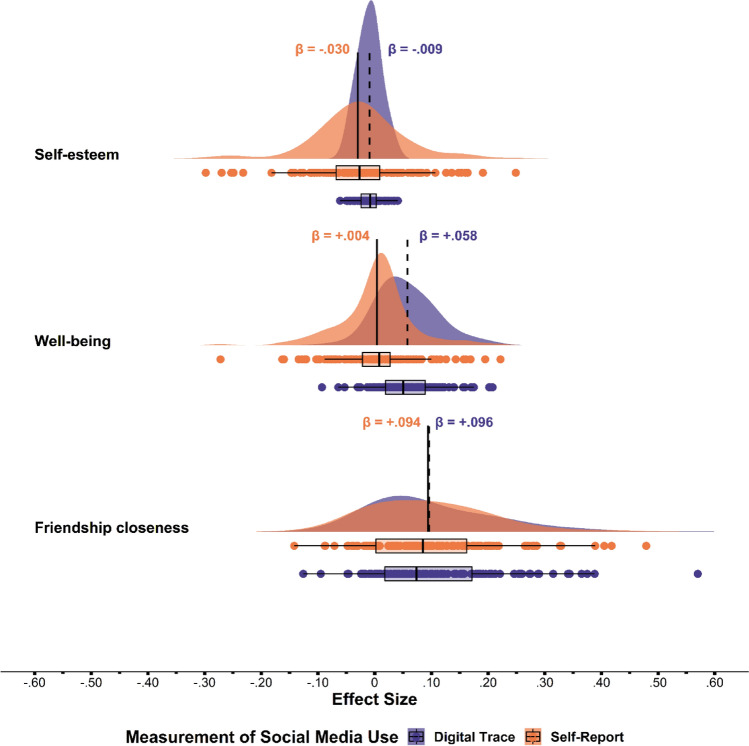
Research agrees that self-reported measures of time spent with social media (TSM) show poor convergent validity, because they correlate modestly with equivalent objective digital trace measures. This experience sampling study among 159 adolescents (12,617 self-reports) extends this work by examining the comparative predictive validity of self-reported and digital trace measures of TSM, that is, the extent to which self-reported and digital trace measures of TSM correspond in their effects on self-esteem, well-being, and friendship closeness. Using an N = 1 method of analysis, we investigated the correspondence on a between-person, within-person, and person-specific level. Although our results confirmed the poor convergent validity of self-reported TSM reported earlier, we found that self-reports of TSM had comparable predictive validity to digital trace measures on all three levels. Because comparative predictive validity of self-reported TSM is crucial for investigating social media effects, our results have important implications for future research using self-reported TSM.
Overview
The claims and statistics of this paper haven’t been checked yet.
Run the check — free, no account needed. It reads the open-access text and checks the sources it cites.
Integrity signals
Registry
Cites
Statistics
Figures
Verification
Claims the paper makes
The claims and statistics of this paper haven’t been checked yet.
Run the check — free, no account needed. It reads the open-access text and checks the sources it cites.
Claims other papers make about this one
Each is checked against this paper’s own text: does it say what the citing paper says it does?
The source backs part of the claim, not all of it — or backs it for a different population, condition or comparison.
In the citing paper
“Our dataset consists of voluntarily posted Reddit content, which offers advantages because posts are shared anonymously and at the time the user wanted to share. This reduces social desirability and recall bias compared to surveys or interviews and can lead to more candid reflections [37, 134].”
From Understanding Teen Overreliance on AI Companion Chatbots Through Self-Reported Reddit Narratives (2026) · cites this paper as [134]
Experimental — accuracy not yet measured
Self-check
Percentages, sums and reported differences re-computed from the paper’s own numbers.
The self-check needs the paper’s full text.
Citations
Cites
Lakens, D. (2013) · Frontiers in Psychology · doi:10.3389/fpsyg.2013.00863 · Cited by 10,303
Effect size guidelines for individual differences researchers
Gignac, G. E., & Szodorai, E. T. (2016) · Personality and Individual Differences · doi:10.1016/j.paid.2016.06.069 · Cited by 2,860
cocor: A Comprehensive Solution for the Statistical Comparison of Correlations
Diedenhofen, B., & Musch, J. (2015) · PLOS ONE · doi:10.1371/journal.pone.0121945 · Cited by 1,919
Five domains of interpersonal competence in peer relationships.
Buhrmester, D., Furman, W., Wittenberg, M. T., & Reis, H. T. (1988) · Journal of Personality and Social Psychology · doi:10.1037//0022-3514.55.6.991 · Cited by 859
Parry, D. A., Davidson, B. I., Sewall, C. J. R., Fisher, J. T., Mieczkowski, H., & Quintana, D. S. (2021) · Nature Human Behaviour · doi:10.1038/s41562-021-01117-5 · Cited by 793
Social media use and its impact on adolescent mental health: An umbrella review of the evidence.
Valkenburg, P. M., Meier, A., & Beyens, I. (2022) · Current opinion in psychology · doi:10.1016/j.copsyc.2021.08.017 · Cited by 767
Self-citationUnderstanding the Impact of Convergent Validity on Research Results
Carlson, K. D., & Herdman, A. O. (2012) · Organizational Research Methods · doi:10.1177/1094428110392383 · Cited by 642
Meier, A., & Reinecke, L. (2021) · Communication Research · doi:10.1177/0093650220958224 · Cited by 534
The effect of social media on well-being differs from adolescent to adolescent
Beyens, I., Pouwels, J. L., van Driel, I. I., Keijsers, L., & Valkenburg, P. M. (2020) · Scientific Reports · doi:10.1038/s41598-020-67727-7 · Cited by 497
Self-citationTime spent on social network sites and psychological well-being: a meta-analysis
Huang, C. (2017) · Cyberpsychology, Behavior, and Social Networking · doi:10.1089/cyber.2016.0758 · Cited by 457
Research works printed but not linked: 23
- Preedy, V. R. & Watson, R. R. in Handbook of Disease Burdens and Quality of Life Measures (eds Victor R. Preedy & Ronald R. Watson) pp. 4301–4301 (Springer New York, 2010). · DOI
- Ryff, C. D. Happiness is everything, or is it? Explorations on the meaning of psychological well-Being. J. Pers. Soc. Psychol. 57, 1069–1081. https://doi.org/10.1037/0022-3514.57.6.1069 (1989). · DOI · Paper page
- Orth, U. & Robins, R. W. The development of self-esteem. Curr. Dir. Psychol. Sci. 23, 381–387. https://doi.org/10.1177/0963721414547414 (2014). · DOI · Paper page
- Liu, D., Baumeister, R. F., Yang, C.-C. & Hu, B. Digital communication media use and psychological well-being: a meta-analysis. J. Comput. Mediat. Commun. 24, 259–274. https://doi.org/10.1093/ccc/zmz013 (2019). · DOI
- Paez, D. et al. A longitudinal study of the effects of internet use on subjective well-being. Media Psychol. 23, 676–710. https://doi.org/10.1080/15213269.2019.1624177 (2020). · DOI
- Aalbers, G., McNally, R. J., Heeren, A., de Wit, S. & Fried, E. I. Social media and depression symptoms: a network perspective. J. Exp. Psychol. 148, 1454–1462. https://doi.org/10.1037/xge0000528 (2019). · DOI
- Johannes, N., Nguyen, T.-V., Weinstein, N. & Przybylski, A. K. Objective, subjective, and accurate reporting of social media use: no evidence that daily social media use correlates with personality traits, motivational states, or well-being. Technol. Mind Behav. https://doi.org/10.1037/tmb0000035 (2021). · DOI
- Valkenburg, P. M., Beyens, I., Pouwels, J. L., van Driel, I. I. & Keijsers, L. Social media and adolescents’ self-esteem: heading for a person-specific media effects paradigm. J. Commun. 71, 56–78. https://doi.org/10.1093/joc/jqaa/039 (2021). · DOI
- Pouwels, J. L., Valkenburg, P. M., Beyens, I., van Driel, I. I. & Keijsers, L. Social media use and friendship closeness in adolescents’ daily lives: An experience sampling study. Dev. Psychol. 57, 309–323. https://doi.org/10.1037/dev0001148 (2021). · DOI
- Valkenburg, P. M., Pouwels, J. L., Beyens, I., van Driel, I. I. & Keijsers, L. Adolescents’ experiences on social media and their self-esteem: a person-specific susceptibility perspective. Technol. Mind Behav. https://doi.org/10.1037/tmb0000037 (2021). · DOI
- Harter, S. & Whitesell, N. R. Beyond the debate: Why some adolescents report stable self-worth over time and situation, whereas others report changes in self-worth. J. Personal. 71, 1027–1058. https://doi.org/10.1111/1467-6494.7106006 (2003). · DOI
- Eid, M. & Diener, E. Global judgments of subjective well-being: Situational variability and long-term stability. Soc. Indic. Res. 65, 245–277. https://doi.org/10.1023/B:SOCI.0000003801.89195.bc (2004). · DOI · Paper page
- Armsden, G. C. & Greenberg, M. T. The inventory of parent and peer attachment: individual differences and their relationship to psychological well-being in adolescence. J. Youth Adolesc. 16, 427–454. https://doi.org/10.1007/BF02202939 (1987). · DOI · Paper page
- Asparouhov, T., Hamaker, E. L. & Muthén, B. Dynamic structural equation models. Struct. Equ. Model. 25, 359–388. https://doi.org/10.1080/10705511.2017.1406803 (2018). · DOI
- Deng, T. et al. Measuring smartphone usage and task switching with log tracking and self-reports. Mob. Media Commun. 7, 3–23. https://doi.org/10.1177/2050157918761491 (2019). · DOI · Paper page
- Geyer, K., Ellis, D. A., Shaw, H. & Davidson, B. I. Open-source smartphone app and tools for measuring, quantifying, and visualizing technology use. Behav. Res. Methods 54, 1–12. https://doi.org/10.3758/s13428-021-01585-7 (2022). · DOI
- Griffioen, N., Rooij, M. V., Lichtwarck-Aschoff, A. & Granic, I. Toward improved methods in social media research. Technol. Mind Behav. https://doi.org/10.1037/tmb0000005 (2020). · DOI
- Robins, R. W., Hendin, H. M. & Trzesniewski, K. H. Measuring global self-esteem: construct validation of a single-item measure and the Rosenberg self-esteem scale. Pers. Soc. Psychol. Bull. 27, 151–161. https://doi.org/10.1177/0146167201272002 (2001). · DOI · Paper page
- Lee, S. J. Online communication and adolescent social ties: Who benefits more from internet use?. J. Comput.-Mediat. Commun. 14, 509–531. https://doi.org/10.1111/j.1083-6101.2009.01451.x (2009). · DOI · Paper page
- Furman, W. & Buhrmester, D. Children’s perceptions of the personal relationships in their social networks. Dev. Psychol. 21, 1016–1024. https://doi.org/10.1037/0012-1649.21.6.1016 (1985). · DOI
- McNeish, D. & Hamaker, E. L. A primer on two-level dynamic structural equation models for intensive longitudinal data in Mplus. Psychol Methods 25, 610–635. https://doi.org/10.1037/met0000250 (2020). · DOI
- Kline, R. B. Principles and practice of structural equation modeling (Guilford Press, 2011).
- Allen, M. et al. Raincloud plots: a multi-platform tool for robust data visualization. Wellcome Open Res. https://doi.org/10.12688/wellcomeopenres.15191.2 (2021). · DOI
Cited by
Sorted by citations
Mahalingham, T., McEvoy, P. M., & Clarke, P. J. F. (2023) · Computers in Human Behavior · doi:10.1016/j.chb.2022.107567 · Cited by 73
Gentzler, A. L., Hughes, J. L., Johnston, M., & Alderson, J. E. (2023) · Journal of Adolescence · doi:10.1002/jad.12243 · Cited by 34
Understanding Teen Overreliance on AI Companion Chatbots Through Self-Reported Reddit Narratives
Namvarpour, M. (., Brofsky, B., Medina, J. Y., Akter, M., & Razi, A. (2026) · Proceedings of the 2026 CHI Conference on Human Factors in Computing Systems · doi:10.1145/3772318.3790597 · Cited by 24
Metadata
- Authors
- Verbeij, T., Pouwels, J. L., Beyens, I., & Valkenburg, P. M.
- Venue
- Scientific Reports
- Published
- 2022-05-09
- Volume
- 12
- Issue
- 1
- ISSN
- 2045-2322
- PMC
- PMC9084269
- Cited by
- 47
- References
- 17
- Language
- en
- Funders
- Nederlandse Organisatie voor Wetenschappelijk Onderzoek (Spinoza Prize)
About these checks
Registry, retraction, Cites and statistics results are computed, not judged, with one exception: a printed reference that no index lists is read once by a model before it counts as a citation error. Claims are extracted by a model and kept only when their quote appears verbatim in the text; each cited source is then checked, with a model’s help, for whether it says what the claim relies on. Those verdicts can be wrong — read the claim’s quote and the cited source before relying on one.
Statistics and arithmetic are recomputed, not judged.
Confidence bands are shown only for fields calibrated on our annotated test set. None is calibrated yet, so no band is shown.
What counts as a claim ›How we measure confidence ›How we check this ›
Are you an author, or do you see a problem with this page? Request a review
How to cite
Cite CoChat for the checks on this page, and the paper for its own findings.
- This page
- CoChat. (2026). Citation check: Experience sampling self-reports of social media use have comparable predictive validity to digital trace measures. https://app.cochat.ai/papers/10.1038/s41598-022-11510-3
- The paper
- Verbeij, T., Pouwels, J. L., Beyens, I., & Valkenburg, P. M. (2022). Experience sampling self-reports of social media use have comparable predictive validity to digital trace measures. Scientific Reports. https://doi.org/10.1038/s41598-022-11510-3
