

Optimized removal of hexavalent chromium from water using spent tea leaves treated with ascorbic acid
Open accessThe DOI matches its Crossref record; 51 of the 53 references it cites were found in a registry or an index; 23 of the 68 sources its claims cite were checked for support.
Abstract
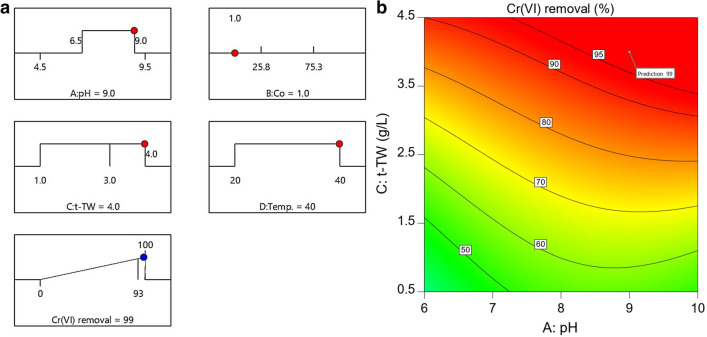
Abstract Spent tea leaves were functionalized with ascorbic acid to obtain treated tea waste (t-TW) to encourage the adsorption of hexavalent chromium from water. The adsorption removal of Cr(VI) was systematically investigated as a function of four experimental factors: pH (2–12), initial Cr(VI) concentration (1–100 mg L−1), t-TW dosage (0–4 g L−1), and temperature (10–50 °C) by following a statistical experimental design. A central composite rotatable experimental design based on a response surface methodology was used to establish an empirical model that assessed the individual and combined effects of factors on adsorptive removal of Cr(VI). The model was experimentally verified and statistically validated then used to predict optimal adsorption removal of Cr(VI) from water. At optimized conditions, ≥ 99% of 1 mg L−1 Cr(VI) can be removed by 4 g L−1 t-TW at a pH of 9. The adsorptive mechanism was assessed by conducting kinetics and equilibrium studies. The adsorption of Cr(VI) by t-TW followed a pseudo-second-order kinetics model (k2 = 0.001 g mg−1 h−1) and could be described by Langmuir and Temkin isotherms, indicating monolayer adsorption and predominantly adsorbate-adsorbent interactions. The t-TW exhibited a competitive Cr(VI) adsorption capacity of 232.2 mg g−1 compared with the other low-cost adsorbents. These results support the utilization of tea waste for the removal of hazardous metal contaminants from aqueous systems.
Overview
CoChat Summary
TL;DR
Spent black tea leaves functionalized with ascorbic acid (t-TW) were optimized via response surface methodology for Cr(VI) removal from water. At optimized conditions, ≥99% of 1 mg L−1 Cr(VI) was removed by 4 g L−1 t-TW at pH 9, with a competitive adsorption capacity of 232.2 mg g−1.
Key findings
- The RSM model predicted and experiments verified ≥99% removal of 1 mg L−1 Cr(VI) at pH 9, 4 g L−1 t-TW, and 40 °C; residual Cr(VI) was below the method detection limit of 0.002 mg L−1 and below US EPA (0.1 mg L−1) and WHO (0.05 mg L−1) limits.
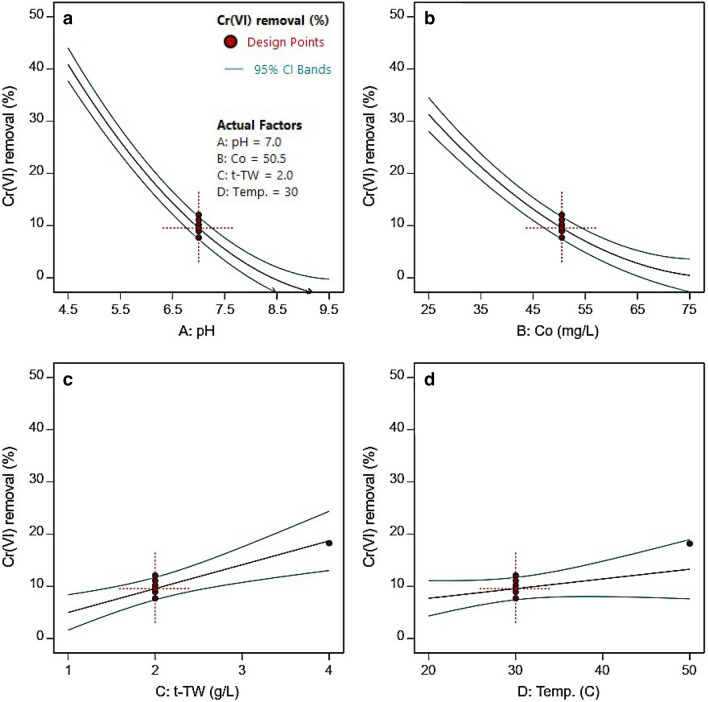
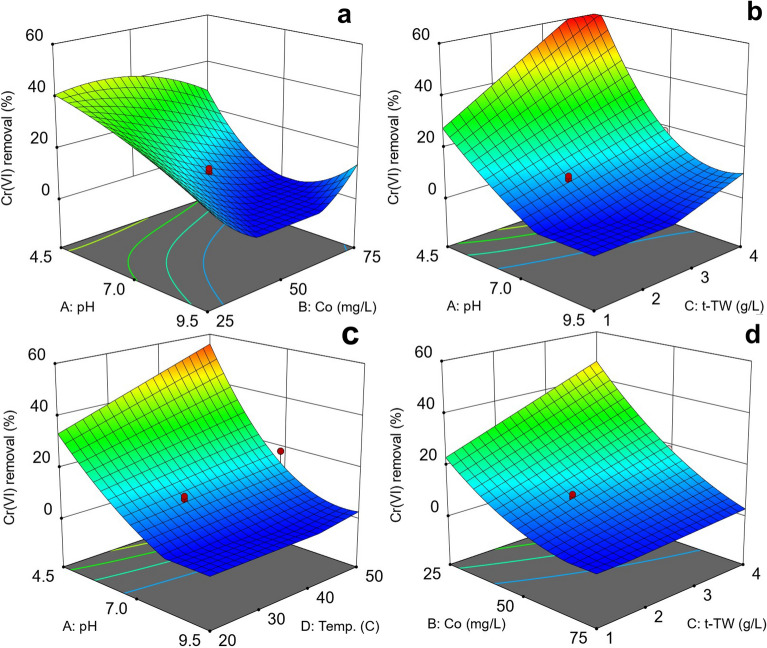
- pH had the greatest effect on Cr(VI) removal, followed by initial Cr(VI) concentration, adsorbent dosage, and temperature; removal decreased as pH increased from 4.5 to 9.5 and as initial Cr(VI) concentration increased.
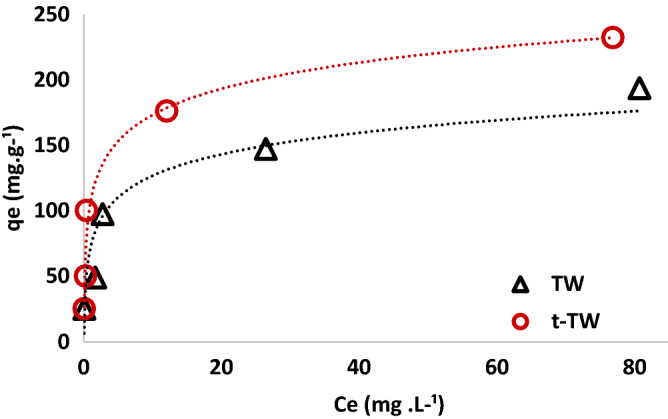
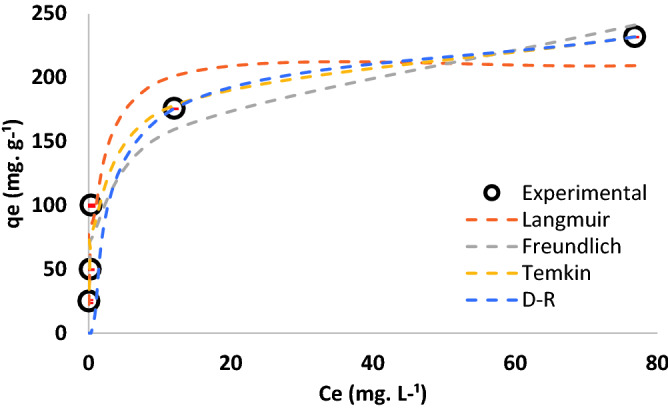
- t-TW showed an experimental maximum adsorption capacity of 231.95 mg g−1 versus 193.45 mg g−1 for untreated tea waste, and a reported capacity of 232.2 mg g−1 in comparison with other adsorbents.
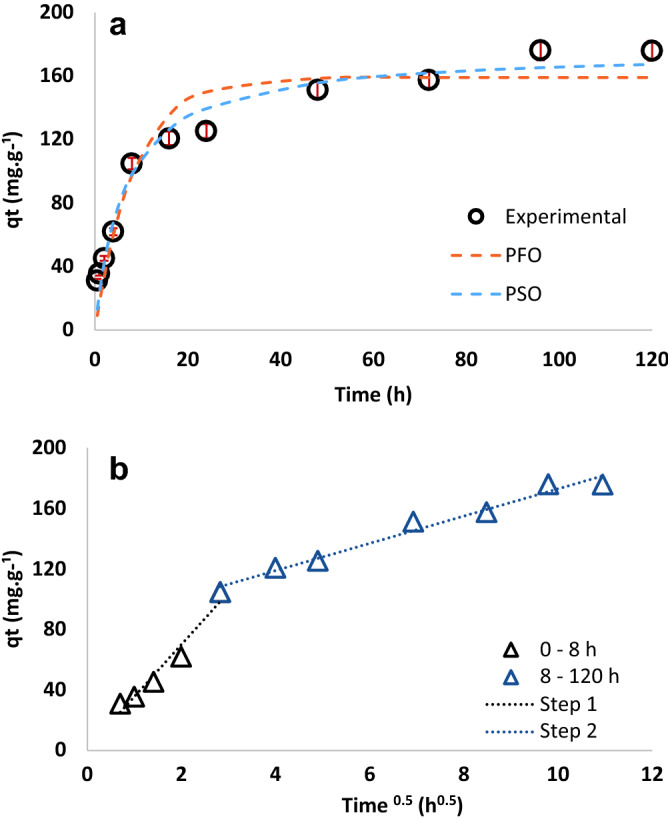
- Equilibrium data were best described by Temkin (R² = 0.97) and Langmuir (R² = 0.95) isotherms; kinetics followed pseudo-second-order (R² = 0.98, k2 = 0.001 g mg−1 h−1, qe = 176.00 mg g−1) and intraparticle diffusion models.
Methods
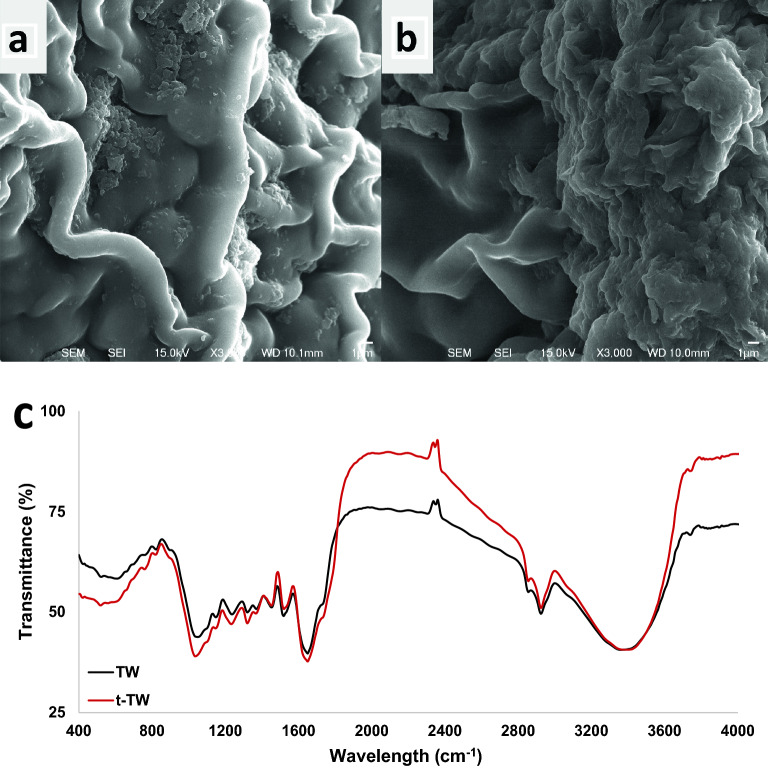
- Spent black tea waste was washed, dried, treated with 0.5 M ascorbic acid, washed again, and dried to produce t-TW; characterization used SEM, EDX, and FTIR.
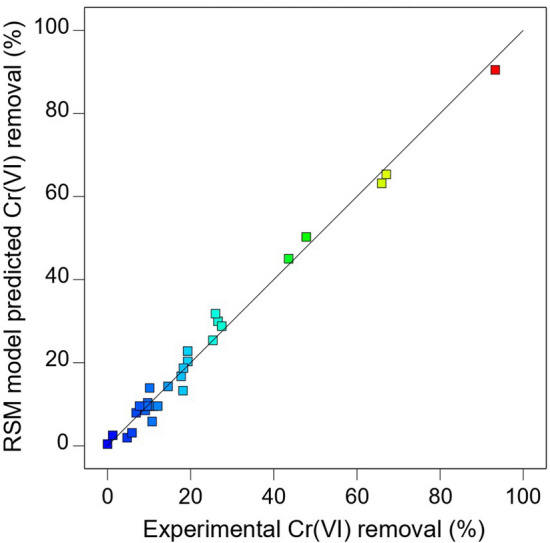
- A central composite rotatable design based on response surface methodology tested four factors: pH (2–12), initial Cr(VI) concentration (1–100 mg L−1), t-TW dosage (0–4 g L−1), and temperature (10–50 °C), with 30 experimental combinations (16 factorial, 8 axial, 6 center replicates).
- Batch adsorption experiments used potassium dichromate solutions and the 1,5-diphenylcarbohydrazide method with UV–Vis detection; isotherm and kinetic parameters were fitted by nonlinear regression.
Limitations
- The paper states that the difference between adjusted R² and predicted R² was 0.23, slightly above the desirable range of ≤0.2, possibly due to the complexity of the cubic model, and cautions that the model should be used with caution when predicting above or below experimentally validated ranges.
- The paper states that the temperature term was significant only at an 85% confidence level but was retained to maintain model hierarchy due to interactions with significant terms.
- Evident from the text: adsorption experiments used synthetic Cr(VI) solutions prepared from potassium dichromate rather than real wastewater, and the study reports batch equilibrium/kinetic tests without assessing adsorbent regeneration, column operation, or long-term stability.
Model-written summary. Check it against the paper before relying on it.
Integrity signals
Registry
Cites
Statistics
Figures
Verification
Claims the paper makes
16 Valid · 2 Not valid · 22 Not checked · 49 Own results and interpretations
Every source the paper cites for this claim was checked and supports it.
In the paper
“However, Cr(VI) is hazardous to living organisms due to its mutagenicity and carcinogenicity2 and is among 129 critical pollutants identified by the US EPA3.”
§ Optimized removal of hexavalent chromium from water using spent tea leaves treated with ascorbic acid > Introduction
What the sources say
- Supportedcites [2] DesMarias TL Costa M Mechanisms of chromium-induced toxicity Curr. Opin. Toxicol. 2019 14 1 7 10.1016/j.cotox.2019.05.003 31511838 PMC6737927 source
The section “Mutagenic Vs non Mutagenic mode of action of Cr(VI)” describes Cr(VI) as a carcinogenic metal and says exposure causes toxic and carcinogenic effects, including mutagenesis. It also identifies Cr(VI) as a mutagenic carcinogen. The separate US EPA pollutant claim is attached to citation 3, not this source. (LLM, conf=0.94)
plainstates a cause- Asserted: passes — The authors put it forward as true.
- Checkable: passes — It can be checked against evidence.
- Load-bearing: passes — The paper’s conclusions depend on it.
- Based: passes — The paper gives a reason why it holds.
- Supported
The cited sources support only part of this claim — read each source’s verdict below.
In the paper
“Tea waste (TW) in particular has demonstrated an ability to effectively adsorb Cr(VI) from aqueous systems13,14.”
§ Optimized removal of hexavalent chromium from water using spent tea leaves treated with ascorbic acid > Introduction
What the sources say
- Not checked — no full text of the sourcecites [13] Cherdchoo W Nithettham S Charoenpanich J Removal of Cr(VI) from synthetic wastewater by adsorption onto coffee ground and mixed waste tea Chemosphere 2019 221 758 767 10.1016/j.chemosphere.2019.01.100 30684773 source
- Partly supportedcites [14] Khalil U Adsorption-reduction performance of tea waste and rice husk biochars for Cr(VI) elimination from wastewater J. Saudi Chem. Soc. 2020 24 799 810 10.1016/j.jscs.2020.07.001 sourceExperimental — accuracy not yet measured
The Conclusion reports effective Cr(VI) removal from water by tea-waste biochar. The Methods (§2.2) show that the tea waste was pyrolyzed before testing, so the paper does not establish the claimed effectiveness of tea waste (TW) itself as an adsorbent. (LLM, conf=0.86)
boostedstates a cause- Asserted: passes — The authors put it forward as true.
- Checkable: passes — It can be checked against evidence.
- Load-bearing: passes — The paper’s conclusions depend on it.
- Based: passes — The paper gives a reason why it holds.
Every source the paper cites for this claim was checked and supports it.
In the paper
“The Cr(VI) speciation in aqueous solution is driven by pH40.”
§ Optimized removal of hexavalent chromium from water using spent tea leaves treated with ascorbic acid > Results and discussion > Effects of variables on Cr(VI) adsorption
What the sources say
- Supportedcites [40] Liu W Efficient removal of hexavalent chromium from water by an adsorption-reduction mechanism with sandwiched nanocomposites RSC Adv. 2018 8 15087 15093 10.1039/C8RA01805G 35541367 PMC9080019 source
The Results and discussion section, under “Effect of solution pH,” explicitly states that Cr(VI) speciation in solution is highly pH dependent and describes different predominant species at different pH ranges. This supports the citing sentence. (LLM, conf=0.94)
plainstates a cause- Asserted: passes — The authors put it forward as true.
- Checkable: passes — It can be checked against evidence.
- Load-bearing: passes — The paper’s conclusions depend on it.
- Based: passes — The paper gives a reason why it holds.
- Supported
The cited sources support only part of this claim — read each source’s verdict below.
In the paper
“At pH ≤ 1, Cr(VI) exists primarily as chromic acid (H2CrO4).”
§ Optimized removal of hexavalent chromium from water using spent tea leaves treated with ascorbic acid > Results and discussion > Effects of variables on Cr(VI) adsorption
What the sources say
- Partly supportedcites [40] Liu W Efficient removal of hexavalent chromium from water by an adsorption-reduction mechanism with sandwiched nanocomposites RSC Adv. 2018 8 15087 15093 10.1039/C8RA01805G 35541367 PMC9080019 sourceExperimental — accuracy not yet measured
The “Effect of solution pH” section says chromic acid occurs at pH less than 1, supporting the claim below pH 1. It does not support the inclusive boundary: the paper places hydrogen chromate at pH 1, and its text says chromic acid “occurs” rather than explicitly saying it is the primary species. (LLM, conf=0.85)
- Not checked — no full text of the sourcecites [43] Chen JH Hsu KC Chang YM Surface modification of hydrophobic resin with tricaprylmethylammonium chloride for the removal of trace hexavalent chromium Ind. Eng. Chem. Res. 2013 52 11685 11694 10.1021/ie401233r source
- Not checked — no full text of the sourcecites [44] Zhu K Gao Y Tan X Chen C Polyaniline-modified Mg/Al layered double hydroxide composites and their application in efficient removal of Cr(VI) ACS Sustain. Chem. Eng. 2016 4 4361 4369 10.1021/acssuschemeng.6b00922 source
plainstates a cause- Asserted: passes — The authors put it forward as true.
- Checkable: passes — It can be checked against evidence.
- Load-bearing: unclear — It is unclear whether the paper’s conclusions depend on it.
- Based: passes — The paper gives a reason why it holds.
- Partly supported
The sources with a verdict support this claim; the rest weren’t checked yet, have no full text we could read, or their verdicts aren’t rated yet.
In the paper
“These values are comparable to those reported for mixed tea waste13 and tea-waste biochar14.”
§ Optimized removal of hexavalent chromium from water using spent tea leaves treated with ascorbic acid > Results and discussion > Characterization
What the sources say
- Not checked — no full text of the sourcecites [13] Cherdchoo W Nithettham S Charoenpanich J Removal of Cr(VI) from synthetic wastewater by adsorption onto coffee ground and mixed waste tea Chemosphere 2019 221 758 767 10.1016/j.chemosphere.2019.01.100 30684773 source
- Supportedcites [14] Khalil U Adsorption-reduction performance of tea waste and rice husk biochars for Cr(VI) elimination from wastewater J. Saudi Chem. Soc. 2020 24 799 810 10.1016/j.jscs.2020.07.001 source
The cited paper reports values for tea-waste biochar, including a Cr(VI) sorption capacity of 197.5 mg/g (section 3.8) and 99.3% removal (Conclusion). That supports its use as the source of tea-waste-biochar values. The citing sentence does not provide its own values, so the comparison itself cannot be checked. (LLM, conf=0.85)
plain- Asserted: passes — The authors put it forward as true.
- Checkable: passes — It can be checked against evidence.
- Load-bearing: unclear — It is unclear whether the paper’s conclusions depend on it.
- Based: passes — The paper gives a reason why it holds.
45 more claims · 7 with their cited sources checked
Create a free account to see all 89 claims and to verify the 3 references still open.
- Probably not a substantial claim. 14
- It may state two separate claims as one. 31
- The quote only partly states this claim. 1
Self-check
Percentages, sums and reported differences re-computed from the paper’s own numbers.
Each contradiction between two passages listed here was confirmed by an independent check.
Rated minor: it would not touch a result — a value no result rests on, a p-value that stays on the same side of the significance level, or a conflict that is clerical, resolved elsewhere in the paper, or outside its own findings.
In the paper
§ Optimized removal of hexavalent chromium from water using spent tea leaves treated with ascorbic acid > Results and discussion > Adsorption equilibrium
“(L.mg−1) is the Temkin isotherm equilibrium binding constant”
§ Optimized removal of hexavalent chromium from water using spent tea leaves treated with ascorbic acid > Results and discussion > Adsorption equilibrium
“AT = 39.90 (L g−1)”
Rated minor: it would not touch a result — a value no result rests on, a p-value that stays on the same side of the significance level, or a conflict that is clerical, resolved elsewhere in the paper, or outside its own findings.
In the paper
§ Optimized removal of hexavalent chromium from water using spent tea leaves treated with ascorbic acid > Results and discussion > Effects of variables on Cr(VI) adsorption
“Table 3 lists the significant interactions of the terms AB, AC, AD, and BD, and response surfaces were generated to study these interactions.”
§ Optimized removal of hexavalent chromium from water using spent tea leaves treated with ascorbic acid > Results and discussion > Model development, validation, and diagnostic analysis
“| BC | 193 | 1 | 193 | 16 | 0.0012 | |”
Rated minor: it would not touch a result — a value no result rests on, a p-value that stays on the same side of the significance level, or a conflict that is clerical, resolved elsewhere in the paper, or outside its own findings.
In the paper
§ Optimized removal of hexavalent chromium from water using spent tea leaves treated with ascorbic acid > Results and discussion > Adsorption kinetics
“(mg g−1 h−0.5) is the intraparticle diffusion rate constant”
§ Optimized removal of hexavalent chromium from water using spent tea leaves treated with ascorbic acid > Results and discussion > Adsorption equilibrium
“KIP(1) = 34.52 (mg g h−1), C(1) = 0.81 (mg g−1), KIP(2) = 0.68 (mg g h−1)”
Citations
Cites
THE CONSTITUTION AND FUNDAMENTAL PROPERTIES OF SOLIDS AND LIQUIDS. PART I. SOLIDS.
Langmuir, I. (1916) · Journal of the American Chemical Society · doi:10.1021/ja02268a002 · Cited by 9,997
Insights into the modeling of adsorption isotherm systems
Foo, K. Y., & Hameed, B. H. (2010) · Chemical Engineering Journal · doi:10.1016/j.cej.2009.09.013 · Cited by 8,479
UNITED STATES ENVIRONMENTAL PROTECTION AGENCY
(2005) · Proceedings of the Water Environment Federation · doi:10.2175/193864705783867675 · Cited by 6,678
Response Surface Methodology: Process and Product Optimization Using Designed Experiments
Gunst, R. F. (1996) · Technometrics · doi:10.1080/00401706.1996.10484509 · Cited by 3,255
Adsorption kinetic models: Physical meanings, applications, and solving methods
Wang, J., & Guo, X. (2020) · Journal of Hazardous Materials · doi:10.1016/j.jhazmat.2020.122156 · Cited by 2,937
Reduction of graphene oxide via l -ascorbic acid
Zhang, J., Yang, H., Shen, G., Cheng, P., Zhang, J., & Guo, S. (2010) · Chem. Commun. · doi:10.1039/b917705a · Cited by 2,344
Adsorption isotherm models: Classification, physical meaning, application and solving method
Wang, J., & Guo, X. (2020) · Chemosphere · doi:10.1016/j.chemosphere.2020.127279 · Cited by 2,289
Activated carbons and low cost adsorbents for remediation of tri- and hexavalent chromium from water
Mohan, D., & Pittman Jr., C. U. (2006) · Journal of Hazardous Materials · doi:10.1016/j.jhazmat.2006.06.060 · Cited by 1,855 · cited 2×
“Five sets of adsorption experiments were performed: (1) preliminary experiments to observe the adsorption difference between TW and t-TW and screen the important factors and ranges effecting the adsorption removal of Cr(VI) by t-TW; (2) thirty experiments according the RSM experimental design (Table 2) to construct th…”
BackgroundMethodA review of chemical, electrochemical and biological methods for aqueous Cr(VI) reduction
Barrera-Díaz, C. E., Lugo-Lugo, V., & Bilyeu, B. (2012) · Journal of Hazardous Materials · doi:10.1016/j.jhazmat.2012.04.054 · Cited by 1,318
Chromium in Drinking Water: Sources, Metabolism, and Cancer Risks
Zhitkovich, A. (2011) · Chemical Research in Toxicology · doi:10.1021/tx200251t · Cited by 1,132
Design and Analysis of Experiments
Shuster, J. J. (2007) · Methods in Molecular Biology™ · doi:10.1007/978-1-59745-530-5_12 · Cited by 1,037
Removal of chromium(VI) from aqueous solution by activated carbons: Kinetic and equilibrium studies
Khezami, L., & Capart, R. (2005) · Journal of Hazardous Materials · doi:10.1016/j.jhazmat.2005.04.012 · Cited by 647
Gupta, V. K., Rastogi, A., & Nayak, A. (2010) · Journal of Colloid and Interface Science · doi:10.1016/j.jcis.2009.09.065 · Cited by 644
Saleh, T. A. (2018) · Journal of Cleaner Production · doi:10.1016/j.jclepro.2017.11.208 · Cited by 640
Sarı, A., & Tuzen, M. (2008) · Journal of Hazardous Materials · doi:10.1016/j.jhazmat.2008.01.008 · Cited by 498
Mechanisms of chromium-induced toxicity
DesMarias, T. L., & Costa, M. (2019) · Current Opinion in Toxicology · doi:10.1016/j.cotox.2019.05.003 · Cited by 492 · cited 3×
“Five sets of adsorption experiments were performed: (1) preliminary experiments to observe the adsorption difference between TW and t-TW and screen the important factors and ranges effecting the adsorption removal of Cr(VI) by t-TW; (2) thirty experiments according the RSM experimental design (Table 2) to construct th…”
BackgroundMethodWater treatment technologies in removing heavy metal ions from wastewater: A review
Saleh, T. A., Mustaqeem, M., & Khaled, M. (2022) · Environmental Nanotechnology, Monitoring & Management · doi:10.1016/j.enmm.2021.100617 · Cited by 491
Removal of Heavy Metals by Waste Tea Leaves from Aqueous Solution
Ahluwalia, S. S., & Goyal, D. (2005) · Engineering in Life Sciences · doi:10.1002/elsc.200420066 · Cited by 374
Saleh, T. A., Naeemullah, Tuzen, M., & Sarı, A. (2017) · Chemical Engineering Research and Design · doi:10.1016/j.cherd.2016.10.030 · Cited by 314
Sarı, A., & Tuzen, M. (2008) · Journal of Hazardous Materials · doi:10.1016/j.jhazmat.2008.03.005 · Cited by 288
Saleh, T. A. (2021) · Chemical Engineering Journal · doi:10.1016/j.cej.2020.126987 · Cited by 285
Zhu, K., Gao, Y., Tan, X., & Chen, C. (2016) · ACS Sustainable Chemistry & Engineering · doi:10.1021/acssuschemeng.6b00922 · Cited by 228
Wen, T., Wang, J., Yu, S., Chen, Z., Hayat, T., & Wang, X. (2017) · ACS Sustainable Chemistry & Engineering · doi:10.1021/acssuschemeng.7b00418 · Cited by 227
Removal of Cr(VI) from synthetic wastewater by adsorption onto coffee ground and mixed waste tea
Cherdchoo, W., Nithettham, S., & Charoenpanich, J. (2019) · Chemosphere · doi:10.1016/j.chemosphere.2019.01.100 · Cited by 204
Adsorption study of hexavalent chromium using tamarind hull-based adsorbents
Verma, A., Chakraborty, S., & Basu, J. K. (2006) · Separation and Purification Technology · doi:10.1016/j.seppur.2005.12.007 · Cited by 189
Hiew, B. Y. Z., Lee, L. Y., Lai, K. C., Gan, S., Thangalazhy-Gopakumar, S., Pan, G.-T., & Yang, T. C.-K. (2019) · Environmental Research · doi:10.1016/j.envres.2018.09.030 · Cited by 189
Adsorption of chromium ion (VI) by acid activated carbon
Attia, A. A., Khedr, S. A., & Elkholy, S. A. (2010) · Brazilian Journal of Chemical Engineering · doi:10.1590/s0104-66322010000100016 · Cited by 172
Anderson, M. J., & Whitcomb, P. J. (2016) · doi:10.1201/9781315382326 · Cited by 156
Khalil, U., Bilal Shakoor, M., Ali, S., Rizwan, M., Nasser Alyemeni, M., & Wijaya, L. (2020) · Journal of Saudi Chemical Society · doi:10.1016/j.jscs.2020.07.001 · Cited by 139
Feng, Z.-Q., Yuan, X., & Wang, T. (2020) · Chemical Engineering Journal · doi:10.1016/j.cej.2019.123730 · Cited by 113
Preparation of activated carbon from carbonized rice husk by ozone activation for Cr(VI) removal
Sugashini, S., & Begum, K. M. M. S. (2015) · New Carbon Materials · doi:10.1016/s1872-5805(15)60190-1 · Cited by 108
Anupam, K., Sharma, A. K., Lal, P. S., Dutta, S., & Maity, S. (2016) · Energy · doi:10.1016/j.energy.2016.03.100 · Cited by 107
Liu, W., Yang, L., Xu, S., Chen, Y., Liu, B., Li, Z., & Jiang, C. (2018) · RSC Advances · doi:10.1039/c8ra01805g · Cited by 105
Kahu, S., Shekhawat, A., Saravanan, D., & Jugade, R. (2016) · Carbohydrate Polymers · doi:10.1016/j.carbpol.2016.03.041 · Cited by 100
Determination of the Chemical Composition of Tea by Chromatographic Methods: A Review
Yashin, A. Y., Nemzer, B. V., Combet, E., & Yashin, Y. I. (2015) · Journal of Food Research · doi:10.5539/jfr.v4n3p56 · Cited by 100
Araghi, S. H., Entezari, M. H., & Chamsaz, M. (2015) · Microporous and Mesoporous Materials · doi:10.1016/j.micromeso.2015.07.008 · Cited by 100
Recent progress in the chemical reduction of graphene oxide by green reductants–A Mini review
Kurian, M. (2021) · Carbon Trends · doi:10.1016/j.cartre.2021.100120 · Cited by 85
Lin, D., Wu, F., Hu, Y., Zhang, T., Liu, C., Hu, Q., Hu, Y., Xue, Z., Han, H., & Ko, T.-H. (2020) · Journal of Chemistry · doi:10.1155/2020/5431046 · Cited by 84
The effect of ascorbic acid on total antioxidant activity of black and green teas
Majchrzak, D., Mitter, S., & Elmadfa, I. (2004) · Food Chemistry · doi:10.1016/j.foodchem.2004.01.058 · Cited by 81
Synthesis of graphene oxide and its reduction by green reducing agent
Tewatia, K., Sharma, A., Sharma, M., & Kumar, A. M. (2020) · Materials Today Proceedings · doi:10.1016/j.matpr.2020.09.294 · Cited by 77
Cai, H., Chen, G., Peng, C., Xu, L., Zhu, X., Zhang, Z., Dong, Y., Shang, G., Ke, F., Gao, H., et al. (2015) · RSC Advances · doi:10.1039/c5ra01560j · Cited by 68
Preethi, J., Prabhu, S. M., & Meenakshi, S. (2017) · Reactive and Functional Polymers · doi:10.1016/j.reactfunctpolym.2017.05.006 · Cited by 59
Tüzen, M., Sarı, A., Mogaddam, M. R. A., Kaya, S., Katin, K. P., & Altunay, N. (2021) · Materials Chemistry and Physics · doi:10.1016/j.matchemphys.2021.125501 · Cited by 57
Adsorptive Removal of Toxic Chromium from Waste-Water Using Wheat Straw and Eupatorium adenophorum
Song, D., Pan, K., Tariq, A., Azizullah, A., Sun, F., Li, Z., & Xiong, Q. (2016) · PLOS ONE · doi:10.1371/journal.pone.0167037 · Cited by 56
Chen, J.-H., Hsu, K.-C., & Chang, Y.-M. (2013) · Industrial & Engineering Chemistry Research · doi:10.1021/ie401233r · Cited by 53
Optimization of Carbon Nanotube Dispersions in Water Using Response Surface Methodology
Zaib, Q., & Ahmad, F. (2019) · ACS Omega · doi:10.1021/acsomega.8b02965 · Cited by 46
Self-citationSarı, A., Saleh, T. A., & Tuzen, M. (2021) · Surfaces and Interfaces · doi:10.1016/j.surfin.2021.101504 · Cited by 40
Heavy Metals Remediation of Water Using Plants and Lignocellulosic Agrowastes
Krishnani, K. K., & Ayyappan, S. (2006) · Reviews of Environmental Contamination and Toxicology · doi:10.1007/978-0-387-32964-2_2 · Cited by 31
Deep Eutectic Solvent Assisted Dispersion of Carbon Nanotubes in Water
Zaib, Q., Adeyemi, I., Warsinger, D. M., & AlNashef, I. M. (2020) · Frontiers in Chemistry · doi:10.3389/fchem.2020.00808 · Cited by 29
Self-citationZaib, Q., Park, H., & Kyung, D. (2021) · Scientific Reports · doi:10.1038/s41598-021-92535-y · Cited by 28
Self-citationZaib, Q., Jouiad, M., & Ahmad, F. (2019) · ACS Omega · doi:10.1021/acsomega.8b02706 · Cited by 22
Self-citation(2017) · doi:10.5772/intechopen.68686 · Cited by 12
Experimental modeling to optimize the sonication energy in water
Zaib, Q., & Ahmad, F. (2020) · Measurement · doi:10.1016/j.measurement.2020.108039 · Cited by 9
Self-citation
Research works printed but not linked: 3
- World Health Organization Chromium in Drinking-Water Background Document for Development of WHO Guidelines for Drinking-Water Quality 2020 WHO
- del García-Rodríguez MC Gordillo-García A Altamirano-Lozano M Hamza AH The role of vitamin C in the protection and modulation of genotoxic damage induced by metals associated with oxidative stress Vitamin C 2017 InTech
- Ebrahimian A Saberikhah E Biosorption of methylene blue onto foumanat tea waste: Equilibrium and thermodynamic studies Cell. Chem. Technol. 2013 47 657 666
Cited by
Inayat, A., Albalawi, K. M., Rehman, A.-U., et al. (2023) · Materials Today Communications · doi:10.1016/j.mtcomm.2023.105479 · Cited by 53
Djezzar, Z., Aidi, A., Rehali, H., Ziad, S., & Othmane, T. (2024) · RSC Advances · doi:10.1039/d3ra08678j · Cited by 47
Recent advances in electrospun fibrous membranes for effective chromium (VI) removal from water
Mohammed, A. M., Thalji, M. R., Yasin, S. A., Shim, J., Chong, K. F., Guda, A. A., & Ali, G. A. M. (2023) · Journal of Molecular Liquids · doi:10.1016/j.molliq.2023.122110 · Cited by 33
Philip, R. S., Aparna, N., & Mathew, M. (2023) · Applied Surface Science Advances · doi:10.1016/j.apsadv.2023.100535 · Cited by 34
Masuku, M., Fito, J., Atagana, H. I., et al. (2024) · Journal of Water Process Engineering · doi:10.1016/j.jwpe.2024.105587 · Cited by 26
Metadata
- Authors
- Zaib, Q., & Kyung, D.
- Affiliations
- University of Ulsan (KR)
- Corresponding author
- Kyung, Daeseung
- Venue
- Scientific Reports
- Published
- 2022-05-25
- Volume
- 12
- Issue
- 1
- Pages
- 8845-8845
- ISSN
- 2045-2322 (ISSN-L)
- PMC
- PMC9132990
- OpenAlex
- W4281481515
- Cited by
- 28
- References
- 50
- Citations by year
- 2026: 1 · 2025: 7 · 2024: 7 · 2023: 10 · 2022: 3
- FWCI
- 1.97
- Type
- journal article
- Language
- en
- Open access
- gold
- doi.org
- Licence
- cc-by
- creativecommons.org/licenses/by/4.0 (tdm)
- creativecommons.org/licenses/by/4.0 (vor)
- Locations
- Scientific Reports (publishedVersion, cc-by)
- PubMed Central (publishedVersion, cc-by)
- PubMed (publishedVersion)
- DOAJ (DOAJ: Directory of Open Access Journals) (submittedVersion, cc-by-sa)
- Funders
- University of Ulsan
- Topics
- Physical Sciences › Environmental Science › Water Science and Technology › Adsorption and biosorption for pollutant removal
- Physical Sciences › Environmental Science › Health, Toxicology and Mutagenesis › Chromium effects and bioremediation
- Physical Sciences › Environmental Science › Environmental Engineering › Environmental remediation with nanomaterials
- Keywords
- hexavalent chromium removal, spent tea leaves, ascorbic acid treatment, low-cost adsorbent, adsorption, heavy metal removal from water, adsorption kinetics, adsorption isotherms, pseudo-second-order kinetics, Langmuir isotherm, Temkin isotherm, response surface methodology, central composite rotatable design, adsorption optimization
- MeSH terms
- Adsorption, Ascorbic Acid, Chromium, Hydrogen-Ion Concentration, Kinetics, Tea, Water, Water Pollutants, Chemical, Water Purification, Plant Leaves
About these checks
Registry, retraction, Cites and statistics results are computed, not judged, with one exception: a printed reference that no index lists is read once by a model before it counts as a citation error. Claims are extracted by a model and kept only when their quote appears verbatim in the text; each cited source is then checked, with a model’s help, for whether it says what the claim relies on. Those verdicts can be wrong — read the claim’s quote and the cited source before relying on one.
The claim verdicts this report counts are experimental: their accuracy is not yet measured.
A language model drew the claims from the paper on 2026-10-10, under version 3 of the claim definition (model deepseek-v4.1-flash, prompt extract-v3).
A second model labelled each claim on 2026-10-10 (model jev-1.13-20260917, definition revision gold-guideline-v0.2).
Cited sources are checked with a language model’s help (gpt-6-sol).
Statistics and arithmetic are recomputed, not judged.
Confidence bands are shown only for fields calibrated on our annotated test set. None is calibrated yet, so no band is shown.
What counts as a claim ›How we measure confidence ›How we check this ›
Are you an author, or do you see a problem with this page? Request a review
Data sources
Bibliographic data: Semantic Scholar, OpenAlex, Crossref.
Contains information from the Semantic Scholar Academic Graph Datasets, made available under the ODC Attribution License (ODC-BY 1.0).
Semantic Scholar’s data is described in: Kinney, R., et al. (2023). The Semantic Scholar Open Data Platform. arXiv:2301.10140.
