

Differential association between the GLP1R gene variants and brain functional connectivity according to the severity of alcohol use
Open accessThe DOI matches its Crossref record; 77 of the 78 references it cites were found in a registry or an index.
Abstract
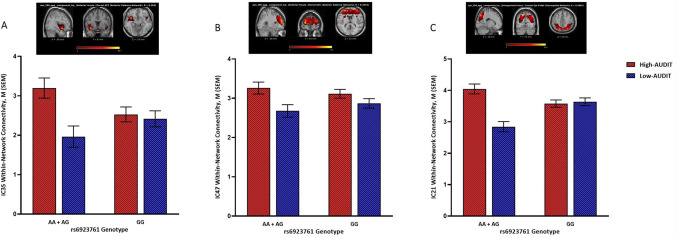
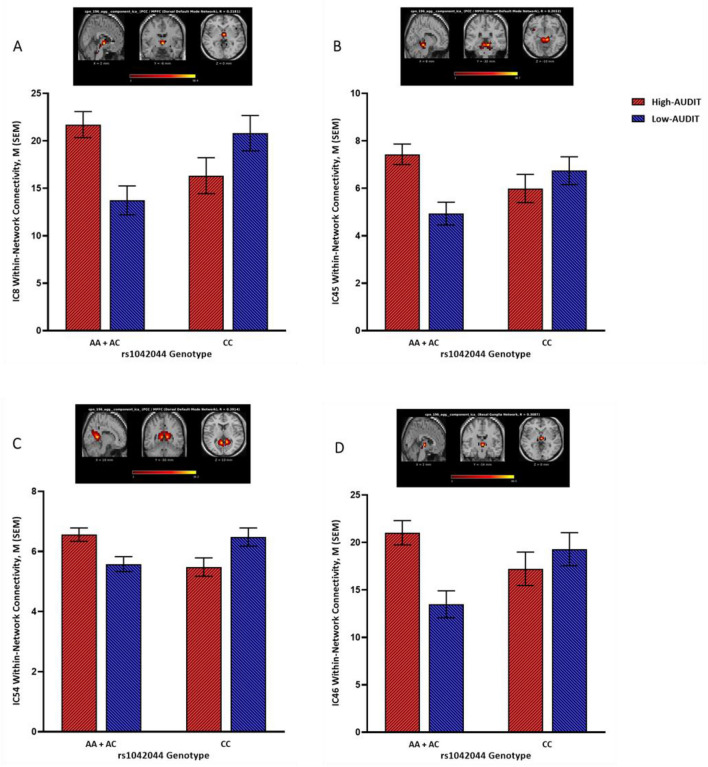
Growing evidence suggests that the glucagon-like peptide-1 (GLP-1) system is involved in mechanisms underlying alcohol seeking and consumption. Accordingly, the GLP-1 receptor (GLP-1R) has begun to be studied as a potential pharmacotherapeutic target for alcohol use disorder (AUD). The aim of this study was to investigate the association between genetic variation at the GLP-1R and brain functional connectivity, according to the severity of alcohol use. Participants were 181 individuals categorized as high-risk (n = 96) and low-risk (n = 85) alcohol use, according to their AUD identification test (AUDIT) score. Two uncommon single nucleotide polymorphisms (SNPs), rs6923761 and rs1042044, were selected a priori for this study because they encode amino-acid substitutions with putative functional consequences on GLP-1R activity. Genotype groups were based on the presence of the variant allele for each of the two GLP-1R SNPs of interest [rs6923761: AA + AG (n = 65), GG (n = 116); rs1042044: AA + AC (n = 114), CC (n = 67)]. Resting-state functional MRI data were acquired for 10 min and independent component (IC) analysis was conducted. Multivariate analyses of covariance (MANCOVA) examined the interaction between GLP-1R genotype group and AUDIT group on within- and between-network connectivity. For rs6923761, three ICs showed significant genotype × AUDIT interaction effects on within-network connectivity: two were mapped onto the anterior salience network and one was mapped onto the visuospatial network. For rs1042044, four ICs showed significant interaction effects on within-network connectivity: three were mapped onto the dorsal default mode network and one was mapped onto the basal ganglia network. For both SNPs, post-hoc analyses showed that in the group carrying the variant allele, high versus low AUDIT was associated with stronger within-network connectivity. No significant effects on between-network connectivity were found. In conclusion, genetic variation at the GLP-1R was differentially associated with brain functional connectivity in individuals with low versus high severity of alcohol use. Significant findings in the salience and default mode networks are particularly relevant, given their role in the neurobiology of AUD and addictive behaviors.
Overview
The claims and statistics of this paper haven’t been checked yet.
Free: it reads the open-access text and checks the first 5 claims that cite a source we can check. Create a free account to check every claim.
Integrity signals
Registry
Cites
Statistics
Figures
Verification
Claims the paper makes
The claims and statistics of this paper haven’t been checked yet.
Free: it reads the open-access text and checks the first 5 claims that cite a source we can check. Create a free account to check every claim.
Claims other papers make about this one
Each is checked against this paper’s own text: does it say what the citing paper says it does?
The cited source says what the claim attributes to it.
In the citing paper
“These are translationally relevant findings and overall consistent with recent human evidence that suggest a role of the GLP-1 system in alcohol drinking and AUD, as indicated by alcohol administration studies (115, 116), postmortem brain analyses (115), and neuroimaging-genetic investigations (116, 117).”
From The glucagon-like peptide-1 (GLP-1) analogue semaglutide reduces alcohol drinking and modulates central GABA neurotransmission (2023) · cites this paper as [117]
Self-check
Percentages, sums and reported differences re-computed from the paper’s own numbers.
The self-check needs the paper’s full text.
Citations
Cites
SAUNDERS, J. B., AASLAND, O. G., BABOR, T. F., DE LA FUENTE, J. R., & GRANT, M. (1993) · Addiction · doi:10.1111/j.1360-0443.1993.tb02093.x · Cited by 13,597 · cited 8×
“For rs6923761, three ICs (21, 35, 47) showed significant genotype × AUDIT interaction effects on within-network connectivity.”
BackgroundInfluentialAFNI: Software for analysis and visualization of functional magnetic resonance neuroimages
Cox, R. W. (1996) · Computers and Biomedical Research · doi:10.1006/cbmr.1996.0014 · Cited by 10,913 · cited 1×
“43 High-AUDIT 96 (53) 62 (53) 34 (52) 33 (49) 63 (55)”
No adjustments are needed for multiple comparisons.
Rothman, K. J. (1990) · Epidemiology · doi:10.1097/00001648-199001000-00010 · Cited by 5,965
Saliency, switching, attention and control: a network model of insula function
Menon, V., & Uddin, L. Q. (2010) · Brain Structure and Function · doi:10.1007/s00429-010-0262-0 · Cited by 5,592
Degenhardt, L., Charlson, F., Ferrari, A., Santomauro, D., Erskine, H., Mantilla-Herrara, A., Whiteford, H., Leung, J., Naghavi, M., Griswold, M., et al. (2018) · The Lancet Psychiatry · doi:10.1016/s2215-0366(18)30337-7 · Cited by 1,572
A Baseline for the Multivariate Comparison of Resting-State Networks
Allen, E. A., Erhardt, E. B., Damaraju, E., Gruner, W., Segall, J. M., Silva, R. F., Havlicek, M., Rachakonda, S., Fries, J., Kalyanam, R., et al. (2011) · Frontiers in Systems Neuroscience · doi:10.3389/fnsys.2011.00002 · Cited by 1,293
Spreng, R. N., Stevens, W. D., Chamberlain, J. P., Gilmore, A. W., & Schacter, D. L. (2010) · NeuroImage · doi:10.1016/j.neuroimage.2010.06.016 · Cited by 1,256
A Review of Research on the Alcohol Use Disorders Identification Test (AUDIT)
Allen, J. P., Litten, R. Z., Fertig, J. B., & Babor, T. (1997) · Alcoholism: Clinical & Experimental Research · doi:10.1097/00000374-199706000-00008 · Cited by 957 · cited 8×
“For rs6923761, three ICs (21, 35, 47) showed significant genotype × AUDIT interaction effects on within-network connectivity.”
BackgroundInfluentialPyke, C., Heller, R. S., Kirk, R. K., Ørskov, C., Reedtz-Runge, S., Kaastrup, P., Hvelplund, A., Bardram, L., Calatayud, D., & Knudsen, L. B. (2014) · Endocrinology · doi:10.1210/en.2013-1934 · Cited by 876
Glucagon-like peptide-1 receptor is involved in learning and neuroprotection
During, M. J., Cao, L., Zuzga, D. S., Francis, J. S., Fitzsimons, H. L., Jiao, X., Bland, R. J., Klugmann, M., Banks, W. A., Drucker, D. J., et al. (2003) · Nature Medicine · doi:10.1038/nm919 · Cited by 851
Research works printed but not linked: 1
- Himberg, J. Hyvarinen, A. Icasso: software for investigating the reliability of ICA estimates by clustering and visualization. In 2003 IEEE XIII Workshop on Neural Networks for Signal Processing (IEEE Cat. No. 03TH8718). 2003. IEEE.
Cited by
Chuong, V., Farokhnia, M., Khom, S., Pince, C. L., Elvig, S. K., Vlkolinsky, R., Marchette, R. C. N., Koob, G. F., Roberto, M., Vendruscolo, L. F., et al. (2023) · JCI Insight · doi:10.1172/jci.insight.170671 · Cited by 214
“These are translationally relevant findings and overall consistent with recent human evidence that suggest a role of the GLP-1 system in alcohol drinking and AUD, as indicated by alcohol administration studies (115, 116), postmortem brain analyses (115), and neuroimaging-genetic investigations (116, 117).”
Self-citationLeggio, L., Hendershot, C. S., Farokhnia, M., Fink-Jensen, A., Klausen, M. K., Schacht, J. P., & Simmons, W. K. (2023) · Nature Medicine · doi:10.1038/s41591-023-02634-8 · Cited by 89
Self-citationBruns VI, N., Tressler, E. H., Vendruscolo, L. F., Leggio, L., & Farokhnia, M. (2024) · Pharmacological Research · doi:10.1016/j.phrs.2024.107312 · Cited by 89
Self-citationFarokhnia, M., Tazare, J., Pince, C. L., Bruns, N., Gray, J. C., Re, V. L., Fiellin, D. A., Kranzler, H. R., Koob, G. F., Justice, A. C., et al. (2025) · Journal of Clinical Investigation · doi:10.1172/jci188314 · Cited by 73
Self-citationGLP-1 Receptor Agonists: Promising Therapeutic Targets for Alcohol Use Disorder
Jerlhag, E. (2025) · Endocrinology · doi:10.1210/endocr/bqaf028 · Cited by 66
Díaz, L. A., Winder, G. S., Leggio, L., Bajaj, J. S., Bataller, R. A., & Arab, J. P. (2025) · Hepatology · doi:10.1097/hep.0000000000000645 · Cited by 49
Self-citationO'Keefe, J. H., Franco, W. G., & O'Keefe, E. L. (2025) · Progress in Cardiovascular Diseases · doi:10.1016/j.pcad.2024.12.010 · Cited by 42
McIntyre, R. S., Rasgon, N., Goldberg, J. F., Wong, S., Le, G. H., Mansur, R. B., Rosenblat, J. D., Teopiz, K. M., & Stahl, S. M. (2025) · CNS Spectrums · doi:10.1017/s1092852925000124 · Cited by 40
“114,115 128 In addition, there is a need for adequate well-controlled studies targeting psychotropic drug-related weight gain (PDWG) and metabolically associated comorbidity (eg, cardiovascular disease, metabolic dysfunction associated with steatotic liver disease; MASLD).”
Edvardsson, C. E., Cadeddu, D., Ericson, M., Adermark, L., & Jerlhag, E. (2025) · EBioMedicine · doi:10.1016/j.ebiom.2025.105684 · Cited by 33
Glucagon-like peptide 1 receptor agonist, exendin-4, reduces alcohol-associated fatty liver disease
Mahalingam, S., Bellamkonda, R., Arumugam, M. K., Perumal, S. K., Yoon, J., Casey, C. A., Kharbanda, K. K., & Rasineni, K. (2023) · Biochemical Pharmacology · doi:10.1016/j.bcp.2023.115613 · Cited by 30
Au, H. C. T., Zheng, Y. J., Le, G. H., Wong, S., Phan, L., Teopiz, K. M., Kwan, A. T. H., Rhee, T. G., Rosenblat, J. D., Ho, R., et al. (2024) · Journal of Affective Disorders · doi:10.1016/j.jad.2024.11.019 · Cited by 32
Scheen, A. J. (2025) · Diabetes Obesity and Metabolism · doi:10.1111/dom.16453 · Cited by 25
Luo, P., Fan, Y., Xiong, Y., Feng, H., Yang, Z., Zhang, C., & Mei, B. (2022) · Diabetology & Metabolic Syndrome · doi:10.1186/s13098-022-00963-1 · Cited by 13
“Moreover, rs1042044 was also differentially associated with brain functional connectivity in individuals with low versus high severity of alcohol use [45].”
BackgroundGhrelin system and GLP-1 as potential treatment targets for alcohol use disorder
Jerlhag, E. (2024) · International review of neurobiology · doi:10.1016/bs.irn.2024.07.006 · Cited by 13
Bottino, M., Bocková, N., Poller, N. W., Smolka, M. N., Böhmer, J., Walter, H., & Marxen, M. (2025) · Human Brain Mapping · doi:10.1002/hbm.70156 · Cited by 14
McIntyre, R. S. (2025) · American Journal of Psychiatry · doi:10.1176/appi.ajp.20241087 · Cited by 12
Neuroendocrinology meets addiction: Emerging pharmacotherapies on the horizon
Loftén, A., Farokhnia, M., Vendruscolo, L. F., & Leggio, L. (2025) · Journal of Internal Medicine · doi:10.1111/joim.70021 · Cited by 8
Self-citationAlcohol use disorder is a chronic disease
Gilpin, N. W., & Molina, P. E. (2026) · Alcoholism Clinical and Experimental Research · doi:10.1111/acer.70230 · Cited by 10
Immunology and treatments of fatty liver disease
Tang, S., Wu, S., Zhang, W., Ma, L., Zuo, L., & Wang, H. (2024) · Archives of Toxicology · doi:10.1007/s00204-024-03920-1 · Cited by 6
“GLP-1, an appetite suppressant and enhancer of glucose-stimulated insulin release and insulin sensitivity, has recently garnered attention for its potential to reduce alcohol cravings and alcohol intake (Farokhnia et al. 2022; Jerlhag 2020; Marty et al. 2020; Suchankova et al. 2015).”
Emerging pharmacological targets for alcohol use disorder
Brockway, D. F., & Crowley, N. A. (2024) · Alcohol · doi:10.1016/j.alcohol.2024.07.007 · Cited by 6
Palzes, V. A., Costales, B., Sterling, S., Kline‐Simon, A. H., Leggio, L., & Farokhnia, M. (2025) · Biological Psychiatry Global Open Science · doi:10.1016/j.bpsgos.2025.100659 · Cited by 8
“…size are needed to determine clinically safe and effective regimens of GLP-1RAs for the treatment of AUD, especially given previous human studies suggesting changes in the endogenous GLP-1 system as a function of alcohol exposure and AUD (18–20 Our study had several limitations and strengths.”
Self-citationvan der Heide, F. C. T., Steens, I. L. M., Singh‐Manoux, A., Sabia, S., Zhou, T. L., Köhler, S., Schram, M. T., Kallen, C., Berendschot, T. T. J. M., Webers, C. A. B., et al. (2025) · Cardiovascular Diabetology · doi:10.1186/s12933-025-02888-1 · Cited by 5
“…GLP1R genetic score would be associated with better brain neural health as recent trials found the use GLP1R agonists was associated with better cognitive performance [12, 37], better structural connectivity [17, 37], higher hippocampal volume [19], and lower risk of Alzheimer’s disease [19].”
InfluentialWard, J., Lyall, L. M., Strawbridge, R. J., Stanciu, I., Veldsman, M., Garfield, V., Celis-Morales, C. A., Newby, D., Stewart, W. B., Jr., Pell, J. P., et al. (2022) · Diabetes Obesity and Metabolism · doi:10.1111/dom.14879 · Cited by 4
Vogrinc, D., Redenšek, S., Blagus, T., Trošt, M., Kramberger, M. G., Emeršič, A., Čučnik, S., Goričar, K., & Dolžan, V. (2024) · Heliyon · doi:10.1016/j.heliyon.2024.e39157 · Cited by 4
“…nucleotide polymorphisms (SNPs), such as GLP1R rs10305420, GLP1R rs6923761, and GIPR rs1800437, have been linked to diverse pathologies, primarily to metabolic disorders such as type 2 diabetes [13 – 15], polycystic ovary syndrome [16], obesity [17 – 21], but also psychiatric diseases [22 – 25].”
BackgroundBlum, K., Dennen, C. A., Lewandrowski, K.-U., Sharafshah, A., Pinhasov, A., Bowirrat, A., Elman, I., Cadet, J. L., Braverman, E. R., Thanos, P. K., et al. (2025) · Medical Hypotheses · doi:10.1016/j.mehy.2025.111612 · Cited by 4
Effects of chronic ethanol consumption on brain GLP-1R gene expression in mice and humans
Torregrosa, A. B., García‐Gutiérrez, M. S., Ortuño‐Miquel, S., & Manzanares, J. (2026) · Translational Psychiatry · doi:10.1038/s41398-026-03838-5 · Cited by 2
“In humans, indirect evidence provided by neuroimaging and biomarker studies showed that chronic alcohol use alters brain circuits involving GLP-1 pathways [26, 30].”
Incretin-Based Therapies: A Novel Pathway in Addiction Treatment
Rosiejka, D., Joanna, M., Marcickiewicz, J., Bogdańska, A., Błażejewska, W., & Szulińska, M. (2026) · Journal of Clinical Medicine · doi:10.3390/jcm15041613 · Cited by 2
“An association has been noted between GLP-1R polymorphisms and Alcohol Use Disorder Identification Test (AUDIT) scores [80].”
The Connection Between the Appetite-Regulatory Peptides Ghrelin and GLP-1 and Alcohol Use Disorder
Jerlhag, E. (2025) · Advances in experimental medicine and biology · doi:10.1007/978-3-031-89525-8_8 · Cited by 2
Lista, S., Ballerio, M., López‐Ortiz, S., Khoramipour, K., Imbimbo, B. P., Santos‐Lozano, A., Minoretti, P., & Emanuele, E. (2026) · Pharmacology Biochemistry and Behavior · doi:10.1016/j.pbb.2026.174217 · Cited by 1
Reitz, J., Rosoff, D. B., Pacher, P., & Lohoff, F. W. (2026) · Biological Psychiatry Global Open Science · doi:10.1016/j.bpsgos.2026.100793 · Cited by 1
“…a role for the GLP1R in AUD: GLP1R variants are linked to functional consequences in alcohol self-administration paradigms or functional magnetic resonance imaging (fMRI) reward-response assays (80) and differences in resting-state functional connectivity in networks relevant to addiction (81).”
Wądołowska, P., Pindlowski, P., Komorowska, E., Szyszkowski, J., Zgrzywa, Z., Tucka, B., Kriese, N., Zawadzka, I., Kowalski, B., & Jaworski, J. (2026) · Medical Science · doi:10.54905/disssi.v30i169.e49ms3791
Polek, N., Sikorska, M., Mularczyk, P., Łysoniewski, W., Marcysiak, A., Mruzek, T., Kiełbasiewicz, M., & Zawadzka, K. (2026) · International Journal of Innovative Technologies in Social Science · doi:10.31435/ijitss.2(50).2026.5584
Lalani, I., Nambayan, R., Carbonell, C., Ruan, Y., O'Sullivan, D. E., Stukalin, I., Hilsden, R. J., & Brenner, D. R. (2026) · Cancer Control · doi:10.1177/10732748261483767 · Cited by 1
GLP-1-reseptoriagonistien käyttö päihderiippuvuuden hoidossa
Linnatsalo, E. (2026) · UEF eRepo (University of Eastern Finland)
Metadata
- Authors
- Farokhnia, M., Fede, S. J., Grodin, E. N., Browning, B. D., Crozier, M. E., Schwandt, M. L., Hodgkinson, C. A., Momenan, R., & Leggio, L.
- Affiliations
- National Institutes of Health (US)
- University of California, Los Angeles (US)
- Corresponding author
- Farokhnia, Mehdi
- Leggio, Lorenzo
- ORCID
- Venue
- Scientific Reports
- Published
- 2022-07-29
- Volume
- 12
- Issue
- 1
- Pages
- 13027-13027
- ISSN
- 2045-2322 (ISSN-L)
- PMC
- PMC9338323
- OpenAlex
- W4288535485
- Semantic Scholar
- 80b66d6eaaf1096056545818d335436bd180fc20
- Cited by
- 32
- References
- 78
- Citations by year
- 2026: 7 · 2025: 12 · 2024: 7 · 2023: 4 · 2022: 2
- FWCI
- 2.76
- Type
- journal article
- Language
- en
- Open access
- gold
- doi.org
- Licence
- cc-by
- creativecommons.org/licenses/by/4.0 (tdm)
- creativecommons.org/licenses/by/4.0 (vor)
- Locations
- Scientific Reports (publishedVersion, cc-by)
- PubMed Central (publishedVersion, cc-by)
- PubMed (publishedVersion)
- DOAJ (DOAJ: Directory of Open Access Journals) (submittedVersion, cc-by-sa)
- eScholarship (California Digital Library) (submittedVersion, cc-by)
- Funders
- National Institute on Drug Abuse (ZIA-DA000635)
- National Institute on Alcohol Abuse and Alcoholism (ZIA-AA000218)
- National Institutes of Health
- Topics
- Life Sciences › Neuroscience › Cellular and Molecular Neuroscience › Neurotransmitter Receptor Influence on Behavior
- Life Sciences › Neuroscience › Cognitive Neuroscience › Functional Brain Connectivity Studies
- Health Sciences › Medicine › Epidemiology › Substance Abuse Treatment and Outcomes
- Keywords
- GLP-1 receptor, glucagon-like peptide-1, alcoholism, brain functional connectivity, single nucleotide polymorphisms, alcohol use severity, salience network, default mode network, basal ganglia network, genetic susceptibility
- MeSH terms
- Glucagon-Like Peptide-1 Receptor, Alcohol Drinking, Alcoholism, Brain, Humans, Glucagon-Like Peptide 1
About these checks
Registry, retraction, Cites and statistics results are computed, not judged, with one exception: a printed reference that no index lists is read once by a model before it counts as a citation error. Claims are extracted by a model and kept only when their quote appears verbatim in the text; each cited source is then checked, with a model’s help, for whether it says what the claim relies on. Those verdicts can be wrong — read the claim’s quote and the cited source before relying on one.
Statistics and arithmetic are recomputed, not judged.
Confidence bands are shown only for fields calibrated on our annotated test set. None is calibrated yet, so no band is shown.
What counts as a claim ›How we measure confidence ›How we check this ›
Are you an author, or do you see a problem with this page? Request a review
Data sources
Bibliographic data: Semantic Scholar, OpenAlex, Crossref.
Contains information from the Semantic Scholar Academic Graph Datasets, made available under the ODC Attribution License (ODC-BY 1.0).
Semantic Scholar’s data is described in: Kinney, R., et al. (2023). The Semantic Scholar Open Data Platform. arXiv:2301.10140.
