

Differential association between the GLP1R gene variants and brain functional connectivity according to the severity of alcohol use
Open accessThe DOI matches its Crossref record; 77 of the 78 references it cites were found in a registry or an index.
Abstract
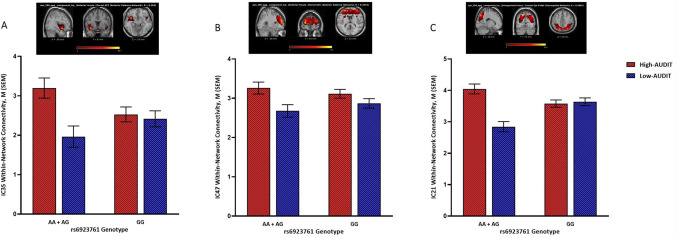
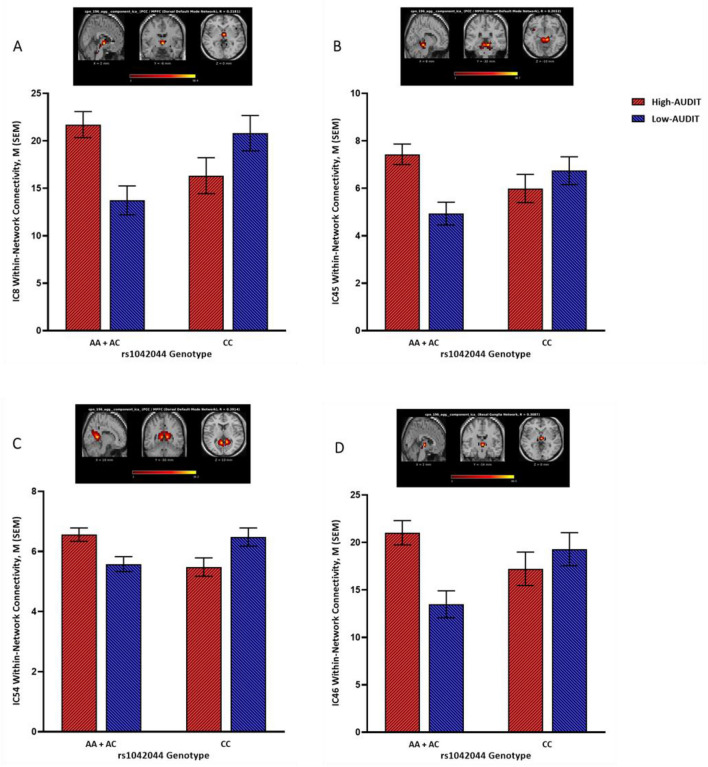
Growing evidence suggests that the glucagon-like peptide-1 (GLP-1) system is involved in mechanisms underlying alcohol seeking and consumption. Accordingly, the GLP-1 receptor (GLP-1R) has begun to be studied as a potential pharmacotherapeutic target for alcohol use disorder (AUD). The aim of this study was to investigate the association between genetic variation at the GLP-1R and brain functional connectivity, according to the severity of alcohol use. Participants were 181 individuals categorized as high-risk (n = 96) and low-risk (n = 85) alcohol use, according to their AUD identification test (AUDIT) score. Two uncommon single nucleotide polymorphisms (SNPs), rs6923761 and rs1042044, were selected a priori for this study because they encode amino-acid substitutions with putative functional consequences on GLP-1R activity. Genotype groups were based on the presence of the variant allele for each of the two GLP-1R SNPs of interest [rs6923761: AA + AG (n = 65), GG (n = 116); rs1042044: AA + AC (n = 114), CC (n = 67)]. Resting-state functional MRI data were acquired for 10 min and independent component (IC) analysis was conducted. Multivariate analyses of covariance (MANCOVA) examined the interaction between GLP-1R genotype group and AUDIT group on within- and between-network connectivity. For rs6923761, three ICs showed significant genotype × AUDIT interaction effects on within-network connectivity: two were mapped onto the anterior salience network and one was mapped onto the visuospatial network. For rs1042044, four ICs showed significant interaction effects on within-network connectivity: three were mapped onto the dorsal default mode network and one was mapped onto the basal ganglia network. For both SNPs, post-hoc analyses showed that in the group carrying the variant allele, high versus low AUDIT was associated with stronger within-network connectivity. No significant effects on between-network connectivity were found. In conclusion, genetic variation at the GLP-1R was differentially associated with brain functional connectivity in individuals with low versus high severity of alcohol use. Significant findings in the salience and default mode networks are particularly relevant, given their role in the neurobiology of AUD and addictive behaviors.
Overview
The claims and statistics of this paper haven’t been checked yet.
Free: it reads the open-access text and checks the first 5 claims that cite a source we can check. Create a free account to check every claim.
Integrity signals
Registry
Cites
Statistics
Figures
Verification
Claims the paper makes
The claims and statistics of this paper haven’t been checked yet.
Free: it reads the open-access text and checks the first 5 claims that cite a source we can check. Create a free account to check every claim.
Claims other papers make about this one
Each is checked against this paper’s own text: does it say what the citing paper says it does?
The cited source says what the claim attributes to it.
In the citing paper
“These are translationally relevant findings and overall consistent with recent human evidence that suggest a role of the GLP-1 system in alcohol drinking and AUD, as indicated by alcohol administration studies (115, 116), postmortem brain analyses (115), and neuroimaging-genetic investigations (116, 117).”
From The glucagon-like peptide-1 (GLP-1) analogue semaglutide reduces alcohol drinking and modulates central GABA neurotransmission (2023) · cites this paper as [117]
Self-check
Percentages, sums and reported differences re-computed from the paper’s own numbers.
The self-check needs the paper’s full text.
Citations
Cites
SAUNDERS, J. B., AASLAND, O. G., BABOR, T. F., DE LA FUENTE, J. R., & GRANT, M. (1993) · Addiction · doi:10.1111/j.1360-0443.1993.tb02093.x · Cited by 13,597 · cited 8×
“For rs6923761, three ICs (21, 35, 47) showed significant genotype × AUDIT interaction effects on within-network connectivity.”
BackgroundInfluentialAFNI: Software for analysis and visualization of functional magnetic resonance neuroimages
Cox, R. W. (1996) · Computers and Biomedical Research · doi:10.1006/cbmr.1996.0014 · Cited by 10,913 · cited 1×
“43 High-AUDIT 96 (53) 62 (53) 34 (52) 33 (49) 63 (55)”
No adjustments are needed for multiple comparisons.
Rothman, K. J. (1990) · Epidemiology · doi:10.1097/00001648-199001000-00010 · Cited by 5,965
Saliency, switching, attention and control: a network model of insula function
Menon, V., & Uddin, L. Q. (2010) · Brain Structure and Function · doi:10.1007/s00429-010-0262-0 · Cited by 5,592
Degenhardt, L., Charlson, F., Ferrari, A., Santomauro, D., Erskine, H., Mantilla-Herrara, A., Whiteford, H., Leung, J., Naghavi, M., Griswold, M., et al. (2018) · The Lancet Psychiatry · doi:10.1016/s2215-0366(18)30337-7 · Cited by 1,572
A Baseline for the Multivariate Comparison of Resting-State Networks
Allen, E. A., Erhardt, E. B., Damaraju, E., Gruner, W., Segall, J. M., Silva, R. F., Havlicek, M., Rachakonda, S., Fries, J., Kalyanam, R., et al. (2011) · Frontiers in Systems Neuroscience · doi:10.3389/fnsys.2011.00002 · Cited by 1,293
Spreng, R. N., Stevens, W. D., Chamberlain, J. P., Gilmore, A. W., & Schacter, D. L. (2010) · NeuroImage · doi:10.1016/j.neuroimage.2010.06.016 · Cited by 1,256
A Review of Research on the Alcohol Use Disorders Identification Test (AUDIT)
Allen, J. P., Litten, R. Z., Fertig, J. B., & Babor, T. (1997) · Alcoholism: Clinical & Experimental Research · doi:10.1097/00000374-199706000-00008 · Cited by 957 · cited 8×
“For rs6923761, three ICs (21, 35, 47) showed significant genotype × AUDIT interaction effects on within-network connectivity.”
BackgroundInfluentialPyke, C., Heller, R. S., Kirk, R. K., Ørskov, C., Reedtz-Runge, S., Kaastrup, P., Hvelplund, A., Bardram, L., Calatayud, D., & Knudsen, L. B. (2014) · Endocrinology · doi:10.1210/en.2013-1934 · Cited by 876
Glucagon-like peptide-1 receptor is involved in learning and neuroprotection
During, M. J., Cao, L., Zuzga, D. S., Francis, J. S., Fitzsimons, H. L., Jiao, X., Bland, R. J., Klugmann, M., Banks, W. A., Drucker, D. J., et al. (2003) · Nature Medicine · doi:10.1038/nm919 · Cited by 851
Functional Neuroanatomy of the Basal Ganglia
Lanciego, J. L., Luquin, N., & Obeso, J. A. (2012) · Cold Spring Harbor Perspectives in Medicine · doi:10.1101/cshperspect.a009621 · Cited by 833 · cited 1×
“88 Non-smoker 134 (74) 88 (76) 46 (71) 50 (75) 84 (74)”
The AUDIT questionnaire: choosing a cut-off score
CONIGRAVE, K. M., HALL, W. D., & SAUNDERS, J. B. (1995) · Addiction · doi:10.1111/j.1360-0443.1995.tb03552.x · Cited by 549
Food and Drug Reward: Overlapping Circuits in Human Obesity and Addiction
Volkow, N. D., Wang, G. J., Fowler, J. S., Tomasi, D., & Baler, R. (2011) · Current Topics in Behavioral Neurosciences · doi:10.1007/7854_2011_169 · Cited by 525
Alhadeff, A. L., Rupprecht, L. E., & Hayes, M. R. (2012) · Endocrinology · doi:10.1210/en.2011-1443 · Cited by 515
Addiction as a stress surfeit disorder
Koob, G. F., Buck, C. L., Cohen, A., Edwards, S., Park, P. E., Schlosburg, J. E., Schmeichel, B., Vendruscolo, L. F., Wade, C. L., Whitfield, T. W., et al. (2014) · Neuropharmacology · doi:10.1016/j.neuropharm.2013.05.024 · Cited by 483
Cork, S. C., Richards, J. E., Holt, M. K., Gribble, F. M., Reimann, F., & Trapp, S. (2015) · Molecular Metabolism · doi:10.1016/j.molmet.2015.07.008 · Cited by 478
Dickson, S. L., Shirazi, R. H., Hansson, C., Bergquist, F., Nissbrandt, H., & Skibicka, K. P. (2012) · The Journal of Neuroscience · doi:10.1523/jneurosci.6326-11.2012 · Cited by 414
De Silva, A., Salem, V., Long, C. J., Makwana, A., Newbould, R. D., Rabiner, E. A., Ghatei, M. A., Bloom, S. R., Matthews, P. M., Beaver, J. D., et al. (2011) · Cell Metabolism · doi:10.1016/j.cmet.2011.09.010 · Cited by 353
Kanoski, S. E., Fortin, S. M., Arnold, M., Grill, H. J., & Hayes, M. R. (2011) · Endocrinology · doi:10.1210/en.2011-0174 · Cited by 347 · cited 8×
“For rs6923761, three ICs (21, 35, 47) showed significant genotype × AUDIT interaction effects on within-network connectivity.”
BackgroundInfluentialAlvarez, E., Martínez, M. D., Roncero, I., Chowen, J. A., García‐Cuartero, B., Gispert, J. D., Sanz, C., Vázquez, P., Maldonado, A., De Cáceres, J., et al. (2005) · Journal of Neurochemistry · doi:10.1111/j.1471-4159.2004.02914.x · Cited by 305
The AUDIT questionnaire: choosing a cut-off score
CONIGRAVE, K. M., HALL, W. D., & SAUNDERS, J. B. (2006) · Addiction · doi:10.1046/j.1360-0443.1995.901013496.x · Cited by 301
Addiction as a brain disease revised: why it still matters, and the need for consilience
(2021) · doi:10.1038/s41386-020-00950-y · Cited by 290
Self-citationAddictions Biology: Haplotype-Based Analysis for 130 Candidate Genes on a Single Array
Hodgkinson, C. A., Yuan, Q., Xu, K., Shen, P.-H., Heinz, E., Lobos, E. A., Binder, E. B., Cubells, J., Ehlers, C. L., Gelernter, J., et al. (2008) · Alcohol and Alcoholism · doi:10.1093/alcalc/agn032 · Cited by 236 · cited 1×
“Low-AUDIT 85 (47) 54 (47) 31 (48) p = 0.”
Self-citationThe glucagon-like peptide 1 analogue Exendin-4 attenuates alcohol mediated behaviors in rodents
Egecioglu, E., Steensland, P., Fredriksson, I., Feltmann, K., Engel, J. A., & Jerlhag, E. (2013) · Psychoneuroendocrinology · doi:10.1016/j.psyneuen.2012.11.009 · Cited by 207
Gut Peptide GLP-1 and Its Analogue, Exendin-4, Decrease Alcohol Intake and Reward
Shirazi, R. H., Dickson, S. L., & Skibicka, K. P. (2013) · PLoS ONE · doi:10.1371/journal.pone.0061965 · Cited by 187
Pannacciulli, N., Le, D. S. N. T., Salbe, A. D., Chen, K., Reiman, E. M., Tataranni, P. A., & Krakoff, J. A. (2007) · NeuroImage · doi:10.1016/j.neuroimage.2006.12.035 · Cited by 182
Glucagon-like Peptide-1 and the Central/Peripheral Nervous System: Crosstalk in Diabetes
Muscogiuri, G., DeFronzo, R. A., Gastaldelli, A., & Holst, J. J. (2017) · Trends in Endocrinology & Metabolism · doi:10.1016/j.tem.2016.10.001 · Cited by 171
Vallöf, D., Maccioni, P., Colombo, G., Mandrapa, M., Jörnulf, J. W., Egecioglu, E., Engel, J. A., & Jerlhag, E. (2016) · Addiction Biology · doi:10.1111/adb.12295 · Cited by 150
Suchankova, P., Yan, J., Schwandt, M. L., Stangl, B. L., Caparelli, E. C., Momenan, R., Jerlhag, E., Engel, J. A., Hodgkinson, C. A., Egli, M., et al. (2015) · Translational Psychiatry · doi:10.1038/tp.2015.68 · Cited by 146
Self-citationSathananthan, A., Man, C. D., Micheletto, F., Zinsmeister, A. R., Camilleri, M., Giesler, P. D., Laugen, J. M., Toffolo, G., Rizza, R. A., Cobelli, C., et al. (2010) · Diabetes Care · doi:10.2337/dc10-0200 · Cited by 138
Alhadeff, A. L., Baird, J.-P., Swick, J., Hayes, M. R., & Grill, H. J. (2014) · Neuropsychopharmacology · doi:10.1038/npp.2014.74 · Cited by 134
Eren-Yazicioglu, C. Y., Yigit, A., Dogruoz, R. E., & Yapici-Eser, H. (2021) · Frontiers in Behavioral Neuroscience · doi:10.3389/fnbeh.2020.614884 · Cited by 127
Koole, C., Wootten, D. L., Simms, J., Valant, C., Miller, L. J., Christopoulos, A., & Sexton, P. M. (2011) · Molecular Pharmacology · doi:10.1124/mol.111.072884 · Cited by 113
The IMAGEN study: a decade of imaging genetics in adolescents
Mascarell-Maricic, L., Walter, H., Rosenthal, A., Ripke, S., Quinlan, E. B., Banaschewski, T., Barker, G. J., Bokde, A. L. W., Bromberg, U., Büchel, C., et al. (2020) · Molecular Psychiatry · doi:10.1038/s41380-020-0822-5 · Cited by 111 · cited 1×
“43 High-AUDIT 96 (53) 62 (53) 34 (52) 33 (49) 63 (55)”
GLP-1 Influences Food and Drug Reward
Hayes, M. R., & Schmidt, H. D. (2016) · Current Opinion in Behavioral Sciences · doi:10.1016/j.cobeha.2016.02.005 · Cited by 108
Role of central glucagon-like peptide-1 in stress regulation
Ghosal, S., Myers, B., & Herman, J. P. (2013) · Physiology & Behavior · doi:10.1016/j.physbeh.2013.04.003 · Cited by 107
Marty, V. N., Farokhnia, M., Munier, J. J., Mulpuri, Y., Leggio, L., & Spigelman, I. (2020) · Frontiers in Neuroscience · doi:10.3389/fnins.2020.599646 · Cited by 102
Self-citationThomsen, M., Dencker, D., Wörtwein, G., Weikop, P., Egecioglu, E., Jerlhag, E., Fink‐Jensen, A., & Molander, A. (2017) · Pharmacology Biochemistry and Behavior · doi:10.1016/j.pbb.2017.07.014 · Cited by 100
Yaribeygi, H., Rashidy-Pour, A., Atkin, S. L., Jamialahmadi, T., & Sahebkar, A. (2021) · Life Sciences · doi:10.1016/j.lfs.2020.118645 · Cited by 96
(1990) · The Journal of Neuropsychiatry and Clinical Neurosciences · doi:10.1176/jnp.2.2.123 · Cited by 77 · cited 1×
“88 Non-smoker 134 (74) 88 (76) 46 (71) 50 (75) 84 (74)”
Heni, M., Kullmann, S., Ketterer, C., Guthoff, M., Bayer, M., Staiger, H., Machicao, F., Häring, H., Preissl, H., Veit, R., et al. (2014) · Human Brain Mapping · doi:10.1002/hbm.22223 · Cited by 77
Sirohi, S., Schurdak, J. D., Seeley, R. J., Benoit, S. C., & Davis, J. F. (2016) · Physiology & Behavior · doi:10.1016/j.physbeh.2016.04.013 · Cited by 76
Grodin, E. N., Cortes, C. R., Spagnolo, P. A., & Momenan, R. (2017) · Drug and Alcohol Dependence · doi:10.1016/j.drugalcdep.2017.06.014 · Cited by 76
Self-citationGLP-1 signaling and alcohol-mediated behaviors; preclinical and clinical evidence
Jerlhag, E. (2018) · Neuropharmacology · doi:10.1016/j.neuropharm.2018.01.013 · Cited by 72
Vallöf, D., Kalafateli, A. L., & Jerlhag, E. (2020) · Translational Psychiatry · doi:10.1038/s41398-020-00923-1 · Cited by 72 · cited 1×
“18 White 77 (42) 31 (27) 46 (71) 36 (54) 41 (36)”
Peptide hormones regulating appetite—focus on neuroimaging studies in humans
Schloegl, H., Percik, R., Horstmann, A., Villringer, A., & Stumvoll, M. (2011) · Diabetes/Metabolism Research and Reviews · doi:10.1002/dmrr.1154 · Cited by 70 · cited 8×
“For rs6923761, three ICs (21, 35, 47) showed significant genotype × AUDIT interaction effects on within-network connectivity.”
BackgroundInfluentialEffects of the GLP‐1 Agonist Exendin‐4 on Intravenous Ethanol Self‐Administration in Mice
Sørensen, G., Caine, S. B., & Thomsen, M. (2016) · Alcoholism: Clinical and Experimental Research · doi:10.1111/acer.13199 · Cited by 69
Resting state connectivity best predicts alcohol use severity in moderate to heavy alcohol users
Fede, S. J., Grodin, E. N., Dean, S. F., Diazgranados, N., & Momenan, R. (2019) · NeuroImage: Clinical · doi:10.1016/j.nicl.2019.101782 · Cited by 66
Self-citationSalience network structural integrity predicts executive impairment in alcohol use disorders
Galandra, C., Basso, G., Manera, M. R., Crespi, C., Giorgi, I., Vittadini, G., Poggi, P., & Canessa, N. (2018) · Scientific Reports · doi:10.1038/s41598-018-32828-x · Cited by 65
Javorský, M., Gotthardová, I., Klimčáková, L., Kvapil, M., Židzik, J., Schroner, Z., Doubravová, P., Gaľa, I., Dravecká, I., & Tkáč, I. (2016) · Diabetes Obesity and Metabolism · doi:10.1111/dom.12682 · Cited by 63
The physiological role of the brain GLP-1 system in stress
Holt, M. K., & Trapp, S. (2016) · Cogent Biology · doi:10.1080/23312025.2016.1229086 · Cited by 63
Guerrero-Hreins, E., Goldstone, A. P., Brown, R. M., & Sumithran, P. (2021) · Progress in Neuro-Psychopharmacology and Biological Psychiatry · doi:10.1016/j.pnpbp.2021.110303 · Cited by 62
Vallöf, D., Vestlund, J., & Jerlhag, E. (2019) · Neuropharmacology · doi:10.1016/j.neuropharm.2019.02.020 · Cited by 61
Alcohol and basal ganglia circuitry: Animal models
Lovinger, D. M., & Alvarez, V. A. (2017) · Neuropharmacology · doi:10.1016/j.neuropharm.2017.03.023 · Cited by 58
Alcohol-mediated behaviours and the gut-brain axis; with focus on glucagon-like peptide-1
Jerlhag, E. (2020) · Brain Research · doi:10.1016/j.brainres.2019.146562 · Cited by 53 · cited 1×
“Multiple races 9 (5) 6 (5) 3 (5) 2 (3) 7 (6)”
Mora, F., Expósito, I., Sanz, B., & Blázquez, E. (1992) · Brain Research Bulletin · doi:10.1016/0361-9230(92)90068-9 · Cited by 52
Suarez, A. N., Noble, E. E., & Kanoski, S. E. (2019) · Frontiers in Molecular Neuroscience · doi:10.3389/fnmol.2019.00101 · Cited by 52
Brain Network Dynamics Underlying Visuospatial Judgment: An fMRI Connectivity Study
de Graaf, T. A., Roebroeck, A., Goebel, R., & Sack, A. T. (2010) · Journal of Cognitive Neuroscience · doi:10.1162/jocn.2009.21345 · Cited by 49
Antonsen, K. K., Klausen, M. K., Brunchmann, A. S., le Dous, N., Jensen, M. E., Miskowiak, K. W., Fisher, P. M., Thomsen, G. K., Rindom, H., Fahmy, T. P., et al. (2018) · BMJ Open · doi:10.1136/bmjopen-2017-019562 · Cited by 47
The future of translational research on alcohol use disorder
Ray, L. A., Grodin, E. N., Leggio, L., Bechtholt, A. J., Becker, H., Feldstein Ewing, S. W., Jentsch, J. D., King, A. C., Mason, B. J., O'Malley, S., et al. (2021) · Addiction Biology · doi:10.1111/adb.12903 · Cited by 47 · cited 1×
“Multiple races 9 (5) 6 (5) 3 (5) 2 (3) 7 (6)”
Self-citationMonnig, M. A., Caprihan, A., Yeo, R. A., Gasparovic, C., Ruhl, D. A., Lysne, P., Bogenschutz, M. P., Hutchison, K. E., & Thoma, R. J. (2013) · Psychology of Addictive Behaviors · doi:10.1037/a0027168 · Cited by 46
Imaging Genetics and Psychiatric Disorders
Hashimoto, R., Ohi, K., Yamamori, H., Yasuda, Y., Fujimoto, M., Umeda-Yano, S., Watanabe, Y., Fukunaga, M., & Takeda, M. (2015) · Current Molecular Medicine · doi:10.2174/1566524015666150303104159 · Cited by 45 · cited 1×
“43 High-AUDIT 96 (53) 62 (53) 34 (52) 33 (49) 63 (55)”
Kamarajan, C., Ardekani, B. A., Pandey, A. K., Chorlian, D. B., Kinreich, S., Pandey, G., Meyers, J. L., Zhang, J., Kuang, W., Stimus, A. T., et al. (2020) · Behavioral Sciences · doi:10.3390/bs10030062 · Cited by 40
Resting‐state functional connectivity and presynaptic monoamine signaling in Alcohol Dependence
Zhu, X., Dutta, N., Helton, S. G., Schwandt, M. L., Yan, J., Hodgkinson, C. A., Cortes, C. R., Kerich, M., Hall, S. D., Sun, H., et al. (2015) · Human Brain Mapping · doi:10.1002/hbm.22951 · Cited by 37
Self-citationDixon, T. N., McNally, G. P., & Ong, Z. Y. (2020) · Alcoholism: Clinical and Experimental Research · doi:10.1111/acer.14437 · Cited by 37
de Luis, D. A., Pacheco, D., Aller, R., & Izaola, O. (2014) · Annals of Nutrition and Metabolism · doi:10.1159/000365975 · Cited by 33
Ramsey, T. L., & Brennan, M. D. (2014) · Schizophrenia Research · doi:10.1016/j.schres.2014.09.038 · Cited by 32
Song, Z.-Y., Chen, J., Wen, Z., & Zhang, L. (2020) · Acta Radiologica · doi:10.1177/0284185120923270 · Cited by 32
de Luis, D. A., Aller, R., Izaola, O., & Bachiller, R. (2014) · Journal of Endocrinological Investigation · doi:10.1007/s40618-014-0161-y · Cited by 28 · cited 2×
“18 White 77 (42) 31 (27) 46 (71) 36 (54) 41 (36)”
Fukushima, S., Kuga, H., Oribe, N., Mutou, T., Yuzuriha, T., Ozawa, H., & Ueno, T. (2020) · PLoS ONE · doi:10.1371/journal.pone.0229187 · Cited by 28
Effects of moderate alcohol levels on default mode network connectivity in heavy drinkers
Fang, X., Deza-Araujo, Y. I., Petzold, J., Spreer, M., Riedel, P., Marxen, M., O’Connor, S., Zimmermann, U. S., & Smolka, M. N. (2021) · Alcoholism Clinical and Experimental Research · doi:10.1111/acer.14602 · Cited by 28 · cited 2×
“18 White 77 (42) 31 (27) 46 (71) 36 (54) 41 (36)”
Sheikh, H. I., Dougherty, L. R., Hayden, E. P., Klein, D. N., & Singh, S. M. (2010) · Progress in Neuro-Psychopharmacology and Biological Psychiatry · doi:10.1016/j.pnpbp.2010.05.007 · Cited by 25
de Luis, D. A., Aller, R., de la Fuente, B., Primo, D., Conde, R., Izaola, O., & Sagrado, M. G. (2014) · Journal of Clinical Laboratory Analysis · doi:10.1002/jcla.21735 · Cited by 24 · cited 1×
“87 Female 77 (43) 49 (42) 28 (43) 28 (42) 49 (43)”
Effective Connectivity for Default Mode Network Analysis of Alcoholism
Khan, D. M., Kamel, N., Mustapha, M., & Hill, T. (2021) · Brain Connectivity · doi:10.1089/brain.2019.0721 · Cited by 24
Gerber, A. J., Peterson, B. S., Muñoz, K. E., Hyde, L. W., & Hariri, A. R. (2009) · Journal of the American Academy of Child & Adolescent Psychiatry · doi:10.1097/chi.0b013e31819aad07 · Cited by 16 · cited 9×
“For rs6923761, three ICs (21, 35, 47) showed significant genotype × AUDIT interaction effects on within-network connectivity.”
BackgroundInfluentialvan Duinkerken, E., Bernardes, G., van Bloemendaal, L., Veltman, D. J., Barkhof, F., Mograbi, D. C., Gerdes, V. E. A., Deacon, C. F., Holst, J. J., Drent, M. L., et al. (2020) · Diabetes Obesity and Metabolism · doi:10.1111/dom.14233 · Cited by 11
Faulkner, M. L., Momenan, R., & Leggio, L. (2021) · Drug and Alcohol Dependence · doi:10.1016/j.drugalcdep.2021.108638 · Cited by 11 · cited 1×
“Multiple races 9 (5) 6 (5) 3 (5) 2 (3) 7 (6)”
Self-citationMerchenthaler (1999) · doi:10.1002/(sici)1096-9861(19990111)403:2<261::aid-cne8>3.0.co;2-5
Research works printed but not linked: 1
- Himberg, J. Hyvarinen, A. Icasso: software for investigating the reliability of ICA estimates by clustering and visualization. In 2003 IEEE XIII Workshop on Neural Networks for Signal Processing (IEEE Cat. No. 03TH8718). 2003. IEEE.
Cited by
Chuong, V., Farokhnia, M., Khom, S., Pince, C. L., Elvig, S. K., Vlkolinsky, R., Marchette, R. C. N., Koob, G. F., Roberto, M., Vendruscolo, L. F., et al. (2023) · JCI Insight · doi:10.1172/jci.insight.170671 · Cited by 214
“These are translationally relevant findings and overall consistent with recent human evidence that suggest a role of the GLP-1 system in alcohol drinking and AUD, as indicated by alcohol administration studies (115, 116), postmortem brain analyses (115), and neuroimaging-genetic investigations (116, 117).”
Self-citationLeggio, L., Hendershot, C. S., Farokhnia, M., Fink-Jensen, A., Klausen, M. K., Schacht, J. P., & Simmons, W. K. (2023) · Nature Medicine · doi:10.1038/s41591-023-02634-8 · Cited by 89
Self-citationBruns VI, N., Tressler, E. H., Vendruscolo, L. F., Leggio, L., & Farokhnia, M. (2024) · Pharmacological Research · doi:10.1016/j.phrs.2024.107312 · Cited by 89
Self-citationFarokhnia, M., Tazare, J., Pince, C. L., Bruns, N., Gray, J. C., Re, V. L., Fiellin, D. A., Kranzler, H. R., Koob, G. F., Justice, A. C., et al. (2025) · Journal of Clinical Investigation · doi:10.1172/jci188314 · Cited by 73
Self-citationGLP-1 Receptor Agonists: Promising Therapeutic Targets for Alcohol Use Disorder
Jerlhag, E. (2025) · Endocrinology · doi:10.1210/endocr/bqaf028 · Cited by 66
Metadata
- Authors
- Farokhnia, M., Fede, S. J., Grodin, E. N., Browning, B. D., Crozier, M. E., Schwandt, M. L., Hodgkinson, C. A., Momenan, R., & Leggio, L.
- Affiliations
- National Institutes of Health (US)
- University of California, Los Angeles (US)
- Corresponding author
- Farokhnia, Mehdi
- Leggio, Lorenzo
- ORCID
- Venue
- Scientific Reports
- Published
- 2022-07-29
- Volume
- 12
- Issue
- 1
- Pages
- 13027-13027
- ISSN
- 2045-2322 (ISSN-L)
- PMC
- PMC9338323
- OpenAlex
- W4288535485
- Cited by
- 32
- References
- 78
- Citations by year
- 2026: 7 · 2025: 12 · 2024: 7 · 2023: 4 · 2022: 2
- FWCI
- 2.76
- Type
- journal article
- Language
- en
- Open access
- gold
- doi.org
- Licence
- cc-by
- creativecommons.org/licenses/by/4.0 (tdm)
- creativecommons.org/licenses/by/4.0 (vor)
- Locations
- Scientific Reports (publishedVersion, cc-by)
- PubMed Central (publishedVersion, cc-by)
- PubMed (publishedVersion)
- DOAJ (DOAJ: Directory of Open Access Journals) (submittedVersion, cc-by-sa)
- eScholarship (California Digital Library) (submittedVersion, cc-by)
- Funders
- National Institute on Drug Abuse (ZIA-DA000635)
- National Institute on Alcohol Abuse and Alcoholism (ZIA-AA000218)
- National Institutes of Health
- Topics
- Life Sciences › Neuroscience › Cellular and Molecular Neuroscience › Neurotransmitter Receptor Influence on Behavior
- Life Sciences › Neuroscience › Cognitive Neuroscience › Functional Brain Connectivity Studies
- Health Sciences › Medicine › Epidemiology › Substance Abuse Treatment and Outcomes
- Keywords
- GLP-1 receptor, glucagon-like peptide-1, alcoholism, brain functional connectivity, single nucleotide polymorphisms, alcohol use severity, salience network, default mode network, basal ganglia network, genetic susceptibility
- MeSH terms
- Glucagon-Like Peptide-1 Receptor, Alcohol Drinking, Alcoholism, Brain, Humans, Glucagon-Like Peptide 1
About these checks
Registry, retraction, Cites and statistics results are computed, not judged, with one exception: a printed reference that no index lists is read once by a model before it counts as a citation error. Claims are extracted by a model and kept only when their quote appears verbatim in the text; each cited source is then checked, with a model’s help, for whether it says what the claim relies on. Those verdicts can be wrong — read the claim’s quote and the cited source before relying on one.
Statistics and arithmetic are recomputed, not judged.
Confidence bands are shown only for fields calibrated on our annotated test set. None is calibrated yet, so no band is shown.
What counts as a claim ›How we measure confidence ›How we check this ›
Are you an author, or do you see a problem with this page? Request a review
Data sources
Bibliographic data: Semantic Scholar, OpenAlex, Crossref.
Contains information from the Semantic Scholar Academic Graph Datasets, made available under the ODC Attribution License (ODC-BY 1.0).
Semantic Scholar’s data is described in: Kinney, R., et al. (2023). The Semantic Scholar Open Data Platform. arXiv:2301.10140.
