

Deep language algorithms predict semantic comprehension from brain activity
Open accessThe DOI matches its Crossref record; 67 of the 67 references it cites were found in a registry or an index.
Abstract
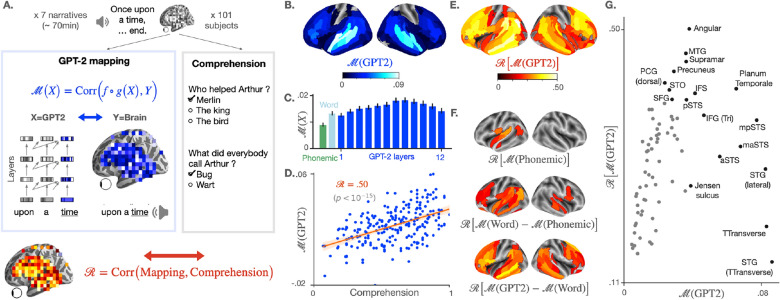
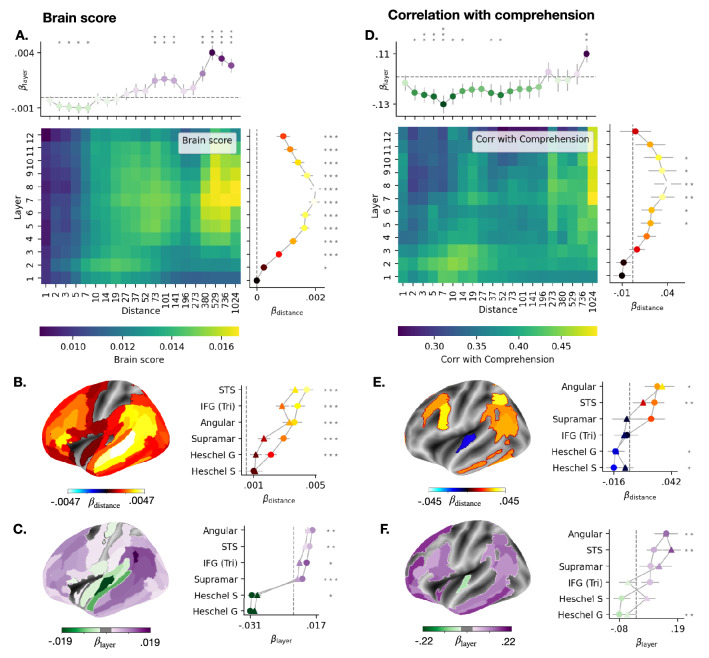
Deep language algorithms, like GPT-2, have demonstrated remarkable abilities to process text, and now constitute the backbone of automatic translation, summarization and dialogue. However, whether these models encode information that relates to human comprehension still remains controversial. Here, we show that the representations of GPT-2 not only map onto the brain responses to spoken stories, but they also predict the extent to which subjects understand the corresponding narratives. To this end, we analyze 101 subjects recorded with functional Magnetic Resonance Imaging while listening to 70 min of short stories. We then fit a linear mapping model to predict brain activity from GPT-2’s activations. Finally, we show that this mapping reliably correlates ($$\mathcal {R}=0.50, p<10^{-15}$$R=0.50,p<10-15) with subjects’ comprehension scores as assessed for each story. This effect peaks in the angular, medial temporal and supra-marginal gyri, and is best accounted for by the long-distance dependencies generated in the deep layers of GPT-2. Overall, this study shows how deep language models help clarify the brain computations underlying language comprehension.
Overview
The claims and statistics of this paper haven’t been checked yet.
Free: it reads the open-access text and checks the first 5 claims that cite a source we can check. Create a free account to check every claim.
Integrity signals
Registry
Cites
Statistics
Figures
Verification
Claims the paper makes
The claims and statistics of this paper haven’t been checked yet.
Free: it reads the open-access text and checks the first 5 claims that cite a source we can check. Create a free account to check every claim.
Claims other papers make about this one
Each is checked against this paper’s own text: does it say what the citing paper says it does?
The cited source doesn’t support the claim as written.
In the citing paper
“Previous studies in the neural encoding literature all used LLMs that were only aware of the short-term context, i.e., where the context window size was as large as several tens of words1–10.”
From Incremental accumulation of linguistic context in artificial and biological neural networks (2025) · cites this paper as [6]
Checked by a reasoning model — may be wrong.
Experimental — accuracy not yet measuredThe cited source says what the claim attributes to it.
In the citing paper
“Large Language Models (LLMs) have shown success in predicting neural signals associated with narrative processing”
From Incremental accumulation of linguistic context in artificial and biological neural networks (2025) · cites this paper as [6]
The cited source says what the claim attributes to it.
In the citing paper
“This was the case even though the participants in these studies were exposed to language stimuli that encompassed hundreds and even thousands of words.”
From Incremental accumulation of linguistic context in artificial and biological neural networks (2025) · cites this paper as [6]
Self-check
Percentages, sums and reported differences re-computed from the paper’s own numbers.
The self-check needs the paper’s full text.
Citations
Cites
BERT: Pre-training of Deep Bidirectional Transformers for Language Understanding
Devlin, J., Chang, M.-W., Lee, K., & Toutanova, K. (2018) · arXiv · doi:10.48550/arxiv.1810.04805 · Cited by 73,173
Scikit-learn: Machine Learning in Python
Pedregosa, F., Varoquaux, G., Gramfort, A., Michel, V., Thirion, B., Grisel, O., Blondel, M., Müller, A., Nothman, J., Louppe, G., et al. (2012) · arXiv · doi:10.48550/arxiv.1201.0490 · Cited by 71,016
Self-citationSciPy 1.0: fundamental algorithms for scientific computing in Python
Virtanen, P., Gommers, R., Oliphant, T. E., Haberland, M., Reddy, T., Cournapeau, D., Burovski, E., Peterson, P., Weckesser, W., Bright, J., et al. (2020) · Nature Methods · doi:10.1038/s41592-019-0686-2 · Cited by 38,430
Language Models are Few-Shot Learners
Brown, T. B., Mann, B., Ryder, N., Subbiah, M., Kaplan, J., Dhariwal, P., Neelakantan, A., Shyam, P., Sastry, G., Askell, A., et al. (2020) · arXiv · doi:10.48550/arxiv.2005.14165 · Cited by 23,372
Learning Transferable Visual Models From Natural Language Supervision
Radford, A., Kim, J. W., Hallacy, C., Ramesh, A., Goh, G., Agarwal, S., Sastry, G., Askell, A., Mishkin, P., Clark, J., et al. (2021) · arXiv · doi:10.48550/arxiv.2103.00020 · Cited by 15,293
Exploring the Limits of Transfer Learning with a Unified Text-to-Text Transformer
Raffel, C., Shazeer, N., Roberts, A., Lee, K., Narang, S., Matena, M., Zhou, Y., Li, W., & Liu, P. J. (2019) · arXiv · doi:10.48550/arxiv.1910.10683 · Cited by 10,929
SciPy 1.0: fundamental algorithms for scientific computing in Python
Virtanen, P., Gommers, R., Oliphant, T. E., Haberland, M., Reddy, T., Cournapeau, D., Burovski, E., Peterson, P., Weckesser, W., Bright, J., et al. (2019) · Apollo - University of Cambridge Repository · doi:10.17863/cam.64134 · Cited by 10,460
Transformers: State-of-the-Art Natural Language Processing
Wolf, T., Debut, L., Sanh, V., Chaumond, J., Delangue, C., Moi, A., Cistac, P., Rault, T., Louf, R., Funtowicz, M., et al. (2020) · Proceedings of the 2020 Conference on Empirical Methods in Natural Language Processing: System Demonstrations · doi:10.18653/v1/2020.emnlp-demos.6 · Cited by 8,741
XLNet: Generalized Autoregressive Pretraining for Language Understanding
Yang, Z., Dai, Z., Yang, Y., Carbonell, J., Salakhutdinov, R., & Le, Q. V. (2019) · arXiv · doi:10.48550/arxiv.1906.08237 · Cited by 6,687
Statsmodels: Econometric and Statistical Modeling with Python
Seabold, S., & Perktold, J. (2010) · Proceedings of the Python in Science Conference · doi:10.25080/majora-92bf1922-011 · Cited by 6,465
Research works printed but not linked: 3
- Radford, A. et al. Language models are unsupervised multitask learners. OpenAI blog 1(8), 9 (2019).
- Caucheteux, C., Gramfort, A., & King, J.-R. Disentangling syntax and semantics in the brain with deep networks. In International Conference on Machine Learning, 1336–1348. PMLR, (2021b).
- Reddy, A. J. & Wehbe, L. Syntactic representations in the human brain: Beyond effort-based metrics. preprint, Neuroscience (2020).
Cited by
Shared computational principles for language processing in humans and deep language models
Goldstein, A., Zada, Z., Buchnik, E., Schain, M., Price, A., Aubrey, B., Nastase, S. A., Feder, A., Emanuel, D., Cohen, A., et al. (2022) · Nature Neuroscience · doi:10.1038/s41593-022-01026-4 · Cited by 447
Brains and algorithms partially converge in natural language processing
Caucheteux, C., & King, J.-R. (2022) · Communications Biology · doi:10.1038/s42003-022-03036-1 · Cited by 318
Self-citationEvidence of a predictive coding hierarchy in the human brain listening to speech
Caucheteux, C., Gramfort, A., & King, J.-R. (2023) · Nature Human Behaviour · doi:10.1038/s41562-022-01516-2 · Cited by 308
Self-citationThe language network as a natural kind within the broader landscape of the human brain
Fedorenko, E., Ivanova, A. A., & Regev, T. I. (2024) · Nature Reviews Neuroscience · doi:10.1038/s41583-024-00802-4 · Cited by 293
Decoding speech perception from non-invasive brain recordings
Défossez, A., Caucheteux, C., Rapin, J., Kabeli, O., & King, J.-R. (2023) · Nature Machine Intelligence · doi:10.1038/s42256-023-00714-5 · Cited by 215
Self-citation
Metadata
- Authors
- Caucheteux, C., Gramfort, A., & King, J.-R.
- Affiliations
- Commissariat à l'Énergie Atomique et aux Énergies Alternatives (FR)
- Institut national de recherche en sciences et technologies du numérique (FR)
- Centre National de la Recherche Scientifique (FR)
- Corresponding author
- Caucheteux, Charlotte
- Venue
- Scientific Reports
- Published
- 2022-09-29
- Volume
- 12
- Issue
- 1
- Pages
- 16327-16327
- ISSN
- 2045-2322 (ISSN-L)
- PMC
- PMC9522791
- OpenAlex
- W4297995647
- Cited by
- 91
- References
- 53
- Citations by year
- 2026: 18 · 2025: 18 · 2024: 30 · 2023: 21 · 2022: 2
- FWCI
- 9.15
- Type
- journal article
- Language
- en
- Open access
- gold
- doi.org
- Licence
- cc-by
- creativecommons.org/licenses/by/4.0 (tdm)
- creativecommons.org/licenses/by/4.0 (vor)
- Locations
- Scientific Reports (publishedVersion, cc-by)
- PubMed Central (publishedVersion, cc-by)
- PubMed (publishedVersion)
- HAL (submittedVersion, other-oa)
- DOAJ (DOAJ: Directory of Open Access Journals) (submittedVersion, cc-by-sa)
- Greater South Information System
- Funders
- Agence Nationale de la Recherche (ANR-17-EURE-, ANR-17-EURE-0017, ANR-17)
- Fondation Fyssen (17-EURE-0017, ANR-17-EURE-0017)
- Topics
- Life Sciences › Neuroscience › Cognitive Neuroscience › Neurobiology of Language and Bilingualism
- Social Sciences › Psychology › Developmental and Educational Psychology › Reading and Literacy Development
- Physical Sciences › Computer Science › Artificial Intelligence › Topic Modeling
- Keywords
- GPT-2, language comprehension, semantic understanding, deep language models, oral narrative, functional MRI, long-distance dependencies, angular gyrus, medial temporal lobe, supramarginal gyrus
- MeSH terms
- Alanine Transaminase, Algorithms, Brain, Humans, Language, Semantics, Comprehension
About these checks
Registry, retraction, Cites and statistics results are computed, not judged, with one exception: a printed reference that no index lists is read once by a model before it counts as a citation error. Claims are extracted by a model and kept only when their quote appears verbatim in the text; each cited source is then checked, with a model’s help, for whether it says what the claim relies on. Those verdicts can be wrong — read the claim’s quote and the cited source before relying on one.
Statistics and arithmetic are recomputed, not judged.
Confidence bands are shown only for fields calibrated on our annotated test set. None is calibrated yet, so no band is shown.
What counts as a claim ›How we measure confidence ›How we check this ›
Are you an author, or do you see a problem with this page? Request a review
How to cite
Cite CoChat for the checks on this page, and the paper for its own findings.
- This page
- CoChat. (2026). Citation check: Deep language algorithms predict semantic comprehension from brain activity. https://app.cochat.ai/papers/10.1038/s41598-022-20460-9
- The paper
- Caucheteux, C., Gramfort, A., & King, J.-R. (2022). Deep language algorithms predict semantic comprehension from brain activity. Scientific Reports. https://doi.org/10.1038/s41598-022-20460-9
Data sources
Bibliographic data: Semantic Scholar, OpenAlex, Crossref.
Contains information from the Semantic Scholar Academic Graph Datasets, made available under the ODC Attribution License (ODC-BY 1.0).
Semantic Scholar’s data is described in: Kinney, R., et al. (2023). The Semantic Scholar Open Data Platform. arXiv:2301.10140.
