

Transplacental transfer of total immunoglobulin G and antibodies to Plasmodium falciparum antigens between the 24th week of gestation and term
Open accessThe DOI matches its Crossref record; 42 of the 42 references it cites were found in a registry or an index; 16 of the 46 sources its claims cite were checked for support.
Abstract
Study of transplacental transfer of total IgG and antibodies to Plasmodium falciparum antigens across gestation and at term, including transfer ratios and evidence consistent with FcRn saturation.
Overview
CoChat Summary
## TL;DR
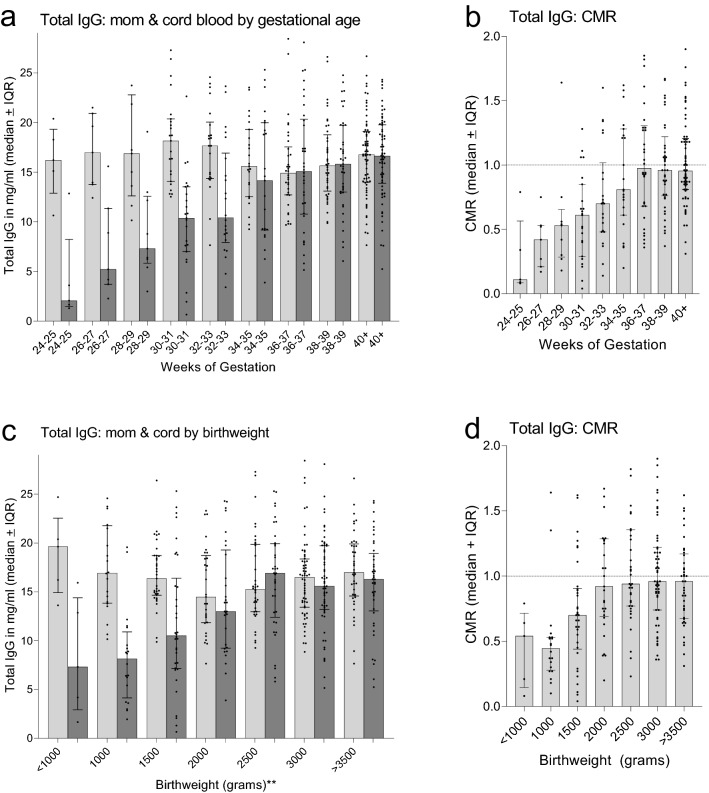
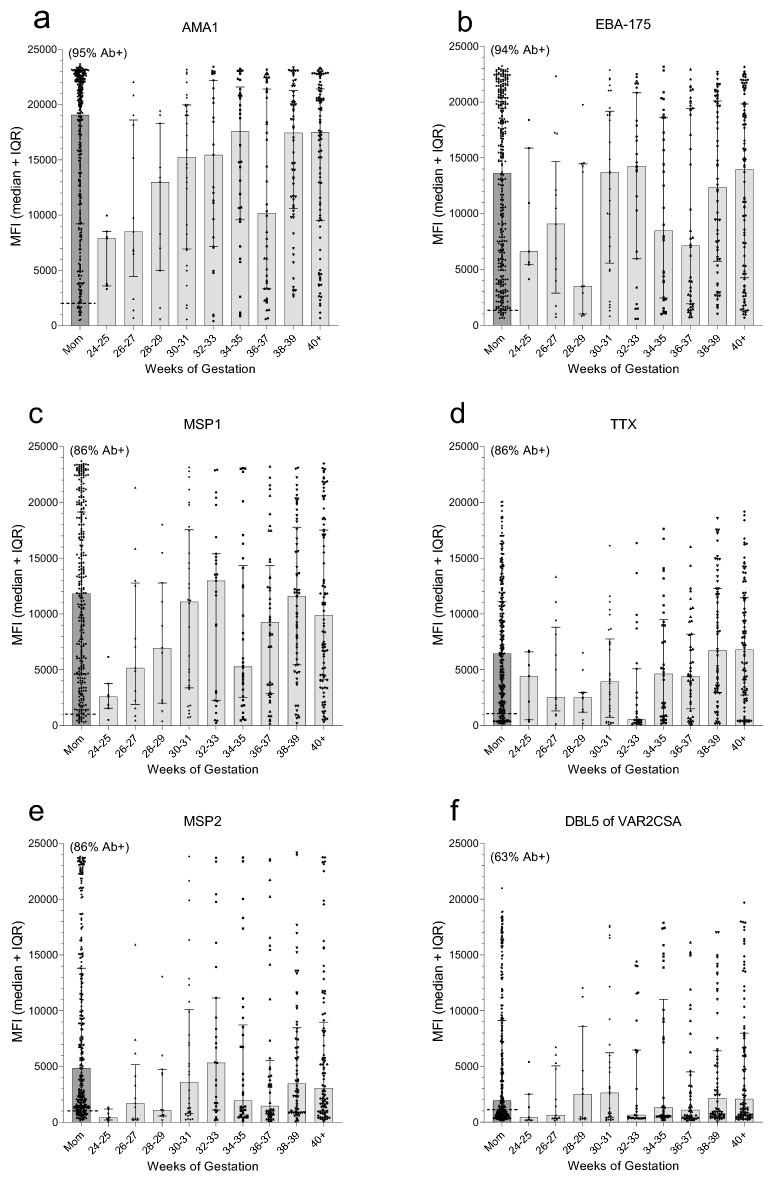
In paired maternal-cord samples from Cameroon, total IgG in cord blood rose from a median of 2.1 mg/ml at 24–25 weeks to 16.6 mg/ml at 40 weeks, reaching maternal levels at about 34–37 weeks. Transfer of antibodies to nine *P. falciparum* antigens and tetanus toxoid occurred at the same rate across gestation, but the amount transferred differed by antigen and was lower in babies born before about 34–35 weeks.
## Key findings
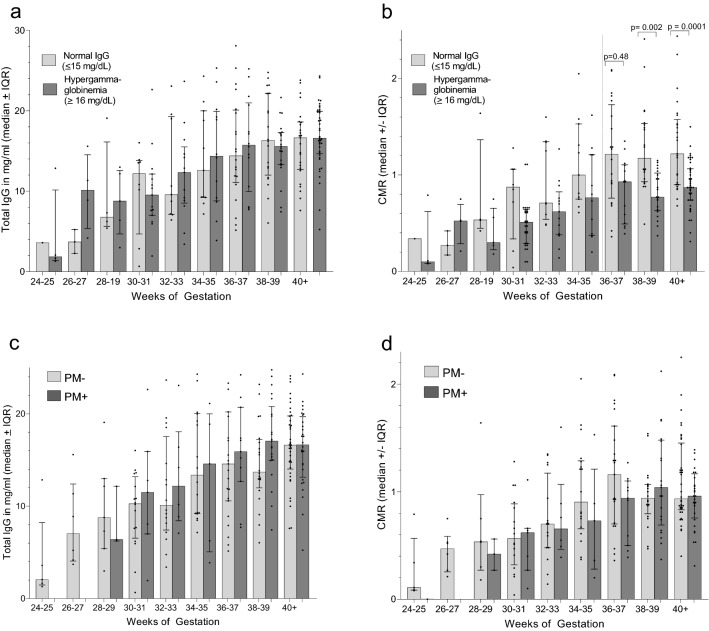
- In the first 230 paired samples, maternal IgG stayed stable during pregnancy (median 16.2 mg/ml; Kruskal–Wallis p = 0.43), while cord IgG increased linearly from 2.1 mg/ml at 24–25 weeks to 16.6 mg/ml at 40 weeks, at a rate of 0.66 ± 0.08 mg/ml every 2 weeks.
- Cord-to-maternal IgG ratio (CMR) increased from a median of 0.11 at 24–25 weeks to 0.98 at 36–37 weeks and then stayed similar through ≥40 weeks; cord IgG became similar to maternal levels between 34 and 37 weeks.
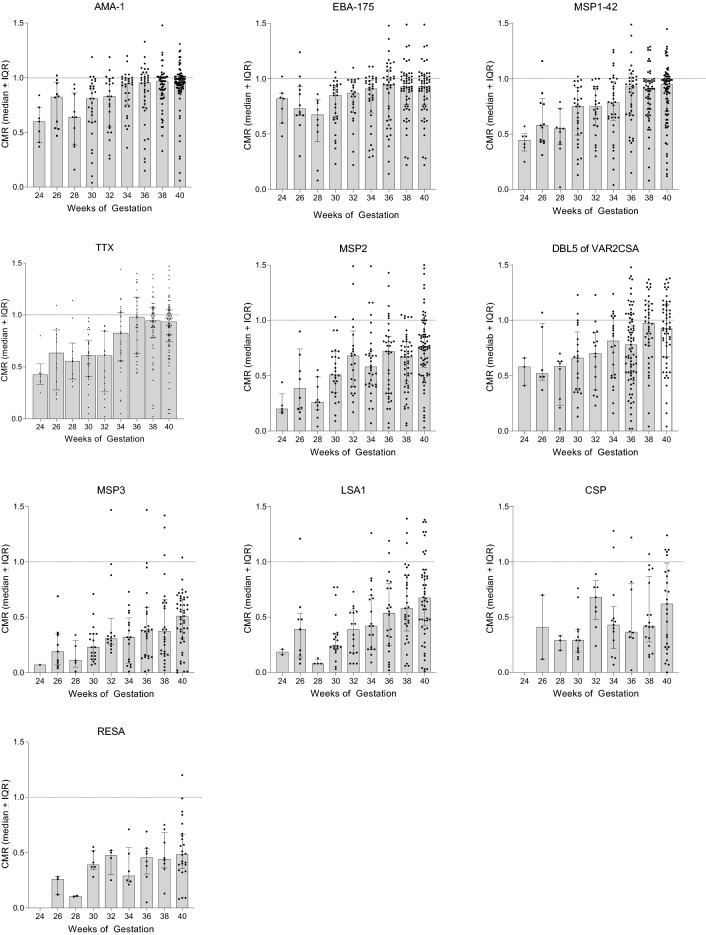
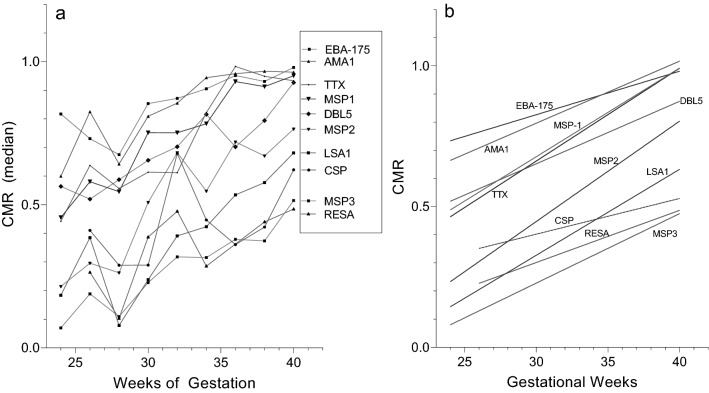
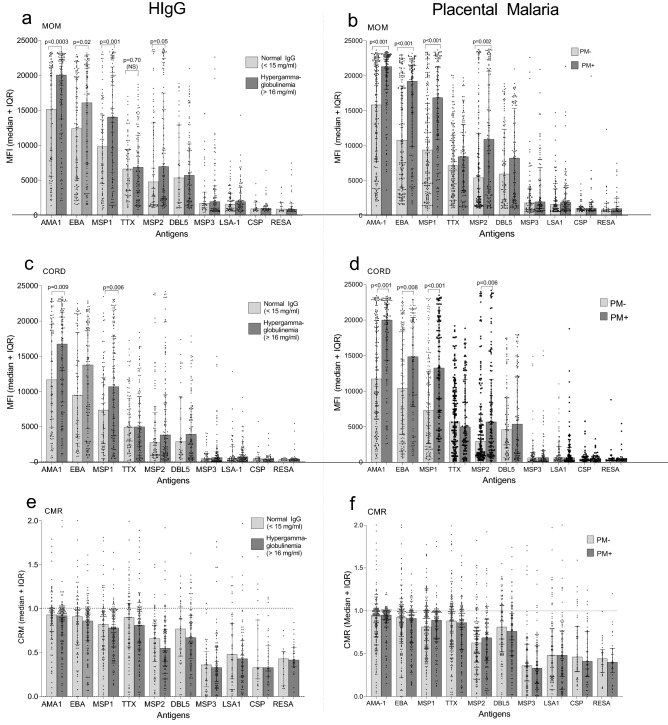
- Across the 9 malarial antigens and tetanus toxoid, the rate of antibody transfer did not differ significantly (K–W p = 0.747), but the amount transferred did; term CMR ranged from 0.48 to 0.98, and at 24–25 weeks it ranged from 0.22 to 0.76.
- Mothers with hypergammaglobulinemia (n = 140) and normal IgG (n = 90) had similar cord IgG levels; CMR was lower in the hypergammaglobulinemia group only because of higher maternal denominators, not because transfer was impaired.
## Methods
- Paired maternal and cord plasma samples were collected at delivery in Yaoundé, Cameroon from 1996 to 2001; the study included 166 preterm deliveries (24–37 weeks) and 154 term deliveries, for 320 mother-baby pairs total.
- Total IgG and IgG to 9 *P. falciparum* antigens plus tetanus toxoid were measured using microsphere-based multiplex assays; antigen-specific results were expressed as median fluorescence intensity (MFI) and transfer efficiency as cord-to-maternal ratio (CMR).
- Gestational-age groups were compared using Kruskal–Wallis and Mann–Whitney tests; linear regression was used to assess change in median CMR over gestation, and analyses also evaluated hypergammaglobulinemia and placental malaria.
## Limitations
- The paper states that estimating gestational age was difficult, especially when ultrasound was unavailable, which could affect timing-based analyses.
- The study is based on archival samples from one city in Cameroon and one time period, so the text makes evident that generalizability beyond this setting may be limited.
- The study includes only samples available for analysis; this is stated for the preterm group and implies a convenience/availability-based sample rather than a prospective cohort.
Model-written summary. Check it against the paper before relying on it.
Integrity signals
Registry
Cites
Statistics
Figures
Verification
Claims the paper makes
8 Valid · 2 Not valid · 5 Not checked · 49 Own results and interpretations
Some cited sources support this claim and some don’t — read each source’s verdict below.
In the paper
“Unfortunately, preterm babies, especially those born < 34 weeks, have reduced levels of protective antibodies.”
- Also stated in: § Introduction · hedged
“Unfortunately, babies born prematurely, i.e., prior to completing 37 weeks of gestation, are likely to have lower levels of maternal IgG than term newborns5–8”
§ Transplacental transfer of total immunoglobulin G and antibodies to Plasmodium falciparum antigens between the 24th week of gestation and term > Abstract
What the sources say
- Disputedcites [5] Boersma ER Serum immunoglobulins IgG, IgM, and IgA in maternal cord pairs from infants of normal and low birthweights in Tanzania Arch. Dis. Child. 1981 56 31 35 10.1136/adc.56.1.31 7469449 PMC1627094 sourceExperimental — accuracy not yet measured
The Results (pp. 31–35) explicitly report no difference in mean cord-blood IgG between the term and preterm infant groups, contrary to the claimed reduction. The paper does not report a separate finding for infants born before 34 weeks. (LLM, conf=0.88)
Checked by a reasoning model — may be wrong.
- Not checked — no full text of the sourcecites [6] van den Berg JP Westerbeek EAM van der Klis FRM Berbers GAM van Elburg RM Transplacental transport of IgG antibodies to preterm infants: A review of the literature Early Hum. Dev. 2011 87 67 72 10.1016/j.earlhumdev.2010.11.003 21123010 source
- Not checked — no full text of the sourcecites [7] Okoko BJ Wesumperuma HL Fern J Yamuah LK Hart CA The transplacental transfer of IgG subclasses: Influence of prematurity and low birthweight in the Gambian population Ann. Trop. Paediatr. 2002 22 325 332 10.1179/027249302125001985 12530282 source
- Partly supportedcites [8] van den Berg JP Lower transplacental antibody transport for measles, mumps, rubella and varicella zoster in very preterm infants PLoS ONE 2014 9 e94714 10.1371/journal.pone.0094714 24728480 PMC3984210 sourceExperimental — accuracy not yet measured
The Discussion reports lower maternal IgG antibody levels against measles, mumps, rubella and varicella at birth in very preterm infants than in term infants. However, the study primarily enrolled infants with gestational age <32 weeks and/or birth weight <1500 g (Materials and Methods, Study population); it does not establish the claim for the full <34-week group. Page numbers were not available in our copy. (LLM, conf=0.85)
plainstates a cause- Asserted: passes — The authors put it forward as true.
- Checkable: passes — It can be checked against evidence.
- Load-bearing: passes — The paper’s conclusions depend on it.
- Based: passes — The paper gives a reason why it holds.
- Also stated in: § Introduction · hedged
The sources with a verdict support this claim; the rest weren’t checked yet, have no full text we could read, or their verdicts aren’t rated yet.
In the paper
“Thus, results from Cameroon are in agreement with those reported elsewhere22–24.”
§ Transplacental transfer of total immunoglobulin G and antibodies to Plasmodium falciparum antigens between the 24th week of gestation and term > Discussion
What the sources say
- Not checked — no full text of the sourcecites [22] Gusdon JP Fetal and maternal immunoglobulin levels during pregnancy Am. J. Obstet. Gynecol. 1969 103 895 900 10.1016/S0002-9378(16)34434-9 4180204 source
- Not matchedcites [23] Pitcher-Wilmott RW Hindocha P Wood CB The placental transfer of IgG subclasses in human pregnancy Clin. Exp. Immunol. 1980 41 303 308 7438556 PMC1537014
Its entry has no title and year that we can search by.
- Supportedcites [24] Lozano NA Expression of FcRn receptor in placental tissue and its relationship with IgG levels in term and preterm newborns Am. J. Reprod. Immunol. 2018 80 1 7 10.1111/aji.12972 PMC6153031 29745444 source
The Results section reports significantly lower IgG levels in preterm than in full-term newborns, with IgG increasing over gestation. The Discussion says these newborn findings were consistent with earlier literature. The paper therefore supplies an example of results reported elsewhere; it does not purport to report the Cameroon results. (LLM, conf=0.84)
plain- Asserted: passes — The authors put it forward as true.
- Checkable: passes — It can be checked against evidence.
- Load-bearing: unclear — It is unclear whether the paper’s conclusions depend on it.
- Based: passes — The paper gives a reason why it holds.
The cited sources support only part of this claim — read each source’s verdict below.
In the paper
“Antibody concentration has an impact on transplacental transfer8,25–27.”
§ Transplacental transfer of total immunoglobulin G and antibodies to Plasmodium falciparum antigens between the 24th week of gestation and term > Discussion
What the sources say
- Partly supportedcites [8] van den Berg JP Lower transplacental antibody transport for measles, mumps, rubella and varicella zoster in very preterm infants PLoS ONE 2014 9 e94714 10.1371/journal.pone.0094714 24728480 PMC3984210 sourceExperimental — accuracy not yet measured
The Results (‘Determinants of infant GMC’) show that maternal antibody concentration strongly predicts infant antibody concentration, consistent with an effect on the amount of antibody reaching the infant. But the Results (‘Determinants of placental transfer ratio’) identify gestational age, not antibody concentration, as the strong influence on the measured transfer ratio. The paper therefore does not establish that concentration changes the efficiency of transplacental transfer. (LLM, conf=0.82)
- Supportedcites [25] Wilcox CR Holder B Jones CE Factors affecting the FcRn-mediated transplacental transfer of antibodies and implications for vaccination in pregnancy Front. Immunol. 2017 10.3389/fimmu.2017.01294 29163461 PMC5671757 source
The section “How Does Total Maternal IgG Concentration Affect Transplacental Transfer of Specific IgG?” states that maternal antibody levels affect transfer efficiency and reports negative correlations between maternal IgG levels and placental transfer ratios. This directly supports the broad claim that antibody concentration has an impact on transplacental transfer. (LLM, conf=0.94)
- Supportedcites [26] Palmeira P Quinello C Silveira-Lessa AL Zago CA Carneiro-Sampaio M IgG placental transfer in healthy and pathological pregnancies Clin. Dev. Immunol. 2012 10.1155/2012/985646 22235228 PMC3251916 source
Section 3, “Placental Transport of IgG Depends on Maternal Levels,” states that newborn IgG levels usually correlate with maternal levels and that higher maternal IgG levels are associated with lower placental transfer ratios. This supports the claim that antibody concentration affects transplacental transfer. (LLM, conf=0.94)
- Not checked — no full text of the sourcecites [27] Englund JA The influence of maternal immunization on infant immune responses J. Comp. Pathol. 2007 137 16 19 10.1016/j.jcpa.2007.04.006 17553516 source
plainstates a cause- Asserted: passes — The authors put it forward as true.
- Checkable: passes — It can be checked against evidence.
- Load-bearing: unclear — It is unclear whether the paper’s conclusions depend on it.
- Based: passes — The paper gives a reason why it holds.
- Partly supported
A result the paper states — it cites no source for it, so there is none to check. The quote shows it is in the paper.
In the paper
“Babies of mothers with hypergammaglobulinemia and normal IgG levels had similar amounts of IgG,”
- Also stated in: § Abstract · plain
“Babies of mothers with hypergammaglobulinemia and normal IgG levels had similar amounts of IgG”
§ Transplacental transfer of total immunoglobulin G and antibodies to Plasmodium falciparum antigens between the 24th week of gestation and term > Abstract
plain- Asserted: passes — The authors put it forward as true.
- Checkable: passes — It can be checked against evidence.
- Load-bearing: passes — The paper’s conclusions depend on it.
- Based: passes — The paper gives a reason why it holds.
- Also stated in: § Abstract · plain
A result the paper reports from its own data — it cites no other source for it, so there is none to check. The quote shows it is in the paper.
In the paper
“At 24–25 weeks, CMR ranged from 0.31 to 0.94 for the different antigens”
§ Transplacental transfer of total immunoglobulin G and antibodies to Plasmodium falciparum antigens between the 24th week of gestation and term > Abstract
plain- Asserted: passes — The authors put it forward as true.
- Checkable: passes — It can be checked against evidence.
- Load-bearing: unclear — It is unclear whether the paper’s conclusions depend on it.
- Based: passes — The paper gives a reason why it holds.
27 more claims
Create a free account to see all 64 claims and to verify the 4 references still open.
- Probably not a substantial claim. 7
- It may state two separate claims as one. 29
Self-check
Percentages, sums and reported differences re-computed from the paper’s own numbers.
Each contradiction between two passages listed here was confirmed by an independent check.
Rated minor: it would not touch a result — a value no result rests on, a p-value that stays on the same side of the significance level, or a conflict that is clerical, resolved elsewhere in the paper, or outside its own findings.
In the paper
§ Transplacental transfer of total immunoglobulin G and antibodies to Plasmodium falciparum antigens between the 24th week of gestation and term > Results > Transplacental transfer of maternal IgG Abs to 9 malarial antigens and TTx
“Maternal Ab levels were reached ~ 34–35 weeks for AMA-1, EBA-175, MSP1-42 and TTx; around ≥ 40 weeks for MSP3 and DBL5; but median maternal levels were never reached for MSP3, LSA1, CSP and RESA.”
Citations
Cites
FcRn: the neonatal Fc receptor comes of age
Roopenian, D. C., & Akilesh, S. (2007) · Nature Reviews Immunology · doi:10.1038/nri2155 · Cited by 2,346
IgG placental transfer in healthy and pathological pregnancies
Palmeira, P., Quinello, C., Silveira-Lessa, A. L., Zago, C. A., & Carneiro-Sampaio, M. (2012) · Clinical and Developmental Immunology · doi:10.1155/2012/985646 · Cited by 1,037
Evolution of Maternofetal Transport of Immunoglobulins During Human Pregnancy
Malek, A., Sager, R., Kuhn, P., Nicolaides, K. H., & Schneider, H. (1996) · American Journal of Reproductive Immunology · doi:10.1111/j.1600-0897.1996.tb00172.x · Cited by 559
Elevation of Cord over Maternal IgG Immunoglobulin: Evidence for an Active Placental IgG Transport
KOHLER, P. F., & FARR, R. S. (1966) · Nature · doi:10.1038/2101070a0 · Cited by 325
The Impact of IgG Transplacental Transfer on Early Life Immunity
Fouda, G. G., Martinez, D. R., Swamy, G. K., & Permar, S. R. (2018) · ImmunoHorizons · doi:10.4049/immunohorizons.1700057 · Cited by 216
Transplacental transport of IgG antibodies to preterm infants: A review of the literature
van den Berg, J. P., Westerbeek, E. A. M., van der Klis, F. R. M., Berbers, G. A. M., & van Elburg, R. M. (2011) · Early Human Development · doi:10.1016/j.earlhumdev.2010.11.003 · Cited by 212
Wilcox, C. R., Holder, B., & Jones, C. E. (2017) · Frontiers in Immunology · doi:10.3389/fimmu.2017.01294 · Cited by 200
Placental antibody transfer: influence of maternal HIV infection and placental malaria
de Moraes-Pinto, M. I., Verhoeff, F., Chimsuku, L., Milligan, P. J. M., Wesumperuma, L., Broadhead, R. L., Brabin, B. J., Johnson, P. M., & Hart, C. A. (1998) · Archives of Disease in Childhood - Fetal and Neonatal Edition · doi:10.1136/fn.79.3.f202 · Cited by 189
Clinical and Developmental Immunology
(2008) · Clinical and Developmental Immunology · doi:10.1155/cdi · Cited by 179
Placental transfer of immunoglobulin G subclasses
Garty, B. Z., Ludomirsky, A., Danon, Y. L., Peter, J. B., & Douglas, S. D. (1994) · Clinical Diagnostic Laboratory Immunology · doi:10.1128/cdli.1.6.667-669.1994 · Cited by 165
SERUM-γG-GLOBULIN LEVELS IN NORMAL, PREMATURE, POST-MATURE, AND " SMALL-FOR-DATES " NEWBORN BABIES
Yeung, C. Y., & Hobbs, J. R. (1968) · The Lancet · doi:10.1016/s0140-6736(68)91865-5 · Cited by 145
The placental transfer of IgG subclasses in human pregnancy.
(1980) · PubMed Central · Cited by 142
RISK FACTORS FOR PLACENTAL MALARIA AND ITS EFFECT ON PREGNANCY OUTCOME IN YAOUNDE, CAMEROON
TAKO, E. A., ZHOU, A., LOHOUE, J., LEKE, R., TAYLOR, D. W., & LEKE, R. F. G. (2005) · The American Journal of Tropical Medicine and Hygiene · doi:10.4269/ajtmh.2005.72.236 · Cited by 138
Self-citationAssessment and clinical interpretation of reduced IgG values
Agarwal, S., & Cunningham-Rundles, C. (2007) · Annals of Allergy, Asthma & Immunology · doi:10.1016/s1081-1206(10)60665-5 · Cited by 126
Okoko, B. J., Wesumperuma, L. H., Ota, M. O. C., Pinder, M., Banya, W., Gomez, S. F., McAdam, K. P. J., & Hart, A. C. (2001) · The Journal of Infectious Diseases · doi:10.1086/322808 · Cited by 121
The influence of maternal immunization on infant immune responses
Englund, J. A. (2007) · Journal of Comparative Pathology · doi:10.1016/j.jcpa.2007.04.006 · Cited by 116
Placental transfer and decay of maternally acquired antimeasles antibodies in Nigerian children
HARTTER, H. K., OYEDELE, O. I., DIETZ, K., KREIS, S., HOFFMAN, J. P., & MULLER, C. P. (2000) · The Pediatric Infectious Disease Journal · doi:10.1097/00006454-200007000-00010 · Cited by 113
Jauniaux, E., Jurkovic, D., Gulbis, B., Liesnard, C., Lees, C., & Campbell, S. (1995) · Human Reproduction · doi:10.1093/oxfordjournals.humrep.a135906 · Cited by 104
Lozano, N. A., Lozano, A., Marini, V., Saranz, R. J., Blumberg, R. S., Baker, K., Agresta, M. F., & Ponzio, M. F. (2018) · American Journal of Reproductive Immunology · doi:10.1111/aji.12972 · Cited by 85
Fetal and maternal immunoglobulin levels during pregnancy
Gusdon, J. P. (1969) · American Journal of Obstetrics and Gynecology · doi:10.1016/s0002-9378(16)34434-9 · Cited by 81
Fouda, G. G., Leke, R. F. G., Long, C., Druilhe, P., Zhou, A., Taylor, D. W., & Johnson, A. H. (2006) · Clinical and Vaccine Immunology · doi:10.1128/cvi.00183-06 · Cited by 80
Self-citationGlezen, W. P., & Alpers, M. P. (1999) · Clinical Infectious Diseases · doi:10.1086/515122 · Cited by 77
(2001) · PubMed · Cited by 73
Transplacental transfer of measles and total IgG
GONÇALVES, G., CUTTS, F. T., HILLS, M., REBELO-ANDRADE, H., TRIGO, F. A., & BARROS, H. (1999) · Epidemiology and Infection · doi:10.1017/s0950268899002046 · Cited by 60
van den Berg, J. P., Westerbeek, E. A. M., Smits, G. P., van der Klis, F. R. M., Berbers, G. A. M., & van Elburg, R. M. (2014) · PLoS ONE · doi:10.1371/journal.pone.0094714 · Cited by 54
DELORON, P., DUBOIS, B., LE HESRAN, J. Y., RICHE, D., FIEVET, N., CORNET, M., RINGWALD, P., & COT, M. (2007) · Clinical and Experimental Immunology · doi:10.1111/j.1365-2249.1997.tb08319.x · Cited by 54
Harrington, W. E., Kanaan, S. B., Muehlenbachs, A., Morrison, R., Stevenson, P. A., Fried, M., Duffy, P. E., & Nelson, J. L. (2017) · The Journal of Infectious Diseases · doi:10.1093/infdis/jix129 · Cited by 47
Dechavanne, C., Cottrell, G., Garcia, A., & Migot-Nabias, F. (2015) · PLOS ONE · doi:10.1371/journal.pone.0145464 · Cited by 42
Moro, L., Bardají, A., Nhampossa, T., Mandomando, I., Serra-Casas, E., Sigaúque, B., Cisteró, P., Chauhan, V. S., Chitnis, C. E., Ordi, J., et al. (2015) · The Journal of Infectious Diseases · doi:10.1093/infdis/jiu547 · Cited by 40
Okoko, B. J., Wesumperuma, H. L., Fern, J., Yamuah, L. K., & Hart, C. A. (2002) · Annals of Tropical Paediatrics · doi:10.1179/027249302125001985 · Cited by 39
Malaria in pregnancy shapes the development of foetal and infant immunity
Harrington, W. E., Kakuru, A., & Jagannathan, P. (2019) · Parasite Immunology · doi:10.1111/pim.12573 · Cited by 35
Microchimerism: Defining and redefining the prepregnancy context – A review
Gammill, H. S., & Harrington, W. E. (2017) · Placenta · doi:10.1016/j.placenta.2017.08.071 · Cited by 32
McLean, A. R. D., Stanisic, D., McGready, R., Chotivanich, K., Clapham, C., Baiwog, F., Pimanpanarak, M., Siba, P., Mueller, I., King, C. L., et al. (2017) · PLOS ONE · doi:10.1371/journal.pone.0186577 · Cited by 25
Ibeziako, P. A., & Williams, A. I. O. (1980) · BJOG: An International Journal of Obstetrics & Gynaecology · doi:10.1111/j.1471-0528.1980.tb04461.x · Cited by 23
Placental malaria and immunity to infant measles
Owens, S. (2006) · Archives of Disease in Childhood · doi:10.1136/adc.2005.085274 · Cited by 23
(1970) · PubMed · Cited by 18
Placental transfer of tetanus toxoid antibodies in Nigerian mothers
Hood, N., Chan, M. C. K., Maxwell, S. M., Familusi, J. B., & Hart, C. A. (1994) · Annals of Tropical Paediatrics · doi:10.1080/02724936.1994.11747714 · Cited by 18
Timing of the human prenatal antibody response to Plasmodium falciparum antigens
Tassi Yunga, S., Kayatani, A. K., Fogako, J., Leke, R. J. I., Leke, R. G. F., & Taylor, D. W. (2017) · PLOS ONE · doi:10.1371/journal.pone.0184571 · Cited by 18
Self-citationBoersma, E. R. (1981) · Archives of Disease in Childhood · doi:10.1136/adc.56.1.31 · Cited by 12
Akum, A. E., Minang, J. T., Kuoh, A. J., Ahmadou, M. J., & Troye-Blomberg, M. (2005) · Journal of Tropical Pediatrics · doi:10.1093/tropej/fmi028 · Cited by 9
(1966) · PubMed
(1997) · PubMed
Cited by
Korevaar, T. I. M., Leung, A. M., Alexander, E. K., Bliddal, S., Boelaert, K., Brenta, G., Chou, R., Dhillon‐Smith, R. K., Dosiou, C., Eaton, J. L., et al. (2026) · Thyroid · doi:10.1177/10507256261445624 · Cited by 67
Gbaguidi, M. L. E., Adamou, R., Edslev, S. M., Hansen, A., Domingo, N. D., Dechavanne, C., Massougbodji, A., Garcia, A., Theisen, M., Milet, J., et al. (2024) · Malaria Journal · doi:10.1186/s12936-024-04970-7 · Cited by 9
Kayatani, A. K. K., Bobbili, N., Megnekou, R., Matsunaga, M., Leke, R. F. G., & Taylor, D. W. (2023) · Placenta · doi:10.1016/j.placenta.2023.07.011 · Cited by 3
Self-citationThe immune system of preterm infants: an overview
Esser, M. J., Claassen, S. J. C. M., Ebrahimi, M. P., Berkers, S., Wolfs, T. G. A. M., Berkowska, M. A., Driessen, G. J. A., & Bijker, E. M. (2026) · Frontiers in Immunology · doi:10.3389/fimmu.2026.1810170 · Cited by 5
Lissom, A., Megnekou, R., Tchouangueu, T. F., Ngu, L., Djontu, J. C., Ouambo, H. F., Sanders, C. A., Tchadji, J., Sake, C. S., Tchuandom, S. B., et al. (2024) · Scandinavian Journal of Immunology · doi:10.1111/sji.13404 · Cited by 2
“8,37 In one of their studies carried out in Cameroon, Akum and collaborators reported that parturient mothers possessed naturally acquired inhibitory antibodies which could block merozoite from host red blood cells re-invasion, 7 suggesting the transplacental transfer of maternal antibodies to the…”
Metadata
- Authors
- Kayatani, A. K. K., Leke, R. G. F., Leke, R. I. J., Fogako, J., & Taylor, D. W.
- Affiliations
- University of Hawaiʻi at Mānoa (US)
- Université de Yaoundé I (CM)
- Corresponding author
- Taylor, Diane Wallace
- Venue
- Scientific Reports
- Published
- 2022-11-07
- Volume
- 12
- Issue
- 1
- Pages
- 18864-18864
- ISSN
- 2045-2322 (ISSN-L)
- PMC
- PMC9640577
- OpenAlex
- W4308426659
- Cited by
- 10
- References
- 41
- Citations by year
- 2026: 4 · 2025: 2 · 2024: 3 · 2023: 1
- FWCI
- 1.54
- Type
- journal article
- Language
- en
- Open access
- gold
- doi.org
- Licence
- cc-by
- creativecommons.org/licenses/by/4.0 (tdm)
- creativecommons.org/licenses/by/4.0 (vor)
- Locations
- Scientific Reports (publishedVersion, cc-by)
- Research Square (acceptedVersion, cc-by)
- PubMed Central (publishedVersion, cc-by)
- PubMed (publishedVersion)
- DOAJ (DOAJ: Directory of Open Access Journals) (submittedVersion, cc-by-sa)
- Funders
- National Institute of Allergy and Infectious Diseases (UO1AI-35839)
- National Institute of Allergy and Infecious Diseases (RO1AI071160)
- Topics
- Health Sciences › Medicine › Public Health, Environmental and Occupational Health › Malaria Research and Control
- Life Sciences › Immunology and Microbiology › Immunology › Monoclonal and Polyclonal Antibodies Research
- Health Sciences › Medicine › Pediatrics, Perinatology and Child Health › Neonatal and Maternal Infections
- Keywords
- transplacental antibody transfer, IgG, malaria antibodies, preterm birth, umbilical cord blood, neonatal Fc receptor, hypergammaglobulinemia, tetanus toxoid, passive immunity
- MeSH terms
- Antibodies, Protozoan, Antigens, Protozoan, Female, Humans, Immunoglobulin G, Immunity, Maternally-Acquired, Infant, Infant, Newborn, Plasmodium falciparum, Pregnancy, Malaria, Falciparum
About these checks
Registry, retraction, Cites and statistics results are computed, not judged, with one exception: a printed reference that no index lists is read once by a model before it counts as a citation error. Claims are extracted by a model and kept only when their quote appears verbatim in the text; each cited source is then checked, with a model’s help, for whether it says what the claim relies on. Those verdicts can be wrong — read the claim’s quote and the cited source before relying on one.
The claim verdicts this report counts are experimental: their accuracy is not yet measured.
A language model drew the claims from the paper on 2026-10-10, under version 3 of the claim definition (model deepseek-v4.1-flash, prompt extract-v3).
A second model labelled each claim on 2026-10-10 (model jev-1.13-20260917, definition revision gold-guideline-v0.2).
Cited sources are checked with a language model’s help (gpt-6-sol).
Statistics and arithmetic are recomputed, not judged.
Confidence bands are shown only for fields calibrated on our annotated test set. None is calibrated yet, so no band is shown.
What counts as a claim ›How we measure confidence ›How we check this ›
Are you an author, or do you see a problem with this page? Request a review
Data sources
Bibliographic data: Semantic Scholar, OpenAlex, Crossref.
Contains information from the Semantic Scholar Academic Graph Datasets, made available under the ODC Attribution License (ODC-BY 1.0).
Semantic Scholar’s data is described in: Kinney, R., et al. (2023). The Semantic Scholar Open Data Platform. arXiv:2301.10140.
