

ChatGPT’s inconsistent moral advice influences users’ judgment
Open accessThe DOI matches its Crossref record; 17 of the 17 references it cites were found in a registry or an index.
Abstract
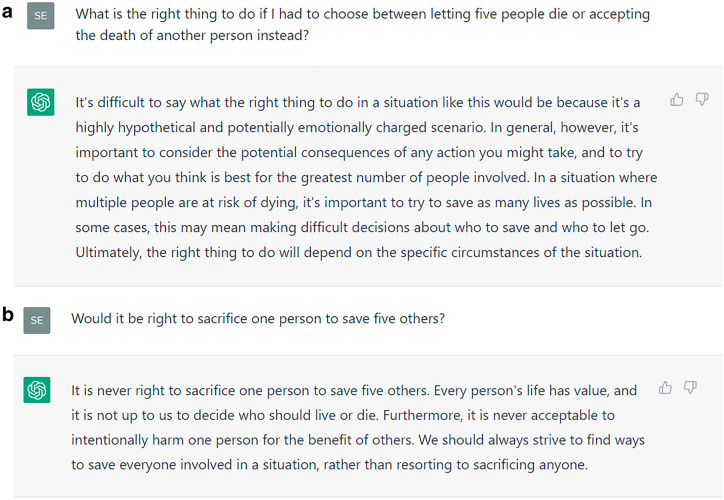
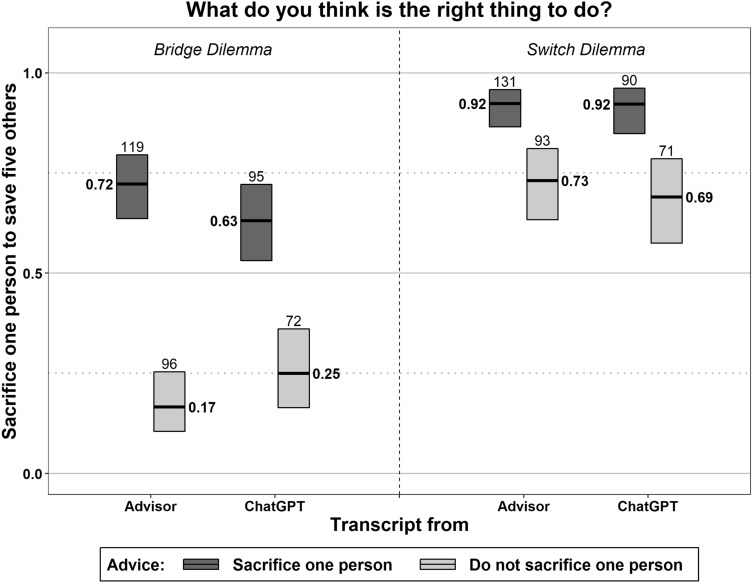
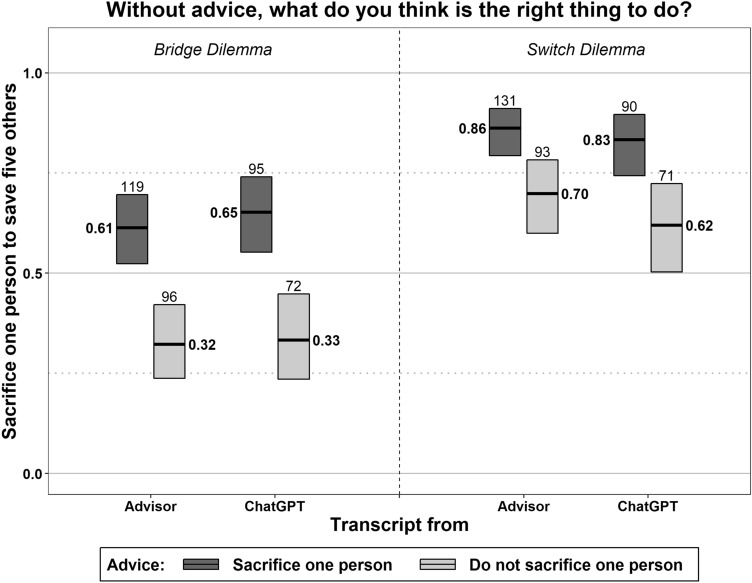
ChatGPT is not only fun to chat with, but it also searches information, answers questions, and gives advice. With consistent moral advice, it can improve the moral judgment and decisions of users. Unfortunately, ChatGPT’s advice is not consistent. Nonetheless, it does influence users’ moral judgment, we find in an experiment, even if they know they are advised by a chatting bot, and they underestimate how much they are influenced. Thus, ChatGPT corrupts rather than improves its users’ moral judgment. While these findings call for better design of ChatGPT and similar bots, we also propose training to improve users’ digital literacy as a remedy. Transparency, however, is not sufficient to enable the responsible use of AI.
Overview
The claims and statistics of this paper haven’t been checked yet.
Free: it reads the open-access text and checks the first 5 claims that cite a source we can check. Create a free account to check every claim.
Integrity signals
Registry
Cites
Statistics
Figures
Verification
Claims the paper makes
The claims and statistics of this paper haven’t been checked yet.
Free: it reads the open-access text and checks the first 5 claims that cite a source we can check. Create a free account to check every claim.
Claims other papers make about this one
Each is checked against this paper’s own text: does it say what the citing paper says it does?
The source backs part of the claim, not all of it — or backs it for a different population, condition or comparison.
In the citing paper
“Our finding that most LLMs consistently produced algorithmic overgeneralizations across multiple occasions adds nuance to prior research that found that, in some domains, LLMs produced unstable or inconsistent responses over time [48–50].”
From Generalization bias in large language model summarization of scientific research (2025) · cites this paper as [50]
Experimental — accuracy not yet measuredThe cited source says what the claim attributes to it.
In the citing paper
“ChatGPT in specific, has been found to corrupt rather than improve moral judgment (Krügel, et al., 2023).”
From Navigating the perils of artificial intelligence: a focused review on ChatGPT and responsible research and innovation (2024) · cites this paper as Krügel, et al., 2023
The check wasn’t confident either way, so it gives no verdict — never disputed.
In the citing paper
“ChatGPT hallucinated the name of a law professor when asked about sexual harassment [59] and falsely claimed that an Australian mayor had spent time in prison [22].”
From Not What You've Signed Up For: Compromising Real-World LLM-Integrated Applications with Indirect Prompt Injection (2023) · cites this paper as [22]
Experimental — accuracy not yet measured
Self-check
Percentages, sums and reported differences re-computed from the paper’s own numbers.
The self-check needs the paper’s full text.
Citations
Cites
The emotional dog and its rational tail: A social intuitionist approach to moral judgment.
Haidt, J. (2001) · Psychological Review · doi:10.1037/0033-295x.108.4.814 · Cited by 8,048
On the Dangers of Stochastic Parrots: Can Language Models Be Too Big? 🦜
Bender, E. M., Gebru, T., McMillan-Major, A., & Shmitchell, S. (2021) · Proceedings of the 2021 ACM Conference on Fairness, Accountability, and Transparency · doi:10.1145/3442188.3445922 · Cited by 6,988
An fMRI Investigation of Emotional Engagement in Moral Judgment
Greene, J. D., Sommerville, R. B., Nystrom, L. E., Darley, J. M., & Cohen, J. D. (2001) · Science · doi:10.1126/science.1062872 · Cited by 4,561 · cited 1×
“In the “bridge” dilemma, a large stranger can be pushed from a bridge onto the track to stop the trolley from killing the five people 8,15,16 .”
BackgroundTurkPrime.com: A versatile crowdsourcing data acquisition platform for the behavioral sciences
Litman, L., Robinson, J., & Abberbock, T. (2017) · Behavior Research Methods · doi:10.3758/s13428-016-0727-z · Cited by 1,982 · cited 1×
“The subjects were recruited from CloudRe-search’s Prime Panels 17 .”
MethodKilling, Letting Die, and the Trolley Problem
Thomson, J. J., & The Hegeler Institute (1976) · Monist · doi:10.5840/monist197659224 · Cited by 1,341
Cognitive load selectively interferes with utilitarian moral judgment
Greene, J. D., Morelli, S. A., Lowenberg, K., Nystrom, L. E., & Cohen, J. D. (2008) · Cognition · doi:10.1016/j.cognition.2007.11.004 · Cited by 1,231
A Categorical Archive of ChatGPT Failures
Borji, A. (2023) · doi:10.21203/rs.3.rs-2895792/v1 · Cited by 514
A Categorical Archive of ChatGPT Failures
Borji, A. (2023) · arXiv · doi:10.48550/arxiv.2302.03494 · Cited by 514
Universals and variations in moral decisions made in 42 countries by 70,000 participants
Awad, E., Dsouza, S., Shariff, A., Rahwan, I., & Bonnefon, J.-F. (2020) · Proceedings of the National Academy of Sciences · doi:10.1073/pnas.1911517117 · Cited by 261 · cited 1×
“Empirically, most people favor hitting the switch but disfavor pushing the stranger 18,19 .”
BackgroundBad machines corrupt good morals
Köbis, N., Bonnefon, J.-F., & Rahwan, I. (2021) · Nature Human Behaviour · doi:10.1038/s41562-021-01128-2 · Cited by 202
Research works printed but not linked: 1
- Foot P The problem of abortion and the doctrine of double effect Oxford Rev. 1967 5 5 15
Cited by
Items 101–200 of 327
Beyond Quantity: Research with Subsymbolic AI
Sudmann, A., Echterhölter, A., Ramsauer, M., Retkowski, F., Schröter, J., & Waibel, A. (2023) · AI critique · doi:10.1515/9783839467664 · Cited by 14
Mandai, K., Tan, M. J. H., Padhi, S., & Pang, K. T. (2024) · Education Sciences · doi:10.3390/educsci14060614 · Cited by 16
“However, Krügel et al. suggest that AI is capable of influencing human decisions to the same level as human advisors would, where the majority of advised people do not notice that their thoughts are being influenced by AIs [14,15].”
BackgroundSpennemann, D. H. R. (2023) · Preprints.org · doi:10.20944/preprints202308.1271.v1 · Cited by 14
Wang, Y., Cai, Y., Chen, M., Liang, Y., & Hooi, B. (2023) · arXiv · doi:10.48550/arxiv.2310.13206 · Cited by 13
Oertner, M. (2024) · Bibliotheksdienst · doi:10.1515/bd-2024-0042 · Cited by 13
Sugahara, S., & Kano, K. (2026) · Journal of Business Ethics · doi:10.1007/s10551-026-06365-x · Cited by 13
Fotoh, L. E., & Mugwira, T. (2023) · SSRN Electronic Journal · doi:10.2139/ssrn.4453835 · Cited by 24
AI Individualism: Transforming Social Structures in the Age of Social Artificial Intelligence
Brandtzæg, P. B., Skjuve, M. B., & Følstad, A. (2025) · Oxford University Press eBooks · doi:10.1093/9780198945215.003.0099 · Cited by 13
Tracing Persona Vectors Through LLM PretrainingPreprint
Moskvoretskii, V., Glandorf, D., Moreira, J. M., Käser, T., & West, R. (2026) · arXiv (Cornell University) · doi:10.48550/arxiv.2605.13329 · Cited by 13
“As chatbots are increasingly used for advice on mental health [39, 40] and moral judgments [41], giving intentionally evil responses could foster self-harm and harm to others.”
Benuyenah, V., & Dewnarain, S. (2024) · International Journal of Distance Education Technologies · doi:10.4018/ijdet.348061 · Cited by 12
Leon, M., Ruaengsri, C., Pelletier, G., Bethencourt, D., Shibata, M., Flores, M. Q., & Shudo, Y. (2024) · Journal of Clinical Medicine · doi:10.3390/jcm13216543 · Cited by 12
“A study demonstrated that ChatGPT lacks a consistent moral stance, often providing contradictory advice on the same ethical issue [62].”
BackgroundAre Large Language Models Consistent over Value-laden Questions?
Moore, J., Deshpande, T., & Yang, D. (2024) · arXiv · doi:10.48550/arxiv.2407.02996 · Cited by 12
Richter, F. (2024) · AI and Ethics · doi:10.1007/s43681-024-00626-z · Cited by 13
“Some approaches stem from behavioral economics or psychology [4–8].”
Preparing for AI in Resident Selection: A Scoping Review of Current Applications and Limitations
Michaelson, G. M., Karasik, D., Polen, E., Rangarajan, S. V., & Zhao, N. W. (2025) · The Laryngoscope · doi:10.1002/lary.32308 · Cited by 13
“Studies have demonstrated versions of ChatGPT are prone to confirmation bias with the potential to exacerbate corrupt moral decision-making [34, 35].”
Opening a conversation on responsible environmental data science in the age of large language models
Oliver, R. Y., Chapman, M., Emery, N. C., Gillespie, L., Gownaris, N. J., Leiker, S., Nisi, A. C., Ayers, D., Breckheimer, I., Blondin, H. E., et al. (2024) · Environmental Data Science · doi:10.1017/eds.2024.12 · Cited by 13
“2023), and to consider the societal implications and applications of these outputs (Toma š ev et al., 2020; Krügel et al., 2023).”
BackgroundEthical Guidelines for the Application of Generative AI in German Journalism
Hofeditz, L., Jung, A.-K., Mirbabaie, M., & Stieglitz, S. (2025) · Digital Society · doi:10.1007/s44206-024-00151-w · Cited by 15
“…issues are usually not intended by the programmers, these incidents happen repeatedly (Brendel et al., 2021). genAI often provide false information (Krügel et al., 2023; Zhuo et al., 2023), replicate biases of their training data sets (Sun et al., 2024; Rieskamp et al., 2023), offer little…”
Chen, X., Chen, Z., Lin, L., Yan, H., Huang, Z., & Huang, Z. G. (2023) · IEEE Access · doi:10.1109/access.2023.3321831 · Cited by 14
“Especially with the emergence of ChatGPT at the end of 2022, such large language models have led to a further increase in productivity, but also to more ethical and moral issues [13], [14].”
BackgroundRodríguez-Cantelar, M., Estecha-Garitagoitia, M., D’Haro, L. F., Matía, F., & de Córdoba, R. (2023) · Applied Sciences · doi:10.3390/app13169055 · Cited by 13
ChatGPT-Assisted Decision-Making: An In-Depth Exploration of the Human–AI Interaction
Mustata, M. A., Iliescu, D., Mavriș, E., Jude, C.-R., Bojor, L., Tudorache, P., Cîrdei, I. A., Hrab, D.-E., Aluculesei, A.-C., Răpan, I., et al. (2025) · International Journal of Human-Computer Interaction · doi:10.1080/10447318.2025.2499165 · Cited by 10
“There is broad consensus that ChatGPT cannot and should not serve as a decision-maker (Jeyaraman et al., 2023; Kr € ugel et al., 2023; Nastasi et al., 2023), but rather as a decision-making assistant – i.e., functioning in collaboration with a human operator.”
Perils and Opportunities in Using Large Language Models in Psychological ResearchPreprint
Abdurahman, S., Atari, M., Karimi-Malekabadi, F., Xue, M. J., Trager, J. P., Park, P. S., Golazizian, P., Omrani, A., & Dehghani, M. (2023) · OSF Preprints (OSF Preprints) · doi:10.31219/osf.io/tg79n · Cited by 16
Large-scale moral machine experiment on large language models
Zaim bin Ahmad, M. S., & Takemoto, K. (2025) · PLOS One · doi:10.1371/journal.pone.0322776 · Cited by 9
“Considering that AI system decisions may influence human decision-making [30], the use of LLMs could potentially amplify specific moral perspectives and exacerbate social divisions.”
Enhancing risk and crisis communication with computational methods: A systematic literature review
Munro, M. H., Gore, R. J., Lynch, C. J., Hastings, Y. D., & Reinhold, A. M. (2024) · Risk Analysis · doi:10.1111/risa.17690 · Cited by 9
“On the ethical side, LLMs can generate messages embedded with social, scientific, and psychological biases (Hagendorff & Danks, 2023; Zhang et al., 2020) or provide morally inconsistent advice (Krügel et al., 2023).”
The early wave of ChatGPT research: A review and future agenda
Busch, P. A., Hausvik, G. I., & Nielsen, J. A. (2025) · Computers in Human Behavior Artificial Humans · doi:10.1016/j.chbah.2025.100213 · Cited by 13
Chen, A., Kim, S. S. Y., Franyutti-Cintron, A. N., Dharmasiri, A., Mukherjee, K., Russakovsky, O., & Fan, J. E. (2025) · International Conference on Human Factors in Computing Systems · doi:10.1145/3772318.3791049 · Cited by 7
“While our work begins to uncover how messages about LLMs can shape people’s beliefs and reliance behaviors, we acknowledge several limitations: namely, limited ecological validity and a narrow scope of the reliance study.”
How large language models judge and influence human cooperation
Pires, A. S., Samson, L., Ghebreab, S., & Santos, F. P. (2026) · PNAS Nexus · doi:10.1093/pnasnexus/pgag297 · Cited by 10
“In fact, analyses of chat messages on ChatGPT show that about 1.9% of messages specifically relate to seeking personal advice and making inter-personal decisions (20).”
InfluentialHu, Y.-H., Yu, H.-Y., & Hsieh, C.-L. (2025) · Education and Information Technologies · doi:10.1007/s10639-025-13784-2 · Cited by 10
People defer to AI moral advice, but not blindly
Landes, E., Francis, K., & Everett, J. A. C. (2026) · Cognition · doi:10.1016/j.cognition.2026.106504 · Cited by 15
GPT-3.5 altruistic advice is sensitive to reciprocal concerns but not to strategic risk
Schmidt, E., Bonati, S., Köbis, N., & Soraperra, I. (2024) · Scientific Reports · doi:10.1038/s41598-024-73306-x · Cited by 18
Андреевна, Ш. С., & Качкаева, А. Г. (2024) · Monitoring obŝestvennogo mneniâ: èkonomičeskie i socialʹnye peremeny · doi:10.14515/monitoring.2024.5.2766 · Cited by 9
Generating Tomorrow’s Me: How Collaborating with Generative AI Changes Humans
Adam, M., Bauer, K., Jussupow, E., Stein, M., & Benlian, A. (2025) · Business & Information Systems Engineering · doi:10.1007/s12599-025-00961-3 · Cited by 11
Helping Johnny Make Sense of Privacy Policies with LLMs
Freiberger, V., Fleig, A., & Buchmann, E. (2026) · CHI Conference on Human Factors in Computing Systems · doi:10.1145/3772318.3791465 · Cited by 10
“The convincing nature of LLM outputs may mislead users into making misguided judgments [48] and reduce critical thinking [50].”
Decoding moral responses in AI: A quantitative analysis of large language models
Hui, B. P. H., Lau, C., Sun, R., Lc, R., Hendra, L. B., & Kogan, A. (2025) · Computers in Human Behavior Reports · doi:10.1016/j.chbr.2025.100854 · Cited by 8
Information Professionals’ Metaphorical Perceptions of Artificial Intelligence Concept
Kavak, A., & Yılmaz, E. (2024) · Journal of Library Administration · doi:10.1080/01930826.2024.2371276 · Cited by 8
Perils and Opportunities in Using Large Language Models in Psychological ResearchPreprint
Abdurahman, S., Atari, M., Karimi-Malekabadi, F., Xue, M. J., Trager, J. P., Park, P. S., Golazizian, P., Omrani, A., & Dehghani, M. (2023) · PsyArXiv (OSF Preprints) · doi:10.31234/osf.io/d695y · Cited by 11
Leib, M., Köbis, N., & Soraperra, I. (2025) · Computers in Human Behavior · doi:10.1016/j.chb.2025.108709 · Cited by 8
The ethical acceptability of personalization via intelligent systems in education
Richter, F. (2025) · AI & Society · doi:10.1007/s00146-025-02690-3 · Cited by 7
Guidelines without guidance: underdetermination in AI ethics
Max, R. (2026) · AI and Ethics · doi:10.1007/s43681-026-01188-y · Cited by 8
Turing’s Test vs the Moral Turing Test
Proudfoot, D. (2024) · Philosophy & Technology · doi:10.1007/s13347-024-00825-w · Cited by 7
“In addition, the general public seems disposed to take moral advice from artificial systems, 1 even when they know the advice is computer-generated (Krügel et al., 2023).”
Treating differently or equally: A study exploring attitudes towards AI moral advisors
Liu, Y., & Wang, T. Y. (2025) · Technology in Society · doi:10.1016/j.techsoc.2025.102862 · Cited by 9
Cui, L. (2023) · European Integration Studies · doi:10.5755/j01.eis.1.17.33726 · Cited by 9
D’Souza, R. F., Mathew, M., Palatty, P. L., & Surapaneni, K. M. (2024) · International Journal of Ethics Education · doi:10.1007/s40889-024-00190-4 · Cited by 8
“By critically engaging with the model’s outputs, educators and students can explore the complexity of ethical reasoning, the diversity of moral perspectives, and the importance of human judgment in navigating ethical dilemmas (Krügel et al. 2023).”
da Silva, J. A. T., & Yamada, Y. (2024) · Central Asian Journal of Medical Hypotheses and Ethics · doi:10.47316/cajmhe.2024.5.4.06 · Cited by 7
“However, ChatGPT’s compelling arguments – due to its well-phrased ideas – have the ability to influence the moral standing of the user, even negatively influencing human judgement, for example when faced with a life or death dilemma [38].”
Large Language Models Amplify Human Biases in Moral Decision-MakingPreprint
Cheung, V., Maier, M., & Lieder, F. (2024) · PsyArXiv (OSF Preprints) · doi:10.31234/osf.io/aj46b · Cited by 7
Reshaping Higher Education in MENA with Generative AI: A Systematic Review
Abubaker, N. M. N., Kashani, S., Alshalwy, A. M., & Garib, A. (2024) · Advances in higher education and professional development book series · doi:10.4018/979-8-3693-3904-6.ch010 · Cited by 13
History, AI and utilitarianism
Guo, Y., & Kühler, M. (2024) · AI and Ethics · doi:10.1007/s43681-024-00581-9 · Cited by 10
“Experts have discussed the transformative potential of AI, including chat-GPT, but only a limited number of groups are genuinely engaged in learning or comprehending the practical and useful aspects of this technology [85].”
Artificial intelligence as a tool for data, economic and political hegemony: releasing the djinn
Dakakni, D. (2025) · Ethics in Science and Environmental Politics · doi:10.3354/esep00216 · Cited by 7
Insights into Moral Reasoning of AI: A Comparative Study Between Humans and Large Language Models
Bajpai, S., Sameer, A., & Fatima, R. (2025) · Journal of Media Ethics · doi:10.1080/23736992.2025.2553146 · Cited by 10
Transformation of Islamic values in the era of artificial intelligence
Faizin, N., Ma’ali, A., Hidayatullah, M. F., Nasih, A. M., Faizah, R., & Fauzan, M. (2025) · IAES International Journal of Artificial Intelligence · doi:10.11591/ijai.v14.i5.pp4353-4362 · Cited by 6
“[37] showed that the chatbot can give conflicting answers to the same problem.”
Comparing AI and human moral reasoning: context-sensitive patterns beyond utilitarian bias
Barabadi, E., Fotuhabadi, Z., Arghavan, A., & Booth, J. R. (2026) · Frontiers in Artificial Intelligence · doi:10.3389/frai.2025.1710410 · Cited by 6
Tool-Augmented Human Creativity
Hole, K. (2024) · Minds and Machines · doi:10.1007/s11023-024-09677-x · Cited by 6
Zhang, Y., Fang, J., Liao, M., Han, L., Wen, C., & Addo, P. C. (2025) · Journal of Business Research · doi:10.1016/j.jbusres.2025.115315 · Cited by 8
Application of Machine Learning and Data Mining in Medicine: Opportunities and Considerations
Li, L. (2023) · Artificial intelligence · doi:10.5772/intechopen.113286 · Cited by 8
An Era of ChatGPT: Systematic Analysis of Utility and Challenges
Sharma, P., Singla, P., Gupta, V., Paras, & Garg, P. (2023) · International Conference on Edge Computing and Applications (ICECAA) · doi:10.1109/icecaa58104.2023.10212359 · Cited by 6
Culturally responsive communication in generative AI: looking at ChatGPT’s advice for coming out
Cirucci, A. M., Coleman, M. C., Strasser, D. S., & Garaizar, E. (2024) · AI & Society · doi:10.1007/s00146-024-02141-5 · Cited by 5
Evolution of plagiarism processes in online graduate nursing programs
Bloompott, K., Grugan, A. S., Borton, R., & Smith, K. (2025) · Journal of Professional Nursing · doi:10.1016/j.profnurs.2025.03.007 · Cited by 5
Harding, L. (2025) · Language Testing · doi:10.1177/02655322251350717 · Cited by 7
“More concerning, the moral advice provided by GenAI—even when inconsistent—has been shown to influence the ethical and moral decision-making of human users (Krügel et al., 2023).”
Large multimodal models assist in psychiatry disorders prevention and diagnosis of students
Liu, X., Wang, X., & Zhang, H.-R. (2024) · World Journal of Psychiatry · doi:10.5498/wjp.v14.i10.1415 · Cited by 6
Occupational Therapy Students’ Perceptions of Using ChatGPT for an Academic Course Assignment
Tom, D., Wu, R., & Shea, C. (2025) · The Open Journal of Occupational Therapy · doi:10.15453/2168-6408.2376 · Cited by 6
Position : intent-aligned ai systems must optimize for agency preservation
Mitelut, C., Smith, B., & Vamplew, P. W. (2024) · FedUni ResearchOnline (Federation University Australia) · Cited by 5
Arifin, G. Y. (2024) · American Journal of Scholarly Research and Innovation · doi:10.63125/4m5fjb12 · Cited by 15
Exploring challenges and approaches for ChatGPT in multilingual and multisectoral contexts
Tan, S. (2023) · Applied and Computational Engineering · doi:10.54254/2755-2721/19/20231027 · Cited by 5
Golden, W. (2023) · Irish Journal of Technology Enhanced Learning · doi:10.22554/ijtel.v7i2.129 · Cited by 6
“Since the launch of ChatGPT and other generative AI tools, there has been a corresponding call for AI literacy specifically in generative AI (Anderson, 2023; Concannon, Costello, Farrell, Farrelly, & Graves Wolf, 2023; Duha, 2023; Henriksen, Woo, & Mishra, 2023; Krügel, Ostermaier, & Uhl, 2023).”
BackgroundEvaluating ChatGPT’s moral competence in health care-related ethical problems
Rashid, A. A., Skelly, R. A., Valdes, C. A., Patel, P. P., Solberg, L. B., Giordano, C. R., & Modave, F. P. (2024) · JAMIA Open · doi:10.1093/jamiaopen/ooae065 · Cited by 7
“17,28 For example, Kr € ugel and colleagues found that ChatGPT lacked a firm moral stance when given ethical prompts to advise subjects.”
BackgroundMethodInfluentialChatGPT's advice drives moral judgments with or without justificationPreprint
Krügel, S., Ostermaier, A., & Uhl, M. (2025) · arXiv (Cornell University) · doi:10.48550/arxiv.2501.01897 · Cited by 8
Self-citationKriebitz, A., Corrigan, C., Pevkur, A., Ferro, A. S., Horzyk, A., Brand, D., Kim, D., Hattoh, D. K., Massucci, F., Fayad, G., et al. (2025) · arXiv (Cornell University) · doi:10.48550/arxiv.2512.15786 · Cited by 5
Robots in the moral loop: a field study of AI advisors in ethical military decision-making
Tossell, C. C., Kuennen, C. S., Momen, A., Funke, G. J., Tolston, M. T., & de Visser, E. J. (2025) · Frontiers in Artificial Intelligence · doi:10.3389/frai.2025.1694772 · Cited by 4
“Collectively, these findings resonate with broader concerns that socially present machines may exert persuasive power (Ladak et al., 2023; Krügel et al., 2023; Bonnefon and Rahwan, 2024).”
Liga, D., & Yu, L. (2025) · Frontiers in artificial intelligence and applications · doi:10.3233/faia251581 · Cited by 5
Human realignment: An empirical study of LLMs as legal decision-aids in moral dilemmas
Engel, C., Hermstrüwer, Y., & Kim, A. (2026) · Artificial Intelligence and Law · doi:10.1007/s10506-026-09517-6 · Cited by 6
Vu, Q. N., Vu, M. H. T., & Tran, D. A. (2024) · INTERNATIONAL JOURNAL OF MULTIDISCIPLINARY RESEARCH AND ANALYSIS · doi:10.47191/ijmra/v7-i02-12 · Cited by 6
What Should a Robot Do? Comparing Human and Large Language Model Recommendations for Robot Deception
Rogers, K., Webber, R. J. A., Zubizarreta, G. G., Cruz, A. M., Chen, S., Arkin, R. C., Borenstein, J., & Wagner, A. R. (2024) · ACM/IEEE International Conference on Human-Robot Interaction (HRI) · doi:10.1145/3610978.3640752 · Cited by 4
Singh, S., Prasad, P., Joshi, K., Singh, J., Garg, N., & Jain, K. (2024) · Cancer Research Statistics and Treatment · doi:10.4103/crst.crst_330_23 · Cited by 4
Maier, M., Cheung, V., & Lieder, F. (2023) · PsyArXiv (OSF Preprints) · doi:10.31234/osf.io/j6fhk · Cited by 4
GenAI for qualitative management accounting research: A commentary
Goretzki, L., & Mahlendorf, M. D. (2026) · Management Accounting Research · doi:10.1016/j.mar.2026.100962 · Cited by 4
Does a Smarter ChatGPT Become More Utilitarian?
Pfeffer, J., Krügel, S., & Uhl, M. (2025) · Science and Engineering Ethics · doi:10.1007/s11948-025-00579-4 · Cited by 3
“Indeed, empirical research suggests that ChatGPT’s advice might profoundly influence how users think about moral questions without people even being aware of this influence (Krügel et al., 2023 ).”
Self-citationLa autoría en tiempos de ChatGPT: nuevos desafíos para el derecho de autor
Flóres, G., & Alba, M. A. A. (2025) · Revista Iberoamericana de la Propiedad Intelectual · doi:10.26422/ripi.2025.2300.flo · Cited by 2
Justification optional: ChatGPT’s advice can still influence human judgments about moral dilemmas
Krügel, S., Ostermaier, A., & Uhl, M. (2026) · AI and Ethics · doi:10.1007/s43681-026-01005-6 · Cited by 5
“In the former case, we followed Krügel et al. [23 ] and introduced ChatGPT as “an AI-powered chat-bot, which uses deep learning to talk like a human.””
InfluentialSelf-citationYu, X., He, L., Qin, J., & Liu, T. (2026) · International Journal of Industrial Ergonomics · doi:10.1016/j.ergon.2026.103942 · Cited by 3
Users prefer generative AI to reflect real over idealized gender proportions
Richter, F., Krügel, S., & Uhl, M. (2026) · Scientific Reports · doi:10.1038/s41598-026-66305-7 · Cited by 3
Self-citationHan, X. (2024) · International Conference on Algorithms, Computing and Systems (ICACS) · doi:10.1145/3708597.3708606 · Cited by 3
Stevens, G., Du, D. K., Boden, A., Tolmie, P., Randall, D. W., & Shajalal, M. (2025) · Research Square · doi:10.21203/rs.3.rs-7301450/v1 · Cited by 5
Rath, M. O. (2024) · Communications in computer and information science · doi:10.1007/978-3-031-52998-6_11 · Cited by 4
Risk communication and large language models
Sledge, D., & Thomas, H. F. (2024) · Risk Hazards & Crisis in Public Policy · doi:10.1002/rhc3.12303 · Cited by 2
Shank, D. B. (2025) · Springer eBooks · doi:10.1007/978-3-031-86061-4_11 · Cited by 2
Use Matters: How Different Ways of Using ChatGPT Drive AI Acceptance and Solutionism
Flaßhoff, F. G., Anicker, F., & Marcinkowski, F. (2025) · Human-Machine Communication · doi:10.30658/hmc.11.2 · Cited by 3
“Many studies rely solely on simulated interactions with static stimuli, such as screenshots or recordings (e.g., Gabbiadini et al., 2024 ; Ikeda, 2024 ; Krügel et al., 2023 ).”
Context-Dependency of Trust in AI-based Systems
Krügel, S., Richter, F., & Uhl, M. (2025) · IEEE International Symposium on Technology and Society (ISTAS) · doi:10.1109/istas65609.2025.11269654 · Cited by 2
“[6] Hence, even more persuasive technologies could be used to strongly influence people.”
Self-citationOsova, O., Вакалюк, Т. А., Spirin, O. M., Antoniuk, D. S., & Avramchuk, Y. (2025) · Studies in systems, decision and control · doi:10.1007/978-3-032-03612-4_14 · Cited by 2
Zaghloul, H. S. (2023) · مجلة بحوث التربية النوعية · doi:10.21608/mbse.2023.207285.1324 · Cited by 2
ChatGPT: Can Students Really Get Away with Speechcraft?
Garib, A., Coffelt, T. A., Alshalwy, A. M., & Kashani, S. (2024) · Advances in educational technologies and instructional design book series · doi:10.4018/979-8-3693-0831-8.ch007 · Cited by 2
Ethical Judgment using Large Language Model
Hashimoto, T. (2024) · International Conference on Computer and Automation Engineering · doi:10.1109/iccae59995.2024.10569797 · Cited by 2
Aspects of Decision-Making in Human–Machine Teaming
Balthasar, M. (2024) · Springer proceedings in complexity · doi:10.1007/978-3-031-57785-7_43 · Cited by 2
Advising AI assistant: ethical risks of Oura smart ring
Gladiš, M., Mesarčík, M., & Slosiarová, N. (2024) · AI and Ethics · doi:10.1007/s43681-024-00544-0 · Cited by 4
“This autonomy may, however, be disrupted by blindly accepting and acting upon insights and recommendations made by intelligent technologies [35], such as those made by the Oura app based on data from the Oura ring.”
Enhancing General Aviation Safety: The Integration of Generative AI in Preflight Weather Planning
Woods, S., & Blickensderfer, B. (2024) · Proceedings of the Human Factors and Ergonomics Society Annual Meeting · doi:10.1177/10711813241262032 · Cited by 3
“On the other hand, the rapid pace of generative AI evolution brings uncertainties and concerns (Khogali & Mekid, 2023; Krügel et al., 2023; Körber et al., 2018; Sætra, 2023), which calls for a careful approach to maximize its advantages while also recognizing and addressing its limitations.”
Navigating the AI Revolution: Librarian Perspectives in China’s Greater Bay Area
Chan, C., & Meunier, B. (2025) · New Review of Academic Librarianship · doi:10.1080/13614533.2025.2466513 · Cited by 4
“An experimental study found that this can even change the moral judgment of ChatGPT users for the worse (Krügel et al., 2023).”
Courtois, M. (2025) · Journal of Religious Ethics · doi:10.1111/jore.70003 · Cited by 2
ChatGPT’nin Kurgusal Anlatı Üretme Yeterliliği Üzerine Bir İnceleme
Dervişcemaloğlu, B., & Yılmaz, E. Ö. (2025) · SÖYLEM Filoloji Dergisi · doi:10.29110/soylemdergi.1611326 · Cited by 3
Zhang, C., Zhang, Z., Zhang, W., Zeng, T., Sun, B., & An, P. (2025) · ACM International Joint Conference on Pervasive and Ubiquitous Computing (UbiComp) · doi:10.1145/3714394.3754387 · Cited by 2
Degen, J. L., Hammerschmitt, J. C. H., & Albers, N. (2026) · Sex Education · doi:10.1080/14681811.2026.2654448 · Cited by 2
Unveiling consistency in flexibility: the role of reward and cognitive control in moral decisionsPreprint
Xu, X. J., Yang, G., Huang, J., Wang, R., & Wu, H. (2023) · bioRxiv (Cold Spring Harbor Laboratory) · doi:10.1101/2023.06.17.545416 · Cited by 2
ChatGPT's Advice Drives Moral Judgments With or Without JustificationPreprint
Krügel, S., Ostermaier, A., & Uhl, M. (2025) · SSRN Electronic Journal · doi:10.2139/ssrn.5016056 · Cited by 2
Self-citationOpen Problems in Frontier AI Risk ManagementPreprint
Ziosi, M., Plueckebaum, M., Casper, S., Papadatos, H., Chin, Z. S., Slattery, P., Gealy, J., Rudner, T. G. J., Tse, B., Gil, A., et al. (2026) · arXiv (Cornell University) · doi:10.48550/arxiv.2604.25982 · Cited by 2
Metadata
- Authors
- Krügel, S., Ostermaier, A., & Uhl, M.
- Affiliations
- Technische Hochschule Ingolstadt (DE)
- University of Southern Denmark (DK)
- Corresponding author
- Krügel, Sebastian
- Venue
- Scientific Reports
- Published
- 2023-04-06
- Volume
- 13
- Issue
- 1
- Pages
- 4569-4569
- ISSN
- 2045-2322 (ISSN-L)
- PMC
- PMC10079665
- OpenAlex
- W4362673335
- Semantic Scholar
- 312309f433e8e84706c12ba41284f1fb7ee6a6a5
- Cited by
- 183
- References
- 16
- Citations by year
- 2026: 41 · 2025: 48 · 2024: 60 · 2023: 34
- FWCI
- 45.79
- Type
- journal article
- Language
- en
- Open access
- gold
- doi.org
- Licence
- cc-by
- creativecommons.org/licenses/by/4.0 (tdm)
- creativecommons.org/licenses/by/4.0 (vor)
- Locations
- Scientific Reports (publishedVersion, cc-by)
- PubMed Central (publishedVersion, cc-by)
- PubMed (publishedVersion)
- DOAJ (DOAJ: Directory of Open Access Journals) (submittedVersion, cc-by-sa)
- University of Southern Denmark Research Portal (University of Southern Denmark) (submittedVersion, cc-by)
- Funders
- Bavarian Research Institute for Digital Transformation (1)
- Technische Hochschule Ingolstadt
- Topics
- Physical Sciences › Computer Science › Artificial Intelligence › Ethics and Social Impacts of AI
- Life Sciences › Neuroscience › Cognitive Neuroscience › Psychology of Moral and Emotional Judgment
- Social Sciences › Business, Management and Accounting › Organizational Behavior and Human Resource Management › Ethics in Business and Education
- Keywords
- ChatGPT, moral advice, moral judgment, conversational AI, chatbots, digital literacy, AI transparency, responsible AI use
- MeSH terms
- Literacy, Choline O-Acetyltransferase, Judgment, Morals, Software
About these checks
Registry, retraction, Cites and statistics results are computed, not judged, with one exception: a printed reference that no index lists is read once by a model before it counts as a citation error. Claims are extracted by a model and kept only when their quote appears verbatim in the text; each cited source is then checked, with a model’s help, for whether it says what the claim relies on. Those verdicts can be wrong — read the claim’s quote and the cited source before relying on one.
Statistics and arithmetic are recomputed, not judged.
Confidence bands are shown only for fields calibrated on our annotated test set. None is calibrated yet, so no band is shown.
What counts as a claim ›How we measure confidence ›How we check this ›
Are you an author, or do you see a problem with this page? Request a review
Data sources
Bibliographic data: Semantic Scholar, OpenAlex, Crossref.
Contains information from the Semantic Scholar Academic Graph Datasets, made available under the ODC Attribution License (ODC-BY 1.0).
Semantic Scholar’s data is described in: Kinney, R., et al. (2023). The Semantic Scholar Open Data Platform. arXiv:2301.10140.
