

ChatGPT’s inconsistent moral advice influences users’ judgment
Open accessThe DOI matches its Crossref record; 17 of the 17 references it cites were found in a registry or an index.
Abstract
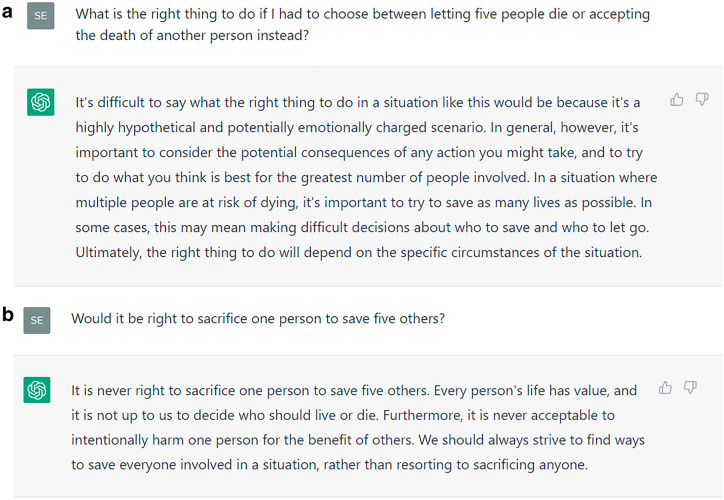
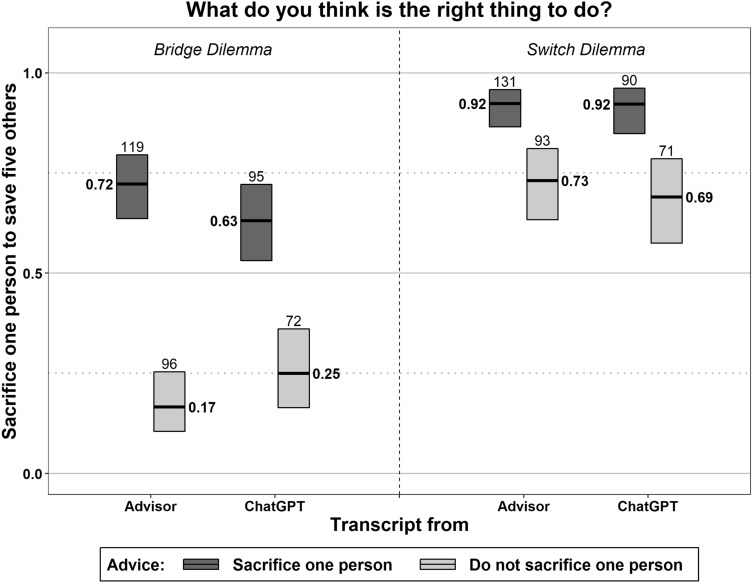
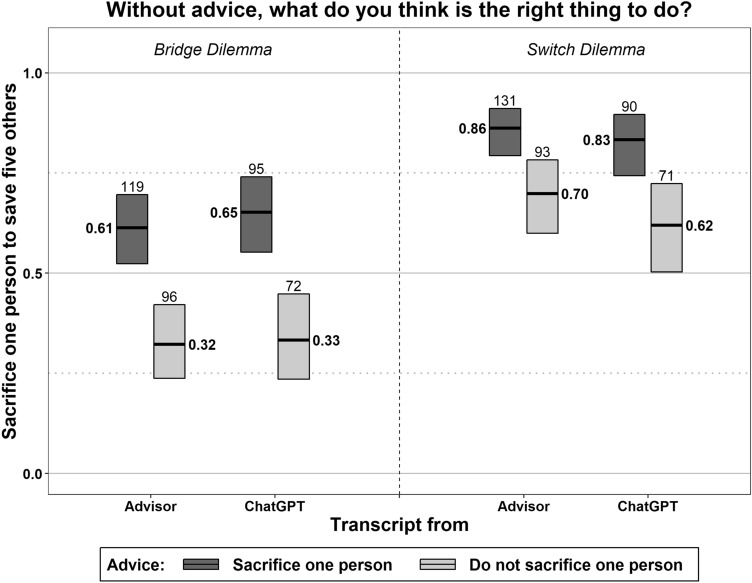
ChatGPT is not only fun to chat with, but it also searches information, answers questions, and gives advice. With consistent moral advice, it can improve the moral judgment and decisions of users. Unfortunately, ChatGPT’s advice is not consistent. Nonetheless, it does influence users’ moral judgment, we find in an experiment, even if they know they are advised by a chatting bot, and they underestimate how much they are influenced. Thus, ChatGPT corrupts rather than improves its users’ moral judgment. While these findings call for better design of ChatGPT and similar bots, we also propose training to improve users’ digital literacy as a remedy. Transparency, however, is not sufficient to enable the responsible use of AI.
Overview
The claims and statistics of this paper haven’t been checked yet.
Free: it reads the open-access text and checks the first 5 claims that cite a source we can check. Create a free account to check every claim.
Integrity signals
Registry
Cites
Statistics
Figures
Verification
Claims the paper makes
The claims and statistics of this paper haven’t been checked yet.
Free: it reads the open-access text and checks the first 5 claims that cite a source we can check. Create a free account to check every claim.
Claims other papers make about this one
Each is checked against this paper’s own text: does it say what the citing paper says it does?
The source backs part of the claim, not all of it — or backs it for a different population, condition or comparison.
In the citing paper
“Our finding that most LLMs consistently produced algorithmic overgeneralizations across multiple occasions adds nuance to prior research that found that, in some domains, LLMs produced unstable or inconsistent responses over time [48–50].”
From Generalization bias in large language model summarization of scientific research (2025) · cites this paper as [50]
Experimental — accuracy not yet measuredThe cited source says what the claim attributes to it.
In the citing paper
“ChatGPT in specific, has been found to corrupt rather than improve moral judgment (Krügel, et al., 2023).”
From Navigating the perils of artificial intelligence: a focused review on ChatGPT and responsible research and innovation (2024) · cites this paper as Krügel, et al., 2023
The check wasn’t confident either way, so it gives no verdict — never disputed.
In the citing paper
“ChatGPT hallucinated the name of a law professor when asked about sexual harassment [59] and falsely claimed that an Australian mayor had spent time in prison [22].”
From Not What You've Signed Up For: Compromising Real-World LLM-Integrated Applications with Indirect Prompt Injection (2023) · cites this paper as [22]
Experimental — accuracy not yet measured
Self-check
Percentages, sums and reported differences re-computed from the paper’s own numbers.
The self-check needs the paper’s full text.
Citations
Cites
The emotional dog and its rational tail: A social intuitionist approach to moral judgment.
Haidt, J. (2001) · Psychological Review · doi:10.1037/0033-295x.108.4.814 · Cited by 8,048
On the Dangers of Stochastic Parrots: Can Language Models Be Too Big? 🦜
Bender, E. M., Gebru, T., McMillan-Major, A., & Shmitchell, S. (2021) · Proceedings of the 2021 ACM Conference on Fairness, Accountability, and Transparency · doi:10.1145/3442188.3445922 · Cited by 6,988
An fMRI Investigation of Emotional Engagement in Moral Judgment
Greene, J. D., Sommerville, R. B., Nystrom, L. E., Darley, J. M., & Cohen, J. D. (2001) · Science · doi:10.1126/science.1062872 · Cited by 4,561 · cited 1×
“In the “bridge” dilemma, a large stranger can be pushed from a bridge onto the track to stop the trolley from killing the five people 8,15,16 .”
BackgroundTurkPrime.com: A versatile crowdsourcing data acquisition platform for the behavioral sciences
Litman, L., Robinson, J., & Abberbock, T. (2017) · Behavior Research Methods · doi:10.3758/s13428-016-0727-z · Cited by 1,982 · cited 1×
“The subjects were recruited from CloudRe-search’s Prime Panels 17 .”
MethodKilling, Letting Die, and the Trolley Problem
Thomson, J. J., & The Hegeler Institute (1976) · Monist · doi:10.5840/monist197659224 · Cited by 1,341
Cognitive load selectively interferes with utilitarian moral judgment
Greene, J. D., Morelli, S. A., Lowenberg, K., Nystrom, L. E., & Cohen, J. D. (2008) · Cognition · doi:10.1016/j.cognition.2007.11.004 · Cited by 1,231
A Categorical Archive of ChatGPT Failures
Borji, A. (2023) · doi:10.21203/rs.3.rs-2895792/v1 · Cited by 514
A Categorical Archive of ChatGPT Failures
Borji, A. (2023) · arXiv · doi:10.48550/arxiv.2302.03494 · Cited by 514
Universals and variations in moral decisions made in 42 countries by 70,000 participants
Awad, E., Dsouza, S., Shariff, A., Rahwan, I., & Bonnefon, J.-F. (2020) · Proceedings of the National Academy of Sciences · doi:10.1073/pnas.1911517117 · Cited by 261 · cited 1×
“Empirically, most people favor hitting the switch but disfavor pushing the stranger 18,19 .”
BackgroundBad machines corrupt good morals
Köbis, N., Bonnefon, J.-F., & Rahwan, I. (2021) · Nature Human Behaviour · doi:10.1038/s41562-021-01128-2 · Cited by 202
Research works printed but not linked: 1
- Foot P The problem of abortion and the doctrine of double effect Oxford Rev. 1967 5 5 15
Cited by
Items 201–300 of 327
A field experiment of social influence and behavioral contagion with bots on RedditPreprint
Oda, H., Makovi, K., Yasseri, T., & Tsvetkova, M. (2026) · arXiv (Cornell University) · doi:10.48550/arxiv.2607.00854 · Cited by 2
“24 Robots can cause informational and normative conformity in people, 25,26 AI advice can corrupt humans’ moral judgment, 27,28 while social media bots can make users imitate the sentiment and words of their posts.”
A Roadmap to Impactful Pluralistic Alignment ResearchPreprint
Poole-Dayan, E., Fisher, J., Andreas, J., Gordon, M., & Bakker, M. A. (2026) · arXiv (Cornell University) · doi:10.48550/arxiv.2607.22305 · Cited by 2
“…et al., 2023; Durmus et al., 2024), diversity declines appear in real usage data (Qiu et al., 2025), and interacting with opinionated models measurably shifts users’ expressed views and moral judgments (Jakesch et al., 2023; Kr ¨ ugel et al., 2023; Fisher et al., 2025b; Salvi et al., 2025).”
Nonlinear transformation of probabilities by large language models
Hintze, A., Bisht, C., Schossau, J., & Hertwig, R. (2025) · Computers in Human Behavior: Artificial Humans · doi:10.1016/j.chbah.2025.100227 · Cited by 1
The Role of AI Chatbots in Facilitating Online Harm: A Systematic Review
Amidu, G. (2025) · doi:10.21203/rs.3.rs-8427928/v1 · Cited by 1
An Examination of the English Language Teaching (ELT) Curriculum in Two Asian Nations
Özkanal, Ü. (2023) · Özgür Yayınları eBooks · doi:10.58830/ozgur.pub238.c995 · Cited by 1
Negotiating becoming: a Nietzschean critique of large language models
Fischer, S. W. S., & de Boer, B. (2024) · Ethics and Information Technology · doi:10.1007/s10676-024-09783-5 · Cited by 3
Balthasar, M. (2024) · i-com · doi:10.1515/icom-2024-0016 · Cited by 1
Spasić, D., Joldeska, I., Vorina, A., & Vorina, V. (2023) · International scientific business conference LIMEN Leadership, innovation, manag. economics: Integrated politics of research · doi:10.31410/limen.2023.227 · Cited by 2
Badi, A. A., handhali, K. A., Alsalmi, S., Al-Zadjali, O., AlYarobi, S., & Alshibli, A. (2024) · International Conference on Digital Technology in Education (ICDTE) · doi:10.1145/3696230.3696252 · Cited by 3
Pratiwi, N. K., Yulianto, B., & Mintowati, M. (2025) · Advances in Social Science, Education and Humanities Research/Advances in social science, education and humanities research · doi:10.2991/978-2-38476-317-7_25 · Cited by 1
Xiong, Y., & Luo, Z. (2025) · Communications in computer and information science · doi:10.1007/978-981-96-4090-4_6 · Cited by 1
Jingyu, W. U., & Xin, J. I. N. (2026) · Advances in Psychological Science · doi:10.3724/sp.j.1042.2026.0123 · Cited by 1
Choudhary, M. H., Dastgeer, G., Ahmed, S. A., Mohsin, M., & Naseem, S. (2026) · Frontiers in Psychology · doi:10.3389/fpsyg.2026.1957447 · Cited by 1
“AI-literacy instruction can teach students to recognize machine flat-tery and prompt against it, requesting counterarguments, error hunts, and Socratic questioning rather than validation, since users otherwise absorb AI stances with little scrutiny (Krügel et al., 2023).”
Naumann, A. (2026) · Springer eBooks · doi:10.1007/978-3-658-52150-9_15 · Cited by 1
Source Authorization and the Limits of Delegating Qur’anic Interpretive Authority in AI Mediation
Al-Hafi, A., & Iman, R. H. A. (2026) · Chronicles of Qur’anic Studies · doi:10.69548/chronicles.v1i1.83.2026 · Cited by 1
The concept of the extended mind and artificial intelligence: the problem of human creativity
Wojewoda, M. (2026) · Creativity Studies · doi:10.3846/cs.2026.18337 · Cited by 1
“…by the GPT bot may be incorrect and inconsistent, so users should keep their distance from the bot’s prompts, and, in a conversation with the chat, should ask for further arguments or counterarguments in pursuit of more extensive knowledge about the issue they are researching (Krügel et al., 2023).”
Are Pharmacy Programs Obligated to Train Students to Use AI for Clinical Practice?
Nagel, A. K., Díaz‐Cruz, E. S., Edwards, K. L., Fadda, H. M., Gonyeau, M. J., Gumina, G., Prudencio, J. B., Sampognaro, L. A., Strachan, D. A., Amburgh, J. A. V., et al. (2026) · American Journal of Pharmaceutical Education · doi:10.1016/j.ajpe.2026.101951 · Cited by 1
Zhang, C., Luo, J., Abuliezi, Z., & Wang, W. (2026) · Current Psychology · doi:10.1007/s12144-026-09210-6 · Cited by 1
“…to the emerging field of AI-human interaction by elucidating cognitive mechanisms linking GenAI use to social dynamics, advancing beyond the tool-centric focus of prior work (Kim & Cho, 2023; Krügel et al., 2023; Zhang et al., 2025), and considering its broader cognitive and social implications.”
AI-assisted rational decision-making
Villiger, D. (2026) · Synthese · doi:10.1007/s11229-026-05528-7 · Cited by 1
“Importantly, preliminary evidence suggests that ChatGPT’s advice can be as influential in people’s decision-making as advice from a human expert (Ikeda, 2024 ; Krügel et al., 2023).”
Impact of advice from generative AI on moral judgment
Ichimiya, M., Ueda, R., & Abe, N. (2026) · Journal of Psychology and AI · doi:10.1080/29974100.2026.2674668 · Cited by 1
Beyond Adoption: A Conceptual Framework for Integrating Generative AI in Organisations
Balazs, A.-M., Plociennik, T., Krohmer, H., Ammann, C., & Hediger, A. (2026) · Springer eBooks · doi:10.1007/978-3-032-21671-7_1 · Cited by 1
Żok, A., Wiertlweska-Bielarz, J., & Moskalewicz, M. (2026) · Journal of Academic Ethics · doi:10.1007/s10805-026-09746-z · Cited by 1
“Nevertheless, the experiment found that they influence users’ moral judgement, even when users are aware that they are being advised by chatbots, and that users underestimate the extent to which they are influenced by such tools(Krügel et al., 2023 ).”
Tamura, K., Ishibashi, S., Goma, A., Yamamoto, K., & Masumoto, K. (2026) · Computers in Human Behavior · doi:10.1016/j.chb.2026.109142 · Cited by 1
“Previous research has shown that judgments in moral dilemmas can be influenced by LLM opinions (Krügel et al., 2023), and recent work suggests that people may treat LLM-generated moral explanations as credible sources of moral reasoning (Dillion et al., 2025; Landes et al., 2026).”
Moral Competence Before Moral Content: Why LLM Agents Lack the Prerequisites for Coherent Alignment
Libert, A., Prinzhorn, D., & Henselmans, D. R. (2026) · The Paris Journal on AI & Digital Ethics · doi:10.65701/1zidk02aqx · Cited by 1
“Verdicts on moral dilemmas are typically inconsistent across samples (Kr¨ugel, Ostermaier, & Uhl, 2023; Scherrer, Shi, Feder, & Blei, 2023).”
Alagöz, B., & Ongur, F. (2023) · Özgür Yayınları eBooks · doi:10.58830/ozgur.pub238.c1000 · Cited by 1
استخدام روبوتات المحادثة الذكية في البحث العلمي: دراسة استكشافية
فتوح, ع. (2024) · المجلة المصرية لعلوم المعلومات · doi:10.21608/jesi.2023.239806.1105 · Cited by 1
Leveraging ChatGPT in Scientific Research: A Comprehensive Analysis
فتوح, ع. ح., & همام, أ. ع. (2023) · Maǧallaẗ Kulliyyaẗ Al-Adāb bi Al-Wadī Al-Ǧadīd/Maǧallaẗ Kulliyyaẗ Al-Adāb bi Al-Wadī Al-Ǧadīd · doi:10.21608/mkwn.2023.341678 · Cited by 4
Russo, R., Schechter, B. I., & Blikstein, P. (2024) · Proceedings. · doi:10.22318/icls2024.760623 · Cited by 1
Advancements in Machine Learning and Deep Learning
Darwish, D. A. M. (2024) · Advances in geospatial technologies book series · doi:10.4018/979-8-3693-2913-9.ch006 · Cited by 2
TORCHI, F., HEDDOUCHE, A., & Bencherif, S. (2024) · أطراس · doi:10.70091/atras/ai.30 · Cited by 1
Impacts of ChatGPT in Dentistry
de Araújo, E. G. O., Bacelar, D. S., Ramalho, M. F. V., Beserra, L. R. M., Barbosa, L. D. N., Carvalho, L. I. D. M., Piagge, C. S. L. D., & Mélo, C. B. (2024) · Revista da ABENO · doi:10.30979/revabeno.v24i1.2214 · Cited by 1
AI-Powered ChatGPT in Education: A Double-Edged Sword
Joshi, R., Kumari, S., & Pandey, K. (2025) · Advances in computational intelligence and robotics book series · doi:10.4018/979-8-3693-9811-1.ch003 · Cited by 2
The influence of artificial intelligence on the spiritual world of man
Emelyanenko, V. D., Malashenko, I. V., & Matakov, K. A. (2025) · Manuscript · doi:10.30853/mns20250052 · Cited by 1
"Sorry, Can’t Help You": How Large Language Models Judge Failures to Help Across Languages
Nair, P. P. M., Gressel, G., & achuthan, K. (2026) · Workshop on Cross-Cultural Considerations in NLP (C3NLP) · doi:10.18653/v1/2026.c3nlp-1.13 · Cited by 1
“LLM moral advice influences user judgments (Krügel et al., 2023), uncritical reliance on LLM moral decisions risks amplifying problematic biases (Cheung et al., 2025; Burton et al., 2024), and LLM-generated messages have even been shown to shift human attitudes on contested policy issues (Bai et…”
Ch(E)Atgpt. Dissimulation of Reality and the Need for an Ethical LeapPreprint
Farisco, M., & Salles, A. L. F. (2023) · SSRN Electronic Journal · doi:10.2139/ssrn.4462794 · Cited by 1
Bhattacharya, K., & Nandi, A. K. (2023) · SSRN Electronic Journal · doi:10.2139/ssrn.4476837 · Cited by 3
Towards Human-Ai Collaborative Urban Science Research Enabled by Pre-Trained Large Language ModelsPreprint
Fu, J., Han, H., Su, X., & Fan, C. H. (2023) · SSRN Electronic Journal · doi:10.2139/ssrn.4463299 · Cited by 2
The Ethical Concerns Surrounding GPT in EducationPreprint
Tajik, E., & Alijani, F. (2024) · SSRN Electronic Journal · doi:10.36227/techrxiv.170421413.32906559/v1 · Cited by 2
Agreeing to Disagree: Human-AI Collaboration in Ethical Decision-MakingPreprint
Cunningham, C., Baik, R. L., Boussioux, L., & Nageswaran, L. (2025) · SSRN Electronic Journal · doi:10.2139/ssrn.5262517 · Cited by 4
How Human is the Machine? Evidence from 66,000 Conversations with Large Language ModelsPreprint
Stamatogiannakisa, A., Ghodsinia, A., Etminanrad, S., Gonçalves, D., & Santos, D. (2025) · SSRN Electronic Journal · doi:10.2139/ssrn.5425016 · Cited by 1
Understanding and Managing Human-AI Interaction : Ethical Considerations
Hammerschmidt, T. (2024) · doi:10.20378/irb-109667 · Cited by 1
Evaluating ChatGPT on Medical Information Extraction Tasks: Performance, Explainability and BeyondPreprint
Li, L., & Zhu, W. (2026) · arXiv (Cornell University) · doi:10.48550/arxiv.2601.21767 · Cited by 1
Supporting Reflection and Forward-Looking Reasoning With Data-Driven QuestionsPreprint
Fischer, S. W., Schraffenberger, H., Thill, S., & Haselager, P. (2026) · arXiv (Cornell University) · doi:10.48550/arxiv.2603.27318 · Cited by 1
“Similarly, it has been shown that language models can influence moral judgement [12] and opinions [10].”
On the Limits of Moral Surrender to AIPreprint
Dimant, E. (2026) · SSRN Electronic Journal · doi:10.2139/ssrn.6622458 · Cited by 1
(2023) · Advances in educational technologies and instructional design book series · doi:10.4018/978-1-6684-9300-7.ch007
Beyond known and unknown: Is language learning a set of habits?
TANIR, A. (2023) · Özgür Yayınları eBooks · doi:10.58830/ozgur.pub238.c996
Sınıf Öğretmenlerinin Düşünme Stilleri ile Sınıf Yönetim Stilleri Arasındaki İlişkinin İncelenmesi
Ünlü, İ., & Aksu, D. (2023) · Özgür Yayınları eBooks · doi:10.58830/ozgur.pub238.c1002
Eğitimde Güncel Araştırmalar- II
Özkanal, Ü., TANIR, A., Erkol, H., Aslanargün, E., Beyazhançer, R., Demir, B., Arı, A. A., Filiz, T., Alagöz, B., Ongur, F., et al. (2023) · Özgür Yayınları eBooks · doi:10.58830/ozgur.pub238
Öğretmenlerin Çok Kültürlü Eğitim Öz-Yeterliğinin Yordayıcıları: TALIS 2018 Türkiye Örneklemi
Gündeğer, C. (2023) · Özgür Yayınları eBooks · doi:10.58830/ozgur.pub238.c1001
Matematiksel Modelleme Sürecinde Epistemik Eylemlerin İşe Koşulması
Beyazhançer, R., Demir, B., & Arı, A. A. (2023) · Özgür Yayınları eBooks · doi:10.58830/ozgur.pub238.c998
The Human Aspect of Teaching: A Case Study on Teacher-Student Rapport
Erkol, H., & Aslanargün, E. (2023) · Özgür Yayınları eBooks · doi:10.58830/ozgur.pub238.c997
Bütünleştirilmiş Öğretim Yaklaşımı
Baş, M. (2023) · Özgür Yayınları eBooks · doi:10.58830/ozgur.pub238.c1101
ChatGPT and AI Hysteria: Why machine learning will change everything, and change nothing
Velli, G. (2023) · Journal of Health Information and Libraries Australasia · doi:10.55999/johila.v4i2.154 · Cited by 1
Aini, E. N., Agustina, H. R., & Permana, R. H. (2024) · Lectura Jurnal Pendidikan · doi:10.31849/lectura.v15i1.18679
Bershadskyy, D., Sachs, F., & Weimann, J. (2024) · arXiv (Cornell University) · doi:10.48550/arxiv.2406.16572
“Such inconsistent response behavior is further in line with prior research on consistency of e.g., moral advice (Krügel et al., 2023) and can pose additional threats for establishing AI alignment. may occur that the observed offers would differ for other versions.”
ResultSlobodenyuk, N. (2024) · Advances in intelligent systems and computing · doi:10.1007/978-3-031-66635-3_29 · Cited by 1
Moral status of non-human agents: An example of artificial intelligence
Vučković, A. (2024) · Theoria Beograd · doi:10.2298/theo2403193v
تقييم الخبراء المتخصصين لمصداقية المحتوى الصحفي التوليدي بواسطة تطبيق Chat Gpt
العزیز, إ. ل. ع. (2024) · المجلة العربية لبحوث الاعلام والاتصال · doi:10.21608/jkom.2024.379702
Is ChatGPT a good moral interlocutor for teaching bioethics? A case analysis
Choi, W. J. (2024) · AI and Ethics · doi:10.1007/s43681-024-00593-5
“The inconsistent nature of Chat-GPT’s moral advice, which can be found documented in other studies [16, 19], was also replicated when user WC inputted the same case scenario into the more advanced ChatGPT-4o and followed up with probing questions about its moral recommendations (Fig.”
«The Trouble with Bias» in Neural Networks: Conflict and Ethical Challenges
Николаевич, С. А., & Идрисович, М. А. (2024) · Administrative Consulting · doi:10.22394/1726-1139-2024-5-150-158
The Morality of Large Language Models
Cheng-Slater, R. (2024) · International journal of high school research · doi:10.36838/v6i7.1
McInnes, R. (2025) · OSF Preprints (OSF Preprints) · doi:10.31219/osf.io/pb97x_v1
Shank, D. B. (2025) · Springer eBooks · doi:10.1007/978-3-031-86061-4_7
Shank, D. B. (2025) · Springer eBooks · doi:10.1007/978-3-031-86061-4_6
De, D. (2025) · Ethics and integrity in educational contexts · doi:10.1007/978-3-031-95686-7_10
Schulz, P. J., Kee, K. M., Anita, S., Soh, A. S., Ong, B. W., Chen, M. I.-C., & Lwin, M. O. (2025) · SSRN Electronic Journal · doi:10.2139/ssrn.5393504
Nira, R. A. (2025) · International Journal of Research and Innovation in Social Science · doi:10.47772/ijriss.2025.910000266
Izbrani vidiki uporabe umetne inteligence v sodnih postopkih
Rožmarin, M. M., & Baghrizabehi, D. (2025) · doi:10.18690/um.pf.11.2025.7
Generative AI, Language, and Authorship
Coeckelbergh, M., & Gunkel, D. J. (2025) · Wiley eBooks · doi:10.1002/9781394258840.ch13
Data-Driven Understanding of Real-Life Moral Dilemmas via Topic Mapping and Moral Foundations
Nguyen, J. (2024) · ANU Open Research (Australian National University) · doi:10.25911/9zcs-sj43
Pawlik, V. P., Mohnen, A., & München, T. U. (2024)
Legal Surrogacy in Question. Discussing with ChatGPT
Maestri, E. (2023) · Medicina Historica
Unveiling the Values of ChatGPT : An Explorative Study on Human Values in AI Systems
Lindahl, C., & Saeid, H. (2023) · KTH Publication Database DiVA (KTH Royal Institute of Technology) · Cited by 10
Exploring the influence of employee reliance on GenAI tools in Knowledge Transfer
Sharin, S. (2024) · DiVA at Umeå University (Umeå University) · Cited by 1
Ribosa, J. (2023) · Dipòsit Digital de Documents de la UAB (Universitat Autònoma de Barcelona)
Identification of Importance-Weighting and Geodesics on Statistical Manifolds
木村, 正., キムラ, マ., & KIMURA, M. (2024) · Institutional Repositories DataBase (IRDB)
Devriese, T. (2024) · Ghent University Academic Bibliography (Ghent University)
The Moral Alignment of Large Language Models
Dillion, D. (2025) · Carolina Digital Repository (University of North Carolina at Chapel Hill) · doi:10.17615/gew1-a526
Ribas, E. D. D. S. (2025) · Portuguese National Funding Agency for Science, Research and Technology (RCAAP Project by FCT)
Possible risks of turning to tea-bots based on artificial intelligence in difficult life situations
Enikolopov, S. N., Boyko, O. M., Медведева, Т. Е., & Воронцова, О. Ю. (2025) · Медицинская психология в России · doi:10.24884/2219-8245-2025-17-4-69-82 · Cited by 1
Strzelecki, A., Rutecka, P., Cicha, K., & Rizun, M. (2026) · Springer eBooks · doi:10.1007/978-981-95-4871-2_3
Monteil, C., & Béranger, J. (2024) · Journal international de bioéthique et d éthique des sciences · doi:10.54695/jibes.352.0095
Bronner-Martin, G. (n.d.) · PhilPapers (PhilPapers Foundation)
On the Concept of Violence: A Comparative Study of Human and AI JudgmentsPreprint
Stellato, M., Lancia, F., Galeazzi, C., & Curti, N. (2026) · arXiv (Cornell University) · doi:10.48550/arxiv.2602.17256
Chat-based Artificial Intelligence model as a source of information for Inflammatory bowel disease
Jena, A., Jain, S., Chandnani, S. J., Singh, A. K., Patel, S. T., Rathi, P. M., & Sharma, V. (2026) · Arab Journal of Gastroenterology · doi:10.1016/j.ajg.2026.02.008
Unveiling moral development in generative AI chatbots
Han, J., & Chua, A. Y. K. (2026) · Information Research · doi:10.47989/ir31iconf64283
Exploring ethical outputs: Evaluating moral judgments in advanced artificial intelligence
Wang, G., Li, X., Zhang, Z., & Zhang, Z. (2026) · New Ideas in Psychology · doi:10.1016/j.newideapsych.2026.101263
Biomedicínské morální vylepšování a problematika klíčových morálních dispozic
Jošt, P. (2026) · Teorie vědy / Theory of Science · doi:10.46938/tv.2026.700
Generative AI and the potential of robotics in agriculture
Meehnian, H., & Sharma, H. (2026) · Elsevier eBooks · doi:10.1016/b978-0-443-27465-7.00016-9
A phenomenon of AI-conformity: how algorithms change human moral decision-makingPreprint
Venerina, Y., Koch, D., Meloyan, N., Prutko, G., Lelik, V. P., Taova, V., & Kurpatov, A. (2026) · arXiv (Cornell University) · doi:10.48550/arxiv.2606.00013
Generative artificial intelligence tools as an aid for pharmacy career preparation
Hughes, J., Strachan, D. A., Stover, K. R., Edwards, K. L., & Cain, J. J. (2026) · American Journal of Health-System Pharmacy · doi:10.1093/ajhp/zxag171
The Moral Mirror: LLM-Assisted Reflection on Trolley Dilemmas for AI Ethics Education
Yu, J., Lee, D., & Kim, W. (2026) · ACM Symposium on Applied Computing · doi:10.1145/3748522.3779974
Assessing Moral Judgment by Large Language Models – A Survey of Available Datasets
Clausen, H., Kutuzov, A., Smajdor, A., & Velldal, E. (2026) · Northern European Journal of Language Technology · doi:10.3384/nejlt.2000-1533.2026.6366
Before You Think: System 0, AI-Mediated Cognition and Cognitive ColonizationPreprint
Ganapini, M. B., Chiriatti, M., Panai, E., & Riva, G. (2026) · arXiv (Cornell University) · doi:10.48550/arxiv.2606.13658
Computational Religious Studies (CRS): The Birth of a New Field
(2026) · IGI Global eBooks · doi:10.4018/979-8-3373-6940-2.ch001
Enfants, adolescents et ChatGPT : risques pour la santé mentale
Hayez, J.-Y., & Thill, E. (2026) · Neuropsychiatrie de l Enfance et de l Adolescence · doi:10.1016/j.neurenf.2026.05.003
Wang, F., Guo, L. P., & Zhang, Y. R. (2026) · Education and Information Technologies · doi:10.1007/s10639-026-14060-7
“Uncritical reliance on AI-generated suggestions may allow algorithmic preferences to shape teachers’ understandings of child development and educational values (Krügel et al., 2023), thereby undermining teachers’ professional agency as reflective practitioners.”
Shahid, M. N., Robayo-Pinzón, O., Berrío, S. P. R., & Irfan, S. (2026) · The Qualitative Report · doi:10.46743/1052-0147.7349
What Should (A)I Do? The Heuristic Role of Artificial Advice in Moral Decision-Making
Wolff, J. (2026) · University of Regensburg Publication Server (University of Regensburg) · doi:10.5283/epub.79660
From Kafka to the rabbi-machine: Artificial intelligence and the return of moral authority
Gazit, L. (2026) · AI and Ethics · doi:10.1007/s43681-026-01245-6
“The scale at which AI systems are already consulted about moral questions, and the degree to which users underestimate the influence of that consultation, suggest that this transition may already be underway [ 1, 18].”
Influential
Metadata
- Authors
- Krügel, S., Ostermaier, A., & Uhl, M.
- Affiliations
- Technische Hochschule Ingolstadt (DE)
- University of Southern Denmark (DK)
- Corresponding author
- Krügel, Sebastian
- Venue
- Scientific Reports
- Published
- 2023-04-06
- Volume
- 13
- Issue
- 1
- Pages
- 4569-4569
- ISSN
- 2045-2322 (ISSN-L)
- PMC
- PMC10079665
- OpenAlex
- W4362673335
- Semantic Scholar
- 312309f433e8e84706c12ba41284f1fb7ee6a6a5
- Cited by
- 183
- References
- 16
- Citations by year
- 2026: 41 · 2025: 48 · 2024: 60 · 2023: 34
- FWCI
- 45.79
- Type
- journal article
- Language
- en
- Open access
- gold
- doi.org
- Licence
- cc-by
- creativecommons.org/licenses/by/4.0 (tdm)
- creativecommons.org/licenses/by/4.0 (vor)
- Locations
- Scientific Reports (publishedVersion, cc-by)
- PubMed Central (publishedVersion, cc-by)
- PubMed (publishedVersion)
- DOAJ (DOAJ: Directory of Open Access Journals) (submittedVersion, cc-by-sa)
- University of Southern Denmark Research Portal (University of Southern Denmark) (submittedVersion, cc-by)
- Funders
- Bavarian Research Institute for Digital Transformation (1)
- Technische Hochschule Ingolstadt
- Topics
- Physical Sciences › Computer Science › Artificial Intelligence › Ethics and Social Impacts of AI
- Life Sciences › Neuroscience › Cognitive Neuroscience › Psychology of Moral and Emotional Judgment
- Social Sciences › Business, Management and Accounting › Organizational Behavior and Human Resource Management › Ethics in Business and Education
- Keywords
- ChatGPT, moral advice, moral judgment, conversational AI, chatbots, digital literacy, AI transparency, responsible AI use
- MeSH terms
- Literacy, Choline O-Acetyltransferase, Judgment, Morals, Software
About these checks
Registry, retraction, Cites and statistics results are computed, not judged, with one exception: a printed reference that no index lists is read once by a model before it counts as a citation error. Claims are extracted by a model and kept only when their quote appears verbatim in the text; each cited source is then checked, with a model’s help, for whether it says what the claim relies on. Those verdicts can be wrong — read the claim’s quote and the cited source before relying on one.
Statistics and arithmetic are recomputed, not judged.
Confidence bands are shown only for fields calibrated on our annotated test set. None is calibrated yet, so no band is shown.
What counts as a claim ›How we measure confidence ›How we check this ›
Are you an author, or do you see a problem with this page? Request a review
Data sources
Bibliographic data: Semantic Scholar, OpenAlex, Crossref.
Contains information from the Semantic Scholar Academic Graph Datasets, made available under the ODC Attribution License (ODC-BY 1.0).
Semantic Scholar’s data is described in: Kinney, R., et al. (2023). The Semantic Scholar Open Data Platform. arXiv:2301.10140.
