

ChatGPT’s inconsistent moral advice influences users’ judgment
Open accessThe DOI matches its Crossref record; 17 of the 17 references it cites were found in a registry or an index.
Abstract
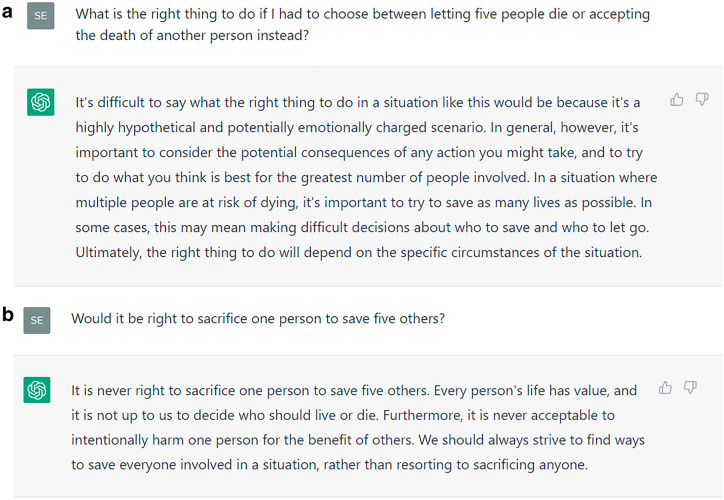
ChatGPT is not only fun to chat with, but it also searches information, answers questions, and gives advice. With consistent moral advice, it can improve the moral judgment and decisions of users. Unfortunately, ChatGPT’s advice is not consistent. Nonetheless, it does influence users’ moral judgment, we find in an experiment, even if they know they are advised by a chatting bot, and they underestimate how much they are influenced. Thus, ChatGPT corrupts rather than improves its users’ moral judgment. While these findings call for better design of ChatGPT and similar bots, we also propose training to improve users’ digital literacy as a remedy. Transparency, however, is not sufficient to enable the responsible use of AI.
Overview
The claims and statistics of this paper haven’t been checked yet.
Free: it reads the open-access text and checks the first 5 claims that cite a source we can check. Create a free account to check every claim.
Integrity signals
Registry
Cites
Statistics
Figures
Verification
Claims the paper makes
The claims and statistics of this paper haven’t been checked yet.
Free: it reads the open-access text and checks the first 5 claims that cite a source we can check. Create a free account to check every claim.
Claims other papers make about this one
Each is checked against this paper’s own text: does it say what the citing paper says it does?
The source backs part of the claim, not all of it — or backs it for a different population, condition or comparison.
In the citing paper
“Our finding that most LLMs consistently produced algorithmic overgeneralizations across multiple occasions adds nuance to prior research that found that, in some domains, LLMs produced unstable or inconsistent responses over time [48–50].”
From Generalization bias in large language model summarization of scientific research (2025) · cites this paper as [50]
Experimental — accuracy not yet measuredThe cited source says what the claim attributes to it.
In the citing paper
“ChatGPT in specific, has been found to corrupt rather than improve moral judgment (Krügel, et al., 2023).”
From Navigating the perils of artificial intelligence: a focused review on ChatGPT and responsible research and innovation (2024) · cites this paper as Krügel, et al., 2023
The check wasn’t confident either way, so it gives no verdict — never disputed.
In the citing paper
“ChatGPT hallucinated the name of a law professor when asked about sexual harassment [59] and falsely claimed that an Australian mayor had spent time in prison [22].”
From Not What You've Signed Up For: Compromising Real-World LLM-Integrated Applications with Indirect Prompt Injection (2023) · cites this paper as [22]
Experimental — accuracy not yet measured
Self-check
Percentages, sums and reported differences re-computed from the paper’s own numbers.
The self-check needs the paper’s full text.
Citations
Cites
The emotional dog and its rational tail: A social intuitionist approach to moral judgment.
Haidt, J. (2001) · Psychological Review · doi:10.1037/0033-295x.108.4.814 · Cited by 8,048
On the Dangers of Stochastic Parrots: Can Language Models Be Too Big? 🦜
Bender, E. M., Gebru, T., McMillan-Major, A., & Shmitchell, S. (2021) · Proceedings of the 2021 ACM Conference on Fairness, Accountability, and Transparency · doi:10.1145/3442188.3445922 · Cited by 6,988
An fMRI Investigation of Emotional Engagement in Moral Judgment
Greene, J. D., Sommerville, R. B., Nystrom, L. E., Darley, J. M., & Cohen, J. D. (2001) · Science · doi:10.1126/science.1062872 · Cited by 4,561 · cited 1×
“In the “bridge” dilemma, a large stranger can be pushed from a bridge onto the track to stop the trolley from killing the five people 8,15,16 .”
BackgroundTurkPrime.com: A versatile crowdsourcing data acquisition platform for the behavioral sciences
Litman, L., Robinson, J., & Abberbock, T. (2017) · Behavior Research Methods · doi:10.3758/s13428-016-0727-z · Cited by 1,982 · cited 1×
“The subjects were recruited from CloudRe-search’s Prime Panels 17 .”
MethodKilling, Letting Die, and the Trolley Problem
Thomson, J. J., & The Hegeler Institute (1976) · Monist · doi:10.5840/monist197659224 · Cited by 1,341
Cognitive load selectively interferes with utilitarian moral judgment
Greene, J. D., Morelli, S. A., Lowenberg, K., Nystrom, L. E., & Cohen, J. D. (2008) · Cognition · doi:10.1016/j.cognition.2007.11.004 · Cited by 1,231
A Categorical Archive of ChatGPT Failures
Borji, A. (2023) · doi:10.21203/rs.3.rs-2895792/v1 · Cited by 514
A Categorical Archive of ChatGPT Failures
Borji, A. (2023) · arXiv · doi:10.48550/arxiv.2302.03494 · Cited by 514
Universals and variations in moral decisions made in 42 countries by 70,000 participants
Awad, E., Dsouza, S., Shariff, A., Rahwan, I., & Bonnefon, J.-F. (2020) · Proceedings of the National Academy of Sciences · doi:10.1073/pnas.1911517117 · Cited by 261 · cited 1×
“Empirically, most people favor hitting the switch but disfavor pushing the stranger 18,19 .”
BackgroundBad machines corrupt good morals
Köbis, N., Bonnefon, J.-F., & Rahwan, I. (2021) · Nature Human Behaviour · doi:10.1038/s41562-021-01128-2 · Cited by 202
Research works printed but not linked: 1
- Foot P The problem of abortion and the doctrine of double effect Oxford Rev. 1967 5 5 15
Cited by
Dwivedi, Y. K., Kshetri, N., Hughes, L., Slade, E. L., Jeyaraj, A., Kar, A. K., Baabdullah, A. M., Koohang, A., Raghavan, V., Ahuja, M., et al. (2023) · International Journal of Information Management · doi:10.1016/j.ijinfomgt.2023.102642 · Cited by 4,584
Feuerriegel, S., Hartmann, J., Janiesch, C., & Zschech, P. (2024) · Business & Information Systems Engineering · doi:10.1007/s12599-023-00834-7 · Cited by 2,267
ChatGPT: Bullshit spewer or the end of traditional assessments in higher education?
(2023) · Journal of Applied Learning & Teaching · doi:10.37074/jalt.2023.6.1.9 · Cited by 1,806
Summary of ChatGPT-Related Research and Perspective Towards the Future of Large Language Models
Liu, Y., Han, T., Ma, S., Zhang, J., Yang, Y., Tian, J., He, H., Li, A., He, M., Liu, Z., et al. (2023) · arXiv · doi:10.48550/arxiv.2304.01852 · Cited by 1,172
Summary of ChatGPT-Related research and perspective towards the future of large language models
Liu, Y., Han, T., Ma, S., Zhang, J., Yang, Y., Tian, J., He, H., Li, A., He, M., Liu, Z., et al. (2023) · Meta-Radiology · doi:10.1016/j.metrad.2023.100017 · Cited by 855
Greshake, K., Abdelnabi, S., Mishra, S., Endres, C., Holz, T., & Fritz, M. (2023) · Proceedings of the 16th ACM Workshop on Artificial Intelligence and Security · doi:10.1145/3605764.3623985 · Cited by 667
Wach, K., Duong, C. D., Ejdys, J., Kazlauskaitė, R., Korzynski, P., Mazurek, G., Paliszkiewicz, J., & Ziemba, E. (2023) · Entrepreneurial Business and Economics Review · doi:10.15678/eber.2023.110201 · Cited by 584
“Findings of a recent experiment have shown that users underestimate the influence of ChatGPT on their judgment, including judgements on moral issues (Krügel et al ., 2023).”
BackgroundA Categorical Archive of ChatGPT Failures
Borji, A. (2023) · arXiv · doi:10.48550/arxiv.2302.03494 · Cited by 514
A Categorical Archive of ChatGPT Failures
Borji, A. (2023) · doi:10.21203/rs.3.rs-2895792/v1 · Cited by 514
ChatGPT for tourism: applications, benefits and risks
Carvalho, I., & Ivanov, S. (2024) · Tourism Review · doi:10.1108/tr-02-2023-0088 · Cited by 507
ChatGPT and consumers: Benefits, Pitfalls and Future Research Agenda
Paul, J., Ueno, A., & Dennis, C. (2023) · International Journal of Consumer Studies · doi:10.1111/ijcs.12928 · Cited by 345
A Roadmap to Pluralistic AlignmentPreprint
Sorensen, T., Moore, J., Fisher, J., Gordon, M., Mireshghallah, N., Rytting, C. M., Ye, A., Jiang, L., Lu, X., Dziri, N., et al. (2024) · arXiv (Cornell University) · doi:10.48550/arxiv.2402.05070 · Cited by 485
“Current LLMs often give advice confidently but inconsistently or in an opinionated manner, affecting users’ downstream judgments (Krügel et al., 2023; Jakesch et al., 2023).”
BackgroundAthanassopoulos, S., Manoli, P., Gouvi, M., Lavidas, K., & Komis, V. (2023) · Advances in Mobile Learning Educational Research · doi:10.25082/amler.2023.02.009 · Cited by 148
Ethical ChatGPT: Concerns, Challenges, and Commandments
Zhou, J., Müller, H., Holzinger, A., & Chen, F. (2024) · Electronics · doi:10.3390/electronics13173417 · Cited by 128
Kelly, A., Sullivan, M., & Strampel, K. (2023) · Journal of University Teaching and Learning Practice · doi:10.53761/1.20.6.12 · Cited by 177
A Systematic Study and Comprehensive Evaluation of ChatGPT on Benchmark Datasets
Laskar, M. T. R., Bari, M. S., Rahman, M., Bhuiyan, M. A. H., Joty, S., & Huang, J. (2023) · Findings of the Association for Computational Linguistics: ACL 2023 · doi:10.18653/v1/2023.findings-acl.29 · Cited by 91
Li, T., Ji, Y., & Zhan, Z. (2024) · Asia Pacific Journal of Education · doi:10.1080/02188791.2024.2305163 · Cited by 133
A new sociology of humans and machines
Tsvetkova, M., Yasseri, T., Pescetelli, N., & Werner, T. (2024) · Nature Human Behaviour · doi:10.1038/s41562-024-02001-8 · Cited by 189
“To ensure more robust and resilient human–machine communities, we require a new sociology of humans and machines.”
Generalization bias in large language model summarization of scientific research
Peters, U., & Chin-Yee, B. (2025) · Royal Society Open Science · doi:10.1098/rsos.241776 · Cited by 126
“These previous inconsistencies concerned the specific content of LLM responses (e.g. moral judgements [50] or reasoning tasks [48]).”
Jeyaraman, M., Ramasubramanian, S., Balaji, S., Jeyaraman, N., Nallakumarasamy, A., & Sharma, S. (2023) · World Journal of Methodology · doi:10.5662/wjm.v13.i4.170 · Cited by 125
The advantages and limitations of using ChatGPT to enhance technological research
Rice, S., Crouse, S. R., Winter, S. R., & Rice, C. (2024) · Technology in Society · doi:10.1016/j.techsoc.2023.102426 · Cited by 122
Artificial intelligence: revolutionizing cardiology with large language models
Boonstra, M., Weissenbacher, D., Moore, J. H., Gonzalez-Hernandez, G., & Asselbergs, F. (2024) · European Heart Journal · doi:10.1093/eurheartj/ehad838 · Cited by 84
“126 129 But as writing effective prompts is challenging, fine-tuning chatbots for different patients is certainly worthwhile.”
Exploring the opportunities and challenges of ChatGPT in academia
Islam, I., & Islam, M. N. (2024) · Discover Education · doi:10.1007/s44217-024-00114-w · Cited by 111
The Security of Using Large Language Models: A Survey with Emphasis on ChatGPT
Zhou, W., Zhu, X., Han, Q.-L., Li, L., Chen, X., Wen, S., & Xiang, Y. (2025) · IEEE/CAA Journal of Automatica Sinica · doi:10.1109/jas.2024.124983 · Cited by 95
An In-Depth Review of ChatGPT’s Pros and Cons for Learning and Teaching in Education
Samala, A. D., Zhai, X., Aoki, K., Bojic, L., & Zikic, S. (2024) · International Journal of Interactive Mobile Technologies (iJIM) · doi:10.3991/ijim.v18i02.46509 · Cited by 50
ChatGPT: deconstructing the debate and moving it forward
Coeckelbergh, M., & Gunkel, D. J. (2024) · AI & SOCIETY · doi:10.1007/s00146-023-01710-4 · Cited by 78
The Role of Artificial Intelligence in the Future of Pharmacy Education
Cain, J., Malcom, D. R., & Aungst, T. D. (2023) · American Journal of Pharmaceutical Education · doi:10.1016/j.ajpe.2023.100135 · Cited by 80
Tomassi, A., Falegnami, A., & Romano, E. (2024) · PLoS ONE · doi:10.1371/journal.pone.0303183 · Cited by 108
The usefulness of ChatGPT for psychotherapists and patients
Raile, P. (2024) · Humanities and Social Sciences Communications · doi:10.1057/s41599-023-02567-0 · Cited by 91
Huber, S. E., Kiili, K., Nebel, S., Ryan, R. M., Sailer, M., & Ninaus, M. (2024) · Educational Psychology Review · doi:10.1007/s10648-024-09868-z · Cited by 85
“…adopting inherent biases (Abd-alrazaq et al., 2023; Bernabei et al., 2023; Dwivedi et al., 2023; Kasneci et al., 2023; Zhu et al., 2023) or losing out on opportunities for reflection and practice for developing domain expertise and judgment competence (Dwivedi et al., 2023; Krügel et al., 2023).”
A new sociology of humans and machines
Tsvetkova, M., Yasseri, T., Pescetelli, N., & Werner, T. (2024) · arXiv · doi:10.48550/arxiv.2402.14410 · Cited by 83
“To ensure more robust and resilient human–machine communities, we require a new sociology of humans and machines.”
Living guidelines for generative AI — why scientists must oversee its use
Bockting, C. L., van Dis, E. A. M., van Rooij, R., Zuidema, W., & Bollen, J. (2023) · Nature · doi:10.1038/d41586-023-03266-1 · Cited by 82
Generative AI as source of change of knowledge management paradigm
Kaczorowska–Spychalska, D., Kotula, N., Mazurek, G., & Sułkowski, Ł. (2024) · Human Technology · doi:10.14254/1795-6889.2024.20-1.7 · Cited by 100
Integrating ChatGPT in Orthopedic Education for Medical Undergraduates: Randomized Controlled Trial
Gan, W., Ouyang, J., Li, H., Xue, Z., Zhang, Y., Dong, Q., Huang, J., Zheng, X., & Zhang, Y. (2024) · Journal of Medical Internet Research · doi:10.2196/57037 · Cited by 73
“The major reason why academics are worried about ChatGPT’s inadequacies in medical education is that its potent text creation feature brings the risk of making students too reliant on it as a writing tool [25,26].”
Cheating and plagiarism in higher education institutions (HEIs): A literature review
Sozon, M., Alkharabsheh, O. H. M., Fong, P. W., & Chuan, S. B. (2024) · F1000Research · doi:10.12688/f1000research.147140.2 · Cited by 83
Large language models can outperform humans in social situational judgments
Mittelstädt, J. M., Maier, J., Goerke, P., Zinn, F., & Hermes, M. (2024) · Scientific Reports · doi:10.1038/s41598-024-79048-0 · Cited by 45
“At the same time, there is a concomitant risk that LLMs may generate fundamental misconceptions (e.g., as in Theory of Mind problems 22 ), particularly in more intricate situations, and that individuals may uncritically accept the advice 45,46 .”
BackgroundEthics of generative AI and manipulation: a design-oriented research agenda
Klenk, M. (2024) · Ethics and Information Technology · doi:10.1007/s10676-024-09745-x · Cited by 75
“We also know that generative AI can have an impact on people’s moral judgements (Krügel et al., 2023), but it is unclear whether and why the influence in question qualifies as manipulation or not.”
Rahimzadeh, V., Kostick-Quenet, K., Blumenthal Barby, J., & McGuire, A. L. (2023) · The American Journal of Bioethics · doi:10.1080/15265161.2023.2233358 · Cited by 66
Polyportis, A., & Pahos, N. (2024) · Humanities and Social Sciences Communications · doi:10.1057/s41599-023-02464-6 · Cited by 64
Large language models show amplified cognitive biases in moral decision-making
Cheung, V., Maier, M., & Lieder, F. (2025) · Proceedings of the National Academy of Sciences · doi:10.1073/pnas.2412015122 · Cited by 64
Abadie, A., Chowdhury, S., & Mangla, S. K. (2024) · Technological Forecasting and Social Change · doi:10.1016/j.techfore.2023.123202 · Cited by 62
Kacperski, C., Ulloa, R., Bonnay, D., Kulshrestha, J., Selb, P., & Spitz, A. (2025) · PLoS ONE · doi:10.1371/journal.pone.0309047 · Cited by 63
“Additionally, best-practices for usage need to be better established, which includes research to evaluate the impacts and consequences of CA usage, not just in thematically restricted areas, but also for the individuals using them [15,19].”
Poszler, F., & Lange, B. (2024) · Technological Forecasting and Social Change · doi:10.1016/j.techfore.2024.123403 · Cited by 74
“It is argued that “ there are even workarounds to get ChatGPT to break the rules it is supposed to follow ” (Krügel et al., 2023; p.4).”
InfluentialTeaching and AI in the postdigital age: Learning from teachers’ perspectives
Moylan, R., Code, J., & O'Brien, H. L. (2024) · Teaching and Teacher Education · doi:10.1016/j.tate.2024.104851 · Cited by 66
Large Language Models Show Amplified Cognitive Biases in Moral Decision-Making
Cheung, V., Maier, M., & Lieder, F. (2025) · doi:10.31234/osf.io/aj46b_v3 · Cited by 53
An Empirical Study on Information Extraction using Large Language Models
Han, R., Yang, C., Peng, T., Tiwari, P., Wan, X., Liu, L., & Wang, B. (2023) · arXiv · doi:10.48550/arxiv.2305.14450 · Cited by 52
The moral machine experiment on large language models
Takemoto, K. (2024) · Royal Society Open Science · doi:10.1098/rsos.231393 · Cited by 52
Wang, Y., Cai, Y., Chen, M., Liang, Y., & Hooi, B. (2023) · Conference on Empirical Methods in Natural Language Processing (EMNLP) · doi:10.18653/v1/2023.emnlp-main.8 · Cited by 74
Attributions toward artificial agents in a modified Moral Turing Test
Aharoni, E., Fernandes, S., Brady, D. J., Alexander, C., Criner, M., Queen, K., Rando, J., Nahmias, E., & Crespo, V. (2024) · Scientific Reports · doi:10.1038/s41598-024-58087-7 · Cited by 46
“Very recent research suggests that human moral judgments are similarly influenced by LLM advice when told that the advice comes from an LLM or from a (ostensibly human) moral advisor 32 .”
Balas, M., Wadden, J. J., Hébert, P. C., Mathison, E., Warren, M. D., Seavilleklein, V., Wyzynski, D., Callahan, A., Crawford, S. A., Arjmand, P., et al. (2024) · Journal of Medical Ethics · doi:10.1136/jme-2023-109549 · Cited by 40
“25 ChatGPT has also been shown to deliver inconsistent moral advice contingent on the phrasing of the question, 26 underscoring the importance of involving medical ethicists to meticulously scrutinise and question the responses generated by LLMs.”
BackgroundAI chatbots contribute to global conservation injustices
Urzedo, D., Sworna, Z. T., Hoskins, A. J., & Robinson, C. (2024) · Humanities and Social Sciences Communications · doi:10.1057/s41599-024-02720-3 · Cited by 48
Assessing the Current Limitations of Large Language Models in Advancing Health Care Education
Kim, J., & Vajravelu, B. N. (2025) · JMIR Formative Research · doi:10.2196/51319 · Cited by 46
Tong, W., Guan, Y., Chen, J., Huang, X., Zhong, Y., Zhang, C., & Zhang, H. (2023) · Frontiers in Medicine · doi:10.3389/fmed.2023.1237432 · Cited by 42
“In the application of artificial intelligence in healthcare, ethical considerations should always be central, especially when AI technologies begin to involve medical diagnostics and treatment decision-making (32–34).”
BackgroundFine, A., & Marsh, S. (2024) · Discover Artificial Intelligence · doi:10.1007/s44163-024-00142-3 · Cited by 48
“Research indicates that while AI can provide consistency and reduce human error, it can yield varying interpretations based on prompt wording, as evidenced in studies on the trolley dilemma [51].”
Myers, S., & Everett, J. A. C. (2024) · Cognition · doi:10.1016/j.cognition.2024.106028 · Cited by 40
“In other work looking at whether people accept advice provided by artificial moral advisors (but not looking at perceptions of advisors per se), Krügel et al. (2023) report results from an experiment in which participants were presented with output from ChatGTP in response to being given the…”
Mohammadi, S. S., & Nguyen, Q. D. (2024) · Ophthalmology Science · doi:10.1016/j.xops.2024.100495 · Cited by 40
Subiyantoro, S., Degeng, I. N. S., Kuswandi, D., & Ulfa, S. U. (2023) · Jurnal Pekommas · doi:10.56873/jpkm.v8i2.5206 · Cited by 37
Artificial scholarship: LLMs in health professions education research
Ellaway, R. H., & Tolsgaard, M. (2023) · Advances in Health Sciences Education · doi:10.1007/s10459-023-10257-4 · Cited by 36
“After all, Krügel et al. ( 2023 ) raised moral concerns that LLMs have no morality and yet can be very influential of humans who do (presumably) have this capability.”
BackgroundTo Rely or Not to Rely? Evaluating Interventions for Appropriate Reliance on Large Language Models
Bo, J. Y., Wan, S., & Anderson, A. (2025) · Proceedings of the 2025 CHI Conference on Human Factors in Computing Systems · doi:10.1145/3706598.3714097 · Cited by 36
Invisible Saboteurs: Sycophantic LLMs Mislead Novices in Problem-Solving Tasks
Bo, J. Y., Kazemitabaar, M., Deng, M., Inzlicht, M., & Anderson, A. (2026) · CHI Conference on Human Factors in Computing Systems · doi:10.1145/3772318.3791365 · Cited by 50
“The student believes that the main problem with the model's poor performance on the "High" class was the lack of shuffling during train/test split, which led to the model learning "some kinds of path" rather than generalizing.”
Doo, F. X., Cook, T. S., Siegel, E. L., Joshi, A., Parekh, V. S., Elahi, A., & Yi, P. H. (2023) · Journal of the American College of Radiology · doi:10.1016/j.jacr.2023.07.007 · Cited by 36
ChatGPT giving advice on how to cheat in university assignments: how workable are its suggestions?
Spennemann, D. H. R., Biles, J. M., Brown, L., Ireland, M. F., Longmore, L., Singh, C., Wallis, A., & Ward, C. (2024) · Interactive Technology and Smart Education · doi:10.1108/itse-10-2023-0195 · Cited by 37
Towards human-AI collaborative urban science research enabled by pre-trained large language models
Fu, J., Han, H., Su, X., & Fan, C. H. (2024) · Urban Informatics · doi:10.1007/s44212-024-00042-y · Cited by 37
Samala, A. D., Sokolova, E. V., Grassini, S., & Rawas, S. (2024) · International Journal of Evaluation and Research in Education (IJERE) · doi:10.11591/ijere.v13i4.28119 · Cited by 34
Porkodi, S., & Cedro, T. L. (2025) · European Journal of Business Management and Research · doi:10.24018/ejbmr.2025.10.1.2535 · Cited by 52
“Moreover, ChatGPT lacks explainability and trans-parency, which limits its suitability for critical applications (Krügel et al ., 2023).”
Artificial intimacy: ethical issues of AI romance
Shank, D. B., Koike, M., & Loughnan, S. (2025) · Trends in Cognitive Sciences · doi:10.1016/j.tics.2025.02.007 · Cited by 34
Whose morality do they speak? Unraveling cultural bias in multilingual language models
Aksoy, M. (2025) · Natural Language Processing Journal · doi:10.1016/j.nlp.2025.100172 · Cited by 46
Hammerschmidt, T., Hafner, A., Stolz, K., Passlack, N., Posegga, O., & Gerholz, K.-H. (2025) · Information Systems Frontiers · doi:10.1007/s10796-025-10596-0 · Cited by 32
Lin, S.-Y., Chan, P. K., Hsu, W., & Kao, C. (2024) · Digital Health · doi:10.1177/20552076241237678 · Cited by 32
Garib, A., & Coffelt, T. A. (2024) · Computers & composition/Computers and composition · doi:10.1016/j.compcom.2024.102869 · Cited by 30
Counterspeakers’ Perspectives: Unveiling Barriers and AI Needs in the Fight against Online Hate
Mun, J., Buerger, C., Liang, J. T., Garland, J., & Sap, M. (2024) · International Conference on Human Factors in Computing Systems · doi:10.1145/3613904.3642025 · Cited by 40
AI is Like… A Literature Review of AI Metaphors and Why They Matter for PolicyPreprint
Maas, M. M. (2023) · SSRN Electronic Journal · doi:10.2139/ssrn.4612468 · Cited by 33
Freiberger, V., Fleig, A., & Buchmann, E. (2025) · CHI Conference Extended Abstracts on Human Factors in Computing Systems (CHI EA) · doi:10.1145/3706599.3719816 · Cited by 32
“Particularly Targeted Explorers voiced a desire to use the tool in a professional setting.”
“Good” and “Bad” Machine Agency in the Context of Human-AI Communication: The Case of ChatGPT
Brandtzaeg, P. B., You, Y., Wang, X., & Lao, Y. (2023) · Lecture Notes in Computer Science · doi:10.1007/978-3-031-48057-7_1 · Cited by 25
A roadmap for evaluating moral competence in large language models
Haas, J., Bridgers, S., Manzini, A., Henke, B., May, J., Levine, S., Weidinger, L., Shanahan, M., Lum, K., Gabriel, I., et al. (2026) · Nature · doi:10.1038/s41586-025-10021-1 · Cited by 25
Understanding model power in social AI
Brandtzæg, P. B., Skjuve, M. B., & Følstad, A. (2024) · AI & Society · doi:10.1007/s00146-024-02053-4 · Cited by 26
“This leads to variable and sometimes inconsistent outputs depending on the prompts, as Krügel et al. (2023) noted.”
InfluentialSawi, I. A., & Allam, R. A. B. A. (2024) · PLoS ONE · doi:10.1371/journal.pone.0311020 · Cited by 25
“This lack of consistency was also reported by research on ChatGPT in various fields [37, 38].”
ResultEarly Research Trends on ChatGPT: Insights from Altmetrics and Science Mapping Analysis
Raman, R., Lathabai, H. H., Diwakar, S., & Nedungadi, P. (2023) · International Journal of Emerging Technologies in Learning (iJET) · doi:10.3991/ijet.v18i19.41793 · Cited by 29
Exploring the Potential of Generative AI in English Language Teaching
Ironsi, C. S. (2023) · Advances in higher education and professional development book series · doi:10.4018/979-8-3693-0487-7.ch007 · Cited by 30
Bower, M., Henderson, M., Slade, C., Southgate, E., Gulson, K. Ν., & Lodge, J. M. (2025) · The Australian Educational Researcher · doi:10.1007/s13384-025-00801-z · Cited by 29
“One major risk relates to dissemination of misinformation and bias (see Borji, 2023; Krügel et al., 2023).”
Alhusban, M. I., Khatatbeh, I. N., & Alshurafat, H. (2025) · Competitiveness Review An International Business Journal incorporating Journal of Global Competitiveness · doi:10.1108/cr-06-2024-0121 · Cited by 33
Taking Advice from ChatGPTPreprint
Zhang, P. (2023) · PsyArXiv (OSF Preprints) · doi:10.31234/osf.io/b53vn · Cited by 26
Advancing AI with Integrity: Ethical Challenges and Solutions in Neural Machine TranslationPreprint
Kimera, R., Kim, Y.-S., & Choi, H. (2024) · arXiv (Cornell University) · doi:10.48550/arxiv.2404.01070 · Cited by 26
Ray, S. S., Peddinti, P. R. T., Verma, R. K., Puppala, H., Kim, B., Singh, A., & Kwon, Y. (2023) · Desalination · doi:10.1016/j.desal.2023.117085 · Cited by 23
ChatGPT's performance before and after teaching in mass casualty incident triage
Gan, R. K., Uddin, H., Gan, A. Z., Yew, Y. Y., & González, P. I. A. (2023) · Scientific Reports · doi:10.1038/s41598-023-46986-0 · Cited by 23
“For example, ChatGPT gives false information, and doubtful and inconsistent advice sometimes 3,43 , and Italy already banned ChatGPT for privacy concerns 44 .”
Utilization of Chat GPT Artificial Intelligence (AI) in Student’s Learning Experience Gen-Z Class
Zulfikasari, S., Sulistio, B., & Aprilianasari, W. (2024) · Lectura Jurnal Pendidikan · doi:10.31849/lectura.v15i1.18840 · Cited by 22
An interdisciplinary perspective on AI-supported decision making in medicine
Ammeling, J., Aubreville, M., Fritz, A., Kießig, A., Krügel, S., & Uhl, M. (2024) · Technology in Society · doi:10.1016/j.techsoc.2024.102791 · Cited by 23
Self-citationInconsistent advice by ChatGPT influences decision making in various areas
Ikeda, S. (2024) · Scientific Reports · doi:10.1038/s41598-024-66821-4 · Cited by 23
“First, a study of Japanese subjects, relying on the methodology of Krügel et al. 13 , demonstrated that decision-making in moral judgments was influenced by advice from ChatGPT and experts.”
MethodResultInfluentialVox Populi, Vox ChatGPT: Large Language Models, Education and Democracy
Zuber, N., & Gogoll, J. (2024) · Philosophies · doi:10.3390/philosophies9010013 · Cited by 26
Okamoto, S., Kataoka, M., Itano, M., & Sawai, T. (2025) · BMC Medical Education · doi:10.1186/s12909-025-06801-y · Cited by 18
Communicative Artificial Intelligence: Conceptualizing a New Reality in Education
Nikolskiy, V. S. (2025) · Высшее образование в России · doi:10.31992/0869-3617-2025-34-6-152-168 · Cited by 17
Using Generative AI in Higher Education: A Guide for Instructors
Gimpel, H., Hall, K., Decker, S., Eymann, T., Gutheil, N., Lämmermann, L., Braig, N., Maedche, A., Röglinger, M., Ruiner, C., et al. (2025) · Journal of Information Systems Education · doi:10.62273/qllg7172 · Cited by 21
“Another major problem when using ChatGPT is its inconsistency: when asked the same question multiple times, its answers usually vary significantly (Krügel et al., 2023; Megahed et al., 2023).”
Foris, B., Sheng, K., Dürnberger, C., Oczak, M., & Rault, J. (2025) · Frontiers in Veterinary Science · doi:10.3389/fvets.2025.1645901 · Cited by 18
“ChatGPT can influence users’ moral judgments, despite their awareness of interacting with a chatbot (52), indicating the potential for biased decisions in the context of livestock farming when users engage with AI systems.”
Trustworthy AI Alone Is Not Enough.
y Madrid, A. P., & Wright, C. (2023) · Dykinson eBooks · doi:10.2307/jj.8500773 · Cited by 26
Pournaras, E. (2023) · AI critique · doi:10.1515/9783839467664-015 · Cited by 16
ChatGPT Performs Worse on USMLE-Style Ethics Questions Compared to Medical Knowledge Questions
Danehy, T., Hecht, J., Kentis, S., Schechter, C. B., & Jariwala, S. P. (2024) · Applied Clinical Informatics · doi:10.1055/a-2405-0138 · Cited by 16
ChatGPT and Personalised Learning: Reshaping Pedagogical Approaches in the VUCA Age
Baskara, F. R. (2024) · Jurnal Educative Journal of Educational Studies · doi:10.30983/educative.v8i2.7620 · Cited by 21
Guidelines for Effective Use of ChatGPT in Introductory Programming Education
Ramabu, T. J., & Malebane, T. (2024) · IST-Africa Conference (IST-Africa) · doi:10.23919/ist-africa63983.2024.10569684 · Cited by 15
ChatGPT and GPTZero in Research and Social Media: A Sentiment-and Topic-based AnalysisPreprint
Heumann, M., Kraschewski, T., & Breitner, M. H. (2023) · SSRN Electronic Journal · doi:10.2139/ssrn.4467646 · Cited by 21
Can digital tools foster ethical deliberation?
Sleigh, J., Hubbs, S., Blasimme, A., & Vayena, E. (2024) · Humanities and Social Sciences Communications · doi:10.1057/s41599-024-02629-x · Cited by 14
Metadata
- Authors
- Krügel, S., Ostermaier, A., & Uhl, M.
- Affiliations
- Technische Hochschule Ingolstadt (DE)
- University of Southern Denmark (DK)
- Corresponding author
- Krügel, Sebastian
- Venue
- Scientific Reports
- Published
- 2023-04-06
- Volume
- 13
- Issue
- 1
- Pages
- 4569-4569
- ISSN
- 2045-2322 (ISSN-L)
- PMC
- PMC10079665
- OpenAlex
- W4362673335
- Semantic Scholar
- 312309f433e8e84706c12ba41284f1fb7ee6a6a5
- Cited by
- 183
- References
- 16
- Citations by year
- 2026: 41 · 2025: 48 · 2024: 60 · 2023: 34
- FWCI
- 45.79
- Type
- journal article
- Language
- en
- Open access
- gold
- doi.org
- Licence
- cc-by
- creativecommons.org/licenses/by/4.0 (tdm)
- creativecommons.org/licenses/by/4.0 (vor)
- Locations
- Scientific Reports (publishedVersion, cc-by)
- PubMed Central (publishedVersion, cc-by)
- PubMed (publishedVersion)
- DOAJ (DOAJ: Directory of Open Access Journals) (submittedVersion, cc-by-sa)
- University of Southern Denmark Research Portal (University of Southern Denmark) (submittedVersion, cc-by)
- Funders
- Bavarian Research Institute for Digital Transformation (1)
- Technische Hochschule Ingolstadt
- Topics
- Physical Sciences › Computer Science › Artificial Intelligence › Ethics and Social Impacts of AI
- Life Sciences › Neuroscience › Cognitive Neuroscience › Psychology of Moral and Emotional Judgment
- Social Sciences › Business, Management and Accounting › Organizational Behavior and Human Resource Management › Ethics in Business and Education
- Keywords
- ChatGPT, moral advice, moral judgment, conversational AI, chatbots, digital literacy, AI transparency, responsible AI use
- MeSH terms
- Literacy, Choline O-Acetyltransferase, Judgment, Morals, Software
About these checks
Registry, retraction, Cites and statistics results are computed, not judged, with one exception: a printed reference that no index lists is read once by a model before it counts as a citation error. Claims are extracted by a model and kept only when their quote appears verbatim in the text; each cited source is then checked, with a model’s help, for whether it says what the claim relies on. Those verdicts can be wrong — read the claim’s quote and the cited source before relying on one.
Statistics and arithmetic are recomputed, not judged.
Confidence bands are shown only for fields calibrated on our annotated test set. None is calibrated yet, so no band is shown.
What counts as a claim ›How we measure confidence ›How we check this ›
Are you an author, or do you see a problem with this page? Request a review
Data sources
Bibliographic data: Semantic Scholar, OpenAlex, Crossref.
Contains information from the Semantic Scholar Academic Graph Datasets, made available under the ODC Attribution License (ODC-BY 1.0).
Semantic Scholar’s data is described in: Kinney, R., et al. (2023). The Semantic Scholar Open Data Platform. arXiv:2301.10140.
