

Modified stepping behaviour during outdoor winter walking increases resistance to forward losses of stability
Open accessPublished version of a preprint
The DOI matches its Crossref record; 36 of the 37 references it cites were found in a registry or an index, and 1 are not checked yet.
Abstract
Healthy humans are proficient at maintaining stability when faced with diverse walking conditions, however, the control strategies that lead to this proficiency are unclear. Previous laboratory-based research has predominantly concluded that corrective stepping is the main strategy, but whether this finding holds when facing everyday obstacles outside of the laboratory is uncertain. We investigated changes in gait stability behaviour when walking outdoors in the summer and winter, hypothesizing that as ground conditions worsened in the winter, the stepping strategy would be hindered. Stability would then be maintained through compensatory strategies such as with ankle torques and trunk rotation. Data was collected in the summer and winter using inertial measurement units to collect kinematics and instrumented insoles to collect vertical ground reaction forces. Using the goodness of fit for a multivariate regression between the centre of mass state and foot placement we found that, counter to our hypothesis, stepping was not hindered by winter conditions. Instead, the stepping strategy was modified to increase the anterior-posterior margin of stability, increasing the resistance to a forward loss of stability. With stepping being unhindered, we did not observe any additional compensation from the ankle or trunk strategies.
Overview
The claims and statistics of this paper haven’t been checked yet.
Free: it reads the open-access text and checks the first 5 claims that cite a source we can check. Create a free account to check every claim.
Integrity signals
Registry
Cites
Statistics
Figures
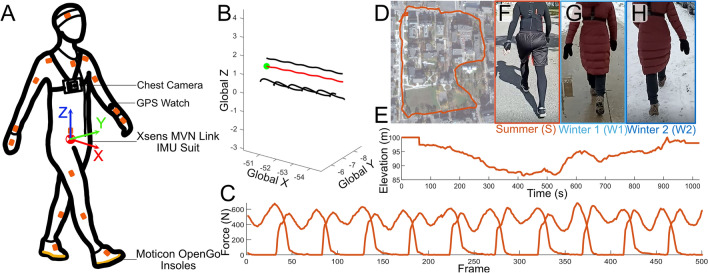
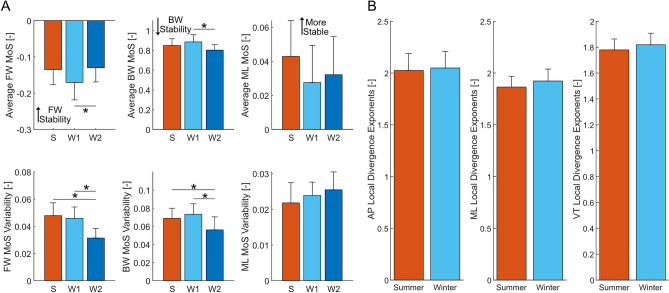
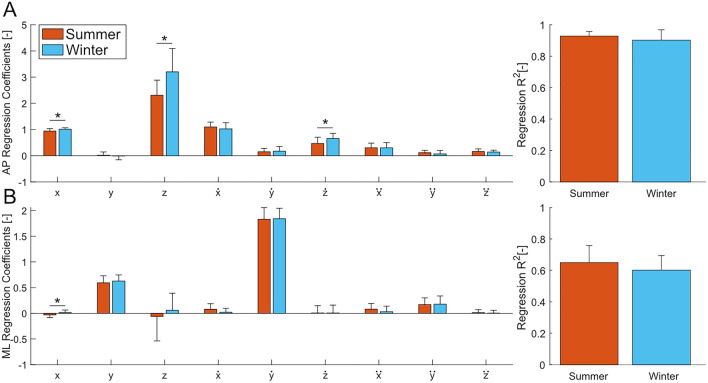
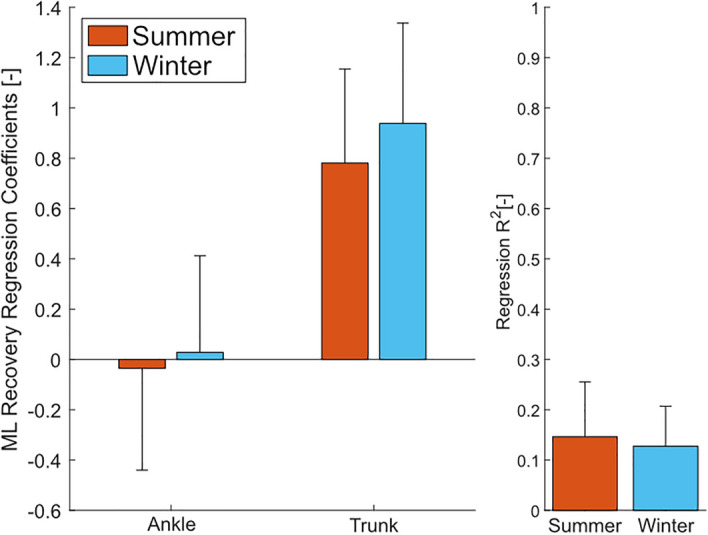
Verification
Claims the paper makes
The claims and statistics of this paper haven’t been checked yet.
Free: it reads the open-access text and checks the first 5 claims that cite a source we can check. Create a free account to check every claim.
Claims other papers make about this one
Each is checked against this paper’s own text: does it say what the citing paper says it does?
In the citing paper
“To monitor the body's center of mass stability, most studies place triaxial accelerometers on the waist to measure body acceleration 100,101 .”
From Recent advances in intelligent wearable systems: from multiscale biomechanical features towards human motion intent prediction (2026) · cites this paper as [101]
Self-check
Percentages, sums and reported differences re-computed from the paper’s own numbers.
The self-check needs the paper’s full text.
Citations
Cites
Yaşlı Kadınlarda Üreme Sağlığı
Kokanalı, D., & Engin Üstün, Y. (n.d.) · DergiPark (Istanbul University) · Cited by 170,090
Yaşlı Kadınlarda Üreme Sağlığı
Kokanalı, D., & Üstün, Y. E. (2019) · Jinekoloji-Obstetrik ve Neonatoloji Tıp Dergisi · Cited by 169,629
Human balance and posture control during standing and walking
Winter, D. (1995) · Gait & Posture · doi:10.1016/0966-6362(96)82849-9 · Cited by 3,421
Horak, F. B. (2006) · Age and Ageing · doi:10.1093/ageing/afl077 · Cited by 2,758
The condition for dynamic stability
Hof, A. L., Gazendam, M. G. J., & Sinke, W. E. (2005) · Journal of Biomechanics · doi:10.1016/j.jbiomech.2004.03.025 · Cited by 1,688 · cited 2×
“An increase in FW MoS suggests an increase in resistance to a forwards loss of stability, and an increase in the BW MoS suggests an increase in resistance to a backwards loss of stability 3,16 .”
Assessing the stability of human locomotion: a review of current measures
Bruijn, S. M., Meijer, O. G., Beek, P. J., & van Dieën, J. H. (2013) · Journal of The Royal Society Interface · doi:10.1098/rsif.2012.0999 · Cited by 663
Nonlinear time series analysis of normal and pathological human walking
Dingwell, J. B., & Cusumano, J. P. (2000) · Chaos: An Interdisciplinary Journal of Nonlinear Science · doi:10.1063/1.1324008 · Cited by 596 · cited 1×
“The calculation of the LDE was conducted using a publicly available version 25 of the algorithm suggested by Mehdizadeh 26 with the embedding dimension set to 5 27 and the delay set to 10 28 .”
The influence of gait speed on local dynamic stability of walking
England, S. A., & Granata, K. P. (2007) · Gait & Posture · doi:10.1016/j.gaitpost.2006.03.003 · Cited by 496 · cited 1×
“The calculation of the LDE was conducted using a publicly available version 25 of the algorithm suggested by Mehdizadeh 26 with the embedding dimension set to 5 27 and the delay set to 10 28 .”
Gaze and the Control of Foot Placement When Walking in Natural Terrain
Matthis, J. S., Yates, J. L., & Hayhoe, M. M. (2018) · Current Biology · doi:10.1016/j.cub.2018.03.008 · Cited by 424 · cited 2×
“The few research studies on walking outdoors 17–19 have utilized inertial measurement unit (IMU) based motion capture for remote data collection outside fixed laboratory environments.”
Control of human gait stability through foot placement
Bruijn, S. M., & van Dieën, J. H. (2018) · Journal of The Royal Society Interface · doi:10.1098/rsif.2017.0816 · Cited by 424 · cited 1×
“The calculation of the LDE was conducted using a publicly available version 25 of the algorithm suggested by Mehdizadeh 26 with the embedding dimension set to 5 27 and the delay set to 10 28 .”
Predictors of falls in the elderly by location
Bergland, A., Jarnlo, G.-B., & Laake, K. (2003) · Aging Clinical and Experimental Research · doi:10.1007/bf03324479 · Cited by 269
Wang, Y., & Srinivasan, M. (2014) · Biology Letters · doi:10.1098/rsbl.2014.0405 · Cited by 265 · cited 2×
“One of the surprising results is that the value of the gains in the VT direction were significantly different from zero for the AP regression, which has not been observed in previous studies 7 .”
Balance responses to lateral perturbations in human treadmill walking
Hof, A. L., Vermerris, S. M., & Gjaltema, W. A. (2010) · Journal of Experimental Biology · doi:10.1242/jeb.042572 · Cited by 261
Statistical precision and sensitivity of measures of dynamic gait stability
Bruijn, S. M., van Dieën, J. H., Meijer, O. G., & Beek, P. J. (2009) · Journal of Neuroscience Methods · doi:10.1016/j.jneumeth.2008.12.015 · Cited by 219 · cited 1×
“A previous study has suggested that 150 strides is sufficient for calculating the LDE for gait 29 .”
Biomechanics and energetics of walking on uneven terrain
Voloshina, A. S., Kuo, A. D., Daley, M. A., & Ferris, D. P. (2013) · Journal of Experimental Biology · doi:10.1242/jeb.081711 · Cited by 177 · cited 2×
“Voloshina et al. 13 studied walking on uneven terrain using rectangular wooden blocks of different height covered in foam.”
Vlutters, M., Van Asseldonk, E. H. F., & Van der Kooij, H. (2016) · Journal of Experimental Biology · doi:10.1242/jeb.129338 · Cited by 153
Gates, D. H., Scott, S. J., Wilken, J. M., & Dingwell, J. B. (2013) · Gait & Posture · doi:10.1016/j.gaitpost.2013.01.024 · Cited by 110 · cited 2×
“Gates et al. 15 compared the frontal plane dynamics of healthy individual and individuals with transtibial amputations while walking on loose rocks.”
Kowalsky, D. B., Rebula, J. R., Ojeda, L. V., Adamczyk, P. G., & Kuo, A. D. (2021) · PLOS One · doi:10.1371/journal.pone.0228682 · Cited by 106
Validation of an IMU Suit for Military-Based Tasks
Mavor, M. P., Ross, G. B., Clouthier, A. L., Karakolis, T., & Graham, R. B. (2020) · Sensors · doi:10.3390/s20154280 · Cited by 93
Over rough and smooth: Amputee gait on an irregular surface
Curtze, C., Hof, A. L., Postema, K., & Otten, B. (2010) · Gait & Posture · doi:10.1016/j.gaitpost.2010.11.023 · Cited by 89 · cited 1×
“Similarly, Curtze et al. 14 found that the mean step width increased and mean ML MoS remained the same when walking on an irregular surface.”
Walking indoors, outdoors, and on a treadmill: Gait differences in healthy young and older adults
Schmitt, A. C., Baudendistel, S. T., Lipat, A. L., White, T., Raffegeau, T. E., & Hass, C. J. (2021) · Gait & Posture · doi:10.1016/j.gaitpost.2021.09.197 · Cited by 85 · cited 2×
“The few research studies on walking outdoors 17–19 have utilized inertial measurement unit (IMU) based motion capture for remote data collection outside fixed laboratory environments.”
Outdoor Falls in an Urban Context: Winter Weather Impacts and Geographical Variations
Morency, P., Voyer, C., Burrows, S., & Goudreau, S. (2012) · Canadian Journal of Public Health · doi:10.1007/bf03403816 · Cited by 76
Ankle muscles drive mediolateral center of pressure control to ensure stable steady state gait
van Leeuwen, A. M., van Dieën, J. H., Daffertshofer, A., & Bruijn, S. M. (2021) · Scientific Reports · doi:10.1038/s41598-021-00463-8 · Cited by 63 · cited 3×
“Additionally, a previous study 34 using similar insoles found that the estimation of the range and standard deviation of the ML CoP is lower in the insole measurements compared to the in-ground force plates such as from van Leeuwen et al. The significant values of the trunk gain do suggest that the trunk strategy may…”
InfluentialOerbekke, M. S., Stukstette, M. J. P. M., Schütte, K., de Bie, R. A., Pisters, M. F., & Vanwanseele, B. (2016) · Gait & Posture · doi:10.1016/j.gaitpost.2016.10.005 · Cited by 58 · cited 2×
“Additionally, a previous study 34 using similar insoles found that the estimation of the range and standard deviation of the ML CoP is lower in the insole measurements compared to the in-ground force plates such as from van Leeuwen et al. The significant values of the trunk gain do suggest that the…”
Effect of Traffic Noise and Relaxations Sounds on Pedestrian Walking Speed
Franěk, M., Režný, L., Šefara, D., & Cabal, J. (2018) · International Journal of Environmental Research and Public Health · doi:10.3390/ijerph15040752 · Cited by 53 · cited 1×
“However, it is also possible that other factors such as changes in pedestrians traffic, environmental noise 35 , ambient temperature 36 , or practical changes in clothing contributed to the change in observed behaviour.”
Mehdizadeh, S. (2019) · Journal of Biomechanics · doi:10.1016/j.jbiomech.2019.01.013 · Cited by 46
Mahaki, M., Bruijn, S. M., & van Dieën, J. H. (2019) · PeerJ · doi:10.7717/peerj.7939 · Cited by 45
Walking is regulated by environmental temperature
Obuchi, S. P., Kawai, H., Garbalosa, J. C., Nishida, K., & Murakawa, K. (2021) · Scientific Reports · doi:10.1038/s41598-021-91633-1 · Cited by 34
Validation of Inertial Sensors to Evaluate Gait Stability
Riek, P. M., Best, A. N., & Wu, A. R. (2023) · Sensors · doi:10.3390/s23031547 · Cited by 32
Self-citationVlutters, M., van Asseldonk, E. H. F., & van der Kooij, H. (2017) · Journal of Biomechanics · doi:10.1016/j.jbiomech.2017.12.021 · Cited by 30 · cited 2×
“The calculation of the LDE was conducted using a publicly available version 25 of the algorithm suggested by Mehdizadeh 26 with the embedding dimension set to 5 27 and the delay set to 10 28 .”
Upper body and ankle strategies compensate for reduced lateral stability at very slow walking speeds
Best, A. N., & Wu, A. R. (2020) · Proceedings of the Royal Society B Biological Sciences · doi:10.1098/rspb.2020.1685 · Cited by 27
Self-citationvan den Bogaart, M., Bruijn, S. M., Spildooren, J., van Dieën, J. H., & Meyns, P. (2022) · Journal of Biomechanics · doi:10.1016/j.jbiomech.2022.111073 · Cited by 18
SjoerdBruijn/LocalDynamicStability: First release
Bruijn, S. M. (2017) · Zenodo (CERN European Organization for Nuclear Research) · doi:10.5281/zenodo.598035 · Cited by 16
Bone, M. D., Arora, T., Musselman, K. E., Lanovaz, J. L., Linassi, G. A., & Oates, A. (2021) · Neuroscience Letters · doi:10.1016/j.neulet.2021.135744 · Cited by 9 · cited 3×
“An increase in FW MoS suggests an increase in resistance to a forwards loss of stability, and an increase in the BW MoS suggests an increase in resistance to a backwards loss of stability 3,16 .”
Changes in Seasonal Footwear Elicited Alterations in Gait Kinematics but Not StabilityPreprint
Garrah, S. N., Best, A. N., & Wu, A. R. (2023) · bioRxiv (Cold Spring Harbor Laboratory) · doi:10.1101/2023.05.18.541138 · Cited by 2 · cited 1×
“We believe the change in footwear is a limited contributing factor to some of the observed changes with changes primarily found in gait kinematics than stability measures 37 .”
Self-citation(2014) · Institutional Repository University of Antioquia (University of Antioquia) · doi:10.1371/journal.pone
Cited by
Chen, S., Peng, C., Yang, B., Lin, J., Zhou, L., Jiang, Z., Liu, Z., Liu, Y., & Tang, L. (2026) · npj Artificial Intelligence · doi:10.1038/s44387-026-00083-5 · Cited by 9
Clinical Rehabilitation Practice Guidelines on Standing Balance Disorder in Patients with Stroke
Shen, Y., Zhifei, Y. I. N., Meng, D., Su, M., He, J., Lan, Y., Wang, C., Zou, J., Jiang, S., Tang, C., et al. (2024) · Rehabilitation Medicine · doi:10.3724/sp.j.1329.2024.03001 · Cited by 6
Lordall, J., Mehrabani, A., Bui, S., Oates, A., & Lanovaz, J. L. (2025) · Journal of Biomechanics · doi:10.1016/j.jbiomech.2025.112774 · Cited by 2
Changes in Seasonal Footwear Elicited Alterations in Gait Kinematics but Not StabilityPreprint
Garrah, S. N., Best, A. N., & Wu, A. R. (2023) · bioRxiv (Cold Spring Harbor Laboratory) · doi:10.1101/2023.05.18.541138 · Cited by 2
Self-citation
Metadata
- Authors
- Best, A. N., & Wu, A. R.
- Affiliations
- Queen's University (CA)
- Corresponding author
- Best, Aaron N.
- Venue
- Scientific Reports
- Published
- 2023-05-24
- Volume
- 13
- Issue
- 1
- Pages
- 8432-8432
- ISSN
- 2045-2322 (ISSN-L)
- PMC
- PMC10209205
- OpenAlex
- W4378070484
- Cited by
- 4
- References
- 35
- Citations by year
- 2026: 1 · 2025: 1 · 2024: 1 · 2023: 1
- FWCI
- 2.47
- Type
- journal article
- Language
- en
- Open access
- gold
- doi.org
- Licence
- cc-by
- creativecommons.org/licenses/by/4.0 (tdm)
- creativecommons.org/licenses/by/4.0 (vor)
- Locations
- Scientific Reports (publishedVersion, cc-by)
- Research Square (acceptedVersion, cc-by)
- PubMed Central (publishedVersion, cc-by)
- PubMed (publishedVersion)
- DOAJ (DOAJ: Directory of Open Access Journals) (submittedVersion, cc-by-sa)
- Funders
- Natural Sciences and Engineering Research Council of Canada (CGS-D, RGPIN-2019-05221)
- Queen’s Ingenuity Labs Research Institute
- Topics
- Health Sciences › Health Professions › Physical Therapy, Sports Therapy and Rehabilitation › Balance, Gait, and Falls Prevention
- Physical Sciences › Engineering › Control and Systems Engineering › Robotic Locomotion and Control
- Physical Sciences › Engineering › Biomedical Engineering › Lower Extremity Biomechanics and Pathologies
- Keywords
- gait stability, outdoor walking, center of mass, stability margin, ankle torque, trunk rotation, compensatory strategies, ground reaction force, inertial measurement unit, instrumented insoles
- MeSH terms
- Ankle Joint, Gait, Humans, Thinking, Walking, Lower Extremity
About these checks
Registry, retraction, Cites and statistics results are computed, not judged, with one exception: a printed reference that no index lists is read once by a model before it counts as a citation error. Claims are extracted by a model and kept only when their quote appears verbatim in the text; each cited source is then checked, with a model’s help, for whether it says what the claim relies on. Those verdicts can be wrong — read the claim’s quote and the cited source before relying on one.
Statistics and arithmetic are recomputed, not judged.
Confidence bands are shown only for fields calibrated on our annotated test set. None is calibrated yet, so no band is shown.
What counts as a claim ›How we measure confidence ›How we check this ›
Are you an author, or do you see a problem with this page? Request a review
Data sources
Bibliographic data: Semantic Scholar, OpenAlex, Crossref.
Contains information from the Semantic Scholar Academic Graph Datasets, made available under the ODC Attribution License (ODC-BY 1.0).
Semantic Scholar’s data is described in: Kinney, R., et al. (2023). The Semantic Scholar Open Data Platform. arXiv:2301.10140.
