

Egyptian propolis extract for functionalization of cellulose nanofiber/poly(vinyl alcohol) porous hydrogel along with characterization and biological applications
The DOI matches its Crossref record; 81 of the 81 references it cites were found in a registry or an index.
Abstract
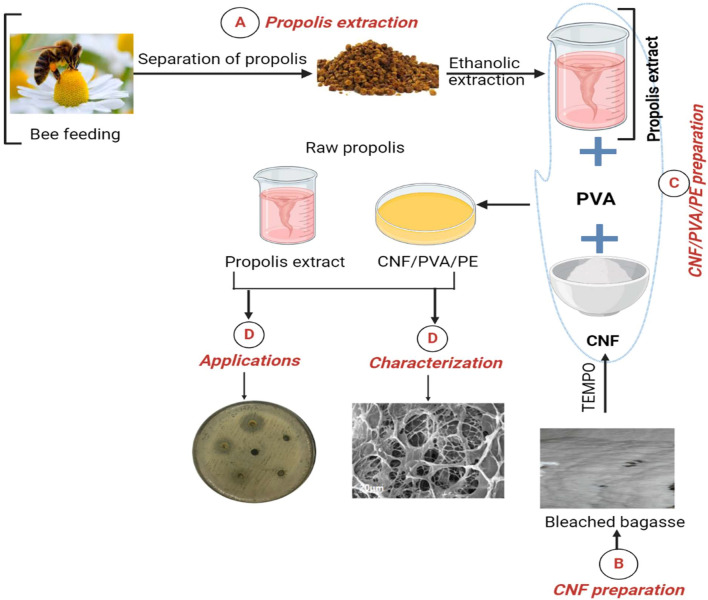
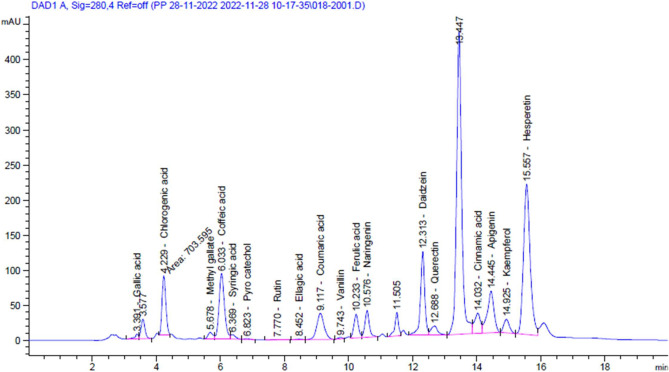
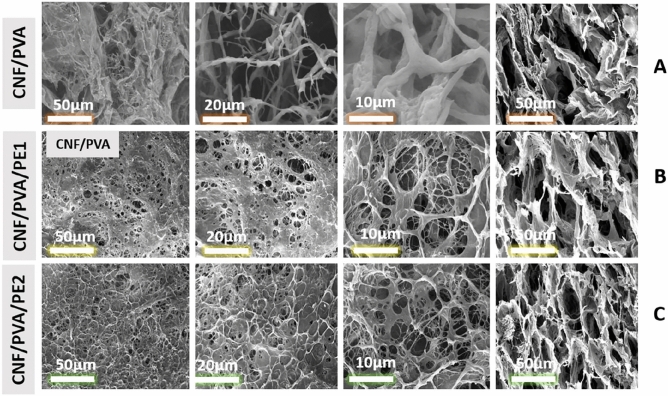
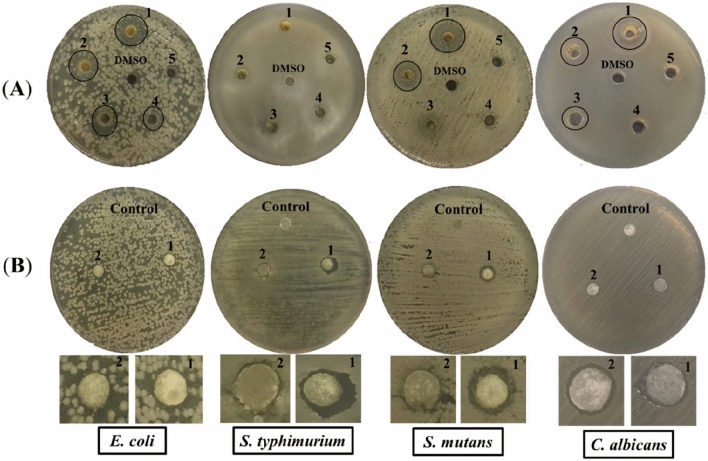
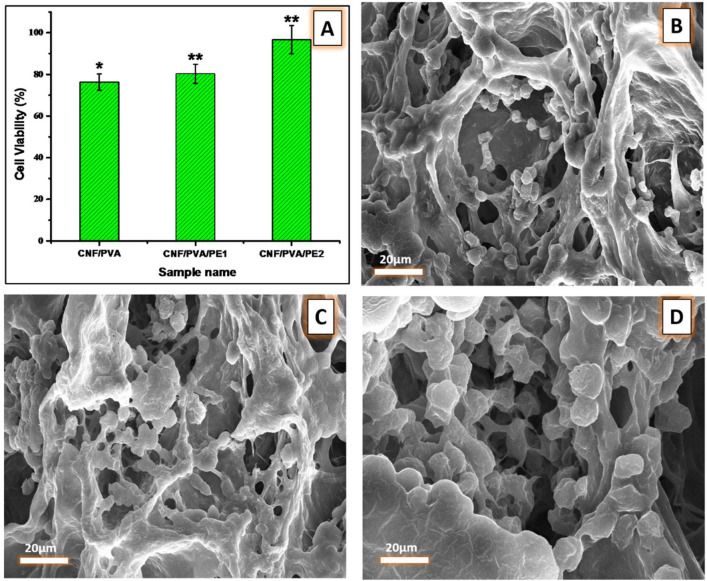
Bee propolis is one of the most common natural extracts and has gained significant interest in biomedicine due to its high content of phenolic acids and flavonoids, which are responsible for the antioxidant activity of natural products. The present study report that the propolis extract (PE) was produced by ethanol in the surrounding environment. The obtained PE was added at different concentrations to cellulose nanofiber (CNF)/poly(vinyl alcohol) (PVA), and subjected to freezing thawing and freeze drying methods to develop porous bioactive matrices. Scanning electron microscope (SEM) observations displayed that the prepared samples had an interconnected porous structure with pore sizes in the range of 10–100 μm. The high performance liquid chromatography (HPLC) results of PE showed around 18 polyphenol compounds, with the highest amounts of hesperetin (183.7 µg/mL), chlorogenic acid (96.9 µg/mL) and caffeic acid (90.2 µg/mL). The antibacterial activity results indicated that both PE and PE-functionalized hydrogels exhibited a potential antimicrobial effects against Escherichia coli, Salmonella typhimurium, Streptococcus mutans, and Candida albicans. The in vitro test cell culture experiments indicated that the cells on the PE-functionalized hydrogels had the greatest viability, adhesion, and spreading of cells. Altogether, these data highlight the interesting effect of propolis bio-functionalization to enhance the biological features of CNF/PVA hydrogel as a functional matrix for biomedical applications.
Overview
The claims and statistics of this paper haven’t been checked yet.
Free: it reads the open-access text and checks the first 5 claims that cite a source we can check. Create a free account to check every claim.
Integrity signals
Registry
Cites
Statistics
Figures
Verification
Claims the paper makes
The claims and statistics of this paper haven’t been checked yet.
Free: it reads the open-access text and checks the first 5 claims that cite a source we can check. Create a free account to check every claim.
Claims other papers make about this one
Each is checked against this paper’s own text: does it say what the citing paper says it does?
In the citing paper
“Porous structures obtained from cellulose nanofibers (CNFs) and poly(vinyl alcohol) (PVA) were loaded with propolis extract (PE) and showed antimicrobial activity against Escherichia coli, Streptococcus mutans, and Candida albicans [24].”
From Plant-Derived Nanocellulose with Antibacterial Activity for Wound Healing Dressing (2023) · cites this paper as [24]
In the citing paper
“The capacity of the propolis extract to inflict a more compact structure and a decrease in the pore size was also observed in hydrogels based on cellulose nanofibers and poly (vinyl alcohol) [24].”
From Plant-Derived Nanocellulose with Antibacterial Activity for Wound Healing Dressing (2023) · cites this paper as [24]
In the citing paper
“Propolis was also used to induce antimicrobial activity in nanocellulose-containing polymer composites [24,25].”
From Plant-Derived Nanocellulose with Antibacterial Activity for Wound Healing Dressing (2023) · cites this paper as [24]
Self-check
Percentages, sums and reported differences re-computed from the paper’s own numbers.
The self-check needs the paper’s full text.
Citations
Cites
1 retracted
El-Adham, E. K., Hassan, A. I., & Dawoud, M. M. A. (2022) · Scientific Reports · doi:10.1038/s41598-022-05979-1 · Cited by 68
RetractedSegal, L., Creely, J. J., Martin, A. E., & Conrad, C. M. (1959) · Textile Research Journal · doi:10.1177/004051755902901003 · Cited by 8,613
Cellulose nanocrystals: chemistry, self-assembly, and applications
Habibi, Y., Lucia, L. A., & Rojas, O. J. (2010) · Chemical Reviews · doi:10.1021/cr900339w · Cited by 5,980
Hydrogel: Preparation, characterization, and applications: A review
Ahmed, E. M. (2015) · Journal of Advanced Research · doi:10.1016/j.jare.2013.07.006 · Cited by 5,800
Hydrogels for biomedical applications
Hoffman, A. S. (2012) · Advanced Drug Delivery Reviews · doi:10.1016/j.addr.2012.09.010 · Cited by 3,396
Three-Dimensional Scaffolds for Tissue Engineering Applications: Role of Porosity and Pore Size
Loh, Q. L., & Choong, C. (2013) · Tissue Engineering Part B: Reviews · doi:10.1089/ten.teb.2012.0437 · Cited by 2,668
Azizi Samir, M. A. S., Alloin, F., & Dufresne, A. (2005) · Biomacromolecules · doi:10.1021/bm0493685 · Cited by 2,311
Engineering Hydrogels as Extracellular Matrix Mimics
Geckil, H., Xu, F., Zhang, X., Moon, S., & Demirci, U. (2010) · Nanomedicine · doi:10.2217/nnm.10.12 · Cited by 944
Smart Hydrogels in Tissue Engineering and Regenerative Medicine
Mantha, S., Pillai, S., Khayambashi, P., Upadhyay, A., Zhang, Y., Tao, O., Pham, H. M., & Tran, S. D. (2019) · Materials · doi:10.3390/ma12203323 · Cited by 857
van de Loosdrecht, A. A., Beelen, R. H. J., Ossenkoppele, G. J., Broekhoven, M. G., & Langenhuijsen, M. M. A. C. (1994) · Journal of Immunological Methods · doi:10.1016/0022-1759(94)90034-5 · Cited by 821
Research works printed but not linked: 4
- Peixoto, L. S. et al.Macromolecular Symposia. 190–199 (Wiley Online Library).
- Salama A Mohamed F Hesemann P Preparation and dielectric relaxation of a novel ionocellulose derivative Carbohydr. Polym. Technol. Appl. 2021 2 100087
- Oliveira RN FTIR analysis and quantification of phenols and flavonoids of five commercially available plants extracts used in wound healing Matéria 2016 21 767 779
- Eddebbagh M Correlation of the cytotoxic and antioxidant activities of Moroccan pomegranate (Punica granatum) with phenolic and flavonoid contents J. Pharm. Pharmacol. 2016 68 511 519
Cited by
Applications of propolis-based materials in wound healing
El-Sakhawy, M., Salama, A., & Tohamy, H.-A. S. (2023) · Archives of Dermatological Research · doi:10.1007/s00403-023-02789-x · Cited by 64
Self-citationPlant-Derived Nanocellulose with Antibacterial Activity for Wound Healing Dressing
Oprică, G. M., Panaitescu, D. M., Lixandru, B. E., Uşurelu, C. D., Gabor, A. R., Nicolae, C.-A., Fierascu, R. C., & Frone, A. N. (2023) · Pharmaceutics · doi:10.3390/pharmaceutics15122672 · Cited by 30
Metadata
- Authors
- Saleh, S., Salama, A., Ali, A. M., Saleh, A. K., Elhady, B. A., & Tolba, E.
- Venue
- Scientific Reports
- Published
- 2023-05-12
- Volume
- 13
- Issue
- 1
- ISSN
- 2045-2322
- PMC
- PMC10182032
- Cited by
- 38
- References
- 81
- Language
- en
- Licence
- creativecommons.org/licenses/by/4.0 (tdm)
- creativecommons.org/licenses/by/4.0 (vor)
- Funders
- National Research Centre Egypt
About these checks
Registry, retraction, Cites and statistics results are computed, not judged, with one exception: a printed reference that no index lists is read once by a model before it counts as a citation error. Claims are extracted by a model and kept only when their quote appears verbatim in the text; each cited source is then checked, with a model’s help, for whether it says what the claim relies on. Those verdicts can be wrong — read the claim’s quote and the cited source before relying on one.
Statistics and arithmetic are recomputed, not judged.
Confidence bands are shown only for fields calibrated on our annotated test set. None is calibrated yet, so no band is shown.
What counts as a claim ›How we measure confidence ›How we check this ›
Are you an author, or do you see a problem with this page? Request a review
Data sources
Bibliographic data: Semantic Scholar, OpenAlex, Crossref.
Contains information from the Semantic Scholar Academic Graph Datasets, made available under the ODC Attribution License (ODC-BY 1.0).
Semantic Scholar’s data is described in: Kinney, R., et al. (2023). The Semantic Scholar Open Data Platform. arXiv:2301.10140.
