

Adolescent leisure reading and its longitudinal association with prosocial behavior and social adjustment
Open accessThe DOI matches its Crossref record; 71 of the 72 references it cites were found in a registry or an index; 14 of the 60 sources its claims cite were checked for support.
Abstract
Reading is a popular leisure activity for children, teenagers, and adults. Several theories agree that reading might improve social cognition, but the empirical evidence remains tentative, with research on adolescents especially lacking. We employed a very large, and nationally representative, longitudinal dataset from the National Educational Panel Study (NEPS) in Germany to examine this hypothesis. Specifically, we tested whether reading prospectively predicted future self-reported prosocial behavior and social adjustment in adolescents, controlling for a number of covariates. Two-way cross-lagged panel analyses probed the longitudinal relationship between leisure reading and these social outcomes from Grade 6 to Grade 9. In addition, we examined the effect of cumulative reading experience across Grades 5–8 on future social outcomes, using structural equation modeling. We also explored the unique contributions of cumulative reading experience in different literary genres (classic literature, popular literature, nonfiction, comic books). Cumulative reading in general did not predict future prosocial behavior and social adjustment. However, cumulative reading of modern classic literature was positively associated with later prosocial behavior and social adjustment. Protocol registration: The stage 1 protocol for this Registered Report was accepted in principle on 08 November 2021. The protocol, as accepted by the journal, can be found at: https://doi.org/10.17605/OSF.IO/KSWY7 .
Overview
CoChat Summary
TL;DR
Using nationally representative German longitudinal data (NEPS), this registered report tested whether adolescent leisure reading predicts later prosocial behavior and social adjustment. General cumulative leisure reading did not predict these outcomes, but cumulative reading of modern classic literature was positively associated with later prosocial behavior and social adjustment.
Key findings
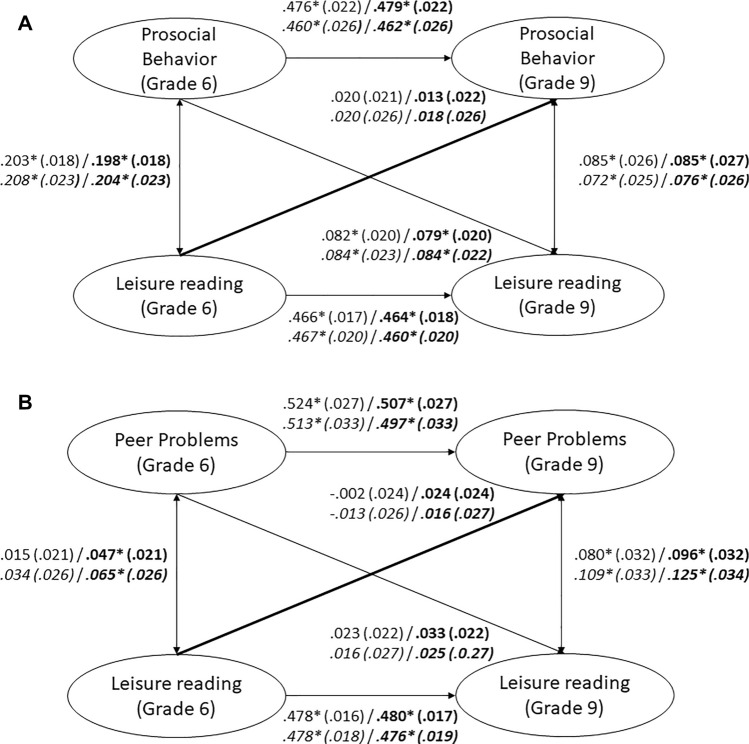
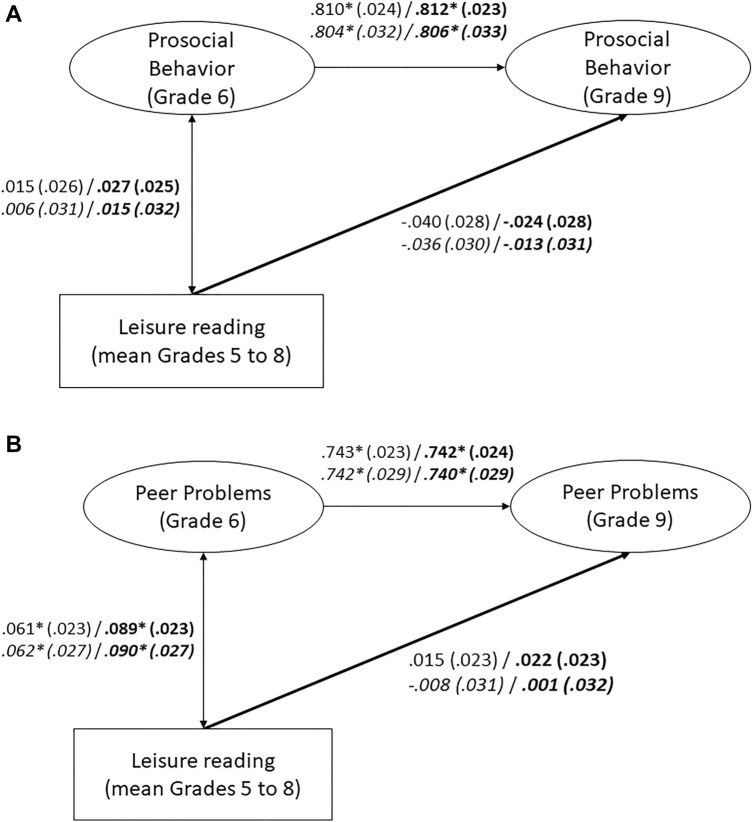
- Cross-lagged models found no significant effect of leisure reading at Grade 6 on later self-reported prosocial behavior or peer problems at Grade 9; prosocial behavior did predict later leisure reading.
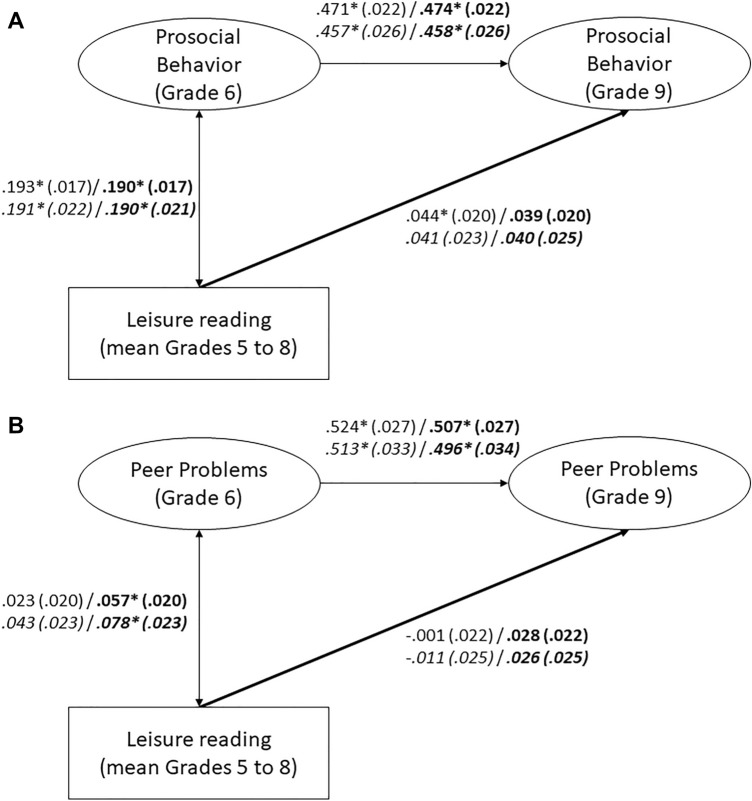
- Cumulative leisure reading across Grades 5–8 did not significantly predict later self-reported prosocial behavior or peer problems after including controls (migration background, socioeconomic status, nonverbal intelligence).
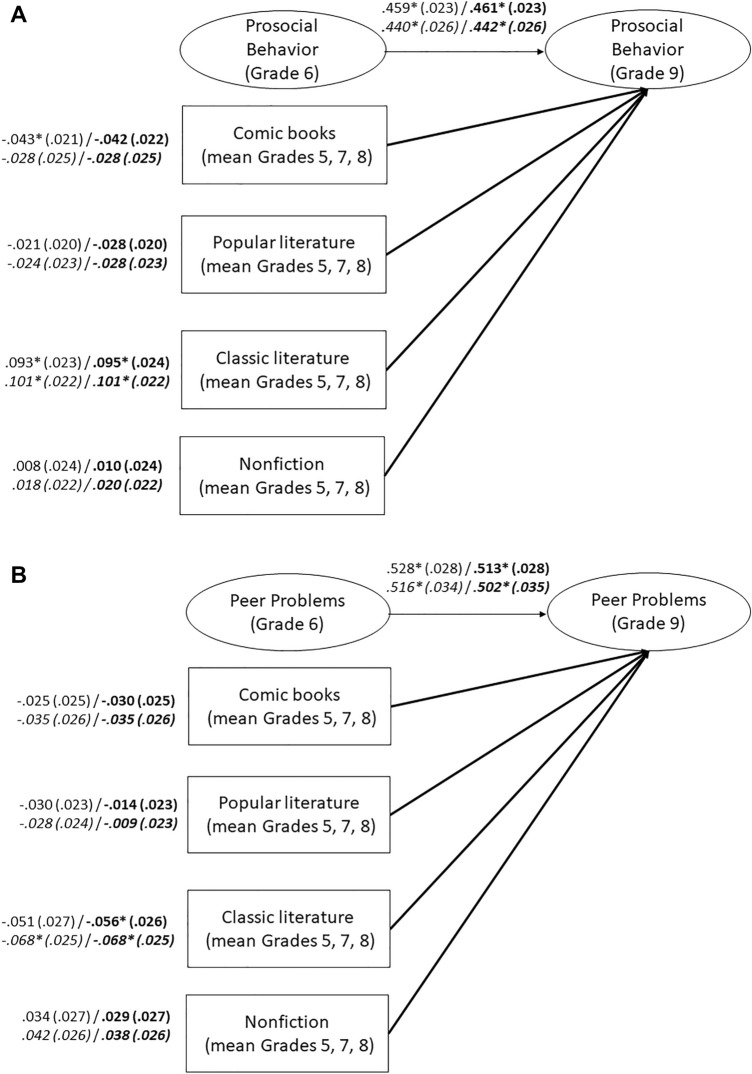
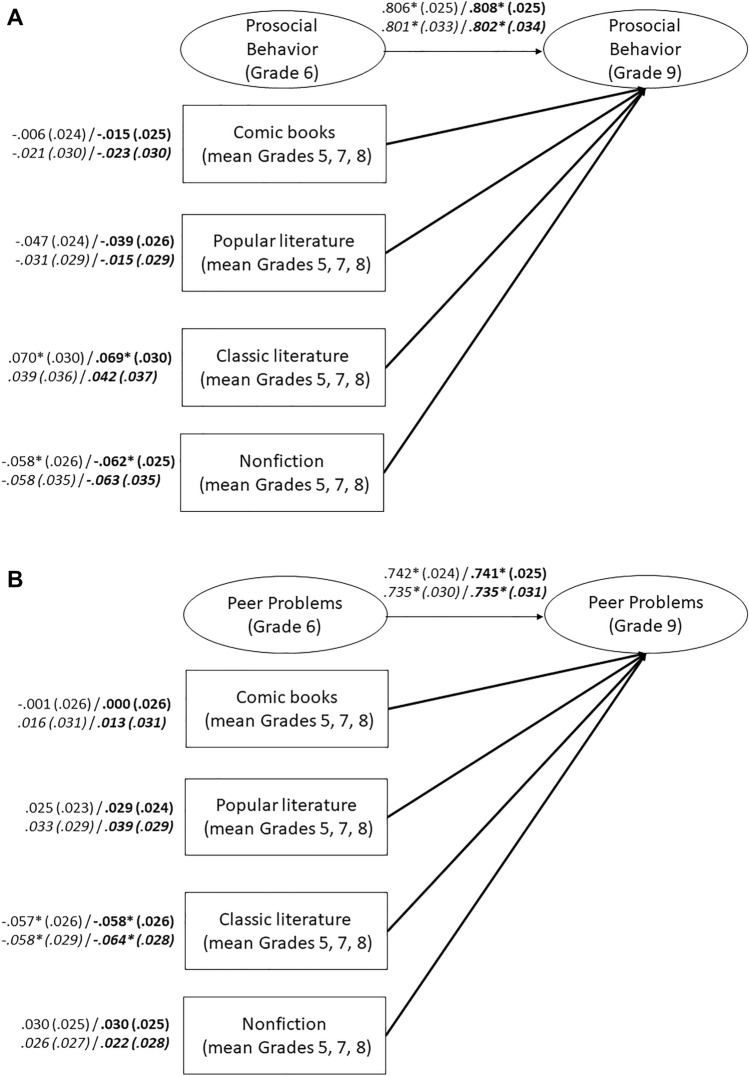
- Among genres, cumulative reading of modern classic literature positively predicted more self-reported prosocial behavior and fewer self-reported peer problems, with effects described as small (β ≤ 0.10); popular literature and comic books did not show these associations.
- Nonfiction reading did not predict later prosocial behavior or peer problems and was even negatively related to later parent-reported prosocial behavior in exploratory analyses.
Methods
- Secondary analysis of the National Educational Panel Study (NEPS), Starting Cohort Grade 5, following students from about age 10 to 15; participants were 6,112 students sampled representatively in Germany, with final analyses using N = 5,152 after removing multivariate outliers.
- Leisure reading frequency and genre reading were self-reported; prosocial behavior and peer problems were measured with Strengths and Difficulties Questionnaire (SDQ) self-reports (pre-registered) and parent reports (exploratory) in Grades 6 and 9.
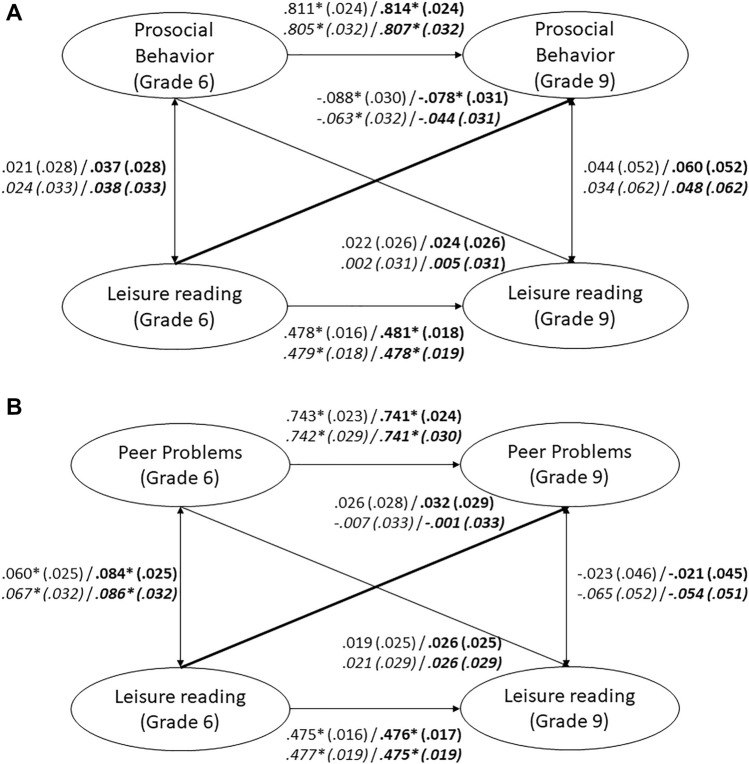
- Analyses used two-way cross-lagged panel models and structural equation models, controlling for prior outcomes, migration background, socioeconomic status, and nonverbal intelligence; preregistered on AsPredicted, with additional robustness analyses including gender, reading competence, and openness to experience.
Limitations
- The paper states that school and class membership were not stable from Grades 5 to 9, so the preregistered nested analytic approach had to be adjusted; both the non-nested total-sample analyses and reduced nested-in-school analyses may yield biased parameter estimates.
- The paper notes that cross-classified models could address non-stable group membership, but would reduce the sample and, to the authors’ knowledge, Mplus cannot handle the required combination of cross-classified and nested memberships.
- The paper states that NEPS did not measure social-cognitive skills (e.g., theory-of-mind or empathy) or motivation to engage in social processing, so the study tested distal downstream outcomes rather than a strict test of reading effects on social cognition.
Model-written summary. Check it against the paper before relying on it.
Integrity signals
Registry
Cites
Statistics
Figures
Verification
Claims the paper makes
12 Valid · 2 Not valid · 25 Not checked · 68 Own results and interpretations
The sources with a verdict support this claim; the rest weren’t checked yet, have no full text we could read, or their verdicts aren’t rated yet.
In the paper
“In contrast, after controlling for fiction, nonfiction shows null or even negative correlations with these same measures26,30.”
§ Adolescent leisure reading and its longitudinal association with prosocial behavior and social adjustment > Introduction
What the sources say
- Not checked — no full text of the sourcecites [26] Mar RA Oatley K Hirsh J Delaaz J Peterson JB Bookworms versus nerds: Exposure to fiction versus non-fiction, divergent associations with social ability, and the simulation of fictional social worlds J. Res. Person. 2006 40 694 712 10.1016/j.jrp.2005.08.002 source
- Supportedcites [30] Stansfield J Bunce L The relationship between empathy and reading fiction: Separate roles for cognitive and affective components J. Eur. Psychol. Stud. 2014 5 9 18 10.5334/jeps.ca source
The Results report partial correlations for nonfiction exposure controlling for fiction exposure and age. Table 2 shows a significant negative correlation with trait cognitive empathy (r = −0.522) and no significant correlations with the other listed empathy measures, consistent with the claim. (LLM, conf=0.91)
plainstates an association- Asserted: passes — The authors put it forward as true.
- Checkable: passes — It can be checked against evidence.
- Load-bearing: passes — The paper’s conclusions depend on it.
- Based: passes — The paper gives a reason why it holds.
The cited sources support only part of this claim — read each source’s verdict below.
In the paper
“Moreover, past studies almost exclusively study young adult student populations or, to a lesser degree, children. This neglects the pivotal period of adolescence, when crucial social-cognitive development takes place13.”
§ Adolescent leisure reading and its longitudinal association with prosocial behavior and social adjustment > Introduction
What the sources say
- Partly supportedcites [13] Burnett S Blakemore S-J The development of adolescent social cognition Ann. New York Acad. Sci. 2009 1167 51 56 10.1111/j.1749-6632.2009.04509.x 19580552 PMC3427903 sourceExperimental — accuracy not yet measured
In “Milestones in Social Ability from Birth to Adulthood” (page not provided), the paper says research into adolescent social-cognitive development is comparatively young. The Introduction (page not provided) describes continued development of social abilities during adolescence. It does not say that past studies almost exclusively used young adult students or children. (LLM, conf=0.86)
plain- Asserted: passes — The authors put it forward as true.
- Checkable: passes — It can be checked against evidence.
- Load-bearing: passes — The paper’s conclusions depend on it.
- Based: passes — The paper gives a reason why it holds.
- Partly supported
Every source the paper cites for this claim was checked and supports it.
In the paper
“This lack of insight into student experiences while at school may explain why the parental version is only moderately correlated with the self-report version57.”
§ Adolescent leisure reading and its longitudinal association with prosocial behavior and social adjustment > Methods > Measures
What the sources say
- Supportedcites [57] Bergström M Baviskar S A systematic review of some reliability and validity issues regarding the strengths and difficulties questionnaire focusing on its use in out-of-home care J. Evid. Based Soc. Work 2021 2019 18 1 31 10.1080/26408066.2020.1788477 32684105 source
The Results (page unavailable) report parent–self-report agreement above the paper’s .30 acceptability threshold for nearly all SDQ scales in community samples and all six scales in clinical samples. The Discussion (page unavailable) describes cross-informant correlations as non-negligible but says the informants are not interchangeable, consistent with the claim of moderate rather than strong agreement. (LLM, conf=0.85)
hedgedstates an association- Asserted: passes — The authors put it forward as true.
- Checkable: passes — It can be checked against evidence.
- Load-bearing: passes — The paper’s conclusions depend on it.
- Based: passes — The paper gives a reason why it holds.
- Supported
The cited sources support only part of this claim — read each source’s verdict below.
In the paper
“This lack of insight into student experiences while at school may explain why the parental version is only moderately correlated with the self-report version57.”
§ Adolescent leisure reading and its longitudinal association with prosocial behavior and social adjustment > Methods > Measures
What the sources say
- Partly supportedcites [57] Bergström M Baviskar S A systematic review of some reliability and validity issues regarding the strengths and difficulties questionnaire focusing on its use in out-of-home care J. Evid. Based Soc. Work 2021 2019 18 1 31 10.1080/26408066.2020.1788477 32684105 sourceExperimental — accuracy not yet measured
The Discussion (page unavailable) says that children may view themselves differently from their parents and that a single informant’s SDQ assessment may not generalize across home and school contexts. The Results (page unavailable) report non-negligible parent–self-report consistency, but the paper does not specifically identify parents’ lack of insight into school experiences as the explanation or characterize that correlation as moderate. (LLM, conf=0.78)
hedgedstates a possible cause- Asserted: passes — The authors put it forward as true.
- Checkable: passes — It can be checked against evidence.
- Load-bearing: passes — The paper’s conclusions depend on it.
- Based: passes — The paper gives a reason why it holds.
- Partly supported
A result the paper reports from its own data — it cites no other source for it, so there is none to check. The quote shows it is in the paper.
In the paper
“In addition, cumulative leisure reading did not significantly predict later self-reported peer problems (Fig. 2B).”
§ Adolescent leisure reading and its longitudinal association with prosocial behavior and social adjustment > Results > Cumulative leisure reading and self-reported prosocial behavior and peer problems
plain- Asserted: passes — The authors put it forward as true.
- Checkable: passes — It can be checked against evidence.
- Load-bearing: passes — The paper’s conclusions depend on it.
- Based: passes — The paper gives a reason why it holds.
42 more claims
Create a free account to see all 107 claims and to verify the 1 reference still open.
- Probably not a substantial claim. 43
- It may state two separate claims as one. 28
- The quote only partly states this claim. 1
Claims other papers make about this one
Each is checked against this paper’s own text: does it say what the citing paper says it does?
The cited source says what the claim attributes to it.
In the citing paper
“They found that children and adolescents who read more ' classic literature ' ( fi ction that is not contemporary but is still widely read) showed more prosocial behavior and better social adjustment than their peers”
From Longitudinal development of theory of mind in adolescence and its associations with fiction reading experience. (2025) · cites this paper as Lenhart et al., 2023
Self-check
Percentages, sums and reported differences re-computed from the paper’s own numbers.
Each contradiction between two passages listed here was confirmed by an independent check.
Rated minor: it would not touch a result — a value no result rests on, a p-value that stays on the same side of the significance level, or a conflict that is clerical, resolved elsewhere in the paper, or outside its own findings.
In the paper
§ Adolescent leisure reading and its longitudinal association with prosocial behavior and social adjustment > Methods > Analyses
“We constructed structural equation models examining associations between leisure reading of different genre (mean of Grades 5, 7, and 8) and social adjustment (self-reports; Grade 9), controlling for earlier prosocial behavior (self-report; Grade 6), non-verbal intelligence, migration background, and socioeconomic status.”
§ Adolescent leisure reading and its longitudinal association with prosocial behavior and social adjustment > Methods > Analyses
“controlling for previous social-cognitive behavior (respective SDQ scales; measured in Grade 6)”
Rated minor: it would not touch a result — a value no result rests on, a p-value that stays on the same side of the significance level, or a conflict that is clerical, resolved elsewhere in the paper, or outside its own findings.
In the paper
§ Adolescent leisure reading and its longitudinal association with prosocial behavior and social adjustment > Discussion
“To examine our hypotheses, we used cross-lagged panel analyses between leisure reading and prosocial behavior/social adjustment from Grades 5 to 9, as well as analyses linking cumulative reading across Grades 5 to 8 to later prosocial behavior/social adjustment in Grade 9.”
§ Adolescent leisure reading and its longitudinal association with prosocial behavior and social adjustment > Methods > Analyses
“We conducted two-way cross-lagged panel design analyses that examined associations between leisure reading (Grade 6 and 9) and prosocial behavior (self-reports; Grade 6 and 9), controlling for non-verbal intelligence, migration background, and socioeconomic status.”
Citations
Cites
Hu, L., & Bentler, P. M. (1999) · Structural Equation Modeling A Multidisciplinary Journal · doi:10.1080/10705519909540118 · Cited by 108,788
The Strengths and Difficulties Questionnaire: A research note
Goodman, R. (1997) · Journal of Child Psychology and Psychiatry · doi:10.1111/j.1469-7610.1997.tb01545.x · Cited by 14,908
Sensitivity of Goodness of Fit Indexes to Lack of Measurement Invariance
Chen, F. F. (2007) · Structural Equation Modeling: A Multidisciplinary Journal · doi:10.1080/10705510701301834 · Cited by 12,217
Bruner, J. (1986) · doi:10.4159/9780674029019 · Cited by 8,657
Problems of Dostoevsky's Poetics
Bakhtin, M. (1984) · doi:10.5749/j.ctt22727z1 · Cited by 5,909
Putnick, D. L., & Bornstein, M. H. (2016) · Developmental Review · doi:10.1016/j.dr.2016.06.004 · Cited by 4,369 · cited 1×
“In addition, in a next step, the variables were examined for partial measurement invariance 65,68 .”
Rammstedt, B., & John, O. P. (2007) · Journal of Research in Personality · doi:10.1016/j.jrp.2006.02.001 · Cited by 4,244 · cited 2×
“The Openness to Experience subscale of the German BFI-10 showed adequate test–retest reliability ( r tt = 0.78) and a high correlation with the standard 9-item scale from the BFI-44 ( r = 0.80) 79 .”
MethodInfluentialHow Many Imputations are Really Needed? Some Practical Clarifications of Multiple Imputation Theory
Graham, J. W., Olchowski, A. E., & Gilreath, T. D. (2007) · Prevention Science · doi:10.1007/s11121-007-0070-9 · Cited by 2,795 · cited 1×
“Concomitant with the change of the estimator, we used multiple imputation (with covariates included; 40 imputations 63 ) to address missing data (instead of FIML, which is used with MLR).”
MethodSocial cognitive theory of gender development and differentiation.
Bussey, K., & Bandura, A. (1999) · Psychological Review · doi:10.1037/0033-295x.106.4.676 · Cited by 2,476
International Standard Classification of Education, ISCED 1997
UNESCO United Nations Educational, S. A. C. O. (2003) · Advances in Cross-National Comparison · doi:10.1007/978-1-4419-9186-7_10 · Cited by 2,351
Reading literary fiction improves theory of mind
Kidd, D. C., & Castano, E. (2013) · Science · doi:10.1126/science.1239918 · Cited by 1,642 · cited 10×
“Theoretically, the social effects of reading are assumed to emerge from cumulative, repeated exposure to stories over long periods of time 6,8 .”
BackgroundResultInfluentialWhy the items versus parcels controversy needn’t be one.
Little, T. D., Rhemtulla, M., Gibson, K., & Schoemann, A. M. (2013) · Psychological Methods · doi:10.1037/a0033266 · Cited by 1,603
The Raven's Progressive Matrices: Change and Stability over Culture and Time
Raven, J. (2000) · Cognitive Psychology · doi:10.1006/cogp.1999.0735 · Cited by 1,560
Longitudinal Structural Equation Modeling
Geiser, C. (2014) · Encyclopedia of Quality of Life and Well-Being Research · doi:10.1007/978-94-007-0753-5_1701 · Cited by 1,366
To read or not to read: a meta-analysis of print exposure from infancy to early adulthood
Mol, S. E., & Bus, A. G. (2011) · Psychological Bulletin · doi:10.1037/a0021890 · Cited by 1,299
Why we read fiction: theory of mind and the novel
(2006) · Choice Reviews Online · doi:10.5860/choice.44-1963 · Cited by 1,163
Keen, S. (2007) · Oxford University Press eBooks · doi:10.1093/acprof:oso/9780195175769.001.0001 · Cited by 1,085
Brysbaert, M. (2019) · Journal of Cognition · doi:10.5334/joc.72 · Cited by 996
Mar, R. A., Oatley, K., Hirsh, J., dela Paz, J., & Peterson, J. B. (2006) · Journal of Research in Personality · doi:10.1016/j.jrp.2005.08.002 · Cited by 614
Self-citationWhy Fiction May be Twice as True as Fact: Fiction as Cognitive and Emotional Simulation
Oatley, K. (1999) · Review of General Psychology · doi:10.1037/1089-2680.3.2.101 · Cited by 585
Mar, R. A., Oatley, K., & Peterson, J. B. (2009) · COMM · doi:10.1515/comm.2009.025 · Cited by 552
Self-citationForegrounding, defamiliarization, and affect: Response to literary stories
Miall, D. S., & Kuiken, D. (1994) · Poetics · doi:10.1016/0304-422x(94)00011-5 · Cited by 499
Theory of mind and prosocial behavior in childhood: A meta-analytic review.
Imuta, K., Henry, J. D., Slaughter, V., Selcuk, B., & Ruffman, T. (2016) · Developmental Psychology · doi:10.1037/dev0000140 · Cited by 474
The road to excellence: deliberate practice and the development of expertise.
Ward, P., Hodges, N. J., Starkes, J. L., & Williams, M. A. (2007) · High Ability Studies · doi:10.1080/13598130701709715 · Cited by 353 · cited 1×
“Cumulative leisure reading was modelled as a manifest variable, averaging all items across Grades 5 to 8 (in analogy to the treatment of cumulative practice in expertise research 70 ).”
MethodTesting measurement invariance in longitudinal data with ordered-categorical measures.
Liu, Y., Millsap, R. E., West, S. G., Tein, J.-Y., Tanaka, R., & Grimm, K. J. (2017) · Psychological Methods · doi:10.1037/met0000075 · Cited by 351 · cited 1×
“To do so, we tested for longitudinal measurement invariance by comparing a series of nested factor models, adding specific restrictions to the models 65,66 .”
MethodHanscombe, K. B., Trzaskowski, M., Haworth, C. M. A., Davis, O. S. P., Dale, P. S., & Plomin, R. (2012) · PLoS ONE · doi:10.1371/journal.pone.0030320 · Cited by 343
Meta-Analysis of Theory of Mind and Peer Popularity in the Preschool and Early School Years
Slaughter, V., Imuta, K., Peterson, C. C., & Henry, J. D. (2015) · Child Development · doi:10.1111/cdev.12372 · Cited by 324 · cited 1×
“Those higher in empathy are less likely to be bullies (although theory-of-mind is unassociated) 17 , those higher in theory-of-mind at age 5 are less likely to be friendless at age 7 18 , and theory-of-mind is also associated with popularity (among children aged 2–10) 19 .”
BackgroundLeys, C., Delacre, M., Mora, Y. L., Lakens, D., & Ley, C. (2019) · International Review of Social Psychology · doi:10.5334/irsp.289 · Cited by 297
Panero, M. E., Weisberg, D. S., Black, J., Goldstein, T. R., Barnes, J. L., Brownell, H., & Winner, E. (2016) · Journal of Personality and Social Psychology · doi:10.1037/pspa0000064 · Cited by 289
Education as a Lifelong Process: The German National Educational Panel Study (NEPS)
(2019) · Edition ZfE · doi:10.1007/978-3-658-23162-0 · Cited by 257
Leisure reading and social cognition: A meta-analysis.
Mumper, M. L., & Gerrig, R. J. (2017) · Psychology of Aesthetics, Creativity, and the Arts · doi:10.1037/aca0000089 · Cited by 249
Emotional and behavioral problems in migrant children and adolescents in Europe: a systematic review
Belhadj Kouider, E., Koglin, U., & Petermann, F. (2014) · European Child & Adolescent Psychiatry · doi:10.1007/s00787-013-0485-8 · Cited by 241
Hakemulder, F. (2000) · Utrecht Publications in General and Comparative Literature · doi:10.1075/upal.34 · Cited by 235
Fiction reading has a small positive impact on social cognition: A meta-analysis.
Dodell-Feder, D., & Tamir, D. I. (2018) · Journal of Experimental Psychology: General · doi:10.1037/xge0000395 · Cited by 223 · cited 2×
“For example, a meta-analysis of 76 studies of children (aged 2–12) confirmed that better theory-of-mind abilities predict prosocial behavior 16 .”
BackgroundInfluentialEffects of Literature on Empathy and Self-Reflection: A Theoretical-Empirical Framework
Koopman, E. M. (., & Hakemulder, F. (2015) · Journal of Literary Theory · doi:10.1515/jlt-2015-0005 · Cited by 218 · cited 2×
“Most relevant theories agree that engaging with stories that comprise social content might improve social cognition and related behavior 7,8 .”
BackgroundWhat is literariness? Three components of literary reading
Miall, D. S., & Kuiken, D. (1999) · Discourse Processes · doi:10.1080/01638539909545076 · Cited by 177
Mental simulation and meaning in life.
Waytz, A., Hershfield, H. E., & Tamir, D. I. (2015) · Journal of Personality and Social Psychology · doi:10.1037/a0038322 · Cited by 176 · cited 1×
“Most of the empirical evidence concerning whether stories promote social-cognition stems from cross-sectional correlational data 24–27 or experiments examining short-term effects 6,28,29 .”
BackgroundStutz, F., Schaffner, E., & Schiefele, U. (2016) · Learning and Individual Differences · doi:10.1016/j.lindif.2015.11.022 · Cited by 175
Education as a Lifelong Process
Blossfeld, H.-P., & von Maurice, J. (2019) · Edition ZfE · doi:10.1007/978-3-658-23162-0_2 · Cited by 167
Friendlessness and theory of mind: A prospective longitudinal study
Fink, E., Begeer, S., Peterson, C. C., Slaughter, V., & de Rosnay, M. (2015) · British Journal of Developmental Psychology · doi:10.1111/bjdp.12060 · Cited by 165 · cited 1×
“Those higher in empathy are less likely to be bullies (although theory-of-mind is unassociated) 17 , those higher in theory-of-mind at age 5 are less likely to be friendless at age 7 18 , and theory-of-mind is also associated with popularity (among children aged 2–10) 19 .”
BackgroundSamur, D., Tops, M., & Koole, S. L. (2018) · Cognition and Emotion · doi:10.1080/02699931.2017.1279591 · Cited by 142 · cited 4×
“Most of the empirical evidence concerning whether stories promote social-cognition stems from cross-sectional correlational data 24–27 or experiments examining short-term effects 6,28,29 .”
BackgroundResultInfluentialCorrelates of leisure‐time reading
Greaney, V., & Hegarty, M. (1987) · Journal of Research in Reading · doi:10.1111/j.1467-9817.1987.tb00278.x · Cited by 133
What you read matters: The role of fiction genre in predicting interpersonal sensitivity.
Fong, K., Mullin, J. B., & Mar, R. A. (2013) · Psychology of Aesthetics, Creativity, and the Arts · doi:10.1037/a0034084 · Cited by 133
Self-citationHoosen, N., Davids, E. L., de Vries, P. J., & Shung-King, M. (2018) · Child and Adolescent Psychiatry and Mental Health · doi:10.1186/s13034-017-0212-1 · Cited by 127
Different stories: How levels of familiarity with literary and genre fiction relate to mentalizing.
Kidd, D., & Castano, E. (2017) · Psychology of Aesthetics, Creativity, and the Arts · doi:10.1037/aca0000069 · Cited by 124 · cited 2×
“However, Kidd and Castano followed a parallel approach in several distinct samples and found just the opposite: after controlling for a number of covariates (e.g., gender, age) only exposure to literary texts, and not popular fiction, predicted social-cognitive performance 32,37 .”
BackgroundResultThe Use of “Literary Fiction” to Promote Mentalizing Ability
Pino, M. C., & Mazza, M. (2016) · PLOS ONE · doi:10.1371/journal.pone.0160254 · Cited by 123 · cited 1×
“Second, reading a single short story or an excerpt 6,28,29,32,33 or even an entire book 34 , does not reflect the theoretical accounts of these phenomena 8,9 .”
BackgroundThe Development of Adolescent Social Cognition
Burnett, S., & Blakemore, S. (2009) · Annals of the New York Academy of Sciences · doi:10.1111/j.1749-6632.2009.04509.x · Cited by 108
Mar, R. A. (2018) · Discourse Processes · doi:10.1080/0163853x.2018.1448209 · Cited by 108
Self-citation4 Sampling designs of the National Educational Panel Study: challenges and solutions
Aßmann, C., Steinhauer, H. W., Kiesl, H., Koch, S., Schönberger, B., Müller-Kuller, A., Rohwer, G., Rässler, S., & Blossfeld, H. (2011) · Zeitschrift für Erziehungswissenschaft · doi:10.1007/s11618-011-0181-8 · Cited by 93
Kidd, D., & Castano, E. (2019) · Social Psychological and Personality Science · doi:10.1177/1948550618775410 · Cited by 87
The relationship among different types of arts engagement, empathy, and prosocial behavior.
Kou, X., Konrath, S., & Goldstein, T. R. (2019) · Psychology of Aesthetics Creativity and the Arts · doi:10.1037/aca0000269 · Cited by 87
Bergström, M., & Baviskar, S. (2021) · Journal of Evidence-Based Social Work · doi:10.1080/26408066.2020.1788477 · Cited by 80 · cited 3×
“Its popularity is in part evidenced by the fact it has been translated into several other languages and adapted for different cultures 57,58 .”
BackgroundInfluentialAdams, J. W., Snowling, M. J., Hennessy, S. M., & Kind, P. (1999) · British Journal of Educational Psychology · doi:10.1348/000709999157905 · Cited by 78
On literary fiction and its effects on theory of mind
Kidd, D., Ongis, M., & Castano, E. (2016) · Scientific Study of Literature · doi:10.1075/ssol.6.1.04kid · Cited by 72
van Kuijk, I., Verkoeijen, P., Dijkstra, K., & Zwaan, R. A. (2018) · Collabra: Psychology · doi:10.1525/collabra.117 · Cited by 67
(2014) · Journal of European Psychology Students · doi:10.5334/jeps.ca · Cited by 62 · cited 3×
“For instance, fiction and nonfiction reading habits tend to be highly correlated 26,30 , with frequent fiction readers also consuming more nonfiction (and vice versa).”
BackgroundHow Does Social Behavior Relate to Both Grades and Achievement Scores?
DeVries, J. M., Rathmann, K., & Gebhardt, M. (2018) · Frontiers in Psychology · doi:10.3389/fpsyg.2018.00857 · Cited by 61
Reading minds and reading texts: Evidence for independent and specific associations
Lecce, S., Bianco, F., & Hughes, C. (2021) · Cognitive Development · doi:10.1016/j.cogdev.2021.101010 · Cited by 58 · cited 1×
“This study also joins a growing body of longitudinal research examining the relation between reading and social outcomes, which has sometimes supported a longitudinal association between the two 44,45 , and sometimes failed to find such an association 46 .”
BackgroundImuta, K., Song, S., Henry, J. D., Ruffman, T., Peterson, C., & Slaughter, V. (2022) · Psychological Bulletin · doi:10.1037/bul0000364 · Cited by 55
Mak, H. W., & Fancourt, D. (2020) · Social Science & Medicine · doi:10.1016/j.socscimed.2020.112971 · Cited by 51
Beyond perspective-taking: Mind-reading motivation
Carpenter, J. M., Green, M. C., & Vacharkulksemsuk, T. (2016) · Motivation and Emotion · doi:10.1007/s11031-016-9544-z · Cited by 45
The development of literary response in secondary education
van Schooten, E., & de Glopper, K. (2003) · Poetics · doi:10.1016/s0304-422x(03)00029-9 · Cited by 45
Everyday Mind Reading Is Driven by Motives and Goals
Ickes, W. (2011) · Psychological Inquiry · doi:10.1080/1047840x.2011.561133 · Cited by 39 · cited 1×
“The NEPS data also did not measure the motivation to engage in social processing, and possessing the ability to engage in social cognition is separate from the motivation to do so 41–43 .”
BackgroundCarpenter, J. M., Green, M. C., & Fitzgerald, K. (2018) · Scientific Study of Literature · doi:10.1075/ssol.18011.car · Cited by 33 · cited 1×
“The NEPS data also did not measure the motivation to engage in social processing, and possessing the ability to engage in social cognition is separate from the motivation to do so 41–43 .”
BackgroundLenhart, J., Dangel, J., & Richter, T. (2022) · Psychology of Aesthetics, Creativity, and the Arts · doi:10.1037/aca0000341 · Cited by 22
Self-citationReading fiction and reading minds in early adolescence: A longitudinal study
van der Kleij, S. W., Apperly, I., Shapiro, L. R., Ricketts, J., & Devine, R. T. (2022) · Journal of Experimental Child Psychology · doi:10.1016/j.jecp.2022.105476 · Cited by 19
Busch, J., Claus, C., Schneider, S., & Siefen, R. G. (2021) · BMC Psychology · doi:10.1186/s40359-021-00555-0 · Cited by 17
Assessing Differences between Nested and Cross-Classified Hierarchical Models
Melamed, D., & Vuolo, M. (2019) · Sociological Methodology · doi:10.1177/0081175019862839 · Cited by 13
Scientific Use File of NEPS Starting Cohort 3: Grade 5
NEPS Network (2021) · LIfBi Leibniz Institute for Educational Trajectories · doi:10.5157/neps:sc3:11.0.1 · Cited by 10
NEPS Technical Report for Reading: Scaling Results of Starting Cohort 3 for Grade 7
Krannich, M., Jost, O., Rohm, T., Koller, I., Pohl, S., Haberkorn, K., Carstensen, C. H., Fischer, L., & Gnambs, T. (2017) · Leibniz Institute for Educational Trajectories · doi:10.5157/neps:sp14:2.0 · Cited by 8
Flouri, E., & Tzavidis, N. (2010) · Child Psychiatry & Human Development · doi:10.1007/s10578-010-0201-6 · Cited by 2
Research works printed but not linked: 4
- Oatley K Leverage P Mancing H Schweickert R William JM Theory of mind and theory of minds in literature Theory of Mind in Literature 2014 West Lafayette, Indiana Purdue University Press 13 26
- Bandura A Social Foundations of Thought and Action: A Social Cognitive Theory 1986 Prentice-Hall
- Haberkorn K Pohl S Cognitive Basic Skills – Data in the Scientific Use File 2013 University of Bamberg
- Muthén, L. K. & Muthén, B. O. Mplus users's guide. Eighth Edition (Muthén & Muthén, Los Angeles, CA, 1998–2017).
Cited by
Narrative transportation: How stories shape how we see ourselves and the world
Green, M. C., & Appel, M. (2024) · Advances in experimental social psychology · doi:10.1016/bs.aesp.2024.03.002 · Cited by 198
Self-citationvan der Kleij, S. W., Devine, R. T., Shapiro, L. R., Ricketts, J., & Apperly, I. (2025) · Developmental Psychology · doi:10.1037/dev0001965 · Cited by 7
Gasser, L., Preisig, D., Frei, A., Dammert, Y., Egger, S., & Murphy, P. K. (2024) · Learning and Instruction · doi:10.1016/j.learninstruc.2024.101996 · Cited by 10
Andersen, T. R., & Hakemulder, F. (2023) · Poetics · doi:10.1016/j.poetic.2023.101847 · Cited by 13
Peco, S. G., Tellado, I., de Aguileta, G. L., & Fernández, L. D. B. (2023) · Literacy · doi:10.1111/lit.12354 · Cited by 16
Metadata
- Authors
- Lenhart, J., Richter, T., Appel, M., & Mar, R. A.
- Affiliations
- University of Bamberg (DE)
- University of Würzburg (DE)
- York University (CA)
- Corresponding author
- Lenhart, Jan
- Venue
- Scientific Reports
- Published
- 2023-06-15
- Volume
- 13
- Issue
- 1
- Pages
- 9695-9695
- ISSN
- 2045-2322 (ISSN-L)
- PMC
- PMC10272230
- OpenAlex
- W4380872404
- Cited by
- 29
- References
- 72
- Citations by year
- 2026: 12 · 2025: 7 · 2024: 7 · 2023: 3
- FWCI
- 21.39
- Type
- journal article
- Language
- en
- Open access
- gold
- doi.org
- Licence
- cc-by
- creativecommons.org/licenses/by/4.0 (tdm)
- creativecommons.org/licenses/by/4.0 (vor)
- Locations
- Scientific Reports (publishedVersion, cc-by)
- PubMed Central (publishedVersion, cc-by)
- PubMed (publishedVersion)
- DOAJ (DOAJ: Directory of Open Access Journals) (submittedVersion, cc-by-sa)
- Funders
- Otto-Friedrich-Universität Bamberg
- Topics
- Social Sciences › Education › Literacy and Educational Practices
- Social Sciences › Arts and Humanities › Literature and Literary Theory › Themes in Literature Analysis
- Social Sciences › Psychology › Developmental and Educational Psychology › Reading and Literacy Development
- Keywords
- reading for pleasure, adolescents, prosocial behavior, social adaptation, classic literature, popular literature, nonfiction, comics, social cognition, reading promotion
- MeSH terms
- Adolescent, Adult, Altruism, Child, Germany, Humans, Leisure Activities, Longitudinal Studies, Reading, Social Adjustment, Social Behavior
About these checks
Registry, retraction, Cites and statistics results are computed, not judged, with one exception: a printed reference that no index lists is read once by a model before it counts as a citation error. Claims are extracted by a model and kept only when their quote appears verbatim in the text; each cited source is then checked, with a model’s help, for whether it says what the claim relies on. Those verdicts can be wrong — read the claim’s quote and the cited source before relying on one.
The claim verdicts this report counts are experimental: their accuracy is not yet measured.
A language model drew the claims from the paper on 2026-10-10, under version 3 of the claim definition (model deepseek-v4.1-flash, prompt extract-v3).
A second model labelled each claim on 2026-10-10 (model jev-1.13-20260917, definition revision gold-guideline-v0.2).
Cited sources are checked with a language model’s help (gpt-6-sol).
Statistics and arithmetic are recomputed, not judged.
Confidence bands are shown only for fields calibrated on our annotated test set. None is calibrated yet, so no band is shown.
What counts as a claim ›How we measure confidence ›How we check this ›
Are you an author, or do you see a problem with this page? Request a review
Data sources
Bibliographic data: Semantic Scholar, OpenAlex, Crossref.
Contains information from the Semantic Scholar Academic Graph Datasets, made available under the ODC Attribution License (ODC-BY 1.0).
Semantic Scholar’s data is described in: Kinney, R., et al. (2023). The Semantic Scholar Open Data Platform. arXiv:2301.10140.
