

Interventions to reduce burnout among clinical nurses: systematic review and meta-analysis
Open accessThe DOI matches its Crossref record; 54 of the 54 references it cites were found in a registry or an index.
Abstract
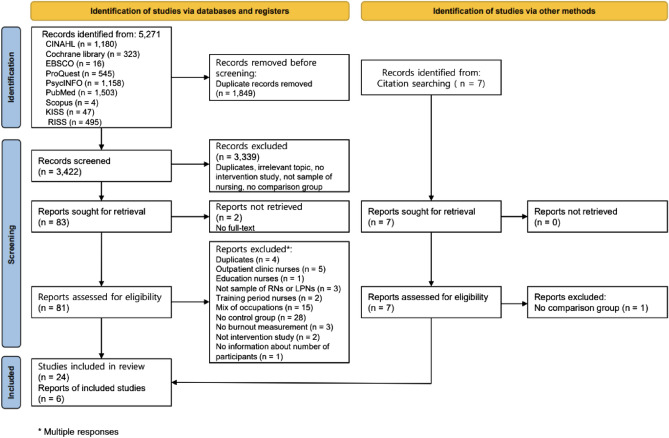
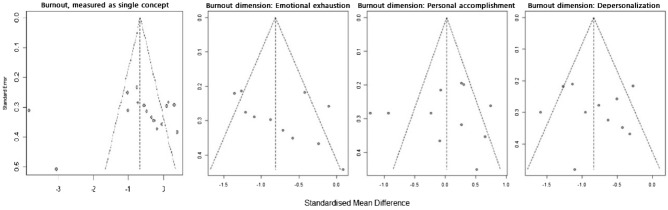
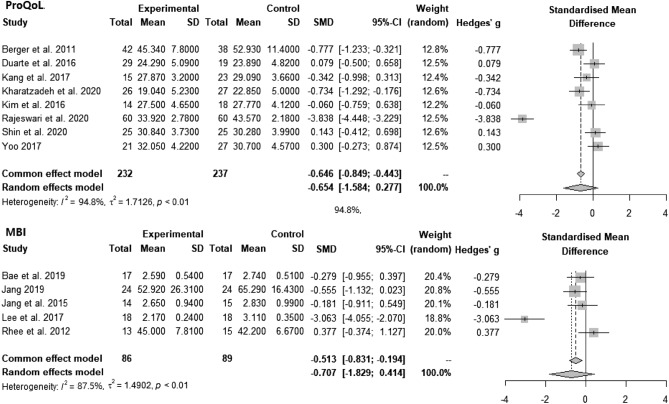
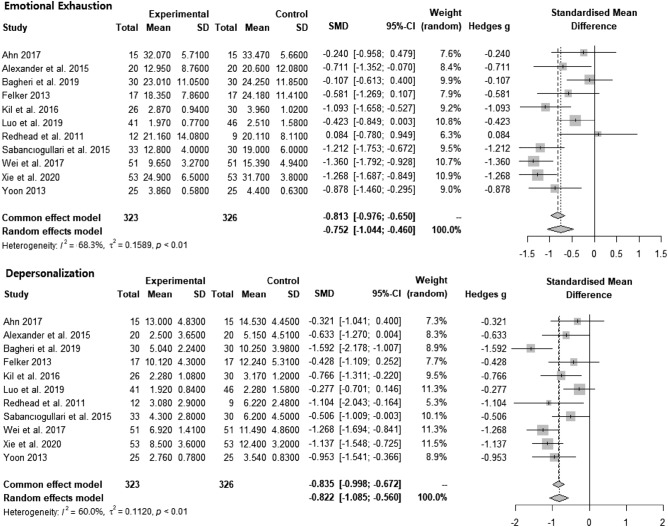
Sporadic evidence exists for burnout interventions in terms of types, dosage, duration, and assessment of burnout among clinical nurses. This study aimed to evaluate burnout interventions for clinical nurses. Seven English databases and two Korean databases were searched to retrieve intervention studies on burnout and its dimensions between 2011 and 2020.check Thirty articles were included in the systematic review, 24 of them for meta-analysis. Face-to-face mindfulness group intervention was the most common intervention approach. When burnout was measured as a single concept, interventions were found to alleviate burnout when measured by the ProQoL (n = 8, standardized mean difference [SMD] = − 0.654, confidence interval [CI] = − 1.584, 0.277, p < 0.01, I 2 = 94.8%) and the MBI (n = 5, SMD = − 0.707, CI = − 1.829, 0.414, p < 0.01, I 2 = 87.5%). The meta-analysis of 11 articles that viewed burnout as three dimensions revealed that interventions could reduce emotional exhaustion (SMD = − 0.752, CI = − 1.044, − 0.460, p < 0.01, I 2 = 68.3%) and depersonalization (SMD = − 0.822, CI = − 1.088, − 0.557, p < 0.01, I 2 = 60.0%) but could not improve low personal accomplishment. Clinical nurses' burnout can be alleviated through interventions. Evidence supported reducing emotional exhaustion and depersonalization but did not support low personal accomplishment.
Overview
The claims and statistics of this paper haven’t been checked yet.
Free: it reads the open-access text and checks the first 5 claims that cite a source we can check. Create a free account to check every claim.
Integrity signals
Registry
Cites
Statistics
Figures
Verification
Claims the paper makes
The claims and statistics of this paper haven’t been checked yet.
Free: it reads the open-access text and checks the first 5 claims that cite a source we can check. Create a free account to check every claim.
Claims other papers make about this one
Each is checked against this paper’s own text: does it say what the citing paper says it does?
The source backs part of the claim, not all of it — or backs it for a different population, condition or comparison.
In the citing paper
“Another meta-analysis among clinical nurses concluded that while individual-level interventions can significantly reduce emotional exhaustion and depersonalization, they are less effective in enhancing personal accomplishment, which may be more closely tied to the workplace environment [7].”
From The Work-life Check-ins randomized controlled trial: a leader-based adaptive, semi-structured burnout intervention in primary care clinics (2024) · cites this paper as [7]
Experimental — accuracy not yet measuredThe source backs part of the claim, not all of it — or backs it for a different population, condition or comparison.
In the citing paper
“Despite the growing body of research on third-wave CBTs, there is a paucity of comprehensive analyses of their effectiveness, specifically for HPs experiencing burnout.”
From Effects of Third-Wave Cognitive Behavioral Therapy for Healthcare Professionals’ Burnout: A Systematic Review and Meta-Analysis (2025) · cites this paper as [24]
Experimental — accuracy not yet measuredThe source backs part of the claim, not all of it — or backs it for a different population, condition or comparison.
In the citing paper
“Previous systematic reviews and meta-analyses have frequently focused on specific CBTs or subsets of HPs.”
From Effects of Third-Wave Cognitive Behavioral Therapy for Healthcare Professionals’ Burnout: A Systematic Review and Meta-Analysis (2025) · cites this paper as [24]
Experimental — accuracy not yet measured
Self-check
Percentages, sums and reported differences re-computed from the paper’s own numbers.
The self-check needs the paper’s full text.
Citations
Cites
The PRISMA 2020 Statement: An Updated Guideline for Reporting Systematic Reviews
Page, M. J., McKenzie, J. E., Bossuyt, P. M., Boutron, I., Hoffmann, T. C., Mulrow, C. D., Shamseer, L., Tetzlaff, J. M., Akl, E. A., Brennan, S. E., et al. (2021) · International Journal of Surgery · doi:10.1016/j.ijsu.2021.105906 · Cited by 11,748
(1996) · Consulting Psychologists Press eBooks · Cited by 7,863
Freudenberger, H. J. (1974) · Journal of Social Issues · doi:10.1111/j.1540-4560.1974.tb00706.x · Cited by 5,463
Burnout in nursing: a theoretical review.
Dall’Ora, C., Ball, J., Reinius, M., & Griffiths, P. (2020) · Human Resources for Health · doi:10.1186/s12960-020-00469-9 · Cited by 1,181
Field, A. P., & Gillett, R. (2010) · British Journal of Mathematical and Statistical Psychology · doi:10.1348/000711010x502733 · Cited by 1,162
Galanis, P., Vraka, I., Fragkou, D., Bilali, A., & Kaitelidou, D. (2021) · Journal of Advanced Nursing · doi:10.1111/jan.14839 · Cited by 993
Global prevalence of burnout symptoms among nurses: a systematic review and meta-analysis
Woo, T., Ho, R., Tang, A., & Tam, W. (2020) · Journal of Psychiatric Research · doi:10.1016/j.jpsychires.2019.12.015 · Cited by 866
The relationship between professional burnout and quality and safety in healthcare: a meta-analysis
Salyers, M. P., Bonfils, K. A., Luther, L., Firmin, R. L., White, D. A., Adams, E. L., & Rollins, A. L. (2017) · Journal of General Internal Medicine · doi:10.1007/s11606-016-3886-9 · Cited by 843
Morgantini, L. A., Naha, U., Wang, H., Francavilla, S., Acar, Ö., Flores, J. M., Crivellaro, S., Moreira, D., Abern, M., Eklund, M., et al. (2020) · PLOS ONE · doi:10.1371/journal.pone.0238217 · Cited by 682
Global nurse shortages—the facts, the impact and action for change
Drennan, V. M., & Ross, F. (2019) · British Medical Bulletin · doi:10.1093/bmb/ldz014 · Cited by 493
Research works printed but not linked: 10
- Maslach C Burned-out Hum. Behav. 1976 5 9 16 22
- Jang OJ Ryu UJ Song HJ The effects of a group art therapy on job stress and burnout among clinical nurses in oncology units J. Korean Clin. Nurs. Res. 2015 21 3 366 376
- Kil KH Song YS Effects on psychological health of nurses in tertiary hospitals by applying a self-cosmetology training program J. Korean Soc. Cosm. 2016 22 6 1444 1453
- Ahn, M. N. The effect of mindfulness-based stress reduction program on nurse's stress, burnout, sleep and happiness. Master’s thesis, Eulji University (Daejeon, 2017).
- Choi KH Kwon S Hong M The effect of an empowerment program for advanced beginner hospital nurses J. Korean Data Anal. Soc. 2016 18 2 1079 1092
- Felker, A. J. An Examination of yoga as a stress reduction intervention for nurses. Doctoral dissertation, Walden University (Minnesota, 2013).
- Jang, Y. M. Development and evaluation of nurse's workplace mutual respect program, Doctoral dissertation, Eulji University (Daejeon, 2019).
- Rhee JS Kim SH Lee WK Shin JG The effects of MBSR(Mindfulness based stress reduction) program on burnout of psychiatric nurses: Pilot study J. Korean Assoc. Soc. Psychiatry 2012 17 1 25 31
- Yoo, D. Effect of an expressive writing program on professional quality of life and resilience of intensive care unit nurses. In Master’s thesis, Cha University (Gyeonggi, 2017).
- Yoon HS Effects of the happy arts therapy program to psychological well-being and emotional exhaust in nurse practitioners Off. J. Korean Soc. Dance Sci. 2013 29 29 53 74
Cited by
Li, L. Z., Yang, P., Singer, S. J., Pfeffer, J., Mathur, M. B., & Shanafelt, T. (2024) · JAMA Network Open · doi:10.1001/jamanetworkopen.2024.43059 · Cited by 501
Lay, K. S. M., & Masingboon, K. (2025) · International Journal of Nursing Studies Advances · doi:10.1016/j.ijnsa.2025.100390 · Cited by 56
From compassion to burnout: emotional labor in oncology nursing — a qualitative study
Salehi, M., Ghasemian, A., Najar, A. V., Nazari, H., & Hooshmand, E. (2025) · BMC Nursing · doi:10.1186/s12912-025-02928-x · Cited by 36
“Several interventions have been explored to mitigate burnout and emotional burden among oncology nurses [14].”
Shoker, D., Desmet, L., Ledoux, N., & Héron, A. (2024) · Frontiers in Public Health · doi:10.3389/fpubh.2024.1381373 · Cited by 33
The association between problematic internet use and burnout: A three-level meta-analysis
Mao, P., Cai, Z., Chen, B., & Sun, X. (2024) · Journal of Affective Disorders · doi:10.1016/j.jad.2024.01.240 · Cited by 30
Frías, C. E., Samarasinghe, N., Cuzco, C., Koorankot, J., de Juan, A., Rudwan, H. M. A., Rahim, H. F. A., Zabalegui, A., Tulley, I., Al-Harahsheh, S. T., et al. (2025) · Frontiers in Medicine · doi:10.3389/fmed.2025.1530287 · Cited by 37
“In Evidence claimed by Lee and Chiyoung (44) supported reducing emotional exhaustion and depersonalization but did not support low personal accomplishment.”
Jin, F., Ni, S., & Wang, L. (2025) · Frontiers in Public Health · doi:10.3389/fpubh.2025.1537120 · Cited by 44
Deriglazov, D., Halamová, J., & Kernová, L. (2025) · Worldviews on Evidence-Based Nursing · doi:10.1111/wvn.70033 · Cited by 39
Alsadaan, N. (2025) · BMC Nursing · doi:10.1186/s12912-025-03421-1 · Cited by 30
Lee, Y.-L., Dai, J.-W., Li, X.-W., Chiang, M.-Y., Chen, P.-T., Lin, Y.-C., & Wang, C. (2024) · BMC Public Health · doi:10.1186/s12889-024-21084-6 · Cited by 39
Johnson, L. G., Madandola, O. O., Santos, F. C. D., Priola, K., Yao, Y., Macieira, T. G. R., & Keenan, G. M. (2025) · The Journal of Perinatal & Neonatal Nursing · doi:10.1097/jpn.0000000000000831 · Cited by 24
Nielsen, C. L., Lindhardt, C. L., Näslund-Koch, L., Frandsen, T. F., Clemensen, J., & Timmermann, C. (2024) · Journal of Advanced Nursing · doi:10.1111/jan.16484 · Cited by 20
Chunxia, L., Ding, Y., Wang, D., & Deng, C. (2025) · Journal of Advanced Nursing · doi:10.1111/jan.16761 · Cited by 23
Person-directed burnout intervention for nurses: A systematic review of psychoeducational approaches
Sharin, I. A., Jinah, N., Bakit, P. A., Adnan, I. K., Zakaria, N. H. B., Subki, S. Z. A., Zakaria, N., & Lee, K. Y. (2025) · PLoS ONE · doi:10.1371/journal.pone.0322282 · Cited by 30
“The lack of impact exerted by the burnout intervention on the domains of PA can be attributed to the problem-solving-centric components, such as empowering the participants with stress reduction and coping skills that are more beneficial for the domains of EE and DP [23].”
InfluentialCosta, J. F., Moran, N., Marti, C. G., Hernandez, L. J. C., Ciorba, F. R. C., & Ciudad, M. J. (2024) · JMIR XR and spatial computing. · doi:10.2196/55678 · Cited by 17
“This aligns with the findings of Lee and Cha [42], indicating the need for refined VR strategies to balance reducing burnout and boosting work engagement in health care.”
ResultPsychoeducational Burnout Intervention for Nurses: Protocol for a Systematic Review
Sharin, I. A., Jinah, N., Bakit, P. A., Adnan, I. K., Zakaria, N. H., Mohmad, S., Subki, S. Z. A., Zakaria, N., & Lee, K. Y. (2024) · JMIR Research Protocols · doi:10.2196/58692 · Cited by 20
“For instance, Zhang et al [32] focused on nurses as well as physicians, whereas Lee and Cha [33] targeted clinical nurses solely.”
Past the tipping point: Understanding and addressing burnout among nursing students
Boamah, S. A., Olarte‐Godoy, J., Jack, S. M., Root, F., & Halladay, J. E. (2024) · Nurse Education Today · doi:10.1016/j.nedt.2024.106319 · Cited by 21
Gill, S. K., & Kennedy-Metz, L. R. (2025) · International Journal for Quality in Health Care · doi:10.1093/intqhc/mzaf033 · Cited by 19
Collett, G., Gupta, J., Eltayeb, A., Korszun, A., Sharples, L. D., Rice, K. M., & Gupta, A. K. (2025) · Annals of Internal Medicine · doi:10.7326/annals-25-00469 · Cited by 20
Determinants of clinical nurses’ patient safety competence: a systematic review protocol
Park, J.-H., Lee, N., Lee, H., & Park, G. (2024) · BMJ Open · doi:10.1136/bmjopen-2023-080038 · Cited by 20
“31 Therefore, this study aims to encompass a diverse group of clinical nurses, including medical, surgical and intensive care unit nurses.”
BackgroundHealth Worker Burnout and Moral Injury: Drivers, Effects, and Remedies
Grumbach, K., & Willard‐Grace, R. (2025) · Annual Review of Public Health · doi:10.1146/annurev-publhealth-071823-122832 · Cited by 19
Schwartz‐Mette, R. A., Sapp, M., & Strout, K. A. (2025) · Worldviews on Evidence-Based Nursing · doi:10.1111/wvn.70031 · Cited by 14
Burned Out on Burnout—The Urgency of Equity-Minded Structural Approaches to Support Nurses
Cunningham, T., & Gonzalez-Guarda, R. M. (2023) · JAMA Health Forum · doi:10.1001/jamahealthforum.2023.5249 · Cited by 9
Zhang, S., Zhang, X., Zhang, L., Zhang, Q., Liu, H., Li, L., Huang, T., & He, Y. (2026) · Journal of Nursing Management · doi:10.1155/jonm/6694491 · Cited by 16
“…as incorporating short mindfulness practices into morning briefngs, using digital platforms (e.g., WeChat groups) for peer refection or integrating feedback into routine handovers—could provide more realistic avenues for implementation without overburdening clinical de-partments [40–42].”
Systematic review of servant leadership and burnout
Mahon, D. (2024) · Mental Health and Social Inclusion · doi:10.1108/mhsi-02-2024-0027 · Cited by 11
Campione, A., & Henschke, C. (2025) · BMC Nursing · doi:10.1186/s12912-025-03745-y · Cited by 10
The Economic Burden of BurnoutPreprint
Nekoei, A., Sigurðsson, J., & Wehr, D. (2024) · SSRN Electronic Journal · doi:10.2139/ssrn.4827359 · Cited by 14
Liu, H., Li, X., Zhao, L., Zhang, Y., Huang, D., Li, T. X., Xie, K., & Shen, Y. (2025) · BMJ Open · doi:10.1136/bmjopen-2025-099192 · Cited by 13
“Improving the well-being of these frontline workers is crucial for maintaining the operational integrity of the healthcare system during crises.”
Zhang, C., Feng, J., Li, D., & Wang, H. (2026) · Frontiers in Public Health · doi:10.3389/fpubh.2026.1719915 · Cited by 7
Giménez‐Díez, D., Leyva‐Moral, J. M., Watson, C., & Bernabeu‐Tamayo, M. D. (2024) · Journal of Psychiatric and Mental Health Nursing · doi:10.1111/jpm.13116 · Cited by 6
Do nurse spiritual responses to trauma explain nurse outcomes? A correlational observational study
Taylor, E. J., Morrell, H. E. R., Ada, H. M., Dupée, C., Jordan, M., Radovich, P., & Boyd, K. C. (2024) · Nursing Outlook · doi:10.1016/j.outlook.2024.102296 · Cited by 7
Shigematsu, J., Hako, S., Toyokuni, C., Kambara, K., Tanabe, S., Machino, A., Takebayashi, M., & Ogata, A. (2024) · Current Psychology · doi:10.1007/s12144-024-07062-6 · Cited by 7
“A similar mechanism can be inferred from the effectiveness of mindful - ness-based approaches to burnout (Lee & Cha, 2023).”
Dangal, R. K., Studer, E., Gupta, T. K., Nguyen, K., Suneja, A., Khadka, K., Shrestha, S. B., & Acharya, B. (2025) · BMC Health Services Research · doi:10.1186/s12913-025-12294-8 · Cited by 8
Pike, N. A., Dougherty, C. M., Black, T., Freedenberg, V. A., Green, T., Howie‐Esquivel, J., Pucciarelli, G., Souffront, K., & Laurent, P. S. (2024) · Journal of the American Heart Association · doi:10.1161/jaha.124.038199 · Cited by 6
“9,71,72 Data also suggest that there are differences in the prevalence of stress and burnout between countries.”
Nurses, Psychological Distress, and Burnout: Is There an App for That?
Murali, K. P., Brody, A. A., & Stimpfel, A. W. (2023) · Annals of the American Thoracic Society · doi:10.1513/annalsats.202307-629ed · Cited by 4
Hurtado, D. A., Boyd, J., Madjlesi, R., Greenspan, S. A., Ezekiel-Herrera, D., Potgieter, G., Hammer, L. B., Everson, T., & Lenhart, A. (2024) · Contemporary Clinical Trials · doi:10.1016/j.cct.2024.107609 · Cited by 3
Han, J.-H., Lee, M., Cha, C., & Baek, G. (2025) · Healthcare · doi:10.3390/healthcare13243253 · Cited by 3
“For example, meta-analysis studies on mindfulness-based interventions for nurses [24,25] and a systematic review of mindfulness [26] were conducted to retrieve evidence for CBT for HP burnout.”
Self-citationFostering Workforce Wellness: Insights from Nurse Managers and Early Childhood Educators
Charlot‐Swilley, D., Zuskov, S. F., Curtis, L., Mitchell, S., & Anderson, E. (2025) · Healthcare · doi:10.3390/healthcare13050487 · Cited by 6
A meta-analysis of parental burnout interventions
Urbanowicz, A. M., Verger, N. B., Shankland, R., Rance, J. Y., Bennett, P. D., & Gauchet, A. (2025) · Journal of Affective Disorders · doi:10.1016/j.jad.2025.121022 · Cited by 6
Hu, X., Liu, C., & Yang, X. (2025) · Journal of Nursing Management · doi:10.1155/jonm/2572646 · Cited by 4
“Currently, burnout intervention measures in nursing management often rely on generalized universal approaches (such as self-care activities and mindfulness practices) and lack specifcity to the needs of individuals or groups [60, 61].”
Hughes, T., & Robertson, N. (2026) · Maturitas · doi:10.1016/j.maturitas.2026.108964 · Cited by 3
Labrague, L. J., Sabei, S. D. A., Rawajfah, O. A., Burney, I. A., & ABUALRUB, R. F. (2025) · International Journal of Nursing Practice · doi:10.1111/ijn.70026 · Cited by 5
Leenen, J. P. L., Lok-Visser, J., Vollenbroek, C., Sonneveld, H., van Houwelingen, T., & Leeftink, G. (2025) · PLOS Digital Health · doi:10.1371/journal.pdig.0000974 · Cited by 3
Abundo, M. F., & Sav, A. (2025) · Healthcare · doi:10.3390/healthcare13172113 · Cited by 7
“While it is unclear whether the decline reflects natural fading or other factors, research shows that without ongoing support, early gains in resilience and accomplishment often diminish over time [28,29].”
Community‐based health programme for nurses and midwives: A mixed methods evaluation
Jarden, R., Jarden, A., Bujalka, H., Weiland, T. J., Brockenshire, N., Taylor, G., & Gerdtz, M. F. (2024) · Journal of Advanced Nursing · doi:10.1111/jan.16336 · Cited by 4
Liu, J., Gu, S., Song, C.-M., Yang, H., Shi, Y., Gu, Y.-F., Wang, S.-F., & Chen, Y. (2025) · Frontiers in Public Health · doi:10.3389/fpubh.2025.1595550 · Cited by 2
“Globally, approximately 30% of nurses experience occupational burnout (3), leading to increased turnover rates (4), economic losses (5), and compromised patient safety (6).”
Gigola, F., Italiano, F., Riccio, M. D., Cassaro, F., Corso, L. D., Pagliara, C., & Zambaiti, E. (2025) · Journal of Pediatric Surgery · doi:10.1016/j.jpedsurg.2025.162647 · Cited by 3
Psychological capital, work stress and burnout among Chinese clinical nurses
Song, G., & Landicho, L. C. (2023) · International Journal of Research Studies in Psychology · doi:10.5861/ijrsp.2023.2004 · Cited by 3
High-Level Burnout in Physicians and Nurses Working in Adult Intensive Care Units
Cooper, A. S. (2024) · Critical Care Nurse · doi:10.4037/ccn2024113 · Cited by 4
The Economic Burden of BurnoutPreprint
Nekoei, A., Sigurðsson, J., & Wehr, D. (2024) · SSRN Electronic Journal · doi:10.2139/ssrn.4856947 · Cited by 19
Aleksitimi ile Duygusal Tükenmişlik Arasındaki İlişki: Eğitim Çalışanları Üzerine Bir Araştırma
Durmuş, Ş. (2024) · Selçuk Üniversitesi Sosyal Bilimler Meslek Yüksekokulu dergisi · doi:10.29249/selcuksbmyd.1481050 · Cited by 2
Lalovic, A., Hyde, M., Bergmans, Y., Kiriakidis, A., Ebegbare, N., Verduyn, A., & Rizvi, S. J. (2025) · Canadian Journal of Nursing Research · doi:10.1177/08445621251354918 · Cited by 2
“We observed improvements in burnout and secondary traumatic stress, depression and anxiety symptoms, consistent with some studies of mindfulness and psychoeducation interventions (Cocker & Joss, 2016; Lee & Cha, 2023; Melnyk et al., 2020; Ramachandran et al., 2023; Wasson et al., 2020).”
InfluentialSchröter, M., Koch, A. K., Berschick, J., Schiele, J. K., Bogdanski, M., Steinmetz, M., Czakert, J., Stritter, W., Keßler, C. S., & Seifert, G. (2025) · Scientific Reports · doi:10.1038/s41598-025-12543-0 · Cited by 2
“The most common interventions on individual-level were mind-body medicine (MBM) approaches, especially mindfulness-based programs 16,18,19 .”
InfluentialBurnout in Nurses in Aotearoa New Zealand: A post-COVID Analysis
Toma, G., Fevre, D. M. L., Topp, M., & Rubie-Davies, C. M. (2025) · Nursing Praxis in Aotearoa New Zealand · doi:10.36951/001c.143520 · Cited by 1
Thai Burnout Assessment Tool (T-BAT): Translation, validity, and reliability testing in nurses
Posai, V., Srisintorn, W., Thongsuksai, P., & Jitpanya, C. (2025) · Belitung Nursing Journal · doi:10.33546/bnj.4086 · Cited by 1
“This supports the implementation of targeted interventions — such as workload adjustment, resilience training, and psychological support — to mitigate burnout and promote workforce well-being (Lee & Cha, 2023).”
Jiang, C., & Gao, Q. (2025) · Frontiers in Psychology · doi:10.3389/fpsyg.2025.1706567 · Cited by 2
Lorenzo, R. D., Incerti, M., Bandiera, G., Biral, C., Cavana, S., Santo, L. D., Mele, G., Vanni, C., Rovesti, S., & Ferri, P. (2025) · Risk Management and Healthcare Policy · doi:10.2147/rmhp.s534164 · Cited by 2
“24,25 Many studies highlight how the quality of professional life of nurses is positively influenced by a good level of personal empathy and negatively by factors related to burnout.”
From Stress to Departure: A Concept Analysis of Burnout in New Graduate Nurses
Crawford, S., & Booth, R. G. (2026) · Nursing Forum · doi:10.1155/nuf/6622919 · Cited by 1
Lippe, M. M. F. (2025) · Journal of Medical and Biosciences Research. · doi:10.70164/jmbr.v2i1.451 · Cited by 4
Uminah, U., Handiyani, H., & Kuntarti, K. (2025) · Malahayati International Journal of Nursing and Health Science · doi:10.33024/minh.v8i5.1188
BURNOUT EN ENFERMERAS Y ERRORES EN LA ADMINISTRACIÓN DE MEDICAMENTOS
García, R. P., & García, M. P. (2023) · Benessere Revista de Enfermería · doi:10.22370/bre.81.2023.3889
Summary of best evidence for interventions for nurse burnoutPreprint
Liping, W., Li, G., Liu, J., Diao, Y., & Yu, Z. (2024) · medRxiv · doi:10.1101/2024.06.27.24309626 · Cited by 1
“…yes yes yes yes yes yes yes yes not mentioned y Jun [24] yes yes yes yes yes yes yes yes not mentioned y Velando [25] yes Zhang [28] yes yes yes yes yes Not mentioned yes yes not mentioned y Lee [29] yes yes yes yes yes yes yes yes yes y Wang Fen [30] yes yes yes yes yes yes yes yes not mentioned y”
BackgroundInfluentialExperiences of nurse preceptors in a continuity-aligned dedicated education unit
Stubbs, M. A., Porteous, B., Reis, J., Kelly, M., Vandy, C., Olaisen, J.-A., Makaza, M., Mollart, L. J., Koizumi, N., Volegoff, K., et al. (2025) · Contemporary Nurse · doi:10.1080/10376178.2025.2529231
“Burden and burnout are well documented contributory factors to nursing workforce shortages (Galanis et al., 2023; Lee & Cha, 2023; Ren et al., 2024).”
Effectiveness of the mood shifter ball intervention on stress and burnout among nurses
Seethalakshmi, A., Raj, J. M., & Poomalai, G. (2025) · Journal of Education and Health Promotion · doi:10.4103/jehp.jehp_2163_24 · Cited by 1
“[24] This study implemented a four‑week intervention, and similar studies have shown that repeated, in‑person mindfulness programs can significantly reduce burnout by fostering emotional well‑being and resilience.”
Tajima, K., Azuma, T., Kita, A., Shimoyama, Y., Tada, H., Nishimura, Y., Mukobayashi, C., Deguchi, H., Yanagimoto, R., & Yanaoka, K. (2025) · An Official Journal of the Japan Primary Care Association · doi:10.14442/generalist.48.90
Kurawaki, Y., Aimi, R., Misumi, K., Matsumoto, A., Mitsui, M., Asaeda, M., Nishimura, R., Takemoto, T., & Naito, M. (2025) · BMC Medical Education · doi:10.1186/s12909-025-08077-8
“This pattern is consistent with research indicating that training programs for healthcare workers require sustained reinforcement to maintain effectiveness and prevent burnout [34].”
Yang, J., Zhang, R., Zhong, Y., Wang, Y., & Liu, S. (2025) · medRxiv · doi:10.1101/2025.11.06.25339703
A Narrative Inquiry into Junior Nurses’ Psychological Recovery After Adverse Events in China
Qi, L., Xu, J., & Mao, A. (2026) · Healthcare · doi:10.3390/healthcare14060707
“Subsequent research has confirmed that these emotional injuries can harm a provider’s well-being and performance, leading to burnout or leaving the profession if unaddressed [2–4].”
Work Experience, Nursing Competency, and Self-Compassion of Nurses in San Pablo City
Aguila, A. L., Iranzo, B. J., Sarmiento, T. A., Briones, J. C., Quintana, M. L., & Lajara, V. P. (2026) · Journal of interdisciplinary perspectives · doi:10.69569/jip.2026.064
Agyei, F., Affum, P., Amoah, D. O., Apiiyah, B. L., Anane, B. T., Danso, N., Agyeiwaa, C., Kando, S. B., & Yabani, P. A. (2026) · Journal of Mental Health · doi:10.1080/09638237.2026.2645549 · Cited by 1
“Furthermore, burnout undermines progress toward universal health coverage by limiting the capacity of health systems to address the increasing healthcare demands of populations (Ayisi-Boateng et al., 2020; Chemali et al., 2019; Khasne et al., 2020; Lee & Cha, 2023).”
Kiss, H., Balogh, Z., Szabó, A. P., Nyilas, O., & Takács, P. (2026) · BMC Nursing · doi:10.1186/s12912-026-04579-y
“The effectiveness of burnout-reducing interventions among nurses – particularly person-directed psychoeducational approaches (e.g., mindfulness-based and cognitive-behavioral interventions) – is supported by systematic reviews and meta-analyses [21, 22].”
Ayoub, A. Y., Maree, C., & van Wyk, N. (2026) · Nursing Reports · doi:10.3390/nursrep16040145 · Cited by 1
“…that produced a reduction in burnout at one month, with attenuation by six months, mirrors findings in reviews where mindfulness-based and multimodal programmes yield small to moderate improvements in burnout that are often not sustained in the absence of wider organisational change [22].”
Network analysis of factors affecting the quality of life of nurses
Zhou, J., Liu, Z., Kan, Y., Wan, B., Bu, T., Yang, Y., & Qiao, Z. (2026) · Frontiers in Organizational Psychology · doi:10.3389/forgp.2026.1734686
Frey, E., Chong, Y. Y., Chien, W. T., & Gloster, A. T. (2026) · BMC Nursing · doi:10.1186/s12912-026-04587-y
“In line with our findings, the systematic review by Lee and Cha [54], which examined the effects of intervention to reduce burnout among nurses, found no improvement in personal accomplishment and also suggested that achieving personal accomplishment is strongly influenced by workplace factors,…”
Liu, X., Wang, H., Tian, S., Guo, X., & Cao, H. (2026) · International Journal of Nursing Studies · doi:10.1016/j.ijnurstu.2026.105622 · Cited by 2
Tang, Y. H., Kong, D., Zhou, J., Li, Y., Li, S., & Pu, C. (2026) · Frontiers in Public Health · doi:10.3389/fpubh.2026.1835612
“Although these approaches can alleviate stress responses to some extent, they often fail to fully address the individualized needs of individuals or specific groups (45, 46).”
Kim, Y., Cha, C., & Baek, G. (2026) · JMIR mhealth and uhealth · doi:10.2196/85986
“Despite growing evidence supporting the effectiveness of CBT-based interventions in reducing burnout among nurses, most studies have focused on evaluating the effects of a single standardized program [16].”
InfluentialSelf-citationTailoring the unified protocol for the treatment of burnout: A co-design approach
Gândilă, A., Rusu, A., Pap, Z., Tulbure, B. T., Vîrgă, D., & Sauer-Zavala, S. E. (2026) · Acta Psychologica · doi:10.1016/j.actpsy.2026.107443
GLOBAL RESEARCH TRENDS ON NURSE BURNOUT WITHIN HEALTHCARE SYSTEMS: A BIBLIOMETRIC ANALYSIS
Kiprawi, M. S., Bakar, N. A. A., Rahman, R. A. A., & Ismail, H. (2026) · International Journal of Entrepreneurship and Management Practices · doi:10.35631/ijepc.1163048
Doğrusöz, L. A., Polat, Ş., & Yeşil, A. (2026) · Work · doi:10.1177/10519815261466616
Online vs. face-to-face laughter yoga to support nurses’ well-being: A pilot randomized trial
TOPSAKAL, Ö., Erdenilgen, Ö., Yılmaz, R., & Dönmez, P. (2026) · Work · doi:10.1177/10519815261472875
Kwon, D. Y., Kim, H. J., & Kim, H. Y. (2026) · INQUIRY The Journal of Health Care Organization Provision and Financing · doi:10.1177/00469580261478035
“6,19 Lee and Cha 34 demonstrated that stress management interventions are highly effective in reducing burnout among clinical nurses.”
Yang, Y., Wen, J., Wan, H., Yang, Q., Guan, J., Min, L., Jia, S., Wang, Z., & Gary, J. (2026) · Frontiers in Public Health · doi:10.3389/fpubh.2026.1879258
“Existing reviews have often combined nurses with other healthcare workers, focused on traditional face-to-face interventions, or examined a single digital modality such as mindfulness apps (8, 10, 12, 14, 15).”
InfluentialLotfy, E. M., Alenezi, I. N., Alanazi, F. K., Salem, S. G. A., Ammar, N. A. A., Saleh, M. S. M., Alshmemri, M., & Aldughmi, O. N. (2026) · Healthcare · doi:10.3390/healthcare14183015
A Narrative Review on Nurse Burnout: Prevalence, Determinants, and Protective Mechanisms
Fazeli, B. (2026) · Journal of Multidisciplinary Care · doi:10.34172/jmdc.1432
Metadata
- Authors
- Lee, M., & Cha, C.
- Affiliations
- Ewha Womans University (KR)
- Corresponding author
- Cha, Chiyoung
- Venue
- Scientific Reports
- Published
- 2023-07-06
- Volume
- 13
- Issue
- 1
- Pages
- 10971-10971
- ISSN
- 2045-2322 (ISSN-L)
- PMC
- PMC10325963
- OpenAlex
- W4383342085
- Cited by
- 84
- References
- 53
- Citations by year
- 2026: 22 · 2025: 36 · 2024: 22 · 2023: 4
- FWCI
- 5.49
- Type
- journal article
- Language
- en
- Open access
- gold
- doi.org
- Licence
- cc-by
- creativecommons.org/licenses/by/4.0 (tdm)
- creativecommons.org/licenses/by/4.0 (vor)
- Locations
- Scientific Reports (publishedVersion, cc-by)
- PubMed Central (publishedVersion, cc-by)
- PubMed (publishedVersion)
- DOAJ (DOAJ: Directory of Open Access Journals) (submittedVersion, cc-by-sa)
- Funders
- National Research Foundation of Korea (2021R1A2C2008166)
- Topics
- Health Sciences › Medicine › Public Health, Environmental and Occupational Health › Occupational Health and Burnout
- Social Sciences › Psychology › Social Psychology › Stress and Burnout Research
- Health Sciences › Health Professions › General Health Professions › Healthcare professionals’ stress and burnout
- Keywords
- burnout, clinical nurses, burnout intervention, emotional exhaustion, depersonalization, personal accomplishment, ProQOL, Maslach Burnout Inventory, nurse well-being
- MeSH terms
- Achievement, Burnout, Professional, Emotions, Humans, Nurses, Mindfulness
About these checks
Registry, retraction, Cites and statistics results are computed, not judged, with one exception: a printed reference that no index lists is read once by a model before it counts as a citation error. Claims are extracted by a model and kept only when their quote appears verbatim in the text; each cited source is then checked, with a model’s help, for whether it says what the claim relies on. Those verdicts can be wrong — read the claim’s quote and the cited source before relying on one.
Statistics and arithmetic are recomputed, not judged.
Confidence bands are shown only for fields calibrated on our annotated test set. None is calibrated yet, so no band is shown.
What counts as a claim ›How we measure confidence ›How we check this ›
Are you an author, or do you see a problem with this page? Request a review
Data sources
Bibliographic data: Semantic Scholar, OpenAlex, Crossref.
Contains information from the Semantic Scholar Academic Graph Datasets, made available under the ODC Attribution License (ODC-BY 1.0).
Semantic Scholar’s data is described in: Kinney, R., et al. (2023). The Semantic Scholar Open Data Platform. arXiv:2301.10140.
