

Interventions to reduce burnout among clinical nurses: systematic review and meta-analysis
Open accessThe DOI matches its Crossref record; 54 of the 54 references it cites were found in a registry or an index.
Abstract
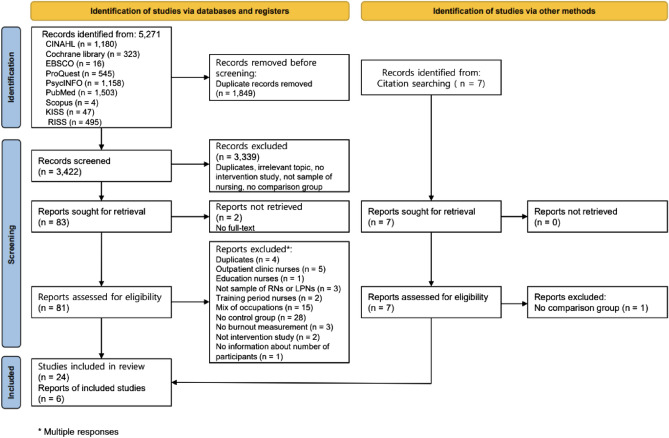
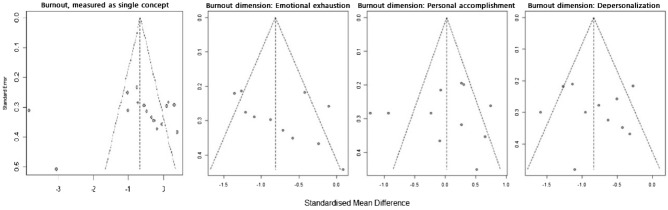
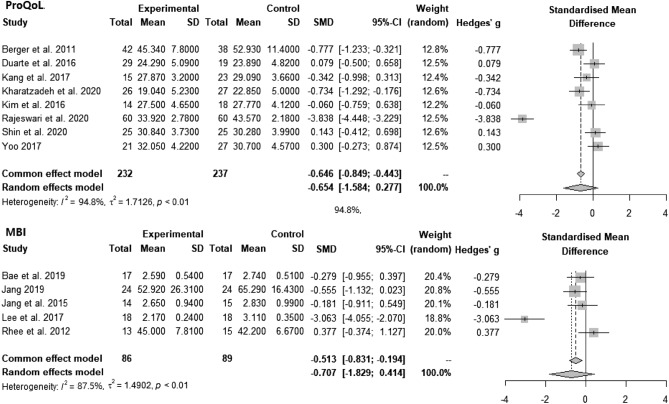
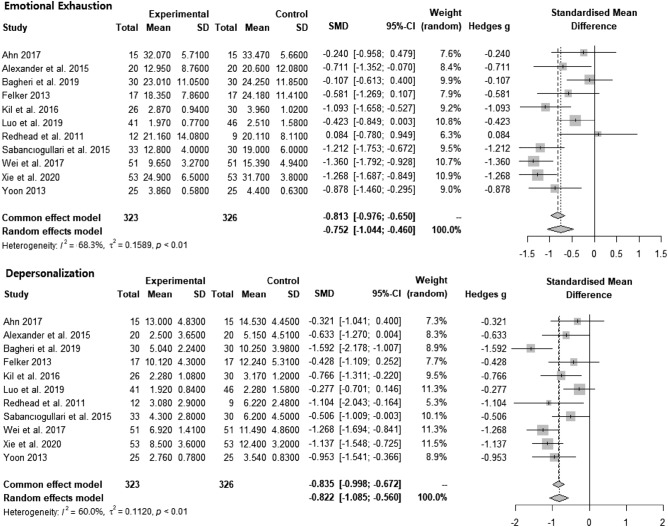
Sporadic evidence exists for burnout interventions in terms of types, dosage, duration, and assessment of burnout among clinical nurses. This study aimed to evaluate burnout interventions for clinical nurses. Seven English databases and two Korean databases were searched to retrieve intervention studies on burnout and its dimensions between 2011 and 2020.check Thirty articles were included in the systematic review, 24 of them for meta-analysis. Face-to-face mindfulness group intervention was the most common intervention approach. When burnout was measured as a single concept, interventions were found to alleviate burnout when measured by the ProQoL (n = 8, standardized mean difference [SMD] = − 0.654, confidence interval [CI] = − 1.584, 0.277, p < 0.01, I 2 = 94.8%) and the MBI (n = 5, SMD = − 0.707, CI = − 1.829, 0.414, p < 0.01, I 2 = 87.5%). The meta-analysis of 11 articles that viewed burnout as three dimensions revealed that interventions could reduce emotional exhaustion (SMD = − 0.752, CI = − 1.044, − 0.460, p < 0.01, I 2 = 68.3%) and depersonalization (SMD = − 0.822, CI = − 1.088, − 0.557, p < 0.01, I 2 = 60.0%) but could not improve low personal accomplishment. Clinical nurses' burnout can be alleviated through interventions. Evidence supported reducing emotional exhaustion and depersonalization but did not support low personal accomplishment.
Overview
The claims and statistics of this paper haven’t been checked yet.
Free: it reads the open-access text and checks the first 5 claims that cite a source we can check. Create a free account to check every claim.
Integrity signals
Registry
Cites
Statistics
Figures
Verification
Claims the paper makes
The claims and statistics of this paper haven’t been checked yet.
Free: it reads the open-access text and checks the first 5 claims that cite a source we can check. Create a free account to check every claim.
Claims other papers make about this one
Each is checked against this paper’s own text: does it say what the citing paper says it does?
The source backs part of the claim, not all of it — or backs it for a different population, condition or comparison.
In the citing paper
“Another meta-analysis among clinical nurses concluded that while individual-level interventions can significantly reduce emotional exhaustion and depersonalization, they are less effective in enhancing personal accomplishment, which may be more closely tied to the workplace environment [7].”
From The Work-life Check-ins randomized controlled trial: a leader-based adaptive, semi-structured burnout intervention in primary care clinics (2024) · cites this paper as [7]
Experimental — accuracy not yet measuredThe source backs part of the claim, not all of it — or backs it for a different population, condition or comparison.
In the citing paper
“Despite the growing body of research on third-wave CBTs, there is a paucity of comprehensive analyses of their effectiveness, specifically for HPs experiencing burnout.”
From Effects of Third-Wave Cognitive Behavioral Therapy for Healthcare Professionals’ Burnout: A Systematic Review and Meta-Analysis (2025) · cites this paper as [24]
Experimental — accuracy not yet measuredThe source backs part of the claim, not all of it — or backs it for a different population, condition or comparison.
In the citing paper
“Previous systematic reviews and meta-analyses have frequently focused on specific CBTs or subsets of HPs.”
From Effects of Third-Wave Cognitive Behavioral Therapy for Healthcare Professionals’ Burnout: A Systematic Review and Meta-Analysis (2025) · cites this paper as [24]
Experimental — accuracy not yet measured
Self-check
Percentages, sums and reported differences re-computed from the paper’s own numbers.
The self-check needs the paper’s full text.
Citations
Cites
The PRISMA 2020 Statement: An Updated Guideline for Reporting Systematic Reviews
Page, M. J., McKenzie, J. E., Bossuyt, P. M., Boutron, I., Hoffmann, T. C., Mulrow, C. D., Shamseer, L., Tetzlaff, J. M., Akl, E. A., Brennan, S. E., et al. (2021) · International Journal of Surgery · doi:10.1016/j.ijsu.2021.105906 · Cited by 11,748
(1996) · Consulting Psychologists Press eBooks · Cited by 7,863
Freudenberger, H. J. (1974) · Journal of Social Issues · doi:10.1111/j.1540-4560.1974.tb00706.x · Cited by 5,463
Burnout in nursing: a theoretical review.
Dall’Ora, C., Ball, J., Reinius, M., & Griffiths, P. (2020) · Human Resources for Health · doi:10.1186/s12960-020-00469-9 · Cited by 1,181
Field, A. P., & Gillett, R. (2010) · British Journal of Mathematical and Statistical Psychology · doi:10.1348/000711010x502733 · Cited by 1,162
Galanis, P., Vraka, I., Fragkou, D., Bilali, A., & Kaitelidou, D. (2021) · Journal of Advanced Nursing · doi:10.1111/jan.14839 · Cited by 993
Global prevalence of burnout symptoms among nurses: a systematic review and meta-analysis
Woo, T., Ho, R., Tang, A., & Tam, W. (2020) · Journal of Psychiatric Research · doi:10.1016/j.jpsychires.2019.12.015 · Cited by 866
The relationship between professional burnout and quality and safety in healthcare: a meta-analysis
Salyers, M. P., Bonfils, K. A., Luther, L., Firmin, R. L., White, D. A., Adams, E. L., & Rollins, A. L. (2017) · Journal of General Internal Medicine · doi:10.1007/s11606-016-3886-9 · Cited by 843
Morgantini, L. A., Naha, U., Wang, H., Francavilla, S., Acar, Ö., Flores, J. M., Crivellaro, S., Moreira, D., Abern, M., Eklund, M., et al. (2020) · PLOS ONE · doi:10.1371/journal.pone.0238217 · Cited by 682
Global nurse shortages—the facts, the impact and action for change
Drennan, V. M., & Ross, F. (2019) · British Medical Bulletin · doi:10.1093/bmb/ldz014 · Cited by 493
Systematic review of burnout among healthcare providers in sub-Saharan Africa
Dubale, B. W., Friedman, L. E., Chemali, Z., Denninger, J. W., Mehta, D. H., Alem, A., Fricchione, G. L., Dossett, M. L., & Gelaye, B. (2019) · BMC Public Health · doi:10.1186/s12889-019-7566-7 · Cited by 327
Prevalence of burnout in paediatric nurses: A systematic review and meta-analysis
Pradas-Hernández, L., Ariza, T., Gómez-Urquiza, J. L., Albendín-García, L., De la Fuente, E. I., & Cañadas-De la Fuente, G. A. (2018) · PLOS ONE · doi:10.1371/journal.pone.0195039 · Cited by 250
Zhang, X.-J., Song, Y., Jiang, T., Ding, N., & Shi, T.-Y. (2020) · Medicine · doi:10.1097/md.0000000000020992 · Cited by 233
Duarte, J., & Pinto-Gouveia, J. (2016) · International Journal of Nursing Studies · doi:10.1016/j.ijnurstu.2016.10.002 · Cited by 225
Suleiman‐Martos, N., Gomez‐Urquiza, J. L., Aguayo‐Estremera, R., Cañadas‐De La Fuente, G. A., De La Fuente‐Solana, E. I., & Albendín‐García, L. (2020) · Journal of Advanced Nursing · doi:10.1111/jan.14318 · Cited by 217
Interdisciplinary teamwork in hospitals: A review and practical recommendations for improvement
O'Leary, K. J., Sehgal, N. L., Terrell, G., Williams, M. V., & for the High Performance Teams and the Hospital of the Future Project Team (2012) · Journal of Hospital Medicine · doi:10.1002/jhm.970 · Cited by 211
The Effects of Mindfulness Meditation on Stress and Burnout in Nurses
Green, A. A., & Kinchen, E. V. (2021) · Journal of Holistic Nursing · doi:10.1177/08980101211015818 · Cited by 191
A Meta-Analysis of the Effects of Coping Strategies on Reducing Nurse Burnout
Lee, H., Kuo, C., Chien, T., & Wang, Y.-R. (2016) · Applied Nursing Research · doi:10.1016/j.apnr.2016.01.001 · Cited by 191
Levels of Burnout and Risk Factors in Medical Area Nurses: A Meta-Analytic Study
Molina-Praena, J., Ramirez-Baena, L., Gómez-Urquiza, J. L., Cañadas, G. R., De la Fuente, E. I., & Cañadas-De la Fuente, G. A. (2018) · International Journal of Environmental Research and Public Health · doi:10.3390/ijerph15122800 · Cited by 187
Bruyneel, A., Smith, P., Tack, J., & Pirson, M. (2021) · Intensive and Critical Care Nursing · doi:10.1016/j.iccn.2021.103059 · Cited by 183
Yoga for Self-Care and Burnout Prevention Among Nurses
Alexander, G. K., Rollins, K., Walker, D., Wong, L., & Pennings, J. (2015) · Workplace Health & Safety · doi:10.1177/2165079915596102 · Cited by 180
Nurse Burnout, Nurse‐Reported Quality of Care, and Patient Outcomes in Thai Hospitals
Nantsupawat, A., Nantsupawat, R., Kunaviktikul, W., Turale, S., & Poghosyan, L. (2016) · Journal of Nursing Scholarship · doi:10.1111/jnu.12187 · Cited by 179
Dincer, B., & Inangil, D. (2021) · EXPLORE · doi:10.1016/j.explore.2020.11.012 · Cited by 179
Sabancıogullari, S., & Dogan, S. (2015) · International Journal of Nursing Practice · doi:10.1111/ijn.12330 · Cited by 142
Berger, R., & Gelkopf, M. (2010) · International Journal of Nursing Studies · doi:10.1016/j.ijnurstu.2010.09.007 · Cited by 113
Rudman, A., Arborelius, L., Dahlgren, A., Finnes, A., & Gustavsson, P. (2020) · eClinicalMedicine · doi:10.1016/j.eclinm.2020.100565 · Cited by 108
Ramirez-Baena, L., Ortega-Campos, E., Gomez-Urquiza, J. L., Cañadas-De la Fuente, G. R., De la Fuente-Solana, E. I., & Cañadas-De la Fuente, G. A. (2019) · Journal of Clinical Medicine · doi:10.3390/jcm8010092 · Cited by 94
Interventions on reducing burnout in physicians and nurses: A systematic review
Aryankhesal, A., Mohammadibakhsh, R., Hamidi, Y., Alidoost, S., Behzadifar, M., Sohrabi, R., & Farhadi, Z. (2019) · Medical Journal of The Islamic Republic of Iran · doi:10.47176/mjiri.33.77 · Cited by 93
Prevention Actions of Burnout Syndrome in Nurses: An Integrating Literature Review
de Oliveira, S. M., de Alcantara Sousa, L. V., Vieira Gadelha, M. D. S., & do Nascimento, V. B. (2019) · Clinical Practice & Epidemiology in Mental Health · doi:10.2174/1745017901915010064 · Cited by 90
Interventions on reducing burnout in physicians and nurses: A systematic review.
(2019) · Europe PMC (PubMed Central) · doi:10.34171/mjiri.33.77 · Cited by 88
Salvado, M., Marques, D. L., Pires, I. M., & Silva, N. M. (2021) · Healthcare · doi:10.3390/healthcare9101342 · Cited by 88
Emotional regulation training for intensive and critical care nurses
Kharatzadeh, H., Alavi, M., Mohammadi, A., Visentin, D. C., & Cleary, M. L. (2020) · Nursing and Health Sciences · doi:10.1111/nhs.12679 · Cited by 84
Özbaş, A. A., & Tel, H. (2015) · Palliative & Supportive Care · doi:10.1017/s1478951515001121 · Cited by 83
Active Intervention Can Decrease Burnout In Ed Nurses
Wei, R., Ji, H., Li, J., & Zhang, L. (2017) · Journal of Emergency Nursing · doi:10.1016/j.jen.2016.07.011 · Cited by 76
Deldar, K., Froutan, R., Dalvand, S., Gheshlagh, R. G., & Mazloum, S. R. (2018) · Open Access Macedonian Journal of Medical Sciences · doi:10.3889/oamjms.2018.428 · Cited by 73
Nurses’ Job Burnout: A Hybrid Concept Analysis
Nabizadeh‐Gharghozar, Z., Adib‐Hajbaghery, M., & Bolandianbafghi, S. (2020) · Journal of Caring Sciences · doi:10.34172/jcs.2020.023 · Cited by 67
Alenezi, A., McAndrew, S., & Fallon, P. (2019) · International Journal of Mental Health Nursing · doi:10.1111/inm.12608 · Cited by 60
Nurse Burnout Predicts Self-Reported Medication Administration Errors in Acute Care Hospitals
Montgomery, A. P., Azuero, A., Baernholdt, M., Loan, L. A., Miltner, R. S., Qu, H., Raju, D., & Patrician, P. A. (2021) · Journal for Healthcare Quality · doi:10.1097/jhq.0000000000000274 · Cited by 55
Kubota, Y., Okuyama, T., Uchida, M., Umezawa, S., Nakaguchi, T., Sugano, K., Ito, Y., Katsuki, F., Nakano, Y., Nishiyama, T., et al. (2016) · Psycho-Oncology · doi:10.1002/pon.4000 · Cited by 53
Xie, C., Zeng, Y., Lv, Y., Li, X., Xiao, J., & Hu, X. (2020) · Complementary Therapies in Medicine · doi:10.1016/j.ctim.2020.102485 · Cited by 48
REDHEAD, K., BRADSHAW, T., BRAYNION, P., & DOYLE, M. (2011) · Journal of Psychiatric and Mental Health Nursing · doi:10.1111/j.1365-2850.2010.01629.x · Cited by 48
An evaluation of a positive psychological intervention to reduce burnout among nurses
Luo, Y.-H., Li, H., Plummer, V., Cross, W. M., Lam, L., Guo, Y.-F., Yin, Y.-Z., & Zhang, J.-P. (2019) · Archives of Psychiatric Nursing · doi:10.1016/j.apnu.2019.08.004 · Cited by 40
A Meta analysis of variables related to Burnout of nurse in korea
Kim, S.-H., & Yang, Y.-S. (2015) · Journal of Digital Convergence · doi:10.14400/jdc.2015.13.8.387 · Cited by 37
Ashrafi, Z., Ebrahimi, H., Khosravi, A., Navidian, A., & Ghajar, A. (2018) · Health Scope · doi:10.5812/jhealthscope.68266 · Cited by 36
Wu, X., Hayter, M., Lee, A. J., & Zhang, Y. (2021) · Nurse Education Today · doi:10.1016/j.nedt.2021.104830 · Cited by 34
Lee, S. M., & Sung, K. M. (2017) · Journal of Korean Academy of Nursing · doi:10.4040/jkan.2017.47.3.332 · Cited by 30
The effects of stress-coping strategies and group cognitive-behavioral therapy on nurse burnout.
Bagheri, T., Fatemi, M. J., payandan, H., Skandari, A., & Momeni, M. (2019) · PubMed · Cited by 29
Kim, H.-L., & Yoon, S.-H. (2018) · Journal of Korean Academy of Nursing · doi:10.4040/jkan.2018.48.4.432 · Cited by 27
Shin, Y. K., Lee, S.-Y., Lee, J.-M., Kang, P., & Seol, G. H. (2020) · The Journal of Alternative and Complementary Medicine · doi:10.1089/acm.2020.0206 · Cited by 25
Development and Application of an Overcoming Compassion Fatigue Program for Emergency Nurses
Kim, Y. A., & Park, J. S. (2016) · Journal of Korean Academy of Nursing · doi:10.4040/jkan.2016.46.2.260 · Cited by 24
Impact of Accelerated Recovery Program on Compassion Fatigue among Nurses in South India
Rajeswari, H., Sreelekha, B., Nappinai, S., Subrahmanyam, U., & Rajeswari, V. (2020) · Iranian Journal of Nursing and Midwifery Research · doi:10.4103/ijnmr.ijnmr_218_19 · Cited by 19
Kang, H.-J., & Bang, K. (2017) · Journal of Korean Academy of Nursing · doi:10.4040/jkan.2017.47.3.392 · Cited by 16
Promoting Personal Accomplishment to Decrease Nurse Burnout
Whittington, K. D., Shaw, T., McKinnies, R. C., & Collins, S. K. (2020) · Nurse Leader · doi:10.1016/j.mnl.2020.10.008 · Cited by 10
Effects of Mindfulness-Based Stress Reduction Program for Small and Medium Sized Hospital Nurses
Bea, H., & Eun, Y. (2019) · Korean Journal of Stress Research · doi:10.17547/kjsr.2019.27.4.455 · Cited by 7
Research works printed but not linked: 10
- Maslach C Burned-out Hum. Behav. 1976 5 9 16 22
- Jang OJ Ryu UJ Song HJ The effects of a group art therapy on job stress and burnout among clinical nurses in oncology units J. Korean Clin. Nurs. Res. 2015 21 3 366 376
- Kil KH Song YS Effects on psychological health of nurses in tertiary hospitals by applying a self-cosmetology training program J. Korean Soc. Cosm. 2016 22 6 1444 1453
- Ahn, M. N. The effect of mindfulness-based stress reduction program on nurse's stress, burnout, sleep and happiness. Master’s thesis, Eulji University (Daejeon, 2017).
- Choi KH Kwon S Hong M The effect of an empowerment program for advanced beginner hospital nurses J. Korean Data Anal. Soc. 2016 18 2 1079 1092
- Felker, A. J. An Examination of yoga as a stress reduction intervention for nurses. Doctoral dissertation, Walden University (Minnesota, 2013).
- Jang, Y. M. Development and evaluation of nurse's workplace mutual respect program, Doctoral dissertation, Eulji University (Daejeon, 2019).
- Rhee JS Kim SH Lee WK Shin JG The effects of MBSR(Mindfulness based stress reduction) program on burnout of psychiatric nurses: Pilot study J. Korean Assoc. Soc. Psychiatry 2012 17 1 25 31
- Yoo, D. Effect of an expressive writing program on professional quality of life and resilience of intensive care unit nurses. In Master’s thesis, Cha University (Gyeonggi, 2017).
- Yoon HS Effects of the happy arts therapy program to psychological well-being and emotional exhaust in nurse practitioners Off. J. Korean Soc. Dance Sci. 2013 29 29 53 74
Cited by
Li, L. Z., Yang, P., Singer, S. J., Pfeffer, J., Mathur, M. B., & Shanafelt, T. (2024) · JAMA Network Open · doi:10.1001/jamanetworkopen.2024.43059 · Cited by 501
Lay, K. S. M., & Masingboon, K. (2025) · International Journal of Nursing Studies Advances · doi:10.1016/j.ijnsa.2025.100390 · Cited by 56
From compassion to burnout: emotional labor in oncology nursing — a qualitative study
Salehi, M., Ghasemian, A., Najar, A. V., Nazari, H., & Hooshmand, E. (2025) · BMC Nursing · doi:10.1186/s12912-025-02928-x · Cited by 36
“Several interventions have been explored to mitigate burnout and emotional burden among oncology nurses [14].”
Shoker, D., Desmet, L., Ledoux, N., & Héron, A. (2024) · Frontiers in Public Health · doi:10.3389/fpubh.2024.1381373 · Cited by 33
The association between problematic internet use and burnout: A three-level meta-analysis
Mao, P., Cai, Z., Chen, B., & Sun, X. (2024) · Journal of Affective Disorders · doi:10.1016/j.jad.2024.01.240 · Cited by 30
Metadata
- Authors
- Lee, M., & Cha, C.
- Affiliations
- Ewha Womans University (KR)
- Corresponding author
- Cha, Chiyoung
- Venue
- Scientific Reports
- Published
- 2023-07-06
- Volume
- 13
- Issue
- 1
- Pages
- 10971-10971
- ISSN
- 2045-2322 (ISSN-L)
- PMC
- PMC10325963
- OpenAlex
- W4383342085
- Semantic Scholar
- 04d97b06c28a3d6473c69cd392e7100406583082
- Cited by
- 84
- References
- 53
- Citations by year
- 2026: 22 · 2025: 36 · 2024: 22 · 2023: 4
- FWCI
- 5.49
- Type
- journal article
- Language
- en
- Open access
- gold
- doi.org
- Licence
- cc-by
- creativecommons.org/licenses/by/4.0 (tdm)
- creativecommons.org/licenses/by/4.0 (vor)
- Locations
- Scientific Reports (publishedVersion, cc-by)
- PubMed Central (publishedVersion, cc-by)
- PubMed (publishedVersion)
- DOAJ (DOAJ: Directory of Open Access Journals) (submittedVersion, cc-by-sa)
- Funders
- National Research Foundation of Korea (2021R1A2C2008166)
- Topics
- Health Sciences › Medicine › Public Health, Environmental and Occupational Health › Occupational Health and Burnout
- Social Sciences › Psychology › Social Psychology › Stress and Burnout Research
- Health Sciences › Health Professions › General Health Professions › Healthcare professionals’ stress and burnout
- Keywords
- burnout, clinical nurses, burnout intervention, emotional exhaustion, depersonalization, personal accomplishment, ProQOL, Maslach Burnout Inventory, nurse well-being
- MeSH terms
- Achievement, Burnout, Professional, Emotions, Humans, Nurses, Mindfulness
About these checks
Registry, retraction, Cites and statistics results are computed, not judged, with one exception: a printed reference that no index lists is read once by a model before it counts as a citation error. Claims are extracted by a model and kept only when their quote appears verbatim in the text; each cited source is then checked, with a model’s help, for whether it says what the claim relies on. Those verdicts can be wrong — read the claim’s quote and the cited source before relying on one.
Statistics and arithmetic are recomputed, not judged.
Confidence bands are shown only for fields calibrated on our annotated test set. None is calibrated yet, so no band is shown.
What counts as a claim ›How we measure confidence ›How we check this ›
Are you an author, or do you see a problem with this page? Request a review
Data sources
Bibliographic data: Semantic Scholar, OpenAlex, Crossref.
Contains information from the Semantic Scholar Academic Graph Datasets, made available under the ODC Attribution License (ODC-BY 1.0).
Semantic Scholar’s data is described in: Kinney, R., et al. (2023). The Semantic Scholar Open Data Platform. arXiv:2301.10140.
