

Visual satisfaction with progressive addition lenses prescribed with novel foveal fixation axis measurements
Open accessThe DOI matches its Crossref record; 38 of the 38 references it cites were found in a registry or an index.
Abstract
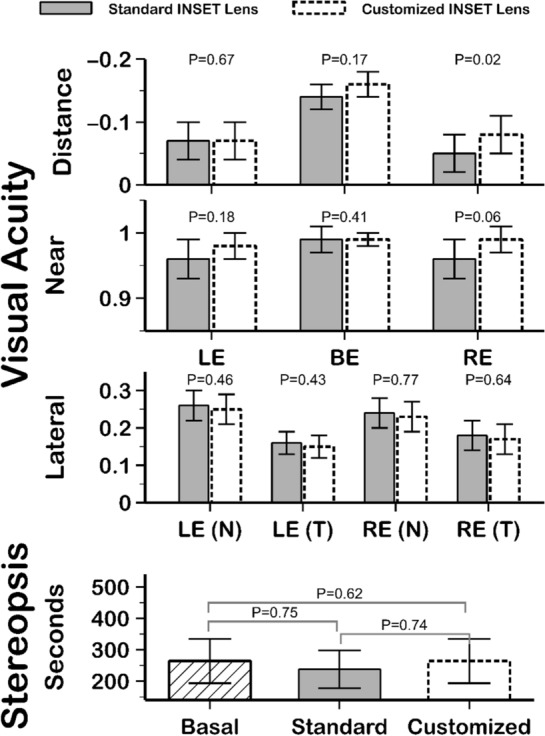
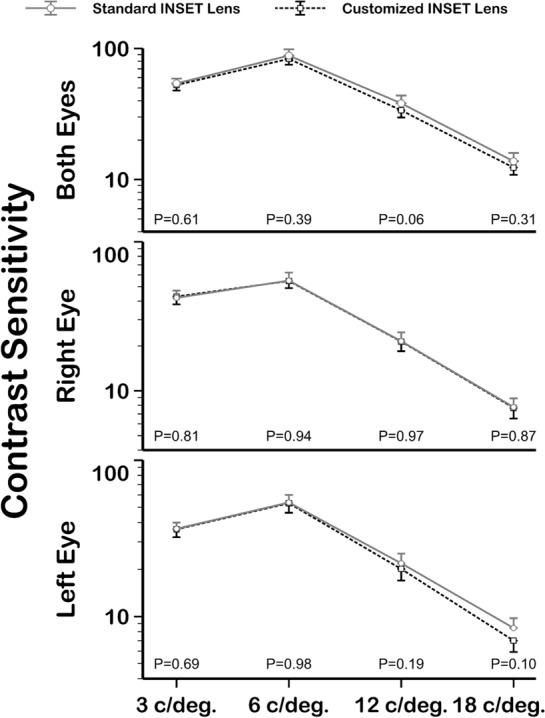
Progressive addition lens (PAL) prescription is usually conducted using the pupillary centre as a reference, which in general does not coincide with the visual axis (kappa distance), and this difference could induce undesired prismatic effects in far and near vision distances and adaptation problems. This study aimed to assess the impact on subjects’ visual satisfaction with PALs prescribed based on foveal fixation axis (FFA) measurements. Two different PALs (LifeStyle 3i, Hoya Lens Iberia) were randomly prescribed [one with a customized inset (the difference between the FFA measurements (Ergofocus®, Lentitech, Spain) at far and near distances and the second with a standard inset (2.5 mm)] to be used by 71 healthy presbyopic volunteers in a prospective double-masked crossover clinical study involving one month of use of each PAL. Patients were self-classified into four groups according to their previous experience with PALs: neophyte, PAL users, PAL drop-out, and uncomfortable PAL users. Visual function and overall satisfaction with each PAL were collected and compared. Ninety-seven percent (95% CI 93–100%) of participants successfully adapted to PALs prescribed with FFA without significant differences (P = 0.26) among the study groups (100% neophyte and uncomfortable PAL users (95% CI 100% in both groups), 89% (95% CI 67–100%) PAL users and 94% (95% CI 82–100%) PAL drop-out group). There were no statistically significant differences in visual function (P > 0.05) between customized and standard inset PALs. Customized and standard inset lenses showed similar satisfaction (P > 0.42) that increased significantly (P < 0.01 without any carry-over effect) after 30 days of wear. PALs prescribed with FFA measurements showed high visual satisfaction, suggesting that these measurements are suitable for prescribing PAL adaptation processes. Additional research is necessary to assess differences in PAL users’ performance with different prescription methods and lens designs.
Overview
The claims and statistics of this paper haven’t been checked yet.
Free: it reads the open-access text and checks the first 5 claims that cite a source we can check. Create a free account to check every claim.
Integrity signals
Registry
Cites
Statistics
Figures
Verification
Claims the paper makes
The claims and statistics of this paper haven’t been checked yet.
Free: it reads the open-access text and checks the first 5 claims that cite a source we can check. Create a free account to check every claim.
Claims other papers make about this one
Each is checked against this paper’s own text: does it say what the citing paper says it does?
The source backs part of the claim, not all of it — or backs it for a different population, condition or comparison.
In the citing paper
“Adaptation appears faster, and patient satisfaction is higher with FFLs”
From Freeform vs. Aspheric Spectacle Lenses: A Comprehensive Review of Optical Performance, Clinical Outcomes, and Patient Considerations (2026) · cites this paper as [55]
Experimental — accuracy not yet measured
Self-check
Percentages, sums and reported differences re-computed from the paper’s own numbers.
The self-check needs the paper’s full text.
Citations
Cites
Voutilainen, A., Pitkäaho, T., Kvist, T., & Vehviläinen‐Julkunen, K. (2016) · Journal of Advanced Nursing · doi:10.1111/jan.12875 · Cited by 382
Presbyopia: Effectiveness of correction strategies
Wolffsohn, J. S., & Davies, L. N. (2019) · Progress in Retinal and Eye Research · doi:10.1016/j.preteyeres.2018.09.004 · Cited by 324
(2019) · doi:10.18356/9df3caed-en · Cited by 299
Chang, D. H., & Waring, G. O. (2014) · American Journal of Ophthalmology · doi:10.1016/j.ajo.2014.06.028 · Cited by 162
Optical Zone Centration in Keratorefractive Surgery
Pande, M., & Hillman, J. S. (1993) · Ophthalmology · doi:10.1016/s0161-6420(93)31500-9 · Cited by 157
Measurement of Angle Kappa With Synoptophore and Orbscan II in a Normal Population
Başmak, H., Şahin, A., Yıldırım, N., Papakostas, T. D., & Kanellopoulos, A. J. (2007) · Journal of Refractive Surgery · doi:10.3928/1081-597x-20070501-06 · Cited by 153
Pande, M., & Hillman, J. S. (1993) · PubMed · Cited by 146
Meister, D. J., & Fisher, S. W. (2008) · Clinical and Experimental Optometry · doi:10.1111/j.1444-0938.2007.00245.x · Cited by 114
Design, Analysis, and Reporting of Crossover Trials for Inclusion in a Meta-Analysis
Li, T., Yu, T., Hawkins, B. S., & Dickersin, K. (2015) · PLOS ONE · doi:10.1371/journal.pone.0133023 · Cited by 107
Progressive Powered Lenses: the Minkwitz Theorem
SHEEDY, J. E., CAMPBELL, C., KING-SMITH, E., & HAYES, J. R. (2005) · Optometry and Vision Science · doi:10.1097/01.opx.0000181266.60785.c9 · Cited by 99
Adaptation to Multifocal and Monovision Contact Lens Correction
Fernandes, P. R. B., Neves, H., Lopes-Ferreira, D., Jorge, J., & González‐Méijome, J. M. (2013) · Optometry and Vision Science · doi:10.1097/opx.0b013e318282951b · Cited by 85
Assessing visual performance with progressive addition lenses
SELENOW, A., BAUER, E. A., ALI, S. R., SPENCER, L. W., & CIUFFREDA, K. J. (2002) · Optometry and Vision Science · doi:10.1097/00006324-200208000-00012 · Cited by 76
Progressive addition lenses — measurements and ratings
Sheedy, J., Hardy, R. F., & Hayes, J. R. (2006) · Optometry - Journal of the American Optometric Association · doi:10.1016/j.optm.2005.10.019 · Cited by 65
Subjective Satisfaction in Long-term Orthokeratology Patients
Sanz, E. S., Cerviño, A., Queirós, A., Brautaset, R., & González‐Méijome, J. M. (2013) · Eye & Contact Lens Science & Clinical Practice · doi:10.1097/icl.0b013e3182a27777 · Cited by 45
Lined multifocal wearers prefer progressive addition lenses.
Boroyan, H. J., Cho, M. H., Fuller, B., Krefman, R. A., McDougall, J., Schaeffer, J. L., & Tahran, R. (1995) · PubMed · Cited by 44
Jaschinski, W., König, M., Mekontso, T. M., Ohlendorf, A., & Welscher, M. (2015) · Clinical and Experimental Optometry · doi:10.1111/cxo.12259 · Cited by 44
Distribution of angle α and angle κ in a population with cataract in Shanghai
Meng, J., Du, Y., Wei, L., Yao, Y., He, W., Qian, D., Lü, Y., & Zhu, X. (2020) · Journal of Cataract & Refractive Surgery · doi:10.1097/j.jcrs.0000000000000490 · Cited by 42
Spectacle non‐tolerance in clinical practice – a systematic review with meta‐analysis
Bist, J., Kaphle, D., Marasini, S., & Kandel, H. (2021) · Ophthalmic and Physiological Optics · doi:10.1111/opo.12796 · Cited by 41
Pharmacological Treatment in Presbyopia
Grzybowski, A. E., & Ruamviboonsuk, V. (2022) · Journal of Clinical Medicine · doi:10.3390/jcm11051385 · Cited by 40
Velasco‐Barona, C., Corredor-Ortega, C., Mendez-León, A., Casillas-Chavarín, N. L., Velarde, D. V.-L., Cervantes-Coste, G., Malacara-Hernández, D., & González-Salinas, R. (2019) · Journal of Ophthalmology · doi:10.1155/2019/7018937 · Cited by 37
Measurement of angle Kappa with Orbscan II and Galilei G4: effect of accommodation
Domínguez‐Vicent, A., Monsálvez-Romín, D., Pérez‐Vives, C., Ferrer‐Blasco, T., & Montés‐Micó, R. (2013) · Graefe s Archive for Clinical and Experimental Ophthalmology · doi:10.1007/s00417-013-2509-y · Cited by 34
Clinical Assessment of a Customized Free-Form Progressive Add Lens Spectacle
Han, S. C., Graham, A. D., & Lin, M. C. (2011) · Optometry and Vision Science · doi:10.1097/opx.0b013e31820846ac · Cited by 31
Pointer, J. S. (2012) · Ophthalmic and Physiological Optics · doi:10.1111/j.1475-1313.2012.00910.x · Cited by 28
Presbyopic correction use and its impact on quality of vision symptoms
Sivardeen, A., McAlinden, C., & Wolffsohn, J. S. (2019) · Journal of Optometry · doi:10.1016/j.optom.2018.12.004 · Cited by 28
Patient satisfaction following dental implant treatment: A survey
Pradyachaipimol, N., Tangsathian, T., Supanimitkul, K., Sophon, N., Suwanwichit, T., Manopattanasoontorn, S., Arunyanak, S. P., & Kungsadalpipob, K. (2023) · Clinical Implant Dentistry and Related Research · doi:10.1111/cid.13196 · Cited by 26
Accuracy and Repeatability of Self‐Measurement of Interpupillary Distance
McMahon, T. T., Irving, E. L., & Lee, C. (2012) · Optometry and Vision Science · doi:10.1097/opx.0b013e318257f37b · Cited by 24
Kolbe, O., & Degle, S. (2018) · Optometry and Vision Science · doi:10.1097/opx.0000000000001295 · Cited by 22
Personalized Progressive Addition Lenses: Correlation between Performance and Design
Forkel, J., Reiniger, J. L., Muschielok, A., Welk, A., Seidemann, A., & Baumbach, P. (2017) · Optometry and Vision Science · doi:10.1097/opx.0000000000001016 · Cited by 21
A Comparison of Spectacles Purchased Online and in UK Optometry Practice
Alderson, A. J., Green, A., Whitaker, D., Scally, A., & Elliott, D. B. (2016) · Optometry and Vision Science · doi:10.1097/opx.0000000000000955 · Cited by 18
Peripheral Design of Progressive Addition Lenses and the Lag of Accommodation in Myopes
Schilling, T., Ohlendorf, A., Varnas, S. R., & Wahl, S. (2017) · Investigative Ophthalmology & Visual Science · doi:10.1167/iovs.17-21589 · Cited by 17
Yang, A., Lim, S. Y., Wong, Y. L., Yeo, A. C. H., Rajeev, N., & Drobe, B. (2021) · Journal of Clinical Medicine · doi:10.3390/jcm10081589 · Cited by 17
Espinilla, O. G., Gallegos-Cocho, I., Sánchez, I., Cañadas, P., & Martín, R. (2021) · Clinical and Experimental Optometry · doi:10.1080/08164622.2021.1914511 · Cited by 16
Walsh, G., & Pearce, E. I. (2009) · Ophthalmic and Physiological Optics · doi:10.1111/j.1475-1313.2008.00619.x · Cited by 11
Patient factors influencing outpatient satisfaction in patients presenting with shoulder pain
Bedeir, Y. H., & Grawe, B. M. (2018) · Journal of Shoulder and Elbow Surgery · doi:10.1016/j.jse.2018.06.016 · Cited by 11
Individually designed PALs vs. power optimized PALs adaptation comparison.
Muždalo, N. V., & Mihelčič, M. (2015) · PubMed · Cited by 8
Determining the Vertical and Horizontal Positioning of Multifocal and Progressive Lenses
Kozol, F., Capone, R. C., & Kozol, N. D. (1998) · Survey of Ophthalmology · doi:10.1016/s0039-6257(98)00013-7 · Cited by 8
Espinilla, O. G., Gallegos-Cocho, I., Sánchez, I., Cañadas, P., & Martín, R. (2022) · Clinical and Experimental Optometry · doi:10.1080/08164622.2021.2006042 · Cited by 6
Intrasession repeatability and agreement of a new method to measure the foveal fixation axis
Espinilla, O. G., Sánchez, I., & Martín, R. (2023) · PeerJ · doi:10.7717/peerj.14942 · Cited by 2
Research works printed but not linked: 2
- Chamorro E Cleva JM Concepción P Subero M Alonso J Lens design techniques to improve satisfaction in free-form progressive addition lens users JOJ Ophtalmol. 2018 6 555688
- Rabbetts R Bennet & Rabbetts’ Clinical Visual Optics 2007 Butterworth-Heinemann-Elsevier
Cited by
Presbyopia: Current Perspectives and Prospects for Patients
Davies, L. N. (2026) · Ophthalmic and Physiological Optics · doi:10.1007/s44402-026-00083-7 · Cited by 4
Ladopoulos, K., Pateras, E., & Ninos, G. (2026) · Cureus · doi:10.7759/cureus.104008
Metadata
- Authors
- Oscar, G.-E., Irene, S., & Raul, M.
- Affiliations
- Universidad de Valladolid (ES)
- Corresponding author
- Irene, Sanchez
- Venue
- Scientific Reports
- Published
- 2023-07-12
- Volume
- 13
- Issue
- 1
- Pages
- 11262-11262
- ISSN
- 2045-2322 (ISSN-L)
- PMC
- PMC10338446
- OpenAlex
- W4384069059
- Cited by
- 2
- References
- 37
- Citations by year
- 2026: 2
- FWCI
- 0.40
- Type
- journal article
- Language
- en
- Open access
- gold
- dx.doi.org
- Licence
- cc-by
- creativecommons.org/licenses/by/4.0 (tdm)
- creativecommons.org/licenses/by/4.0 (vor)
- Locations
- Scientific Reports (publishedVersion, cc-by)
- PubMed Central (publishedVersion, cc-by)
- PubMed (publishedVersion)
- Hispana (publishedVersion, cc-by)
- UVaDOC UVaDOC University of Valladolid Documentary Repository (University of Valladolid) (submittedVersion, cc-by)
- DOAJ (DOAJ: Directory of Open Access Journals) (submittedVersion, cc-by-sa)
- Topics
- Health Sciences › Medicine › Ophthalmology › Ophthalmology and Visual Impairment Studies
- Health Sciences › Medicine › Ophthalmology › Intraocular Surgery and Lenses
- Social Sciences › Human Factors and Ergonomics › Ergonomics and Musculoskeletal Disorders
- Keywords
- progressive addition lenses, lens prescription, visual satisfaction, presbyopia, prismatic effect, lens adaptation, visual axis, residual effects
- MeSH terms
- Acclimatization, Humans, Lenses, Personal Satisfaction, Prospective Studies, Apocynaceae
About these checks
Registry, retraction, Cites and statistics results are computed, not judged, with one exception: a printed reference that no index lists is read once by a model before it counts as a citation error. Claims are extracted by a model and kept only when their quote appears verbatim in the text; each cited source is then checked, with a model’s help, for whether it says what the claim relies on. Those verdicts can be wrong — read the claim’s quote and the cited source before relying on one.
Statistics and arithmetic are recomputed, not judged.
Confidence bands are shown only for fields calibrated on our annotated test set. None is calibrated yet, so no band is shown.
What counts as a claim ›How we measure confidence ›How we check this ›
Are you an author, or do you see a problem with this page? Request a review
Data sources
Bibliographic data: Semantic Scholar, OpenAlex, Crossref.
Contains information from the Semantic Scholar Academic Graph Datasets, made available under the ODC Attribution License (ODC-BY 1.0).
Semantic Scholar’s data is described in: Kinney, R., et al. (2023). The Semantic Scholar Open Data Platform. arXiv:2301.10140.
