

How our hearts beat together: a study on physiological synchronization based on a self-paced joint motor task
Open accessPublished version of a preprint
The DOI matches its Crossref record; 79 of the 79 references it cites were found in a registry or an index.
Abstract
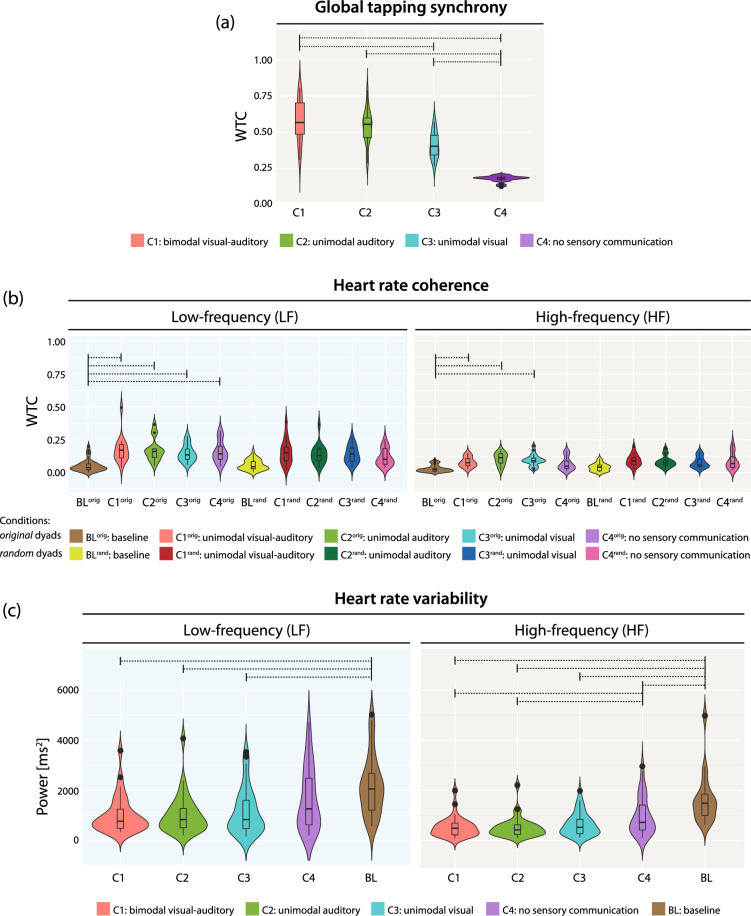
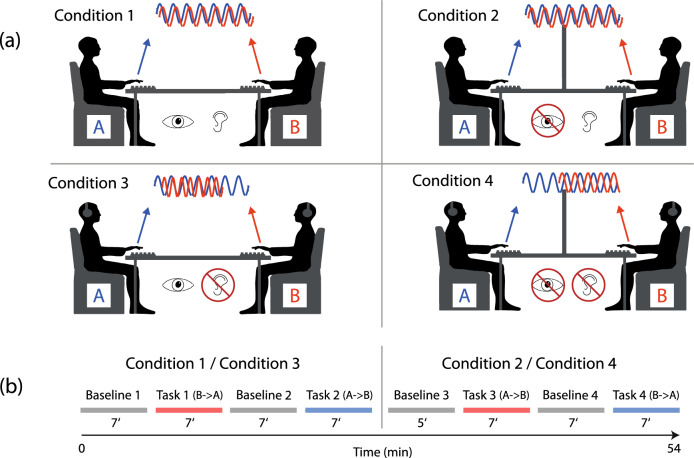
Cardiac physiological synchrony is regarded as an important component of social interaction due to its putative role in prosocial behaviour. Yet, the processes underlying physiological synchrony remain unclear. We aim to investigate these processes. 20 dyads (19 men, 21 women, age range 18–35) engaged in a self-paced interpersonal tapping synchronization task under different levels of tapping synchrony due to blocking of sensory communication channels. Applying wavelet transform coherence analysis, significant increases in heart rate synchronization from baseline to task execution were found with no statistically significant difference across conditions. Furthermore, the control analysis, which assessed synchrony between randomly combined dyads of participants showed no difference from the original dyads’ synchrony. We showed that interindividual cardiac physiological synchrony during self-paced synchronized finger tapping resulted from a task-related stimulus equally shared by all individuals. We hypothesize that by applying mental effort to the task, individuals changed into a similar mental state, altering their cardiac regulation. This so-called psychophysiological mode provoked more uniform, less variable fluctuation patterns across all individuals leading to similar heart rate coherence independent of subsequent pairings. With this study, we provide new insights into cardiac physiological synchrony and highlight the importance of appropriate study design and control analysis.
Overview
The claims and statistics of this paper haven’t been checked yet.
Free: it reads the open-access text and checks the first 5 claims that cite a source we can check. Create a free account to check every claim.
Integrity signals
Registry
Cites
Statistics
Figures
Verification
Claims the paper makes
The claims and statistics of this paper haven’t been checked yet.
Free: it reads the open-access text and checks the first 5 claims that cite a source we can check. Create a free account to check every claim.
Claims other papers make about this one
Each is checked against this paper’s own text: does it say what the citing paper says it does?
The source backs part of the claim, not all of it — or backs it for a different population, condition or comparison.
In the citing paper
“In group settings, synchrony at the collective level (not just between pairs) predicted affective outcomes, and task-induced synchrony emerged even among stranger dyads (83).”
From Physiological attunement and flourishing: understanding the influence of relationships on health (2025) · cites this paper as [83]
Experimental — accuracy not yet measuredThe source backs part of the claim, not all of it — or backs it for a different population, condition or comparison.
In the citing paper
“here we show that such tasks—often conflated with the visual exchange of social cues—might not be necessary for the synchrony to emerge.”
From Interpersonal Synchronization of Autonomic Physiology via Mere Visual Contact (2026) · cites this paper as [87]
Experimental — accuracy not yet measuredThe source backs part of the claim, not all of it — or backs it for a different population, condition or comparison.
In the citing paper
“No statistically significant difference across the various conditions was seen regarding synchrony levels.”
From Physiological attunement and flourishing: understanding the influence of relationships on health (2025) · cites this paper as [83]
Experimental — accuracy not yet measuredThe cited source says what the claim attributes to it.
In the citing paper
“Synchrony between randomly combined dyads was similar to that of the original dyads, indicating that the observed cardiac synchrony might be a universal phenomenon arising from the task-dependent mechanism.”
From Physiological attunement and flourishing: understanding the influence of relationships on health (2025) · cites this paper as [83]
The cited source says what the claim attributes to it.
In the citing paper
“Significant increases in heart rate synchronization from baseline to task execution were observed.”
From Physiological attunement and flourishing: understanding the influence of relationships on health (2025) · cites this paper as [83]
Self-check
Percentages, sums and reported differences re-computed from the paper’s own numbers.
The self-check needs the paper’s full text.
Citations
Cites
Welch, P. (1967) · IEEE Transactions on Audio and Electroacoustics · doi:10.1109/tau.1967.1161901 · Cited by 12,277
An overview of heart rate variability metrics and norms
Shaffer, F., & Ginsberg, J. P. (2017) · Frontiers in Public Health · doi:10.3389/fpubh.2017.00258 · Cited by 7,185
Application of the cross wavelet transform and wavelet coherence to geophysical time series
Grinsted, A., Moore, J. C., & Jevrejeva, S. (2004) · Nonlinear Processes in Geophysics · doi:10.5194/npg-11-561-2004 · Cited by 6,285
A model of neurovisceral integration in emotion regulation and dysregulation
Thayer, J. F., & Lane, R. D. (2000) · Journal of Affective Disorders · doi:10.1016/s0165-0327(00)00338-4 · Cited by 3,092
Heart rate variability: A review
Rajendra Acharya, U., Paul Joseph, K., Kannathal, N., Lim, C. M., & Suri, J. S. (2006) · Medical & Biological Engineering & Computing · doi:10.1007/s11517-006-0119-0 · Cited by 2,820
Laborde, S., Mosley, E., & Thayer, J. F. (2017) · Frontiers in Psychology · doi:10.3389/fpsyg.2017.00213 · Cited by 2,336
The James-Lange Theory of Emotions: A Critical Examination and an Alternative Theory
Cannon, W. B. (1927) · The American Journal of Psychology · doi:10.2307/1415404 · Cited by 1,899
Time–frequency dynamics of resting-state brain connectivity measured with fMRI
Chang, C., & Glover, G. H. (2010) · NeuroImage · doi:10.1016/j.neuroimage.2009.12.011 · Cited by 1,808
Wiltermuth, S. S., & Heath, C. (2009) · Psychological Science · doi:10.1111/j.1467-9280.2008.02253.x · Cited by 1,717
Sensorimotor synchronization: A review of the tapping literature
Repp, B. H. (2005) · Psychonomic Bulletin & Review · doi:10.3758/bf03206433 · Cited by 1,462
It's All in the Timing: Interpersonal Synchrony Increases Affiliation
Hove, M. J., & Risen, J. L. (2009) · Social Cognition · doi:10.1521/soco.2009.27.6.949 · Cited by 1,334
Sensorimotor synchronization: a review of recent research (2006–2012).
Repp, B. H., & Su, Y.-H. (2013) · Psychonomic Bulletin & Review · doi:10.3758/s13423-012-0371-2 · Cited by 1,204
Heart Rate Variability ? A Historical Perspective
Billman, G. E. (2011) · Frontiers in Physiology · doi:10.3389/fphys.2011.00086 · Cited by 786
Synchronized arousal between performers and related spectators in a fire-walking ritual
Konvalinka, I., Xygalatas, D., Bulbulia, J., Schjødt, U., Jegindø, E.-M., Wallot, S., Van Orden, G., & Roepstorff, A. (2011) · Proceedings of the National Academy of Sciences · doi:10.1073/pnas.1016955108 · Cited by 632
Michael, S., Graham, K. S., & Davis, G. M. (2017) · Frontiers in Physiology · doi:10.3389/fphys.2017.00301 · Cited by 603
Interpersonal autonomic physiology: a systematic review of the literature
Palumbo, R. V., Marraccini, M. E., Weyandt, L. L., Wilder-Smith, O., McGee, H. A., Liu, S., & Goodwin, M. S. (2017) · Personality and Social Psychology Review · doi:10.1177/1088868316628405 · Cited by 566
Bernardi, L., Wdowczyk-Szulc, J., Valenti, C., Castoldi, S., Passino, C., Spadacini, G., & Sleight, P. (2000) · Journal of the American College of Cardiology · doi:10.1016/s0735-1097(00)00595-7 · Cited by 516
Music and dance as a coalition signaling system
Hagen, E. H., & Bryant, G. A. (2003) · Human Nature · doi:10.1007/s12110-003-1015-z · Cited by 469
Sbarra, D. A., & Hazan, C. (2008) · Personality and Social Psychology Review · doi:10.1177/1088868308315702 · Cited by 427
Marci, C. D., Ham, J., Moran, E., & Orr, S. P. (2007) · Journal of Nervous & Mental Disease · doi:10.1097/01.nmd.0000253731.71025.fc · Cited by 364
Lipponen, J. A., & Tarvainen, M. P. (2019) · Journal of Medical Engineering & Technology · doi:10.1080/03091902.2019.1640306 · Cited by 364
Feldman, R. (2012) · Monographs of the Society for Research in Child Development · doi:10.1111/j.1540-5834.2011.00660.x · Cited by 360
The theory of emotion: I: Emotional attitudes.
Dewey, J. (1894) · Psychological Review · doi:10.1037/h0069054 · Cited by 294
Musical Rhythm, Linguistic Rhythm, and Human Evolution
Patel, A. D. (2006) · Music Perception · doi:10.1525/mp.2006.24.1.99 · Cited by 287
The connection between rhythmicity and brain function
Thaut, M. H., Kenyon, G. P., Schauer, M. L., & McIntosh, G. C. (1999) · IEEE Engineering in Medicine and Biology Magazine · doi:10.1109/51.752991 · Cited by 284
Cardiac and Respiratory Patterns Synchronize between Persons during Choir Singing
Müller, V., & Lindenberger, U. (2011) · PLoS ONE · doi:10.1371/journal.pone.0024893 · Cited by 256
Fatisson, J., Oswald, V., & Lalonde, F. (2016) · Heart International · doi:10.5301/heartint.5000232 · Cited by 240
SOME EFFECTS OF SPINAL CORD LESIONS ON EXPERIENCED EMOTIONAL FEELINGS
Hohmann, G. W. (1966) · Psychophysiology · doi:10.1111/j.1469-8986.1966.tb02690.x · Cited by 236
Repp, B. H. (2003) · Journal of Motor Behavior · doi:10.1080/00222890309603156 · Cited by 226
Rhythmic entrainment as a musical affect induction mechanism
J. Trost, W., Labbé, C., & Grandjean, D. (2017) · Neuropsychologia · doi:10.1016/j.neuropsychologia.2017.01.004 · Cited by 209
Between-brain connectivity during imitation measured by fNIRS
Holper, L., Scholkmann, F., & Wolf, M. (2012) · NeuroImage · doi:10.1016/j.neuroimage.2012.06.028 · Cited by 207
Self-citationNeuroelectrical Hyperscanning Measures Simultaneous Brain Activity in Humans
Astolfi, L., Toppi, J., De Vico Fallani, F., Vecchiato, G., Salinari, S., Mattia, D., Cincotti, F., & Babiloni, F. (2010) · Brain Topography · doi:10.1007/s10548-010-0147-9 · Cited by 190
What can music tell us about social interaction?
D’Ausilio, A., Novembre, G., Fadiga, L., & Keller, P. E. (2015) · Trends in Cognitive Sciences · doi:10.1016/j.tics.2015.01.005 · Cited by 188
Assessing cross-partner associations in physiological responses via coupled oscillator models.
Helm, J. L., Sbarra, D., & Ferrer, E. (2012) · Emotion · doi:10.1037/a0025036 · Cited by 179
Cannon, W. B. (1987) · PubMed · Cited by 174
Inter-brain synchrony and cooperation context in interactive decision making
Hu, Y., Pan, Y., Shi, X., Cai, Q., Li, X., & Cheng, X. (2018) · Biological Psychology · doi:10.1016/j.biopsycho.2017.12.005 · Cited by 166
The sociophysiology of caring in the doctor-patient relationship
Adler, H. M. (2002) · Journal of General Internal Medicine · doi:10.1046/j.1525-1497.2002.10640.x · Cited by 165
Instantaneous changes in heart rate regulation due to mental load in simulated office work
Taelman, J., Vandeput, S., Vlemincx, E., Spaepen, A., & Van Huffel, S. (2011) · European Journal of Applied Physiology · doi:10.1007/s00421-010-1776-0 · Cited by 164
Intra- and Inter-Brain Synchronization during Musical Improvisation on the Guitar
Müller, V., Sänger, J., & Lindenberger, U. (2013) · PLoS ONE · doi:10.1371/journal.pone.0073852 · Cited by 159
Golland, Y., Arzouan, Y., & Levit-Binnun, N. (2015) · PLOS ONE · doi:10.1371/journal.pone.0125804 · Cited by 152
Being in the zone: physiological markers of togetherness in joint improvisation
Noy, L., Levit-Binun, N., & Golland, Y. (2015) · Frontiers in Human Neuroscience · doi:10.3389/fnhum.2015.00187 · Cited by 148
Physiological and Behavioral Synchrony Predict Group Cohesion and Performance
Gordon, I., Gilboa, A., Cohen, S., Milstein, N., Haimovich, N., Pinhasi, S., & Siegman, S. (2020) · Scientific Reports · doi:10.1038/s41598-020-65670-1 · Cited by 146
Dynamical systems modeling of physiological coregulation in dyadic interactions
Ferrer, E., & Helm, J. L. (2013) · International Journal of Psychophysiology · doi:10.1016/j.ijpsycho.2012.10.013 · Cited by 132
Social–physiological compliance as a determinant of team performance
Henning, R. A., Boucsein, W., & Gil, M. C. (2001) · International Journal of Psychophysiology · doi:10.1016/s0167-8760(00)00190-2 · Cited by 130
Heart rate variability during adolescent and adult social interactions: A meta-analysis
Shahrestani, S., Stewart, E. M., Quintana, D. S., Hickie, I. B., & Guastella, A. J. (2015) · Biological Psychology · doi:10.1016/j.biopsycho.2014.12.012 · Cited by 126
Physiological compliance and team performance
Elkins, A. N., Muth, E. R., Hoover, A. W., Walker, A. D., Carpenter, T. L., & Switzer, F. S. (2009) · Applied Ergonomics · doi:10.1016/j.apergo.2009.02.002 · Cited by 115
Reaction-anticipation transitions in human perception-action patterns
Engstrøm, D. A., Kelso, J. A. S., & Holroyd, T. (1996) · Human Movement Science · doi:10.1016/s0167-9457(96)00031-0 · Cited by 113
McCraty, R. (2017) · Frontiers in Public Health · doi:10.3389/fpubh.2017.00267 · Cited by 111
Physiological compliance for social gaming analysis: Cooperative versus competitive play
Chanel, G., Kivikangas, J. M., & Ravaja, N. (2012) · Interacting with Computers · doi:10.1016/j.intcom.2012.04.012 · Cited by 110
Estimating time‐varying RSA to examine psychophysiological linkage of marital dyads
Gates, K. M., Gatzke‐Kopp, L. M., Sandsten, M., & Blandon, A. Y. (2015) · Psychophysiology · doi:10.1111/psyp.12428 · Cited by 106
Acute effects of caffeine on heart rate variability
Sondermeijer, H. P., van Marle, A. G. J., Kamen, P., & Krum, H. (2002) · The American Journal of Cardiology · doi:10.1016/s0002-9149(02)02725-x · Cited by 99
Physio-behavioral coupling in a cooperative team task: Contributors and relations.
Strang, A. J., Funke, G. J., Russell, S. M., Dukes, A. W., & Middendorf, M. S. (2014) · Journal of Experimental Psychology: Human Perception and Performance · doi:10.1037/a0033125 · Cited by 94
Physiological synchrony is associated with cooperative success in real-life interactions
Behrens, F., Snijdewint, J. A., Moulder, R. G., Prochazkova, E., Sjak-Shie, E. E., Boker, S. M., & Kret, M. E. (2020) · Scientific Reports · doi:10.1038/s41598-020-76539-8 · Cited by 93
Altini, M., & Plews, D. (2021) · Sensors · doi:10.3390/s21237932 · Cited by 86
Strangers, Friends, and Lovers Show Different Physiological Synchrony in Different Emotional States
Bizzego, A., Azhari, A., Campostrini, N., Truzzi, A., Ng, L. Y., Gabrieli, G., Bornstein, M. H., Setoh, P., & Esposito, G. (2019) · Behavioral Sciences · doi:10.3390/bs10010011 · Cited by 85
Coutinho, J., Pereira, A., Oliveira‐Silva, P., Meier, D., Lourenço, V., & Tschacher, W. (2021) · Psychophysiology · doi:10.1111/psyp.13739 · Cited by 83
Heart Rate Variability in Sport Performance: Do Time of Day and Chronotype Play A Role?
Vitale, J. A., Bonato, M., Torre, A. L., & Banfi, G. (2019) · Journal of Clinical Medicine · doi:10.3390/jcm8050723 · Cited by 78
Porges, S. W., Heilman, K. J., Bazhenova, O. V., Bal, E., Doussard‐Roosevelt, J. A., & Koledin, M. (2007) · Developmental Psychobiology · doi:10.1002/dev.20228 · Cited by 72
The neural basis of audiomotor entrainment: an ALE meta-analysis
Chauvigné, L. A. S., Gitau, K. M., & Brown, S. (2014) · Frontiers in Human Neuroscience · doi:10.3389/fnhum.2014.00776 · Cited by 69
Physiological evidence of rapport during psychotherapeutic interviews.
Coleman, R., Greenblatt, M., & Hc, S. (1956) · PubMed · Cited by 60
Increase in Synchronization of Autonomic Rhythms between Individuals When Listening to Music
Bernardi, N. F., Codrons, E., di Leo, R., Vandoni, M., Cavallaro, F., Vita, G., & Bernardi, L. (2017) · Frontiers in Physiology · doi:10.3389/fphys.2017.00785 · Cited by 56
Cardiolocomotor Coupling in Young and Elderly People
Novak, V., Hu, K., Vyas, M. V., & Lipsitz, L. A. (2007) · The Journals of Gerontology Series A · doi:10.1093/gerona/62.1.86 · Cited by 53
Methodological Advances for Detecting Physiological Synchrony During Dyadic Interactions
McAssey, M. P., Helm, J., Hsieh, F., Sbarra, D. A., & Ferrer, E. (2013) · Methodology · doi:10.1027/1614-2241/a000053 · Cited by 51
Montague, E., Xu, J., & Chiou, E. (2014) · IEEE Transactions on Human-Machine Systems · doi:10.1109/thms.2014.2325859 · Cited by 51
Toward a Biopsychosocial Understanding of the Patient–Physician Relationship: An Emerging Dialogue
Adler, H. M. (2007) · Journal of General Internal Medicine · doi:10.1007/s11606-006-0037-8 · Cited by 51
Spectral analysis of heart rate variability
Estévez, M., Machado, C., Leisman, G., Estévez-Hernández, T., Arias-Morales, A., Machado, A., & Montes-Brown, J. (2016) · International Journal on Disability and Human Development · doi:10.1515/ijdhd-2014-0025 · Cited by 49
Kajimura, S., & Nomura, M. (2016) · Cognition · doi:10.1016/j.cognition.2016.10.002 · Cited by 42
Comparison of cardio-locomotor synchronization during running and cycling
Nomura, K., Takei, Y., & Yanagida, Y. (2003) · European Journal of Applied Physiology · doi:10.1007/s00421-002-0784-0 · Cited by 40
Trujillo, L. T. (2019) · Frontiers in Neuroscience · doi:10.3389/fnins.2019.01292 · Cited by 36
Non-verbal communication of compassion: measuring psychophysiologic effects
Kemper, K. J., & Shaltout, H. A. (2011) · BMC Complementary and Alternative Medicine · doi:10.1186/1472-6882-11-132 · Cited by 32
Turner, C. K. (2017) · Frontiers in Psychology · doi:10.3389/fpsyg.2017.00137 · Cited by 28
Persistent autonomic dysfunction and bladder sensitivity in primary dysmenorrhea
Oladosu, F. A., Hellman, K. M., Ham, P. J., Kochlefl, L., Datta, A., Garrison, E. F., Steiner, N. D., Roth, G. E., & Tu, F. F. (2019) · Scientific Reports · doi:10.1038/s41598-019-38545-3 · Cited by 28
Positive emotions foster spontaneous synchronisation in a group movement improvisation task
Smykovskyi, A., Bieńkiewicz, M. M. N., Pla, S., Janaqi, S., & Bardy, B. G. (2022) · Frontiers in Human Neuroscience · doi:10.3389/fnhum.2022.944241 · Cited by 27
Heart Rate Variability Synchronizes When Non-experts Vocalize Together
Ruiz-Blais, S., Orini, M., & Chew, E. (2020) · Frontiers in Physiology · doi:10.3389/fphys.2020.00762 · Cited by 25
Effects of cognitive workload on heart and locomotor rhythms coupling
Bartolo, D. D., Giorgi, C. D., Compagnucci, L., Betti, V., Antonucci, G., Morone, G., Paolucci, S., & Iosa, M. (2021) · Neuroscience Letters · doi:10.1016/j.neulet.2021.136140 · Cited by 25
Failure of accentuated vertical body movements to induce cardiac-locomotor coupling
Kirby, R. L., Atkinson, S. M., Donville, J. E., Urdang, M. F., Stanley, D. A., Gupta, S., & MacLeod, D. A. (1992) · Journal of Applied Physiology · doi:10.1152/jappl.1992.72.4.1368 · Cited by 22
Phase-dependent chronotropic response of the heart during running in humans
Nomura, K., Takei, Y., Yoshida, M., & Yanagida, Y. (2006) · European Journal of Applied Physiology · doi:10.1007/s00421-005-0103-7 · Cited by 21
Touchscreen-based finger tapping: Repeatability and configuration effects on tapping performance
Makai‐Bölöni, S., Thijssen, E., van Brummelen, E. M. J., Groeneveld, G. J., & Doll, R. J. (2021) · PLoS ONE · doi:10.1371/journal.pone.0260783 · Cited by 10
(2009) · DOAJ (DOAJ: Directory of Open Access Journals)
Cited by
Barbaresi, M., Nardo, D., & Fagioli, S. (2024) · Brain Sciences · doi:10.3390/brainsci15010003 · Cited by 33
“In rhythm research, physiological synchronization examines how individuals in interaction—whether working together or simply talking to each other—co-regulate their physiological responses through both central and autonomic nervous system activity [17–20].”
Boukarras, S., Placidi, V., Rossano, F., Era, V., Aglioti, S. M., & Candidi, M. (2025) · Psychophysiology · doi:10.1111/psyp.70031 · Cited by 23
A Review of Human Synchronization Datasets
Velletaz, T., Janaqi, S., Harispe, S., Lagarde, J., & Guyot, P. (2025) · IEEE Access · doi:10.1109/access.2025.3560424 · Cited by 7
“Half of these datasets (4/10) are recorded while individuals engaged in joint motor tasks [62], or during dyadic social interactions (5/10) [82], and the last one through joint piano playing [101].”
Physiological attunement and flourishing: understanding the influence of relationships on health
Bastos, M. A. V., Braz, D. F., Porto, A. L. M., Cordeiro, K. S. D. S., Portella, R. B., & Granger, D. A. (2025) · Frontiers in Psychiatry · doi:10.3389/fpsyt.2025.1614379 · Cited by 7
“In group settings, synchrony at the collective level (not just between pairs) predicted affective outcomes, and task-induced synchrony emerged even among stranger dyads (83).”
Jang, H., & Lee, J. (2025) · CHI Conference on Human Factors in Computing Systems · doi:10.1145/3706598.3714264 · Cited by 7
“When a group of people engaged in synchronized tapping or drumming, their shared haptic experiences led to synchronized motion and heart-beats [41, 49].”
Metadata
- Authors
- Flory, S., Guglielmini, S., Scholkmann, F., Marcar, V. L., & Wolf, M.
- Affiliations
- University of Zurich (CH)
- University of Bern (CH)
- Corresponding author
- Flory, Stephan
- Venue
- Scientific Reports
- Published
- 2023-07-25
- Volume
- 13
- Issue
- 1
- Pages
- 11987-11987
- ISSN
- 2045-2322 (ISSN-L)
- PMC
- PMC10368740
- OpenAlex
- W4385264081
- Cited by
- 18
- References
- 79
- Citations by year
- 2026: 8 · 2025: 9 · 2024: 1
- FWCI
- 5.32
- Type
- journal article
- Language
- en
- Open access
- gold
- doi.org
- Licence
- cc-by
- creativecommons.org/licenses/by/4.0 (tdm)
- creativecommons.org/licenses/by/4.0 (vor)
- Locations
- Scientific Reports (publishedVersion, cc-by)
- Research Square (acceptedVersion, cc-by)
- PubMed Central (publishedVersion, cc-by)
- PubMed (publishedVersion)
- Zurich Open Repository and Archive (University of Zurich) (acceptedVersion, other-oa)
- BORIS (University Library Bern) (submittedVersion, cc-by)
- DOAJ (DOAJ: Directory of Open Access Journals) (submittedVersion, cc-by-sa)
- Zurich Open Repository and Archive (University of Zurich) (submittedVersion, cc-by)
- Zurich Open Repository and Archive (University of Zurich)
- Funders
- National Science Foundation
- Schweizerischer Nationalfonds zur Förderung der Wissenschaftlichen Forschung (159490)
- Topics
- Social Sciences › Psychology › Social Psychology › Action Observation and Synchronization
- Health Sciences › Medicine › Cardiology and Cardiovascular Medicine › Heart Rate Variability and Autonomic Control
- Life Sciences › Neuroscience › Cognitive Neuroscience › Neural dynamics and brain function
- Keywords
- heart rate synchronization, interpersonal synchrony, finger tapping, social interaction, prosocial behavior, cognitive effort, wavelet coherence, dyads, control analysis
- MeSH terms
- Social Interaction, Adolescent, Adult, Female, Fingers, Heart, Humans, Male, Psychophysiology, Young Adult
About these checks
Registry, retraction, Cites and statistics results are computed, not judged, with one exception: a printed reference that no index lists is read once by a model before it counts as a citation error. Claims are extracted by a model and kept only when their quote appears verbatim in the text; each cited source is then checked, with a model’s help, for whether it says what the claim relies on. Those verdicts can be wrong — read the claim’s quote and the cited source before relying on one.
Statistics and arithmetic are recomputed, not judged.
Confidence bands are shown only for fields calibrated on our annotated test set. None is calibrated yet, so no band is shown.
What counts as a claim ›How we measure confidence ›How we check this ›
Are you an author, or do you see a problem with this page? Request a review
Data sources
Bibliographic data: Semantic Scholar, OpenAlex, Crossref.
Contains information from the Semantic Scholar Academic Graph Datasets, made available under the ODC Attribution License (ODC-BY 1.0).
Semantic Scholar’s data is described in: Kinney, R., et al. (2023). The Semantic Scholar Open Data Platform. arXiv:2301.10140.
