

Quaternary low-temperature serpentinization and carbonation in the New Caledonia ophiolite
Open accessThe DOI matches its Crossref record; 64 of the 66 references it cites were found in a registry or an index.
Abstract
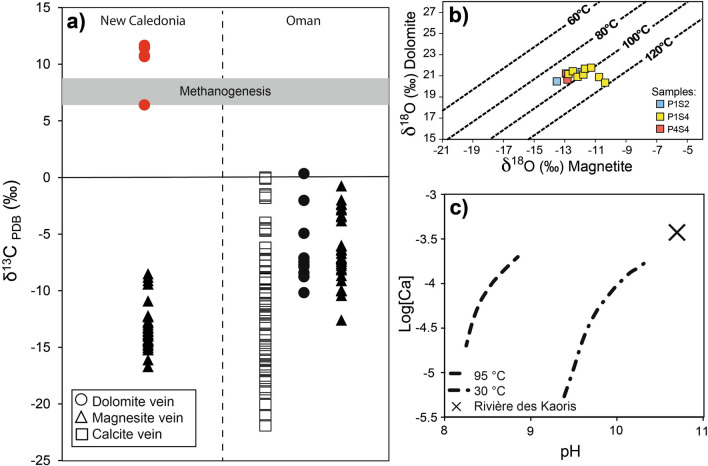
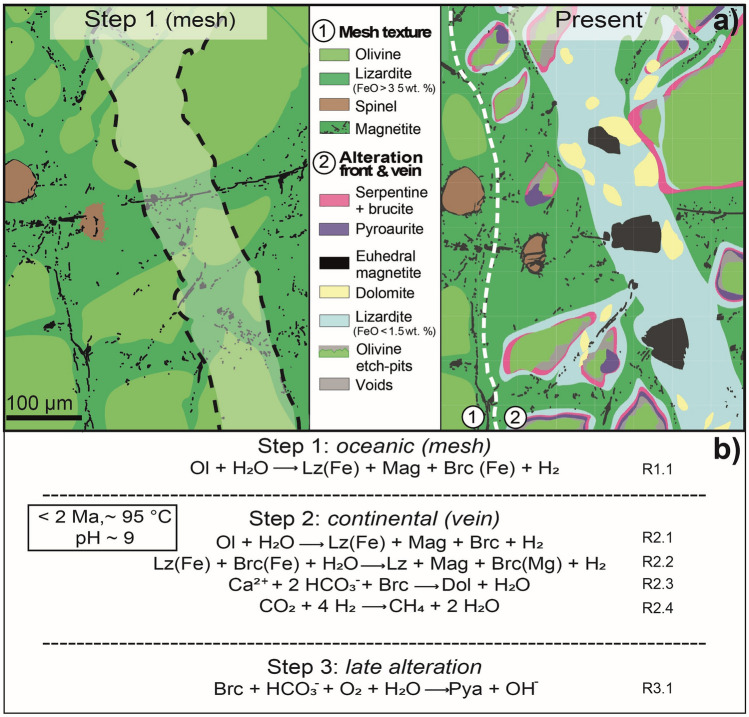
The low-temperature alteration (< 150 °C) of ophiolites by infiltrated meteoric waters removes atmospheric CO 2 through mineral carbonation and is assumed to generate H 2 and possibly CH 4 according to so-called serpentinization reactions. This overall alteration pattern is primarily constrained by the chemical composition of alkaline springs that are issued in several ophiolites worldwide. Here we report on the fingerprint, as veinlet mineralization, of the reactive percolation of such meteoric waters in the New Caledonia ophiolite (Massif du Sud). The mineralization which resulted from carbonation and serpentinization reactions, is young (< 2 Ma) and formed at a temperature of ca. 95 °C. It is mainly composed of lizardite, dolomite, magnetite ± pyroaurite. Thermochemical simulation of mineral–water equilibria shows that the percolating aqueous fluid was alkaline and H 2 bearing. The δ 13 C of dolomite is exceptionally high, between 7.1 and up to 17.3‰, and is interpreted as evidence of low-temperature methanogenesis. Overall, the percolating fluid had a chemical composition similar to that of the waters issued today in the (hyper)alkaline springs of the Massif du Sud. The studied veinlets are thus interpreted as a sample of the plumbing system that fed an ancient Quaternary alkaline spring in the area.
Overview
The claims and statistics of this paper haven’t been checked yet.
Free: it reads the open-access text and checks the first 5 claims that cite a source we can check. Create a free account to check every claim.
Integrity signals
Registry
Cites
Statistics
Figures
Verification
Claims the paper makes
The claims and statistics of this paper haven’t been checked yet.
Free: it reads the open-access text and checks the first 5 claims that cite a source we can check. Create a free account to check every claim.
Self-check
Percentages, sums and reported differences re-computed from the paper’s own numbers.
The self-check needs the paper’s full text.
Citations
Cites
Parkhurst, D. L., & Appelo, C. A. J. (2013) · Techniques and Methods · doi:10.3133/tm6a43 · Cited by 3,779 · cited 1×
“The composition and pH of the fluid from which the vein minerals precipitated were modeled at 95 °C using PHREEQC 45 (see “Methods”).”
MethodAn off-axis hydrothermal vent field near the Mid-Atlantic Ridge at 30° N
Party, T. A.-6. S., Kelley, D. S., Karson, J. A., Blackman, D. K., Früh-Green, G. L., Butterfield, D. A., Lilley, M. D., Olson, E. J., Schrenk, M. O., Roe, K. K., et al. (2001) · Nature · doi:10.1038/35084000 · Cited by 1,168
In situ carbonation of peridotite for CO 2 storage
Kelemen, P. B., & Matter, J. (2008) · Proceedings of the National Academy of Sciences · doi:10.1073/pnas.0805794105 · Cited by 750
Etiope, G., & Sherwood Lollar, B. (2013) · Reviews of Geophysics · doi:10.1002/rog.20011 · Cited by 620
H 2 -rich fluids from serpentinization: Geochemical and biotic implications
Sleep, N. H., Meibom, A., Fridriksson, T., Coleman, R. G., & Bird, D. K. (2004) · Proceedings of the National Academy of Sciences · doi:10.1073/pnas.0405289101 · Cited by 568
Kelemen, P. B., Matter, J., Streit, E. E., Rudge, J. F., Curry, W. B., & Blusztajn, J. (2011) · Annual Review of Earth and Planetary Sciences · doi:10.1146/annurev-earth-092010-152509 · Cited by 518
Trace elements in magnetite as petrogenetic indicators
Dare, S. A. S., Barnes, S.-J., Beaudoin, G., Méric, J., Boutroy, E., & Potvin-Doucet, C. (2014) · Mineralium Deposita · doi:10.1007/s00126-014-0529-0 · Cited by 502 · cited 1×
“With a Ti concentration below 400 ppm and a Ni/Cr ratio above 50 (Supplementary Table S1), magnetite from both occurrences falls at the end of the “ hydrothermal magnetite” field defined by Dare et al. 40 and within the compositional range of magnetite formed by serpentinization reactions 40 .”
BackgroundSerpentinization of abyssal peridotites at mid-ocean ridges
Mével, C. (2003) · Comptes Rendus. Géoscience · doi:10.1016/j.crte.2003.08.006 · Cited by 495
Volcanoes, Fluids, and Life at Mid-Ocean Ridge Spreading Centers
Kelley, D. S., Baross, J. A., & Delaney, J. R. (2002) · Annual Review of Earth and Planetary Sciences · doi:10.1146/annurev.earth.30.091201.141331 · Cited by 463
Wenner, D. B., & Taylor, H. P. (1971) · Contributions to Mineralogy and Petrology · doi:10.1007/bf00643332 · Cited by 405 · cited 1×
“The serpentine—water fractionation factor amounts to ca. 7‰ at 95 °C according to calibration by Wenner and Taylor 15 .”
MethodBARNES, I., & O'NEIL, J. R. (1969) · Geological Society of America Bulletin · doi:10.1130/0016-7606(1969)80[1947:trbfis]2.0.co;2 · Cited by 392 · cited 1×
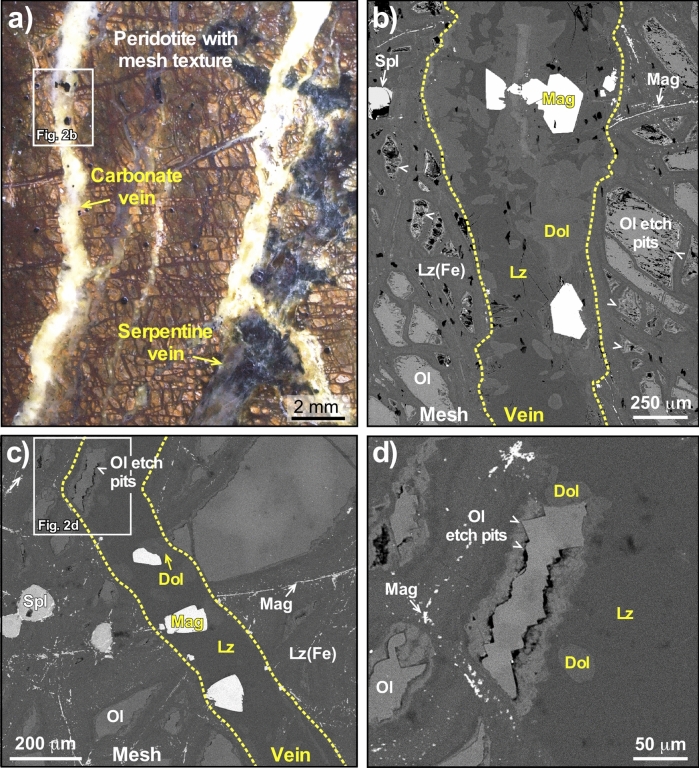
“They contain typical serpentinization products, lizardite, a serpentine-group mineral, magnetite, along with carbonates, abundant dolomite (CaMg(CO 3 ) 2 ), and pyroaurite (Mg 6 Fe 2 (OH) 16 (CO 3 ),4.5H 2 O).”
Klein, F., Bach, W., Jöns, N., McCollom, T., Moskowitz, B., & Berquó, T. (2009) · Geochimica et Cosmochimica Acta · doi:10.1016/j.gca.2009.08.021 · Cited by 391
Thin crust, ultramafic exposures, and rugged faulting patterns at the Mid-Atlantic Ridge (22°–24°N)
Cannat, M., Mevel, C., Maia, M., Deplus, C., Durand, C., Gente, P., Agrinier, P., Belarouchi, A., Dubuisson, G., Humler, E., et al. (1995) · Geology · doi:10.1130/0091-7613(1995)023<0049:tcuear>2.3.co;2 · Cited by 384
Compositional controls on hydrogen generation during serpentinization of ultramafic rocks
Klein, F., Bach, W., & McCollom, T. M. (2013) · Lithos · doi:10.1016/j.lithos.2013.03.008 · Cited by 377 · cited 1×
“The magnetite and H 2 amounts calculated with a pure Mg end-member are likely to be overestimated due to the iron affinity with respect to serpentine at T 150 °C 52 .”
BackgroundCharlou, J. L., Donval, J. P., Douville, E., Jean-Baptiste, P., Radford-Knoery, J., Fouquet, Y., Dapoigny, A., & Stievenard, M. (2000) · Chemical Geology · doi:10.1016/s0009-2541(00)00244-8 · Cited by 329
Serpentinization and its implications for life on the early earth and Mars
Schulte, M., Blake, D., Hoehler, T., & McCollom, T. (2006) · Astrobiology · doi:10.1089/ast.2006.6.364 · Cited by 321
Cluzel, D., Aitchison, J. C., & Picard, C. (2001) · Tectonophysics · doi:10.1016/s0040-1951(01)00148-2 · Cited by 310 · cited 1×
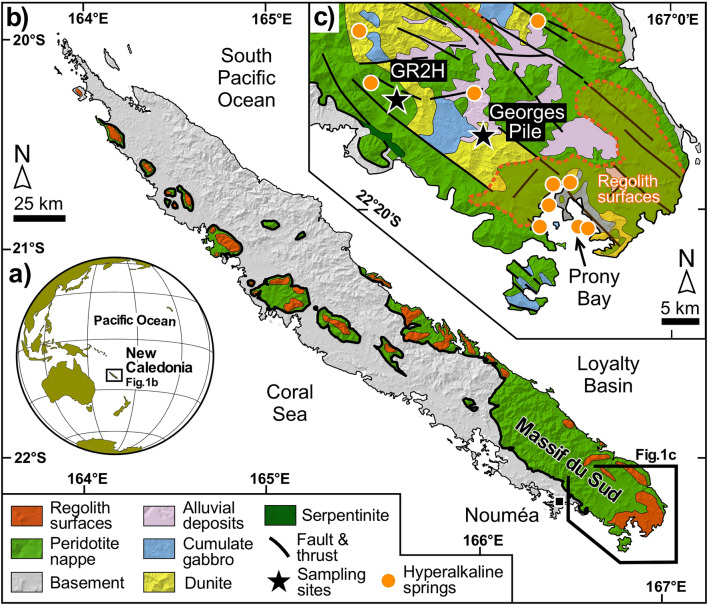
“1a) during the late Eocene (ca. 34 Ma) 29 .”
BackgroundPresent day serpentinization in New-Caledonia, Oman and Yugoslavia
Barnes, I., O'Neil, J. R., & Trescases, J. J. (1978) · Geochimica et Cosmochimica Acta · doi:10.1016/0016-7037(78)90225-9 · Cited by 266
Geochemical evidence of present-day serpentinization
Barnes, I., LaMarche, V. C., & Himmelberg, G. (1967) · Science · doi:10.1126/science.156.3776.830 · Cited by 195
Cipolli, F., Gambardella, B., Marini, L., Ottonello, G., & Vetuschi Zuccolini, M. (2004) · Applied Geochemistry · doi:10.1016/j.apgeochem.2003.10.007 · Cited by 194
Vacquand, C., Deville, E., Beaumont, V., Guyot, F., Sissmann, O., Pillot, D., Arcilla, C., & Prinzhofer, A. (2018) · Geochimica et Cosmochimica Acta · doi:10.1016/j.gca.2017.12.018 · Cited by 186
Paukert, A. N., Matter, J. M., Kelemen, P. B., Shock, E. L., & Havig, J. R. (2012) · Chemical Geology · doi:10.1016/j.chemgeo.2012.08.013 · Cited by 179
The process of serpentinization in dunite from New Caledonia
Frost, C. D., Evans, K. A., Swapp, S. M., Beard, J. S., & Mothersole, F. E. (2013) · Lithos · doi:10.1016/j.lithos.2013.02.002 · Cited by 174 · cited 3×
“Iron depletion in serpentine found in successive vein generations has already been described in a New Caledonia dunite and interpreted as the transition from rock-dominated to fluid-dominated systems subjected to fluid infiltration 46 .”
BackgroundMethodInfluentialBruni, J., Canepa, M., Chiodini, G., Cioni, R., Cipolli, F., Longinelli, A., Marini, L., Ottonello, G., & Vetuschi Zuccolini, M. (2002) · Applied Geochemistry · doi:10.1016/s0883-2927(01)00113-5 · Cited by 155
Paleoclimatic Reconstruction in Northern Oman Based on Carbonates from Hyperalkaline Groundwaters
Clark, I. D., & Fontes, J.-C. (1990) · Quaternary Research · doi:10.1016/0033-5894(90)90059-t · Cited by 150
Deville, É., & Prinzhofer, A. (2016) · Chemical Geology · doi:10.1016/j.chemgeo.2016.06.011 · Cited by 126
Clumped isotopologue constraints on the origin of methane at seafloor hot springs
Wang, D. T., Reeves, E. P., McDermott, J. M., Seewald, J. S., & Ono, S. (2017) · Geochimica et Cosmochimica Acta · doi:10.1016/j.gca.2017.11.030 · Cited by 123
Monnin, C., Chavagnac, V., Boulart, C., Ménez, B., Gérard, M., Gérard, E., Pisapia, C., Quéméneur, M., Erauso, G., Postec, A., et al. (2014) · Biogeosciences · doi:10.5194/bg-11-5687-2014 · Cited by 117 · cited 2×
“4c) of water in equilibrium with the GR2H mineralization and then cooled down to 30 °C approach those reported at La rivière des Kaoris spring 37 .”
BackgroundNeal, C., & Stanger, G. (1984) · Mineralogical Magazine · doi:10.1180/minmag.1984.048.347.07 · Cited by 108
Leong, J. A. M., Nielsen, M., McQueen, N., Karolytė, R., Hillegonds, D. J., Ballentine, C. J., Darrah, T., McGillis, W. R., & Kelemen, P. B. (2023) · Geochimica et Cosmochimica Acta · doi:10.1016/j.gca.2023.02.008 · Cited by 102 · cited 1×
“However, it has been shown that the amount of CH 4 outgassed at the Samail ophiolite (Oman) is unlikely to offset negative carbon emissions estimated from active carbon mineralization reactions 23 .”
BackgroundPirard, C., Hermann, J., & O'Neill, H. S. C. (2013) · Journal of Petrology · doi:10.1093/petrology/egt030 · Cited by 99 · cited 1×
“%) associated with dunite and cumulate gabbros 34,35 .”
BackgroundCooperdock, E. H. G., Ketcham, R. A., & Stockli, D. F. (2019) · Geochronology · doi:10.5194/gchron-1-17-2019 · Cited by 98
Streit, E., Kelemen, P., & Eiler, J. (2012) · Contributions to Mineralogy and Petrology · doi:10.1007/s00410-012-0775-z · Cited by 97 · cited 1×
“In the Samail Oman Ophiolite, late Ca-carbonate vein/veinlet networks prevail in highly serpentinized peridotites near low-temperature alkaline springs emanating from the peridotite 56 .”
BackgroundBach, W., Rösner, M., Jöns, N., Rausch, S., Robinson, L. F., Paulick, H., & Erzinger, J. (2011) · Earth and Planetary Science Letters · doi:10.1016/j.epsl.2011.09.021 · Cited by 89
Boskabadi, A., Pitcairn, I., Broman, C., Boyce, A. J., Teagle, D. A. H., Cooper, M. J., Azer, M. K., Stern, R. J., Mohamed, F. H., & Majka, J. (2016) · International Geology Review · doi:10.1080/00206814.2016.1227281 · Cited by 89 · cited 1×
“Dolomite is a common alteration product of ultramafic rocks 47–50 The LT serpentine (Step 2) described here is noticeably Fe-poor (Mg# = 0.98).”
BackgroundInfluentialMervine, E. M., Humphris, S. E., Sims, K. W. W., Kelemen, P. B., & Jenkins, W. J. (2014) · Geochimica et Cosmochimica Acta · doi:10.1016/j.gca.2013.11.007 · Cited by 88
Structures in the new caledonia peridotites-gabbros: Implications for oceanic mantle and crust
Prinzhofer, A., Nicolas, A., Cassard, D., Moutte, J., Leblanc, M. J., Paris, J. P., & Rabinovitch, M. (1980) · Tectonophysics · doi:10.1016/0040-1951(80)90128-6 · Cited by 82
McCollom, T. M., & Donaldson, C. (2016) · Astrobiology · doi:10.1089/ast.2015.1382 · Cited by 81 · cited 1×
“Indeed, it should be recalled that the collection of meaningful experimental data on LT serpentinization and associated H 2 and CH 4 production is highly difficult 26 .”
BackgroundEllison, E. T., Templeton, A. S., Zeigler, S. D., Mayhew, L. E., Kelemen, P. B., Matter, J. M., & The Oman Drilling Project Science Party (2021) · Journal of Geophysical Research: Solid Earth · doi:10.1029/2021jb021981 · Cited by 76 · cited 1×
“Despite the relevance of LT serpentinization and associated carbonation in terms of planet habitability, gas production and emission (H 2 , CH 4 ), and CO 2 mineral sequestration, the mineralogical processes at play under subsurface temperature conditions remain poorly understood 24 .”
BackgroundFalk, E. S., Guo, W., Paukert, A. N., Matter, J. M., Mervine, E. M., & Kelemen, P. B. (2016) · Geochimica et Cosmochimica Acta · doi:10.1016/j.gca.2016.06.026 · Cited by 75
Cluzel, D., Bosch, D., Paquette, J., Lemennicier, Y., Montjoie, P., & Ménot, R.-P. (2005) · Island Arc · doi:10.1111/j.1440-1738.2005.00470.x · Cited by 70
CH4, H2, CO and N2O in submarine hydrothermal vent waters
Lilley, M. D., de Angelis, M. A., & Gordon, L. I. (1982) · Nature · doi:10.1038/300048a0 · Cited by 63
Serpentinization of New Caledonia peridotites: from depth to (sub-)surface
Ulrich, M., Muñoz, M., Boulvais, P., Cathelineau, ., Cluzel, D., Guillot, S., & Picard, C. (2020) · Contributions to Mineralogy and Petrology · doi:10.1007/s00410-020-01713-0 · Cited by 60 · cited 2×
“%) developed by a dense fracture system with mesh-type serpentinization characteristic of oceanic alteration 32 .”
BackgroundInfluentialSevin, B., Ricordel‐Prognon, C., Quesnel, F., Cluzel, D., Lesimple, S., & Maurizot, P. (2012) · Terra Nova · doi:10.1111/j.1365-3121.2011.01041.x · Cited by 54 · cited 3×
“1c) of variable thickness ( 100 m) whose development began at the late Oligocene, at least 25 Ma ago 33 .”
BackgroundInfluentialSelf-citationSyn-tectonic, meteoric water-derived carbonation of the New Caledonia peridotite nappe
Quesnel, B., Gautier, P., Boulvais, P., Cathelineau, M., Maurizot, P., Cluzel, D., Ulrich, M., Guillot, S., Lesimple, S., & Couteau, C. (2013) · Geology · doi:10.1130/g34531.1 · Cited by 51 · cited 2×
“The corresponding drainage system is expected to be contemporaneous with tectonic events (obduction and post-obduction) that occurred before 20 Ma and may have produced lateritization 31 .”
BackgroundSelf-citationRozov, K. B., Berner, U., Kulik, D. A., & Diamond, L. W. (2011) · Clays and Clay Minerals · doi:10.1346/ccmn.2011.0590301 · Cited by 51
Cooperdock, E. H. G., & Stockli, D. F. (2016) · Geology · doi:10.1130/g38587.1 · Cited by 50
de Obeso, J. C., & Kelemen, P. B. (2018) · Chemical Geology · doi:10.1016/j.chemgeo.2018.09.022 · Cited by 50
On the theoretical calculations of oxygen isotope fractionation factors for carbonate-water systems
ZHENG, Y.-F. (2011) · Geochemical Journal · doi:10.2343/geochemj.1.0125 · Cited by 49 · cited 1×
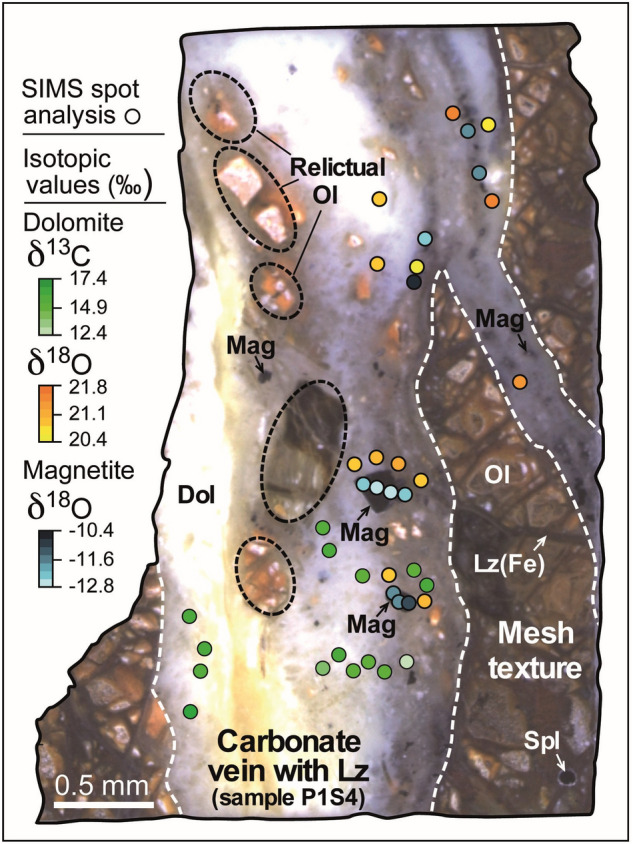
“The δ 18 O of the solution from which they co-precipitated is expected to range from 1.2 to 3.5‰ as calculated with the dolomite–water oxygen isotope fractionation factor 44 .”
MethodInfluentialQuesnel, B., Boulvais, P., Gautier, P., Cathelineau, M., John, C. M., Dierick, M., Agrinier, P., & Drouillet, M. (2016) · Geochimica et Cosmochimica Acta · doi:10.1016/j.gca.2016.03.021 · Cited by 48 · cited 1×
“Note that fluids with temperatures of up to 80–95 °C were also reported in the Koniambo massif in the northern part of New Caledonia based on the oxygen isotopic composition of quartz veins 55 .”
BackgroundGautheron, C., Pinna‐Jamme, R., Derycke, A., Ahadi, F., Sanchez, C., Haurine, F., Monvoisin, G., Barbosa, D., Delpech, G., Maltese, J., et al. (2021) · Geochronology · doi:10.5194/gchron-3-351-2021 · Cited by 47 · cited 1×
“Extracted gas was purified and analyzed for 4 He with an error estimated at 2% using the Pfeiffer® Quad-line Prisma QMG 100 at the GEOPS (Paris—Saclay University, France) following the protocol described in Gautheron et al. 61 .”
MethodSelf-citationYalçin, H., & Bozkaya, Ö. (2004) · Clays and Clay Minerals · doi:10.1346/ccmn.2004.0520209 · Cited by 46 · cited 1×
“Dolomite is a common alteration product of ultramafic rocks 47–50 The LT serpentine (Step 2) described here is noticeably Fe-poor (Mg# = 0.98).”
BackgroundInfluentialNoël, J., Godard, M., Oliot, É., Martinez, I., Williams, M., Boudier, F., Rodriguez, O., Chaduteau, C., Escario, S., & Gouze, P. (2018) · Lithos · doi:10.1016/j.lithos.2018.08.020 · Cited by 43
The stoichiometric effects of ferric iron substitutions in serpentine from microprobe data
Beard, J. S., & Frost, C. D. (2016) · International Geology Review · doi:10.1080/00206814.2016.1197803 · Cited by 42 · cited 2×
“The presence of residual olivine in the vicinity of the studied vein ( 50 µm) ensured that both low SiO 2 activity and low f O 2 prevailed during this latter mineralization stage 51 (Step 2).”
BackgroundGeochemistry and Origin of Listwanites in the Sartohay and Luobusa Ophiolites, China
Robinson, P. T., Malpas, J., Zhou, M.-F., Ash, C., Yang, J.-S., & Bai, W.-J. (2005) · International Geology Review · doi:10.2747/0020-6814.47.2.177 · Cited by 38
Nakashima, D., Kita, N. T., Ushikubo, T., Noguchi, T., Nakamura, T., & Valley, J. W. (2013) · Earth and Planetary Science Letters · doi:10.1016/j.epsl.2013.08.009 · Cited by 38 · cited 1×
“S10) which were pressed into indium within a 25.4 mm diameter aluminum ring 63 .”
BackgroundInfluentialChapter 10 Mineral resources and prospectivity of the ultramafic rocks of New Caledonia
Maurizot, P., Sevin, B., Lesimple, S., Bailly, L., Iseppi, M., & Robineau, B. (2020) · Geological Society London Memoirs · doi:10.1144/m51-2016-17 · Cited by 36 · cited 2×
“1b) and corresponds to a nappe of peridotite 1.5–3.5 km thick 30 .”
BackgroundInfluentialSelf-citationMonnin, C., Quéméneur, M., Price, R. E., Jeanpert, J., Maurizot, P., Boulart, C., Donval, J., & Pelletier, B. (2021) · Journal of Geophysical Research Biogeosciences · doi:10.1029/2021jg006243 · Cited by 32 · cited 2×
“4) through either a Sabatier reaction or by microbial hydrogenotrophic methanogenesis 38 .”
BackgroundSchwartz, S., Gautheron, C., Ketcham, R. A., Brunet, F., Corre, M., Agranier, A., Pinna‐Jamme, R., Haurine, F., Monvoin, G., & Riel, N. (2020) · Earth and Planetary Science Letters · doi:10.1016/j.epsl.2020.116359 · Cited by 31
Self-citationTectonic and metamorphic architecture of the HP belt of New Caledonia
Brovarone, A. V., Agard, P., Monié, P., Chauvet, A., & Rabaute, A. (2018) · Earth-Science Reviews · doi:10.1016/j.earscirev.2018.01.006 · Cited by 30
Cooperdock, E. H. G., Stockli, D. F., Kelemen, P. B., & de Obeso, J. C. (2020) · Journal of Geophysical Research Solid Earth · doi:10.1029/2019jb018632 · Cited by 28 · cited 1×
“On a methodological viewpoint, the MgHe method was already used to date LT magnetite crystals ( 60 °C) in serpentine-free calcite veins from the Samail ophiolite (Oman) 59 .”
MethodCarlin, W., Malvoisin, B., Lanson, B., Brunet, F., Findling, N., Lanson, M., Magnin, V., Fargetton, T., Jeannin, L., & Lhote, O. (2023) · Applied Clay Science · doi:10.1016/j.clay.2023.106845 · Cited by 21 · cited 2×
“RedOx reactions involving Fe-bearing minerals and water, schematically 2Fe(II)O + H 2 O = Fe(III) 2 O 3 + H 2 , are the best candidates for abiotic H 2 production 25 .”
BackgroundSelf-citationBaseline geochemical characterisation of a vulnerable tropical karstic aquifer; Lifou, New Caledonia
Nicolini, E., Rogers, K. M., & Rakowski, D. (2015) · Journal of Hydrology Regional Studies · doi:10.1016/j.ejrh.2015.11.014 · Cited by 14 · cited 1×
“Typical δ 18 O for meteoric and seawater range from slightly negative 54 to near zero, respectively.”
BackgroundBassal, F., Roques, J., Corre, M., Brunet, F., Ketcham, R. A., Schwartz, S., Tassan-Got, L., & Gautheron, C. (2022) · Minerals · doi:10.3390/min12050590 · Cited by 14 · cited 2×
“Helium is retained within the magnetite crystal structure at the temperature (ca. 95 °C) of GR2H magnetite formation 53 .”
BackgroundSelf-citationFallick, A. E., Giuliani, G., Rigaudier, T., Boyce, A. J., Pham, V. L., & Pardieu, V. (2019) · Comptes Rendus Géoscience · doi:10.1016/j.crte.2018.11.008 · Cited by 9 · cited 1×
“The procedural preparation and the analysis method presented in Fallick et al. 64 were followed.”
MethodCorre, M., Agranier, A., Lanson, M., Gautheron, C., Brunet, F., & Schwartz, S. (2022) · Geochronology · doi:10.5194/gchron-4-665-2022 · Cited by 7 · cited 1×
“ICP-MS Thermo® Element XR (GEOPS, Paris—Saclay University, France) was used for Georges Pile aliquots using the isotope dilution method 62 .”
MethodSelf-citation
Cited by
Kinetics of low-temperature H2 production in ultramafic rocks by ferroan brucite oxidation
Carlin, W., Malvoisin, B., Brunet, F., Lanson, B., Findling, N., Lanson, M., Fargetton, T., Jeannin, L., & Lhote, O. (2024) · Geochemical Perspectives Letters · doi:10.7185/geochemlet.2408 · Cited by 22
Self-citationLeila, M., Hazlett, R. D., George, P. M., Moretti, I., Kabashev, Z., & Fustic, M. (2025) · Carbon Capture Science & Technology · doi:10.1016/j.ccst.2025.100481 · Cited by 16
Experimental Evidence for Reaction‐Induced Weakening of (Carbonated) Serpentinite Fault Gouges
Eberhard, L., Niemeijer, A., & Plümper, O. (2024) · Journal of Geophysical Research Solid Earth · doi:10.1029/2024jb029887 · Cited by 6
“…carbonated serpentinites are commonly found along tectonic contacts (Bernoulli & Weissert, 1985; Cannaò et al., 2020; Caurant et al., 2023; Clerc et al., 2014; Corre et al., 2023; Driesner, 1993; Dunkel et al., 2019; Picazo et al., 2013; Schwarzenbach et al., 2013; Ternieten et al., 2021a, 2021b).”
Brunet, F., & Malvoisin, B. (2025) · Advances in Geochemistry and Cosmochemistry · doi:10.33063/agc.v1i2.738 · Cited by 7
Self-citationIsah, A., Samouei, H., & Okoroafor, E. R. (2025) · Hydrogen · doi:10.3390/hydrogen6040076 · Cited by 7
“The rock samples were subjected to temperature and pressure hydrothermal conditions reported in some serpentinized systems [12,22,33], simulating natural subsurface environments where natural hydrogen is produced through rock–water interactions.”
Metadata
- Authors
- Corre, M., Brunet, F., Schwartz, S., Gautheron, C., Agranier, A., & Lesimple, S.
- Affiliations
- Centre National de la Recherche Scientifique (FR)
- Corresponding author
- Brunet, Fabrice
- Venue
- Scientific Reports
- Published
- 2023-11-08
- Volume
- 13
- Issue
- 1
- Pages
- 19413-19413
- ISSN
- 2045-2322 (ISSN-L)
- PMC
- PMC10632469
- OpenAlex
- W4388501059
- Semantic Scholar
- c26517d9d576efd87eac21286293d84e76faedcc
- Cited by
- 19
- References
- 64
- Citations by year
- 2026: 9 · 2025: 7 · 2024: 3
- FWCI
- 3.02
- Type
- journal article
- Language
- en
- Open access
- gold
- doi.org
- Licence
- cc-by
- creativecommons.org/licenses/by/4.0 (tdm)
- creativecommons.org/licenses/by/4.0 (vor)
- Locations
- Scientific Reports (publishedVersion, cc-by)
- PubMed Central (publishedVersion, cc-by)
- PubMed (publishedVersion)
- HAL (submittedVersion, other-oa)
- HAL (submittedVersion, cc-by)
- Institutional Archive of Ifremer (French Research Institute for Exploitation of the Sea) (submittedVersion, cc-by)
- DOAJ (DOAJ: Directory of Open Access Journals) (submittedVersion, cc-by-sa)
- Funders
- Direction de l’Industrie, des Mines et de l’Environnement de Nouvelle Calédonie (DIMENC 19-A03/DAT-AM/IST/CE)
- Topics
- Physical Sciences › Earth and Planetary Sciences › Geochemistry and Petrology › Geochemistry and Elemental Analysis
- Physical Sciences › Earth and Planetary Sciences › Geochemistry and Petrology › Geological and Geochemical Analysis
- Physical Sciences › Environmental Science › Environmental Engineering › CO2 Sequestration and Geologic Interactions
- Keywords
- serpentinization, meteoric water infiltration, alkaline springs, hydrogen production, methane production, methanogenesis, lizardite, dolomite, magnetite, pyroaurite, carbon isotopes, plumbing systems, New Caledonia
About these checks
Registry, retraction, Cites and statistics results are computed, not judged, with one exception: a printed reference that no index lists is read once by a model before it counts as a citation error. Claims are extracted by a model and kept only when their quote appears verbatim in the text; each cited source is then checked, with a model’s help, for whether it says what the claim relies on. Those verdicts can be wrong — read the claim’s quote and the cited source before relying on one.
Statistics and arithmetic are recomputed, not judged.
Confidence bands are shown only for fields calibrated on our annotated test set. None is calibrated yet, so no band is shown.
What counts as a claim ›How we measure confidence ›How we check this ›
Are you an author, or do you see a problem with this page? Request a review
Data sources
Bibliographic data: Semantic Scholar, OpenAlex, Crossref.
Contains information from the Semantic Scholar Academic Graph Datasets, made available under the ODC Attribution License (ODC-BY 1.0).
Semantic Scholar’s data is described in: Kinney, R., et al. (2023). The Semantic Scholar Open Data Platform. arXiv:2301.10140.
