

Enhancing student critical thinking and learning outcomes through innovative pedagogical approaches in higher education: the mediating role of inclusive leadership
Open accessPublished version of a preprint
The DOI matches its Crossref record; 73 of the 73 references it cites were found in a registry or an index.
Abstract
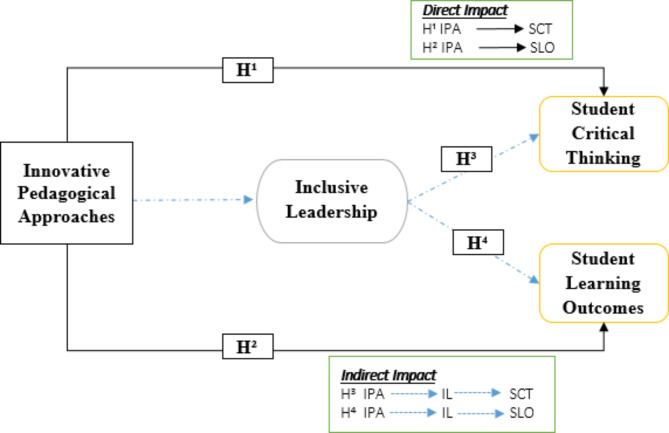
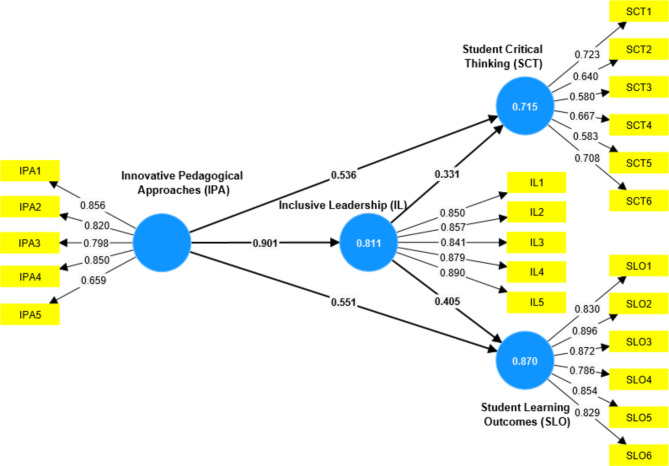
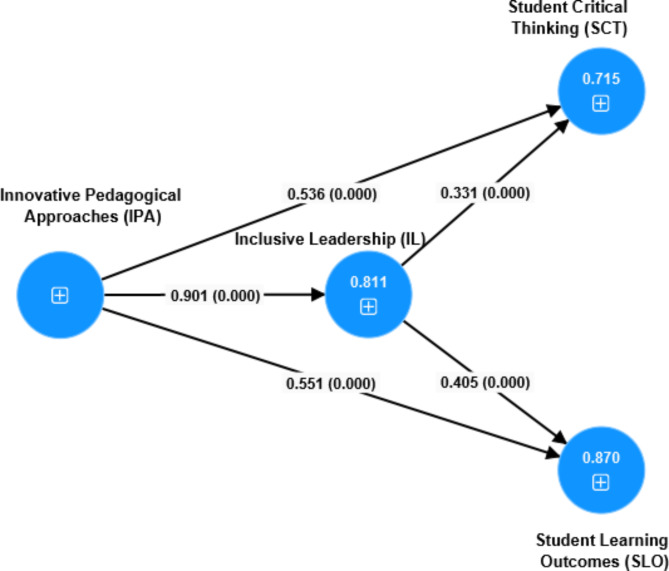
This quantitative study examines the influence of innovative pedagogical approaches (IPA) on enhancing student critical thinking (SCT) and student learning outcomes (SLO) in higher education, with an emphasis on the mediating role of inclusive leadership(IL). Using a sample of 321 students from public and private universities in Pakistan, the research reveals that methods such as problem-based learning, flipped classrooms, and interactive teaching significantly boost academic performance and cultivate critical thinking skills. The findings indicate that innovative pedagogical approaches positively and significantly impact student critical thinking (β = 0.536, t = 6.539, p < 0.001) and learning outcomes (β = 0.551, t = 12.725, p < 0.001). Additionally, inclusive leadership mediates the relationship between innovative teaching methods and both student critical thinking (β = 0.331, t = 3.833, p < 0.001) and learning outcomes (β = 0.405, t = 8.662, p < 0.001). Data were collected using survey questionnaires adapted from established studies on inclusive leadership, innovative pedagogical approaches, student critical thinking, and learning outcomes. These results highlight the essential role of inclusive leadership in enhancing the efficacy of innovative pedagogies by creating a supportive and diverse learning environment. The study suggests that implementing active learning strategies and integrating technology in the classroom, along with inclusive leadership practices, can significantly improve student engagement, critical thinking, and overall academic performance. This research offers valuable insights for educators and policymakers seeking to enhance teaching and learning experiences in higher education.
Overview
The claims and statistics of this paper haven’t been checked yet.
Free: it reads the open-access text and checks the first 5 claims that cite a source we can check. Create a free account to check every claim.
Integrity signals
Registry
Cites
Statistics
Figures
Verification
Claims the paper makes
The claims and statistics of this paper haven’t been checked yet.
Free: it reads the open-access text and checks the first 5 claims that cite a source we can check. Create a free account to check every claim.
Claims other papers make about this one
Each is checked against this paper’s own text: does it say what the citing paper says it does?
The source backs part of the claim, not all of it — or backs it for a different population, condition or comparison.
In the citing paper
“Furthermore, current instructional designs continue to emphasize content delivery and rote memorization, rather than the deep, metacognitive engagement that drives genuine CT development [4,5].”
From A Systematic Literature Review on the Pedagogical Implications and Impact of GenAI on Students' Critical Thinking (2026) · cites this paper as [4]
Experimental — accuracy not yet measured
Self-check
Percentages, sums and reported differences re-computed from the paper’s own numbers.
The self-check needs the paper’s full text.
Citations
Cites
Active learning increases student performance in science, engineering, and mathematics
Freeman, S., Eddy, S. L., McDonough, M., Smith, M. K., Okoroafor, N., Jordt, H., & Wenderoth, M. P. (2014) · Proceedings of the National Academy of Sciences · doi:10.1073/pnas.1319030111 · Cited by 9,787 · cited 1×
“These approaches go beyond rote memorization, encouraging students to analyze, evaluate, and generate new ideas 31 .”
BackgroundDoes Active Learning Work? A Review of the Research
Prince, M. (2004) · Journal of Engineering Education · doi:10.1002/j.2168-9830.2004.tb00809.x · Cited by 7,334
Hair, J. F., Ringle, C. M., & Sarstedt, M. (2013) · Long Range Planning · doi:10.1016/j.lrp.2013.01.001 · Cited by 5,310
Problem-Based Learning: What and How Do Students Learn?
Hmelo-Silver, C. E. (2004) · Educational Psychology Review · doi:10.1023/b:edpr.0000034022.16470.f3 · Cited by 5,212
The ICAP framework: Linking cognitive engagement to active learning outcomes
Chi, M. T. H., & Wylie, R. (2014) · Educational Psychologist · doi:10.1080/00461520.2014.965823 · Cited by 2,911 · cited 1×
“According to 34 , students enrolled in active learning environments achieved higher exam scores and lower failure rates than those enrolled in traditional lecture-based instruction.”
BackgroundTeacher Technology Change: How Knowledge, Confidence, Beliefs, and Culture Intersect
Ertmer, P. A., & Ottenbreit-Leftwich, A. T. (2010) · Journal of Research on Technology in Education · doi:10.1080/15391523.2010.10782551 · Cited by 2,556
The Flipped Classroom: A Survey of the Research
Bishop, J., & Verleger, M. (2020) · 2013 ASEE Annual Conference & Exposition Proceedings · doi:10.18260/1-2--22585 · Cited by 2,437
Nembhard, I. M., & Edmondson, A. C. (2006) · Journal of Organizational Behavior · doi:10.1002/job.413 · Cited by 2,385
The Construction of Shared Knowledge in Collaborative Problem Solving.
Roschelle, J., & Teasley, S. D. (1995) · Computer Supported Collaborative Learning · doi:10.1007/978-3-642-85098-1_5 · Cited by 2,274 · cited 1×
“Technology-supported collaborative learning environments can improve critical thinking through shared knowledge construction 39 .”
BackgroundThe use of flipped classrooms in higher education: A scoping review
O'Flaherty, J., & Phillips, C. (2015) · The Internet and Higher Education · doi:10.1016/j.iheduc.2015.02.002 · Cited by 2,152
Research works printed but not linked: 7
- Fink, L. D., Davis, J. R. & Arend, B. D. Facilitating seven ways of learning: a resource for more purposeful, effective, and enjoyable college teaching (Routledge, 2013).
- Hattie, J. The black box of tertiary assessment: an impending revolution. Tertiary Assess. Higher Educ. Student Outcomes: Policy Pract. Res. 259, 275 (2009).
- Kamran, F., Kanwal, A., Afzal, A. & Rafiq, S. Impact of interactive teaching methods on students learning outcomes at university level. J. Positive School Psychol. 7 (7), 89–105 (2023).
- Barron, B., & Darling-Hammond, L. Teaching for meaningful learning: a review of research on inquiry-based and cooperative learning. Book excerpt. George Lucas Educ. Found. (2008).
- Li, C. C., Aldosari, M. A. & Park, S. E. Understanding pedagogical approaches on student learning styles. Ann. Dent. Oral Health 4 (1), 1039–1045 (2021).
- Ammar, M., Al-Thani, N. J. & Ahmad, Z. Role of pedagogical approaches in fostering innovation among K-12 students in STEM education. Soc. Sci. Human. Open. 9, 100839 (2024).
- Korkmaz, A. V., Van Engen, M. L., Knappert, L. & Schalk, R. About and beyond leading uniqueness and belongingness: a systematic review of inclusive leadership research. Hum. Resour. Manage. Rev. 32 (4), 100894 (2022).
Cited by
Papaneophytou, C. P., & Nicolaou, S. A. (2025) · Trends in Higher Education · doi:10.3390/higheredu4020024 · Cited by 73
Redaelli, S., Germani, F., Spitale, G., Biller‐Andorno, N., Brown, J., & Glöckler, S. (2025) · Frontiers in Education · doi:10.3389/feduc.2025.1577692 · Cited by 59
Determining Factors for the Development of Critical Thinking in Higher Education
Jaramillo Gómez, D. L., Álvarez Maestre, A. J., Parada Trujillo, A. E., Pérez Fuentes, C. A., Bedoya Ortiz, D. H., & Sanabria Alarcón, R. K. (2025) · Journal of Intelligence · doi:10.3390/jintelligence13060059 · Cited by 50
“This suggests that the use of technology in the classroom, without an appropriate pedagogical approach, may not be sufficient to substantially enhance critical thinking (Bhuttah et al. 2024; Ravikumar et al. 2025).”
Awang, N. E., Hamzah, M. I., & Zulkifli, H. (2025) · International Journal of Learning Teaching and Educational Research · doi:10.26803/ijlter.24.3.32 · Cited by 32
Balart, T., Díaz, B., & Shryock, K. (2026) · Algorithms · doi:10.3390/a19030179 · Cited by 29
“Furthermore, current instructional designs continue to emphasize content delivery and rote memorization, rather than the deep, metacognitive engagement that drives genuine CT development [4,5].”
Factors Affecting Teachers’ Implementation of Innovative Pedagogies: A Systematic Literature Review
Awang, N. E., Zulkifli, H., & Hamzah, M. I. (2025) · International Journal of Learning Teaching and Educational Research · doi:10.26803/ijlter.24.3.18 · Cited by 27
“Driven by technological advancements, globalization, and the need for student-centered learning approaches, the field of education is undergoing profound transformations (Bhuttah et al., 2024; Hamadneh et al., 2025).”
Ramaila, S. M. (2025) · African Journal of Teacher Education · doi:10.21083/ajote.v14i1.8250 · Cited by 25
Kassaye, M. T., Damtie, D., Melesse, S., & Yemata, G. (2025) · Discover Education · doi:10.1007/s44217-025-00699-w · Cited by 23
“For example, a review on the effect of inquiry-based learning by Bhuttah et al. [18] established that inquiry-based learning positively influences learning outcomes, including academic performance and motivation.”
Krishnan, S., Rajendran, S., & Zakariah, M. (2025) · Scientific Reports · doi:10.1038/s41598-025-06789-x · Cited by 20
Pedagogical approaches to teaching soft skills in higher education contexts
Sanatbay, P., Atmaca, T., Smailova, G., & Kadyrovna, S. K. (2025) · Cogent Education · doi:10.1080/2331186x.2025.2571683 · Cited by 19
“Therefore, it is crucial for higher education institutions to adopt pedagogical approaches that aim to foster the development of soft skills among students (Bhuttah et al., 2024).”
Kayande, D., & Kukreja, S. (2025) · MethodsX · doi:10.1016/j.mex.2025.103588 · Cited by 19
“Likewise, Bhuttah et al. [11] show that innovative pedagogical strategies, coupled with inclusive leadership, engage learners and enhance higher-order thinking skills.”
Galeboe, K. A., Moalosi, R., Rapitsenyane, Y., & Ruele, V. (2025) · Discover Education · doi:10.1007/s44217-025-00604-5 · Cited by 18
“A study by Bhuttah et al. [37] found that university educators are notably effective in stimulating critical thinking and student engagement as they encourage discussion, problem-solving, and real-world applications.”
Addai, P. (2025) · International Journal of Public Leadership · doi:10.1108/ijpl-04-2025-0073 · Cited by 14
Servant Leadership Style in High Education Institutions: A Systematic Literature Review
Dul, V., Sam, R., Hak, S., Bou, D., Vy, S., & Kheuy, S. (2024) · European Journal of Contemporary Education and E-Learning · doi:10.59324/ejceel.2024.2(6).08 · Cited by 13
“Research conducted by (Aboramadan et al., 2020) and (Bhuttah et al., 2024) emphasized how servant leadership positively influences student engagement, well-being, and academic success.”
Mariyono, D., Yunus, M., Junaidi, J., Syam, N., & Mazhabi, Z. (2026) · Educational Management Administration & Leadership · doi:10.1177/17411432261419475 · Cited by 13
Yasin, A., Susilawati, S., Supriyatno, T., Tasir, Z., Asmawati, R. I., Chakim, A., & Putri, C. A. (2025) · Nazhruna Jurnal Pendidikan Islam · doi:10.31538/nzh.v8i3.319 · Cited by 12
Semerikov, S. O., & Semerikov, S. O. (2026) · Discover Education · doi:10.1007/s44217-026-01179-5 · Cited by 12
Yang, S., Zhu, S., Qin, W., Mai, Y., Guo, Q., & Li, H. (2025) · Education and Information Technologies · doi:10.1007/s10639-025-13710-6 · Cited by 11
“This reliance restricts students’ divergent thinking and problem-solving abilities, thus limiting their opportunities for independent explo-1 ration and innovation, and ultimately negatively affecting their performance in the creative problem-solving process (Bhuttah et al., 2024 ).”
Aposika, F. (2026) · Discover Education · doi:10.1007/s44217-026-01487-w · Cited by 9
“Similarly, Bhuttah et al. [6] found that innovative, student-centred pedagogical approaches foster higher levels of engagement and critical thinking.”
Дмитрієва, І., Dovhaliuk, T., Sobchuk, A. A., Shevchenko, О., & Білюк, О. Г. (2025) · Seminars in Medical Writing and Education · doi:10.56294/mw2025444 · Cited by 9
Misyani, M., Erwis, F., Lubis, A., & Setiawan, A. (2025) · Jurnal Penelitian Pendidikan · doi:10.17509/jpp.v25i2.88497 · Cited by 8
“Selain itu, hasil penelitian ini diperkuat oleh studi kuantitatif yang dilakukan oleh Bhuttah et al. (2024) yang menggunakan pemodelan persamaan struktural untuk menganalisis pengaruh pembelajaran berbasis masalah terhadap kemampuan berpikir kritis mahasiswa.”
Munikwa, S. (2024) · International Journal of Innovative Research in Education · doi:10.18844/ijire.v11i2.9484 · Cited by 7
Yaseen, M., Andleeb, S., Ullah, N., & Zafar, J. M. (2025) · The Knowledge · doi:10.63062/tk/2k25b.42047 · Cited by 6
Operationalizing education 4.0: a structured method for course materials and assessment alignment
Elragal, A. A., & Habibipour, A. (2025) · Frontiers in Education · doi:10.3389/feduc.2025.1694545 · Cited by 6
Four decades of change: The evolution of teaching styles in Nigerian science education (1983–2023)
Ugwuanyi, C. S., Eryılmaz, N., & Pietsch, M. (2026) · International Journal of Educational Development · doi:10.1016/j.ijedudev.2026.103504 · Cited by 6
Gao, M., Yang, S., Zhang, H., Huang, Y., Xiao, H., He, Z., Qiu, C., & Lu, J. (2025) · Scientific Reports · doi:10.1038/s41598-025-07491-8 · Cited by 6
“Higher educational attainment equips individuals with enhanced cognitive skills and critical thinking abilities necessary for effective health decision-making 28 .”
Wijayanti, A., Wiyanto, W., Ridlo, S., & Parmin, P. (2025) · Retos · doi:10.47197/retos.v70.116789 · Cited by 5
Reimagining Education Systems for Curriculum Justice in the Fourth and Fifth Industrial Revolutions
Lumadi, R. I. (2025) · Africa Education Review · doi:10.1080/18146627.2025.2578356 · Cited by 5
Integration of Innovative Learning Methods in 21st Century Skills Development: A Systematic Review
Fitriyani, R., Nurlela, N., Aqil, N., Marba'i, M., Ameliyah, R., Khairani, D. R., Musliman, A., & Rifai, D. S. (2026) · Paedagogie · doi:10.31603/paedagogie.v21i1.16192 · Cited by 5
“Furthermore, educators must create inclusive and supportive learning environments that cater to diverse learners, ensuring that all students have an equal opportunity to develop 21st-century skills (Bhuttah et al., 2024).”
Rafiq-uz-Zaman, M., Shih, Y.-H., & Muthmainnah (2026) · Proscholar insights · doi:10.55737/psi.2026a-51164 · Cited by 5
Anselmo, C. T., Dumelod, D. A., Molano, T., Liban, A., Cagayan, A. J., Maglelong, A., & Mara, J. M. (2025) · Psychology and Education A Multidisciplinary Journal · doi:10.70838/pemj.390501 · Cited by 5
Roza, M. R. M. (2025) · Journal of Educational Innovation and Research · Cited by 5
Younyi, T. M., Etomes, S. E., & Ndille, R. (2024) · Perspectives in Education · doi:10.38140/pie.v42i4.7891 · Cited by 5
Strengthening Arabic Language Learning Through Language Environment: A Case Study in Pesantren Riau
Samin, S. M., Pebrian, R., Alfitri, A., Supriady, H., Yunita, Y., & Yasin, M. F. (2025) · Al-Ta rib Jurnal Ilmiah Program Studi Pendidikan Bahasa Arab IAIN Palangka Raya · doi:10.23971/altarib.v13i2.10565 · Cited by 5
Strategies for building an inclusive culture in higher education
Supriyanto, S., Wiyono, B. B., & Muhimmah, H. A. (2025) · Global Journal of Sociology Current Issues · doi:10.18844/gjs.v15i1.9711 · Cited by 4
Raptis, N., Psyrras, N., Mastrothanasis, K., & Koutsourai, S.-E. (2025) · European Journal of Humanities and Social Sciences · doi:10.24018/ejsocial.2025.5.6.621 · Cited by 4
Riyanti, H., Sopandi, W., Mulyadi, D., & Muslim (2026) · Frontiers in Education · doi:10.3389/feduc.2026.1801268 · Cited by 4
Gonzalez-Sanchez, J., Ponce, N. E. C., PEÑAHERRERA-RAMÓN, T., & Solís-Zambrano, R. (2026) · ESPACIOS · doi:10.48082/espacios-a26v47n02i13 · Cited by 4
Adam, A. S., Mubarok, H., & Suprapto, N. (2025) · Journal of Science Education and Technology · doi:10.1007/s10956-025-10253-w · Cited by 3
Analysis of the Features Shaping Students’ Thinking to Enhance the Educational Process
Motukeeva, A., Azhibaeva, A., Kazieva, G., Zainiev, R., & Tokonbekova, K. (2025) · Higher Education for the Future · doi:10.1177/23476311251372249 · Cited by 3
“Innovative pedagogical strategies in higher education, particularly those promoting critical thinking through inclusive leadership, were the focus of research by Bhuttah et al. (2024).”
Matlubah, H., & Anwara, A. (2025) · Tandhuk Majeng · doi:10.24929/tandhuk-majeng.v1i1.4487 · Cited by 3
Estrategia pedagógica: Mejorando el compromiso y el rendimiento académico
Eche, F. R. D., & Santos, R. O. Z. (2025) · Código Científico Revista de Investigación · doi:10.55813/gaea/ccri/v6/ne2/1018 · Cited by 3
Nurhastuti, N., Putra, A., Yuliana, S., Zulpiani, M., Oktaviani, J. N., Sekolah Luar Biasa Negeri Kuantan Singingi, K. S., Putri, T. D., & Afdal (2025) · International Journal of Information and Education Technology · doi:10.18178/ijiet.2025.15.12.2469 · Cited by 5
“The existence of leadership ability at the primary school level is often overlooked because many people think that leadership only develops in adolescence or adulthood [71].”
An AI-driven multimodal framework for language inclusive STEM education in indic languages
Patil, P., Deshmukh, P. V., & Sonkar, M. (2025) · International Journal of Information Technology · doi:10.1007/s41870-025-03009-7 · Cited by 3
Syna, S., & Mam, S. (2026) · Journal Of Social Sciences And Humanites · doi:10.56943/jssh.v5i1.785 · Cited by 3
“Contemporary educational expectations require teachers to cultivate not only academic knowledge but also critical thinking, creativity, and inclusive pedagogical practices (Bhuttah et al., 2024).”
Purnomo, E., Markhamah, M. H., Prayitno, H. J., Adhantoro, M. S., Rohmadi, M., Yusof, N., & Alas, Y. (2026) · Indonesian Journal on Learning and Advanced Education (IJOLAE) · doi:10.23917/ijolae.v8i1.15023 · Cited by 3
“A variety of teaching activities enhance creativity and explain theory with practice, thereby improving learning outcomes and innovation (Bhuttah et al., 2024; Kulachai et al., 2025; Tanveer, 2025).”
Mudhofir, F., Cahyono, E., Saptono, S., & Sulhadi (2026) · Journal of Advanced Sciences and Mathematics Education · doi:10.58524/jasme.v6i1.1020 · Cited by 3
“The quality of problem design, the nature of pedagogical support provided by the teacher, and the dynamics of classroom interaction all play crucial roles in determining learning outcomes (Bhuttah et al., 2024; Zhai, 2025).”
Lara-Lara, T. A., Yánez-Zapata, P. Y., Aguirre-Palacios, J. L., Espín-Velasco, L. I., & Pullas-Tapia, G. J. (2025) · Revista Mexicana de Investigación e Intervención Educativa · doi:10.62697/rmiie.v5i1.295 · Cited by 3
DANLADI, A. J., EWUGA, L. E., & GUNDE, Y. (2026) · Journal of Educational Research and Practice · doi:10.70382/bejerp.v11i8.030 · Cited by 3
Pengaruh Kewirausahaan Mahasiswa terhadap Kinerja Belajar: Systematic Literature Review
Asbari, M. (2026) · Jurnal Ilmu Sosial, Manajemen, Akuntansi dan Bisnis. · doi:10.70508/rbyyry36 · Cited by 3
“…di Pakistan menunjukkan bahwa innovative pedagogical approaches (IPA) seperti problem-based learning dan flipped classrooms memiliki dampak positif dan signifikan terhadap stu dent critical thinking (β = 0.536, p < 0.001) dan learning outcomes (β = 0.551, p < 0.001) ( Bhuttah et al., 2024).”
InfluentialImran, A. F., Idham, A. Z., Yamin, M., Anto, M. A., & Paramita, S. (2026) · SOSIOEDUKASI JURNAL ILMIAH ILMU PENDIDIKAN DAN SOSIAL · doi:10.36526/sosioedukasi.v15i2.6255 · Cited by 3
“Research by Bhuttah et al. (2024) further argues that conventional approaches are insufficient to foster the development of critical thinking skills, and that policymakers must encourage the integration of innovative teaching practices within curricula so that lecturers can engage more creatively,…”
Auliya, H. R., Adi, B. S., Rakhmawati, S., Suryani, L., Haliem, T. D., & Pangastuti, D. (2025) · Jurnal Prima Edukasia · doi:10.21831/jpe.v13i2.80657 · Cited by 3
“Problem-Based Learning (PBL) has emerged as an effective educational approach that emphasizes active student engagement (Bhuttah et al., 2024; Pangestu et al., 2024; Wu et al., 2025) and the water cycle.”
Fajriah, K., & Andrian, D. (2025) · Jurnal Penelitian Ilmu Pendidikan Indonesia · Cited by 3
Afikah, A., Rahmadani, A., Rohaeti, E., Jumadi, J., & Wilujeng, İ. (2025) · International Journal of Learning & Teaching · doi:10.18844/ijlt.v17i2.9709 · Cited by 3
“Emphasis on communication within collaborative inquiry-based instruction fosters active participation and collective reflection on disciplinary knowledge and theoretical constructs (Fu & Hwang, 2018; Sung & Hwang, 2013; Bhuttah et al., 2024).”
Indriyani, V., Triana, H., Helda, T., Zakarya, Z., & Fendi, H. (2025) · Jurnal Pemberdayaan Masyarakat · doi:10.46843/jpm.v4i2.465 · Cited by 3
“This approach is also positively correlated with holistic learning outcomes, including literacy, social leadership, moral development, and attitudes toward diversity (Bhuttah et al., 2024).”
Galinada, L. B., & Pimentel, G. (2025) · Psychology and Education A Multidisciplinary Journal · doi:10.70838/pemj.380306 · Cited by 2
Nam, O. V. (2025) · Journal of Posthumanism · doi:10.63332/joph.v5i6.2332 · Cited by 2
“Extending this model to higher education, Bhuttah et al. (2024) showed that instructors who practice inclusive leadership can amplify the effectiveness of active teaching methods, thereby enhancing students’ critical thinking and improving academic performance.”
InfluentialMohan, T. C., Rajulu, C., Gopalan, C., & Arun, M. (2025) · AJP Advances in Physiology Education · doi:10.1152/advan.00063.2025 · Cited by 2
Innovating handoff communication training: A scoping review
Martínez, M. M., Gunning, M., Gelhorn, A. F., Aranda, G. N., Gomez, L. S., Sesto, M. L., Balmaceda, L. M., Brunelli, M. V., Kesler, B., & Moore, F. (2025) · Nurse Education in Practice · doi:10.1016/j.nepr.2025.104597 · Cited by 2
We All Have Climate Solutions: Embracing Evolution Over Revolution in Management Education
Hope, A. J., & Molthan‐Hill, P. (2025) · Organizational Behavior Teaching Review · doi:10.1177/10525629251390444 · Cited by 2
“Measured outcomes demonstrate increased systemic understanding, enhanced critical thinking, stronger civic responsibility, and deeper community connections among students (Bhuttah et al., 2024).”
Rufaiqoh, E., Huda, M., & Firdansyah, A. (2025) · Learning Media and Technology in Arabic Education · doi:10.53515/f6wkf857 · Cited by 2
Fakhrudin, Suhartini, S., & Paidi, P. (2025) · Jurnal Penelitian Pendidikan IPA · doi:10.29303/jppipa.v11i11.12482 · Cited by 2
“This aligns with the principles of ethnopedagogy, which prioritizes local culture as the primary source of (Silvola et al., 2021), and ecopedagogy, which positions education as a means of building ecological awareness grounded in community wisdom (Bhuttah et al., 2024).”
Bueno, W. T. P., Huacho, M. E. R., Candiotti, G. M. V., & Mendoza, J. C. (2026) · Revista Tribunal · doi:10.59659/revistatribunal.v6i14.349 · Cited by 2
Quantitative Analysis of Creative Thinking Skills and Concept Mastery in Physics: Temperature & Heat
Pratiwi, S. M. V., Wiyono, K., İsmet, İ., & Utami, Y. (2025) · Jurnal Penelitian & Pengembangan Pendidikan Fisika · doi:10.21009/1.11107 · Cited by 2
Wulandari, S., Hartoyo, A., Samodra, Y. T. J., & Dafun, P. B. (2026) · Primary Jurnal Pendidikan Guru Sekolah Dasar · doi:10.33578/jpfkip.v15i1.27-41 · Cited by 2
“Systematically designed media support students in understanding complex or abstract material while simultaneously fostering learning interest and motivation (Bhuttah et al., 2024; Maharani & Hidayah Putri, 2023).”
Hotimah, H., Sujana, A., Supriatna, E., & Nurulpaik, I. (2026) · Journal of Advanced Sciences and Mathematics Education · doi:10.58524/jasme.v6i1.1114 · Cited by 2
“Furthermore, a significant number of previous studies emphasize instructional interventions aimed at improving critical thinking through specific learning models (Bhuttah et al., 2024; Rivas et al., 2022).”
Syaukani, M. H., Suyanta, & Mahdian (2026) · Tadris Jurnal Keguruan dan Ilmu Tarbiyah · doi:10.24042/tadris.v11i1.28583 · Cited by 2
Ramírez, D. A. M., García, R. E. R., & Turusina, M. A. C. (2026) · Ciencia y Educación · doi:10.5281/zenodo.19598522 · Cited by 2
Bueno, G. C. S., Rodríguez, P. D. L. M. W., & Albán, J. S. L. (2026) · RECIMUNDO · doi:10.26820/recimundo/10.(2).abril.2026.105-120 · Cited by 2
Winarto, W., Misbah, M., Ariyatun, A., Satria, E., Widiyati, E., Jumini, S., Parameswari, P., & Shidiq, G. A. (2026) · European Journal of STEM Education · doi:10.20897/ejsteme/18304 · Cited by 2
Syahfitri, J., Nasral, & Pariyanto (2026) · Jurnal Pengabdian Sains dan Humaniora · doi:10.32938/jpsh.v5i1.10807 · Cited by 2
“Such learning patterns are less effective in encouraging active student participation and do not adequately support the development of higher-order thinking skills (Bhuttah et al., 2024) .”
Alsetri, B., Alhulimi, S., Mushayqiri, B., & Aljasim, F. (2026) · AJBMSS - Advance Journal of Business Management and Social Sciences · doi:10.65080/ajbmss.v2i1.cmt2621101003 · Cited by 2
Siregar, M., Lubis, F. R., & Ramadhani, Y. R. (2026) · Jurnal Kepemimpinan dan Pengurusan Sekolah · doi:10.34125/jkps.v11i2.1988 · Cited by 2
Lindriany, J., Suyatno, S., & Hartanto, D. (2026) · Jurnal Kepemimpinan dan Pengurusan Sekolah · doi:10.34125/jkps.v11i1.1869 · Cited by 2
A Validity of E-LKPD Based on Problem Based Learning for Improve Critical Thinking Skill
Meitaza, D., Sriyanti, I., Marlina, L., & Zulkarnain, N. N. B. (2024) · Indonesian Journal of Education Research (IJoER) · doi:10.37251/ijoer.v5i6.1244 · Cited by 2
Romadhon, D. R., Rosyada, D., Murodi, M., Wahdi, W., Asmu’i, A., & Mani, S. (2025) · CRC Press eBooks · doi:10.1201/9781003645542-62 · Cited by 2
Mapping research trends in innovative pedagogies: a bibliometric analysis
Awang, N. E., Zulkifli, H., & Hamzah, M. I. (2025) · International Journal of Evaluation and Research in Education (IJERE) · doi:10.11591/ijere.v14i6.34519 · Cited by 2
“Innovative pedagogy represents a significant shift in educational practices, focusing on dynamic, student-centered approaches, technology integration, and interdisciplinary strategies to meet the evolving needs of modern learners [1] – [5].”
Barata, M. F., Aisyah, S. N., & Epandi, D. (2025) · ISEJ Indonesian Science Education Journal · doi:10.62159/isej.v6i1.2066 · Cited by 2
“In response to this issue, various instructional models have been proposed to enhance students’ critical thinking skills (Bhuttah et al., 2024; Ma, 2023; Saenab et al., 2020).”
Open-Ended Learning Model Effect on Critical and Creative Thinking in Islamic Education
Ritonga, K. R., Murniati, A., & Hulawa, D. E. (2026) · JIE (Journal of Islamic Education) · doi:10.35723/jie.v11i1.721 · Cited by 2
“…of the Open-Ended Learning model in developing both skills simultaneously, this research provides a practical contribution to efforts to improve the quality of education that produces learners who are not only knowledgeable but also capable of thinking deeply and creatively (Bhuttah et al., 2024).”
InfluentialMỘT SỐ PHƯƠNG PHÁP ỨNG DỤNG TƯ DUY PHẢN BIỆN KHI SỬ DỤNG AI TẠO SINH TRONG GIÁO DỤC PHỔ THÔNG
Thùy, K. P., Ân, N. K., & Giang, V. T. (2025) · Journal of Science Educational Science · doi:10.18173/2354-1075.2025-0060 · Cited by 1
Wanabuliandari, S., Sumaji, S., Ulya, F. F., Ardianti, S. D., & Ghozali, M. I. (2025) · Journal of Curriculum and Teaching · doi:10.5430/jct.v14n3p229 · Cited by 2
Aceron, R. E. (2025) · European Journal of Education Studies · doi:10.46827/ejes.v12i11.6259 · Cited by 1
“Similarly, Bhuttah et al. (2024) stated that pedagogical leaders play a crucial role in fostering a strong online discussion community and critical thinking.”
Hasanah, H., & Slamet, U. A.-G. (2026) · el-Tarbawi · doi:10.20885/tarbawi.vol18.iss1.art10 · Cited by 1
“These findings support previous studies indicating that inclusive pedagogical approaches can significantly improve educational access and learning outcomes for students with disabilities (Bhuttah et al., 2024; Page et al., 2023).”
Mohamed, M., & Vetbuje, B. G. (2026) · Buildings · doi:10.3390/buildings16061244 · Cited by 1
A Critical Evaluation of the Barriers Students With Disabilities Face in Higher Education
Sadiki, M. C. (2026) · IGI Global eBooks · doi:10.4018/979-8-3373-6132-1.ch002 · Cited by 1
Anđić, D., Čepić, R., & Vorkapić, S. T. (2026) · Sodobna Pedagogika · doi:10.63384/spb61z895a · Cited by 1
Cultural Dynamics and Leadership Practices in ASEAN Higher Education
Salendab, F. A., & Almanon, L. G. (2026) · IGI Global eBooks · doi:10.4018/979-8-3373-7123-8.ch002 · Cited by 1
Rambe, A., Aritonang, S., Ritonga, M., & Hasanah, N. (2026) · Prisma Sains Jurnal Pengkajian Ilmu dan Pembelajaran Matematika dan IPA IKIP Mataram · doi:10.33394/j-ps.v14i1.17375 · Cited by 1
Lê, M. V., Trần, T. T. T., Hang, C. T. H., Ta, T. B. L., & Nguyễn, T. H. A. (2026) · VNU Journal of Foreign Studies · doi:10.63023/2525-2445/jfs.ulis.5710 · Cited by 1
Qin, J., Song, W., & Feng, X. (2026) · Frontiers in Medicine · doi:10.3389/fmed.2026.1787256 · Cited by 1
Taouis, H. B., & García, A. D. (2026) · Journal of University Teaching and Learning Practice · doi:10.53761/28y4hw95 · Cited by 1
“To cultivate them, educators are increasingly adopting innovative approaches such as problem-based and collaborative learning, which have been shown to improve both critical thinking and academic outcomes (Bhuttah et al., 2024).”
Oktafiani, R., Kesumawardani, A. D., Saputra, Y. A., & Barata, M. F. (2026) · Pro-Life · doi:10.33541/pro-life.v13i1.7838 · Cited by 1
“Instructional practices are no longer expected to focus solely on content delivery but rather on fostering cognitive processes that support reasoning, reflection, and problem-solving (Bhuttah et al., 2024; Daulika et al., 2025; Kusuma & Fauzi, 2025).”
Babar, M., & Ishaque, S. (2026) · The Critical Review of Social Sciences Studies · doi:10.59075/zcphqp11 · Cited by 1
Laroza, J. M. A., & Naparota, L. C. (2026) · International Journal of Research and Innovation in Social Science · doi:10.47772/ijriss.2026.1026edu0280 · Cited by 1
Improving critical thinking skills in mathematics: Implementation of the M6 learning model
Susandi, A. D., Sa’dijah, C., & Susiswo, S. (2026) · Pedagogical Research · doi:10.29333/pr/18773 · Cited by 1
“Research has shown that the provision of scaffolding has a significant positive effect on students ’ critical thinking skills (Bhuttah et al., 2024).”
Tanjung, D. A. S. M., Bukhori, M., & Karnawati, T. A. (2026) · Journal of Educational Management Research · doi:10.61987/jemr.v5i3.2189 · Cited by 1
“By identifying the factors that drive parental decisions in such institutions, this study provides valuable insights for school administrators and policymakers seeking to improve school offerings and attract more students (Bhuttah et al., 2024).”
Biliaminu, B. M., Olaniyan, M. F., Odegbemi, C. D., & Odegbemi, O. B. (2026) · Discover Education · doi:10.1007/s44217-025-00781-3 · Cited by 1
“This reinforces the need for ongoing professional development and institutional support to ensure that educators are equipped to maximize the potential of LMS [4, 23–28].”
Wildaniati, Y., Sa’dijah, C., Subanji, S., Rufiana, I. S., & Gestiardi, R. (2026) · Diaspora Indigenous and Minority Education · doi:10.1080/15595692.2026.2691025 · Cited by 1
Storytelling and educational robotics in literature education: a quasi-experimental study
Palioura, M., Sapounidis, T., & Vaiopoulou, J. (2026) · Education and Information Technologies · doi:10.1007/s10639-026-14096-9 · Cited by 1
“Previous research indicates that knowledge acquisition can be supported through innovative pedagogical practices and digital tools that may foster active cognitive engagement and meaningful processing of instructional content (Weng et al., 2024 ; Bhuttah et al., 2024 ; Lee, 2025 ).”
Inovasi Kurikulum: Keseimbangan Pendidikan di Pesantren
Mahmudi, R., & Khaudli, M. I. (2025) · Journal of Innovative and Creativity (Joecy) · doi:10.31004/joecy.v5i2.857 · Cited by 1
Metadata
- Authors
- Bhuttah, T. M., Xusheng, Q., Abid, M. N., & Sharma, S.
- Affiliations
- Zhejiang Normal University (CN)
- Huazhong University of Science and Technology (CN)
- Lovely Professional University (IN)
- Corresponding author
- Xusheng, Qian
- Abid, Muhammad Naseem
- Venue
- Scientific Reports
- Published
- 2024-10-17
- Volume
- 14
- Issue
- 1
- Pages
- 24362-24362
- ISSN
- 2045-2322 (ISSN-L)
- PMC
- PMC11487073
- OpenAlex
- W4403485959
- Cited by
- 95
- References
- 72
- Citations by year
- 2026: 58 · 2025: 35 · 2024: 2
- FWCI
- 118.74
- Type
- journal article
- Language
- en
- Open access
- gold
- doi.org
- Licence
- cc-by-nc-nd
- creativecommons.org/licenses/by-nc-nd/4.0 (tdm)
- creativecommons.org/licenses/by-nc-nd/4.0 (vor)
- Locations
- Scientific Reports (publishedVersion, cc-by-nc-nd)
- Research Square (acceptedVersion, cc-by)
- PubMed Central (publishedVersion, cc-by-nc-nd)
- PubMed (publishedVersion)
- DOAJ (DOAJ: Directory of Open Access Journals) (submittedVersion, cc-by-sa)
- Topics
- Social Sciences › Education › Education and Critical Thinking Development
- Social Sciences › Education › Innovative Teaching Methods
- Social Sciences › Education › Evaluation of Teaching Practices
- Keywords
- innovative pedagogical approaches, student critical thinking, learning outcomes, inclusive leadership, higher education, problem-based learning, flipped classroom, interactive teaching methods, active learning, academic performance, mediating effect, student engagement, educational technology
- MeSH terms
- Adult, Female, Humans, Leadership, Learning, Male, Pakistan, Surveys and Questionnaires, Students, Teaching, Thinking, Universities, Problem-Based Learning, Young Adult
About these checks
Registry, retraction, Cites and statistics results are computed, not judged, with one exception: a printed reference that no index lists is read once by a model before it counts as a citation error. Claims are extracted by a model and kept only when their quote appears verbatim in the text; each cited source is then checked, with a model’s help, for whether it says what the claim relies on. Those verdicts can be wrong — read the claim’s quote and the cited source before relying on one.
Statistics and arithmetic are recomputed, not judged.
Confidence bands are shown only for fields calibrated on our annotated test set. None is calibrated yet, so no band is shown.
What counts as a claim ›How we measure confidence ›How we check this ›
Are you an author, or do you see a problem with this page? Request a review
Data sources
Bibliographic data: Semantic Scholar, OpenAlex, Crossref.
Contains information from the Semantic Scholar Academic Graph Datasets, made available under the ODC Attribution License (ODC-BY 1.0).
Semantic Scholar’s data is described in: Kinney, R., et al. (2023). The Semantic Scholar Open Data Platform. arXiv:2301.10140.
