

Enhancing student critical thinking and learning outcomes through innovative pedagogical approaches in higher education: the mediating role of inclusive leadership
Open accessPublished version of a preprint
The DOI matches its Crossref record; 73 of the 73 references it cites were found in a registry or an index.
Abstract
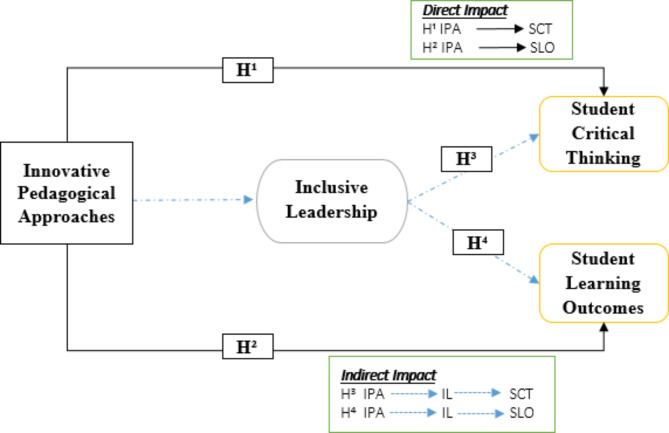
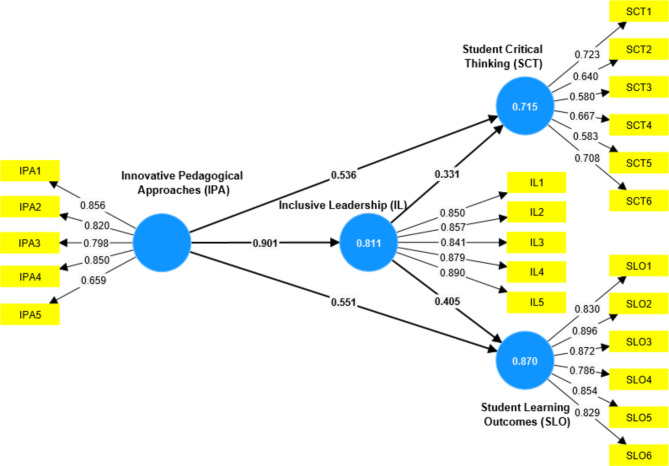
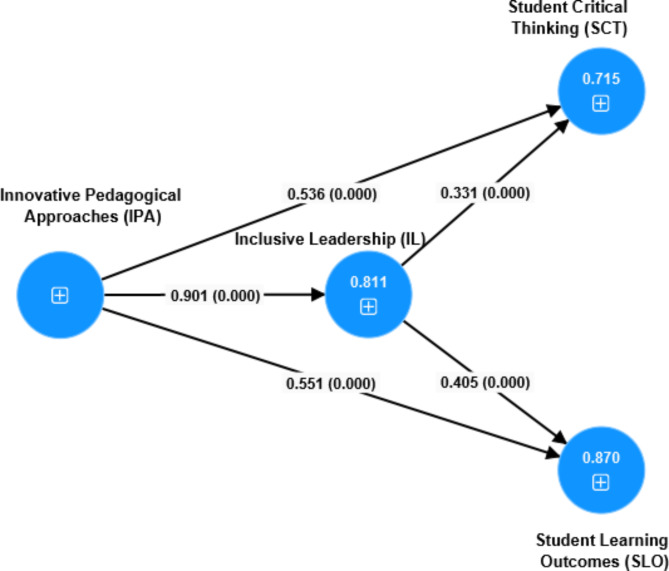
This quantitative study examines the influence of innovative pedagogical approaches (IPA) on enhancing student critical thinking (SCT) and student learning outcomes (SLO) in higher education, with an emphasis on the mediating role of inclusive leadership(IL). Using a sample of 321 students from public and private universities in Pakistan, the research reveals that methods such as problem-based learning, flipped classrooms, and interactive teaching significantly boost academic performance and cultivate critical thinking skills. The findings indicate that innovative pedagogical approaches positively and significantly impact student critical thinking (β = 0.536, t = 6.539, p < 0.001) and learning outcomes (β = 0.551, t = 12.725, p < 0.001). Additionally, inclusive leadership mediates the relationship between innovative teaching methods and both student critical thinking (β = 0.331, t = 3.833, p < 0.001) and learning outcomes (β = 0.405, t = 8.662, p < 0.001). Data were collected using survey questionnaires adapted from established studies on inclusive leadership, innovative pedagogical approaches, student critical thinking, and learning outcomes. These results highlight the essential role of inclusive leadership in enhancing the efficacy of innovative pedagogies by creating a supportive and diverse learning environment. The study suggests that implementing active learning strategies and integrating technology in the classroom, along with inclusive leadership practices, can significantly improve student engagement, critical thinking, and overall academic performance. This research offers valuable insights for educators and policymakers seeking to enhance teaching and learning experiences in higher education.
Overview
The claims and statistics of this paper haven’t been checked yet.
Free: it reads the open-access text and checks the first 5 claims that cite a source we can check. Create a free account to check every claim.
Integrity signals
Registry
Cites
Statistics
Figures
Verification
Claims the paper makes
The claims and statistics of this paper haven’t been checked yet.
Free: it reads the open-access text and checks the first 5 claims that cite a source we can check. Create a free account to check every claim.
Claims other papers make about this one
Each is checked against this paper’s own text: does it say what the citing paper says it does?
The source backs part of the claim, not all of it — or backs it for a different population, condition or comparison.
In the citing paper
“Furthermore, current instructional designs continue to emphasize content delivery and rote memorization, rather than the deep, metacognitive engagement that drives genuine CT development [4,5].”
From A Systematic Literature Review on the Pedagogical Implications and Impact of GenAI on Students' Critical Thinking (2026) · cites this paper as [4]
Experimental — accuracy not yet measured
Self-check
Percentages, sums and reported differences re-computed from the paper’s own numbers.
The self-check needs the paper’s full text.
Citations
Cites
Active learning increases student performance in science, engineering, and mathematics
Freeman, S., Eddy, S. L., McDonough, M., Smith, M. K., Okoroafor, N., Jordt, H., & Wenderoth, M. P. (2014) · Proceedings of the National Academy of Sciences · doi:10.1073/pnas.1319030111 · Cited by 9,787 · cited 1×
“These approaches go beyond rote memorization, encouraging students to analyze, evaluate, and generate new ideas 31 .”
BackgroundDoes Active Learning Work? A Review of the Research
Prince, M. (2004) · Journal of Engineering Education · doi:10.1002/j.2168-9830.2004.tb00809.x · Cited by 7,334
Hair, J. F., Ringle, C. M., & Sarstedt, M. (2013) · Long Range Planning · doi:10.1016/j.lrp.2013.01.001 · Cited by 5,310
Problem-Based Learning: What and How Do Students Learn?
Hmelo-Silver, C. E. (2004) · Educational Psychology Review · doi:10.1023/b:edpr.0000034022.16470.f3 · Cited by 5,212
The ICAP framework: Linking cognitive engagement to active learning outcomes
Chi, M. T. H., & Wylie, R. (2014) · Educational Psychologist · doi:10.1080/00461520.2014.965823 · Cited by 2,911 · cited 1×
“According to 34 , students enrolled in active learning environments achieved higher exam scores and lower failure rates than those enrolled in traditional lecture-based instruction.”
BackgroundTeacher Technology Change: How Knowledge, Confidence, Beliefs, and Culture Intersect
Ertmer, P. A., & Ottenbreit-Leftwich, A. T. (2010) · Journal of Research on Technology in Education · doi:10.1080/15391523.2010.10782551 · Cited by 2,556
The Flipped Classroom: A Survey of the Research
Bishop, J., & Verleger, M. (2020) · 2013 ASEE Annual Conference & Exposition Proceedings · doi:10.18260/1-2--22585 · Cited by 2,437
Nembhard, I. M., & Edmondson, A. C. (2006) · Journal of Organizational Behavior · doi:10.1002/job.413 · Cited by 2,385
The Construction of Shared Knowledge in Collaborative Problem Solving.
Roschelle, J., & Teasley, S. D. (1995) · Computer Supported Collaborative Learning · doi:10.1007/978-3-642-85098-1_5 · Cited by 2,274 · cited 1×
“Technology-supported collaborative learning environments can improve critical thinking through shared knowledge construction 39 .”
BackgroundThe use of flipped classrooms in higher education: A scoping review
O'Flaherty, J., & Phillips, C. (2015) · The Internet and Higher Education · doi:10.1016/j.iheduc.2015.02.002 · Cited by 2,152
Research works printed but not linked: 7
- Fink, L. D., Davis, J. R. & Arend, B. D. Facilitating seven ways of learning: a resource for more purposeful, effective, and enjoyable college teaching (Routledge, 2013).
- Hattie, J. The black box of tertiary assessment: an impending revolution. Tertiary Assess. Higher Educ. Student Outcomes: Policy Pract. Res. 259, 275 (2009).
- Kamran, F., Kanwal, A., Afzal, A. & Rafiq, S. Impact of interactive teaching methods on students learning outcomes at university level. J. Positive School Psychol. 7 (7), 89–105 (2023).
- Barron, B., & Darling-Hammond, L. Teaching for meaningful learning: a review of research on inquiry-based and cooperative learning. Book excerpt. George Lucas Educ. Found. (2008).
- Li, C. C., Aldosari, M. A. & Park, S. E. Understanding pedagogical approaches on student learning styles. Ann. Dent. Oral Health 4 (1), 1039–1045 (2021).
- Ammar, M., Al-Thani, N. J. & Ahmad, Z. Role of pedagogical approaches in fostering innovation among K-12 students in STEM education. Soc. Sci. Human. Open. 9, 100839 (2024).
- Korkmaz, A. V., Van Engen, M. L., Knappert, L. & Schalk, R. About and beyond leading uniqueness and belongingness: a systematic review of inclusive leadership research. Hum. Resour. Manage. Rev. 32 (4), 100894 (2022).
Cited by
Items 201–264 of 264
Tursun, S., Satybaldiev, M., Маткасымова, М., Даминова, И., & Джалалидиновна, Р. М. (2025) · doi:10.67524/verus2/1.2025.58
Experiencias docentes interdisciplinarias en educación superior: desafíos y propuestas
Valencia, A., Poblete, A., Cano, S., Peña, C., Marambio, N., Quezada, N., Hermosilla, P., Mellado, R., Herrera, R., & Inturrieta, S. (2026) · Ariadna Ediciones eBooks · doi:10.26448/ae9789564300047.185
Learning paths and patterns in learning design: Insights from 500+ courses
Divjak, B., Svetec, B., & Horvat, D. (2026) · Computers and Education Open · doi:10.1016/j.caeo.2026.100412
Khairusy, M. A., Haryadi, D., Putra, A., Prameswari, Y., & Febriani, R. (2026) · Jurnal Riset Bisnis dan Manajemen · doi:10.23969/jrbm.v19i2.47028
“…appears particularly influential because academic quality constitutes the institution’s core service and directly shapes students’ daily experiences (Bhuttah et al., 2024), Career value further reinforces distinctiveness by providing tangible future-oriented benefits, such as employability and…”
La pedagogía de preguntas y su influencia en el desarrollo del pensamiento crítico universitario
Galindo, M. G., Ccolqque, L. Y. C., & Quispe, R. M. (2026) · Revista Tribunal · doi:10.59659/revistatribunal.v6i16.501
Gangwar, D. S., Tyagi, S. K., & Gangwar, S. (2026) · Innovations in Pedagogy and Technology · doi:10.63385/ipt.v2i3.101070
(2026) · Journal of Research Innovation and Implications in Education · doi:10.59765/vny53
Sabado, J. A. C. A. G. (2026) · Bamboo Nexus Journal of Innovation Education and Climate Action · doi:10.67691/bnjeca.v1i1.019
Nihaya, M., Nurhilaliyah, N., Nihaya, H., & Nurhidayat, N. (2026) · Jurnal Riset dan Inovasi Pembelajaran · doi:10.51574/jrip.v6i2.5403
Salo, E. S., Pandang, A., & Pattaufi (2026) · Jurnal Teknologi Pendidikan · doi:10.47134/jtp.v3i3.2845
Sampurna, I., Muhyidin, A., & Nulhakim, L. (2026) · IJORER International Journal of Recent Educational Research · doi:10.46245/ijorer.vi.1515
“This discovery corroborates earlier research (Bhuttah et al., 2024; Orhan & Bülent, 2022; Ratnaningsih & Triwahyuni, 2025; Rivas et al., 2023; Usman et al., 2024), in many contexts, pupils identified as possessing superior critical thinking skills generally demonstrate enhanced learning outcomes…”
BOURZIKI, K., SLAMI-AMINE, A., & Zerrad, J. (2026) · Revue Française d'Economie et de Gestion · doi:10.5281/zenodo.21967450
Banda, R. J., & Dagondon, R. K. –. (2026) · International Journal of Management Studies and Social Science Research · doi:10.56293/ijmsssr.2026.6238
Analysis of Pedagogical Practices, Learning Skills and Students Achievement at Higher Education
Ali, M. N., & Rizvi, S. A. A. (2026) · The regional tribune. · doi:10.55737/trt/v-vi.336
Ning, R., & Xu, T. C. (2026) · International Conference on Computer Science and Technologies in Education (CSTE) · doi:10.1109/cste69562.2026.11649626
“While Kardan et al. (2013) utilized neural networks for course selection prediction [11], and Bhuttah et al. (2024) explored pedagogical approaches via statistical learning [12], few studies have leveraged ML to challenge the structural findings of HLM regarding the “ School vs. System ” debate.”
Small classroom innovations and their real-world impact on teaching and learning
Hasan, N. H., Hassan, F. A., Abidin, N. A. N. Z., Sallehuddin, N. H. M., & Ahmad, T. S. A. S. (2026) · UiTM Institutional Repositories (Universiti Teknologi MARA)
Okpebenyo, W., & Onakpoberuo, A. (2026) · Asian Journal of Economics and Empirical Research · doi:10.20448/ajeer.v13i2.9195
“Similarly, Bell and Bell (2020), Meung (2023), Bhuttah et al. (2024), and Bajarias et al. (2025) focused on entrepreneurial learning and innovation outside the Nigerian context.”
Ningrum, T. A. W. (2025) · Walisongo Repository (Walisongo State Islamic University)
Beyond Traditional Sales Training: An AI Driven Experiential Learning Framework
Singh, P. P., Saran, A., Khan, I., & Kalliny, M. (2026) · Marketing Education Review · doi:10.1080/10528008.2026.2729466
Lorenzo, M. D. C. R., Delgado-Parada, J., Ricoy, S. F., Pereira, M. D. P. D., & Murias, T. F. (2026) · Sustainability · doi:10.3390/su18189298
“İNKLÜZİV TƏHSİL” FƏNNİNİN TƏDRİSİNDƏ PEDAQOJİ YANAŞMALAR: NƏZƏRİ ƏSASLAR VƏ MÜASİR İSTİQAMƏTLƏR
QURBANOVA, G. (2026) · Azerbaijan Journal of Educational Studies · doi:10.30546/32898065.2026.3.6554
Research Competencies and Educational Innovation in Higher Education: A Bibliometric Analysis
Bedón, M. F. Q., Cejas, M. N., Rivas-Urrego, G., Martínez, M. F. C., Liccioni, E. J., & Intriago, E. (2026) · Journal of Management Practices Humanities and Social Sciences · doi:10.33152/jmphss-10.2.6
Subarkah, M. A., & Hastuti, S. (2026) · Al Qodiri Jurnal Pendidikan Sosial dan Keagamaan · doi:10.53515/alqodiri.v24i2.199
“Systematic reviews have shown that deep learning environments contribute positively to higher-order thinking skills and students’ capacity for independent learning (Bal & Öztürk, 2025; Bhuttah et al., 2024; Hamzah et al., 2025).”
Hashish, E. A. A., Felemban, R. A., & Allehaiby, W. H. (2026) · BMC Medical Education · doi:10.1186/s12909-026-10239-1
“Similarly, Bhuttah et al. [7] reported that participatory teaching practices were positively associated with students’ critical thinking orientations.”
InfluentialHabilidades de pensamiento e inclusión: repensando los cimientos del aprendizaje en el siglo XXI
Carvajal, R. P. O. (2026) · Revista Enfoques Educacionales · doi:10.5354/2735-7279.2026.85303
“Como señalan Bhuttah et al. (2024), las prácticas pedagógicas innovadoras logran potenciar el pensamiento crítico y los aprendizajes cuando están mediadas por un liderazgo inclusivo que reconoce y valora la diversidad.”
Husin, M., Maaytah, S. A. A., Ibrahim, A. A., Hashi, A. I., & LABAN, O. (2026) · Discover Education · doi:10.1007/s44217-026-02233-y
“Students who report higher levels of engagement also tend to report stronger higher-order cognitive skills, intercultural awareness, and learning outcomes, reinforcing the close relationship between faculty competencies and student achievement [8].”
Okpebenyo, W., & Onakpoberuo, A. (2026) · Kampala International University Interdisciplinary Journal of Humanities and Social Sciences · doi:10.59568/kijhus-2026-7-1-02
Jampahom, I., Kasemsukpipat, W., & Lertamornpong, C. (2025) · Journal of Inclusive and Innovative Education
Process-Based vs. Product-Based Approaches in Teaching Academic Writing: A Comparative Study
Asrifan, A., Cardoso, L., Vargheese, K. J., & Vivekanantharasa, R. (2025) · INTERNATIONAL JOURNAL OF LANGUAGE PEDAGOGY · doi:10.24036/ijolp.v5i2.131
Pangaribuan, T. P. (2026) · Pendas Jurnal Ilmiah Pendidikan Dasar · doi:10.23969/jp.v11i02.45860
Ramzi, M., Arzani, M., Hamidi, H., & Junaidi, J. (2025) · Attractive Innovative Education Journal · doi:10.51278/aj.v7i3.2824
Villanueva, D. J. (2026) · Bamboo Nexus Journal of Education Technology Innovation and Climate Action (BN-JETICA) · doi:10.68213/bnjetica.2026.008
XXI asr o‘quvchilari uchun innovatsion pedagogik strategiyalar
Bobokulova, S., & Boboqulova, S. (2026) · Общество и инновации · doi:10.47689/2181-1415-vol7-iss5/s-pp471-476
Shofia, H. M., Hidayati, A., Izhara, M. D., & Daristin, P. E. (2026) · Islamic Learning Journal
Peeran, S., Noor-e-Sahar, & Leghari, A. I. (2026) · Liberal Journal of Language & Literature Review
Teaching at the Margins: Navigating Curriculum Reform in Indonesia’s Remote Primary Schools
Azizah, S. Y. (2025) · Journal of Educational Innovation and Research
Gwiliza, M. J., & Diko, N. (2026) · TWIST
Nabilah, R. (2025) · Journal of Educational Innovation and Research
Shofwan, I. (2025) · Journal of Educational Innovation and Research
The Correlation between Serendipitous Learning, Teacher Resilience and Reflective Pedagogy
Batool, M., Aziz, S., & Ajmal, F. (2025) · Archives of Educational Studies (ARES)
Purwaningsih, N. T., & Siswanto, D. H. (2026) · Jurnal Padamu Negeri · doi:10.69714/p5yvt225
“…between the present findings and previous studies highlights the urgent need to develop Deep Learning-based electronic modules within a cryptography context as adaptive, constructive, and inclusive learning media that effectively support the development of students’ critical thinking skills [44].”
Aminah, L., & bin Najmuddin, A. H. (2026) · ELBASH Journal of Social Science and Education · doi:10.68299/tv0z8g41
Rejollo, M. R. A., Tagalog, R. J., Laping, I. P., Cayabyab, M. A. S., Lauron, L. K. A. Y., & Rayco, R. C. M. (2026) · doi:10.68050/jams.2026.696
Alkathiri, S., Shahba, A. A.-W., Alsadoon, E., Alharbi, A. A., Alrusaiyes, R., Ain, G., & Alnowibet, K. A. (2026) · Frontiers in Education · doi:10.3389/feduc.2026.1862014
Digital Transformation and Critical Pedagogy: Reimagining Leadership Curriculum inBusiness Schools
Yan, D. (2026) · International Journal of World Economic Research · doi:10.54097/et64s385
“…and learning ecosystem which brings new opportunities for educational innovation, whereas on the other hand it could reinforce the approach of efficiency-driven, algorithmic authority and instrumental rationivity, which poses new challenges to learner's subjectivity and educational equity [3].”
Innovative Teaching Strategy: A Solution to Enhance Critical Thinking and Problem-Solving Skills
Madathil, S. V. (2026) · International Journal of Teacher Education Research Studies (IJTERS) · doi:10.63090/ijters/3049.1614.0057
Belo, F., Sembiring, M., & Kodrat, D. S. (2026) · Journal of Economics Entrepreneurship Management Business and Accounting · doi:10.61255/jeemba.v4i5.1780
Altınay, Z., Birand, A., Adedoyın, O. B., Dağlı, G., SHADIEV, R., & Altınay, F. (2026) · Humanities and Social Sciences Communications · doi:10.1057/s41599-026-09527-4
INNOVATIVE TEACHING AND LEARNING STRATEGIES IN AEROSPACE ENGINEERING EDUCATION
Güneş, T., & Dağ, T. (2026) · Bidge Yayınları eBooks · doi:10.70269/10.70269/2921938894
Perez, J., Abayon, A. J., & Roque, J. (2026) · International Journal of Transformative Multidisciplinary Studies · doi:10.66074/w4l8j3p6r
Iqbal, S., Taib, C. A. B., Allumi, N. A., al-Rejal, H. A., Alvi, G. F., Kafi, M. A., & Abbas, M. (2026) · PLoS ONE · doi:10.1371/journal.pone.0361914
Sembiring, D. A. K., Supriyanto, A., & Ubaidillah, A. F. (2026) · AL-ISHLAH Jurnal Pendidikan
Yin, S. (2026) · Journal of Language, Literature, Social and Cultural Studies · doi:10.58881/jllscs.v4i3.518
Employability Readiness of Senior High School Learners: Proposed Skills Integration Plan
Cortes, N. C. C. (2026) · International Journal of Global Goals and Sustainable Development · doi:10.65339/ijggsd.v1.i1.38
Somuah, B. A., Norgbey, K. D., Dorsah, E., Kwaah, C. Y., & Sam, L. (2026) · Discover Education · doi:10.1007/s44217-026-02365-1
Chang, U., & Bugti, F. (2026) · Journal of Social Research Development · doi:10.59075/jsrd.v7i9.639
Egheneji, B. (2026) · DELSU Journal of Educational Research and Development · doi:10.61448/djerd23209
Domugho, M. J. (2026) · International Journal For Multidisciplinary Research · doi:10.36948/ijfmr.2026.v08i06.90776
Jiménez, I. F. J. (2026) · Editora Artemis eBooks · doi:10.37572/edart_1011264063
Metadata
- Authors
- Bhuttah, T. M., Xusheng, Q., Abid, M. N., & Sharma, S.
- Affiliations
- Zhejiang Normal University (CN)
- Huazhong University of Science and Technology (CN)
- Lovely Professional University (IN)
- Corresponding author
- Xusheng, Qian
- Abid, Muhammad Naseem
- Venue
- Scientific Reports
- Published
- 2024-10-17
- Volume
- 14
- Issue
- 1
- Pages
- 24362-24362
- ISSN
- 2045-2322 (ISSN-L)
- PMC
- PMC11487073
- OpenAlex
- W4403485959
- Cited by
- 95
- References
- 72
- Citations by year
- 2026: 58 · 2025: 35 · 2024: 2
- FWCI
- 118.74
- Type
- journal article
- Language
- en
- Open access
- gold
- doi.org
- Licence
- cc-by-nc-nd
- creativecommons.org/licenses/by-nc-nd/4.0 (tdm)
- creativecommons.org/licenses/by-nc-nd/4.0 (vor)
- Locations
- Scientific Reports (publishedVersion, cc-by-nc-nd)
- Research Square (acceptedVersion, cc-by)
- PubMed Central (publishedVersion, cc-by-nc-nd)
- PubMed (publishedVersion)
- DOAJ (DOAJ: Directory of Open Access Journals) (submittedVersion, cc-by-sa)
- Topics
- Social Sciences › Education › Education and Critical Thinking Development
- Social Sciences › Education › Innovative Teaching Methods
- Social Sciences › Education › Evaluation of Teaching Practices
- Keywords
- innovative pedagogical approaches, student critical thinking, learning outcomes, inclusive leadership, higher education, problem-based learning, flipped classroom, interactive teaching methods, active learning, academic performance, mediating effect, student engagement, educational technology
- MeSH terms
- Adult, Female, Humans, Leadership, Learning, Male, Pakistan, Surveys and Questionnaires, Students, Teaching, Thinking, Universities, Problem-Based Learning, Young Adult
About these checks
Registry, retraction, Cites and statistics results are computed, not judged, with one exception: a printed reference that no index lists is read once by a model before it counts as a citation error. Claims are extracted by a model and kept only when their quote appears verbatim in the text; each cited source is then checked, with a model’s help, for whether it says what the claim relies on. Those verdicts can be wrong — read the claim’s quote and the cited source before relying on one.
Statistics and arithmetic are recomputed, not judged.
Confidence bands are shown only for fields calibrated on our annotated test set. None is calibrated yet, so no band is shown.
What counts as a claim ›How we measure confidence ›How we check this ›
Are you an author, or do you see a problem with this page? Request a review
Data sources
Bibliographic data: Semantic Scholar, OpenAlex, Crossref.
Contains information from the Semantic Scholar Academic Graph Datasets, made available under the ODC Attribution License (ODC-BY 1.0).
Semantic Scholar’s data is described in: Kinney, R., et al. (2023). The Semantic Scholar Open Data Platform. arXiv:2301.10140.
