

Enhancing student critical thinking and learning outcomes through innovative pedagogical approaches in higher education: the mediating role of inclusive leadership
Open accessPublished version of a preprint
The DOI matches its Crossref record; 73 of the 73 references it cites were found in a registry or an index.
Abstract
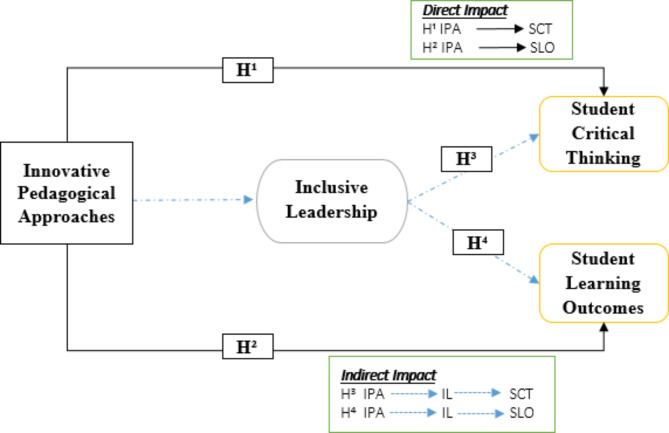
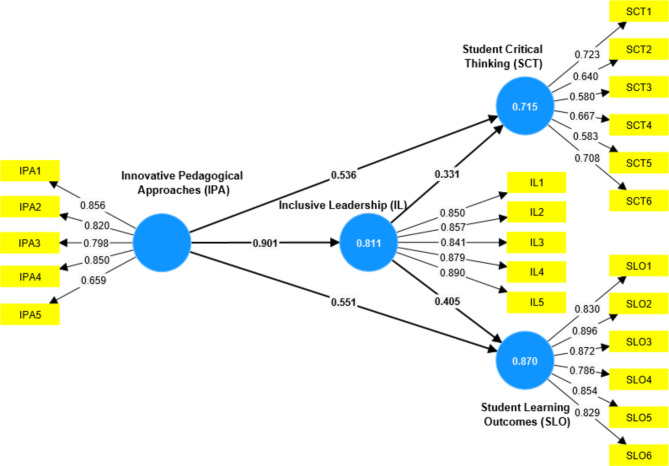
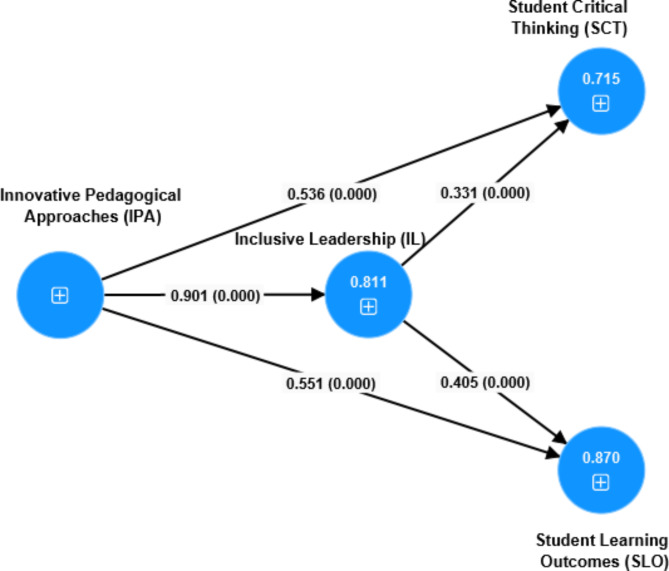
This quantitative study examines the influence of innovative pedagogical approaches (IPA) on enhancing student critical thinking (SCT) and student learning outcomes (SLO) in higher education, with an emphasis on the mediating role of inclusive leadership(IL). Using a sample of 321 students from public and private universities in Pakistan, the research reveals that methods such as problem-based learning, flipped classrooms, and interactive teaching significantly boost academic performance and cultivate critical thinking skills. The findings indicate that innovative pedagogical approaches positively and significantly impact student critical thinking (β = 0.536, t = 6.539, p < 0.001) and learning outcomes (β = 0.551, t = 12.725, p < 0.001). Additionally, inclusive leadership mediates the relationship between innovative teaching methods and both student critical thinking (β = 0.331, t = 3.833, p < 0.001) and learning outcomes (β = 0.405, t = 8.662, p < 0.001). Data were collected using survey questionnaires adapted from established studies on inclusive leadership, innovative pedagogical approaches, student critical thinking, and learning outcomes. These results highlight the essential role of inclusive leadership in enhancing the efficacy of innovative pedagogies by creating a supportive and diverse learning environment. The study suggests that implementing active learning strategies and integrating technology in the classroom, along with inclusive leadership practices, can significantly improve student engagement, critical thinking, and overall academic performance. This research offers valuable insights for educators and policymakers seeking to enhance teaching and learning experiences in higher education.
Overview
The claims and statistics of this paper haven’t been checked yet.
Free: it reads the open-access text and checks the first 5 claims that cite a source we can check. Create a free account to check every claim.
Integrity signals
Registry
Cites
Statistics
Figures
Verification
Claims the paper makes
The claims and statistics of this paper haven’t been checked yet.
Free: it reads the open-access text and checks the first 5 claims that cite a source we can check. Create a free account to check every claim.
Claims other papers make about this one
Each is checked against this paper’s own text: does it say what the citing paper says it does?
The source backs part of the claim, not all of it — or backs it for a different population, condition or comparison.
In the citing paper
“Furthermore, current instructional designs continue to emphasize content delivery and rote memorization, rather than the deep, metacognitive engagement that drives genuine CT development [4,5].”
From A Systematic Literature Review on the Pedagogical Implications and Impact of GenAI on Students' Critical Thinking (2026) · cites this paper as [4]
Experimental — accuracy not yet measured
Self-check
Percentages, sums and reported differences re-computed from the paper’s own numbers.
The self-check needs the paper’s full text.
Citations
Cites
Active learning increases student performance in science, engineering, and mathematics
Freeman, S., Eddy, S. L., McDonough, M., Smith, M. K., Okoroafor, N., Jordt, H., & Wenderoth, M. P. (2014) · Proceedings of the National Academy of Sciences · doi:10.1073/pnas.1319030111 · Cited by 9,787 · cited 1×
“These approaches go beyond rote memorization, encouraging students to analyze, evaluate, and generate new ideas 31 .”
BackgroundDoes Active Learning Work? A Review of the Research
Prince, M. (2004) · Journal of Engineering Education · doi:10.1002/j.2168-9830.2004.tb00809.x · Cited by 7,334
Hair, J. F., Ringle, C. M., & Sarstedt, M. (2013) · Long Range Planning · doi:10.1016/j.lrp.2013.01.001 · Cited by 5,310
Problem-Based Learning: What and How Do Students Learn?
Hmelo-Silver, C. E. (2004) · Educational Psychology Review · doi:10.1023/b:edpr.0000034022.16470.f3 · Cited by 5,212
The ICAP framework: Linking cognitive engagement to active learning outcomes
Chi, M. T. H., & Wylie, R. (2014) · Educational Psychologist · doi:10.1080/00461520.2014.965823 · Cited by 2,911 · cited 1×
“According to 34 , students enrolled in active learning environments achieved higher exam scores and lower failure rates than those enrolled in traditional lecture-based instruction.”
BackgroundTeacher Technology Change: How Knowledge, Confidence, Beliefs, and Culture Intersect
Ertmer, P. A., & Ottenbreit-Leftwich, A. T. (2010) · Journal of Research on Technology in Education · doi:10.1080/15391523.2010.10782551 · Cited by 2,556
The Flipped Classroom: A Survey of the Research
Bishop, J., & Verleger, M. (2020) · 2013 ASEE Annual Conference & Exposition Proceedings · doi:10.18260/1-2--22585 · Cited by 2,437
Nembhard, I. M., & Edmondson, A. C. (2006) · Journal of Organizational Behavior · doi:10.1002/job.413 · Cited by 2,385
The Construction of Shared Knowledge in Collaborative Problem Solving.
Roschelle, J., & Teasley, S. D. (1995) · Computer Supported Collaborative Learning · doi:10.1007/978-3-642-85098-1_5 · Cited by 2,274 · cited 1×
“Technology-supported collaborative learning environments can improve critical thinking through shared knowledge construction 39 .”
BackgroundThe use of flipped classrooms in higher education: A scoping review
O'Flaherty, J., & Phillips, C. (2015) · The Internet and Higher Education · doi:10.1016/j.iheduc.2015.02.002 · Cited by 2,152
Inclusion and diversity in work groups: A review and model for future research
Shore, L. M., Randel, A. E., Chung, B. G., Dean, M. A., Holcombe Ehrhart, K., & Singh, G. (2011) · Journal of Management · doi:10.1177/0149206310385943 · Cited by 2,135 · cited 1×
“Inclusive leaders foster a supportive, diverse environment that encourages active participation, which is essential for the success of these teaching methods 43 .”
BackgroundPhases of inquiry-based learning: Definitions and the inquiry cycle
Pedaste, M., Mäeots, M., Siiman, L. A., de Jong, T., van Riesen, S. A. N., Kamp, E. T., Manoli, C. C., Zacharia, Z. C., & Tsourlidaki, E. (2015) · Educational Research Review · doi:10.1016/j.edurev.2015.02.003 · Cited by 2,119
Where's the evidence that active learning works?
Michael, J. (2006) · Advances in Physiology Education · doi:10.1152/advan.00053.2006 · Cited by 1,648 · cited 1×
“These methods often result in better academic outcomes, increased student engagement, and more positive attitudes toward learning 33 .”
BackgroundHow Leadership Influences Student Learning
Louis, K. S., Leithwood, K. A., Wahlstrom, K. L., & Anderson, S. E. (2004) · Issue Lab (Candid) · Cited by 1,644
Flip your classroom reach every student in every class every day
Bergmann, J., & Sams, A. (2012) · Cited by 1,601
Understanding Teacher Development
Hargreaves, A., & Fullan, M. G. (1992) · Cited by 1,156
Leithwood, K., & Jantzi, D. (2006) · School Effectiveness and School Improvement · doi:10.1080/09243450600565829 · Cited by 1,022
Randel, A. E., Galvin, B. M., Shore, L. M., Ehrhart, K. H., Chung, B. G., Dean, M. A., & Kedharnath, U. (2018) · Human Resource Management Review · doi:10.1016/j.hrmr.2017.07.002 · Cited by 955 · cited 1×
“This finding aligns with leadership theories that emphasize the importance of inclusivity in creating equitable and effective learning environments 66,67 .”
ResultWhere's the learning in service-learning?
Eyler, J., & Giles, D. E. (1999) · Cited by 793
Cheung, A. C. K., & Slavin, R. E. (2013) · Educational Research Review · doi:10.1016/j.edurev.2013.01.001 · Cited by 792
The concept of experiential learning and John Dewey's theory of reflective thought and action
Miettinen, R. (2000) · International Journal of Lifelong Education · doi:10.1080/026013700293458 · Cited by 658 · cited 1×
“A combination of experiential learning and critical thinking enhances learning outcomes 26 .”
BackgroundReview of Research: How Leadership Influences Student Learning
Leithwood, K. A., Louis, K. S., Anderson, S. E., & Wahlstrom, K. L. (2004) · University of Minnesota Digital Conservancy (University of Minnesota) · Cited by 627
How Leadership Influences Student Learning
Leithwood, K., Louis, K. S., Anderson, S., & Wahlstrom, K. (2004) · doi:10.59656/el-sb5787.001 · Cited by 506
Teacher pedagogical content knowledge, practice, and student achievement
Gess-Newsome, J., Taylor, J. A., Carlson, J., Gardner, A. L., Wilson, C. D., & Stuhlsatz, M. A. M. (2019) · International Journal of Science Education · doi:10.1080/09500693.2016.1265158 · Cited by 363
Integrated STEM defined: Contexts, challenges, and the future
Nadelson, L. S., & Seifert, A. L. (2017) · The Journal of Educational Research · doi:10.1080/00220671.2017.1289775 · Cited by 320 · cited 1×
“However, many educational systems still rely on traditional teaching methods that often fail to effectively engage students, particularly in STEM subjects, where theory is frequently prioritized over practical, hands-on learning 5,6 .”
BackgroundThe Effect of Inquiry-based Learning Method on Students’ Academic Achievement in Science Course
Abdi, A. (2014) · Universal Journal of Educational Research · doi:10.13189/ujer.2014.020104 · Cited by 291
Lee, J.-S. (2012) · International Journal of Educational Research · doi:10.1016/j.ijer.2012.04.006 · Cited by 272 · cited 1×
“Engaging students, facilitating active participation, and fostering collaborative learning can enhance academic performance, motivation, and critical thinking skills 53 .”
BackgroundA pedagogical study on promoting students' deep learning through design-based learning
Weng, C., Chen, C., & Ai, X. (2022) · International Journal of Technology and Design Education · doi:10.1007/s10798-022-09789-4 · Cited by 237 · cited 1×
“For example, problem-based learning in STEM education in China has been shown to enhance students’ creativity and entrepreneurship 7 .”
BackgroundSchool-based teacher collaboration: Different learning opportunities across various contexts
de Jong, L., Meirink, J. A., & Admiraal, W. (2019) · Teaching and Teacher Education · doi:10.1016/j.tate.2019.102925 · Cited by 224 · cited 1×
“Leadership plays a critical role in any sector, according to research by 45 .”
BackgroundEnhancing student success: Taking the classroom success seriously
Tinto, V. (2012) · The International Journal of the First Year in Higher Education · doi:10.5204/intjfyhe.v3i1.119 · Cited by 208 · cited 1×
“Student retention and success in higher education are stressed by 4 , who emphasizes the importance of engaging and supportive pedagogical approaches.”
BackgroundLeadership effects on innovation propensity: A two-factor full range leadership model
Ryan, J. C., & Tipu, S. A. A. (2013) · Journal of Business Research · doi:10.1016/j.jbusres.2013.02.038 · Cited by 194 · cited 1×
“Research by 42 emphasizes that inclusive leadership practices, such as acknowledging individual contributions and promoting open communication, enhance the effectiveness of innovative pedagogies by ensuring all students feel supported and valued.”
BackgroundInteractive teaching methods in contemporary higher education
Олеговна, Я. Н., & Yakovlev, E. V. (2014) · Pacific Science Review · doi:10.1016/j.pscr.2014.08.016 · Cited by 190
Inclusive leadership: new age leadership to foster organizational inclusion
Kuknor, S. C., & Bhattacharya, S. (2022) · European Journal of Training and Development · doi:10.1108/ejtd-07-2019-0132 · Cited by 183
Dialogic interactions in the cooperative classroom
Gillies, R. M. (2015) · International Journal of Educational Research · doi:10.1016/j.ijer.2015.02.009 · Cited by 165 · cited 1×
“According to 38 , collaborative learning strategies such as group discussions and peer teaching foster deeper engagement and reflection among students, thus contributing to enhanced critical thinking.”
BackgroundFurtak, E. M., Kiemer, K., Circi, R. K., Swanson, R., de León, V., Morrison, D., & Heredia, S. C. (2016) · Instructional Science · doi:10.1007/s11251-016-9371-3 · Cited by 160
Teaching in flipped classrooms: Exploring pre-service teachers' concerns
Hao, Y., & Lee, K. S. (2015) · Computers in Human Behavior · doi:10.1016/j.chb.2015.12.022 · Cited by 154 · cited 1×
“Using flipped classroom approaches 37 , examine the impact of these approaches on students’ academic performance and critical thinking skills.”
BackgroundPozo-Rico, T., Brotons, R. P., Fresneda, R. G., Costa, J. L. C., & Corbí, R. G. (2023) · Psychology Research and Behavior Management · doi:10.2147/prbm.s382572 · Cited by 153 · cited 1×
“As shown in the study by 50 , the availability of the necessary resources can improve the performance of teachers with an integrating attitude.”
BackgroundByers, T., Imms, W., & Hartnell-Young, E. A. (2018) · Studies In Educational Evaluation · doi:10.1016/j.stueduc.2018.07.003 · Cited by 152 · cited 1×
“These results are consistent with previous studies by 64,65 , which reported similar effects of innovative pedagogical practices on student performance.”
ResultKivunja, C. (2014) · International Journal of Higher Education · doi:10.5430/ijhe.v3n4p37 · Cited by 149 · cited 1×
“These findings align with prior studies, such as those by 60,61 which reported significant direct effects of IPA on similar constructs, further reinforcing the validity of these relationships.”
ResultOkolie, U. C., Igwe, P. A., Mong, I. K., Nwosu, H. E., Kanu, C., & Ojemuyide, C. C. (2021) · Higher Education Research & Development · doi:10.1080/07294360.2021.1896482 · Cited by 149 · cited 1×
“This result aligns with prior research 62,63 , emphasizing the need for educators to adopt innovative pedagogies to stimulate deeper cognitive engagement in students.”
ResultAsad, M. M., Hussain, N., Wadho, M., Khand, Z. H., & Churi, P. P. (2021) · Journal of Applied Research in Higher Education · doi:10.1108/jarhe-04-2020-0103 · Cited by 141
Collaborative online professional development for teachers in higher education
Teräs, H. (2014) · Professional Development in Education · doi:10.1080/19415257.2014.961094 · Cited by 133
Zhang, J.-H., Zou, L.-C., Miao, J.-J., Zhang, Y.-X., Hwang, G.-J., & Zhu, Y. (2020) · Interactive Learning Environments · doi:10.1080/10494820.2019.1636078 · Cited by 126
Azzouz Boudadi, N., & Gutiérrez-Colón, M. (2020) · The EuroCALL Review · doi:10.4995/eurocall.2020.12974 · Cited by 124
Train-the-Trainers: Implementing Outcomes-based Teaching and Learning in Malaysian Higher Education
BIGGS, J. B., & Tang, C. S. (2011) · Malaysian Journal of Learning and Instruction · doi:10.32890/mjli.8.2011.7624 · Cited by 110
Androutsos, A., & Brinia, V. (2019) · Education Sciences · doi:10.3390/educsci9020113 · Cited by 107 · cited 1×
“According to 49 , the university administration needs to motivate the teachers to adopt the new methods so they can do the appropriate job for the learners.”
BackgroundInclusive leadership and employees’ voice behavior: A moderated mediation model
Jiang, J., Ding, W., Wang, R., & Saisai, L. (2020) · Current Psychology · doi:10.1007/s12144-020-01139-8 · Cited by 103
Creating meaningful work for employees: The role of inclusive leadership
Shafaei, A., & Nejati, M. (2023) · Human Resource Development Quarterly · doi:10.1002/hrdq.21512 · Cited by 102
Rayner, S. (2009) · Educational Review · doi:10.1080/00131910903404004 · Cited by 83 · cited 1×
“Inclusive leaders cultivate environments that value diversity and encourage full participation from all students 41 .”
BackgroundInnovative teaching and learning methodologies for higher education Institutions
Nicolaides, A. (2012) · Cited by 83
Embedding engaged learning in high enrollment lecture-based classes
Dean, K. L., & Wright, S. (2016) · Higher Education · doi:10.1007/s10734-016-0070-4 · Cited by 82
Killian, M. P., & Bastas, H. (2015) · Journal of the Scholarship of Teaching and Learning · doi:10.14434/josotl.v15i3.12960 · Cited by 68 · cited 1×
“Using team-based problem-solving scenarios 35 , stated that PBL fosters critical thinking and collaboration.”
BackgroundBetti, A., Biderbost, P., & Domonte, A. G. (2022) · PLoS ONE · doi:10.1371/journal.pone.0265408 · Cited by 64
Yu, D., Zhang, Y., Xu, Y., Wu, J., & Wang, C. (2013) · Journal of Nursing Education · doi:10.3928/01484834-20130924-02 · Cited by 60 · cited 1×
“Problem-based learning (PBL), for instance, involves students tackling real-world challenges, thereby fostering higher-order thinking 29 .”
BackgroundThe development of critical thinking: what university students have to say
Lee, N. Y., Wang, Z., & Lim, B. (2021) · Teaching in Higher Education · doi:10.1080/13562517.2021.1973412 · Cited by 56 · cited 1×
“This result aligns with prior research 62,63 , emphasizing the need for educators to adopt innovative pedagogies to stimulate deeper cognitive engagement in students.”
ResultThe Work of Inclusive Leadership
Gallegos, P. V. (2013) · Wiley eBooks · doi:10.1002/9781118764282.ch6 · Cited by 55
Falih Bannay, D., Jabbar Hadi, M., & Abdullah Amanah, A. (2020) · Problems and Perspectives in Management · doi:10.21511/ppm.18(3).2020.39 · Cited by 55
A framework of smart pedagogy based on the facilitating of high order thinking skills
Meng, Q., Jia, J., & Zhang, Z. (2020) · Interactive Technology and Smart Education · doi:10.1108/itse-11-2019-0076 · Cited by 53 · cited 1×
“These findings align with prior studies, such as those by 60,61 which reported significant direct effects of IPA on similar constructs, further reinforcing the validity of these relationships.”
ResultPositive Teaching: The Behavioural Approach
Wheldall, K., & Merrett, F. E. (1984) · Cited by 53
High school student perspectives on flipped classroom learning
Ölmefors, O., & Scheffel, J. (2021) · Pedagogy Culture and Society · doi:10.1080/14681366.2021.1948444 · Cited by 48 · cited 1×
“As 36 explore, flipped classroom models promote critical thinking by shifting instruction outside of the classroom and allowing more time for interactive and analytical activities.”
BackgroundTHE PATH TO INCLUSION: A Literature Review of Attributes and Impacts of Inclusive Leaders
Fagan, H. A. S., Wells, B., Guenther, S., & Matkin, G. S. (2022) · Journal of Leadership Education · doi:10.12806/v21/i1/r7 · Cited by 46
Bao, Y. (2024) · Scientific Reports · doi:10.1038/s41598-024-63332-0 · Cited by 44 · cited 1×
“Positive relationships between teachers and management can lead to improved student learning 48 .”
BackgroundFlipping an EFL classroom with the LINE application: students’ performance and perceptions
Chang, M.-M., & Lan, S.-W. (2021) · Journal of Computers in Education · doi:10.1007/s40692-020-00179-0 · Cited by 40
Active Student Engagement: The Heart of Effective Learning
Strachan, R., & Liyanage, L. (2014) · Springer eBooks · doi:10.1007/978-3-319-10482-9_16 · Cited by 39
Critical Thinking Questionnaire (CThQ) – construction and application of critical thinking test tool
Kobylarek, A., Błaszczyński, K., Ślósarz, L., & Madej, M. (2022) · Andragogy Adult Education and Social Marketing · doi:10.15503/andr2022.1 · Cited by 38
Debs, L., Miller, K. D., Ashby, I., & Exter, M. (2018) · Research in Science & Technological Education · doi:10.1080/02635143.2018.1551199 · Cited by 37
IMPROVING TEACHER PERFORMANCE: LEADERSHIP QUALITIES OF SCHOOL PRINCIPALS AS A TOOL
Özgenel, M., Pınar, M. E. R. T., & Parlar, H. (2020) · İstanbul Ticaret Üniversitesi Sosyal Bilimler Dergisi · Cited by 25
Kidd, W., & Murray, J. (2022) · Journal of Education for Teaching International Research and Pedagogy · doi:10.1080/02607476.2022.2082273 · Cited by 13 · cited 1×
“As a result 46 , report that the management’s less productive attitudes can hinder the teachers’ performance.”
BackgroundShared Equity Leadership: A New Model for Making Inclusion and Equity Part of Organizational Culture
Ueda, N., Kezar, A. J., & Holcombe, E. M. (2023) · Building leadership bridges · doi:10.1108/s2058-880120230000009001 · Cited by 12
Inclusive Leadership in Complex Times
Wasserman, I. (2020) · Routledge eBooks · doi:10.4324/9780429449673-6 · Cited by 11
Aboramadan, M., & Dahleez, K. A. (2022) · Future of business and finance · doi:10.1007/978-3-030-95652-3_17 · Cited by 8
Alam, F., Das, H. K., & Arafin, S. S. (2022) · Journal of Applied Research in Higher Education · doi:10.1108/jarhe-09-2021-0356 · Cited by 6
Rohaetin, S. (2021) · Jurnal Ilmiah Kanderang Tingang · doi:10.37304/jikt.v12i02.139 · Cited by 1
Research works printed but not linked: 7
- Fink, L. D., Davis, J. R. & Arend, B. D. Facilitating seven ways of learning: a resource for more purposeful, effective, and enjoyable college teaching (Routledge, 2013).
- Hattie, J. The black box of tertiary assessment: an impending revolution. Tertiary Assess. Higher Educ. Student Outcomes: Policy Pract. Res. 259, 275 (2009).
- Kamran, F., Kanwal, A., Afzal, A. & Rafiq, S. Impact of interactive teaching methods on students learning outcomes at university level. J. Positive School Psychol. 7 (7), 89–105 (2023).
- Barron, B., & Darling-Hammond, L. Teaching for meaningful learning: a review of research on inquiry-based and cooperative learning. Book excerpt. George Lucas Educ. Found. (2008).
- Li, C. C., Aldosari, M. A. & Park, S. E. Understanding pedagogical approaches on student learning styles. Ann. Dent. Oral Health 4 (1), 1039–1045 (2021).
- Ammar, M., Al-Thani, N. J. & Ahmad, Z. Role of pedagogical approaches in fostering innovation among K-12 students in STEM education. Soc. Sci. Human. Open. 9, 100839 (2024).
- Korkmaz, A. V., Van Engen, M. L., Knappert, L. & Schalk, R. About and beyond leading uniqueness and belongingness: a systematic review of inclusive leadership research. Hum. Resour. Manage. Rev. 32 (4), 100894 (2022).
Cited by
Papaneophytou, C. P., & Nicolaou, S. A. (2025) · Trends in Higher Education · doi:10.3390/higheredu4020024 · Cited by 73
Redaelli, S., Germani, F., Spitale, G., Biller‐Andorno, N., Brown, J., & Glöckler, S. (2025) · Frontiers in Education · doi:10.3389/feduc.2025.1577692 · Cited by 59
Determining Factors for the Development of Critical Thinking in Higher Education
Jaramillo Gómez, D. L., Álvarez Maestre, A. J., Parada Trujillo, A. E., Pérez Fuentes, C. A., Bedoya Ortiz, D. H., & Sanabria Alarcón, R. K. (2025) · Journal of Intelligence · doi:10.3390/jintelligence13060059 · Cited by 50
“This suggests that the use of technology in the classroom, without an appropriate pedagogical approach, may not be sufficient to substantially enhance critical thinking (Bhuttah et al. 2024; Ravikumar et al. 2025).”
Awang, N. E., Hamzah, M. I., & Zulkifli, H. (2025) · International Journal of Learning Teaching and Educational Research · doi:10.26803/ijlter.24.3.32 · Cited by 32
Balart, T., Díaz, B., & Shryock, K. (2026) · Algorithms · doi:10.3390/a19030179 · Cited by 29
“Furthermore, current instructional designs continue to emphasize content delivery and rote memorization, rather than the deep, metacognitive engagement that drives genuine CT development [4,5].”
Metadata
- Authors
- Bhuttah, T. M., Xusheng, Q., Abid, M. N., & Sharma, S.
- Affiliations
- Zhejiang Normal University (CN)
- Huazhong University of Science and Technology (CN)
- Lovely Professional University (IN)
- Corresponding author
- Xusheng, Qian
- Abid, Muhammad Naseem
- Venue
- Scientific Reports
- Published
- 2024-10-17
- Volume
- 14
- Issue
- 1
- Pages
- 24362-24362
- ISSN
- 2045-2322 (ISSN-L)
- PMC
- PMC11487073
- OpenAlex
- W4403485959
- Cited by
- 95
- References
- 72
- Citations by year
- 2026: 58 · 2025: 35 · 2024: 2
- FWCI
- 118.74
- Type
- journal article
- Language
- en
- Open access
- gold
- doi.org
- Licence
- cc-by-nc-nd
- creativecommons.org/licenses/by-nc-nd/4.0 (tdm)
- creativecommons.org/licenses/by-nc-nd/4.0 (vor)
- Locations
- Scientific Reports (publishedVersion, cc-by-nc-nd)
- Research Square (acceptedVersion, cc-by)
- PubMed Central (publishedVersion, cc-by-nc-nd)
- PubMed (publishedVersion)
- DOAJ (DOAJ: Directory of Open Access Journals) (submittedVersion, cc-by-sa)
- Topics
- Social Sciences › Education › Education and Critical Thinking Development
- Social Sciences › Education › Innovative Teaching Methods
- Social Sciences › Education › Evaluation of Teaching Practices
- Keywords
- innovative pedagogical approaches, student critical thinking, learning outcomes, inclusive leadership, higher education, problem-based learning, flipped classroom, interactive teaching methods, active learning, academic performance, mediating effect, student engagement, educational technology
- MeSH terms
- Adult, Female, Humans, Leadership, Learning, Male, Pakistan, Surveys and Questionnaires, Students, Teaching, Thinking, Universities, Problem-Based Learning, Young Adult
About these checks
Registry, retraction, Cites and statistics results are computed, not judged, with one exception: a printed reference that no index lists is read once by a model before it counts as a citation error. Claims are extracted by a model and kept only when their quote appears verbatim in the text; each cited source is then checked, with a model’s help, for whether it says what the claim relies on. Those verdicts can be wrong — read the claim’s quote and the cited source before relying on one.
Statistics and arithmetic are recomputed, not judged.
Confidence bands are shown only for fields calibrated on our annotated test set. None is calibrated yet, so no band is shown.
What counts as a claim ›How we measure confidence ›How we check this ›
Are you an author, or do you see a problem with this page? Request a review
Data sources
Bibliographic data: Semantic Scholar, OpenAlex, Crossref.
Contains information from the Semantic Scholar Academic Graph Datasets, made available under the ODC Attribution License (ODC-BY 1.0).
Semantic Scholar’s data is described in: Kinney, R., et al. (2023). The Semantic Scholar Open Data Platform. arXiv:2301.10140.
