

Enhancing student critical thinking and learning outcomes through innovative pedagogical approaches in higher education: the mediating role of inclusive leadership
Open accessPublished version of a preprint
The DOI matches its Crossref record; 73 of the 73 references it cites were found in a registry or an index.
Abstract
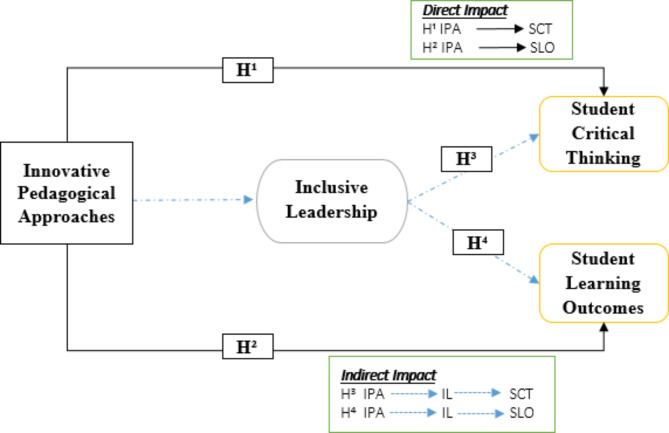
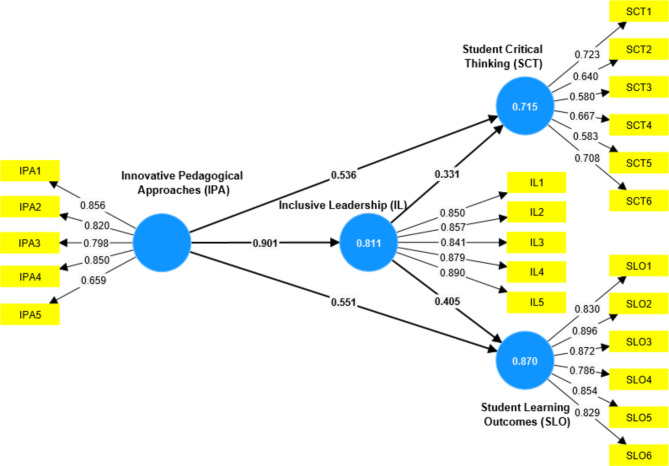
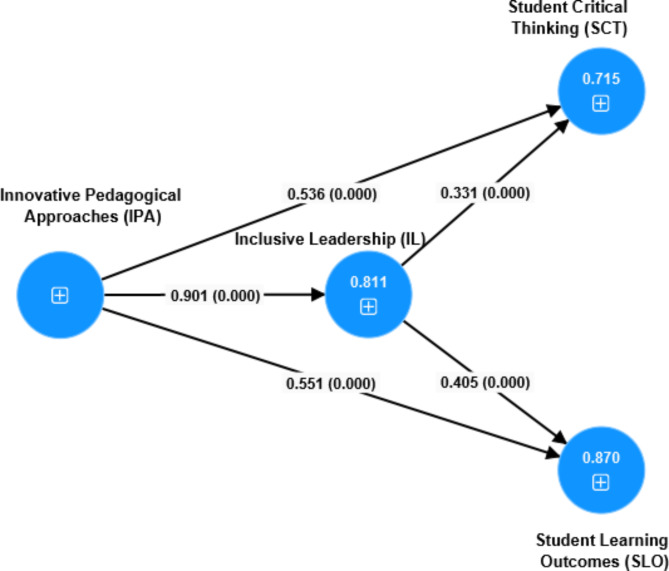
This quantitative study examines the influence of innovative pedagogical approaches (IPA) on enhancing student critical thinking (SCT) and student learning outcomes (SLO) in higher education, with an emphasis on the mediating role of inclusive leadership(IL). Using a sample of 321 students from public and private universities in Pakistan, the research reveals that methods such as problem-based learning, flipped classrooms, and interactive teaching significantly boost academic performance and cultivate critical thinking skills. The findings indicate that innovative pedagogical approaches positively and significantly impact student critical thinking (β = 0.536, t = 6.539, p < 0.001) and learning outcomes (β = 0.551, t = 12.725, p < 0.001). Additionally, inclusive leadership mediates the relationship between innovative teaching methods and both student critical thinking (β = 0.331, t = 3.833, p < 0.001) and learning outcomes (β = 0.405, t = 8.662, p < 0.001). Data were collected using survey questionnaires adapted from established studies on inclusive leadership, innovative pedagogical approaches, student critical thinking, and learning outcomes. These results highlight the essential role of inclusive leadership in enhancing the efficacy of innovative pedagogies by creating a supportive and diverse learning environment. The study suggests that implementing active learning strategies and integrating technology in the classroom, along with inclusive leadership practices, can significantly improve student engagement, critical thinking, and overall academic performance. This research offers valuable insights for educators and policymakers seeking to enhance teaching and learning experiences in higher education.
Overview
The claims and statistics of this paper haven’t been checked yet.
Free: it reads the open-access text and checks the first 5 claims that cite a source we can check. Create a free account to check every claim.
Integrity signals
Registry
Cites
Statistics
Figures
Verification
Claims the paper makes
The claims and statistics of this paper haven’t been checked yet.
Free: it reads the open-access text and checks the first 5 claims that cite a source we can check. Create a free account to check every claim.
Claims other papers make about this one
Each is checked against this paper’s own text: does it say what the citing paper says it does?
The source backs part of the claim, not all of it — or backs it for a different population, condition or comparison.
In the citing paper
“Furthermore, current instructional designs continue to emphasize content delivery and rote memorization, rather than the deep, metacognitive engagement that drives genuine CT development [4,5].”
From A Systematic Literature Review on the Pedagogical Implications and Impact of GenAI on Students' Critical Thinking (2026) · cites this paper as [4]
Experimental — accuracy not yet measured
Self-check
Percentages, sums and reported differences re-computed from the paper’s own numbers.
The self-check needs the paper’s full text.
Citations
Cites
Active learning increases student performance in science, engineering, and mathematics
Freeman, S., Eddy, S. L., McDonough, M., Smith, M. K., Okoroafor, N., Jordt, H., & Wenderoth, M. P. (2014) · Proceedings of the National Academy of Sciences · doi:10.1073/pnas.1319030111 · Cited by 9,787 · cited 1×
“These approaches go beyond rote memorization, encouraging students to analyze, evaluate, and generate new ideas 31 .”
BackgroundDoes Active Learning Work? A Review of the Research
Prince, M. (2004) · Journal of Engineering Education · doi:10.1002/j.2168-9830.2004.tb00809.x · Cited by 7,334
Hair, J. F., Ringle, C. M., & Sarstedt, M. (2013) · Long Range Planning · doi:10.1016/j.lrp.2013.01.001 · Cited by 5,310
Problem-Based Learning: What and How Do Students Learn?
Hmelo-Silver, C. E. (2004) · Educational Psychology Review · doi:10.1023/b:edpr.0000034022.16470.f3 · Cited by 5,212
The ICAP framework: Linking cognitive engagement to active learning outcomes
Chi, M. T. H., & Wylie, R. (2014) · Educational Psychologist · doi:10.1080/00461520.2014.965823 · Cited by 2,911 · cited 1×
“According to 34 , students enrolled in active learning environments achieved higher exam scores and lower failure rates than those enrolled in traditional lecture-based instruction.”
BackgroundTeacher Technology Change: How Knowledge, Confidence, Beliefs, and Culture Intersect
Ertmer, P. A., & Ottenbreit-Leftwich, A. T. (2010) · Journal of Research on Technology in Education · doi:10.1080/15391523.2010.10782551 · Cited by 2,556
The Flipped Classroom: A Survey of the Research
Bishop, J., & Verleger, M. (2020) · 2013 ASEE Annual Conference & Exposition Proceedings · doi:10.18260/1-2--22585 · Cited by 2,437
Nembhard, I. M., & Edmondson, A. C. (2006) · Journal of Organizational Behavior · doi:10.1002/job.413 · Cited by 2,385
The Construction of Shared Knowledge in Collaborative Problem Solving.
Roschelle, J., & Teasley, S. D. (1995) · Computer Supported Collaborative Learning · doi:10.1007/978-3-642-85098-1_5 · Cited by 2,274 · cited 1×
“Technology-supported collaborative learning environments can improve critical thinking through shared knowledge construction 39 .”
BackgroundThe use of flipped classrooms in higher education: A scoping review
O'Flaherty, J., & Phillips, C. (2015) · The Internet and Higher Education · doi:10.1016/j.iheduc.2015.02.002 · Cited by 2,152
Research works printed but not linked: 7
- Fink, L. D., Davis, J. R. & Arend, B. D. Facilitating seven ways of learning: a resource for more purposeful, effective, and enjoyable college teaching (Routledge, 2013).
- Hattie, J. The black box of tertiary assessment: an impending revolution. Tertiary Assess. Higher Educ. Student Outcomes: Policy Pract. Res. 259, 275 (2009).
- Kamran, F., Kanwal, A., Afzal, A. & Rafiq, S. Impact of interactive teaching methods on students learning outcomes at university level. J. Positive School Psychol. 7 (7), 89–105 (2023).
- Barron, B., & Darling-Hammond, L. Teaching for meaningful learning: a review of research on inquiry-based and cooperative learning. Book excerpt. George Lucas Educ. Found. (2008).
- Li, C. C., Aldosari, M. A. & Park, S. E. Understanding pedagogical approaches on student learning styles. Ann. Dent. Oral Health 4 (1), 1039–1045 (2021).
- Ammar, M., Al-Thani, N. J. & Ahmad, Z. Role of pedagogical approaches in fostering innovation among K-12 students in STEM education. Soc. Sci. Human. Open. 9, 100839 (2024).
- Korkmaz, A. V., Van Engen, M. L., Knappert, L. & Schalk, R. About and beyond leading uniqueness and belongingness: a systematic review of inclusive leadership research. Hum. Resour. Manage. Rev. 32 (4), 100894 (2022).
Cited by
Items 101–200 of 264
Curriculum Management in Teacher Leadership: Pedagogy & Policy Implications
Marvi, K. M. H., & Gul, R. (2026) · American Journal of Education and Practice · doi:10.47672/ajep.2999 · Cited by 1
“Additionally, the quality of education and student outcomes can be greatly enhanced by an organizational curriculum and pedagogical model built on critical thinking, digital and AI preparation, foundational teacher learning, and teacher professional development (Tariq et al., 2024).”
Budiyati, E., Nurhayati, M., & Rihyanti, E. (2025) · Bussman Journal Indonesian Journal of Business and Management · Cited by 1
Muspardi, M., Ambiyar, A., Rizal, F., Zuzano, F., & Yusmanila, Y. (2025) · JURNAL Studi Tindakan Edukatif ( JSTE ) · Cited by 1
An Examination of Students’ Critical Thinking Skills in the Context of the Digestive System
Safitri, T., Kurniasih, S., Rachman, I., & Kodama, Y. (2025) · Jurnal Inovasi Pendidikan IPA · doi:10.21831/jipi.v11i2.82696 · Cited by 1
Afriantoni, A. (2025) · Journal of Educational Innovation and Research · Cited by 1
Rivana, A. (2025) · Journal of Educational Innovation and Research · Cited by 1
Subkan, A., Adzfar, Z., & Sudarto (2026) · Indonesian Journal of Religious Studies · doi:10.64268/ijors.v2i1.139
Development of a Robotic Arm Trainer with Color Detection Capabilities for Vocational Schools
Rahmah, U., Mustapa, M., Sari, R. N., & Resyi, M. (2024) · Ceddi Journal of Education · doi:10.56134/cje.v3i2.101
“According to (Bhuttah et al., 2024), the integration of innovative teaching tools significantly enhances student engagement and learning outcomes, emphasizing the importance of addressing these challenges through technological advancements.”
Adjei, D. A., Osei, S., & Boakye-Yiadom, A. (2025) · East African Journal of Education Studies · doi:10.37284/eajes.8.3.3399
Corozo, J. S. M., & Ardisana, E. F. H. (2025) · CHAKIÑAN REVISTA DE CIENCIAS SOCIALES Y HUMANIDADES · doi:10.37135/chk.002.26.10
Alcala, M. C. Q., & ADO, N. R. B. (2025) · Cognizance Journal of Multidisciplinary Studies · doi:10.47760/cognizance.2025.v05i07.042
Yan, L., Jiang, M., Feng, M., & Zhang, J. (2025) · Environment and Social Psychology · doi:10.59429/esp.v10i6.3737
Ilato, N. R., Ntobuo, N. E., Setiawan, D. G. E., Samatowa, L., Mohamad, W. M., & Yunus, M. H. (2025) · JURNAL PIJAR MIPA · doi:10.29303/jpm.v20i5.9631
Sylka, O., Синявська, Л. І., Хвіст, В., & Shevtsova, Y. (2025) · Communications in computer and information science · doi:10.1007/978-3-032-04225-5_22
Does e-Learning Improve Teachers’ Professionalism?
Anouar, E. M. E., Adnani, M. J. E., Es-seqally, M., Zouine, M., Azzabi, M. E., & Laghribi, S. (2025) · Lecture notes in networks and systems · doi:10.1007/978-3-031-99997-0_37
Iriyani, S. A., Patty, E. N. S., & Anggeraini, N. (2025) · MASALIQ · doi:10.58578/masaliq.v5i5.7498
“Tantangan pendidikan abad ke-21 tercermin dalam upaya transformasi sistem pendidikan tinggi menuntut mahasiswa terutama calon guru menguasai keterampilan berpikir kritis, kolaboratif, kreatif dan komunikatif (Almulla, 2023; Bhuttah et al., 2024; Rizaldi et al., 2020).”
Development of Articulate Storyline Media to Improve Students' Critical Thinking Skills
Maulidiya, S., & Asih, S. S. (2025) · AL-ISHLAH Jurnal Pendidikan · doi:10.35445/alishlah.v17i3.7254
Integration of the “Leadership” course in STEM universities using a complex method
Sokolova, E. E., & Sysoeva, M. N. (2025) · Perspectives of science and education · doi:10.32744/pse.2025.5.9
Revisión literaria del pensamiento crítico en la formación investigativa universitaria
Reyes, J. E. V. (2025) · Revista Guatemalteca de Educación Superior · doi:10.46954/revistages.v8iespecial.180
Conventional Critical Reading Practices and 21st Century Learner Preference
Aziz, A., Ahmad, T. S. A. S., Aziz, R. A., Awang, S. B., Ahmad, S. N., & Azlan, N. A. B. (2025) · English Language Teaching · doi:10.5539/elt.v18n12p22
“Bhuttah et al., (2024) stress the need to delve into pedagogical approaches to suit students’ changing needs for an active learning setting.”
Martínez, J. L. C. (2025) · Journal of Integrated OMICS · doi:10.5584/jiomics.v15i3.249
Transformational Goal for Science Education: The 1Student - 1Apparatus (1S1A) Model
Domingos, I. F., Figueiredo, A. Q., Santos, H. M., Lodeiro, C., Flores, O., Dória, G., Patricio, R., Lopes, I., Mercolini, L., Muniz, M. T. C., et al. (2025) · Journal of Integrated OMICS · doi:10.5584/jiomics.v15i3.250
Pimentel, D. E. F., Lizandro-Crispín, R., Villarreal, J. L. M., Pimentel, J. F. F., Meza, L. C. F., Vera, Ó. A. B., Rojas, L. G. S., & Acuña, N. J. (2025) · Religación Press eBooks · doi:10.46652/religacionpress.358.c624
PEDAGOGICAL STRATEGIES FOR DEVELOPING CRITICAL THINKING IN STUDENTS OF TECHNICAL UNIVERSITIES
Girich, Z. (2025) · Academic Notes Series Pedagogical Science · doi:10.36550/2415-7988-2025-1-221-379-386
Nisa, W. U., Awais, S. M., Ahmad, S., Khan, I. A., Riasat, M., & Zaman, R. (2025) · Pakistan Journal of Health Sciences · doi:10.54393/pjhs.v6i8.3156
Alfahl, Z., Caulfield, M., Mahony, A., Meaney, T., Smyth, S., Bullen, B., & Kelly, J. P. (2025) · Research Square · doi:10.21203/rs.3.rs-8136815/v1
السلمي, ف. ق. (2025) · Journal of Arts, Literature, Humanities and Social Sciences · doi:10.33193/jalhss.127.2025.1596
Misra, S. (2026) · Studies in systems, decision and control · doi:10.1007/978-3-032-07220-7_38
Ross, N., Sulliman, B., Sentle, L., Matswaka, M., & Mncube, L. M. (2025) · Commonwealth Youth and Development · doi:10.25159/2663-6549/19598
Mutmainah, M., Reksamunandar, R. P., Mokoginta, A. R., & Rahman, F. A. (2025) · Journal of Elementary Educational Research · doi:10.30984/jeer.v5i2.1639
“As an inquiry-oriented approach, RBL encourages learners to analyze problems critically, formulate arguments, and synthesize diverse perspectives, thus enhancing higher-order thinking skills (Bhuttah et al., 2024; Widiastuti et al., 2023).”
Andani, M., Sari, T. P., Lestari, D., Muryanti, T., & Sulastri, S. (2026) · Journal of Social Work and Science Education · doi:10.52690/jswse.v7i1.1345
“Recent studies indicate that creativity and critical thinking serve as significant mediators between 21st-century skills (motivation, collaboration, social interaction, smart learning environments) and students ’ learning outcomes (Bhuttah et al., 2024).”
Nkolika, C. J. (2026) · Journal of Education and Teacher Training Innovation · doi:10.61227/xx6jhz89
The Influence of PBL and PjBL Models and Learning Motivation on Science Learning Outcomes
Aziziah, Rufi’i, R., & Rusmawati, R. D. (2026) · Jurnal Penelitian Pendidikan IPA · doi:10.29303/jppipa.v12i1.13557
“One key element that influences student learning outcomes is the learning model (Bhuttah et al., 2024; Du et al., 2024; James et al., 2025).”
Liang, Z., Chen, B., & Forhad, M. Z. A. (2025) · The EUrASEANs journal on global socio-economic dynamics · doi:10.35678/2539-5645.5(54).2025.545-561
Work-Related Stress and Teachers' Productivity of Public Elementary Schools in Maa District
Algabre, A. L. (2026) · Nexus International Journal of Science and Education · doi:10.5281/zenodo.18637089
Gonzales, M. (2026) · Nexus International Journal of Science and Education · doi:10.5281/zenodo.18637037
Lehot, Y. A., Hasan, M. H., & Ersani, E. (2025) · Classroom Experiences · doi:10.59535/care.v3i2.578
“Thus, the ENE model contributes simultaneously to the cognitive and affective domains, as emphasized by Bhuttah et al. [23], and aligns with the view that interactive learning innovations can motivate students to think critically and analytically [24].”
Kumari, N., & Nisha, N. (2026) · ANALISTA International Journal of Multidisciplinary Research · doi:10.71182/aijmr.2512.0302.3003
Sahoo, B. K. (2026) · ANALISTA International Journal of Multidisciplinary Research · doi:10.71182/aijmr.2512.0302.4004
Nurhasanah, E., & Masitoh, S. (2026) · Didaktika Jurnal Kependidikan · doi:10.58230/27454312.3238
Ramírez, L. P. A., & Gutiérrez, Y. A. L. (2025) · DIDAC · doi:10.48102/didac.2026..87_ene-jun.296
An Assessment of Critical Thinking among Senior High School Students: A Basis for Intervention
Allena, A. E., Andrade, H., Amar, R., Ancajas, J., Aninapon, K. J. A., Barriga, A. D., Cambalon, K. J. N., Cuerda, J. C., Pastolero, J. M., Pada, F. J. E., et al. (2026) · International Journal of Research and Innovation in Social Science · doi:10.47772/ijriss.2026.10200322
Jiang, X., Amran, M. S., & Kutty, F. M. (2026) · Environment and Social Psychology · doi:10.59429/esp.v11i3.4631
Acculturating of logical reasoning in mathematics learning elementary schools
Kurniasri, S., Sutama, & Adnan, M. (2026) · AIP conference proceedings · doi:10.1063/5.0319071
Irasubiza, A., & Cheboi, S. T. (2026) · African Journal of Empirical Research · doi:10.51867/ajernet.7.1.108
Rudiyanto, M., Harsono, & Muhibbin, A. (2026) · Theory and Practice in Language Studies · doi:10.17507/tpls.1603.19
“The development of leadership practices that can support sustainable pedagogical innovation in such settings requires a deeper understanding of the local social and cultural context, which is often overlooked in existing leadership models (Bhuttah et al., 2024).”
НАПН, У., України, М. У. М. О. І. Н., освіти, І. Ц. О. С. В. З. С., педагогіки, Н. У. І., Крянге, В. К. (. М. Д. П. У. І. І., університет, І. К. В. П. В. О. (. П. М. Д., наук, В. Л. (. П. М. А. П., наук, У. В. (. П. У. П., україністики, В. У. (. П. І., технологій, (. Р. Р. А., et al. (2026) · doi:10.32751/svit_dydaktyky2025
Factors Influencing Students’ Critical Thinking Disposition in Case-Based Method Learning
Hidayat, H., Hanafi, H. F., Anwar, M., Saputra, H. K., Muji, A. P., & Sandra, R. P. (2026) · International Journal of Information and Education Technology · doi:10.18178/ijiet.2026.16.3.2555
“This finding supports several studies [54, 55], which show that the higher students ’ cognitive engagement in the learning process, the greater the likelihood they will demonstrate well-developed critical thinking.”
Kapsayıcı Liderlik Ölçeğinin (KLÖ) Geçerlik ve Güvenirlik Çalışması
Akman, A. Z. (2026) · Journal of Public Economy & Public Financial Management · doi:10.71284/jpepfm.20266110
Unpacking Critical Thinking Skills in Moroccan Students
Khalil, A., & Hellalet, N. (2026) · Anatolian Journal of Education · doi:10.29333/aje.2026.11110a
“The absence of significant gender differences in the present study confirms the role of current pedagogical practices, such as active learning approaches (Bhuttah et al., 2024), inquiry-based instructional practices (Araújo et al., 2024.”
León-González, C. J. L. (2025) · Revista Mexicana de Investigación e Intervención Educativa · doi:10.62697/rmiie.v5i1.296
Factors influencing online learning motivation of students at Can Tho University
Thuy, N. T., & Doan, T. (2026) · CTU Journal of Innovation and Sustainable Development · doi:10.22144/ctujoisd.2026.007
“Pedagogical quality and inclusive leadership significantly impact online learning motivation by fostering a positive and effective learning environment (Bhuttah et al., 2024) .”
InfluentialOrtaöğretim Felsefe Dersi Öğretim Programının Eleştirel Düşünme Becerisi Açısından İncelenmesi
GÜL, M. (2025) · DergiPark
Dr. Ace N. Bombaes, D. N. N. B. (2026) · Journal of Contemporary Social Science and Education Studies (JOCSSES) · doi:10.5281/zenodo.18603476
Akbar, R. F., Febrianti, D. A., & Hidayatunni’mah, S. (2026) · Journal of Educational Management Research · doi:10.61987/jemr.v5i2.1315
Kamila, T. R., & Junaedi, A. (2026) · ISLAMIKA · doi:10.36088/islamika.v8i2.6059
Collaborative Learning via Social Media: A Pathway to Academic Achievement
R, A. N. J., & Jeyaprabha, B. (2026) · Journal of Industrial Integration and Management · doi:10.1142/s2424862226500119
Implementation of Problem-Based Learning Model in Physical Education to Improve Motor Skills
Samsidar, S. (2025) · Journal Of Salutare · doi:10.62872/jos.v1i3.563
Sánchez, M. C. A., & Pesantez, R. M. M. (2026) · Ciencia y Educación · doi:10.5281/zenodo.19598466
Lopez, E. R. V. (2025) · LA Referencia (Red Federada de Repositorios Institucionales de Publicaciones Científicas)
Ayala, A. V. M. (2025) · LA Referencia (Red Federada de Repositorios Institucionales de Publicaciones Científicas)
Sabariah, S., Rufi’i, R., Bandono, A., Hakim, L., Suharti, S., Pranoto, D. C. Y., Novta, N., & Netty, N. (2025) · International Journal of Artificial Intelligence Research · doi:10.29099/ijair.v9i1.1.1579
“…this research, reflecting a broad diversification of topics, including digital transformation and artificial intelligence (AI)-based leadership, indicating that adaptive, collaborative, and high-tech leadership models are increasingly relevant (Bhuttah et al., 2024; Al-Atwi & Al-Hassani, 2021; ).”
PHYU, P. M. (2026) · Journal of Multidisciplinary Research for SMET (JMR-SMET) · doi:10.64297/jmrsmet.v2i2.53
Innovative Pedagogical Strategies as Predictors of Entrepreneurial Motivation in Secondary Education
Edwin, E., Santosa, M. H., Widiana, I. W., & Dang, T. T. (2026) · Jurnal Pemberdayaan Masyarakat · doi:10.46843/jpm.v5i1.672
“For instance, active learning approaches have been associated with improved critical thinking (Bhuttah et al., 2024; Raber & Vermeesch, 2022; Sasson et al., 2018; Sulistyo et al., 2025), retention (Alhebaishi et al., 2025; Kallemeyn et al., 2021), and motivation (Adeyemi et al., 2024; Lee, 2025).”
Story-Based Learning as a Strategy for Vocabulary Development in Early Language Education
Cadeliña, S. M. J., Galamiton, M., Dahunan, C. J., & Ancheta, J. (2026) · Journal of interdisciplinary perspectives · doi:10.69569/jip.2026.167
Kresdianingsih, K., Koswojo, J., & Rizkyanti, E. (2026) · Jurnal Pendidikan Dasar Flobamorata · doi:10.51494/jpdf.v7i2.3058
Educational Datafication in Smart Attendance Systems: A Bibliometric and Science Mapping Analysis
Purnamawati, P., Nuridayanti, N., Akil, M., Iskandar, A., & Pratama, M. R. (2026) · Journal of Applied Science Engineering Technology and Education · doi:10.35877/454ri.asci4805
“Discussions related to data ethics, privacy, fairness, and pedagogical implications are often limited or treated as secondary concerns (Bhuttah et al., 2024; Jia & Tu, 2024; Sadeghi et al., 2023) .”
Villanueva, D. J. (2026) · Bamboo Nexus Journal of Innovation Education and Climate Action · doi:10.67691/bnjeca.v1i1.016
The Intersection of Bias, Critical Thinking, & Innovation: A Quantitative Analysis
Sands, J., & Huerta, Á. (2026) · The Scholarship Without Borders Journal · doi:10.57229/2834-2267.1083
Nguon, S. O., Hart, B., & Meak, C. (2026) · Journal of Social Knowledge Education (JSKE) · doi:10.37251/jske.v7i3.3008
“Traditional methods often dominate, limiting deeper engagement and 21st-century skill development [5] despite evidence that more student-centered approaches yield better outcomes in critical thinking, problem-solving, and long-term retention [6]-[8].”
Liaqat, F., & Hassan, M. U. (2026) · Contemporary Journal of Social Science Review · doi:10.63878/cjssr.v4i2.2549
Introduction to the Special Issue: Advancing Teaching and Learning Through Research
Clark, B. S., & Burk, B. N. (2025) · SCHOLE A Journal of Leisure Studies and Recreation Education · doi:10.1080/1937156x.2026.2675293
“…field experiences, and collaborative active learning strategies, have consistently been shown to foster critical thinking and enhance student learning outcomes across higher education contexts (Bhuttah et al., 2024; Guo et al., 2020; Hermita et al., 2025; Hunaepi et al., 2024; Kausar, 2025).”
Xiangtong Liu1, Q. T. 1. (2026) · Frontiers in Sport Research · doi:10.25236/fsr.2026.080205
Mawarni, S., & Hartoto, H. (2026) · FINGER Jurnal Ilmiah Teknologi Pendidikan · doi:10.58723/finger.v5i2.633
Mamun, M. A. A., & Hasan, M. (2026) · ASU International Conference in Emerging Technologies for Sustainability and Intelligent Systems (ICETSIS) · doi:10.1109/icetsis68266.2026.11548770
“This approach often results in a critical gap between students' academic performance and their ability to apply knowledge, hindering the development of the deep conceptual understanding required for sustainable innovation and technical leadership [3].”
Lekule, C. S. (2026) · Advances in Social Science, Education and Humanities Research/Advances in social science, education and humanities research · doi:10.2991/978-94-6239-705-7_11
Nitafan, M. P. D., & Genton, E. A. (2026) · Psychology and Education A Multidisciplinary Journal · doi:10.70838/pemj.570909
Zahari, N. A. M. (2026) · International Journal of Research and Innovation in Social Science · doi:10.47772/ijriss.2026.100600139
Karmini, N. W., & Anggreni, M. A. (2026) · Archipel Journal of Indonesian Interdisciplinary Studies · doi:10.65739/archipel.v1i10.62
“Bhuttah et al. (2024) provide compelling evidence that innovative pedagogical approaches emphasizing critical thinking and inclusive leadership consistent with slow education principles produce measurable improvements in student learning outcomes and critical thinking capacity in higher education…”
Integrated Planning and Management Strategies From Leadership to Faculty Stakeholders
Manojkumar, R., Srinivas, T. A. S., Inala, K. P., Venkatesh, B., Yuvaraj, T., & Sharma, N. (2026) · IGI Global eBooks · doi:10.4018/979-8-3373-7645-5.ch007
Empowering Minds: A Learner-Centric Approach to Transforming Higher Education in India
Gupta, Y. V., Bembey, M., Bansal, K., Khurana, K., Pachiyappan, S., & Raj, V. J. P. (2026) · IGI Global eBooks · doi:10.4018/979-8-2600-2606-9.ch007
Zacharová, Z. J., & Andoková, M. (2026) · International Conference on Higher Education Advances (HEAd) · doi:10.4995/head26.2026.21627
Braga, V. S., ARAÚJO, A. E. D., Spadoto, M., Costa, K. S. D. S., Cordeiro, S. P. R. L., Gonzalez, S. D. L. V., da Rocha, J. R. A., DANTAS, L. C., Sales, M. L. D. C. G., Nascimento, M. D. A., et al. (2026) · Aurum Editora eBooks · doi:10.63330/aurumpub.062-042
Justice Reimagined: Open Pedagogy as a Catalyst for Equity in Criminal Justice Education
Trotman, G. (2026) · Journal of Criminal Justice Education · doi:10.1080/10511253.2026.2690435
Hariati, S., Rahmat, A., Irnanda, T., & Saputra, K. W. (2026) · Edu Cendikia Jurnal Ilmiah Kependidikan · doi:10.47709/educendikia.v6i01.8262
Faize, M. F. F., & Amalia, N. (2026) · Edu Cendikia Jurnal Ilmiah Kependidikan · doi:10.47709/educendikia.v6i01.7977
Wardani, K. D. K. A., Supriyadinata, A. A. N. E., & Lepong, S. A. (2026) · International Journal of Education and Teaching Zone · doi:10.57092/ijetz.v5i2.832
“…verify real posts, and the guided discussion of authentic cases (Gutierrez-Aguilar et al., 2024; Prasetiyo et al., 2023; Reynders et al., 2020); innovative pedagogies of this kind have been linked to measurable gains in students' critical thinking and learning outcomes (Bhuttah et al., 2024).”
Palomares, C., & Quines, L. (2026) · Psychology and Education A Multidisciplinary Journal · doi:10.70838/pemj.590402
Sultanmuratov, A. (2026) · Universal Library of business and economics. · doi:10.70315/uloap.ulbec.2026.0303002
Gao, K., & Dong, W. (2026) · Language Teaching Research · doi:10.1177/13621688261458740
Nihaya, M., Nurhilaliyah, N., Nihaya, H., & Nurhidayat, N. (2026) · ETDC Indonesian Journal of Research and Educational Review · doi:10.51574/ijrer.v5i4.4959
“By positioning students as active agents who construct meaning through scientific investigation, reflection, and real-world problem-solving, inquiry models directly empower deep critical thinking (Alfroni et al., 2019; Bhuttah et al., 2024; Uslan et al., 2025).”
Teacher Capacity Building and Professional Development for Inclusive Classrooms
Asiru, A. B., & Adelodun, G. A. (2026) · IGI Global eBooks · doi:10.4018/979-8-2600-2865-0.ch003 · Cited by 1
Assilbek, N., KUDAIBERGENOVA, A. M., Moldassan, K., Shvaikovskiy, A., Salybekova, F., Apashova, A., & Atem, M. (2026) · Open Education Studies · doi:10.1515/edu-2025-0150
“…there is a clear need to reconsider existing teaching methodologies and to develop e ff ective pedagogical strategies aimed at fostering critical thinking in foreign-language learning environments (Bhuttah et al. 2024; Knoll-Frey 2025; Manning 2024; Wale and Bishaw 2020; Zhang et al. 2023).”
Williams, J. (2026) · Digital Commons (Liberty University)
Magfirah, M., Zulhan, Z., Santoso, T., Afadil, A., Pulukadang, S. H. V., & Marpaung, M. E. (2025) · Jurnal Akademika Kimia · doi:10.22487/j24775185.2025.v14.i1.pp29-33
“Similarly, critical thinking allows learners to analyze, evaluate, and synthesize information in a structured manner, leading to more profound understanding and better learning outcomes (Bhuttah et al., 2024; Rusmin et al., 2024).”
Maxmudov, Q. (2026) · Ijtimoiy-gumanitar sohada ilmiy-innovatsion tadqiqotlar · doi:10.67227/p4p2q172
Sifuentes, J. M., Collado, C. P. H., Cuba, L. E. C., & Peralta, R. G. (2026) · Revista Simón Rodríguez · doi:10.62319/simonrodriguez.v.6i12.177
Metadata
- Authors
- Bhuttah, T. M., Xusheng, Q., Abid, M. N., & Sharma, S.
- Affiliations
- Zhejiang Normal University (CN)
- Huazhong University of Science and Technology (CN)
- Lovely Professional University (IN)
- Corresponding author
- Xusheng, Qian
- Abid, Muhammad Naseem
- Venue
- Scientific Reports
- Published
- 2024-10-17
- Volume
- 14
- Issue
- 1
- Pages
- 24362-24362
- ISSN
- 2045-2322 (ISSN-L)
- PMC
- PMC11487073
- OpenAlex
- W4403485959
- Cited by
- 95
- References
- 72
- Citations by year
- 2026: 58 · 2025: 35 · 2024: 2
- FWCI
- 118.74
- Type
- journal article
- Language
- en
- Open access
- gold
- doi.org
- Licence
- cc-by-nc-nd
- creativecommons.org/licenses/by-nc-nd/4.0 (tdm)
- creativecommons.org/licenses/by-nc-nd/4.0 (vor)
- Locations
- Scientific Reports (publishedVersion, cc-by-nc-nd)
- Research Square (acceptedVersion, cc-by)
- PubMed Central (publishedVersion, cc-by-nc-nd)
- PubMed (publishedVersion)
- DOAJ (DOAJ: Directory of Open Access Journals) (submittedVersion, cc-by-sa)
- Topics
- Social Sciences › Education › Education and Critical Thinking Development
- Social Sciences › Education › Innovative Teaching Methods
- Social Sciences › Education › Evaluation of Teaching Practices
- Keywords
- innovative pedagogical approaches, student critical thinking, learning outcomes, inclusive leadership, higher education, problem-based learning, flipped classroom, interactive teaching methods, active learning, academic performance, mediating effect, student engagement, educational technology
- MeSH terms
- Adult, Female, Humans, Leadership, Learning, Male, Pakistan, Surveys and Questionnaires, Students, Teaching, Thinking, Universities, Problem-Based Learning, Young Adult
About these checks
Registry, retraction, Cites and statistics results are computed, not judged, with one exception: a printed reference that no index lists is read once by a model before it counts as a citation error. Claims are extracted by a model and kept only when their quote appears verbatim in the text; each cited source is then checked, with a model’s help, for whether it says what the claim relies on. Those verdicts can be wrong — read the claim’s quote and the cited source before relying on one.
Statistics and arithmetic are recomputed, not judged.
Confidence bands are shown only for fields calibrated on our annotated test set. None is calibrated yet, so no band is shown.
What counts as a claim ›How we measure confidence ›How we check this ›
Are you an author, or do you see a problem with this page? Request a review
Data sources
Bibliographic data: Semantic Scholar, OpenAlex, Crossref.
Contains information from the Semantic Scholar Academic Graph Datasets, made available under the ODC Attribution License (ODC-BY 1.0).
Semantic Scholar’s data is described in: Kinney, R., et al. (2023). The Semantic Scholar Open Data Platform. arXiv:2301.10140.
