

Raw QPP-RNG randomness via system jitter across platforms: a NIST SP 800-90B evaluation
Open accessThe DOI matches its Crossref record; 40 of the 44 references it cites were found in a registry or an index; 4 of the 10 sources its claims cite were checked for support.
Abstract
High-quality randomness is fundamental to the security of modern cryptographic systems. We present QPP-RNG , a true random number generator (TRNG) that harvests entropy from diverse system-level jitters–including CPU pipeline timing divergences, DRAM refresh cycle perturbations, cache miss-driven memory access latencies, and other subtle hardware and operating system-induced fluctuations. QPP-RNG’s core mechanism measures the elapsed time of randomized array sorting operations–where each Fisher-Yates shuffle is infinitesimally perturbed by these microscopic jitters–and amplifies these timing variations into cryptographically strong randomness through a quantum permutation pad (QPP) architecture, all achievable on commodity hardware. The raw output of QPP-RNG underwent rigorous evaluation for independent and identically distributed (IID) behavior using the NIST SP 800-90B IID test suite, alongside the comprehensive NIST SP 800-22 and ENT statistical test batteries. Across a range of platforms, including Windows, macOS, and Raspberry Pi, QPP-RNG consistently achieved high IID min-entropy between $$7.85$$ and $$7.95$$ bits/byte. It passed all NIST SP 800-90B IID tests with $$p$$ -values significantly above the $$\alpha =0.01$$ threshold, confirming that its generated randomness is statistically indistinguishable from ideal IID sources derived directly from system jitter. Cross-platform analyses spanning x86_64 and ARM64 architectures further demonstrate that the extracted jitter fingerprint–and consequently the generated randomness–exhibits remarkable statistical consistency, irrespective of the underlying hardware or operating system. QPP-RNG’s entropy density compares favorably with leading commercial entropy sources. It matches or slightly exceeds the NIST IID-certified min-entropy of ID Quantique’s Quantis QRNG (7.8744 bits/byte), and significantly outperforms both Red Hat’s CPU Time Jitter RNG (7.4528 bits/byte) and Quside’s PCIe One quantum entropy source (6.5136 bits/byte). Even against specialized hardware RNGs like Microchip’s ECC608 (4.0568 bits/byte), QPP-RNG demonstrates superior performance using only general-purpose processors. By effectively transforming otherwise discarded system noise into a reliable and high-quality entropy stream, QPP-RNG establishes a novel paradigm for embedded security, providing a robust entropy source on general-purpose devices without specialized hardware. This makes it especially well-suited for resource-constrained Internet of Things (IoT) and edge computing applications where strong entropy sources are paramount.
Overview
CoChat Summary
## TL;DR
This paper evaluates QPP-RNG, a software-only true random number generator that harvests system-level jitter through permutation-based sorting, across Windows, macOS, and Raspberry Pi platforms. Using NIST SP 800-90B IID testing plus ENT and NIST SP 800-22, the authors report near-ideal entropy and consistent cross-platform randomness.
## Key findings
- Across tested configurations, the worst-case NIST SP 800-90B IID min-entropy was 7.8555 bits/byte and the best-case was 7.8779 bits/byte, exceeding the IID requirement of 7.2 bits/byte.
- The paper reports a min-entropy of 7.928 bits per byte in the discussion, compared with 7.4528 bits/byte for Red Hat’s CPU Time Jitter RNG, 7.8744 bits/byte for ID Quantique Quantis, 6.5136 bits/byte for Quside PCIe One, and 4.0568 bits/byte for Microchip ECC608.
- Health checks passed across platforms: the maximum observed repetition count was 3, and adaptive proportion thresholds were 13 to 16, with observed maxima of 9 to 10.
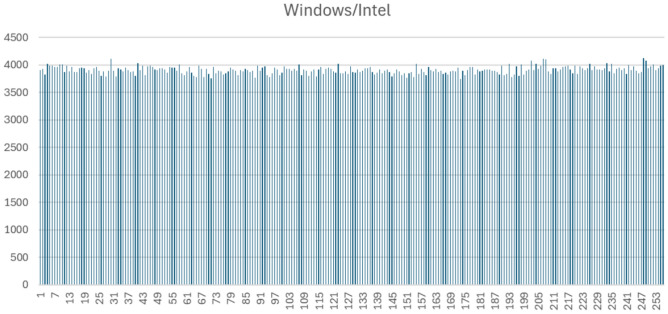
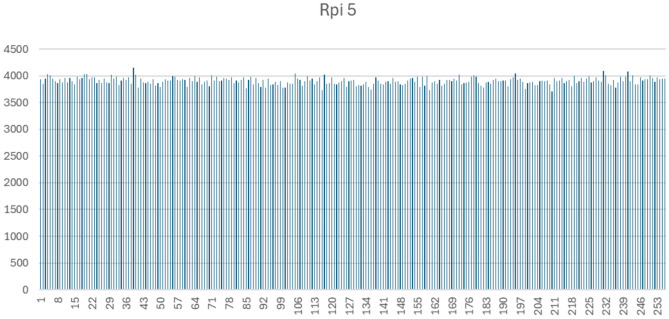
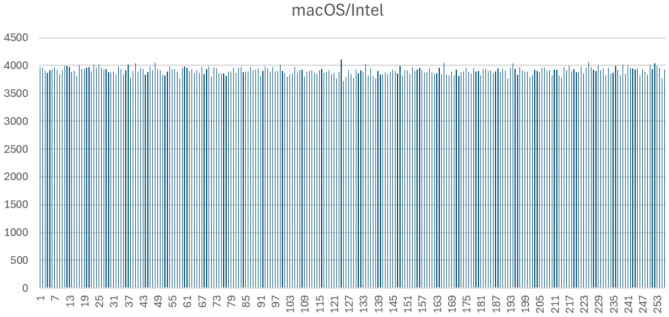
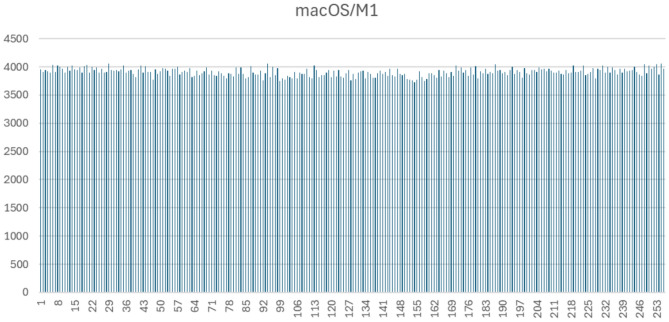
- Additional tests also looked strong: ENT entropy exceeded 7.9997 bits/byte (maximum 7.99983), byte-frequency means were 3906.25 for 1,000,000-byte samples, and NIST SP 800-22 showed 100% passing for several tests, with non-overlapping template passing rates of 93% to 98%.
## Methods
- The study evaluated QPP-RNG, a C implementation that measures timing jitter during repeated Fisher–Yates permutation-sorting cycles and extracts raw 8-bit outputs from timing deltas.
- Experiments were run on heterogeneous bare-metal platforms, including Windows 11, macOS (Intel and Apple Silicon/M1), and Raspberry Pi 5 (ARM), using two internal PRNGs: XORSHIFT128+ and NEXT_X48.
- Each configuration generated 1,000,000 bytes; the authors applied NIST SP 800-90B IID tests, restart and adaptive tests, the ENT suite, and NIST SP 800-22 statistical validation.
## Limitations
- The paper states that it did not quantitatively isolate individual jitter sources; instead, sorting time served as an aggregate measure of CPU, memory, I/O, OS scheduling, and environmental timing variation.
- It notes that some timing sources are too coarse and that timer resolution varies across platforms, which it mitigates with platform-specific scaling; this is an evident limitation of the approach.
- The work focused on raw output evaluation and explicitly says post-processing/conditioning is for future or optional use, so the reported results do not assess conditioned outputs.
Model-written summary. Check it against the paper before relying on it.
Integrity signals
Registry
Cites
Statistics
Figures
Verification
Claims the paper makes
2 Valid · 3 Not valid · 6 Not checked · 121 Own results and interpretations
The cited sources support only part of this claim — read each source’s verdict below.
In the paper
“First, we enhance QPP-RNG15 with a novel hybrid architecture that synergistically combines Quantum Permutation Pads (QPP) and system timing jitter. This approach moves beyond conventional reliance on CPU-specific jitter by aggregating entropy from a wider array of hardware-level noise sources, including memory access patterns, OS scheduling, and peripheral interactions.”
§ Raw QPP-RNG randomness via system jitter across platforms: a NIST SP 800-90B evaluation > Our contributions
What the sources say
- Partly supportedcites [15] Kuang, R. & Lou, D. Iid-based qpp-rng: A random number generator utilizing random permutation sorting driven by system jitter (2025). arXiv:2502.18609. sourceExperimental — accuracy not yet measured
Section II (p. 2) describes QPP-RNG as using system jitter from cache behavior and OS scheduling to generate QPP pads, and Section III (p. 3) identifies memory access patterns as a cause of timing fluctuations. The paper supports combining QPP with system-level jitter rather than relying on raw timing variations alone, but our copy does not identify peripheral interactions as an entropy source. The citing authors’ statement that they enhance QPP-RNG is their own framing, not a finding attributed to this source. (LLM, conf=0.84)
plainstates a cause- Asserted: passes — The authors put it forward as true.
- Checkable: passes — It can be checked against evidence.
- Load-bearing: passes — The paper’s conclusions depend on it.
- Based: passes — The paper gives a reason why it holds.
- Partly supported
A result the paper reports from its own data — it cites no other source for it, so there is none to check. The quote shows it is in the paper.
In the paper
“It matches or slightly exceeds the NIST IID-certified min-entropy of ID Quantique’s Quantis QRNG (7.8744 bits/byte)”
§ Raw QPP-RNG randomness via system jitter across platforms: a NIST SP 800-90B evaluation > Abstract High-quality randomness is fundamental to the security of modern cryptographic systems. We present QPP-RNG, a true random number generator (TRNG) that harvests entropy from diverse system-level jitters–including CPU pipeline timing divergences, DRAM refresh cycle perturbations, cache miss-driven memory access latencies, and other subtle hardware and operating system-induced fluctuations. QPP-RNG’s core mechanism measures the elapsed time of randomized array sorting operations–where each Fisher-Yates shuffle is infinitesimally perturbed by these microscopic jitters–and amplifies these timing variations into cryptographically strong randomness through a quantum permutation pad (QPP) architecture, all achievable on commodity hardware. The raw output of QPP-RNG underwent rigorous evaluation for independent and identically distributed (IID) behavior using the NIST SP 800-90B IID test suite, alongside the comprehensive NIST SP 800-22 and ENT statistical test batteries. Across a range of platforms, including Windows, macOS, and Raspberry Pi, QPP-RNG consistently achieved high IID min-entropy between and bits/byte. It passed all NIST SP 800-90B IID tests with -values significantly above the threshold, confirming that its generated randomness is statistically indistinguishable from ideal IID sources derived directly from system jitter. Cross-platform analyses spanning x86_64 and ARM64 architectures further demonstrate that the extracted jitter fingerprint–and consequently the generated randomness–exhibits remarkable statistical consistency, irrespective of the underlying hardware or operating system. QPP-RNG’s entropy density compares favorably with leading commercial entropy sources. It matches or slightly exceeds the NIST IID-certified min-entropy of ID Quantique’s Quantis QRNG (7.8744 bits/byte), and significantly outperforms both Red Hat’s CPU Time Jitter RNG (7.4528 bits/byte) and Quside’s PCIe One quantum entropy source (6.5136 bits/byte). Even against specialized hardware RNGs like Microchip’s ECC608 (4.0568 bits/byte), QPP-RNG demonstrates superior performance using only general-purpose processors. By effectively transforming otherwise discarded system noise into a reliable and high-quality entropy stream, QPP-RNG establishes a novel paradigm for embedded security, providing a robust entropy source on general-purpose devices without specialized hardware. This makes it especially well-suited for resource-constrained Internet of Things (IoT) and edge computing applications where strong entropy sources are paramount.
plain- Asserted: passes — The authors put it forward as true.
- Checkable: passes — It can be checked against evidence.
- Load-bearing: passes — The paper’s conclusions depend on it.
- Based: unclear — It is unclear why the paper says it holds.
A result the paper reports from its own data — it cites no other source for it, so there is none to check. The quote shows it is in the paper.
In the paper
“It passed all NIST SP 800-90B IID tests with -values significantly above the threshold, confirming that its generated randomness is statistically indistinguishable from ideal IID sources derived directly from system jitter.”
§ Raw QPP-RNG randomness via system jitter across platforms: a NIST SP 800-90B evaluation > Abstract High-quality randomness is fundamental to the security of modern cryptographic systems. We present QPP-RNG, a true random number generator (TRNG) that harvests entropy from diverse system-level jitters–including CPU pipeline timing divergences, DRAM refresh cycle perturbations, cache miss-driven memory access latencies, and other subtle hardware and operating system-induced fluctuations. QPP-RNG’s core mechanism measures the elapsed time of randomized array sorting operations–where each Fisher-Yates shuffle is infinitesimally perturbed by these microscopic jitters–and amplifies these timing variations into cryptographically strong randomness through a quantum permutation pad (QPP) architecture, all achievable on commodity hardware. The raw output of QPP-RNG underwent rigorous evaluation for independent and identically distributed (IID) behavior using the NIST SP 800-90B IID test suite, alongside the comprehensive NIST SP 800-22 and ENT statistical test batteries. Across a range of platforms, including Windows, macOS, and Raspberry Pi, QPP-RNG consistently achieved high IID min-entropy between and bits/byte. It passed all NIST SP 800-90B IID tests with -values significantly above the threshold, confirming that its generated randomness is statistically indistinguishable from ideal IID sources derived directly from system jitter. Cross-platform analyses spanning x86_64 and ARM64 architectures further demonstrate that the extracted jitter fingerprint–and consequently the generated randomness–exhibits remarkable statistical consistency, irrespective of the underlying hardware or operating system. QPP-RNG’s entropy density compares favorably with leading commercial entropy sources. It matches or slightly exceeds the NIST IID-certified min-entropy of ID Quantique’s Quantis QRNG (7.8744 bits/byte), and significantly outperforms both Red Hat’s CPU Time Jitter RNG (7.4528 bits/byte) and Quside’s PCIe One quantum entropy source (6.5136 bits/byte). Even against specialized hardware RNGs like Microchip’s ECC608 (4.0568 bits/byte), QPP-RNG demonstrates superior performance using only general-purpose processors. By effectively transforming otherwise discarded system noise into a reliable and high-quality entropy stream, QPP-RNG establishes a novel paradigm for embedded security, providing a robust entropy source on general-purpose devices without specialized hardware. This makes it especially well-suited for resource-constrained Internet of Things (IoT) and edge computing applications where strong entropy sources are paramount.
boosted- Asserted: passes — The authors put it forward as true.
- Checkable: passes — It can be checked against evidence.
- Load-bearing: passes — The paper’s conclusions depend on it.
- Based: passes — The paper gives a reason why it holds.
- Rests on an assumption not shown here.
A result the paper reports from its own data — it cites no other source for it, so there is none to check. The quote shows it is in the paper.
In the paper
“Cross-platform analyses spanning x86_64 and ARM64 architectures further demonstrate that the extracted jitter fingerprint–and consequently the generated randomness–exhibits remarkable statistical consistency, irrespective of the underlying hardware or operating system.”
§ Raw QPP-RNG randomness via system jitter across platforms: a NIST SP 800-90B evaluation > Abstract High-quality randomness is fundamental to the security of modern cryptographic systems. We present QPP-RNG, a true random number generator (TRNG) that harvests entropy from diverse system-level jitters–including CPU pipeline timing divergences, DRAM refresh cycle perturbations, cache miss-driven memory access latencies, and other subtle hardware and operating system-induced fluctuations. QPP-RNG’s core mechanism measures the elapsed time of randomized array sorting operations–where each Fisher-Yates shuffle is infinitesimally perturbed by these microscopic jitters–and amplifies these timing variations into cryptographically strong randomness through a quantum permutation pad (QPP) architecture, all achievable on commodity hardware. The raw output of QPP-RNG underwent rigorous evaluation for independent and identically distributed (IID) behavior using the NIST SP 800-90B IID test suite, alongside the comprehensive NIST SP 800-22 and ENT statistical test batteries. Across a range of platforms, including Windows, macOS, and Raspberry Pi, QPP-RNG consistently achieved high IID min-entropy between and bits/byte. It passed all NIST SP 800-90B IID tests with -values significantly above the threshold, confirming that its generated randomness is statistically indistinguishable from ideal IID sources derived directly from system jitter. Cross-platform analyses spanning x86_64 and ARM64 architectures further demonstrate that the extracted jitter fingerprint–and consequently the generated randomness–exhibits remarkable statistical consistency, irrespective of the underlying hardware or operating system. QPP-RNG’s entropy density compares favorably with leading commercial entropy sources. It matches or slightly exceeds the NIST IID-certified min-entropy of ID Quantique’s Quantis QRNG (7.8744 bits/byte), and significantly outperforms both Red Hat’s CPU Time Jitter RNG (7.4528 bits/byte) and Quside’s PCIe One quantum entropy source (6.5136 bits/byte). Even against specialized hardware RNGs like Microchip’s ECC608 (4.0568 bits/byte), QPP-RNG demonstrates superior performance using only general-purpose processors. By effectively transforming otherwise discarded system noise into a reliable and high-quality entropy stream, QPP-RNG establishes a novel paradigm for embedded security, providing a robust entropy source on general-purpose devices without specialized hardware. This makes it especially well-suited for resource-constrained Internet of Things (IoT) and edge computing applications where strong entropy sources are paramount.
boosted- Asserted: passes — The authors put it forward as true.
- Checkable: passes — It can be checked against evidence.
- Load-bearing: passes — The paper’s conclusions depend on it.
- Based: passes — The paper gives a reason why it holds.
A result the paper reports from its own data — it cites no other source for it, so there is none to check. The quote shows it is in the paper.
In the paper
“and significantly outperforms both Red Hat’s CPU Time Jitter RNG (7.4528 bits/byte) and Quside’s PCIe One quantum entropy source (6.5136 bits/byte).”
§ Raw QPP-RNG randomness via system jitter across platforms: a NIST SP 800-90B evaluation > Abstract High-quality randomness is fundamental to the security of modern cryptographic systems. We present QPP-RNG, a true random number generator (TRNG) that harvests entropy from diverse system-level jitters–including CPU pipeline timing divergences, DRAM refresh cycle perturbations, cache miss-driven memory access latencies, and other subtle hardware and operating system-induced fluctuations. QPP-RNG’s core mechanism measures the elapsed time of randomized array sorting operations–where each Fisher-Yates shuffle is infinitesimally perturbed by these microscopic jitters–and amplifies these timing variations into cryptographically strong randomness through a quantum permutation pad (QPP) architecture, all achievable on commodity hardware. The raw output of QPP-RNG underwent rigorous evaluation for independent and identically distributed (IID) behavior using the NIST SP 800-90B IID test suite, alongside the comprehensive NIST SP 800-22 and ENT statistical test batteries. Across a range of platforms, including Windows, macOS, and Raspberry Pi, QPP-RNG consistently achieved high IID min-entropy between and bits/byte. It passed all NIST SP 800-90B IID tests with -values significantly above the threshold, confirming that its generated randomness is statistically indistinguishable from ideal IID sources derived directly from system jitter. Cross-platform analyses spanning x86_64 and ARM64 architectures further demonstrate that the extracted jitter fingerprint–and consequently the generated randomness–exhibits remarkable statistical consistency, irrespective of the underlying hardware or operating system. QPP-RNG’s entropy density compares favorably with leading commercial entropy sources. It matches or slightly exceeds the NIST IID-certified min-entropy of ID Quantique’s Quantis QRNG (7.8744 bits/byte), and significantly outperforms both Red Hat’s CPU Time Jitter RNG (7.4528 bits/byte) and Quside’s PCIe One quantum entropy source (6.5136 bits/byte). Even against specialized hardware RNGs like Microchip’s ECC608 (4.0568 bits/byte), QPP-RNG demonstrates superior performance using only general-purpose processors. By effectively transforming otherwise discarded system noise into a reliable and high-quality entropy stream, QPP-RNG establishes a novel paradigm for embedded security, providing a robust entropy source on general-purpose devices without specialized hardware. This makes it especially well-suited for resource-constrained Internet of Things (IoT) and edge computing applications where strong entropy sources are paramount.
boostedstates a cause- Asserted: passes — The authors put it forward as true.
- Checkable: passes — It can be checked against evidence.
- Load-bearing: passes — The paper’s conclusions depend on it.
- Based: passes — The paper gives a reason why it holds.
42 more claims
Create a free account to see all 132 claims and to verify the 1 reference still open.
- Probably not a substantial claim. 35
- It may state two separate claims as one. 65
- The quote only partly states this claim. 2
Self-check
Percentages, sums and reported differences re-computed from the paper’s own numbers.
Each contradiction between two passages listed here was confirmed by an independent check.
Rated major: it would touch a result — a value a result rests on, reported and recomputed p-values on opposite sides of the significance level, two passages that conflict with no sign which is right, or a cited work retracted before this paper was published.
In the paper
§ Raw QPP-RNG randomness via system jitter across platforms: a NIST SP 800-90B evaluation > Discussion and conclusion
“Moreover, QPP-RNG demonstrated a high level of unpredictability through its NIST SP 800-90B IID min-entropy estimate, reaching 7.928 bits per byte—surpassing the reported 7.4528 bits/byte of Red Hat’s CPU Time Jitter RNG (NIST ESV Cert. E.54).”
§ Raw QPP-RNG randomness via system jitter across platforms: a NIST SP 800-90B evaluation > NIST SP 800-90B testing results and analysis: IID > Min-entropy estimates and comparative analysis
“The results in Table 9 indicate that across all tested QPP-RNG configurations, the worst-case estimated min-entropy is 7.8555 bits per byte, while the best-case reaches 7.8779 bits per byte.”
Citations
Cites
A fast quantum mechanical algorithm for database search
Grover, L. K. (1996) · Proceedings of the twenty-eighth annual ACM symposium on Theory of computing - STOC '96 · doi:10.1145/237814.237866 · Cited by 8,830 · cited 1×
“Shor’s algorithm 5 compromises RSA and ECC by enabling efficient factorization and discrete logarithm computation, while Grover’s algorithm 6 reduces the effective security of symmetric encryption.”
Algorithms for quantum computation: discrete logarithms and factoring
Shor, P. W. (2002) · Proceedings 35th Annual Symposium on Foundations of Computer Science · doi:10.1109/sfcs.1994.365700 · Cited by 8,713 · cited 1×
“Shor’s algorithm 5 compromises RSA and ECC by enabling efficient factorization and discrete logarithm computation, while Grover’s algorithm 6 reduces the effective security of symmetric encryption.”
Quantum supremacy using a programmable superconducting processor
Arute, F., Arya, K., Babbush, R., Bacon, D., Bardin, J. C., Barends, R., Biswas, R., Boixo, S., Brandao, F. G. S. L., Buell, D. A., et al. (2019) · Nature · doi:10.1038/s41586-019-1666-5 · Cited by 7,720 · cited 1×
“Forecasts suggest that quantum computers capable of breaking widely deployed encryption standards may arrive within the next decade 7 , prompting sectors such as finance to proactively prepare for post-quantum threats 8 .”
Mersenne twister: a 623-dimensionally equidistributed uniform pseudo-random number generator
Matsumoto, M., & Nishimura, T. (1998) · ACM Transactions on Modeling and Computer Simulation · doi:10.1145/272991.272995 · Cited by 5,780
On Ideal Lattices and Learning with Errors over Rings
Lyubashevsky, V., Peikert, C., & Regev, O. (2013) · Journal of the ACM · doi:10.1145/2535925 · Cited by 836
(2009) · Springer eBooks · doi:10.1007/978-3-540-88702-7 · Cited by 760
Quantum random number generation
Ma, X., Yuan, X., Cao, Z., Qi, B., & Zhang, Z. (2016) · npj Quantum Information · doi:10.1038/npjqi.2016.21 · Cited by 445
Marsaglia, G. (2003) · Journal of Statistical Software · doi:10.18637/jss.v008.i14 · Cited by 434
A generator for unique quantum random numbers based on vacuum states
Gabriel, C., Wittmann, C., Sych, D., Dong, R., Mauerer, W., Andersen, U. L., Marquardt, C., & Leuchs, G. (2010) · Nature Photonics · doi:10.1038/nphoton.2010.197 · Cited by 419
The Art of Computer Programming. Volume 2: Seminumerical Algorithms (Donald E. Knuth)
MacLaren, M. D. (1970) · SIAM Review · doi:10.1137/1012065 · Cited by 306
Recommendation for Random Number Generation Using Deterministic Random Bit Generators
Barker, E. B., & Kelsey, J. M. (2015) · doi:10.6028/nist.sp.800-90ar1 · Cited by 304
Experimentally generated randomness certified by the impossibility of superluminal signals
Bierhorst, P., Knill, E. H., Glancy, S., Zhang, Y., Mink, A., Jordan, S. P., Rommal, A., Liu, Y.-K., Christensen, B., Nam, S. W., et al. (2018) · RePEc: Research Papers in Economics · Cited by 190
Experimentally generated randomness certified by the impossibility of superluminal signals
Bierhorst, P., Knill, E., Glancy, S., Zhang, Y., Mink, A., Jordan, S., Rommal, A., Liu, Y.-K., Christensen, B., Nam, S. W., et al. (2018) · Nature · doi:10.1038/s41586-018-0019-0 · Cited by 181
Scrambled Linear Pseudorandom Number Generators
Blackman, D., & Vigna, S. (2021) · ACM Transactions on Mathematical Software · doi:10.1145/3460772 · Cited by 123
A High-Performance and Scalable Hardware Architecture for Isogeny-Based Cryptography
Koziel, B., Azarderakhsh, R., & Kermani, M. M. (2018) · IEEE Transactions on Computers · doi:10.1109/tc.2018.2815605 · Cited by 114
Fast Random Integer Generation in an Interval
Lemire, D. (2019) · ACM Transactions on Modeling and Computer Simulation · doi:10.1145/3230636 · Cited by 84
Kyber on ARM64: Compact Implementations of Kyber on 64-Bit ARM Cortex-A Processors
Sanal, P., Karagoz, E., Seo, H., Azarderakhsh, R., & Kermani, M. M. (2021) · Lecture notes of the Institute for Computer Sciences, Social Informatics and Telecommunications Engineering · doi:10.1007/978-3-030-90022-9_23 · Cited by 80
A block cipher based pseudo random number generator secure against side-channel key recovery
Petit, C., Standaert, F.-X., Pereira, O., Malkin, T. G., & Yung, M. (2008) · Proceedings of the 2008 ACM symposium on Information, computer and communications security · doi:10.1145/1368310.1368322 · Cited by 70
Design of a cryptographically secure pseudo random number generator with grammatical evolution
Ryan, C., Kshirsagar, M., Vaidya, G., Cunningham, A., & Sivaraman, R. (2022) · Scientific Reports · doi:10.1038/s41598-022-11613-x · Cited by 62
An Experimental Exploration of Marsaglia's xorshift Generators, Scrambled
Vigna, S. (2016) · ACM Transactions on Mathematical Software · doi:10.1145/2845077 · Cited by 55 · cited 5×
“21 • PRNGs: Independent tests with XORSHIFT128+ and NEXT_X48 22 .”
InfluentialQuantum permutation pad for universal quantum-safe cryptography
Kuang, R., & Barbeau, M. (2022) · Quantum Information Processing · doi:10.1007/s11128-022-03557-y · Cited by 53
Self-citationCryptographically Secure Pseudo-Random Number Generator IP-Core Based on SHA2 Algorithm
Baldanzi, L., Crocetti, L., Falaschi, F., Bertolucci, M., Belli, J., Fanucci, L., & Saponara, S. (2020) · Sensors · doi:10.3390/s20071869 · Cited by 48
FPT: A Fixed-Point Accelerator for Torus Fully Homomorphic Encryption
Van Beirendonck, M., D'Anvers, J.-P., Turan, F., & Verbauwhede, I. (2023) · Proceedings of the 2023 ACM SIGSAC Conference on Computer and Communications Security · doi:10.1145/3576915.3623159 · Cited by 38
Bergman, S., Cassel, N., Bjørling, M., & Silberstein, M. (2023) · ACM Transactions on Storage · doi:10.1145/3582434 · Cited by 38
Review of Methodologies and Metrics for Assessing the Quality of Random Number Generators
Crocetti, L., Nannipieri, P., Matteo, S. D., et al. (2023) · Electronics · doi:10.3390/electronics12030723 · Cited by 36
Statistical Testing of Random Number Generators and Their Improvement Using Randomness Extraction
Foreman, C., Yeung, R. W. K., & Curchod, F. J. (2024) · Entropy · doi:10.3390/e26121053 · Cited by 35
Quantum encryption of superposition states with quantum permutation pad in IBM quantum computers
Perepechaenko, M., & Kuang, R. (2023) · EPJ Quantum Technology · doi:10.1140/epjqt/s40507-023-00164-3 · Cited by 34
Self-citationRobust Quantum Random Number Generator Based on Avalanche Photodiodes
Wang, F., Wang, C., Chen, W., Wang, S., Lv, F.-S., He, D.-Y., Yin, Z.-Q., Li, H.-W., Guo, G.-C., & Han, Z.-F. (2015) · Journal of Lightwave Technology · doi:10.1109/jlt.2015.2432803 · Cited by 34
Testing Cryptographically Secure Pseudo Random Number Generators with Artificial Neural Networks
Fischer, T. (2018) · IEEE International Conference on Trust, Security and Privacy in Computing and Communications (TrustCom) · doi:10.1109/trustcom/bigdatase.2018.00168 · Cited by 28
Shannon Perfect Secrecy in a Discrete Hilbert Space
Kuang, R., & Bettenburg, N. (2020) · 2020 IEEE International Conference on Quantum Computing and Engineering (QCE) · doi:10.1109/qce49297.2020.00039 · Cited by 26
Self-citationA Study of Entropy Sources in Cloud Computers: Random Number Generation on Cloud Hosts
Kerrigan, B., & Chen, Y. (2012) · Lecture notes in computer science · doi:10.1007/978-3-642-33704-8_24 · Cited by 26
A strain-engineered graphene qubit in a nanobubble
Park, H. C., Han, J., & Myoung, N. (2023) · Quantum Science and Technology · doi:10.1088/2058-9565/acba40 · Cited by 13
RAVA: An Open Hardware True Random Number Generator Based on Avalanche Noise
Guerrer, G. (2023) · IEEE Access · doi:10.1109/access.2023.3327325 · Cited by 10
Canto, A. C., Kaur, J., Kermani, M. M., et al. (2023) · arXiv (Cornell University) · doi:10.48550/arxiv.2305.13544 · Cited by 5
Quantum permutation pad for quantum secure symmetric and asymmetric cryptography
Kuang, R. (2025) · Academia Quantum · doi:10.20935/acadquant7457 · Cited by 4 · cited 1×
“Building on foundational work in permutation-based PRNGs 16,17 , QPP-RNG leverages the intrinsic complexity of repeated Fisher–Yates shuffles 18 : it permutes an array, records the time to sort it, and uses the timing fluctuations—shaped by fine-grained interactions across CPU, cache, and memory—to…”
Self-citationMemory access time as entropy source for RNG
Агафьин, С. С., & Krasnopevtsev, A. A. (2014) · International Conference on Security of Information and Networks (SIN) · doi:10.1145/2659651.2659695 · Cited by 4
Challenges in Certifying Small-Scale (IoT) Hardware Random Number Generators
Hurley-Smith, D., & Hernandez-Castro, J. C. (2021) · Springer eBooks · doi:10.1007/978-3-030-10591-4_10 · Cited by 4
Asymmetric spoof-fluid-spoof acoustic waveguide and its application as a CO2 sensor
Perchikov, N., Vujić, Đ., Bajac, B., et al. (2023) · Physical Review Applied · doi:10.1103/physrevapplied.20.044047 · Cited by 3
On unpredictability of PRNGs based on multiple block ciphers
Urivskiy, A. (2016) · International Symposium on Problems of Redundancy in Information and Control Systems (REDUNDANCY) · doi:10.1109/red.2016.7779354 · Cited by 3
E-BOOT: Preventing Boot-Time Entropy Starvation in Cloud Systems
Vañó-García, F., & Marco-Gisbert, H. (2020) · IEEE Access · doi:10.1109/access.2020.2984414 · Cited by 3
Kuang, R., & Lou, D. (2025) · arXiv · doi:10.48550/arxiv.2502.18609
Self-citation
Research works printed but not linked: 6
- Chen, Y. & Patel, S. Entropy source identification in modern computing systems. IEEE Trans. Depend. Secure Comput. 20, 3125–3138. 10.1109/TDSC.2023.3266789 (2023). · doi:10.1109/tdsc.2023.3266789
- Huang, L. & Kolesnikov, V. Quantum side-channel attacks on entropy sources: Implications for post-quantum RNG. IEEE Trans. Quantum Eng. 5, 1–14. 10.1109/TQE.2024.3365678 (2024). · doi:10.1109/tqe.2024.3365678
- Miller, M. S. & Wang, H. A comparative analysis of high-resolution timers across modern operating systems.. Softw. Pract. Exp. 53, 745–760 (2024).
- Lehmer, D. H. Mathematical methods in large-scale computing units. Ann. Comput. Lab. Harvard Univ. 26, 141–146 (1949).
- Blackman, D. & Vigna, S. Scrambled linear pseudorandom number generators. ACM Trans. Math. Softw. 47, 1–32. 10.1145/3460772 (2021). · DOI · Paper page
- Keller, P. & Schmidt, R. Adaptive bias suppression for jitter-based entropy sources. In 2023 IEEE Symposium on Security and Privacy (SP). 145–162. 10.1109/SP46215.2023.00012 (2023). · doi:10.1109/sp46215.2023.00012
Cited by
Kwak, B., Koo, R., Cho, Y., Han, C., Kim, D., Jeong, S., Shin, Y., Choi, J., Im, J., Ko, J., et al. (2025) · Advanced Functional Materials · doi:10.1002/adfm.202522351 · Cited by 6
Haque, M. A., Ahmed, M. K., Nirob, J. H., et al. (2026) · Discover Applied Sciences · doi:10.1007/s42452-026-08969-4 · Cited by 1
QPP-RNG: A conceptual quantum system for true randomness
Kuang, R. (2025) · Physical review. E · doi:10.1103/d937-5yt7 · Cited by 4
Self-citationGao, P., Zhang, B., Wang, Z., & Li, C. (2026) · Scientific Reports · doi:10.1038/s41598-026-38020-w · Cited by 1
Kuang, R. (2026) · Physical review. E · doi:10.1103/24hx-9y3l · Cited by 2
Self-citation
Metadata
- Authors
- Vrana, G., Lou, D., & Kuang, R.
- Affiliations
- Quantropi (Canada) (CA)
- Corresponding author
- Kuang, Randy
- ORCID
- Kuang, Randy
- Venue
- Scientific Reports
- Published
- 2025-07-29
- Volume
- 15
- Issue
- 1
- Pages
- 27718-27718
- ISSN
- 2045-2322 (ISSN-L)
- PMC
- PMC12307882
- OpenAlex
- W4412785372
- Cited by
- 8
- References
- 44
- Citations by year
- 2026: 4 · 2025: 4
- FWCI
- 2.06
- Type
- journal article
- Language
- en
- Open access
- gold
- doi.org
- Licence
- cc-by
- creativecommons.org/licenses/by/4.0 (tdm)
- creativecommons.org/licenses/by/4.0 (vor)
- Locations
- Scientific Reports (publishedVersion, cc-by)
- PubMed Central (publishedVersion, cc-by)
- PubMed (publishedVersion)
- DOAJ (DOAJ: Directory of Open Access Journals) (submittedVersion, cc-by-sa)
- Topics
- Physical Sciences › Computer Science › Artificial Intelligence › Cryptographic Implementations and Security
- Physical Sciences › Computer Science › Hardware and Architecture › Security and Verification in Computing
- Physical Sciences › Computer Science › Hardware and Architecture › Physical Unclonable Functions (PUFs) and Hardware Security
- Keywords
- true random number generator, min-entropy, entropy density, memory latency, Fisher-Yates shuffle, Internet of Things security, embedded systems security, NIST SP 800-22 statistical tests
About these checks
Registry, retraction, Cites and statistics results are computed, not judged, with one exception: a printed reference that no index lists is read once by a model before it counts as a citation error. Claims are extracted by a model and kept only when their quote appears verbatim in the text; each cited source is then checked, with a model’s help, for whether it says what the claim relies on. Those verdicts can be wrong — read the claim’s quote and the cited source before relying on one.
The claim verdicts this report counts are experimental: their accuracy is not yet measured.
A language model drew the claims from the paper on 2026-10-09, under version 3 of the claim definition (model deepseek-v4.1-flash, prompt extract-v3).
A second model labelled each claim on 2026-10-09 (model jev-1.13-20260917, definition revision gold-guideline-v0.2).
Cited sources are checked with a language model’s help (gpt-6-sol).
Statistics and arithmetic are recomputed, not judged.
Confidence bands are shown only for fields calibrated on our annotated test set. None is calibrated yet, so no band is shown.
What counts as a claim ›How we measure confidence ›How we check this ›
Are you an author, or do you see a problem with this page? Request a review
Data sources
Bibliographic data: Semantic Scholar, OpenAlex, Crossref.
Contains information from the Semantic Scholar Academic Graph Datasets, made available under the ODC Attribution License (ODC-BY 1.0).
Semantic Scholar’s data is described in: Kinney, R., et al. (2023). The Semantic Scholar Open Data Platform. arXiv:2301.10140.
