

The DOI matches its Crossref record; 70 of the 70 references it cites were found in a registry or an index; 2 of the 108 sources its claims cite were checked for support.
Impact of a single swimming session on inflammatory response and iron homeostasis in adolescent female athletes during the luteal phase
Open accessAbstract
The intensity and duration of physical activity significantly influence hepcidin levels, a vital hormone that manages iron balance. Its increase is associated with exercise-induced inflammation, particularly involving interleukin-6. This study explored the effect of a single swimming session on specific markers of inflammation and iron metabolism in young female athletes during the luteal phase of their menstrual cycle. Eighteen competitive swimmers (13.5 ± 1.2 years old) completed three distances (800 m, 200 m, and 50 m) in the shortest possible time with active recovery periods between segments. Venous blood samples were taken before exercise, immediately afterward, and after 3 h of recovery. Swimming has caused a significant increase in lactate and hypoxanthine, indicating a high level of exercise intensity. While no significant changes in hepcidin or IL-6 were observed at 3 h post-exercise, later time points were not assessed. Immediately following exercise, transferrin levels rose, while total iron-binding capacity declined. Despite the absence of an inflammatory response, mild adaptive changes were observed in selected indicators of iron metabolism. Alterations in concentrations of iron, erythroferrone, ferritin, transferrin, and red blood cell parameters suggest that responses within the iron regulatory system may occur independently of hepcidin activity, with notable contributions from ferritin, transferrin, and mechanisms related to erythropoietic activity.
Overview
CoChat Summary
TL;DR
A single mixed-distance swimming session in adolescent female swimmers during the luteal phase produced high metabolic stress but no significant 3-h increase in hepcidin or IL-6. Mild changes in iron-related markers suggested adaptive iron regulation independent of the IL-6–hepcidin axis.
Key findings
- Exercise intensity was high: blood lactate increased significantly after the protocol (p < 0.0001), and hypoxanthine rose immediately post-exercise (p = 0.0007, d = 0.94) and at 3 h recovery (p = 0.0022, d = 0.83).
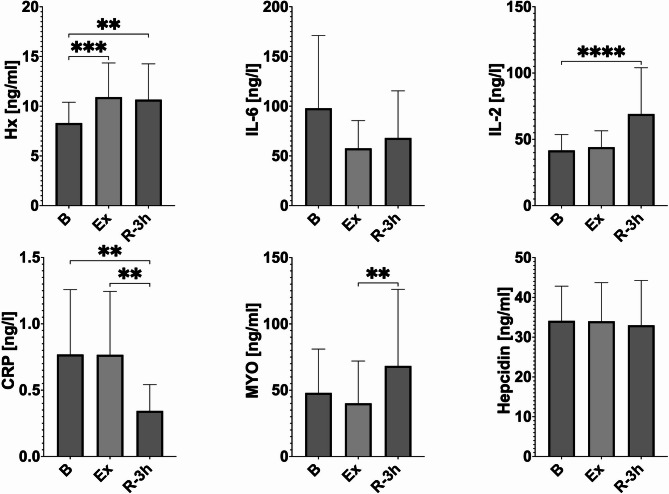
- No significant changes in hepcidin or IL-6 were observed at 3 h post-exercise; IL-2 increased after 3 h recovery (p < 0.0001, d = 1.17), while CRP decreased at 3 h versus baseline (p = 0.001, d = 1.24) and versus immediate post-exercise (p = 0.0019, d = 1.25).
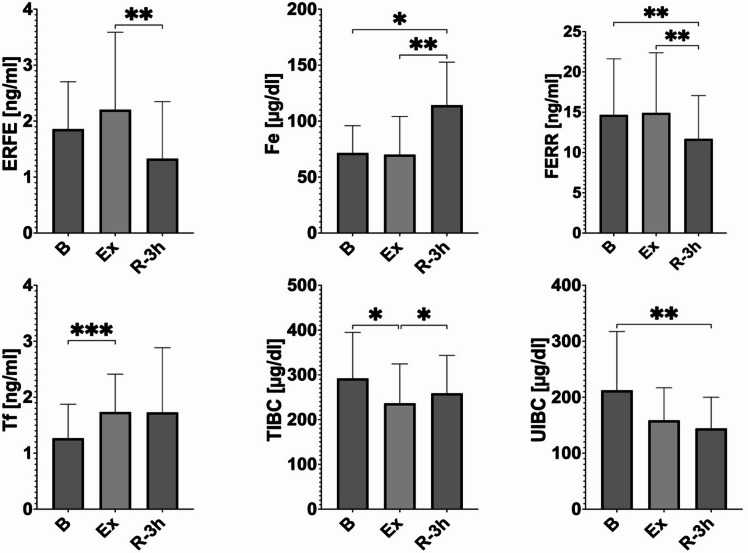
- Transferrin increased immediately post-exercise (p = 0.0007, d = 0.7) and remained elevated at 3 h, while TIBC decreased immediately (p = 0.023, d = 0.58) and then increased after 3 h (p = 0.0138, d = 0.26).
- Serum iron increased at 3 h recovery versus baseline (p = 0.023, d = 1.36) and versus post-exercise (p = 0.0061, d = 1.22); ERFE decreased at 3 h versus post-exercise (p = 0.0026, d = 0.73), and ferritin decreased at 3 h versus baseline (p = 0.0068, d = 0.48) and post-exercise (p = 0.0034, d = 0.5).
Methods
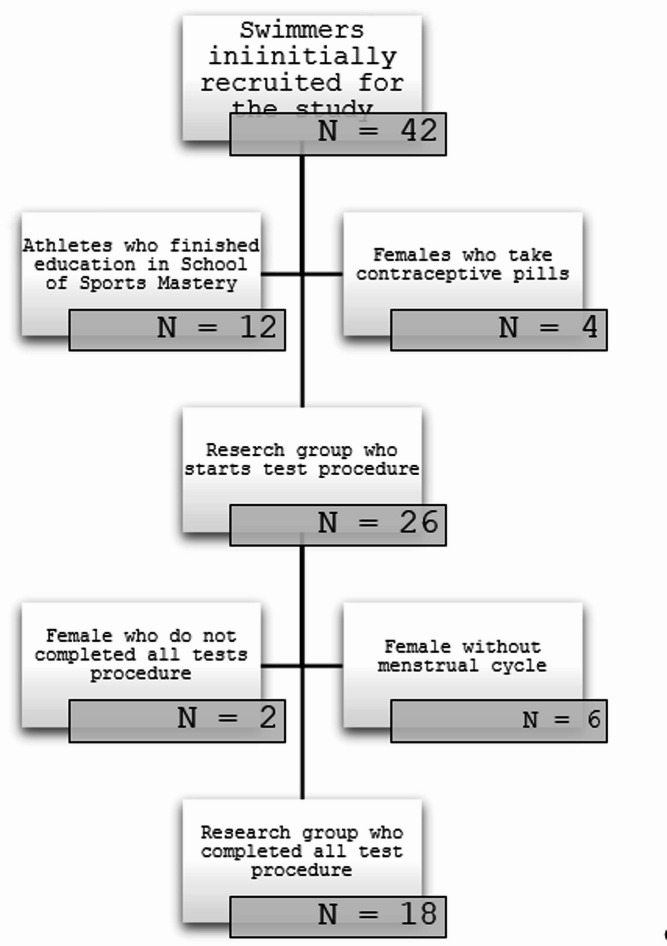
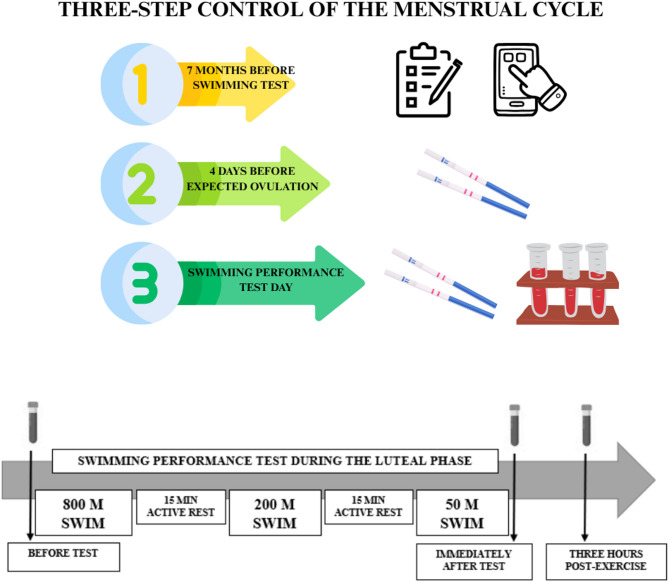
- Observational study with 18 competitive female swimmers (age 13.5 ± 1.2 years) tested during the luteal phase, confirmed by a three-stage protocol including cycle tracking, home ovulation tests, and fasting sex-hormone measurements.
- Participants completed 800 m, 200 m, and 50 m swims in the shortest possible time with 15-min active recovery between segments; total session duration was 60:38 ± 2:31 (min:s).
- Venous blood was collected before exercise, immediately after, and after 3 h recovery; inflammatory and iron markers were measured by ELISA and colorimetric assays, with repeated-measures ANOVA/Tukey, Friedman tests, and Cohen’s d as reported.
Limitations
- The authors state the relatively small number of participants limits generalizability, future studies should include more blood sampling points (6, 12, and 24 h after exercise), and a resting control group could isolate exercise effects.
- Evident from the text: only three time points were assessed, so later hepcidin/IL-6 responses were not captured; the study included only adolescent female swimmers in the luteal phase, with no male or non-luteal comparison.
- Evident from the text: testing occurred during the preparatory training period at peak training volume, which may have influenced baseline iron status and the response to the exercise stimulus.
Model-written summary. Check it against the paper before relying on it.
Integrity signals
Registry
Cites
Statistics
Figures
Verification
Claims the paper makes
1 Valid · 0 Not valid · 71 Not checked · 77 Own results and interpretations
Every source the paper cites for this claim was checked and supports it.
In the paper
“A key factor in this process is hepcidin, a hormone produced in the liver whose production increases in response to inflammation, particularly under the influence of IL-67,8.”
§ Impact of a single swimming session on inflammatory response and iron homeostasis in adolescent female athletes during the luteal phase > Introduction
What the sources say
- Supportedcites [7] Nemeth, E. et al. IL-6 mediates hypoferremia of inflammation by inducing the synthesis of the iron regulatory hormone Hepcidin. J. Clin. Invest. 113, 1271–1276 (2004). source
The Abstract (p.1) states that 'IL-6 is the necessary and sufficient cytokine for the induction of hepcidin during inflammation,' and the Discussion reiterates that 'hepcidin is induced by IL-6, but not IL-1 or TNF-alpha,' making inflammation-dependent hepcidian induction an IL-6–dependent, type II acute-phase response. Human data (Discussion) show IL-6 infusion rapidly increased urinary hepcidin excretion within hours, and the Introduction notes hepcidin mRNA was increased in LPS-treated mice and hepatocytes. Both halves of the claim — hepcidin rises with inflammation, and IL-6 is the particular driver — are stated in our copy. (LLM, conf=0.95)
- Supportedcites [8] Sim, M. et al. Iron considerations for the athlete: a narrative review. Eur. J. Appl. Physiol. 119, 1463–1478 (2019). source
In the section 'What are the contributing factors to iron deficiency in athlete populations?', our copy states that exercise transiently increases the 'master iron regulatory hormone, hepcidin', 'likely a result of the well-documented exercise-induced inflammatory response and associated increases in the cytokine interleukin-6 (IL-6)', and that increases in hepcidin activity decrease iron absorption and recycling. The section 'What is the influence of contemporary nutritional strategies on iron regulation?' reinforces this, calling IL-6 'a key cytokine involved in the up-regulation of hepcidin levels'. The hepatic origin of hepcidin is also treated in the paper ('Hypoxic stress has been shown to strongly inhibit liver hepcidin production', 'How is iron metabolism regulated in hypoxia?'). The paper frames the inflammation-IL-6-hepcidin link chiefly in the exercise setting, but the mechanistic attribution in the citing sentence is clearly contained in our copy. (LLM, conf=0.82)
plainstates a cause- Asserted: passes — The authors put it forward as true.
- Checkable: passes — It can be checked against evidence.
- Load-bearing: passes — The paper’s conclusions depend on it.
- Based: passes — The paper gives a reason why it holds.
- Supported
A result the paper reports from its own data — it cites no other source for it, so there is none to check. The quote shows it is in the paper.
In the paper
“Similarly, hepcidin levels did not show significant changes in response to exercise.”
- Also stated in: § Abstract · hedged
“While no significant changes in hepcidin or IL-6 were observed at 3 h post-exercise, later time points were not assessed.”
§ Impact of a single swimming session on inflammatory response and iron homeostasis in adolescent female athletes during the luteal phase > Results > Markers of inflammation and iron homeostasis
plain- Asserted: passes — The authors put it forward as true.
- Checkable: passes — It can be checked against evidence.
- Load-bearing: passes — The paper’s conclusions depend on it.
- Based: passes — The paper gives a reason why it holds.
- Also stated in: § Abstract · hedged
A result the paper reports from its own data — it cites no other source for it, so there is none to check. The quote shows it is in the paper.
In the paper
“However, a significant decrease in ERFE was noted after three hours of recovery (p = 0.0026, Cohen’s d = 0.73, Ex vs. R-3 h).”
§ Impact of a single swimming session on inflammatory response and iron homeostasis in adolescent female athletes during the luteal phase > Results > Markers of iron metabolism
plainstates a cause- Asserted: passes — The authors put it forward as true.
- Checkable: passes — It can be checked against evidence.
- Load-bearing: passes — The paper’s conclusions depend on it.
- Based: passes — The paper gives a reason why it holds.
A result the paper reports from its own data — it cites no other source for it, so there is none to check. The quote shows it is in the paper.
In the paper
“The observed post-exercise rise in serum iron”
§ Impact of a single swimming session on inflammatory response and iron homeostasis in adolescent female athletes during the luteal phase > Discussion
plainstates a cause- Asserted: passes — The authors put it forward as true.
- Checkable: passes — It can be checked against evidence.
- Load-bearing: passes — The paper’s conclusions depend on it.
- Based: passes — The paper gives a reason why it holds.
A result the paper reports from its own data — it cites no other source for it, so there is none to check. The quote shows it is in the paper.
In the paper
“in the present study, no significant changes were observed in IL-6 or IL-10”
§ Impact of a single swimming session on inflammatory response and iron homeostasis in adolescent female athletes during the luteal phase > Discussion
plain- Asserted: passes — The authors put it forward as true.
- Checkable: passes — It can be checked against evidence.
- Load-bearing: passes — The paper’s conclusions depend on it.
- Based: passes — The paper gives a reason why it holds.
55 more claims
Create a free account to see all 149 claims and to verify the 100 references still open.
- It may state two separate claims as one. 65
- Probably not a substantial claim. 47
Self-check
Percentages, sums and reported differences re-computed from the paper’s own numbers.
Each contradiction between two passages listed here was confirmed by an independent check.
Rated major: it would touch a result — a value a result rests on, reported and recomputed p-values on opposite sides of the significance level, two passages that conflict with no sign which is right, or a cited work retracted before this paper was published.
In the paper
§ Impact of a single swimming session on inflammatory response and iron homeostasis in adolescent female athletes during the luteal phase > Results > Sex hormones
“The results confirm that all athletes were in the luteal phase of the menstrual cycle at the time of testing26.”
§ Impact of a single swimming session on inflammatory response and iron homeostasis in adolescent female athletes during the luteal phase > Results > Sex hormones
“| Progesterone [ng/ml] | 3.5 ± 5.1 | 2.9–27.1 |”
Rated major: it would touch a result — a value a result rests on, reported and recomputed p-values on opposite sides of the significance level, two passages that conflict with no sign which is right, or a cited work retracted before this paper was published.
In the paper
§ Impact of a single swimming session on inflammatory response and iron homeostasis in adolescent female athletes during the luteal phase > Discussion
“the values remained within the reference range, suggesting the absence of an acute inflammatory response in the participants52 (Table 5).”
§ Impact of a single swimming session on inflammatory response and iron homeostasis in adolescent female athletes during the luteal phase > Discussion
“This leukocytosis is interpreted not as a direct marker of muscle injury but as evidence of an acute inflammatory response, with immune cell trafficking toward the exercised tissue.”
Rated minor: it would not touch a result — a value no result rests on, a p-value that stays on the same side of the significance level, or a conflict that is clerical, resolved elsewhere in the paper, or outside its own findings.
In the paper
§ Impact of a single swimming session on inflammatory response and iron homeostasis in adolescent female athletes during the luteal phase > Results > Hematological parameters
“WBC count increased significantly after the test (p = 0.0122, Cohen’s d = 0.82, B vs. Ex) and remained elevated after 3 h of recovery (p = 0.0004, Cohen’s d = 0.26, Ex vs. R-3 h).”
§ Impact of a single swimming session on inflammatory response and iron homeostasis in adolescent female athletes during the luteal phase > Results > Hematological parameters
“| WBC [103/µl] | 6.27 ± 0.84 | 7.38 ± 1.84 | 7.83 ± 1.64 | 0.82* | 0.26*** | 1.24 n.s. |”
Rated minor: it would not touch a result — a value no result rests on, a p-value that stays on the same side of the significance level, or a conflict that is clerical, resolved elsewhere in the paper, or outside its own findings.
In the paper
§ Impact of a single swimming session on inflammatory response and iron homeostasis in adolescent female athletes during the luteal phase > Discussion
“Concurrently, leukocyte subsets (LYM, MON, GRA) increased vs. baseline (Table 5).”
§ Impact of a single swimming session on inflammatory response and iron homeostasis in adolescent female athletes during the luteal phase > Results > Hematological parameters
“| LYM [103/µl] | 2.59 ± 0.36 | 2.78 ± 0.68 | 2.02 ± 0.36 | 0.36 n.s. | 1.42*** | 1.54** |”
Citations
Cites
Statistical power analyses using G∗Power 3.1: tests for correlation and regression analyses
Faul, F., Erdfelder, E., Buchner, A., & Lang, A.-G. (2009) · Behavior Research Methods · doi:10.3758/brm.41.4.1149 · Cited by 37,615
Psychophysical bases of perceived exertion
BORG, G. A. V. (1982) · Medicine & Science in Sports & Exercise · doi:10.1249/00005768-198205000-00012 · Cited by 16,580
Vandenbroucke, J. P., von Elm, E., Altman, D. G., Gøtzsche, P. C., Mulrow, C. D., Pocock, S. J., Poole, C., Schlesselman, J. J., & Egger, M. (2014) · International Journal of Surgery · doi:10.1016/j.ijsu.2014.07.014 · Cited by 2,969
Nemeth, E., Rivera, S., Gabayan, V., Keller, C., Taudorf, S., Pedersen, B. K., & Ganz, T. (2004) · Journal of Clinical Investigation · doi:10.1172/jci200420945 · Cited by 2,650
Muscle as an Endocrine Organ: Focus on Muscle-Derived Interleukin-6
Pedersen, B. K., & Febbraio, M. A. (2008) · Physiological Reviews · doi:10.1152/physrev.90100.2007 · Cited by 2,388
Immune function in sport and exercise
Gleeson, M. (2007) · Journal of Applied Physiology · doi:10.1152/japplphysiol.00008.2007 · Cited by 1,016
Muscle damage and inflammation during recovery from exercise
Peake, J. M., Neubauer, O., Della Gatta, P. A., & Nosaka, K. (2017) · Journal of Applied Physiology · doi:10.1152/japplphysiol.00971.2016 · Cited by 764
Elliott-Sale, K. J., Minahan, C. L., de Jonge, X. A. K. J., Ackerman, K. E., Sipilä, S., Constantini, N. W., Lebrun, C. M., & Hackney, A. C. (2021) · Sports Medicine · doi:10.1007/s40279-021-01435-8 · Cited by 731
Knovich, M. A., Storey, J. A., Coffman, L. G., Torti, S. V., & Torti, F. M. (2009) · Blood Reviews · doi:10.1016/j.blre.2008.08.001 · Cited by 627
Where are all the female participants in Sports and Exercise Medicine research?
Costello, J. T., Bieuzen, F., & Bleakley, C. M. (2014) · European Journal of Sport Science · doi:10.1080/17461391.2014.911354 · Cited by 599
Cited by
Menstrual Profiles and Cardiovascular Markers Among a Cohort of Female Adolescent Athletes
Blevins, K., Brna, M. L., Roth, L. P., Howell, D. R., Kohrt, W. M., & Armento, A. M. (2026) · International Journal of Sports Medicine · doi:10.1055/a-2896-9042
Tokarczyk, W., Palian, J., Smędowski, I., Marczyk, A., Mantaj, J., Główczyk, P., Kurzyński, S., Król, G., Gdowski, M., Mordarski, J., et al. (2026) · African Journal of Biomedical Research · doi:10.65327/30k5yk14
Metadata
- Authors
- Mydłowska, M., Kasperska, A., Cichoń-Woźniak, J., Dziewiecka, H., Ostapiuk-Karolczuk, J., & Skarpańska-Stejnborn, A.
- Corresponding author
- Mydłowska, Marta
- Venue
- Scientific Reports
- Published
- 2025-11-20
- Volume
- 15
- Issue
- 1
- Pages
- 44951-44951
- ISSN
- 2045-2322 (ISSN-L)
- PMC
- PMC12748714
- OpenAlex
- W4416504062
- Semantic Scholar
- e7ee38eb10056ac7fe88e80c0177f4ad352b982c
- Cited by
- 2
- References
- 70
- Citations by year
- 2026: 2
- FWCI
- 1.25
- Type
- journal article
- Language
- en
- Open access
- gold
- doi.org
- Licence
- cc-by-nc-nd
- creativecommons.org/licenses/by-nc-nd/4.0 (tdm)
- creativecommons.org/licenses/by-nc-nd/4.0 (vor, 39 d)
- Locations
- Scientific Reports (publishedVersion, cc-by-nc-nd)
- PubMed (publishedVersion)
- PubMed Central (publishedVersion, cc-by-nc-nd)
- DOAJ (DOAJ: Directory of Open Access Journals) (submittedVersion, cc-by-sa)
- Funders
- Akademia Wychowania Fizycznego im. Eugeniusza Piaseckiego w Poznaniu (6/NSN/W/24)
- Topics
- Health Sciences › Medicine › Hematology › Iron Metabolism and Disorders
- Health Sciences › Medicine › Physiology (medical) › Exercise and Physiological Responses
- Health Sciences › Medicine › Orthopedics and Sports Medicine › Sports Performance and Training
- Keywords
- swimming, exercise-induced inflammation, iron homeostasis, hepcidin, interleukin-6, luteal phase, adolescent female athletes, menstrual cycle, erythroferrone, ferritin, transferrin, total iron binding capacity, erythropoiesis, lactate, hypoxanthine
- MeSH terms
- Adolescent, Female, Ferritins, Homeostasis, Humans, Inflammation, Iron, Luteal Phase, Swimming, Transferrin, Exercise, Interleukin-6, Athletes, Hepcidins
About these checks
Registry, retraction, Cites and statistics results are computed, not judged, with one exception: a printed reference that no index lists is read once by a model before it counts as a citation error. Claims are extracted by a model and kept only when their quote appears verbatim in the text; each cited source is then checked, with a model’s help, for whether it says what the claim relies on. Those verdicts can be wrong — read the claim’s quote and the cited source before relying on one.
A language model drew the claims from the paper on 2026-11-14, under version 3 of the claim definition (model deepseek-v4.1-flash, prompt extract-v3).
A second model labelled each claim on 2026-11-14 (model jev-1.13-20260917, definition revision gold-guideline-v0.2).
Cited sources are checked with a language model’s help (qwen3.8-omni-flash).
Statistics and arithmetic are recomputed, not judged.
Confidence bands are shown only for fields calibrated on our annotated test set. None is calibrated yet, so no band is shown.
What counts as a claim ›How we measure confidence ›How we check this ›
Are you an author, or do you see a problem with this page? Request a review
Data sources
Bibliographic data: Semantic Scholar, OpenAlex, Crossref.
Contains information from the Semantic Scholar Academic Graph Datasets, made available under the ODC Attribution License (ODC-BY 1.0).
Semantic Scholar’s data is described in: Kinney, R., et al. (2023). The Semantic Scholar Open Data Platform. arXiv:2301.10140.
