

Comprehensive pan-cancer genomic landscape of KRAS altered cancers and real-world outcomes in solid tumors
Open accessThe DOI matches its Crossref record; 51 of the 51 references it cites were found in a registry or an index.
Abstract
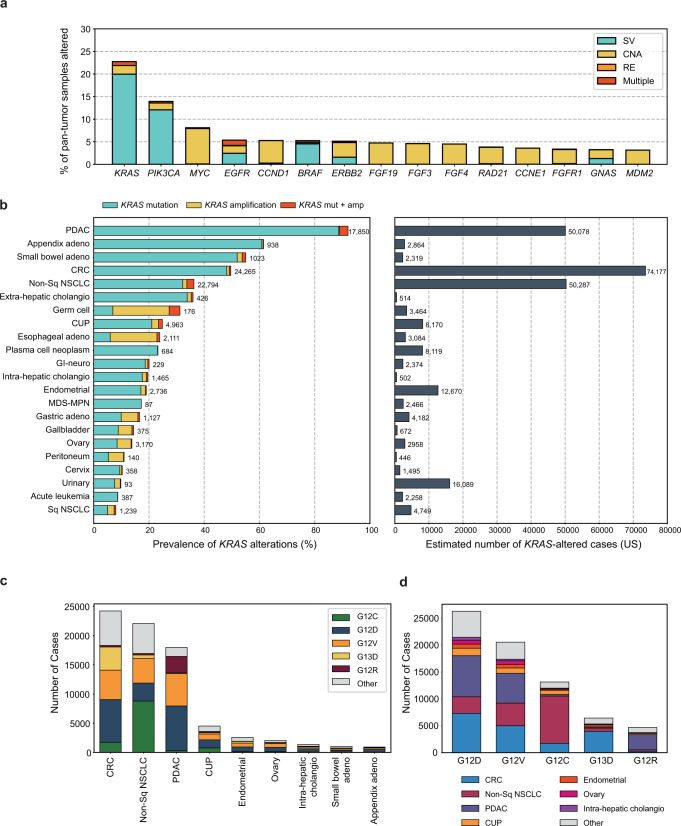
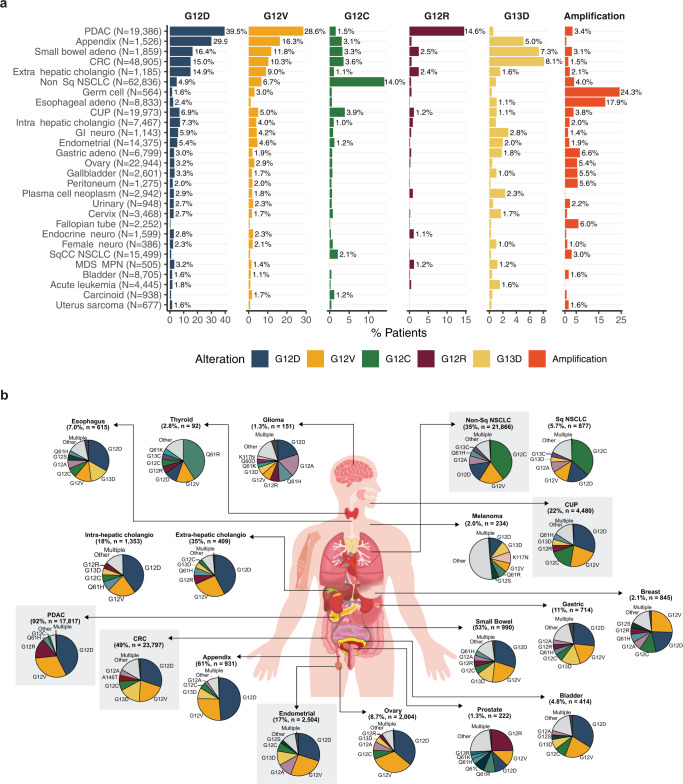
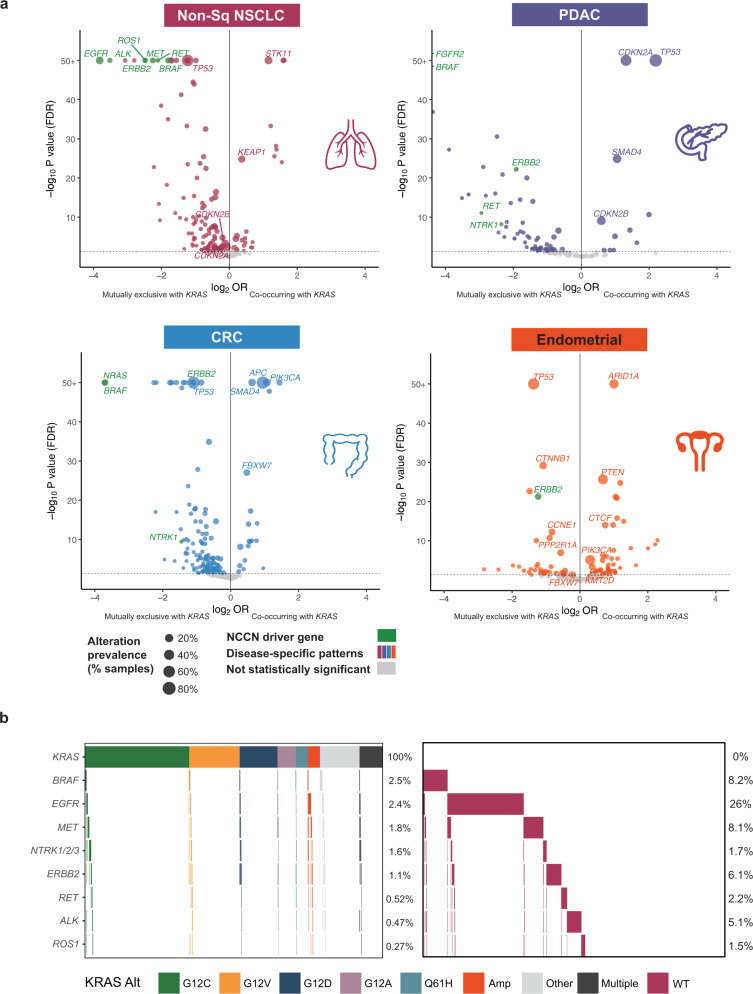
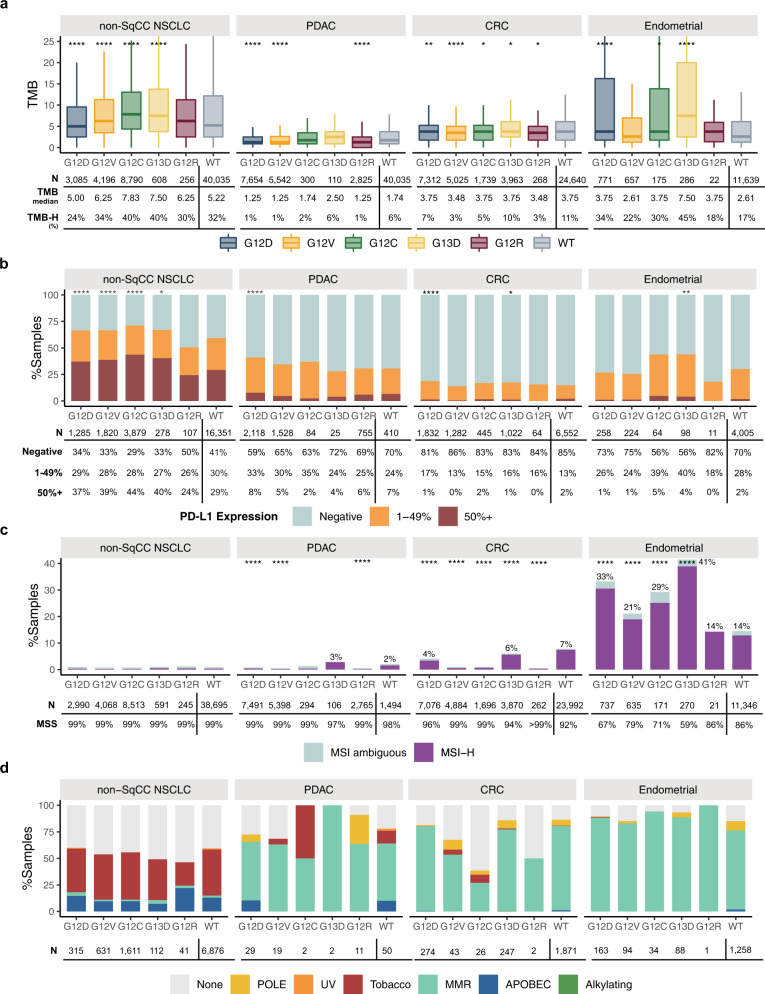
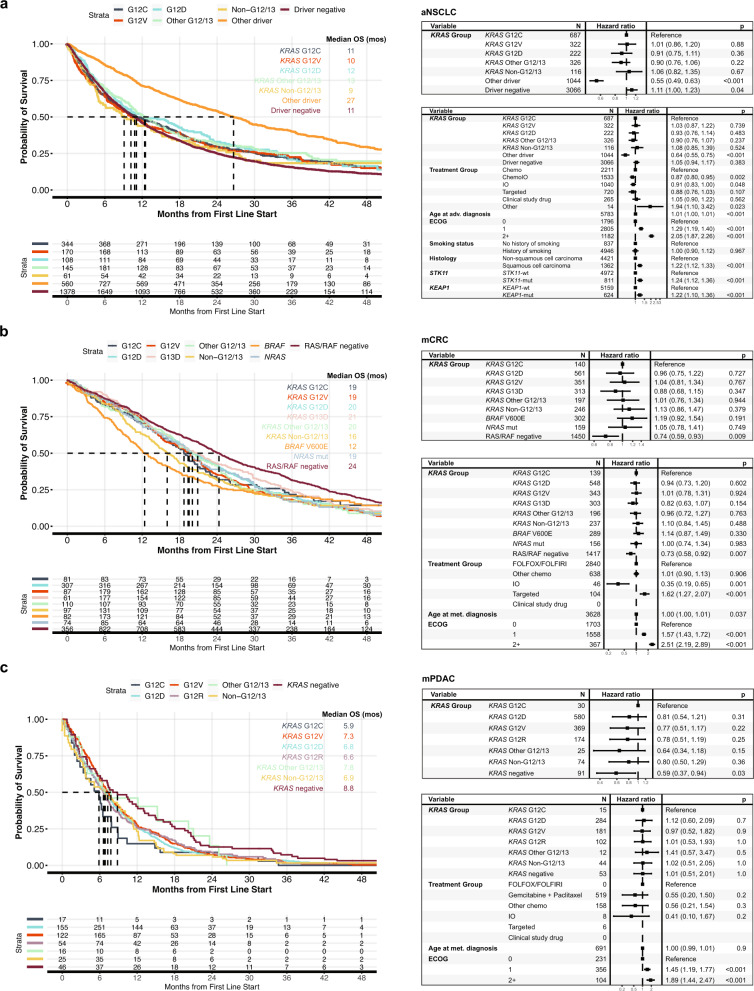
Recent clinical development of KRAS inhibitors has heightened interest in the genomic landscape of KRAS -altered cancers. We performed a pan-cancer analysis of KRAS -altered samples from 426,706 adult patients with solid or hematologic malignancies using comprehensive genomic profiling; additional analyses included 62,369 liquid biopsy and 7241 pediatric samples. 23% of adult pan-cancer samples had KRAS alterations; 88% were mutations, most commonly G12D/G12V/G12C/G13D/G12R , and prevalence was similar in liquid biopsies. Co-alteration landscapes were largely similar across KRAS mutations but distinct from KRAS wild-type, though differences were observed in some tumor types for tumor mutational burden, PD-L1 expression, microsatellite instability, and other mutational signatures. Prognosis of KRAS- mutant versus other genomic cohorts of lung, pancreatic, and colorectal cancer were assessed using a real-world clinicogenomic database. As specific KRAS inhibitors and combination therapeutic strategies are being developed, genomic profiling to understand co-alterations and other biomarkers that may modulate response to targeted or immunotherapies will be imperative.
Overview
The claims and statistics of this paper haven’t been checked yet.
Free: it reads the open-access text and checks the first 5 claims that cite a source we can check. Create a free account to check every claim.
Integrity signals
Registry
Cites
Statistics
Figures
Verification
Claims the paper makes
The claims and statistics of this paper haven’t been checked yet.
Free: it reads the open-access text and checks the first 5 claims that cite a source we can check. Create a free account to check every claim.
Claims other papers make about this one
Each is checked against this paper’s own text: does it say what the citing paper says it does?
The source backs part of the claim, not all of it — or backs it for a different population, condition or comparison.
In the citing paper
“KRAS is the most frequently mutated oncogene, accounting for approximately 85% of all RAS mutations in 20–25% of all cancers [8–10].”
From Differential Response and Resistance to KRAS-Targeted Therapy (2025) · cites this paper as [10]
Experimental — accuracy not yet measuredThe source backs part of the claim, not all of it — or backs it for a different population, condition or comparison.
In the citing paper
“Another study comparing KRASG12C (n = 30) and other KRAS mutations reported longer median OS (starting from the first line therapy, p = 0.03) for KRAS wildtype tumors (n = 91) in patients with metastatic PDAC, which was consistent with our findings of better survival in KRAS wildtype patients12”
From Impact of KRAS mutations and co-mutations on clinical outcomes in pancreatic ductal adenocarcinoma (2024) · cites this paper as [12]
Experimental — accuracy not yet measuredThe source backs part of the claim, not all of it — or backs it for a different population, condition or comparison.
In the citing paper
“Unlike NSCLC, genetic alterations in the PI3K/AKT pathway, especially mutation of PIK3CA and PTEN, are prevalent in CRC and frequently co-occur with KRAS mutations [10, 112].”
From Differential Response and Resistance to KRAS-Targeted Therapy (2025) · cites this paper as [10]
Experimental — accuracy not yet measuredThe cited source says what the claim attributes to it.
In the citing paper
“KRAS G12D mutations occur in nearly 40% of PDAC (25)”
From Mechanisms of Resistance to Oncogenic KRAS Inhibition in Pancreatic Cancer (2024) · cites this paper as [25]
The cited source says what the claim attributes to it.
In the citing paper
“KRASG12R was more common in PDAC (~15%) than in other cancer types12.”
From Impact of KRAS mutations and co-mutations on clinical outcomes in pancreatic ductal adenocarcinoma (2024) · cites this paper as [12]
8 more claims about this paper
Create a free account to see every claim other papers make about this one.
Self-check
Percentages, sums and reported differences re-computed from the paper’s own numbers.
The self-check needs the paper’s full text.
Citations
Cites
A global reference for human genetic variation
The 1000 Genomes Project Consortium, authors, C., Auton, A., Abecasis, G. R., Steering committee, Altshuler, D. M., Durbin, R. M., Abecasis, G. R., Bentley, D. R., Chakravarti, A., et al. (2015) · Nature · doi:10.1038/nature15393 · Cited by 18,247
Analysis of protein-coding genetic variation in 60,706 humans
Exome Aggregation Consortium, Lek, M., Karczewski, K. J., Minikel, E. V., Samocha, K. E., Banks, E., Fennell, T., O’Donnell-Luria, A. H., Ware, J. S., Hill, A. J., et al. (2016) · Nature · doi:10.1038/nature19057 · Cited by 9,587
Analysis of 100,000 human cancer genomes reveals the landscape of tumor mutational burden
Chalmers, Z. R., Connelly, C. F., Fabrizio, D., Gay, L., Ali, S. M., Ennis, R., Schrock, A., Campbell, B., Shlien, A., Chmielecki, J., et al. (2017) · Genome Medicine · doi:10.1186/s13073-017-0424-2 · Cited by 3,519
Self-citationZehir, A., Benayed, R., Shah, R. H., Syed, A., Middha, S., Kim, H. R., Srinivasan, P., Gao, J., Chakravarty, D., Devlin, S. M., et al. (2017) · Nature Medicine · doi:10.1038/nm.4333 · Cited by 3,380
K-Ras(G12C) inhibitors allosterically control GTP affinity and effector interactions
Ostrem, J. M., Peters, U., Sos, M. L., Wells, J. A., & Shokat, K. M. (2013) · Nature · doi:10.1038/nature12796 · Cited by 2,557
Frampton, G. M., Fichtenholtz, A., Otto, G. A., Wang, K., Downing, S. R., He, J., Schnall-Levin, M., White, J., Sanford, E. M., An, P., et al. (2013) · Nature Biotechnology · doi:10.1038/nbt.2696 · Cited by 2,157
Self-citationSotorasib for Lung Cancers with KRAS p.G12C Mutation
Skoulidis, F., Li, B. T., Dy, G. K., Price, T. J., Falchook, G. S., Wolf, J., Italiano, A., Schuler, M., Borghaei, H., Barlesi, F., et al. (2021) · New England Journal of Medicine · doi:10.1056/nejmoa2103695 · Cited by 1,849
KRAS G12C Inhibition with Sotorasib in Advanced Solid Tumors
Hong, D. S., Fakih, M. G., Strickler, J. H., Desai, J., Durm, G. A., Shapiro, G. I., Falchook, G. S., Price, T. J., Sacher, A., Denlinger, C. S., et al. (2020) · New England Journal of Medicine · doi:10.1056/nejmoa1917239 · Cited by 1,733
STK11/LKB1 Mutations and PD-1 Inhibitor Resistance in KRAS -Mutant Lung Adenocarcinoma
Skoulidis, F., Goldberg, M. E., Greenawalt, D. M., Hellmann, M. D., Awad, M. M., Gainor, J. F., Schrock, A. B., Hartmaier, R. J., Trabucco, S. E., Gay, L., et al. (2018) · Cancer Discovery · doi:10.1158/2159-8290.cd-18-0099 · Cited by 1,641
Self-citationT-Cell Transfer Therapy Targeting Mutant KRAS in Cancer
Tran, E., Robbins, P. F., Lu, Y.-C., Prickett, T. D., Gartner, J. J., Jia, L., Pasetto, A., Zheng, Z., Ray, S., Groh, E. M., et al. (2016) · New England Journal of Medicine · doi:10.1056/nejmoa1609279 · Cited by 1,368
Cited by
Items 101–200 of 208
Venegas-Rodríguez, J. L., Hernández-Sandoval, J. A., Angulo, M. G., Moreno-Ortíz, J. M., González‐Mercado, A., Peregrina-Sandoval, J., Ramírez-Plascencia, H. H. F., Flores-López, B. A., Alvizo-Rodríguez, C. R., Valenzuela-Pérez, J. A., et al. (2024) · Cancers · doi:10.3390/cancers16132323 · Cited by 4
“…detected in cancer types characterized by frequent KRAS gene mutations predominantly involve the substitutions of guanine with adenine in codon 12 (c.35G>A, p.Gly12Asp) in pancreatic and colorectal adenocarcinomas and guanine with thymine (c.34G>T, p.Gly12Cys) in lung adenocarcinoma [46,47].”
BackgroundNadee, P., Prompat, N., Yamabhai, M., Sangkhathat, S., Benjakul, S., Tipmanee, V., & Saetang, J. (2024) · Advanced Theory and Simulations · doi:10.1002/adts.202400489 · Cited by 4
Zhai, Z., Wang, S., Cao, Y., Liu, J., Zhao, Q., Ji, Y., Yang, X. Q., Tang, X., Ma, J., & Du, P. (2024) · Biomedicines · doi:10.3390/biomedicines12122653 · Cited by 4
“Therefore, a macroscopic “pan-cancer” perspective may help us to unravel the underlying mechanisms of cancer development [8].”
Han, X., Han, X., Hao, Y., Wang, B., Luo, L., Chen, S., Zou, L., Huang, J., Chen, T., Wang, W., et al. (2025) · Journal of Translational Medicine · doi:10.1186/s12967-025-06094-1 · Cited by 7
“[6] Adoptive transfer of T cell receptor (TCR) T cells has demonstrated the potential to provide durable clinical responses to previously incurable diseases.”
Vaeyens, F., Hetzel, J.-P., Abdullah, K., Eggermont, C., Olsen, C., Mernberger, M., Maes, K., Vlaeminck, J., Claus, R., Vanisterbecq, D., et al. (2026) · International Journal of Cancer · doi:10.1002/ijc.70558 · Cited by 4
“The CRCs, NSCLCs, and PDACs are recurrently found to harbor KRAS variants [43].”
Sommer, S., Schmutz, M., Hildebrand, K., Schiwitza, A., Benedikt, S., Eberle, M., Mögele, T., Sultan, A., Reichl, L., Campillo, M., et al. (2024) · Journal of Laboratory Medicine · doi:10.1515/labmed-2023-0156 · Cited by 6
Li, J., Wang, Z., Huang, J., Ba, Y., Cao, B., Luo, S., Li, W., Bai, C., Song, Z., Xiong, J., et al. (2026) · The Lancet Gastroenterology & Hepatology · doi:10.1016/s2468-1253(25)00267-5 · Cited by 3
EFTX-G12V: a novel KRASG12V-selective RNAi therapeutic
Papavassiliou, K. A., Vassiliou, A. G., & Papavassiliou, A. G. (2025) · Trends in Pharmacological Sciences · doi:10.1016/j.tips.2025.07.004 · Cited by 3
Hitchen, N., Wong, H., Wong, R., Shapiro, J., Burge, M., Nott, L., Lee, B. R., Lim, S. H.-S., Wong, S. F., Caird, S., et al. (2025) · ESMO Real World Data and Digital Oncology · doi:10.1016/j.esmorw.2025.100178 · Cited by 4
“24 25-27 Consistent with prior data, BRAF V600E - mutations were associated with worse PFS and OS outcomes.”
Proteomic Perspectives on KRAS-Driven Cancers and Emerging Therapeutic Approaches
Karki, R., Chen, R., & Pan, S. (2025) · Current Oncology · doi:10.3390/curroncol32110614 · Cited by 3
“[1].”
KRAS G12C-mutant non-small cell lung cancer: A practical guide for clinicians
Remón, J., Cava, G. L., Borgeaud, M., Saw, S. P. L., Hendriks, L. E. L., & Ricciuti, B. (2026) · Cancer Treatment Reviews · doi:10.1016/j.ctrv.2026.103144 · Cited by 3
Targeting KRAS for cancer therapy
Jia, J., Liu, R., Adamide, T. A., Fernandez, I. E., & Stathopoulos, G. T. (2026) · British Journal of Pharmacology · doi:10.1111/bph.70546 · Cited by 4
KRAS inhibitors in drug resistance and potential for combination therapy
Rathod, L. S., Sakle, N. S., & Mokale, S. N. (2024) · Tumori Journal · doi:10.1177/03008916241289206 · Cited by 3
Choi, D.-H., Jang, H., Lim, S. H., Kim, S. T., Hong, J. Y., Park, S. H., Park, J. O., Kim, D. G., Kim, K., & Lee, J. (2024) · Pathology - Research and Practice · doi:10.1016/j.prp.2024.155473 · Cited by 3
Self-citationMa, M., Tan, H., Yan, H., & Zheng, K. (2024) · Scientific Reports · doi:10.1038/s41598-024-73080-w · Cited by 3
“The oncogenic KRAS gene, commonly mutated in both lung and colorectal cancers 18–21 , is influenced by hereditary traits 22 , which could potentially explain the influence of colorectal cancer family history on the survival of NSCLC patients.”
BackgroundKapp, J. N., Verdurmen, W. P. R., Schaefer, J. V., Kopra, K., Nagy‐Davidescu, G., Richard, É., Nokin, M., Erñst, P., Tamaskovic, R., Schwill, M., et al. (2025) · Molecular Oncology · doi:10.1002/1878-0261.70061 · Cited by 3
CDCP1-targeting ADC outperforms standard therapies in Ras-mutant pancreatic cancer
Um, Y. J., Noh, H.-D., Cho, J. G., Ko, H., Wi, T. M., Kim, J.-O., & Park, S. G. (2025) · Molecular Therapy Oncology · doi:10.1016/j.omton.2025.201024 · Cited by 3
Hung, S., Lee, C.-Y., Lien, C.-Y., Chan, C.-H., Yang, Y.-H., Li, C.-W., Lee, T.-H., Huang, H.-M., Jian, Y.-L., Yu, T., et al. (2026) · IEEE Sensors Journal · doi:10.1109/jsen.2026.3669133 · Cited by 2
“Among these, the KRAS G12D mutation is particularly prevalent and serves as a highly specific biomarker for PDAC [27].”
Keller-Evans, R. B., Fleischmann, Z., Sivakumar, S., Sharaf, R., Williams, E. A., Kaplan, B., Sokol, E. S., Schrock, A. B., Tukachinsky, H., Mata, D. A., et al. (2026) · Journal of Molecular Diagnostics · doi:10.1016/j.jmoldx.2025.12.004 · Cited by 2
Self-citationHaas, M., Hempel, L., Krämer, A., & Hübner, G. (2026) · Oncology Research and Treatment · doi:10.1159/000551434 · Cited by 2
Scarlato, E., Dusetti, N., & Melisi, D. (2026) · Cancer Treatment Reviews · doi:10.1016/j.ctrv.2026.103123 · Cited by 2
Lee, J. K., Quintanilha, J. C. F., Chen, K., Fendler, B. J., Tambaoan, C. F. B., Graf, R. P., Odzer, N. B., Pusztai, L., Lustberg, M. B., Singh, H., et al. (2026) · Clinical Cancer Research · doi:10.1158/1078-0432.ccr-25-4018 · Cited by 2
“…pathogenic alterations were called using a multi-step method leveraging annotations which include reporting in COSMIC (RRID: SCR_ 002260), functional knowledge of the gene affected, internal insights, and clinical/functional characterization in the literature, as described previously (35, 38).”
Self-citationAi, X., Song, Z., Wu, L., Zhou, A., Cheng, D., Zong, H., Wu, H., Niu, Z., Sun, Y., Zhu, L., et al. (2026) · Nature Medicine · doi:10.1038/s41591-026-04559-4 · Cited by 3
Advances in Targeting KRAS G12C in Gastrointestinal Malignancies: Focus on KRAS G12C Inhibitors
Hoyek, C., Pirozzi, A., Jones, J. M., Rimassa, L., Sonbol, M. B., & Bekaii‐Saab, T. (2024) · touchREVIEWS in Oncology & Haematology · doi:10.17925/ohr.2024.20.2.7 · Cited by 3
Tang, Z., Ye, J., & Chen, D. (2025) · Journal of Biochemical and Molecular Toxicology · doi:10.1002/jbt.70271 · Cited by 2
“KRAS is one of the three members of the Ras family (H ‐ Ras, N ‐ Ras, and K ‐ Ras), and its mutation sites are mainly located at amino acid residues 12 or 13, such as G12V, G12D, and G12C [10].”
Forkgen, J., Masle‐Farquhar, E., Fontaine, Y., Russell, A., Ji, S., Peters, T. J., Qiao, Z., Geaghan, M. P., Jackson, K., Hammond, J. W., et al. (2026) · Journal of Allergy and Clinical Immunology · doi:10.1016/j.jaci.2026.01.018 · Cited by 2
KRAS (Kirsten rat sarcoma) in modern oncology—The molecular pathological point of view
Schmitz, K., Schatz, C., & Knabl, L. (2024) · memo - Magazine of European Medical Oncology · doi:10.1007/s12254-024-00986-6 · Cited by 3
Divide and conquer: towards isoform-specific diagnosis and therapy of KRAS-mutant lung cancer
Allemann, A., & Gautschi, O. P. (2023) · Translational Lung Cancer Research · doi:10.21037/tlcr-23-72 · Cited by 2
Targeting KRAS mutation in gastrointestinal cancers
Bicer, F., Akce, M., Piazza, G. A., Foote, J. B., & El‐Rayes, B. F. (2023) · F1000Research · doi:10.12688/f1000research.131688.1 · Cited by 1
Metastatic clear cell sarcoma of the pancreas: An overview
Addi, R. A. (2024) · World Journal of Clinical Cases · doi:10.12998/wjcc.v12.i29.6262 · Cited by 1
“Cancer-causing mutations in KRAS usually take place at specific hotspots, with 95% of mutations found in codons 12, 13, and 61[20].”
Dependence of NPPS creates a targetable vulnerability in RAS-mutant cancers
Xia, R., Zou, P., Xie, J.-T., Tang, Y., Gong, M., Fan, F., Aihemaiti, A., Liu, Y., Shen, Y. H., Zhou, B.-B. S., et al. (2024) · Acta Pharmacologica Sinica · doi:10.1038/s41401-024-01409-2 · Cited by 1
“Among these, KRAS variants are the most common RAS mutations, with codon 12 being the predominant mutated spot [2, 4].”
Hong, C., Lee, J., Kim, D., Hong, S.-J., Park, J., Hong, S., An, K. M., Lee, M., & Han, G. (2024) · Bioorganic & Medicinal Chemistry Letters · doi:10.1016/j.bmcl.2024.130087 · Cited by 1
Self-citationDriver mutation detected in cerebrospinal fluid despite negative liquid biopsy results
Kunimasa, K., Aohara, D., & Nishino, K. (2025) · Discover Oncology · doi:10.1007/s12672-025-01931-7 · Cited by 1
“Second, although genetic analysis of the primary tumor could not be performed due to depletion of tumor tissue samples, KRAS G12V is a well-established driver mutation in lung cancer [19], and this was thought to be the driver mutation in the primary tumor.”
Adenomatoid odontogenic tumor molecular pathogenesis: focusing on KRAS oncogenic mutations
Gomes, I. P., & Gomes, C. C. (2025) · JORDI - Journal of Oral Diagnosis · doi:10.5327/2525-5711.301 · Cited by 1
KRAS G12A Identifies a High-Risk Subset in Resected Stage II–III Colorectal Cancer
Momma, T., Okayama, H., Hayashishita, S., Yamaguchi, D., Fujii, A., Katagata, M., Matsumoto, T., Ujiie, D., Chida, S., Saze, Z., et al. (2025) · Cancers · doi:10.3390/cancers17223599 · Cited by 1
“Across the pan-cancer landscape, KRAS G12A is also relatively uncommon, accounting for approximately 4% of all KRAS mutations detected, a frequency observed consistently in pan-tumor tissue data and liquid genotyping assays [5,8].”
InfluentialPrecision medicine advances in pancreatic cancer driven by genomic and molecular alterations
Li, X., Jiao, Y., & Liu, Y. (2025) · World Journal of Gastrointestinal Oncology · doi:10.4251/wjgo.v17.i11.111264 · Cited by 1
Oncogenesis in cholangiocarcinoma
Orzan, R. I., & Seicean, A. (2025) · Advances in clinical chemistry · doi:10.1016/bs.acc.2025.10.008 · Cited by 2
A Comprehensive Review of Marketed KRAS Inhibitors and Degraders: Challenges and Opportunities
Xu, Y.-X., Bai, Y.-R., Rui-fang, L., Peng, Y., Liu, T., Yang, X., Chen, K., Jin, Z., Liu, H., & Yuan, S. (2026) · Medicinal Research Reviews · doi:10.1002/med.70035 · Cited by 2
“The KRAS G12V mutation was the second most common oncogenic alteration in KRAS‐driven cancers, activating the MAPK pathway and promoting tumor growth and metastasis [88].”
Varty, K., MacLean, L. K., Itani, D. M., Hossain, M., Acar, C., Michael, J. C. R., Daigle-Maloney, T., Thompson, R., Johnston, B., Russell, C., et al. (2026) · Genes Chromosomes and Cancer · doi:10.1002/gcc.70111 · Cited by 1
“Compared to existing literature, the prevalence of the KRAS G12V subtype in this cohort is approximately 10% greater [17, 36, 37].”
Tregel, E., Rieke, D. T., Bleckmann, A., Westphalen, C. B., Pretzell, I., Lange, S., Quante, M., & Kloker, L. D. (2026) · Oncology Research and Treatment · doi:10.1159/000551042 · Cited by 1
Liu, X., Cai, R., Meng, Y., Xu, Y., Wang, B., Liu, M., Wang, Y., Yu, Y., Lu, C., Wei, Y., et al. (2026) · Critical Reviews in Oncology/Hematology · doi:10.1016/j.critrevonc.2026.105220 · Cited by 1
The impact of K-Ras Gly12 mutants on homeostasis and tumorigenesis in the colonic epithelium
Yang, M. H., Sheth, S., Shui, B., Grabski, I. N., Park, S. S., Galán‐Cobo, A., Irizarry, R. A., Heymach, J. V., Dow, L. E., & Haigis, K. M. (2026) · Oncogene · doi:10.1038/s41388-026-03771-3 · Cited by 1
Cross-species insights from ART-D to uncover evolutionarily conserved oncogenic mechanisms
Guo, Y., Zheng, J., Wu, Y., Zhao, K., Lv, D., Liu, W., Wang, M., Lu, J., Xu, W., Wang, X., et al. (2026) · Molecular Systems Biology · doi:10.1038/s44320-026-00215-8 · Cited by 2
“…ERBB2 -ampli fi cations co-occurrence) (Stratton et al, 2009; Vogelstein et al, 2013; Pon and Marra, 2015; Schef fl er et al, 2019; Tekle et al, 2021; Lee et al, 2022), our understanding of how RAS dynamically interfaces with tumor suppressor networks to orchestrate malignant transformation remains…”
Macdonald, E. R., Rose, G. L., Simar, D., McCarthy, A. L., Ford, C. E., Warton, K., Hayes, S. C., & Clifford, B. K. (2026) · International Journal of Gynecological Cancer · doi:10.1016/j.ijgc.2026.104767 · Cited by 1
Guo, Y., Zhong, Y., Hu, P., Chen, Y., Guo, W., Chen, J., Guan, P., Zhou, Z., Zhu, F., Zeng, X., et al. (2026) · Nature Communications · doi:10.1038/s41467-026-73805-7 · Cited by 2
“%) in CRC 3 .”
Maloney, M. F., Caushi, J. X., Cullen, L. A., Andrews, A. R., Ford, A. C., Gizzi, A. S., Souza, C., Stokes, K. L., Dobrev, V. S., Krapfl, K., et al. (2026) · Clinical Cancer Research · doi:10.1158/1078-0432.ccr-26-1252 · Cited by 1
“More broadly, these findings outline core principles for developing TCEs against other oncogenes, including KRAS and PIK3CA , the therapeutic value of which is derived from stable genomic alterations (58, 59).”
Sheffield, K. M., Puri, T., Thoele, K., Karu, H., Mansharamani, A., & Uprety, D. (2026) · Cancers · doi:10.3390/cancers18172869 · Cited by 1
“Kirsten rat sarcoma viral oncogene homolog ( KRAS ) mutations occur in approximately 35% of non-squamous non-small-cell lung cancer (NSCLC) cases [1].”
InfluentialRattani, A., Anderson, C. E., Trim, W. V., Garita, E., Imada, S., Khawaled, S., Shin, H., Zhang, J., Yilmaz, Ö. H., & Kirschner, M. W. (2025) · bioRxiv (Cold Spring Harbor Laboratory) · doi:10.1101/2025.10.12.681896 · Cited by 1
“In colorectal tumors, where APC loss frequently co-occurs with activating KRAS mutations (Lee et al. 2022), this GGPP overexpression would be poised to hyperactivate the MEK/ERK cascade.”
Schendel, D. J., Longinotti, G., Catarinella, M., Salvermoser, M., Bittmann, J., Crame, K., & Davari, K. (2023) · Journal for ImmunoTherapy of Cancer · doi:10.1136/jitc-2023-sitc2023.0388
Tripathi, N., Meza, L., Sayegh, N., Govindarajan, A., Byron, S. A., Zhang, J., Chigarira, B., Jo, Y., Zengin, Z. B., Li, H., et al. (2023) · Kidney Cancer · doi:10.3233/kca-230011
“However, KRAS alteration is rarely observed in mRCC, unlike in other tumor types, such as colorectal, lung, and melanoma tumors [28].”
Vaithyanathan, P. (2024) · Research Square · doi:10.21203/rs.3.rs-4193367/v1
Liu, D., Li, X., Xie, H., Tang, Y. W., Xie, Y., Li, Q. C., Yin, B., Luo, W., & Ruan, X. (2024) · Research Square · doi:10.21203/rs.3.rs-4433771/v1
Yang, M., Deng, Y., Ma, Y., Song, C., Wu, Z., Yibulayin, X., Sun, X., Guo, Y., & He, D. (2024) · Functional & Integrative Genomics · doi:10.1007/s10142-024-01397-w
“Thus, from the macro-perspective of "pan-cancer", research may help to uncover the potential mechanisms of malignant tumors (Zhang 2022; Lee et al. 2022; Saidak et al. 2021).”
Pecci, F., Nakazawa, S., Ricciuti, B., Harada, G., Lee, J., Alessi, J. V., Barrichello, A. P. D. C., Vaz, V. R., Lamberti, G., Federico, A. D., et al. (2024) · doi:10.1158/2159-8290.32698137
Self-citationPatny, A., & Simon, D. (2024) · Elsevier eBooks · doi:10.1016/b978-0-443-21861-3.00005-x
Treatment options for KRAS G12C mutated metastatic colorectal cancer
Liberko, M. (2025) · Onkologie · doi:10.36290/xon.2025.008
Liu, D., Jee, J., Drilon, A. E. D. C., Heilmann, A. M., Allen, J. M., Schrock, A. B., Keller-Evans, R. B., & Li, B. T. (2025) · doi:10.1158/2767-9764.32701241
Self-citationShohani, S., Barati, M., & Hosseini, A. (2025) · Current Molecular Medicine · doi:10.2174/0115665240374769250703232841
Attique, Z., Azhar, H. M. F., & Ansari, A. A. (2025) · Research Square · doi:10.21203/rs.3.rs-7335783/v1
Joint analysis of expression and variation at single cell resolution by scVarPreprint
Zhao, W., Yang, F., Zong, W., Zheng, X., & Bao, Y. (2025) · bioRxiv (Cold Spring Harbor Laboratory) · doi:10.1101/2025.10.12.681753
“These mutations are associated with tumorigenesis, therapeutic resistance, and poor clinical outcomes in multiple cancers, including lung, colorectal, and pancreatic carcinomas[49,47,50].”
MARTIN, J., Huang, B., Ehrenberger, T., Hasan, A., Dow, M. T., Khoo, W. H., Pacaud, R., Metwally, E., Porth, K., Kim, G., et al. (2025) · bioRxiv (Cold Spring Harbor Laboratory) · doi:10.1101/2025.10.15.682438
Exploring New Horizons and Emerging Topics in Squamous Anal Cancer and Colorectal Cancer
Danks, R. (2025) · EMJ Oncology · doi:10.33590/emjoncol/puyu5693
Cho, N., Kwon, E., Kim, S.-E., & Kim, K. K. (2025) · Animal Cells and Systems · doi:10.1080/19768354.2025.2598971
“KRAS is one of the most frequently mutated oncogenes in human cancers, with missense mutations typically occurring at hotspot codons 12, 13, and 61 (Lee et al. 2022).”
Computational Evaluation of the Inhibitory Potential of Phytochemical Compounds on the KRAS Protein
Aydın, G. (2025) · Ordu Üniversitesi Bilim ve Teknoloji Dergisi · doi:10.54370/ordubtd.1809849
Htoo, A., Malenie, R., & Xing, J. (2026) · Journal of the American Society of Cytopathology · doi:10.1016/j.jasc.2026.01.002
Lu, X., & Yuan, S. (2026) · Lung Cancer · doi:10.1016/j.lungcan.2026.108937
Cai, L., Tang, E., Zhang, H., Wang, Y., & Cai, Y. (2026) · Discover Oncology · doi:10.1007/s12672-026-04599-9
“Each gene has been associated with various malignancies, suggesting a broader oncological relevance [19].”
Pharmaco-genomic characterization of pancreatic and biliary tract cancer tumoroids for drug response
Fang, K., Zhang, W., Zhao, Q., Hong, Y., Wang, R., Yang, B., Zhao, Y., Shi, Y., Zhou, B., Ding, J., et al. (2026) · iScience · doi:10.1016/j.isci.2026.115062
Oncogenic KRAS Rewires Stress Granule Dynamics: Mechanisms and Therapeutic Opportunities
Ndzinisa, M., Altaye, B. M., & Sher, Y. (2026) · The Kaohsiung Journal of Medical Sciences · doi:10.1002/kjm2.70196
Frisch, A., Martin, E., Cannon, T. L., Wadlow, R. C., Raghavan, S., Sen, T., & Karim, N. A. (2026) · Current Oncology · doi:10.3390/curroncol33030148
“Among these GI malignancies, KRAS G12D appears to be the most common variant seen [93,96].”
Lu, S., Ai, X., Li, Z., Wu, L., Chen, P., Niu, Z., Sun, Y., Song, Z., Yao, W., He, J., et al. (2026) · Research Square · doi:10.21203/rs.3.rs-8540837/v1
Cancer genome standards for long-read sequencing using cancer cell line mixtures
Zhang, J., Wong, H. Y., Liu, L., Koufariotis, L. T., Wood, S., Fitzpatrick, N., Quiatchon, J., Collins, P., Pearson, J. V., & Waddell, N. (2026) · GigaScience · doi:10.1093/gigascience/giag037
“These genomic changes drive abnormal cellular proliferation and carcinogenesis [ 4 ], and represent targets for treatment [ 5 ] making the detection of mutations in tumour cells crucial for cancer research and precision therapy [ 6 , 7 ].”
Characterization of the mode of entry of SG33 oncolytic virus in pancreatic cancer cells
Kontopoulos, N. (2024) · theses.fr (ABES) · doi:10.70675/3c759681z2a9bz424azadf8z7d3fe60d63aa · Cited by 1
Modulation of Oncogenic KRAS Signaling by Branched Actin-driven Cell Membrane ProtrusionsPreprint
Gihana, G. M., Bhatt, K., Chang, B.-J., Murali, V. S., Zhou, F., Noh, J., Ravishankar, R., Borges, H., Lin, J., Oceguera, J., et al. (2026) · bioRxiv (Cold Spring Harbor Laboratory) · doi:10.64898/2026.04.09.717047
“1a, Supplementary Video 1) and in 3D collagen cultures (Fig.”
InfluentialTissue-Specific Prevalence and Clonal Architecture of BRCA1/2 LOH-Inducing Chromosomal AneuploidyPreprint
Wang, X., Sisoudiya, S. D., Bihie, M., Greatti, Y., Contreras, J. G., Jun, T. W., Sivakumar, S., & Huang, K. (2026) · bioRxiv (Cold Spring Harbor Laboratory) · doi:10.64898/2026.04.17.718766
“Specifically, for the assessment of pathogenic germline BRCA1/2 alterations in this study, the prediction from the somatic-germline-zygosity (SGZ) algorithm 38 , as well as a consensus germline prediction overall or in any ancestry group based on >600,000 samples sequenced at FMI was utilized 39 .”
Self-citationAgentic AI Based Reliable Brain Tumour Methylation Profiling
Matheswar, A., Subbulakshmi, B., Karthigeyan, R., & Karpaga Ganesh, S. (2026) · International Conference on Artificial Intelligence and Machine Learning Applications Theme: Healthcare and Internet of Things (AIMLA) · doi:10.1109/aimla67915.2026.11522295
Zhou, C., Zhu, Y., Yang, C., Gao, Y., Lu, J., & Ming, D. (2026) · Pharmaceuticals · doi:10.3390/ph19050753
“In pancreatic ductal adenocarcinoma (PDAC), the most common driver mutations include the oncogene KRAS and the tumor suppressor genes CDKN2A, SMAD4, and TP53 [4,5], as well as a variety of other genes with lower mutation frequencies [6].”
Li, Y., Zhou, M., Pan, J., Su, H., Song, M., Guan, Z., Zhao, D., Zhao, X., Zhao, Y., Chen, P., et al. (2026) · Translational Oncology · doi:10.1016/j.tranon.2026.102821
“In pancreatic cancer, KRAS mutations represent one of the most characteristic molecular events; these mutations are detected in approximately 90% of patients with pancreatic ductal adenocarcinoma and are frequently observed in various solid tumors [9 – 11].”
Pagba, C. V., Dilsha, K. M., Ojha, R., Jakubec, J. L., Liang, X., Sianoya, A. C., Medina, P. M. B., Gilbertson, S. R., & Gorfe, A. A. (2026) · ACS Medicinal Chemistry Letters · doi:10.1021/acsmedchemlett.6c00129
Evolution and breakthroughs of RAS-targeted therapy: A narrative review
Bose, C. K. (2026) · Cancer Research Statistics and Treatment · doi:10.4103/crst.crst_6_26
Zhao, Y., Wang, P., Han, Z., Qiu, Z., Du, X., Wen, Q., Zhou, Z., Lin, X., Zhong, J., Han, B., et al. (2026) · EBioMedicine · doi:10.1016/j.ebiom.2026.106323
Bai, X., Ma, T., Shi, L., Wang, P., Zhao, D., Long, J., Hai, Y., You, Y., Zhao, R., & Ma, L. (2026) · Biochemistry and Biophysics Reports · doi:10.1016/j.bbrep.2026.102649
Lü, S., Ai, X., Li, Z., Wu, L., Chen, P., Niu, Z., Sun, Y., Song, Z., Yao, W., He, J. S., et al. (2026) · Research Square · doi:10.21203/rs.3.rs-8540837/v2
Addis, A. G., Jakubec, J. L., Sanchez, J., Pagba, C. V., Sianoya, A. C., & Gorfe, A. A. (2026) · Journal of Chemical Information and Modeling · doi:10.1021/acs.jcim.6c01372
Yan, D., Liu, C., Li, X., Moore, M., Xu, R., Sanborn, R. E., Gadgeel, S. M., Millward, M., Shi, Z., Wang, Y., et al. (2026) · JTO Clinical and Research Reports · doi:10.1016/j.jtocrr.2026.101037
Self-citationHsiao, Y.-C., Bai, L., Chen, Y.-J., Wu, Y., Wang, W., Chuang, Y.-L., Chang, H., Zeshan, M., Wu, H., Yang, H.-J., et al. (2026) · medRxiv · doi:10.64898/2026.07.01.26356985
Liu, Q., Zhao, J., Wang, L., Zhou, F., Lan, J., Lu, Q., Jiang, T., & Ren, H. (2026) · Biomedical Chromatography · doi:10.1002/bmc.70552
Wurz, R. P., Allen, J. R., Allen, J. G., Amegadzie, A. K., Chen, N., Eshon, J., Li, K., Li, X., Li, Y., Manoni, F., et al. (2026) · Journal of Medicinal Chemistry · doi:10.1021/acs.jmedchem.6c01325
EGUCHI, K., Kajita, Y., Suguru, M., Somekawa, K., & Chin, K. (2026) · Journal of Clinical Question · doi:10.69854/jcq.2026.0020
Salih, R., Sirajudeen, F., & Rahmani, M. (2026) · Journal of Advanced Research · doi:10.1016/j.jare.2026.08.030 · Cited by 1
Hackett, D., Kane, L. E., Prina‐Mello, A., & Maher, S. G. (2026) · BMC Medicine · doi:10.1186/s12916-026-05134-x
Editorial: Innovative ways of targeting the RTK/RAS/RAF pathway
Passardi, A., Noeparast, A., & Todorović, Z. (2026) · Frontiers in Oncology · doi:10.3389/fonc.2026.1922564
Basole, U. M., Fitzpatric, M. M., Donohoe, J., Obulasetti, S., Snider, W., Haugen, E., García‐Cehic, D., González-Manteiga, A., Sertorio, M. G., & Oria, M. (2026) · Frontiers in Molecular Neuroscience · doi:10.3389/fnmol.2026.1857885
“In clinical studies across RAS-mutant cancers (PDAC, NSCLC, CRC), daraxonrasib has been generally well-tolerated even at high doses, with most treatment-related adverse events (TRAEs) consisting of manageable rashes (Spira et al., 2023).”
Wang, C., Ghosh, P., Jin, S., Bai, L., Aguilar, A., McEachern, D., Wang, M., Li, Q., Wen, B., Sun, D., et al. (2026) · Journal of Medicinal Chemistry · doi:10.1021/acs.jmedchem.6c01153
Crane, K., Bhat, K. R. S., Grivas, P., Necchi, A., Bratslavsky, G., Shapiro, O., Jacob, J. M., Goldberg, H., Sager, R., & Ross, J. S. (2026) · Oncotarget · doi:10.18632/oncotarget.28912
“Also, the patients with the mutation in UBC and PAAC exhibited elevated median TMB relative to the cohort from Lee and colleagues [2].”
InfluentialSelf-citationPIK3CA in Cancer: Structure, Biology, Alterations, and Actionability
Ottaiano, A., Picone, C., Santorsola, M., Berretta, M., Cutolo, C., Belli, A., Izzo, F., Carluccio, N. D., Acampora, A., Tarotto, L., et al. (2026) · Cancers · doi:10.3390/cancers18172798
“These mutations frequently co-occur with alterations in TP53 , KRAS , BRAF , or loss of tumor suppressors such as PTEN , particularly in cancers like colorectal, breast, and endometrial carcinomas [101].”
A ferroptosis nanoplatform for overcoming radioresistance in KRAS-mutant colorectal cancer
Deng, L., Zhang, P., Qin, X., Tang, L., Liu, R., Li, F., 肖江卫, & Zhao, M. (2026) · Biomaterials · doi:10.1016/j.biomaterials.2026.124596
Chen, Y.-L., Chen, W.-C., Yeh, T., Ho, H.-H., Chen, T.-C., & Wang, W. (2026) · Biomedical Journal · doi:10.1016/j.bj.2026.101036
KRAS Mutations in Cancers: From Undruggable Dilemma to Precision Medicine
Cai, J., Wu, Y., Jia, X., Yang, L., Yang, W., Lu, W., Huang, Z., Pan, Y., Fei, Z., Ru, J., et al. (2026) · MedComm · doi:10.1002/mco2.71050 · Cited by 1
“…mutations are also found in a range of rare solid tumors, including small bowel cancer (SBC), appendiceal cancer, cervical cancer (CC), and ovarian cancer (OC), with mutation frequencies and subtype distributions varying substantially according to tumor type and histologic subtype [ 177, 178 ].”
Metadata
- Authors
- Lee, J. K., Sivakumar, S., Schrock, A. B., Madison, R., Fabrizio, D., Gjoerup, O., Ross, J. S., Frampton, G. M., Napalkov, P., Montesion, M., Schutzman, J. L., Ye, X., Hegde, P. S., Nagasaka, M., Oxnard, G. R., Sokol, E. S., Ou, S.-H. I., & Shi, Z.
- Affiliations
- Foundation Medicine (United States) (US)
- SUNY Upstate Medical University (US)
- Genentech (US)
- University of California, Irvine (US)
- Corresponding author
- Ou, Sai-Hong Ignatius
- Shi, Zhen
- ORCID
- Venue
- npj Precision Oncology
- Published
- 2022-12-09
- Volume
- 6
- Issue
- 1
- Pages
- 91-91
- ISSN
- 2397-768X (ISSN-L)
- PMC
- PMC9734185
- OpenAlex
- W4311292692
- Semantic Scholar
- 193f394181e79ee20d2aaaf441d552f3d9aea17c
- Cited by
- 187
- References
- 51
- Citations by year
- 2026: 55 · 2025: 66 · 2024: 51 · 2023: 15
- FWCI
- 13.91
- Type
- journal article
- Language
- en
- Open access
- gold
- doi.org
- Licence
- cc-by
- creativecommons.org/licenses/by/4.0 (tdm)
- creativecommons.org/licenses/by/4.0 (vor)
- Locations
- npj Precision Oncology (publishedVersion, cc-by)
- PubMed Central (publishedVersion, cc-by)
- PubMed (publishedVersion)
- DOAJ (DOAJ: Directory of Open Access Journals) (submittedVersion, cc-by-sa)
- eScholarship (California Digital Library) (submittedVersion, cc-by)
- Funders
- Foundation Medicine, Inc.
- Topics
- Life Sciences › Biochemistry, Genetics and Molecular Biology › Cancer Research › Cancer Genomics and Diagnostics
- Life Sciences › Biochemistry, Genetics and Molecular Biology › Molecular Biology › Protein Kinase Regulation and GTPase Signaling
- Health Sciences › Medicine › Oncology › Pancreatic and Hepatic Oncology Research
- Keywords
- KRAS mutation, liquid biopsy, tumor mutational burden, PD-L1 expression, microsatellite instability, mutational signatures, KRAS inhibitors, lung cancer, pancreatic cancer, colorectal cancer, clinicogenomics, real-world outcomes, childhood cancer, hematologic malignancies, immunotherapy response
About these checks
Registry, retraction, Cites and statistics results are computed, not judged, with one exception: a printed reference that no index lists is read once by a model before it counts as a citation error. Claims are extracted by a model and kept only when their quote appears verbatim in the text; each cited source is then checked, with a model’s help, for whether it says what the claim relies on. Those verdicts can be wrong — read the claim’s quote and the cited source before relying on one.
Statistics and arithmetic are recomputed, not judged.
Confidence bands are shown only for fields calibrated on our annotated test set. None is calibrated yet, so no band is shown.
What counts as a claim ›How we measure confidence ›How we check this ›
Are you an author, or do you see a problem with this page? Request a review
Data sources
Bibliographic data: Semantic Scholar, OpenAlex, Crossref.
Contains information from the Semantic Scholar Academic Graph Datasets, made available under the ODC Attribution License (ODC-BY 1.0).
Semantic Scholar’s data is described in: Kinney, R., et al. (2023). The Semantic Scholar Open Data Platform. arXiv:2301.10140.
