

Mechanisms of KRAS inhibitor resistance in KRAS-mutant colorectal cancer harboring Her2 amplification and aberrant KRAS localization
Open accessThe DOI matches its Crossref record; 55 of the 60 references it cites were found in a registry or an index; 26 of the 31 sources its claims cite were checked for support.
Abstract
KRAS-specific inhibitors have shown promising antitumor effects, especially in non-small cell lung cancer, but limited efficacy in colorectal cancer (CRC) patients. Recent studies have shown that EGFR-mediated adaptive feedback mediates primary resistance to KRAS inhibitors, but the other resistance mechanisms have not been identified. In this study, we investigated intrinsic resistance mechanisms to KRAS inhibitors using patient-derived CRC cells (CRC-PDCs). We found that KRAS-mutated CRC-PDCs can be divided into at least an EGFR pathway-activated group and a PI3K/AKT pathway-activated group. In the latter group, PDCs with PIK3CA major mutation showed high sensitivity to PI3K+mTOR co-inhibition, and a PDC with Her2 amplification with PIK3CA minor mutation showed PI3K-AKT pathway dependency but lost KRAS-MAPK dependency by cytoplasmic localization of KRAS. In the PDC, Her2 knockout restored KRAS plasma membrane localization and KRAS inhibitor sensitivity. The current study provides insight into the mechanisms of primary resistance to KRAS inhibitors, including aberrant KRAS localization.
Overview
CoChat Summary
TL;DR
KRAS-mutant colorectal cancer patient-derived cells (CRC-PDCs) show intrinsic resistance to KRAS inhibitors through either EGFR-mediated MAPK reactivation or PI3K/AKT pathway activation. In a Her2-amplified, PIK3CA-mutant KRAS-G12C PDC, cytoplasmic KRAS localization reduces KRAS–MAPK dependency; Her2 knockout restores plasma membrane KRAS and sotorasib sensitivity.
Key findings
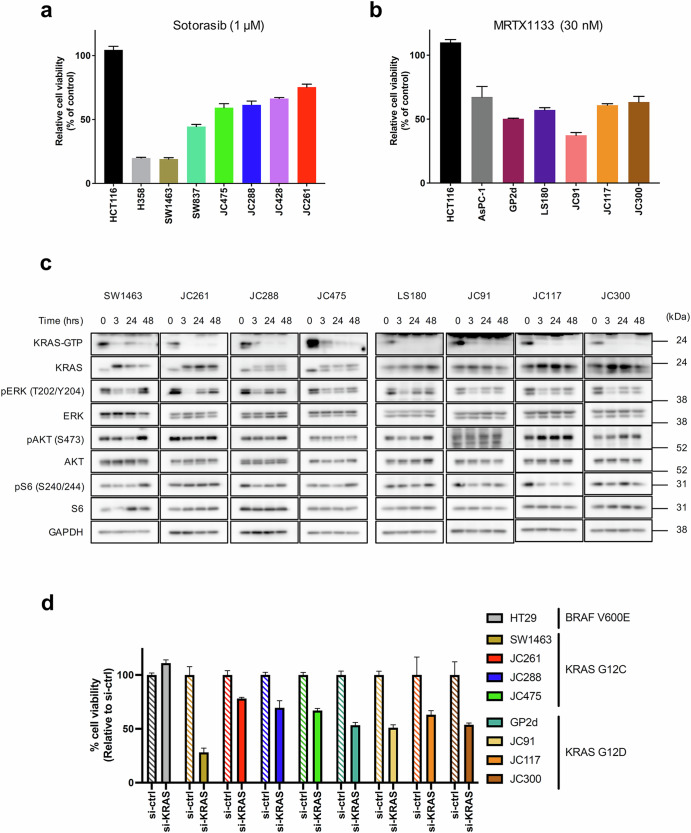
- KRAS inhibitor treatment completely suppressed KRAS-GTP for 48 h, but p-ERK suppression was temporary and recovered by 48 h; all PDCs sustained p-AKT for 48 h, and all PDCs maintained >50% viability after KRAS knockdown, unlike SW1463.
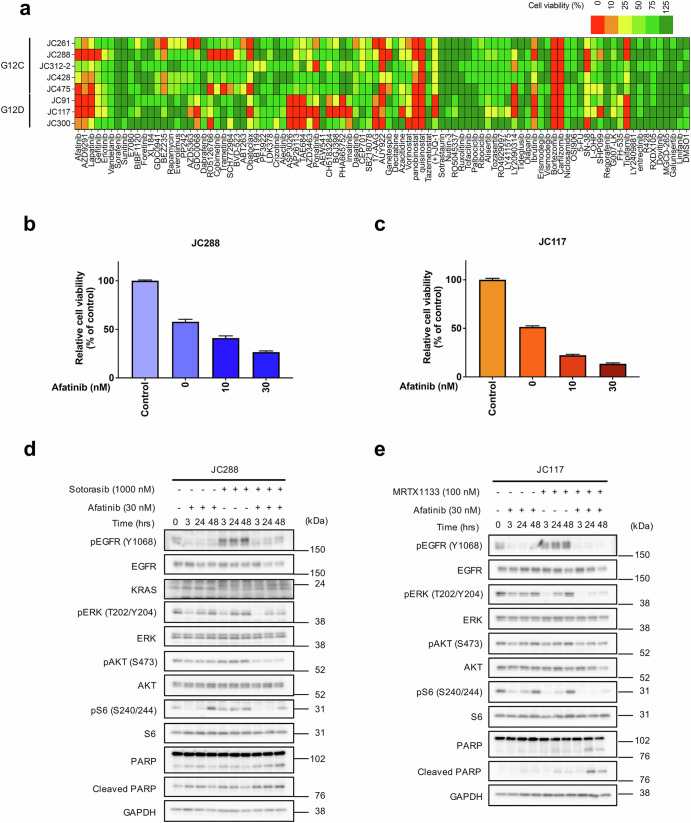
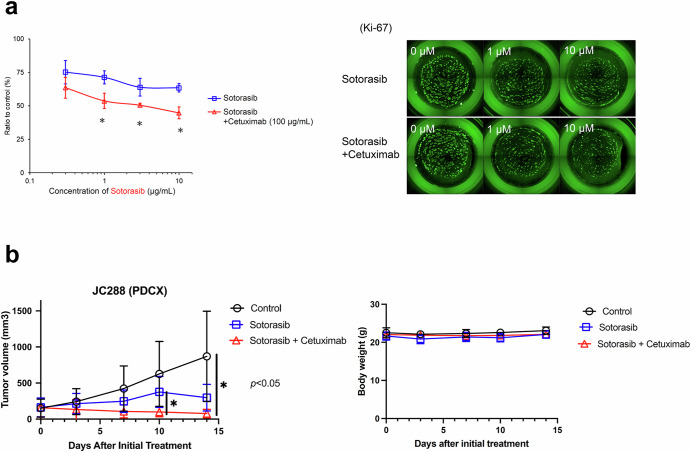
- EGFR-family inhibitors plus KRAS inhibitor suppressed viability in more than half of CRC-PDCs; afatinib plus sotorasib/MRTX1133 produced continuous p-ERK suppression and cleaved PARP, and sotorasib plus cetuximab suppressed tumor growth in JC288 xenografts (N = 4; sotorasib 100 mg/kg, cetuximab 1 mg/body, 5 days/week).
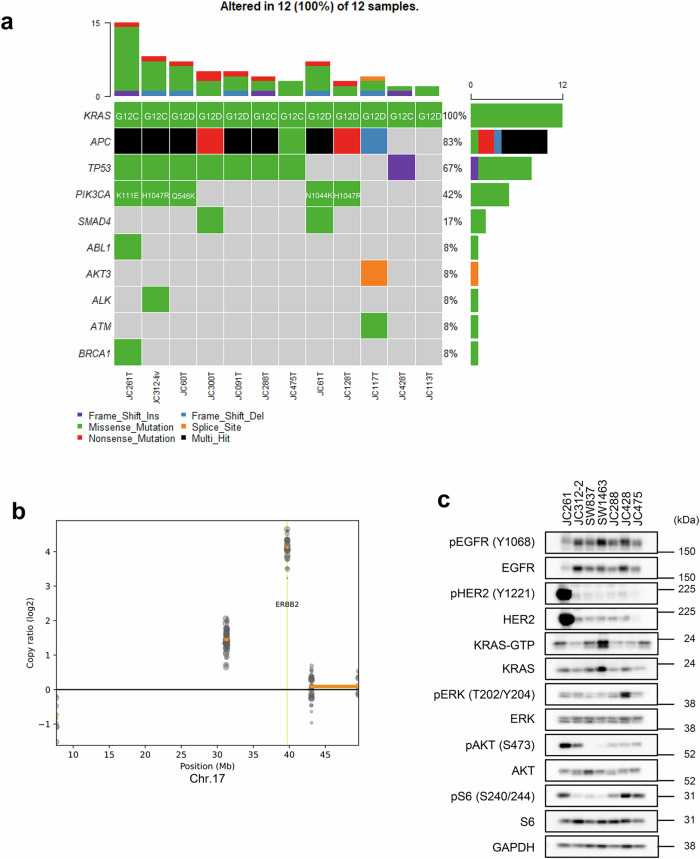
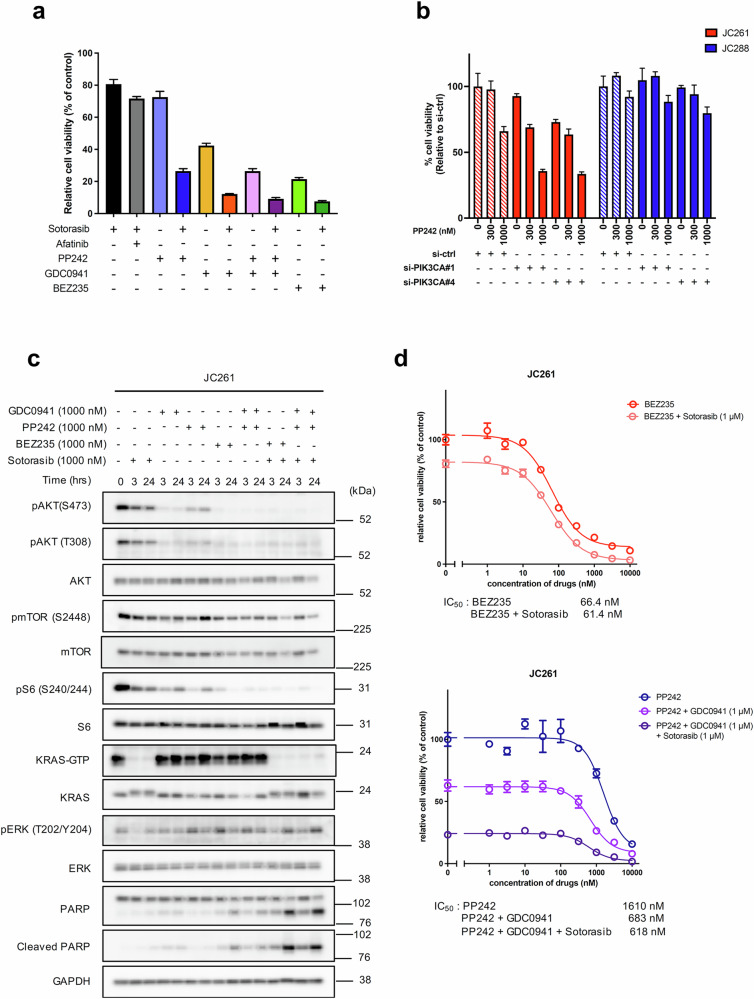
- JC261 (KRAS-G12C, PIK3CA K111E, ERBB2-amplified) was resistant to KRAS–EGFR inhibition; ERBB2 was 16-fold amplified, Her2/p-Her2 and p-AKT were high, and PI3K+mTOR inhibition reduced viability, with triple PI3K/mTOR/KRAS-G12C inhibition inducing robust apoptosis.
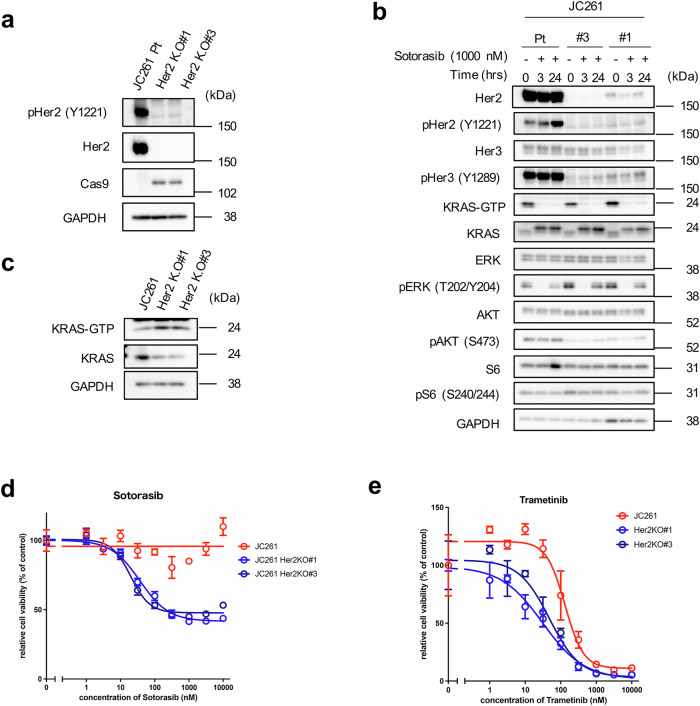
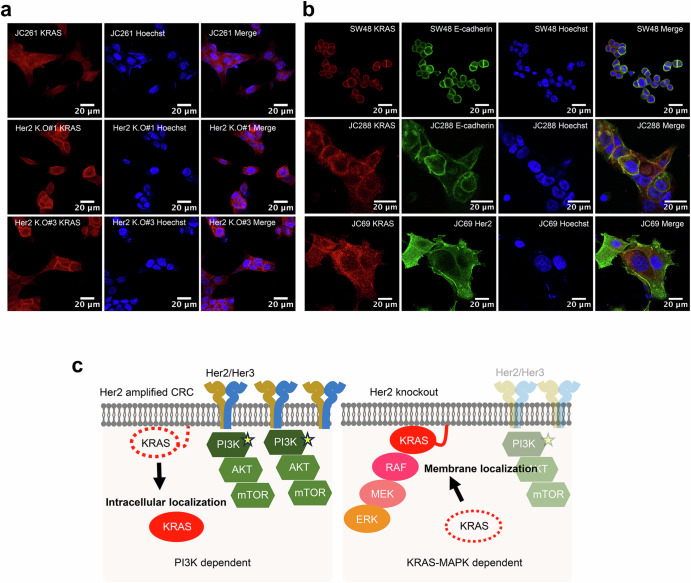
- Her2 knockout in JC261 reduced p-Her3/p-AKT, increased p-ERK and GTP-KRAS, restored KRAS plasma membrane localization, and recovered sensitivity to sotorasib and trametinib; parental JC261 and Her2-amplified KRAS-WT JC69 showed cytoplasmic KRAS.
Methods
- Established KRAS-G12C and -G12D CRC-PDCs from surgically resected specimens; used cell viability assays (CellTiter-Glo), immunoblotting, Ras pull-down, siRNA knockdown, CRISPR-Cas9 Her2 knockout, immunofluorescence, 3D co-culture, and xenograft models.
- Drug screening used a library of 91 targeted drugs with KRAS inhibitors; genomic profiling used target sequencing of 12 surgically resected CRC tumors and normal paired samples with KRAS-G12C or -G12D mutations, plus exome sequencing and CNVkit analysis.
- In vivo: JC288 and JC261 cells were subcutaneously injected into BALB/c-nu/nu mice; once tumors reached ~150 mm³, mice (N = 4) received sotorasib (100 mg/kg) or sotorasib plus cetuximab (1 mg/body) for 5 days/week; tumor volume calculated as 0.5 × length × width² and analyzed by Mann–Whitney U-test.
Limitations
- Stated: Her2-amplified CRC is infrequent (~2 or 3% of CRC), and the authors could not establish Her2-overexpressed KRAS-G12C cells, so the detailed mechanism of aberrant KRAS localization was not identified.
- Stated: the genomic analysis had a small sample size, with 42% KRAS/PIK3CA concomitant mutations versus 26.7% in MSK-IMPACT.
- Evident from the text: the link between Her2 amplification and cytoplasmic KRAS localization remains correlative; the paper notes that farnesyltransferase-related gene mRNA was unchanged and that KRAS localization was not altered by afatinib, leaving the responsible Her2-interacting or scaffold proteins unresolved.
Model-written summary. Check it against the paper before relying on it.
Integrity signals
Registry
Cites
Statistics
Figures
Verification
Claims the paper makes
15 Valid · 3 Not valid · 1 Not checked · 89 Own results and interpretations
Every source the paper cites for this claim was checked and supports it.
In the paper
“As over 50% of patients with CRC did not show marked responses to the combination therapy”
§ Mechanisms of KRAS inhibitor resistance in KRAS-mutant colorectal cancer harboring Her2 amplification and aberrant KRAS localization > Introduction
What the sources say
- Supportedcites [18] Yaeger, R. et al. Adagrasib with or without Cetuximab in Colorectal Cancer with Mutated KRAS G12C. N. Engl. J. Med. 388, 44–54 (2023). 36546659 PMC9908297 source
The Results > Clinical Activity section reports a 46% response rate among 28 clinically evaluable patients receiving adagrasib plus cetuximab, meaning 54% did not have a recorded response. This finding concerns pretreated patients with metastatic KRAS G12C–mutated colorectal cancer, not all patients with colorectal cancer. (LLM, conf=0.90)
plain- Asserted: passes — The authors put it forward as true.
- Checkable: passes — It can be checked against evidence.
- Load-bearing: passes — The paper’s conclusions depend on it.
- Based: passes — The paper gives a reason why it holds.
- Supported
The cited sources support only part of this claim — read each source’s verdict below.
In the paper
“Because cytoplasmic KRAS localization suppresses KRAS–MAPK pathway activity at low levels, activating the MAPK pathway by mutant KRAS and the PI3K pathway by PIK3CA mutation with Her2 amplification may be harmful due to too much oncogene signaling45,46.”
§ Mechanisms of KRAS inhibitor resistance in KRAS-mutant colorectal cancer harboring Her2 amplification and aberrant KRAS localization > Discussion
What the sources say
- Not checked — no full text of the sourcecites [45] Weinstein, I. B. & Joe, A. Oncogene addiction. Cancer Res. 68, 3077–3080 (2008). 18451130 source
- Partly supportedcites [46] Amin, A. D., Rajan, S. S., Groysman, M. J., Pongtornpipat, P. & Schatz, J. H. Oncogene Overdose: Too Much of a Bad Thing for Oncogene-Addicted Cancer Cells. Biomark. Cancer 7, 25–32 (2015). 26688666 PMC4681422 sourceExperimental — accuracy not yet measured
The “MAPK cascade and the Goldilocks principle” section (page unavailable) says excessive RAS–RAF–MEK–ERK signaling can cause senescence, supporting the idea that too much oncogene signaling may be harmful. It does not address the specific combination of mutant KRAS, PIK3CA mutation, and HER2 amplification or establish that activating both pathways in that setting is harmful. (LLM, conf=0.86)
hedgedstates a possible cause- Asserted: passes — The authors put it forward as true.
- Checkable: passes — It can be checked against evidence.
- Load-bearing: passes — The paper’s conclusions depend on it.
- Based: passes — The paper gives a reason why it holds.
The cited sources support only part of this claim — read each source’s verdict below.
In the paper
“a clinical trial revealed that adagrasib and cetuximab combination therapy resulted in a markedly improved response rate (from 19% to 46%) in patients with CRC harboring KRAS-G12C”
§ Mechanisms of KRAS inhibitor resistance in KRAS-mutant colorectal cancer harboring Her2 amplification and aberrant KRAS localization > Introduction
What the sources say
- Partly supportedcites [18] Yaeger, R. et al. Adagrasib with or without Cetuximab in Colorectal Cancer with Mutated KRAS G12C. N. Engl. J. Med. 388, 44–54 (2023). 36546659 PMC9908297 sourceExperimental — accuracy not yet measured
The Abstract Results report a 19% response rate with adagrasib alone and 46% with adagrasib plus cetuximab in patients with KRAS G12C–mutated colorectal cancer. But the Abstract Methods describe a nonrandomized trial with separate cohorts, and the Discussion calls the combination’s greater activity a potential improvement. The rates are accurate; saying the combination resulted in an improved rate overstates what the trial establishes. (LLM, conf=0.84)
plainstates a cause- Asserted: passes — The authors put it forward as true.
- Checkable: passes — It can be checked against evidence.
- Load-bearing: unclear — It is unclear whether the paper’s conclusions depend on it.
- Based: passes — The paper gives a reason why it holds.
- Partly supported
The cited sources support only part of this claim — read each source’s verdict below.
In the paper
“Activating epithelial growth factor receptor (EGFR) conferred intrinsic resistance to KRAS-G12C inhibitor through MAPK pathway reactivation in CRC models”
§ Mechanisms of KRAS inhibitor resistance in KRAS-mutant colorectal cancer harboring Her2 amplification and aberrant KRAS localization > Introduction
What the sources say
- Partly supportedcites [17] Amodio, V. et al. EGFR Blockade Reverts Resistance to KRAS(G12C) Inhibition in Colorectal Cancer. Cancer Discov. 10, 1129–1139 (2020). 32430388 PMC7416460 sourceExperimental — accuracy not yet measured
The Abstract (p. 2) identifies EGFR signaling as the dominant mechanism of resistance to KRAS-G12C inhibitors in CRC models, and the Results (p. 4) show phospho-ERK rebound after inhibition. But the Introduction (p. 4) describes EGFR reactivation as an adaptive response, rather than establishing that EGFR activation confers intrinsic resistance. (LLM, conf=0.85)
plainstates a cause- Asserted: passes — The authors put it forward as true.
- Checkable: passes — It can be checked against evidence.
- Load-bearing: passes — The paper’s conclusions depend on it.
- Based: passes — The paper gives a reason why it holds.
- Partly supported
Every source the paper cites for this claim was checked and supports it.
In the paper
“combining anti-EGFR antibody cetuximab with KRAS inhibitor (e.g., sotolasib) showed synergistic effect in a preclinical study17”
§ Mechanisms of KRAS inhibitor resistance in KRAS-mutant colorectal cancer harboring Her2 amplification and aberrant KRAS localization > Introduction
What the sources say
- Supportedcites [17] Amodio, V. et al. EGFR Blockade Reverts Resistance to KRAS(G12C) Inhibition in Colorectal Cancer. Cancer Discov. 10, 1129–1139 (2020). 32430388 PMC7416460 source
The cell-line results (p. 6) explicitly report that cetuximab synergized with AMG510, a KRAS G12C inhibitor, in the colorectal cancer models tested. The study also tested the combination in patient-derived preclinical models (p. 7). (LLM, conf=0.94)
plainstates a cause- Asserted: passes — The authors put it forward as true.
- Checkable: passes — It can be checked against evidence.
- Load-bearing: unclear — It is unclear whether the paper’s conclusions depend on it.
- Based: passes — The paper gives a reason why it holds.
- Supported
62 more claims · 2 with their cited sources checked
Create a free account to see all 108 claims and every source verdict.
- Probably not a substantial claim. 18
- It may state two separate claims as one. 29
- The quote only partly states this claim. 3
Self-check
Percentages, sums and reported differences re-computed from the paper’s own numbers.
Each contradiction between two passages listed here was confirmed by an independent check.
Rated minor: it would not touch a result — a value no result rests on, a p-value that stays on the same side of the significance level, or a conflict that is clerical, resolved elsewhere in the paper, or outside its own findings.
In the paper
§ Mechanisms of KRAS inhibitor resistance in KRAS-mutant colorectal cancer harboring Her2 amplification and aberrant KRAS localization > Results > Triple inhibition of PI3K, mTOR, and KRAS-G12C robustly induced apoptosis in Her2amp, PI3K, and KRAS-mutated-positive PDCs
“20 nM of each siRNA was introduced to cells for 48 h. The cell viability was analyzed using the CellTiter-Glo assay”
§ Mechanisms of KRAS inhibitor resistance in KRAS-mutant colorectal cancer harboring Her2 amplification and aberrant KRAS localization > Methods > siRNA knockdown
“For the cell viability assay, cells were seeded in triplicate into 96-well collagen-coated plates at 3000 cells/well and incubated with siRNA mixture for 72 h.”
Citations
Cites
Trimmomatic: a flexible trimmer for Illumina sequence data
Bolger, A. M., Lohse, M., & Usadel, B. (2014) · Bioinformatics · doi:10.1093/bioinformatics/btu170 · Cited by 65,548
The Sequence Alignment/Map format and SAMtools
Li, H., Handsaker, B., Wysoker, A., Fennell, T., Ruan, J., Homer, N., Marth, G., Abecasis, G., Durbin, R., & 1000 Genome Project Data Processing Subgroup (2009) · Bioinformatics · doi:10.1093/bioinformatics/btp352 · Cited by 62,041
The Genome Analysis Toolkit: A MapReduce framework for analyzing next-generation DNA sequencing data
McKenna, A., Hanna, M., Banks, E., Sivachenko, A., Cibulskis, K., Kernytsky, A., Garimella, K., Altshuler, D., Gabriel, S., Daly, M., et al. (2010) · Genome Research · doi:10.1101/gr.107524.110 · Cited by 27,895
Maftools: efficient and comprehensive analysis of somatic variants in cancer
Mayakonda, A., Lin, D.-C., Assenov, Y., Plass, C., & Koeffler, H. P. (2018) · Genome Research · doi:10.1101/gr.239244.118 · Cited by 4,935
Zehir, A., Benayed, R., Shah, R. H., Syed, A., Middha, S., Kim, H. R., Srinivasan, P., Gao, J., Chakravarty, D., Devlin, S. M., et al. (2017) · Nature Medicine · doi:10.1038/nm.4333 · Cited by 3,380
K-Ras(G12C) inhibitors allosterically control GTP affinity and effector interactions
Ostrem, J. M., Peters, U., Sos, M. L., Wells, J. A., & Shokat, K. M. (2013) · Nature · doi:10.1038/nature12796 · Cited by 2,557
The Clinical KRAS(G12C) Inhibitor AMG 510 Drives Anti-Tumour Immunity
Canon, J., Rex, K., Saiki, A. Y., Mohr, C., Cooke, K., Bagal, D., Gaida, K., Holt, T., Knutson, C. G., Koppada, N., et al. (2019) · Nature · doi:10.1038/s41586-019-1694-1 · Cited by 2,277
Unresponsiveness of colon cancer to BRAF(V600E) inhibition through feedback activation of EGFR
Prahallad, A., Sun, C., Huang, S., Di Nicolantonio, F., Salazar, R., Zecchin, D., Beijersbergen, R. L., Bardelli, A., & Bernards, R. (2012) · Nature · doi:10.1038/nature10868 · Cited by 2,051
RAS Proteins and Their Regulators in Human Disease
Simanshu, D. K., Nissley, D. V., & McCormick, F. (2017) · Cell · doi:10.1016/j.cell.2017.06.009 · Cited by 1,943
GEFs and GAPs: Critical Elements in the Control of Small G Proteins
Bos, J. L., Rehmann, H., & Wittinghofer, A. (2007) · Cell · doi:10.1016/j.cell.2007.05.018 · Cited by 1,903
RAS oncogenes: weaving a tumorigenic web
Pylayeva-Gupta, Y., Grabocka, E., & Bar-Sagi, D. (2011) · Nature Reviews Cancer · doi:10.1038/nrc3106 · Cited by 1,789
KRAS G12C Inhibition with Sotorasib in Advanced Solid Tumors
Hong, D. S., Fakih, M. G., Strickler, J. H., Desai, J., Durm, G. A., Shapiro, G. I., Falchook, G. S., Price, T. J., Sacher, A., Denlinger, C. S., et al. (2020) · New England Journal of Medicine · doi:10.1056/nejmoa1917239 · Cited by 1,733
VarScan: variant detection in massively parallel sequencing of individual and pooled samples
Koboldt, D. C., Chen, K., Wylie, T., Larson, D. E., McLellan, M. D., Mardis, E. R., Weinstock, G. M., Wilson, R. K., & Ding, L. (2009) · Bioinformatics · doi:10.1093/bioinformatics/btp373 · Cited by 1,348
Hallin, J., Engstrom, L. D., Hargis, L., Calinisan, A., Aranda, R., Briere, D. M., Sudhakar, N., Bowcut, V., Baer, B. R., Ballard, J. A., et al. (2020) · Cancer Discovery · doi:10.1158/2159-8290.cd-19-1167 · Cited by 1,304
Acquired Resistance to KRAS G12C Inhibition in Cancer
Awad, M. M., Liu, S., Rybkin, I. I., Arbour, K. C., Dilly, J., Zhu, V. W., Johnson, M. L., Heist, R. S., Patil, T., Riely, G. J., et al. (2021) · New England Journal of Medicine · doi:10.1056/nejmoa2105281 · Cited by 1,247
Maira, S.-M., Stauffer, F., Brueggen, J., Furet, P., Schnell, C., Fritsch, C., Brachmann, S., Chène, P., De Pover, A., Schoemaker, K., et al. (2008) · Molecular Cancer Therapeutics · doi:10.1158/1535-7163.mct-08-0017 · Cited by 1,134
RAS-targeted therapies: is the undruggable drugged?
Moore, A. R., Rosenberg, S. C., McCormick, F., & Malek, S. (2020) · Nature Reviews Drug Discovery · doi:10.1038/s41573-020-0068-6 · Cited by 1,103
Corcoran, R. B., Ebi, H., Turke, A. B., Coffee, E. M., Nishino, M., Cogdill, A. P., Brown, R. D., Della Pelle, P., Dias-Santagata, D., Hung, K. E., et al. (2012) · Cancer Discovery · doi:10.1158/2159-8290.cd-11-0341 · Cited by 1,022
Weinstein, I. B., & Joe, A. (2008) · Cancer Research · doi:10.1158/0008-5472.can-07-3293 · Cited by 805
Serra, V., Markman, B., Scaltriti, M., Eichhorn, P. J. A., Valero, V., Guzman, M., Botero, M. L., Llonch, E., Atzori, F., Di Cosimo, S., et al. (2008) · Cancer Research · doi:10.1158/0008-5472.can-08-1385 · Cited by 787
A Pan-Cancer Proteogenomic Atlas of PI3K/AKT/mTOR Pathway Alterations
Zhang, Y., Kwok-Shing Ng, P., Kucherlapati, M., Chen, F., Liu, Y., Tsang, Y. H., de Velasco, G., Jeong, K. J., Akbani, R., Hadjipanayis, A., et al. (2017) · Cancer Cell · doi:10.1016/j.ccell.2017.04.013 · Cited by 626
Anti-tumor efficacy of a potent and selective non-covalent KRASG12D inhibitor
Hallin, J., Bowcut, V., Calinisan, A., Briere, D. M., Hargis, L., Engstrom, L. D., Laguer, J., Medwid, J., Vanderpool, D., Lifset, E., et al. (2022) · Nature Medicine · doi:10.1038/s41591-022-02007-7 · Cited by 553
Rapid non-uniform adaptation to conformation-specific KRAS(G12C) inhibition
Xue, J. Y., Zhao, Y., Aronowitz, J., Mai, T. T., Vides, A., Qeriqi, B., Kim, D., Li, C., de Stanchina, E., Mazutis, L., et al. (2020) · Nature · doi:10.1038/s41586-019-1884-x · Cited by 543
Pan-KRAS Inhibitor Disables Oncogenic Signalling and Tumour Growth
Kim, D., Herdeis, L., Rudolph, D., Zhao, Y., Böttcher, J., Vides, A., Ayala-Santos, C. I., Pourfarjam, Y., Cuevas-Navarro, A., Xue, J. Y., et al. (2023) · Nature · doi:10.1038/s41586-023-06123-3 · Cited by 534
Adagrasib with or without Cetuximab in Colorectal Cancer with Mutated KRAS G12C
Yaeger, R., Weiss, J., Pelster, M. S., Spira, A. I., Barve, M., Ou, S.-H. I., Leal, T. A., Bekaii-Saab, T. S., Paweletz, C. P., Heavey, G. A., et al. (2023) · New England Journal of Medicine · doi:10.1056/nejmoa2212419 · Cited by 527
EGFR Blockade Reverts Resistance to KRASG12C Inhibition in Colorectal Cancer.
Amodio, V., Yaeger, R., Arcella, P., Cancelliere, C., Lamba, S., Lorenzato, A., Arena, S., Montone, M., Mussolin, B., Bian, Y., et al. (2020) · Cancer Discovery · doi:10.1158/2159-8290.cd-20-0187 · Cited by 504
Vertical Pathway Inhibition Overcomes Adaptive Feedback Resistance to KRASG12C Inhibition
Ryan, M. B., Fece de la Cruz, F., Phat, S., Myers, D. T., Wong, E., Shahzade, H. A., Hong, C. B., & Corcoran, R. B. (2020) · Clinical Cancer Research · doi:10.1158/1078-0432.ccr-19-3523 · Cited by 496
Diverse alterations associated with resistance to KRAS(G12C) inhibition
Zhao, Y., Murciano-Goroff, Y. R., Xue, J. Y., Ang, A., Lucas, J., Mai, T. T., Da Cruz Paula, A. F., Saiki, A. Y., Mohn, D., Achanta, P., et al. (2021) · Nature · doi:10.1038/s41586-021-04065-2 · Cited by 479
Hofmann, M. H., Gmachl, M., Ramharter, J., Savarese, F., Gerlach, D., Marszalek, J. R., Sanderson, M. P., Kessler, D., Trapani, F., Arnhof, H., et al. (2021) · Cancer Discovery · doi:10.1158/2159-8290.cd-20-0142 · Cited by 444
A model for RAS mutation patterns in cancers: finding the sweet spot
Li, S., Balmain, A., & Counter, C. M. (2018) · Nature Reviews Cancer · doi:10.1038/s41568-018-0076-6 · Cited by 384
Farnesol modification of Kirsten-ras exon 4B protein is essential for transformation.
Jackson, J. H., Cochrane, C. G., Bourne, J. R., Solski, P. A., Buss, J. E., & Der, C. J. (1990) · Proceedings of the National Academy of Sciences · doi:10.1073/pnas.87.8.3042 · Cited by 338
Indexing Graphs for Path Queries with Applications in Genome Research
Siren, J., Valimaki, N., & Makinen, V. (2014) · IEEE/ACM Transactions on Computational Biology and Bioinformatics · doi:10.1109/tcbb.2013.2297101 · Cited by 324
Ou, S.-H. I., Jänne, P. A., Leal, T. A., Rybkin, I. I., Sabari, J. K., Barve, M. A., Bazhenova, L., Johnson, M. L., Velastegui, K. L., Cilliers, C., et al. (2022) · Journal of Clinical Oncology · doi:10.1200/jco.21.02752 · Cited by 322
Cancer-Associated PIK3CA Mutations in Overgrowth Disorders
Madsen, R. R., Vanhaesebroeck, B., & Semple, R. K. (2018) · Trends in Molecular Medicine · doi:10.1016/j.molmed.2018.08.003 · Cited by 276
KRAS G12C NSCLC Models Are Sensitive to Direct Targeting of KRAS in Combination with PI3K Inhibition
Misale, S., Fatherree, J. P., Cortez, E., Li, C., Bilton, S., Timonina, D., Myers, D. T., Lee, D., Gomez-Caraballo, M., Greenberg, M., et al. (2019) · Clinical Cancer Research · doi:10.1158/1078-0432.ccr-18-0368 · Cited by 259
Adachi, Y., Ito, K., Hayashi, Y., Kimura, R., Tan, T. Z., Yamaguchi, R., & Ebi, H. (2020) · Clinical Cancer Research · doi:10.1158/1078-0432.ccr-20-2077 · Cited by 249
Migliardi, G., Sassi, F., Torti, D., Galimi, F., Zanella, E. R., Buscarino, M., Ribero, D., Muratore, A., Massucco, P., Pisacane, A., et al. (2012) · Clinical Cancer Research · doi:10.1158/1078-0432.ccr-11-2683 · Cited by 191
Kinase-mediated RAS signaling via membraneless cytoplasmic protein granules
Tulpule, A., Guan, J., Neel, D. S., Allegakoen, H. R., Lin, Y. P., Brown, D., Chou, Y.-T., Heslin, A., Chatterjee, N., Perati, S., et al. (2021) · Cell · doi:10.1016/j.cell.2021.03.031 · Cited by 189
Combinations with Allosteric SHP2 Inhibitor TNO155 to Block Receptor Tyrosine Kinase Signaling
Liu, C., Lu, H., Wang, H., Loo, A., Zhang, X., Yang, G., Kowal, C., Delach, S., Wang, Y., Goldoni, S., et al. (2021) · Clinical Cancer Research · doi:10.1158/1078-0432.ccr-20-2718 · Cited by 167
Molecular Characterization of Acquired Resistance to KRASG12C–EGFR Inhibition in Colorectal Cancer
Yaeger, R., Mezzadra, R., Sinopoli, J., Bian, Y., Marasco, M., Kaplun, E., Gao, Y., Zhao, H., Paula, A. D. C., Zhu, Y., et al. (2023) · Cancer Discovery · doi:10.1158/2159-8290.cd-22-0405 · Cited by 144
Cathomas, G. (2014) · Frontiers in Oncology · doi:10.3389/fonc.2014.00035 · Cited by 133
Dual Inhibition of MEK and PI3K Pathway in KRAS and BRAF Mutated Colorectal Cancers
Temraz, S., Mukherji, D., & Shamseddine, A. (2015) · International Journal of Molecular Sciences · doi:10.3390/ijms160922976 · Cited by 117
Brown, W. S., McDonald, P. C., Nemirovsky, O., Awrey, S., Chafe, S. C., Schaeffer, D. F., Li, J., Renouf, D. J., Stanger, B. Z., & Dedhar, S. (2020) · Cell Reports Medicine · doi:10.1016/j.xcrm.2020.100131 · Cited by 111
Improving prospects for targeting RAS
Singh, H., Longo, D. L., & Chabner, B. A. (2015) · Journal of Clinical Oncology · doi:10.1200/jco.2015.62.1052 · Cited by 107
Suzuki, S., Yonesaka, K., Teramura, T., Takehara, T., Kato, R., Sakai, H., Haratani, K., Tanizaki, J., Kawakami, H., Hayashi, H., et al. (2021) · Clinical Cancer Research · doi:10.1158/1078-0432.ccr-21-0856 · Cited by 105
Adachi, Y., Kimura, R., Hirade, K., Yanase, S., Nishioka, Y., Kasuga, N., Yamaguchi, R., & Ebi, H. (2023) · Nature Cancer · doi:10.1038/s43018-023-00575-2 · Cited by 93
Genome Analysis of Latin American Cervical Cancer: Frequent Activation of the PIK3CA Pathway
Lou, H., Villagran, G., Boland, J. F., Im, K. M., Polo, S., Zhou, W., Odey, U., Juárez-Torres, E., Medina-Martínez, I., Roman-Basaure, E., et al. (2015) · Clinical Cancer Research · doi:10.1158/1078-0432.ccr-14-1837 · Cited by 88
K-Ras prenylation as a potential anticancer target
Baranyi, M., Buday, L., & Hegedűs, B. (2020) · Cancer and Metastasis Reviews · doi:10.1007/s10555-020-09902-w · Cited by 62
Tumor Intrinsic Efficacy by SHP2 and RTK Inhibitors in KRAS-Mutant Cancers
Hao, H.-X., Wang, H., Liu, C., Kovats, S., Velazquez, R., Lu, H., Pant, B., Shirley, M., Meyer, M. J., Pu, M., et al. (2019) · Molecular Cancer Therapeutics · doi:10.1158/1535-7163.mct-19-0170 · Cited by 53
BEZ235: When Promising Science Meets Clinical Reality
Pongas, G., & Fojo, T. (2016) · The Oncologist · doi:10.1634/theoncologist.2016-0243 · Cited by 43
Oncogene Overdose: Too Much of a Bad Thing for Oncogene-Addicted Cancer Cells
Amin, A. D., Rajan, S. S., Groysman, M. J., Pongtornpipat, P., & schatz, J. H. (2015) · Biomarkers in Cancer · doi:10.4137/bic.s29326 · Cited by 25
Suezawa, T., Sasaki, N., Yukawa, Y., Assan, N., Uetake, Y., Onuma, K., Kamada, R., Tomioka, D., Sakurai, H., Katayama, R., et al. (2023) · Advanced Science · doi:10.1002/advs.202302637 · Cited by 22
Self-citationTakahashi, Y., Morimura, R., Tsukamoto, K., Gomi, S., YAMADA, A., Mizukami, M., Naito, Y., Irie, S., Nagayama, S., Shinozaki, E., et al. (2024) · Acta Biomaterialia · doi:10.1016/j.actbio.2024.05.037 · Cited by 15
Self-citationSuezawa, T., Sasaki, N., Assan, N., et al. (2023) · bioRxiv (Cold Spring Harbor Laboratory) · doi:10.1101/2023.03.21.533590 · Cited by 1
Cited by
Response and Resistance to RAS Inhibition in Cancer
Ebright, R. Y., Dilly, J., Shaw, A. T., & Aguirre, A. J. (2025) · Cancer Discovery · doi:10.1158/2159-8290.cd-25-0349 · Cited by 83
Applications and advances of multi-omics technologies in gastrointestinal tumors
Liu, Y., Gao, F., Cheng, Y., Qi, L., & Yu, H. (2025) · Frontiers in Medicine · doi:10.3389/fmed.2025.1630788 · Cited by 21
Pancreatic ductal adenocarcinoma: integrating molecular insights for targeted interventions
Nagaraju, G. P., Nellipudi, H. R., Ganji, C., Kuppala, V., Ganji, S. P., Kumari, S., Farran, B., Srilatha, M., Guenter, R. E., & El‐Rayes, B. F. (2026) · Signal Transduction and Targeted Therapy · doi:10.1038/s41392-026-02705-5 · Cited by 9
Transforming Gastric Biopsy Diagnostics: Integrating Omics Technologies and Artificial Intelligence
Alwahaibi, N. (2026) · Biomedicines · doi:10.3390/biomedicines14020407 · Cited by 6
Ayali, S., Panja, A., Mitra, P., Gupta, Y. D., Tobi, D., Bazylevich, A., Brenner, B., Cohen, Z., Ayale, A. R., Nesher, E., et al. (2026) · Journal of Controlled Release · doi:10.1016/j.jconrel.2026.114993 · Cited by 6
Metadata
- Authors
- Maruyama, K., Shimizu, Y., Nomura, Y., Oh-hara, T., Takahashi, Y., Nagayama, S., Fujita, N., & Katayama, R.
- Affiliations
- Japanese Foundation For Cancer Research (JP)
- Toppan (Japan) (JP)
- Kyoto University (JP)
- Corresponding author
- Katayama, Ryohei
- Venue
- npj Precision Oncology
- Published
- 2025-01-06
- Volume
- 9
- Issue
- 1
- Pages
- 4-4
- ISSN
- 2397-768X (ISSN-L)
- PMC
- PMC11704227
- OpenAlex
- W4406083140
- Semantic Scholar
- 31051c2a9b6c6e90f8e623104ed94f3c7d230ecf
- Cited by
- 16
- References
- 60
- Citations by year
- 2026: 9 · 2025: 7
- FWCI
- 6.59
- Type
- journal article
- Language
- en
- Open access
- gold
- doi.org
- Licence
- cc-by-nc-nd
- creativecommons.org/licenses/by-nc-nd/4.0 (tdm)
- creativecommons.org/licenses/by-nc-nd/4.0 (vor)
- Locations
- npj Precision Oncology (publishedVersion, cc-by-nc-nd)
- PubMed Central (publishedVersion, cc-by-nc-nd)
- PubMed (publishedVersion)
- DOAJ (DOAJ: Directory of Open Access Journals) (submittedVersion, cc-by-sa)
- Funders
- Japan Agency for Medical Research and Development (JP24ama221210h0003, JP23ama221201h0002, JP24ck0106795h0002)
- Kobayashi Foundation for Cancer Research (2022SK042)
- Naito Foundation
- MEXT | Japan Society for the Promotion of Science (JP22K18383, JP24K02333, JP23KJ0562)
- Mitsubishi Foundation (N/A)
- Nippon Foundation (NA)
- Takeda Science Foundation (NA)
- Topics
- Health Sciences › Medicine › Oncology › Colorectal Cancer Treatments and Studies
- Life Sciences › Biochemistry, Genetics and Molecular Biology › Molecular Biology › Protein Kinase Regulation and GTPase Signaling
- Life Sciences › Biochemistry, Genetics and Molecular Biology › Molecular Biology › PI3K/AKT/mTOR signaling in cancer
- Keywords
- KRAS inhibitor resistance, KRAS-mutant colorectal cancer, HER2 amplification, PI3K/Akt signaling, PIK3CA mutation, EGFR signaling
About these checks
Registry, retraction, Cites and statistics results are computed, not judged, with one exception: a printed reference that no index lists is read once by a model before it counts as a citation error. Claims are extracted by a model and kept only when their quote appears verbatim in the text; each cited source is then checked, with a model’s help, for whether it says what the claim relies on. Those verdicts can be wrong — read the claim’s quote and the cited source before relying on one.
The claim verdicts this report counts are experimental: their accuracy is not yet measured.
A language model drew the claims from the paper on 2026-10-10, under version 3 of the claim definition (model deepseek-v4.1-flash, prompt extract-v3).
A second model labelled each claim on 2026-10-10 (model jev-1.13-20260917, definition revision gold-guideline-v0.2).
Cited sources are checked with a language model’s help (gpt-6-sol).
Statistics and arithmetic are recomputed, not judged.
Confidence bands are shown only for fields calibrated on our annotated test set. None is calibrated yet, so no band is shown.
What counts as a claim ›How we measure confidence ›How we check this ›
Are you an author, or do you see a problem with this page? Request a review
Data sources
Bibliographic data: Semantic Scholar, OpenAlex, Crossref.
Contains information from the Semantic Scholar Academic Graph Datasets, made available under the ODC Attribution License (ODC-BY 1.0).
Semantic Scholar’s data is described in: Kinney, R., et al. (2023). The Semantic Scholar Open Data Platform. arXiv:2301.10140.
