

The DOI matches its Crossref record; 27 of the 27 references it cites were found in a registry or an index.
Machine learning and atherosclerotic cardiovascular disease risk prediction in a multi-ethnic population
Open accessAbstract
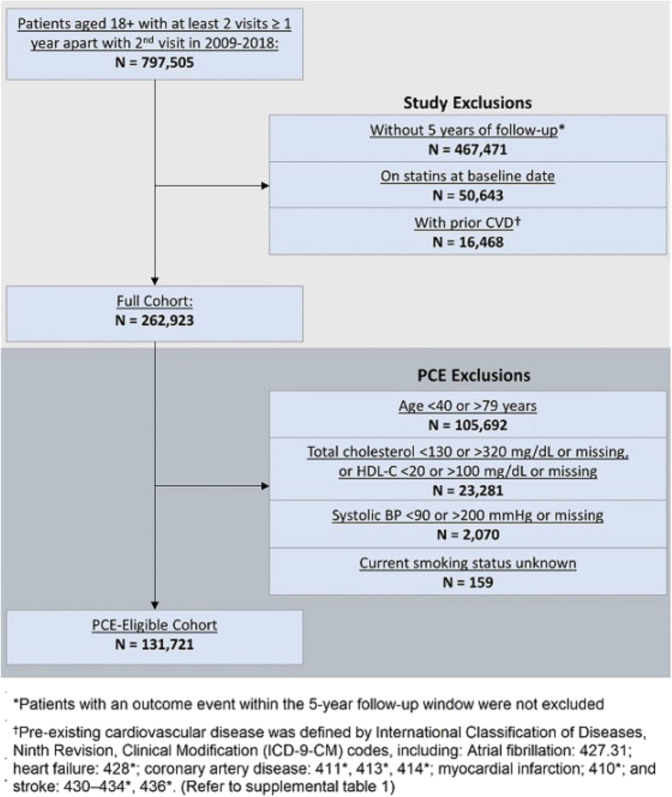
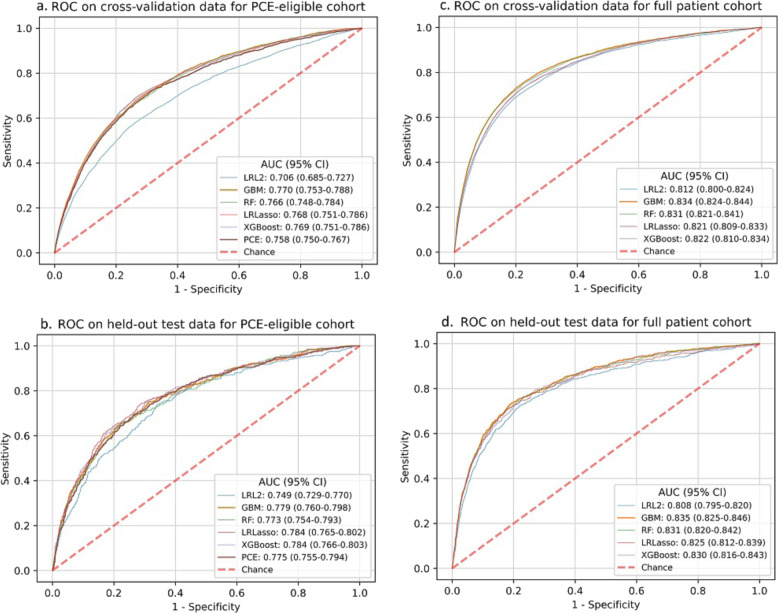
The pooled cohort equations (PCE) predict atherosclerotic cardiovascular disease (ASCVD) risk in patients with characteristics within prespecified ranges and has uncertain performance among Asians or Hispanics. It is unknown if machine learning (ML) models can improve ASCVD risk prediction across broader diverse, real-world populations. We developed ML models for ASCVD risk prediction for multi-ethnic patients using an electronic health record (EHR) database from Northern California. Our cohort included patients aged 18 years or older with no prior CVD and not on statins at baseline (n = 262,923), stratified by PCE-eligible (n = 131,721) or PCE-ineligible patients based on missing or out-of-range variables. We trained ML models [logistic regression with L 2 penalty and L 1 lasso penalty, random forest, gradient boosting machine (GBM), extreme gradient boosting] and determined 5-year ASCVD risk prediction, including with and without incorporation of additional EHR variables, and in Asian and Hispanic subgroups. A total of 4309 patients had ASCVD events, with 2077 in PCE-ineligible patients. GBM performance in the full cohort, including PCE-ineligible patients (area under receiver-operating characteristic curve (AUC) 0.835, 95% confidence interval (CI): 0.825–0.846), was significantly better than that of the PCE in the PCE-eligible cohort (AUC 0.775, 95% CI: 0.755–0.794). Among patients aged 40–79, GBM performed similarly before (AUC 0.784, 95% CI: 0.759–0.808) and after (AUC 0.790, 95% CI: 0.765–0.814) incorporating additional EHR data. Overall, ML models achieved comparable or improved performance compared to the PCE while allowing risk discrimination in a larger group of patients including PCE-ineligible patients. EHR-trained ML models may help bridge important gaps in ASCVD risk prediction.
Overview
The claims and statistics of this paper haven’t been checked yet.
Run the check — free, no account needed. It reads the open-access text and checks the sources it cites.
Integrity signals
Registry
Cites
Statistics
Figures
Verification
Claims the paper makes
The claims and statistics of this paper haven’t been checked yet.
Run the check — free, no account needed. It reads the open-access text and checks the sources it cites.
Claims other papers make about this one
Each is checked against this paper’s own text: does it say what the citing paper says it does?
In the citing paper
“Researchers have developed ML models that integrate clinical, genetic, and lifestyle factors to predict an individual’s risk of developing cardiovascular disease [4–7].”
From Integrating machine learning and artificial intelligence in life-course epidemiology: pathways to innovative public health solutions (2024) · cites this paper as [7]
In the citing paper
“Ward et al. (2020) used EHRs of 262,923 individuals to train and validate ML models, demonstrating performance that was comparable to or better than traditional equations for atherosclerotic cardiovascular disease risk [7].”
From Integrating machine learning and artificial intelligence in life-course epidemiology: pathways to innovative public health solutions (2024) · cites this paper as [7]
Self-check
Percentages, sums and reported differences re-computed from the paper’s own numbers.
The self-check needs the paper’s full text.
Citations
Cites
Scikit-learn: Machine Learning in Python
Pedregosa, F., Varoquaux, G., Gramfort, A., Michel, V., Thirion, B., Grisel, O., Blondel, M., Müller, A., Nothman, J., Louppe, G., et al. (2012) · arXiv · doi:10.48550/arxiv.1201.0490 · Cited by 71,016
The meaning and use of the area under a receiver operating characteristic (ROC) curve.
Hanley, J. A., & McNeil, B. J. (1982) · Radiology · doi:10.1148/radiology.143.1.7063747 · Cited by 21,856
mice: Multivariate Imputation by Chained Equations in R
Buuren, S. V., & Groothuis-Oudshoorn, K. (2011) · Journal of Statistical Software · doi:10.18637/jss.v045.i03 · Cited by 13,870
2013 ACCF/AHA Guideline for the Management of Heart Failure
Yancy, C. W., Jessup, M., Bozkurt, B., Butler, J., Casey, D. E., Drazner, M. H., Fonarow, G. C., Geraci, S. A., Horwich, T., Januzzi, J. L., et al. (2013) · Journal of the American College of Cardiology · doi:10.1016/j.jacc.2013.05.019 · Cited by 12,536
Machine learning: Trends, perspectives, and prospects
Jordan, M. I., & Mitchell, T. M. (2015) · Science · doi:10.1126/science.aaa8415 · Cited by 9,955
Grundy, S. M., Stone, N. J., Bailey, A. L., Beam, C., Birtcher, K. K., Blumenthal, R. S., Braun, L. T., de Ferranti, S., Faiella-Tommasino, J., Forman, D. E., et al. (2019) · Circulation · doi:10.1161/cir.0000000000000625 · Cited by 6,185
Self-citation2013 ACC/AHA Guideline on the Assessment of Cardiovascular Risk
Goff, D. C., Lloyd-Jones, D. M., Bennett, G., Coady, S., D’Agostino, R. B., Gibbons, R., Greenland, P., Lackland, D. T., Levy, D., O’Donnell, C. J., et al. (2014) · Journal of the American College of Cardiology · doi:10.1016/j.jacc.2013.11.005 · Cited by 4,945
Deo, R. C. (2015) · Circulation · doi:10.1161/circulationaha.115.001593 · Cited by 3,466
Hannun, A. Y., Rajpurkar, P., Haghpanahi, M., Tison, G. H., Bourn, C., Turakhia, M. P., & Ng, A. Y. (2019) · Nature Medicine · doi:10.1038/s41591-018-0268-3 · Cited by 3,148
Grundy, S. M., Stone, N. J., Bailey, A. L., Beam, C., Birtcher, K. K., Blumenthal, R. S., Braun, L. T., de Ferranti, S., Faiella-Tommasino, J., Forman, D. E., et al. (2019) · Journal of the American College of Cardiology · doi:10.1016/j.jacc.2018.11.002 · Cited by 1,751
Self-citationCan machine-learning improve cardiovascular risk prediction using routine clinical data?
Weng, S. F., Reps, J., Kai, J., Garibaldi, J. M., & Qureshi, N. (2017) · PLOS ONE · doi:10.1371/journal.pone.0174944 · Cited by 1,346
Validation of the Atherosclerotic Cardiovascular Disease Pooled Cohort Risk Equations
Muntner, P., Colantonio, L. D., Cushman, M., Goff, D. C., Howard, G., Howard, V. J., Kissela, B., Levitan, E. B., Lloyd-Jones, D. M., & Safford, M. M. (2014) · JAMA · doi:10.1001/jama.2014.2630 · Cited by 603
Lloyd-Jones, D. M., Braun, L. T., Ndumele, C. E., Smith, S. C., Sperling, L. S., Virani, S. S., & Blumenthal, R. S. (2019) · Circulation · doi:10.1161/cir.0000000000000638 · Cited by 554
McNeish, D. (2015) · Multivariate Behavioral Research · doi:10.1080/00273171.2015.1036965 · Cited by 443
Rana, J. S., Tabada, G. H., Solomon, M. D., Lo, J. C.-M., Jaffe, M. G., Sung, S. H., Ballantyne, C. M., & Go, A. S. (2016) · Journal of the American College of Cardiology · doi:10.1016/j.jacc.2016.02.055 · Cited by 299
Yadlowsky, S., Hayward, R. A., Sussman, J. B., McClelland, R. L., Min, Y., & Basu, S. (2018) · Annals of Internal Medicine · doi:10.7326/m17-3011 · Cited by 271
Machine Learning Outperforms ACC/AHA CVD Risk Calculator in MESA
Kakadiaris, I. A., Vrigkas, M., Yen, A. A., Kuznetsova, T., Budoff, M., & Naghavi, M. (2018) · Journal of the American Heart Association · doi:10.1161/jaha.118.009476 · Cited by 227
Welsh, C., Celis-Morales, C. A., Brown, R., Mackay, D. F., Lewsey, J., Mark, P. B., Gray, S. R., Ferguson, L. D., Anderson, J. J., Lyall, D. M., et al. (2019) · Circulation · doi:10.1161/circulationaha.119.041149 · Cited by 191
Cardiovascular disease: The rise of the genetic risk score
Knowles, J. W., & Ashley, E. A. (2018) · PLOS Medicine · doi:10.1371/journal.pmed.1002546 · Cited by 182
Ross, E., Shah, N. H., Dalman, R. L., Nead, K. T., Cooke, J. P., & Leeper, N. J. (2016) · Journal of Vascular Surgery · doi:10.1016/j.jvs.2016.04.026 · Cited by 156
Finding missed cases of familial hypercholesterolemia in health systems using machine learning
Banda, J. M., Sarraju, A., Abbasi, F., Parizo, J., Pariani, M., Ison, H., Briskin, E., Wand, H., Dubois, S., Jung, K., et al. (2019) · npj Digital Medicine · doi:10.1038/s41746-019-0101-5 · Cited by 123
Self-citationMachine learning methodologies versus cardiovascular risk scores, in predicting disease risk
Dimopoulos, A. C., Νικολαϊδου, Μ., Caballero, F. F., Engchuan, W., Niubo, A. S., Arndt, H., Ayuso‐Mateos, J. L., Haro, J. M., Chatterji, S., Georgousopoulou, E. N., et al. (2018) · BMC Medical Research Methodology · doi:10.1186/s12874-018-0644-1 · Cited by 118
Rodríguez, F., Chung, S., Blum, M. R., Coulet, A., Basu, S., & Palaniappan, L. P. (2019) · Journal of the American Heart Association · doi:10.1161/jaha.118.011874 · Cited by 107
Self-citationColantonio, L. D., Richman, J., Carson, A. P., Lloyd‐Jones, D. M., Howard, G., Deng, L., Howard, V. J., Safford, M. M., Muntner, P., & Goff, D. C. (2017) · Journal of the American Heart Association · doi:10.1161/jaha.117.005676 · Cited by 93
Mora, S., WENGER, N. K., Cook, N. R., Liu, J., Howard, B. V., Limacher, M. C., Liu, S., Margolis, K. L., Martin, L. W., Paynter, N. P., et al. (2018) · JAMA Internal Medicine · doi:10.1001/jamainternmed.2018.2875 · Cited by 86
Reisberg, S., Iljasenko, T., Läll, K., Fischer, K., & Vilo, J. (2017) · PLoS ONE · doi:10.1371/journal.pone.0179238 · Cited by 70
Using Name Lists to Infer Asian Racial/Ethnic Subgroups in the Healthcare Setting
Wong, E. C., Palaniappan, L. P., & Lauderdale, D. S. (2010) · Medical Care · doi:10.1097/mlr.0b013e3181d559e9 · Cited by 58
Self-citation
Cited by
Sorted by citations
Mersha, M. A., Lâm, K. N., Wood, J., AlShami, A. K., & Kalita, J. K. (2024) · Neurocomputing · doi:10.1016/j.neucom.2024.128111 · Cited by 346
Forrest, I. S., Petrazzini, B. O., Duffy, Á., Park, J. K., Márquez‐Luna, C., Jordan, D. M., Rocheleau, G., Cho, J. H., Rosenson, R. S., Narula, J., et al. (2022) · The Lancet · doi:10.1016/s0140-6736(22)02079-7 · Cited by 182
Advanced machine learning techniques for cardiovascular disease early detection and diagnosis
Baghdadi, N. A., Abdelaliem, S. M. F., Malki, A., Gad, I., Ewis, A. A., & Atlam, E.-S. (2023) · Journal Of Big Data · doi:10.1186/s40537-023-00817-1 · Cited by 178
Liu, T., Krentz, A., Lu, L., & Curcin, V. (2025) · European Heart Journal - Digital Health · doi:10.1093/ehjdh/ztae080 · Cited by 177
Flores, A. M., Demsas, F., Leeper, N. J., & Ross, E. (2021) · Circulation Research · doi:10.1161/circresaha.121.318224 · Cited by 139
Metadata
- Authors
- Ward, A., Sarraju, A., Chung, S., Li, J., Harrington, R., Heidenreich, P., Palaniappan, L., Scheinker, D., & Rodriguez, F.
- Affiliations
- Stanford University (US)
- Stanford Medicine (US)
- Palo Alto Medical Foundation (US)
- ORCID
- Venue
- npj Digital Medicine
- Published
- 2020-09-23
- Volume
- 3
- Issue
- 1
- Pages
- 125-125
- ISSN
- 2398-6352 (ISSN-L)
- PMC
- PMC7511400
- OpenAlex
- W3088053597
- Cited by
- 112
- References
- 27
- Citations by year
- 2026: 18 · 2025: 17 · 2024: 22 · 2023: 28 · 2022: 16 · 2021: 9 · 2020: 1
- FWCI
- 5.30
- Type
- journal article
- Language
- en
- Open access
- gold
- doi.org
- Locations
- npj Digital Medicine (publishedVersion, cc-by)
- PubMed Central (publishedVersion, cc-by)
- PubMed (publishedVersion)
- DOAJ (DOAJ: Directory of Open Access Journals) (submittedVersion, cc-by-sa)
- Funders
- U.S. Department of Health & Human Services | NIH | National Heart, Lung, and Blood Institute (1K01HL144607)
- Topics
- Physical Sciences › Computer Science › Artificial Intelligence › Machine Learning in Healthcare
- Health Sciences › Health Professions › Health Information Management › Artificial Intelligence in Healthcare
- Health Sciences › Medicine › Public Health, Environmental and Occupational Health › Health Promotion and Cardiovascular Prevention
- Keywords
- atherosclerotic cardiovascular disease, cardiovascular risk prediction, Pooled Cohort Equations, machine learning, gradient boosting, extreme gradient boosting, random forest, electronic health records, multi-ethnic population, Asian patients, Hispanic patients, risk discrimination, statin-naive patients
About these checks
Registry, retraction, Cites and statistics results are computed, not judged, with one exception: a printed reference that no index lists is read once by a model before it counts as a citation error. Claims are extracted by a model and kept only when their quote appears verbatim in the text; each cited source is then checked, with a model’s help, for whether it says what the claim relies on. Those verdicts can be wrong — read the claim’s quote and the cited source before relying on one.
Statistics and arithmetic are recomputed, not judged.
Confidence bands are shown only for fields calibrated on our annotated test set. None is calibrated yet, so no band is shown.
What counts as a claim ›How we measure confidence ›How we check this ›
Are you an author, or do you see a problem with this page? Request a review
