

Preventive digital mental health interventions for children and young people: a review of the design and reporting of research
Open accessThe DOI matches its Crossref record; 67 of the 67 references it cites were found in a registry or an index.
Abstract
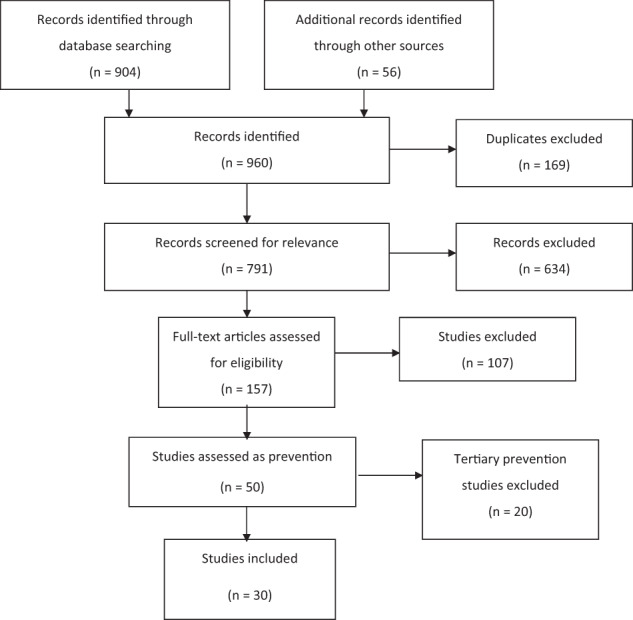
Digital health interventions (DHIs) have frequently been highlighted as one way to respond to increasing levels of mental health problems in children and young people. Whilst many are developed to address existing mental health problems, there is also potential for DHIs to address prevention and early intervention. However, there are currently limitations in the design and reporting of the development, evaluation and implementation of preventive DHIs that can limit their adoption into real-world practice. This scoping review aimed to examine existing evidence-based DHI interventions and review how well the research literature described factors that researchers need to include in their study designs and reports to support real-world implementation. A search was conducted for relevant publications published from 2013 onwards. Twenty-one different interventions were identified from 30 publications, which took a universal ( n = 12), selective ( n = 3) and indicative ( n = 15) approach to preventing poor mental health. Most interventions targeted adolescents, with only two studies including children aged ≤10 years. There was limited reporting of user co-design involvement in intervention development. Barriers and facilitators to implementation varied across the delivery settings, and only a minority reported financial costs involved in delivering the intervention. This review found that while there are continued attempts to design and evaluate DHIs for children and young people, there are several points of concern. More research is needed with younger children and those from poorer and underserved backgrounds. Co-design processes with children and young people should be recognised and reported as a necessary component within DHI research as they are an important factor in the design and development of interventions, and underpin successful adoption and implementation. Reporting the type and level of human support provided as part of the intervention is also important in enabling the sustained use and implementation of DHIs.
Overview
The claims and statistics of this paper haven’t been checked yet.
Free: it reads the open-access text and checks the first 5 claims that cite a source we can check. Create a free account to check every claim.
Integrity signals
Registry
Cites
Statistics
Figures
Verification
Claims the paper makes
The claims and statistics of this paper haven’t been checked yet.
Free: it reads the open-access text and checks the first 5 claims that cite a source we can check. Create a free account to check every claim.
Claims other papers make about this one
Each is checked against this paper’s own text: does it say what the citing paper says it does?
The source backs part of the claim, not all of it — or backs it for a different population, condition or comparison.
In the citing paper
“A systematic review of preventive digital interventions for mental health in youth identified only 3 such programs, with no preventive program including children younger than age 7 (Bergin et al., 2020).”
From Perceived acceptability and appropriateness of a web-based program targeting risk for anxiety in young children and their parents (2025) · cites this paper as Bergin et al., 2020
Experimental — accuracy not yet measuredThe source backs part of the claim, not all of it — or backs it for a different population, condition or comparison.
In the citing paper
“Earlier studies suggest that adolescents are open to using mHealth [48].”
From A Smartphone Serious Game for Adolescents (Grow It! App): Development, Feasibility, and Acceptance Study (2022) · cites this paper as [48]
Experimental — accuracy not yet measured
Self-check
Percentages, sums and reported differences re-computed from the paper’s own numbers.
The self-check needs the paper’s full text.
Citations
Cites
Preferred Reporting Items for Systematic Reviews and Meta-Analyses: the PRISMA statement
Moher, D., Liberati, A., Tetzlaff, J., Altman, D. G., & for the PRISMA Group (2009) · BMJ · doi:10.1136/bmj.b2535 · Cited by 83,823
Preferred reporting items for systematic reviews and meta-analyses: the PRISMA Statement.
(2009) · PubMed Central · Cited by 44,859
Scoping studies: towards a methodological framework
Arksey, H., & O'Malley, L. (2005) · International Journal of Social Research Methodology · doi:10.1080/1364557032000119616 · Cited by 36,742
Munn, Z., Peters, M. D. J., Stern, C., Tufanaru, C., McArthur, A., & Aromataris, E. (2018) · BMC Medical Research Methodology · doi:10.1186/s12874-018-0611-x · Cited by 11,385
(2020) · JBI Manual for Evidence Synthesis · doi:10.46658/jbimes-20-12 · Cited by 2,545
(2007) · PubMed Central · Cited by 2,521
Objective user engagement with mental health apps: systematic search and panel-based usage analysis
Baumel, A., Muench, F., Edan, S., & Kane, J. M. (2019) · Journal of Medical Internet Research · doi:10.2196/14567 · Cited by 965
An Operational Classification of Disease Prevention
Gordon, R. (1987) · PsycEXTRA Dataset · doi:10.1037/e659532007-006 · Cited by 860
Hollis, C., Falconer, C. J., Martin, J. L., Whittington, C., Stockton, S., Glazebrook, C., & Davies, E. B. (2017) · Journal of Child Psychology and Psychiatry · doi:10.1111/jcpp.12663 · Cited by 846
Self-citationFleming, T., Bavin, L., Lucassen, M., Stasiak, K., Hopkins, S., & Merry, S. (2018) · Journal of Medical Internet Research · doi:10.2196/jmir.9275 · Cited by 670
Self-citation
Research works printed but not linked: 1
- National Institute for Health and Care Excellence. Depression in children and young people: identification and management (NICE Guideline 134). Available at: https://www.nice.org.uk/guidance/ng134 (2019). 31577402
Cited by
Items 101–157 of 157
Puolakanaho, A., Kaipainen, K., Keinonen, K., Lappalainen, P., Lappalainen, R. I., & Kiuru, N. H. (2023) · Child & Family Behavior Therapy · doi:10.1080/07317107.2023.2270544 · Cited by 3
“The key to understanding how to cater to adolescents’ different preferences in terms of intervention delivery approaches is co-design; that is, involving adolescents in intervention development (Bergin et al., 2020; Fleming et al., 2019).”
BackgroundDealing with Diversity in Digital Psychological Interventions for Young People: A Structured Review
Jahedi, F., Henman, P. W. F., & Ryan, J. C. (2024) · ACI Open · doi:10.1055/s-0044-1788563 · Cited by 2
“Even though codesign is capable to produce engaging digital solutions for young people, 35 it is uncommon for DPIs.”
Samele, C., Urquía, N., Edwards, R., Donnell, K., & Krause, N. (2025) · JMIR Formative Research · doi:10.2196/55603 · Cited by 3
“Among young people, mobile mental health apps also offer an important opportunity to prevent mental health problems or intervene early to reduce the risk of a long-term mental health condition into adulthood [10].”
Ozturk, C. S., & Demir, K. (2025) · Current Psychiatry Reports · doi:10.1007/s11920-025-01613-9 · Cited by 2
Alam, A. (2025) · IGI Global eBooks · doi:10.4018/979-8-3373-5007-3.ch001 · Cited by 1
Horwitz, A. G., Anand, S., Chen, M., McCarthy, K., Schueller, S. M., Walton, M., Sen, S., & King, C. A. (2026) · Internet Interventions · doi:10.1016/j.invent.2026.100912 · Cited by 2
“A review by Bergin et al. (2020) demonstrated the promise of preventive DMHIs for both primary (i.e., supporting mental health before problems begin) and secondary (i.e., detecting and responding to early signs of distress) prevention, while also noting a need for co-design processes that allow for…”
Worlding otherwise: Virtual production as a participatory method for imagining safer digital futures
Martindale, S., Kennedy, H., Piskopani, A.-M., Ramchurn, R., & Bergin, A. G. (2026) · Convergence The International Journal of Research into New Media Technologies · doi:10.1177/13548565261427993 · Cited by 1
“Drawing on expertise in mental health co-production (Bergin et al., 2020; Hall et al., 2024), we approach lived experience not as raw data to be extracted but as knowledge and expertise to be valued and prioritised within the research.”
Self-citationMirzadegan, I. A., Lewis, E. M., Cole, S. L., & Meyer, A. (2026) · JMIR Pediatrics and Parenting · doi:10.2196/79898 · Cited by 1
“We used a qualitative-dominant, convergent mixed methods design [10,46] to elucidate family engagement in a preventive DHP targeting error sensitivity.”
Salgado, J., Gomes, M., Csabai, M., Daele, T. V., Doyle, F., Eimontas, J., Elster, R. N., Gosar, D., Haddouk, L., Karekla, M., et al. (2026) · European Psychologist · doi:10.1027/1016-9040/a000588 · Cited by 1
Nantwi, S., & O’Connor, S. (2026) · The Journal of School Nursing · doi:10.1177/10598405261473648 · Cited by 1
How Do We Engage Children and Young People in the Design and Development Of Mental Health Games
Saiger, M. J. (2023) · ACM International Conference on Interaction Design and Children (IDC) · doi:10.1145/3585088.3593921 · Cited by 4
“For example, there is a lack of guidance on when and how to engage stakeholders in the design process [2, 13].”
BackgroundWang, Y., Yang, F., & Wang, Y. (2023) · American Journal of Health Behavior · doi:10.5993/ajhb.47.4.9 · Cited by 1
Digital Technology Interventions for Preventing and Treating Youth Depression
Lira, D., & Martínez, V. (2022) · Depression and personality · doi:10.1007/978-3-031-13029-8_4 · Cited by 2
Gunasekaran, S., Shahwan, S., Ong, W. J., Lim, B. W. Z., Koh, H. N. J., Tan, Y. B., Koh, Y. S., Teo, M. S., Lim, C. S. E., & Subramaniam, M. (2026) · Health Promotion International · doi:10.1093/heapro/daaf236 · Cited by 2
“However, these issues were overcome when adequate support was provided to those delivering the intervention (Bergin et al .”
From Where we are Now to What Next: Concluding Thoughts and Future Directions
Jayman, M. (2024) · Emerald Group Publishing Limited eBooks · doi:10.1108/978-1-83797-242-520241010 · Cited by 1
Commentary: A perfectly imperfect approach to reducing risk for pediatric anxiety
Hamilton, A. L., & Kidwell, K. M. (2024) · Journal of Pediatric Psychology · doi:10.1093/jpepsy/jsae074 · Cited by 3
Understanding Mental Health Apps for Youth: A Focus Group Study with Latinx Youth (Preprint)Preprint
Agapie, E., Chang, K., Patrachari, S., Neary, M., & Schueller, S. M. (2022) · doi:10.2196/preprints.40726
Dietvorst, E., Hillegers, M. H. J., Legerstee, J. S., Vreeker, A., & Keijsers, L. (2023) · doi:10.2196/preprints.47511
Rayner, C. L. (2024) · Cronfa (Swansea University) · doi:10.23889/suthesis.66311 · Cited by 1
NOSKOVA, M., SVISTELNYK, I., KOVTUN, I., ZHYGLO, O., & Веньгрін, М. (2024) · AD ALTA Journal of Interdisciplinary Research · doi:10.33543/j.140141.157162 · Cited by 1
“Although several studies have acknowledged that user participation may influence efficacy, other evaluations have backed this as a potential path for future research [4].”
Use of Technology in Brief Interventions
Gega, L., & Saiger, M. J. (2024) · CBT: science into practice · doi:10.1007/978-3-031-60746-2_16
Universal Digital Mental Health Interventions for Children and YouthPreprint
Pierdomenico, K. D., Bucsea, O., Leguia, A., Hashemi, H., Lovegrove, A., Cribbie, R. A., & Riddell, R. P. (2025) · Research Square · doi:10.21203/rs.3.rs-6473660/v1
Chakraborty, S. N., Talagatoti, D. R. P., & Ray, A. (2025) · doi:10.38124/ijisrt/25jun233
Mirzadegan, I. A., Lewis, E. M., Cole, S. L., & Meyer, A. M. (2025) · doi:10.2196/preprints.79898
Fagerström, M., Löf, M., Müssener, U., Neher, M., Nutley, S. B., & Thomas, K. (2025) · School Mental Health · doi:10.1007/s12310-025-09795-6 · Cited by 1
“The rapid development of digital tools during recent years has opened for new opportunities for mental health promotion among this age group in the school context (Bergin et al., 2020; Wright et al., 2023).”
Engelskirchen, L., Asbrand, J., & Tuschen‐Caffier, B. (2025) · Cognitive Therapy and Research · doi:10.1007/s10608-025-10643-9 · Cited by 1
Kuberka, P., Chilton, M., Pike, K. C., Shafran, R., & Yardley, L. (2025) · doi:10.2196/preprints.84384
Wilson, E. L. (2025) · Online Journal of Public Health Informatics · doi:10.2196/72737 · Cited by 1
“Despite the potential of participatory approaches in technology-enabled interventions, few DHIs have fully integrated such methods [23].”
InfluentialGötzl, C., Hiller, S., Rauschenberg, C., Schick, A., Fechtelpeter, J., Fischer Abaigar, U., Koppe, G., Durstewitz, D., Reininghaus, U., & Krumm, S. (2022) · Figshare · doi:10.6084/m9.figshare.21582095
Povey, J., Raphiphatthana, B., Torok, M. H., Nagel, T. M., Shand, F., Sweet, M., Lowell, A., Mills, P. P. J. R., & Dingwall, K. M. (2021) · Figshare · doi:10.6084/m9.figshare.14545221
de Alcântara Mendes, J. A., Lucassen, M. F. G., Adams, A., Martin, L., Aicardi, C., Woodcock, R., Nielsen, E., Townsend, E., & Jirotka, M. (2024) · Figshare · doi:10.6084/m9.figshare.26019622
de Alcântara Mendes, J. A., Lucassen, M. F. G., Adams, A., Martin, L., Aicardi, C., Woodcock, R., Nielsen, E., Townsend, E., & Jirotka, M. (2024) · Figshare · doi:10.6084/m9.figshare.26019727
Götzl, C., Hiller, S., Rauschenberg, C., Schick, A., Fechtelpeter, J., Fischer Abaigar, U., Koppe, G., Durstewitz, D., Reininghaus, U., & Krumm, S. (2022) · Figshare · doi:10.6084/m9.figshare.21582092
Götzl, C., Hiller, S., Rauschenberg, C., Schick, A., Fechtelpeter, J., Fischer Abaigar, U., Koppe, G., Durstewitz, D., Reininghaus, U., & Krumm, S. (2022) · Figshare · doi:10.6084/m9.figshare.21582101
de Alcântara Mendes, J. A., Lucassen, M. F. G., Adams, A., Martin, L., Aicardi, C., Woodcock, R., Nielsen, E., Townsend, E., & Jirotka, M. (2024) · Figshare · doi:10.6084/m9.figshare.26732527
Götzl, C., Hiller, S., Rauschenberg, C., Schick, A., Fechtelpeter, J., Fischer Abaigar, U., Koppe, G., Durstewitz, D., Reininghaus, U., & Krumm, S. (2022) · Figshare · doi:10.6084/m9.figshare.21582089
Götzl, C., Hiller, S., Rauschenberg, C., Schick, A., Fechtelpeter, J., Fischer Abaigar, U., Koppe, G., Durstewitz, D., Reininghaus, U., & Krumm, S. (2022) · Figshare · doi:10.6084/m9.figshare.21582098
Götzl, C., Hiller, S., Rauschenberg, C., Schick, A., Fechtelpeter, J., Fischer Abaigar, U., Koppe, G., Durstewitz, D., Reininghaus, U., & Krumm, S. (2022) · Figshare · doi:10.6084/m9.figshare.21582104
Povey, J., Raphiphatthana, B., Torok, M. H., Nagel, T. M., Shand, F., Sweet, M., Lowell, A., Mills, P. P. J. R., & Dingwall, K. M. (2021) · Figshare · doi:10.6084/m9.figshare.14545218
Smith, H. G., Matheson, E. L., Gentili, C., & Diedrichs, P. C. (2025) · Body Image · doi:10.1016/j.bodyim.2025.102015
Dhariwal, R., Song, M. S. H., Vukmanovic, N., Perowne, R., & Gutman, L. M. (2026) · Counselling and Psychotherapy Research · doi:10.1002/capr.70080
Evidence of Internet- and Mobile-Based Interventions for Mental Disorders
Löchner, J., Schoenenberg, K., & Zarski, A. (2026) · Springer eBooks · doi:10.1007/978-3-032-08980-9_3
Yourell, J., Hedges, E. P., Misch, R., Huberty, J., Schueller, S. M., Waasdorp, T. E., & Salhi, L. (2026) · doi:10.2196/preprints.91312 · Cited by 1
Steinberg, J. S., Lorenzo‐Luaces, L., Wasil, A. R., Howard, J., Murphy, S. T., Strunk, D. R., & DeRubeis, R. J. (2026) · Behaviour Research and Therapy · doi:10.1016/j.brat.2026.105074 · Cited by 2
Julius, N., Zhong, Y., Rajabzadeh, V., Racine, S., Hayhoe, B. W. J., Barber, S., & Otis, M. (2026) · doi:10.2196/preprints.90489
Digital Humanities in Child and Adolescent Mental Health Services: A Review
Hong, S., Walton, B. A., & Kim, H. (2026) · Children · doi:10.3390/children13070967
“Studies described the use of stakeholder advisory boards, community partnerships, and iterative feedback throughout intervention development [1,47].”
Kuberka, P., Chilton, M., Pike, K. C., Shafran, R., & Yardley, L. (2026) · JMIR Pediatrics and Parenting · doi:10.2196/84384
“Some tools are intended for individuals with neurodevelopmental disorders [67] or chronic diseases [68], whereas others are aimed at the general population or at individuals experiencing elevated symptoms, as a form of prevention [69] or early support [70].”
Mkhize, M., van der Westhuizen, C., & Sorsdahl, K. R. (2026) · SSM - Mental Health · doi:10.1016/j.ssmmh.2026.100687
Dabrowski, A., Mackley, G., Fernando, C., Rahim, H. A., & Siena, J. A. (2026) · Frontiers in Education · doi:10.3389/feduc.2026.1812649
Sobrinho, A. C. D. S., Rodrigues, G. D. S., Gomes, G. A. O., & Júnior, C. R. B. (2026) · Digital Health · doi:10.1177/20552076261467668
“19,20”
A Study on the Emotional Well-Being of Young Adults Living Alone Supported by Robotic Pets
Lin, N., Zhang, H., & Liu, P. (2026) · International Conference on Intelligent Engineering and Next-Gen Healthcare Systems (IEHNS) · doi:10.1109/iehns68708.2026.11606958
“AI robotic pets (Fig.1) represent a novel avenue for emotional support by replicating the social and emotional benefits of human-animal companionship, offering enjoyment, comfort, and support for individuals living alone [12][13].”
Zhou, X., & Geng, L. (2026) · Frontiers in Psychiatry · doi:10.3389/fpsyt.2026.1910713
“Preventive digital interventions for young people have often been limited by variable design quality, incomplete reporting, and uncertain implementation evidence (51).”
Brunekreeft-Budding, A., Staal, I. I. E., Vullings, N., Kroeze, W., Smits, E.-J., & Westerhof, G. J. (2026) · Journal of Child Health Care · doi:10.1177/13674935261480188
Wang, Y.-Y., Liu, J., & Zhu, S. (2026) · Digital Health · doi:10.1177/20552076261490359
Hirsig, A., Walder, N., Häfeli, X. A., & Schmidt, S. J. (2026) · Journal of Medical Internet Research · doi:10.2196/76494
Mendes, J. A. D. A., Lucassen, M. F. G., Adams, A., Mahamud, A., Hitcham, L., Ito‐Jaeger, S., Aicardi, C., Nielsen, E., Roberts, L. F., Townsend, E., et al. (2026) · Research Involvement and Engagement · doi:10.1186/s40900-026-00969-3
“…interventions for mental health literacy, and the ethical promises and challenges of digital mental health, with co-design or end-user involvement examined as one component of broader intervention-or ethics-focused analyses (e.g., Bergin et al., 2020; Ito-Jaeger et al., 2022; Wies et al., 2021).”
Julius, N., Zhong, Y., Rajabzadeh, V., Racine, S., Hayhoe, B. W. J., Barber, S., & Otis, M. (2026) · JMIR Mental Health · doi:10.2196/90489
Metadata
- Authors
- Bergin, A. D., Vallejos, E. P., Davies, E. B., Daley, D., Ford, T., Harold, G., Hetrick, S., Kidner, M., Long, Y., Merry, S., Morriss, R., Sayal, K., Sonuga-Barke, E., Robinson, J., Torous, J., & Hollis, C.
- Affiliations
- University of Nottingham (GB)
- University of Cambridge (GB)
- Trinity College Dublin (IE)
- University of Auckland (NZ)
- University of Exeter (GB)
- University of Essex (GB)
- King's College London (GB)
- The University of Melbourne (AU)
- Beth Israel Deaconess Medical Center (US)
- Corresponding author
- Bergin, Aislinn D.
- ORCID
- Venue
- npj Digital Medicine
- Published
- 2020-10-15
- Volume
- 3
- Issue
- 1
- Pages
- 133-133
- ISSN
- 2398-6352 (ISSN-L)
- PMC
- PMC7562906
- OpenAlex
- W3094330626
- Cited by
- 157
- References
- 67
- Citations by year
- 2026: 27 · 2025: 23 · 2024: 32 · 2023: 25 · 2022: 33 · 2021: 17
- FWCI
- 2.95
- Type
- journal article
- Language
- en
- Open access
- gold
- doi.org
- Licence
- cc-by
- creativecommons.org/licenses/by/4.0 (tdm)
- creativecommons.org/licenses/by/4.0 (vor)
- Locations
- npj Digital Medicine (publishedVersion, cc-by)
- PubMed Central (publishedVersion, cc-by)
- PubMed (publishedVersion)
- Research Portal (King's College London) (publishedVersion, other-oa)
- Repository@Nottingham (University of Nottingham) (publishedVersion, cc-by)
- Repository@Nottingham (University of Nottingham) (submittedVersion, cc-by)
- Open Access at Essex (University of Essex) (submittedVersion)
- Apollo (University of Cambridge) (submittedVersion, cc-by)
- DOAJ (DOAJ: Directory of Open Access Journals) (submittedVersion, cc-by-sa)
- Minerva Access (University of Melbourne) (submittedVersion, cc-by)
- Scopus (Elsevier) (submittedVersion, other-oa)
- ResearchSpace (University of Auckland) (submittedVersion, cc-by)
- Apollo (cc-by)
- Apollo
- Funders
- National Institute for Health and Care Research (NF-SI-0617-10016, NIHR200263, NF-SI-0514-10119)
- Department of Health and Social Care
- Auckland Medical Research Foundation
- Cure Kids
- NIHR Maudsley Biomedical Research Centre
- Arts and Humanities Research Council (AH/T003804/1, AH/K003364/1)
- Engineering and Physical Sciences Research Council (EP/M02315X/1, EP/R033633/1, EP/N02785X/1, EP/G065802/1)
- Economic and Social Research Council (ES/S004467/2, ES/S004467/1, ES/L014718/1, ES/M00161X/1)
- NIHR Nottingham Biomedical Research Centre
- Topics
- Social Sciences › Psychology › Applied Psychology › Digital Mental Health Interventions
- Health Sciences › Health Professions › General Health Professions › Mobile Health and mHealth Applications
- Social Sciences › Sociology and Political Science › Impact of Technology on Adolescents
- Keywords
- digital mental health interventions, preventive interventions, children and young people, adolescent mental health, universal prevention, selective prevention, co-design, implementation barriers and facilitators, intervention costs, reporting quality, early intervention
About these checks
Registry, retraction, Cites and statistics results are computed, not judged, with one exception: a printed reference that no index lists is read once by a model before it counts as a citation error. Claims are extracted by a model and kept only when their quote appears verbatim in the text; each cited source is then checked, with a model’s help, for whether it says what the claim relies on. Those verdicts can be wrong — read the claim’s quote and the cited source before relying on one.
Statistics and arithmetic are recomputed, not judged.
Confidence bands are shown only for fields calibrated on our annotated test set. None is calibrated yet, so no band is shown.
What counts as a claim ›How we measure confidence ›How we check this ›
Are you an author, or do you see a problem with this page? Request a review
Data sources
Bibliographic data: Semantic Scholar, OpenAlex, Crossref.
Contains information from the Semantic Scholar Academic Graph Datasets, made available under the ODC Attribution License (ODC-BY 1.0).
Semantic Scholar’s data is described in: Kinney, R., et al. (2023). The Semantic Scholar Open Data Platform. arXiv:2301.10140.
