

The DOI matches its Crossref record; 68 of the 68 references it cites were found in a registry or an index.
Digital health interventions in palliative care: a systematic meta-review
Open accessPublished version of a preprint
Abstract
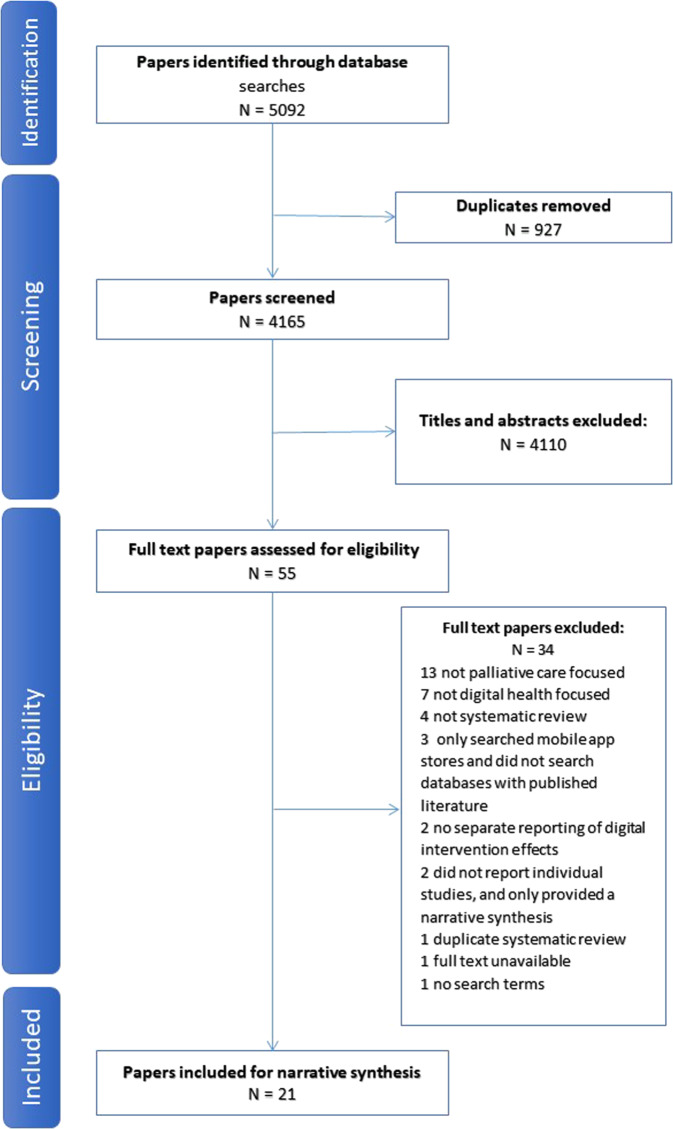
Digital health interventions (DHIs) have the potential to improve the accessibility and effectiveness of palliative care but heterogeneity amongst existing systematic reviews presents a challenge for evidence synthesis. This meta-review applied a structured search of ten databases from 2006 to 2020, revealing 21 relevant systematic reviews, encompassing 332 publications. Interventions delivered via videoconferencing (17%), electronic healthcare records (16%) and phone (13%) were most frequently described in studies within reviews. DHIs were typically used in palliative care for education (20%), symptom management (15%), decision-making (13%), information provision or management (13%) and communication (9%). Across all reviews, mostly positive impacts were reported on education, information sharing, decision-making, communication and costs. Impacts on quality of life and physical and psychological symptoms were inconclusive. Applying AMSTAR 2 criteria, most reviews were judged as low quality as they lacked a protocol or did not consider risk of bias, so findings need to be interpreted with caution.
Overview
The claims and statistics of this paper haven’t been checked yet.
Run the check — free, no account needed. It reads the open-access text and checks the sources it cites.
Integrity signals
Registry
Cites
Statistics
Figures
Verification
Claims the paper makes
The claims and statistics of this paper haven’t been checked yet.
Run the check — free, no account needed. It reads the open-access text and checks the sources it cites.
Claims other papers make about this one
Each is checked against this paper’s own text: does it say what the citing paper says it does?
The source backs part of the claim, not all of it — or backs it for a different population, condition or comparison.
In the citing paper
“Prior to the COVID-19 pandemic, there was already evidence for the utility of digital health interventions for education and training, with online learning and video-conferencing playing a critical role.”
From Feasibility of RESTORE: An online Acceptance and Commitment Therapy intervention to improve palliative care staff wellbeing. (2023) · cites this paper as [28]
Experimental — accuracy not yet measured
Self-check
Percentages, sums and reported differences re-computed from the paper’s own numbers.
The self-check needs the paper’s full text.
Citations
Cites
Preferred Reporting Items for Systematic Reviews and Meta-Analyses: the PRISMA statement
Moher, D., Liberati, A., Tetzlaff, J., Altman, D. G., & for the PRISMA Group (2009) · BMJ · doi:10.1136/bmj.b2535 · Cited by 83,823
Preferred Reporting Items for Systematic Reviews and Meta-Analyses: The PRISMA Statement
Moher, D., Liberati, A., Tetzlaff, J., Altman, D. G., & The PRISMA Group (2009) · PLoS Medicine · doi:10.1371/journal.pmed.1000097 · Cited by 64,042
Preferred reporting items for systematic reviews and meta-analyses: the PRISMA Statement.
(2009) · PubMed Central · Cited by 44,859
Shea, B. J., Reeves, B. C., Wells, G., Thuku, M., Hamel, C., Moran, J., Moher, D., Tugwell, P., Welch, V., Kristjansson, E., et al. (2017) · BMJ · doi:10.1136/bmj.j4008 · Cited by 10,636
Development of AMSTAR: A measurement tool to assess the methodological quality of systematic reviews
Shea, B. J., Grimshaw, J. M., Wells, G. A., Boers, M., Andersson, N., Hamel, C., Porter, A. C., Tugwell, P., Moher, D., & Bouter, L. M. (2007) · BMC Medical Research Methodology · doi:10.1186/1471-2288-7-10 · Cited by 4,374
Utilization of the PICO framework to improve searching PubMed for clinical questions
Schardt, C., Adams, M. B., Owens, T., Keitz, S., & Fontelo, P. (2007) · BMC Medical Informatics and Decision Making · doi:10.1186/1472-6947-7-16 · Cited by 3,053
The Impact of eHealth on the Quality and Safety of Health Care: A Systematic Overview
Black, A. D., Car, J., Pagliari, C., Anandan, C., Cresswell, K., Bokun, T., McKinstry, B., Procter, R., Majeed, A., & Sheikh, A. (2011) · PLoS Medicine · doi:10.1371/journal.pmed.1000387 · Cited by 1,442
Self-citationEffectiveness of telemedicine: A systematic review of reviews
Ekeland, A. G., Bowes, A., & Flottorp, S. (2010) · International Journal of Medical Informatics · doi:10.1016/j.ijmedinf.2010.08.006 · Cited by 1,162
Ross, J., Stevenson, F., Lau, R., & Murray, E. (2016) · Implementation Science · doi:10.1186/s13012-016-0510-7 · Cited by 1,011
Studying complexity in health services research: desperately seeking an overdue paradigm shift
Greenhalgh, T., & Papoutsi, C. (2018) · BMC Medicine · doi:10.1186/s12916-018-1089-4 · Cited by 962
Sleeman, K. E., de Brito, M. F., Etkind, S. N., Nkhoma, K. B., Guo, P., Higginson, I. J., Gomes, B., & Harding, R. (2019) · The Lancet Global Health · doi:10.1016/s2214-109x(19)30172-x · Cited by 875
Artificial intelligence-enabled healthcare delivery
Reddy, S., Fox, J., & Purohit, M. P. (2019) · Journal of the Royal Society of Medicine · doi:10.1177/0141076818815510 · Cited by 635
Jaspers, M. W. M., Smeulers, M., Vermeulen, H., & Peute, L. W. (2011) · Journal of the American Medical Informatics Association · doi:10.1136/amiajnl-2011-000094 · Cited by 525
Iribarren, S. J., Cato, K., Falzon, L., & Stone, P. W. (2017) · PLOS ONE · doi:10.1371/journal.pone.0170581 · Cited by 519
What Is eHealth (4): A Scoping Exercise to Map the Field
Pagliari, C., Sloan, D., Gregor, P., Sullivan, F., Detmer, D., Kahan, J. P., Oortwijn, W., & MacGillivray, S. (2005) · Journal of Medical Internet Research · doi:10.2196/jmir.7.1.e9 · Cited by 479
Self-citationImproving palliative care with deep learning
Avati, A., Jung, K., Harman, S. M., Downing, N. L., Ng, A. Y., & Shah, N. H. (2017) · BMC Medical Informatics and Decision Making · doi:10.1109/bibm.2017.8217669 · Cited by 472
Telemedicine in the Time of Coronavirus
Calton, B. A., Abedini, N. C., & Fratkin, M. D. (2020) · Journal of Pain and Symptom Management · doi:10.1016/j.jpainsymman.2020.03.019 · Cited by 464
A systematic review of telehealth tools and interventions to support family caregivers
Chi, N.-C., & Demiris, G. (2015) · Journal of Telemedicine and Telecare · doi:10.1177/1357633x14562734 · Cited by 409
Elbert, N. J., van Os‐Medendorp, H., van Renselaar, W., Ekeland, A. G., Roijen, L. H., Raat, H., Nijsten, T. E. C., & Pasmans, S. G. M. A. (2014) · Journal of Medical Internet Research · doi:10.2196/jmir.2790 · Cited by 377
Patients’ Experiences of Telehealth in Palliative Home Care: Scoping Review
Steindal, S. A., Nes, A. A. G., Godskesen, T., Dihle, A., Lind, S., Winger, A., & Klarare, A. (2020) · Journal of Medical Internet Research · doi:10.2196/16218 · Cited by 234
Palliative care from diagnosis to death
Murray, S. A., Kendall, M., Mitchell, G. K., Moine, S., Amblàs-Novellas, J., & Boyd, K. J. (2017) · BMJ · doi:10.1136/bmj.j878 · Cited by 220
A systematic review of reasons for gatekeeping in palliative care research
Kars, M. C., van Thiel, G. J., van der Graaf, R., Moors, M., de Graeff, A., & van Delden, J. J. (2016) · Palliative Medicine · doi:10.1177/0269216315616759 · Cited by 205
Pollock, M., Fernandes, R. M., Becker, L. A., Featherstone, R., & Hartling, L. (2016) · Systematic Reviews · doi:10.1186/s13643-016-0367-5 · Cited by 195
Smith, M. B., Macieira, T. G. R., Bumbach, M. D., Garbutt, S. J., Citty, S. W., Stephen, A., Ansell, M., Glover, T. L., & Keenan, G. M. (2018) · American Journal of Hospice and Palliative Medicine® · doi:10.1177/1049909118761386 · Cited by 187
WHO guidance for digital health: What it means for researchers
Jandoo, T. (2020) · Digital Health · doi:10.1177/2055207619898984 · Cited by 184
Implementation science approaches for integrating eHealth research into practice and policy
Glasgow, R. E., Phillips, S. M., & Sanchez, M. A. (2013) · International Journal of Medical Informatics · doi:10.1016/j.ijmedinf.2013.07.002 · Cited by 170
Telehealth in palliative care is being described but not evaluated: a systematic review
Hancock, S., Preston, N. J., Jones, H., & Gadoud, A. (2019) · BMC Palliative Care · doi:10.1186/s12904-019-0495-5 · Cited by 147
Effects of eHealth for patients and informal caregivers confronted with cancer: A meta-review
Slev, V. N., Mistiaen, P., Pasman, H. R. W., Leeuw, I. M. V., van Uden‐Kraan, C. F., & Francke, A. L. (2015) · International Journal of Medical Informatics · doi:10.1016/j.ijmedinf.2015.12.013 · Cited by 140
Telehealth in palliative care in the UK: a review of the evidence
Kidd, L., Cayless, S., Johnston, B., & Wengstrom, Y. (2010) · Journal of Telemedicine and Telecare · doi:10.1258/jtt.2010.091108 · Cited by 132
Electronic consultations (E-consults) and their outcomes: a systematic review
Vimalananda, V. G., Orlander, J. D., Afable, M. K., Fincke, B. G., Solch, A. K., Rinne, S. T., Kim, E. J., Cutrona, S. L., Thomas, D. D., Strymish, J. M., et al. (2019) · Journal of the American Medical Informatics Association · doi:10.1093/jamia/ocz185 · Cited by 132
Video consultations in palliative care: A systematic integrative review
Jess, M., Timm, H., & Dieperink, K. B. (2019) · Palliative Medicine · doi:10.1177/0269216319854938 · Cited by 126 · cited 8×
“Describing evidence with moderate certainty, Jess et al.35 identified positive impacts of videoconferencing on symptom burden, especially in remote settings, though also noted negative impacts in some studies, specifically due to technical challenges, which caused communication problems.”
BackgroundInfluentialGómez‐Batiste, X., Murray, S. A., Thomas, K., Blay, C., Boyd, K. J., Moine, S., Gignon, M., den Eynden, B. V., Leysen, B., Wens, J., et al. (2016) · Journal of Pain and Symptom Management · doi:10.1016/j.jpainsymman.2016.10.361 · Cited by 123
Hoek, P. D., Schers, H. J., Bronkhorst, E. M., Vissers, K. C. P., & Hasselaar, J. G. J. (2017) · BMC Medicine · doi:10.1186/s12916-017-0866-9 · Cited by 122
Utilizing the Electronic Health Record to Improve Advance Care Planning: A Systematic Review
Huber, M. T., Highland, J., Krishnamoorthi, V. R., & Tang, J. W. (2017) · American Journal of Hospice and Palliative Medicine® · doi:10.1177/1049909117715217 · Cited by 112
Gysels, M., Evans, C., & Higginson, I. J. (2012) · BMC Medical Research Methodology · doi:10.1186/1471-2288-12-123 · Cited by 108
Brereton, L., Clark, J., Ingleton, C., Gardiner, C., Preston, L., Ryan, T., & Goyder, E. (2017) · Palliative Medicine · doi:10.1177/0269216317701890 · Cited by 104
Capurro, D., Ganzinger, M., Perez-Lu, J., & Knaup, P. (2014) · Journal of Medical Internet Research · doi:10.2196/jmir.2812 · Cited by 103
Sutherland, A. E., Stickland, J., & Wee, B. L. (2020) · BMJ Supportive & Palliative Care · doi:10.1136/bmjspcare-2020-002326 · Cited by 99
Chambers, E., Gardiner, C., Thompson, J., & Seymour, J. E. (2019) · Palliative Medicine · doi:10.1177/0269216319858247 · Cited by 94
Patients’ experiences of eHealth in palliative care: an integrative review
Widberg, C., Wiklund, B., & Klarare, A. (2020) · BMC Palliative Care · doi:10.1186/s12904-020-00667-1 · Cited by 92
Ostherr, K., Killoran, P. V., Shegog, R., & Bruera, E. D. (2015) · Journal of Palliative Medicine · doi:10.1089/jpm.2015.0341 · Cited by 88
The case for home based telehealth in pediatric palliative care: a systematic review
Bradford, N., Armfield, N. R., Young, J., & Smith, A. C. (2013) · BMC Palliative Care · doi:10.1186/1472-684x-12-4 · Cited by 85
A Systematic Review of Telehealth in Palliative Care: Caregiver Outcomes
Zheng, Y., Head, B. A., & Schapmire, T. J. (2015) · Telemedicine Journal and e-Health · doi:10.1089/tmj.2015.0090 · Cited by 71
Head, B. A., Schapmire, T. J., & Zheng, Y. (2017) · Journal of Hospice and Palliative Nursing · doi:10.1097/njh.0000000000000319 · Cited by 66
Sequeira-Byron, P., Fedorowicz, Z., Jagannath, V. A., & Sharif, M. O. (2011) · Journal of Applied Oral Science · doi:10.1590/s1678-77572011000500002 · Cited by 64
Bush, R. A., Pérez, A., Baum, T., Etland, C., & Connelly, C. D. (2018) · JAMIA Open · doi:10.1093/jamiaopen/ooy028 · Cited by 56
Electronic palliative care coordination systems (EPaCCS): a systematic review
Léniz, J., Weil, A., Higginson, I. J., & Sleeman, K. E. (2019) · BMJ Supportive & Palliative Care · doi:10.1136/bmjspcare-2018-001689 · Cited by 55
A Systematic Review of the Evidence Base for Telehospice
Oliver, D. P., Demiris, G., Wittenberg-Lyles, E. M., Washington, K. T., Day, T., & Novak, H. (2011) · Telemedicine Journal and e-Health · doi:10.1089/tmj.2011.0061 · Cited by 51
Nwosu, A. C., Sturgeon, B., McGlinchey, T., Goodwin, C. D. G., Behera, A., Mason, S. R., Stanley, S., & Payne, T. R. (2019) · Palliative Medicine · doi:10.1177/0269216319857628 · Cited by 51
Allsop, M. J., Taylor, S., Mulvey, M. R., Bennett, M., & Bewick, B. M. (2014) · BMJ Supportive & Palliative Care · doi:10.1136/bmjspcare-2013-000625 · Cited by 45
Daveson, B. A., de Wolf‐Linder, S., Witt, J., Newson, K., Morris, C., Higginson, I. J., & Evans, C. (2015) · Palliative Medicine · doi:10.1177/0269216315584875 · Cited by 45
Putting palliative care on the global health agenda
Powell, R. A., Mwangi-Powell, F. N., Radbruch, L., Yamey, G., Krakauer, E. L., Spence, D., Ali, Z. V., Baxter, S., Lima, L. D., Xhixha, A., et al. (2015) · The Lancet Oncology · doi:10.1016/s1470-2045(15)70002-1 · Cited by 44
e-Health in palliative care: review of literature, Google Play and App Store
Pinto, S. M. O., Caldeira, S., & Martins, J. C. (2017) · International Journal of Palliative Nursing · doi:10.12968/ijpn.2017.23.8.394 · Cited by 44
Telemedicine in palliative care: a review of systematic reviews.
Rogante, M., Giacomozzi, C., Grigioni, M., & Kairy, D. (2016) · Annali dell Istituto Superiore di Sanità · doi:10.4415/ann_16_03_16 · Cited by 43
Holeman, I., Evans, J., Kane, D., Grant, L., Pagliari, C., & Weller, D. (2014) · European Journal of Cancer Care · doi:10.1111/ecc.12250 · Cited by 42
Self-citationAllsop, M. J., Powell, R. A., & Namisango, E. (2016) · BMJ Supportive & Palliative Care · doi:10.1136/bmjspcare-2015-001034 · Cited by 42
Clinician-Targeted Mobile Apps in Palliative Care: A Systematic Review
Meghani, S. H., Greenle, M. M., Morgan, B. E., Kang, Y., Wasim, A., & Sayani, S. (2017) · Journal of Palliative Medicine · doi:10.1089/jpm.2017.0070 · Cited by 35
Digitisation and the patient–professional relationship in palliative care
Payne, S. A., Tanner, M., & Hughes, S. P. F. (2020) · Palliative Medicine · doi:10.1177/0269216320911501 · Cited by 35
Bienfait, F., Petit, M., Pardenaud, R., Guineberteau, C., & Pignon, A. (2019) · American Journal of Hospice and Palliative Medicine® · doi:10.1177/1049909119885655 · Cited by 34
The utilization of telephone follow-up in the advanced cancer population: a review of the literature
Zhou, M., Holden, L., Bedard, G., Zeng, L., Lam, H., Chu, D., Lao, N., Lauzon, N., & Chow, E. (2012) · Journal of Comparative Effectiveness Research · doi:10.2217/cer.12.63 · Cited by 30
Using videoconferencing in palliative care
Regnard, C. (2000) · Palliative Medicine · doi:10.1191/026921600701536444 · Cited by 30
Symptom Control Trials in Patients With Advanced Cancer: A Qualitative Study
Middlemiss, T., Lloyd‐Williams, M., Laird, B. J. A., & Fallon, M. (2015) · Journal of Pain and Symptom Management · doi:10.1016/j.jpainsymman.2015.05.009 · Cited by 29
Internet Use by Hospice Families and Providers: A Review
Willis, L., Demiris, G., & Oliver, D. P. (2007) · Journal of Medical Systems · doi:10.1007/s10916-006-9033-0 · Cited by 28
The social dynamics of lung cancer talk on Twitter, Facebook and Macmillan.org.uk
Taylor, J., & Pagliari, C. (2019) · npj Digital Medicine · doi:10.1038/s41746-019-0124-y · Cited by 27
Self-citationThe use of weblogs within palliative care: A systematic literature review
Ngwenya, N. B., & Mills, S. (2013) · Health Informatics Journal · doi:10.1177/1460458213475894 · Cited by 17
Distance learning for updating health professionals in palliative care: a systematic review
Taroco, A. L. C., Valente, T. C. D. O., & Carbogim, C. S. (2017) · BMJ Supportive & Palliative Care · doi:10.1136/bmjspcare-2015-001042 · Cited by 16
Do Electronic Medical Records Improve Advance Directive Documentation? A Systematic Review
Lemon, C. A., de Ridder, M., & Khadra, M. H. (2018) · American Journal of Hospice and Palliative Medicine® · doi:10.1177/1049909118796191 · Cited by 10
What does 'palliative care' mean? Diverse definitions from cancer care providers.
Kent, E. E., Ferrer, R. A., Mollica, M. A., Huang, G. C., Falisi, A. L., & Chou, W. S. (2016) · Journal of Clinical Oncology · doi:10.1200/jco.2016.34.26_suppl.40 · Cited by 3
Research works printed but not linked: 1
- Avati, A. et al. Improving palliative care with deep learning. BMC Med. Inform. Decis. Mak. 18, 55–64 (2018). · DOI
Cited by
Sorted by citations
Whitehead, L., Talevski, J., Fatehi, F., & Beauchamp, A. (2023) · Journal of Medical Internet Research · doi:10.2196/42719 · Cited by 305
Palliative care to support the needs of adults with neurological disease
Kluger, B. M., Hudson, P., Hanson, L. C., Bužgová, R., Creutzfeldt, C. J., Gursahani, R., Sumrall, M., White, C. M., Oliver, D., Pantilat, S. Z., et al. (2023) · The Lancet Neurology · doi:10.1016/s1474-4422(23)00129-1 · Cited by 110
Steindal, S. A., Nes, A. A. G., Godskesen, T., Holmen, H., Winger, A., Österlind, J., Dihle, A., & Klarare, A. (2023) · Journal of Medical Internet Research · doi:10.2196/43684 · Cited by 118
Identification of Digital Health Priorities for Palliative Care Research: Modified Delphi Study
Nwosu, A. C., McGlinchey, T., Sanders, J. J., Stanley, S., Palfrey, J., Lubbers, P., Chapman, L., Finucane, A., & Mason, S. R. (2021) · JMIR Aging · doi:10.2196/32075 · Cited by 68
Self-citationMay, S., Bruch, D., Gehlhaar, A., Linderkamp, F., Stahlhut, K., Heinze, M., Allsop, M. J., & Muehlensiepen, F. (2022) · BMC Health Services Research · doi:10.1186/s12913-022-08802-9 · Cited by 40
Metadata
- Authors
- Finucane, A. M., O’Donnell, H., Lugton, J., Gibson-Watt, T., Swenson, C., & Pagliari, C.
- Affiliations
- University of Edinburgh (GB)
- Corresponding author
- Finucane, Anne M.
- Venue
- npj Digital Medicine
- Published
- 2021-04-06
- Volume
- 4
- Issue
- 1
- Pages
- 64-64
- ISSN
- 2398-6352 (ISSN-L)
- PMC
- PMC8024379
- OpenAlex
- W3140442677
- Cited by
- 163
- References
- 68
- Citations by year
- 2026: 32 · 2025: 33 · 2024: 39 · 2023: 30 · 2022: 20 · 2021: 7
- FWCI
- 4.29
- Type
- journal article
- Language
- en
- Open access
- gold
- doi.org
- Locations
- npj Digital Medicine (publishedVersion, cc-by)
- medRxiv (acceptedVersion, cc-by-nc-nd)
- PubMed Central (publishedVersion, cc-by)
- PubMed (publishedVersion)
- DOAJ (DOAJ: Directory of Open Access Journals) (submittedVersion, cc-by-sa)
- Edinburgh Research Explorer (University of Edinburgh) (submittedVersion, cc-by)
- Funders
- Marie Curie
- University of Edinburgh
- Topics
- Health Sciences › Medicine › Public Health, Environmental and Occupational Health › Palliative Care and End-of-Life Issues
- Health Sciences › Medicine › Public Health, Environmental and Occupational Health › Telemedicine and Telehealth Implementation
- Health Sciences › Medicine › Public Health, Environmental and Occupational Health › Palliative and Oncologic Care
- Keywords
- digital health interventions, palliative care, videoconferencing, electronic health records, telephone-delivered intervention, symptom management, patient education, shared decision-making, information sharing, quality of life, review quality, AMSTAR 2
About these checks
Registry, retraction, Cites and statistics results are computed, not judged, with one exception: a printed reference that no index lists is read once by a model before it counts as a citation error. Claims are extracted by a model and kept only when their quote appears verbatim in the text; each cited source is then checked, with a model’s help, for whether it says what the claim relies on. Those verdicts can be wrong — read the claim’s quote and the cited source before relying on one.
Statistics and arithmetic are recomputed, not judged.
Confidence bands are shown only for fields calibrated on our annotated test set. None is calibrated yet, so no band is shown.
What counts as a claim ›How we measure confidence ›How we check this ›
Are you an author, or do you see a problem with this page? Request a review
