

Machine learning generalizability across healthcare settings: insights from multi-site COVID-19 screening
Open accessPublished version of a preprint
The DOI matches its Crossref record; 29 of the 29 references it cites were found in a registry or an index.
Abstract
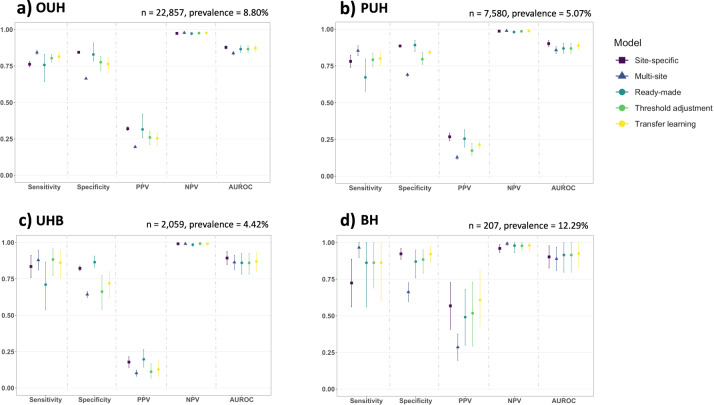
As patient health information is highly regulated due to privacy concerns, most machine learning (ML)-based healthcare studies are unable to test on external patient cohorts, resulting in a gap between locally reported model performance and cross-site generalizability. Different approaches have been introduced for developing models across multiple clinical sites, however less attention has been given to adopting ready-made models in new settings. We introduce three methods to do this—(1) applying a ready-made model “as-is” (2); readjusting the decision threshold on the model’s output using site-specific data and (3); finetuning the model using site-specific data via transfer learning. Using a case study of COVID-19 diagnosis across four NHS Hospital Trusts, we show that all methods achieve clinically-effective performances (NPV > 0.959), with transfer learning achieving the best results (mean AUROCs between 0.870 and 0.925). Our models demonstrate that site-specific customization improves predictive performance when compared to other ready-made approaches.
Overview
The claims and statistics of this paper haven’t been checked yet.
Free: it reads the open-access text and checks the first 5 claims that cite a source we can check. Create a free account to check every claim.
Integrity signals
Registry
Cites
Statistics
Figures
Verification
Claims the paper makes
The claims and statistics of this paper haven’t been checked yet.
Free: it reads the open-access text and checks the first 5 claims that cite a source we can check. Create a free account to check every claim.
Claims other papers make about this one
Each is checked against this paper’s own text: does it say what the citing paper says it does?
The source backs part of the claim, not all of it — or backs it for a different population, condition or comparison.
In the citing paper
“Transfer learning is an approach that can be used to efficiently train models to perform tasks leveraging knowledge gained from historic models trained to perform similar or unique tasks. This can be used to fine-tune externally trained models using smaller quantities of local data, reducing the potential for external algorithmic bias.”
From Bias recognition and mitigation strategies in artificial intelligence healthcare applications (2025) · cites this paper as [53]
Experimental — accuracy not yet measuredThe cited source says what the claim attributes to it.
In the citing paper
“However, it must be recognized this may transfer unrecognized biases inherent to the original environment’s dataset, potentially perpetuating these biases into new healthcare systems53.”
From Bias recognition and mitigation strategies in artificial intelligence healthcare applications (2025) · cites this paper as [53]
The cited source says what the claim attributes to it.
In the citing paper
“Advanced techniques like federated learning [24] or transfer learning [25] aim to improve model performance across sites, especially when local data is limited.”
From Toward generalizable and interpretable machine learning models in healthcare: Insights from ICU outcome predictions (2026) · cites this paper as [25]
The cited source says what the claim attributes to it.
In the citing paper
“and transfer learning, which adapts models trained at one hospital for use at another using small amounts of local data [25, 59].”
From Toward generalizable and interpretable machine learning models in healthcare: Insights from ICU outcome predictions (2026) · cites this paper as [25]
In the citing paper
“The size and number of unique cohorts required for external validation varies based on the model’s application and target population’s diversity, but remains central to confirming performance consistency53.”
From Bias recognition and mitigation strategies in artificial intelligence healthcare applications (2025) · cites this paper as [53]
Self-check
Percentages, sums and reported differences re-computed from the paper’s own numbers.
The self-check needs the paper’s full text.
Citations
Cites
The meaning and use of the area under a receiver operating characteristic (ROC) curve.
Hanley, J. A., & McNeil, B. J. (1982) · Radiology · doi:10.1148/radiology.143.1.7063747 · Cited by 21,856
Federated learning for predicting clinical outcomes in patients with COVID-19
Dayan, I., Roth, H. R., Zhong, A., Harouni, A., Gentili, A., Abidin, A. Z., Liu, A., Costa, A. B., Wood, B. J., Tsai, C.-S., et al. (2021) · Nature Medicine · doi:10.1038/s41591-021-01506-3 · Cited by 842
AI can be sexist and racist — it’s time to make it fair
Zou, J., & Schiebinger, L. (2018) · Nature · doi:10.1038/d41586-018-05707-8 · Cited by 765
A Brief Review of Domain Adaptation
Farahani, A., Voghoei, S., Rasheed, K., & Arabnia, H. R. (2021) · Transactions on Computational Science and Computational Intelligence · doi:10.1007/978-3-030-71704-9_65 · Cited by 615
Transparency and reproducibility in artificial intelligence
Haibe-Kains, B., Adam, G. A., Hosny, A., Khodakarami, F., Massive Analysis Quality Control (MAQC) Society Board of Directors, Shraddha, T., Kusko, R., Sansone, S.-A., Tong, W., Wolfinger, R. D., et al. (2020) · Nature · doi:10.1038/s41586-020-2766-y · Cited by 540 · cited 1×
“Furthermore, the sharing of code and data is widely seen as being crucial to reproducibility; however, in many medical fields, they are rarely made available, as patient health information is highly regulated due to privacy concerns (Haibe-Kains et al., 2020).”
BackgroundDeep Transfer Learning Based Classification Model for COVID-19 Disease
Pathak, Y., Shukla, P. K., Tiwari, A., Stalin, S., Singh, S., & Shukla, P. K. (2022) · IRBM · doi:10.1016/j.irbm.2020.05.003 · Cited by 460
CNN-based transfer learning–BiLSTM network: A novel approach for COVID-19 infection detection
Aslan, M. F., Unlersen, M. F., Sabanci, K., & Durdu, A. (2021) · Applied Soft Computing · doi:10.1016/j.asoc.2020.106912 · Cited by 354
Automated Deep Transfer Learning-Based Approach for Detection of COVID-19 Infection in Chest X-rays
Narayan Das, N., Kumar, N., Kaur, M., Kumar, V., & Singh, D. (2022) · IRBM · doi:10.1016/j.irbm.2020.07.001 · Cited by 351
Smith, J., & Noble, H. (2014) · Evidence Based Nursing · doi:10.1136/eb-2014-101946 · Cited by 293
State of the Art: Reproducibility in Artificial Intelligence
Gundersen, O. E., & Kjensmo, S. (2018) · Proceedings of the AAAI Conference on Artificial Intelligence · doi:10.1609/aaai.v32i1.11503 · Cited by 293
Cited by
Items 101–180 of 180
Chen, E., Saenz, A. D., Banerjee, O., Marklund, H., Zhang, X., Johri, S., Zhou, H.-Y., Luo, L., Adithan, S., Wu, K., et al. (2025) · NEJM AI · doi:10.1056/aioa2500522 · Cited by 3
Fairley, J. L., Kapoor, M., & Sharma, D. (2026) · Osteoarthritis and Cartilage · doi:10.1016/j.joca.2026.03.001 · Cited by 4
Cui, J., He, Z., Lim, E., & Lim, C. E. D. (2026) · Digital Health · doi:10.1177/20552076261443585 · Cited by 7
“, 10 , 12 , 13 Efficient”
Alalawi, K. (2026) · Applied Sciences · doi:10.3390/app16115684 · Cited by 3
Prognostic Prediction of Pediatric DHF in Two Hospitals in Thailand
Haddawy, P., Yin, M. S., Meth, P., Srikaew, A., Wavemanee, C., Niyom, S. L., Sriraksa, K., Limpitikul, W., Kittirat, P., Malasit, P., et al. (2023) · Lecture notes in computer science · doi:10.1007/978-3-031-34344-5_36 · Cited by 2
DOMINO++: Domain-Aware Loss Regularization for Deep Learning Generalizability
Stolte, S. E., Volle, K., Indahlastari, A., Albizu, A., Woods, A. J., Brink, K., Hale, M., & Fang, R. (2023) · Lecture notes in computer science · doi:10.1007/978-3-031-43901-8_68 · Cited by 6
Gericke, F., Voorspoels, W., Peeters, E., Demyttenaere, K., Sabbe, M. B., Bantjes, J. R., & Bruffaerts, R. (2025) · Psychiatry Research · doi:10.1016/j.psychres.2025.116698 · Cited by 3
Asante, I. O., & Wu, L. (2025) · Cluster Computing · doi:10.1007/s10586-025-05589-2 · Cited by 2
Generalizability and Clinical Implications of Electrocardiogram Denoising with Cardio-NAFNet
Lim, C., Chung, Y., Hamm, J., Ding, Z., Mekhael, M., Noujaim, C., Assaf, A. Y. M., Younes, H., Chouman, N., Makan, N., et al. (2024) · Journal of Biotechnology and Biomedicine · doi:10.26502/jbb.2642-91280124 · Cited by 1
Yang, J., Thakur, A., Soltan, A. A. S., & Clifton, D. A. (2023) · medRxiv · doi:10.1101/2023.10.24.23297460 · Cited by 2
“The lack of standardized measures and evaluation metrics for assessing synthetic data quality, particularly in the healthcare domain (with its heterogeneity and variation across populations, diseases, and settings), further complicates the process (15).”
BackgroundSelf-citationDesiraju, B. K., Thiruvengadam, R., Wadhwa, N., Khurana, A., Papageorghiou, A. T., Noble, J. A., & Bhatnagar, S. (2024) · F1000Research · doi:10.12688/f1000research.152426.1 · Cited by 1
Sailer, B., Sari-Yavuz, S., Biergans, S. D., Verbuecheln, R., Achauer, L.-C., Rosenberger, P., Hardt, M., & Koeppen, M. (2026) · European Heart Journal - Digital Health · doi:10.1093/ehjdh/ztag093 · Cited by 2
Survey of AI-Driven Advancements in Diagnosis and Clinical Decisions for Healthcare
Abid, A., Tayari, K., & Cheikhrouhou, O. (2025) · Studies in computational intelligence · doi:10.1007/978-3-031-90573-5_1 · Cited by 1
PICU Face and Thoracoabdominal Detection Using Self-Supervised Divided Space–Time Mamba
Salah, M., Jouvet, P. A., & Noumeir, R. (2025) · Life · doi:10.3390/life15111706 · Cited by 1
“Furthermore, there is a significant domain gap between general-purpose videos and clinical data; features learned from datasets such as Kinetics-400 often fail to generalize to the unique PICU setting [3], limiting model performance across different healthcare settings [4,5].”
Asymmetric impacts of artificial intelligence on housing price valuation across education levels
An, S., Song, Y., Jang, H., & Ahn, K. (2025) · Humanities and Social Sciences Communications · doi:10.1057/s41599-025-06153-4 · Cited by 1
“This situation calls for more empirical evidence and time to ensure the trained AI models ’ capability in real-world settings, aside from the given test datasets (Yang et al., 2022).”
Investigation of machine learning methods for predicting surgical parameters in strabismus surgery
Speidel, A. J., Fetzer, B., Wullbrand, M., Wolf, A., & Münz, M. (2026) · Discover Artificial Intelligence · doi:10.1007/s44163-026-00846-8 · Cited by 1
“Any application would require local calibration [58].”
Quantum artificial intelligence: A comprehensive survey
Jiang, H., Pan, Y., Chen, J., Liu, Z., Sun, L., Li, Q., Zhang, L., Zhu, D., Wang, X., Liu, W., et al. (2026) · Meta-Radiology · doi:10.1016/j.metrad.2026.100205 · Cited by 3
Ryan, C. D., O’Shea, J. P., & Griffin, B. T. (2026) · Journal of Pharmaceutical Sciences · doi:10.1016/j.xphs.2026.104262 · Cited by 1
Virtual medicine: medical AI in human health and diseases
Zhang, C., Wang, F.-X., Tang, X., Li, J.-L., Ding, N., Hong, Y., Song, P., Bai, L., & Su, J. (2026) · Military Medical Research · doi:10.1016/j.mmr.2026.100012 · Cited by 4
“To maximize generalizability and clinical applicability, data sharing across multiple institutions is often required [179].”
Syailendra, E. A., Arshad, H., Lopez‐Ramirez, F., Tixier, F., Kawamoto, S., Fishman, E. K., & Chu, L. C. H. (2026) · Korean Journal of Radiology · doi:10.3348/kjr.2026.0003 · Cited by 2
“A hybrid strategy using a validated pre-trained model while allowing local recalibration may offer a pragmatic approach that aligns scalability with clinical reliability [44-46].”
Integration of artificial intelligence applications in clinical pharmacy services: A scoping review
Al‐Taie, A., Abdullah, A. S., & Arueyingho, O. (2026) · Future Healthcare Journal · doi:10.1016/j.fhj.2026.100547 · Cited by 4
“86,87 Furthermore, recent methodological work has argued that conventional external validation alone may be insufficient to guarantee real-world robustness because healthcare systems continuously evolve and local clinical practices differ substantially between institutions.”
Jang, Y., Kwon, J. H., Kim, H., Joung, Y.-J., Nang, J., & Kim, C. H. (2026) · Journal of Medical Internet Research · doi:10.2196/86087 · Cited by 1
“Furthermore, when external data that were not part of synthetic data generation are used for validation, domain shifts may occur owing to differences in hospital-specific patient characteristics, treatment patterns, and other factors [18].”
Abd-Alrazaq, A. A., Mohamed, S. P., Alajlani, M., Tabassum, A., Ordóñez-Mena, J. M., Yoosuf, S., Alkhateeb, M., Ahmed, A., Bashir, M., Qadir, J., et al. (2026) · Journal of Medical Internet Research · doi:10.2196/87882 · Cited by 1
“Consequently, reported discrimination metrics may reflect optimistic bias inherent to internal validation, limiting confidence in real-world applicability [66].”
Institution-Specific Autosegmentation for Personalized Radiotherapy Protocols
Cho, W., Yoo, G. S., Kim, W. D., Yerim, K., Kim, J. S., & Min, B. J. (2024) · Progress in Medical Physics · doi:10.14316/pmp.2024.35.4.205 · Cited by 1
Alexander, R., & Kumar, K. P. M. (2025) · Cluster Computing · doi:10.1007/s10586-025-05497-5 · Cited by 3
“Generalizability [15] is another crucial concern, as it pertains to the model’s ability to handle entirely novel forms of botnet attacks [16, 17].”
Phillips, E., O’Donoghue, O., Zhang, Y., Tsimpos, P., Mallinger, L. A., Chatzidakis, S., Pohlmann, J. E., Du, Y., Kim, I. S. Y., Song, J. J., et al. (2024) · medRxiv · doi:10.1101/2024.11.13.24317229 · Cited by 1
“By incorporating data from two distinct academic medical centers with differing patient pool demographics, our study demonstrates the generalizability of HELMET in diverse patient populations [28].”
Bohlen, L., Rosenberger, J., Hambauer, N., Zähringer, D., Franz, V., Zschech, P., & Kraus, M. (2026) · Health Care Management Science · doi:10.1007/s10729-026-09760-y
Invited Commentary: Can We Predict Intraoperative Transfusion Nationwide Using a Single Algorithm?
Zapf, M. A. C. (2023) · Journal of the American College of Surgeons · doi:10.1097/xcs.0000000000000882
Duta, I., Kariuki, S. M., Ngugi, A. K., Mwesige, A. K., Masanja, H., Owusu‐Agyei, S., Wagner, R. G., Cross, J. H., Sander, J. W. A. S., Newton, C. R. J. C., et al. (2024) · medRxiv · doi:10.1101/2024.03.25.24304872
dos Santos, L., Silva, L. L., Pelloso, F. C., Maia, V., Pujals, C., Borghesan, D. H. P., Carvalho, M. D. D. B., Pedroso, R. B., & Pelloso, S. M. (2024) · PeerJ · doi:10.7717/peerj.17428 · Cited by 1
Asad, H., Ahmad, O., & Fatima, E. (2024) · European Journal of Surgical Oncology · doi:10.1016/j.ejso.2024.109371
Sumsion, D., Davis, E., Fernandes, M. P., Wei, R., Milde, R., Veltink, J., Kong, W. Y., Xiong, Y., Rao, S., Westover, T. M., et al. (2025) · JMIR Medical Informatics · doi:10.2196/64113 · Cited by 1
“However, sole reliance on ICD codes is problematic due to their imprecision; it is estimated that approximately 40% of hospitalizations labeled with primary ICD codes for CHF do not hold up upon detailed medical record review [9].”
Shenouda, M., Whitney, H. M., Giger, M. L., & Armato, S. G. (2024) · Journal of medical imaging · doi:10.1117/1.jmi.11.6.064503
“9,10 For example, Yang et al. 6 studied models trained on electronic health record data across multiple clinical sites and concluded that models customized to a clinical site improved performance.”
Reiazi, R., Prajapati, S., Fru, L. C., Lee, D., & Salehpour, M. (2025) · Diagnostics · doi:10.3390/diagnostics15060786
“Generalizability refers to the ability of a predictive model to maintain reliability and accuracy when applied to data from a new, independent cohort of patients [4,5].”
Silva, A. P. D., & Prabagar, K. (2025) · Artificial Intelligence in Gastroenterology · doi:10.35712/aig.v6.i2.110109
A Practical Method for Detecting Prognostic CD57 + T Cells in Head and Neck Cancer
Brammer, B., Kinney, B. L. C., Kansal, V., & Schmitt, N. C. (2025) · Head & Neck · doi:10.1002/hed.70074
Millarch, A. S., Kaafarani, H. M. A., Chamseddine, I. M., Folke, F., Rudolph, S. S., & Sillesen, M. (2026) · Journal of Medical Internet Research · doi:10.2196/86202
“If the model is to be used in other countries or regions, retraining with local data is highly advisable [9,32], as trauma systems and underlying patient demography vary substantially even between comparable Western health care systems.”
Auditing coherence through the principle of a single functional mappingPreprint
Haddadi, H., Kloskowski, A., & Mironowicz, P. (2025) · Research Square · doi:10.21203/rs.3.rs-8072048/v1
Multimorbidity measurement strategies for predicting hospital visits
Neves, B. D., Moreira, J. M., Gonçalves, S., Cerejo, J., Mota, I., Silva, N. A., Leite, F., & Silva, M. J. (2025) · BMC Health Services Research · doi:10.1186/s12913-025-13817-z
Li, D., Wang, H., Gao, F., Fu, X., & Han, J. (2025) · Hepatoma Research · doi:10.20517/2394-5079.2025.67
Nickson, D., Meyer, C., Walasek, L., & Toro, C. T. (2024) · Figshare · doi:10.6084/m9.figshare.26645698
Wang, J., Jin, Y., Jiang, A., Chen, W., Shan, G., Gu, Y., Ming, Y., Li, J., Yue, C., Huang, Z., et al. (2024) · Figshare · doi:10.6084/m9.figshare.25884981
Yang, J., Triendl, H., Soltan, A. A. S., Prakash, M., & Clifton, D. A. (2024) · Figshare · doi:10.6084/m9.figshare.26122686
Self-citationDomain generalization and adaptation in intensive care with anchor regression
Londschien, M., Burger, M., Rätsch, G., & Bühlmann, P. (2026) · RSS Data Science and Artificial Intelligence · doi:10.1093/rssdat/udag001 · Cited by 3
Fairness in Breast Cancer Diagnosis with Deep Learning
Bot, L. M. L., Kwok, S. C., Amankwaa-Frempong, E., & Appiah, K. (2025) · IEEE International Conference on Computer Vision Workshops · doi:10.1109/iccvw69036.2025.00763
“Further research should be conducted into the presence of this bias, but may be limited due to models being insufficiently gen-eralisable [24].”
Artificial Intelligence for Automated, Highly Accurate, and Scalable Multimodal EHR Data AbstractionPreprint
Margaritis, G., Petridis, P., Bertsimas, D., Bloom, J. P., Hagberg, R. C., Habib, R., Shahian, D. M., & Orfanoudaki, A. (2026) · medRxiv · doi:10.64898/2026.03.16.26348522 · Cited by 1
Li, J., Dong, Z., Wang, D., & Cui, J. (2026) · International Journal of General Medicine · doi:10.2147/ijgm.s596273
Koo, H., Toikkanen, M., Kim, Y. T., Kim, S. Y., & Kim, J.-W. (2026) · IEEE International Conference on Acoustics Speech and Signal Processing · doi:10.1109/icassp55912.2026.11462615 · Cited by 7
“In RSC, metadata often exhibit skewed distributions across diagnostic categories, leading models to rely on superficial correlations instead of clinically meaningful features [6, 14].”
Fundamentals of Cognitive Diseases and Diagnostic Challenges
Kumar, S. M. (2026) · Cognitive systems monographs · doi:10.1007/978-3-032-18782-6_2
Saeedi, M., Wei, L., & Mooney, C. (2025) · International Conference on Biomedical and Bioinformatics Engineering (ICBBE) · doi:10.1145/3794209.3794282
Zhang, Y., Dong, L., Xiu, Y.-X., & Shen, C. (2026) · Frontiers in Medicine · doi:10.3389/fmed.2026.1781957
“Furthermore, models trained on narrow datasets often fail to generalize across diverse populations or settings (55, 56).”
KUŞCU, F. N. (2026) · BMC Nursing · doi:10.1186/s12912-026-04792-9 · Cited by 2
“First, the data were collected from a single public hospital, which may limit the generalizability of the findings to different health-care settings [105].”
Li, M. M., & Zhang, Q. (2026) · Archives of Microbiology · doi:10.1007/s00203-026-04942-2
“Generalizability remains a persistent hurdle; models trained on EHR data from one health system often fail when transferred to populations with different care-seeking behaviors or demographic compositions (Yang et al. 2022).”
Zhang, Z., Yu, Z., Liao, J. X., Hitomi, A., Ohta, M., Chen, Z., Ding, X., Qiao, A., & Li, G. (2026) · Engineering Applications of Artificial Intelligence · doi:10.1016/j.engappai.2026.115402 · Cited by 1
Research and Scholarly Methods: Using Artificial Intelligence
Trinkley, K. E., & Maw, A. (2026) · JACCP JOURNAL OF THE AMERICAN COLLEGE OF CLINICAL PHARMACY · doi:10.1002/jac5.70239
Allott, N., Bicer, M., Korgaonkar, J., Thomas, R., Banger, M. S., & McGregor, A. H. (2026) · BMJ Open · doi:10.1136/bmjopen-2025-107409 · Cited by 1
“23 26 27 Future work should focus on increasing dataset size and incorporating additional biomechanical features to enhance robustness.”
Can the Net Promoter Score predict the Primary Care Assessment Tool? A transfer learning approach
Chisini, L. A., D’Ávila, O. P., Ribeiro, M. C., Harzheim, E., & Pinto, L. F. (2026) · Ciência & Saúde Coletiva · doi:10.1590/1413-81232026315.23482025
Chisini, L. A., D’Ávila, O. P., Ribeiro, M. C., Harzheim, E., & Pinto, L. F. (2026) · Ciência & Saúde Coletiva · doi:10.1590/1413-81232026315.23492025
Filippi, M., & Katzschmann, R. K. (2026) · Bio-Design and Manufacturing · doi:10.1631/bdm.2500560
Data-driven velocity control for over-ground body weight support in gait rehabilitation
Luu, T., Nguyen, V. L., & Jan, Y. (2026) · Engineering Applications of Artificial Intelligence · doi:10.1016/j.engappai.2026.115723
Rokaya, M., AlZain, M. A., Hemdan, D. I. I., Atwa, M. A., & Atlam, E.-S. (2026) · Journal of Disability Research · doi:10.57197/jdr-2026-0888 · Cited by 1
Zhuo, X.-Y., Dong, P., Lei, S.-H., Liu, B., Xu, N.-W., Jiang, S., Cai, L., Liu, K.-X., & Zhao, B.-C. (2026) · British Journal of Anaesthesia · doi:10.1016/j.bja.2026.06.025
Joice, A., Tazeen, H., Tufaique, T., Gupta, M. J., Igathinathane, C., Rai, N., Whippo, C. W., & Archer, D. W. (2026) · Remote Sensing · doi:10.3390/rs18193337
Uthaititpitak, P. (2026) · Journal of Applied Research on Science and Technology (JARST) · doi:10.60101/jarst.2026.267600
The Rigidity Paradox: Decoupled Drift and Attribution in Cross-Domain Clinical ML Monitoring
Alameer, A. M. A., & Sarma, N. (2026) · International Conference on Emerging Smart Technologies and Applications (eSmarTA) · doi:10.1109/esmarta70636.2026.11652360
“Studies in healthcare show that shifts in multi-site and EHR-based research hinder generalization across different populations and institutions [6], [8].”
InfluentialChampeaux, S., Booth, J., Brown, A. P. Y., Sebire, N. J., Drobnjak, I., & Bowyer, S. A. (2026) · medRxiv · doi:10.64898/2026.08.18.26360666
Wang, Q., Song, Y.-X., Yang, X., Zhang, J., Sun, R., Wu, X., Li, A., Lou, J., Li, H., Liu, Y., et al. (2026) · MedComm · doi:10.1002/mco2.70944
“One major drawback is the need for large centralized datasets, which can be difficult to compile owing to data privacy concerns and regulatory restrictions [ 35 ].”
Wang, X., Liu, G., Wang, A., & Yang, S. (2026) · Advances in Colloid and Interface Science · doi:10.1016/j.cis.2026.104033
Barrado‐Martín, Y., Mathur, S., Khadjesari, Z., Clark, S. E., Vindrola‐Padros, C., Lovat, L. B., & Stevenson, F. A. (2026) · JMIR Human Factors · doi:10.2196/93420
“This is a known generalizability issue previously identified in the literature [29,30].”
In silico biomedicine in the era of artificial intelligence: opportunities and challenges
Mustaffa, F.-E., Sajid, T., Ali, M., & Ashraf, N. M. (2026) · In Silico Research in Biomedicine · doi:10.1016/j.insi.2026.100629
Clark, S. E., Mathur, S., Barrado‐Martín, Y., El-Sayed, A., Zhao, Y., Li, Y., Khadjesari, Z., Stevenson, F. A., Tiwari, M. K., Torii, R., et al. (2026) · Journal of Health Services Research & Policy · doi:10.1177/13558196261486714 · Cited by 4
Touray, M., Longo, M., Ala, A., Prada, J. M., Kanteh, D., Onwuchekwa, U. U., & Green, R. (2026) · Frontiers in Artificial Intelligence · doi:10.3389/frai.2026.1866941
“Even when internal validation is performed, external validation across different populations, devices, or geographies is rare (Youssef et al., 2023; Faes et al., 2020; Yang et al., 2022).”
Zaher, A., Prikshat, V., el aziz, J. A., & Vinot, D. (2026) · Journal of Health Organization and Management · doi:10.1108/jhom-03-2026-0364 · Cited by 1
“For example, technological risks and regulatory uncertainty may constrain adoption even when organisational readiness is high (Yang et al. , 2022), while organisational and environmental support jointly influence digital health adoption trajectories (Jeilani and Hussein, 2025; Nevi et al. , 2025).”
InfluentialYan, Y., Li, G., Chen, T., Yan, J., Wang, C., Yuan, A., Zhang, J., & Pu, J. (2026) · Frontiers in Artificial Intelligence · doi:10.3389/frai.2026.1962796
“High performance under random internal splitting may not be preserved across hospitals, countries, demographic groups, device vendors, acquisition protocols, coding practices, or calendar periods (Guo et al., 2021; Yang et al., 2022).”
Nicora, G., Negri, F., Tibollo, V., Malovini, A. L., Dagliati, A., Sacchi, L., Sottotetti, F., Baiardi, P., & Bellazzi, R. (2026) · Frontiers in Digital Health · doi:10.3389/fdgth.2026.1956993
“An EHR-based foundation model inherently reflects the specific disease distributions, clinical guidelines, treatment pathways, and organizational structures of the healthcare system in which its training data was collected (15).”
Cross-Dataset Wearable Sleep Staging under Source-Only and Target-Normalized Conditions
Fei, Y., Shen, C., & Xiao, F. (2026) · International Conference on Computer Network, Electronic and Automation (ICCNEA) · doi:10.1109/iccnea70678.2026.11722303
“Second, health-AI performance can shift across sites, devices and populations [4]-[6].”
Hierarchical visual prompt disentanglement for continual rare disease diagnosis
Hu, Y., Chen, Y., Zeng, Q., & Xia, Y. (2026) · Medical Image Analysis · doi:10.1016/j.media.2026.104355
Yang, X., Cao, Y., Wang, H., Li, H., Jiang, X., Xu, H., Yao, T., Zhang, X., Chen, Y., Li, J., et al. (2026) · Frontiers in Psychiatry · doi:10.3389/fpsyt.2026.1942164
“Multi-university, multi-region, and temporal validation is also required before broader generalization to Chinese university students (58, 59).”
Baspakova, A. M., Sambaeva, S., Zhilisbayeva, K. R., Suleimenova, R., Yelgondina, G., Kaliyeva, A. E., & Umbetova, A. A. (2026) · Медицинский журнал Западного Казахстана · doi:10.4103/wkmj.wkmj_80_26
Prior-informed machine learning for clinically interpretable medical diagnosis
Lin, Z., Walker, D., Murdoch, C., Colley, H. E., Anumba, D. O. C., & Lang, Z.-Q. (2026) · Frontiers in Bioengineering and Biotechnology · doi:10.3389/fbioe.2026.1973664
Metadata
- Authors
- Yang, J., Soltan, A. A. S., & Clifton, D. A.
- Affiliations
- University of Oxford (GB)
- John Radcliffe Hospital (GB)
- Corresponding author
- Yang, Jenny
- Venue
- npj Digital Medicine
- Published
- 2022-06-07
- Volume
- 5
- Issue
- 1
- Pages
- 69-69
- ISSN
- 2398-6352 (ISSN-L)
- PMC
- PMC9174159
- OpenAlex
- W4281920142
- Cited by
- 181
- References
- 28
- Citations by year
- 2026: 55 · 2025: 48 · 2024: 46 · 2023: 27 · 2022: 4
- FWCI
- 10.28
- Type
- journal article
- Language
- en
- Open access
- gold
- doi.org
- Licence
- cc-by
- creativecommons.org/licenses/by/4.0 (tdm)
- creativecommons.org/licenses/by/4.0 (vor)
- Locations
- npj Digital Medicine (publishedVersion, cc-by)
- medRxiv (acceptedVersion, cc-by)
- PubMed Central (publishedVersion, cc-by)
- PubMed (publishedVersion)
- DOAJ (DOAJ: Directory of Open Access Journals) (submittedVersion, cc-by-sa)
- Funders
- Wellcome Trust (0009350)
- University Hospitals Birmingham NHS Foundation Trust
- National Institute for Health and Care Research (ACF-2020-13-015)
- University of Oxford
- European Commission (HORIZON2020, 955681)
- Oxford University Hospitals NHS Foundation Trust
- Medical Research Council (MC_PC_19049)
- Topics
- Physical Sciences › Computer Science › Artificial Intelligence › Machine Learning in Healthcare
- Health Sciences › Medicine › Radiology, Nuclear Medicine and Imaging › COVID-19 diagnosis using AI
- Health Sciences › Medicine › Health Informatics › Artificial Intelligence in Healthcare and Education
- Keywords
- model generalization, COVID-19 diagnosis, clinical decision support, model finetuning, external validation, NHS hospital trusts, predictive performance
About these checks
Registry, retraction, Cites and statistics results are computed, not judged, with one exception: a printed reference that no index lists is read once by a model before it counts as a citation error. Claims are extracted by a model and kept only when their quote appears verbatim in the text; each cited source is then checked, with a model’s help, for whether it says what the claim relies on. Those verdicts can be wrong — read the claim’s quote and the cited source before relying on one.
Statistics and arithmetic are recomputed, not judged.
Confidence bands are shown only for fields calibrated on our annotated test set. None is calibrated yet, so no band is shown.
What counts as a claim ›How we measure confidence ›How we check this ›
Are you an author, or do you see a problem with this page? Request a review
Data sources
Bibliographic data: Semantic Scholar, OpenAlex, Crossref.
Contains information from the Semantic Scholar Academic Graph Datasets, made available under the ODC Attribution License (ODC-BY 1.0).
Semantic Scholar’s data is described in: Kinney, R., et al. (2023). The Semantic Scholar Open Data Platform. arXiv:2301.10140.
