

Machine learning generalizability across healthcare settings: insights from multi-site COVID-19 screening
Open accessPublished version of a preprint
The DOI matches its Crossref record; 29 of the 29 references it cites were found in a registry or an index.
Abstract
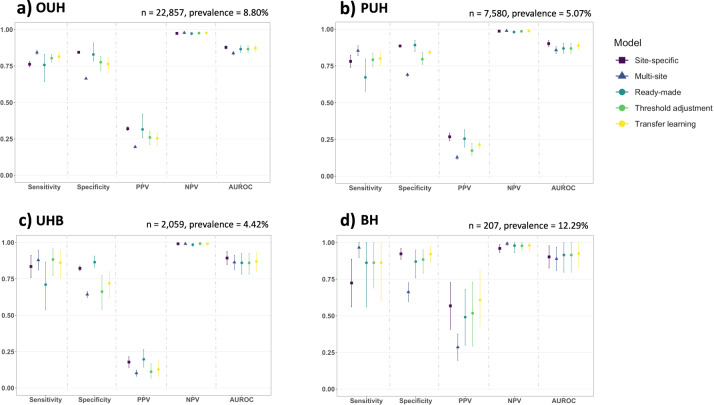
As patient health information is highly regulated due to privacy concerns, most machine learning (ML)-based healthcare studies are unable to test on external patient cohorts, resulting in a gap between locally reported model performance and cross-site generalizability. Different approaches have been introduced for developing models across multiple clinical sites, however less attention has been given to adopting ready-made models in new settings. We introduce three methods to do this—(1) applying a ready-made model “as-is” (2); readjusting the decision threshold on the model’s output using site-specific data and (3); finetuning the model using site-specific data via transfer learning. Using a case study of COVID-19 diagnosis across four NHS Hospital Trusts, we show that all methods achieve clinically-effective performances (NPV > 0.959), with transfer learning achieving the best results (mean AUROCs between 0.870 and 0.925). Our models demonstrate that site-specific customization improves predictive performance when compared to other ready-made approaches.
Overview
The claims and statistics of this paper haven’t been checked yet.
Free: it reads the open-access text and checks the first 5 claims that cite a source we can check. Create a free account to check every claim.
Integrity signals
Registry
Cites
Statistics
Figures
Verification
Claims the paper makes
The claims and statistics of this paper haven’t been checked yet.
Free: it reads the open-access text and checks the first 5 claims that cite a source we can check. Create a free account to check every claim.
Claims other papers make about this one
Each is checked against this paper’s own text: does it say what the citing paper says it does?
The source backs part of the claim, not all of it — or backs it for a different population, condition or comparison.
In the citing paper
“Transfer learning is an approach that can be used to efficiently train models to perform tasks leveraging knowledge gained from historic models trained to perform similar or unique tasks. This can be used to fine-tune externally trained models using smaller quantities of local data, reducing the potential for external algorithmic bias.”
From Bias recognition and mitigation strategies in artificial intelligence healthcare applications (2025) · cites this paper as [53]
Experimental — accuracy not yet measuredThe cited source says what the claim attributes to it.
In the citing paper
“However, it must be recognized this may transfer unrecognized biases inherent to the original environment’s dataset, potentially perpetuating these biases into new healthcare systems53.”
From Bias recognition and mitigation strategies in artificial intelligence healthcare applications (2025) · cites this paper as [53]
The cited source says what the claim attributes to it.
In the citing paper
“Advanced techniques like federated learning [24] or transfer learning [25] aim to improve model performance across sites, especially when local data is limited.”
From Toward generalizable and interpretable machine learning models in healthcare: Insights from ICU outcome predictions (2026) · cites this paper as [25]
The cited source says what the claim attributes to it.
In the citing paper
“and transfer learning, which adapts models trained at one hospital for use at another using small amounts of local data [25, 59].”
From Toward generalizable and interpretable machine learning models in healthcare: Insights from ICU outcome predictions (2026) · cites this paper as [25]
In the citing paper
“The size and number of unique cohorts required for external validation varies based on the model’s application and target population’s diversity, but remains central to confirming performance consistency53.”
From Bias recognition and mitigation strategies in artificial intelligence healthcare applications (2025) · cites this paper as [53]
Self-check
Percentages, sums and reported differences re-computed from the paper’s own numbers.
The self-check needs the paper’s full text.
Citations
Cites
The meaning and use of the area under a receiver operating characteristic (ROC) curve.
Hanley, J. A., & McNeil, B. J. (1982) · Radiology · doi:10.1148/radiology.143.1.7063747 · Cited by 21,856
Federated learning for predicting clinical outcomes in patients with COVID-19
Dayan, I., Roth, H. R., Zhong, A., Harouni, A., Gentili, A., Abidin, A. Z., Liu, A., Costa, A. B., Wood, B. J., Tsai, C.-S., et al. (2021) · Nature Medicine · doi:10.1038/s41591-021-01506-3 · Cited by 842
AI can be sexist and racist — it’s time to make it fair
Zou, J., & Schiebinger, L. (2018) · Nature · doi:10.1038/d41586-018-05707-8 · Cited by 765
A Brief Review of Domain Adaptation
Farahani, A., Voghoei, S., Rasheed, K., & Arabnia, H. R. (2021) · Transactions on Computational Science and Computational Intelligence · doi:10.1007/978-3-030-71704-9_65 · Cited by 615
Transparency and reproducibility in artificial intelligence
Haibe-Kains, B., Adam, G. A., Hosny, A., Khodakarami, F., Massive Analysis Quality Control (MAQC) Society Board of Directors, Shraddha, T., Kusko, R., Sansone, S.-A., Tong, W., Wolfinger, R. D., et al. (2020) · Nature · doi:10.1038/s41586-020-2766-y · Cited by 540 · cited 1×
“Furthermore, the sharing of code and data is widely seen as being crucial to reproducibility; however, in many medical fields, they are rarely made available, as patient health information is highly regulated due to privacy concerns (Haibe-Kains et al., 2020).”
BackgroundDeep Transfer Learning Based Classification Model for COVID-19 Disease
Pathak, Y., Shukla, P. K., Tiwari, A., Stalin, S., Singh, S., & Shukla, P. K. (2022) · IRBM · doi:10.1016/j.irbm.2020.05.003 · Cited by 460
CNN-based transfer learning–BiLSTM network: A novel approach for COVID-19 infection detection
Aslan, M. F., Unlersen, M. F., Sabanci, K., & Durdu, A. (2021) · Applied Soft Computing · doi:10.1016/j.asoc.2020.106912 · Cited by 354
Automated Deep Transfer Learning-Based Approach for Detection of COVID-19 Infection in Chest X-rays
Narayan Das, N., Kumar, N., Kaur, M., Kumar, V., & Singh, D. (2022) · IRBM · doi:10.1016/j.irbm.2020.07.001 · Cited by 351
Smith, J., & Noble, H. (2014) · Evidence Based Nursing · doi:10.1136/eb-2014-101946 · Cited by 293
State of the Art: Reproducibility in Artificial Intelligence
Gundersen, O. E., & Kjensmo, S. (2018) · Proceedings of the AAAI Conference on Artificial Intelligence · doi:10.1609/aaai.v32i1.11503 · Cited by 293
Zeng, L.-L., Wang, H., Hu, P., Yang, B., Pu, W., Shen, H., Chen, X., Liu, Z., Yin, H., Tan, Q., et al. (2018) · eBioMedicine · doi:10.1016/j.ebiom.2018.03.017 · Cited by 277
Reproducibility in machine learning for health research: Still a ways to go
McDermott, M. B. A., Wang, S., Marinsek, N., Ranganath, R., Foschini, L., & Ghassemi, M. (2021) · Science Translational Medicine · doi:10.1126/scitranslmed.abb1655 · Cited by 273 · cited 4×
“Thus, validating a model on only one dataset – particularly, one from the same cohort as the training data – is discouraged, as researchers have found large performance gaps when testing on external patient cohorts (BarakCorren et al., 2021; Burns et al., 2020; McDermott et al., 2021).”
BackgroundResultInfluentialLaboratory diagnosis of COVID-19
Goudouris, E. (2020) · Jornal de Pediatria · doi:10.1016/j.jped.2020.08.001 · Cited by 210
Nunes, A., Schnack, H. G., Ching, C. R. K., Agartz, I., Akudjedu, T. N., Alda, M., Alnæs, D., Alonso-Lana, S., Bauer, J., Baune, B. T., et al. (2020) · Molecular Psychiatry · doi:10.1038/s41380-018-0228-9 · Cited by 171
Soltan, A. A. S., Kouchaki, S., Zhu, T., Kiyasseh, D., Taylor, T., Hussain, Z. B., Peto, T., Brent, A. J., Eyre, D. W., & Clifton, D. A. (2021) · The Lancet Digital Health · doi:10.1016/s2589-7500(20)30274-0 · Cited by 150
Self-citationIhlen, E. A. F., Støen, R. Ø., Boswell, L., de Regnier, R.-A. O., Fjørtoft, T., Gaebler-Spira, D. J., Labori, C., Loennecken, M. C., Msall, M. E., Møinichen, U. I., et al. (2019) · Journal of Clinical Medicine · doi:10.3390/jcm9010005 · Cited by 134
Novel deep transfer learning model for COVID-19 patient detection using X-ray chest images
Kumar, N., Gupta, M., Gupta, D., & Tiwari, S. (2021) · Journal of Ambient Intelligence and Humanized Computing · doi:10.1007/s12652-021-03306-6 · Cited by 109
Data Sharing: Convert Challenges into Opportunities
Figueiredo, A. S. (2017) · Frontiers in Public Health · doi:10.3389/fpubh.2017.00327 · Cited by 86
Advancing COVID-19 diagnosis with privacy-preserving collaboration in artificial intelligence
Bai, X., Wang, H., Ma, L., Xu, Y., Gan, J., Fan, Z., Yang, F., Ma, K., Yang, J., Bai, S., et al. (2021) · Nature Machine Intelligence · doi:10.1038/s42256-021-00421-z · Cited by 75 · cited 1×
“, 2018); and 2) federatedlearning, whereby a model is collaboratively trained at different sites through the sharing of model parameters but not the data itself (Bai et al., 2021; Dayan et al., 2021).”
BackgroundSelf-citationSoltan, A. A. S., Yang, J., Pattanshetty, R., Novak, A., Yang, Y., Rohanian, O., Beer, S., Soltan, M. A., Thickett, D. R., Fairhead, R., et al. (2022) · The Lancet Digital Health · doi:10.1016/s2589-7500(21)00272-7 · Cited by 70
Self-citationEarly Prediction Model of Patient Hospitalization From the Pediatric Emergency Department
Barak-Corren, Y., Fine, A. M., & Reis, B. Y. (2017) · PEDIATRICS · doi:10.1542/peds.2016-2785 · Cited by 56
Grist, J. T., Withey, S., MacPherson, L. K. R., Oates, A., Powell, S., Novák, J., Abernethy, L. J., Pizer, B. L., Grundy, R. G., Bailey, S., et al. (2020) · NeuroImage Clinical · doi:10.1016/j.nicl.2020.102172 · Cited by 55 · cited 2×
“There have been different approaches used to address model generalization for clinical questions, including: 1) combined-site training, where training data comes from multiple sites (Grist et al., 2020; Ihlen et al., 2020; Nunes et al., 2020; Zeng et al., 2018); and 2) federatedlearning, whereby a model is collaborati…”
Between Access and Privacy: Challenges in Sharing Health Data
Malin, B., Goodman, K. W., & Section, S. E. F. T. I. Y. S. (2018) · Yearbook of Medical Informatics · doi:10.1055/s-0038-1641216 · Cited by 47
Azad, T. D., Ehresman, J., Ahmed, A. K., Staartjes, V. E., Lubelski, D., Stienen, M. N., Veeravagu, A., & Ratliff, J. K. (2021) · The Spine Journal · doi:10.1016/j.spinee.2020.10.006 · Cited by 45
Genes, Behavior, and the Social Environment
Institute of Medicine (2006) · National Academies Press eBooks · doi:10.17226/11693 · Cited by 41
Advances in Data Science and Information Engineering
(2021) · Transactions on computational science and computational intelligence · doi:10.1007/978-3-030-71704-9 · Cited by 40
Prediction across healthcare settings: a case study in predicting emergency department disposition
Barak-Corren, Y., Chaudhari, P., Perniciaro, J., Waltzman, M., Fine, A. M., & Reis, B. Y. (2021) · npj Digital Medicine · doi:10.1038/s41746-021-00537-x · Cited by 37
Machine Learning Comes of Age: Local Impact versus National Generalizability
Burns, M. L., & Kheterpal, S. (2020) · Anesthesiology · doi:10.1097/aln.0000000000003223 · Cited by 22
Yang, J., Soltan, A. A. S., Yang, Y., & Clifton, D. A. (2022) · medRxiv · doi:10.1101/2022.01.13.22268948 · Cited by 14 · cited 1×
“To investigate a role for transfer learning, the current work uses a complex neural network approach which was previously shown to be effective at screening for COVID-19 (Yang et al., 2022), instead of the previously described XGBoost approach.”
MethodSelf-citation
Cited by
The Role of AI in Hospitals and Clinics: Transforming Healthcare in the 21st Century
Maleki Varnosfaderani, S., & Forouzanfar, M. (2024) · Bioengineering · doi:10.3390/bioengineering11040337 · Cited by 931
“Techniques such as domain adaptation and transfer learning stand out as effective solutions, enabling AI models trained on one dataset to adjust and perform accurately on another with little need for retraining [194].”
BackgroundBias recognition and mitigation strategies in artificial intelligence healthcare applications
Hasanzadeh, F., Josephson, C. B., Waters, G., Adedinsewo, D., Azizi, Z., & White, J. A. (2025) · npj Digital Medicine · doi:10.1038/s41746-025-01503-7 · Cited by 320
“However,itmustberecognizedthis maytransferunrecognizedbiasesinherenttotheoriginalenvironment ’ s dataset, potentially perpetuating these biases into new healthcare systems 53 .”
InfluentialDeep Learning in Breast Cancer Imaging: State of the Art and Recent Advancements in Early 2024
Carriero, A., Groenhoff, L., Vologina, E., Basile, P., & Albera, M. (2024) · Diagnostics · doi:10.3390/diagnostics14080848 · Cited by 166
“It is still debated which of the two solutions is the most suitable to improve results in final applications, but local retraining by transfer learning seems to be an effective approach [52].”
BackgroundAn adversarial training framework for mitigating algorithmic biases in clinical machine learning
Yang, J., Soltan, A. A. S., Eyre, D. W., Yang, Y., & Clifton, D. A. (2023) · npj Digital Medicine · doi:10.1038/s41746-023-00805-y · Cited by 159
Self-citationYang, J., Soltan, A. A. S., Eyre, D. W., & Clifton, D. A. (2023) · Nature Machine Intelligence · doi:10.1038/s42256-023-00697-3 · Cited by 140
Self-citation
Metadata
- Authors
- Yang, J., Soltan, A. A. S., & Clifton, D. A.
- Affiliations
- University of Oxford (GB)
- John Radcliffe Hospital (GB)
- Corresponding author
- Yang, Jenny
- Venue
- npj Digital Medicine
- Published
- 2022-06-07
- Volume
- 5
- Issue
- 1
- Pages
- 69-69
- ISSN
- 2398-6352 (ISSN-L)
- PMC
- PMC9174159
- OpenAlex
- W4281920142
- Cited by
- 181
- References
- 28
- Citations by year
- 2026: 55 · 2025: 48 · 2024: 46 · 2023: 27 · 2022: 4
- FWCI
- 10.28
- Type
- journal article
- Language
- en
- Open access
- gold
- doi.org
- Licence
- cc-by
- creativecommons.org/licenses/by/4.0 (tdm)
- creativecommons.org/licenses/by/4.0 (vor)
- Locations
- npj Digital Medicine (publishedVersion, cc-by)
- medRxiv (acceptedVersion, cc-by)
- PubMed Central (publishedVersion, cc-by)
- PubMed (publishedVersion)
- DOAJ (DOAJ: Directory of Open Access Journals) (submittedVersion, cc-by-sa)
- Funders
- Wellcome Trust (0009350)
- University Hospitals Birmingham NHS Foundation Trust
- National Institute for Health and Care Research (ACF-2020-13-015)
- University of Oxford
- European Commission (HORIZON2020, 955681)
- Oxford University Hospitals NHS Foundation Trust
- Medical Research Council (MC_PC_19049)
- Topics
- Physical Sciences › Computer Science › Artificial Intelligence › Machine Learning in Healthcare
- Health Sciences › Medicine › Radiology, Nuclear Medicine and Imaging › COVID-19 diagnosis using AI
- Health Sciences › Medicine › Health Informatics › Artificial Intelligence in Healthcare and Education
- Keywords
- model generalization, COVID-19 diagnosis, clinical decision support, model finetuning, external validation, NHS hospital trusts, predictive performance
About these checks
Registry, retraction, Cites and statistics results are computed, not judged, with one exception: a printed reference that no index lists is read once by a model before it counts as a citation error. Claims are extracted by a model and kept only when their quote appears verbatim in the text; each cited source is then checked, with a model’s help, for whether it says what the claim relies on. Those verdicts can be wrong — read the claim’s quote and the cited source before relying on one.
Statistics and arithmetic are recomputed, not judged.
Confidence bands are shown only for fields calibrated on our annotated test set. None is calibrated yet, so no band is shown.
What counts as a claim ›How we measure confidence ›How we check this ›
Are you an author, or do you see a problem with this page? Request a review
Data sources
Bibliographic data: Semantic Scholar, OpenAlex, Crossref.
Contains information from the Semantic Scholar Academic Graph Datasets, made available under the ODC Attribution License (ODC-BY 1.0).
Semantic Scholar’s data is described in: Kinney, R., et al. (2023). The Semantic Scholar Open Data Platform. arXiv:2301.10140.
