

Smartphone camera based assessment of adiposity: a validation study
Open accessPublished version of a preprint
The DOI matches its Crossref record; 52 of the 52 references it cites were found in a registry or an index.
Abstract
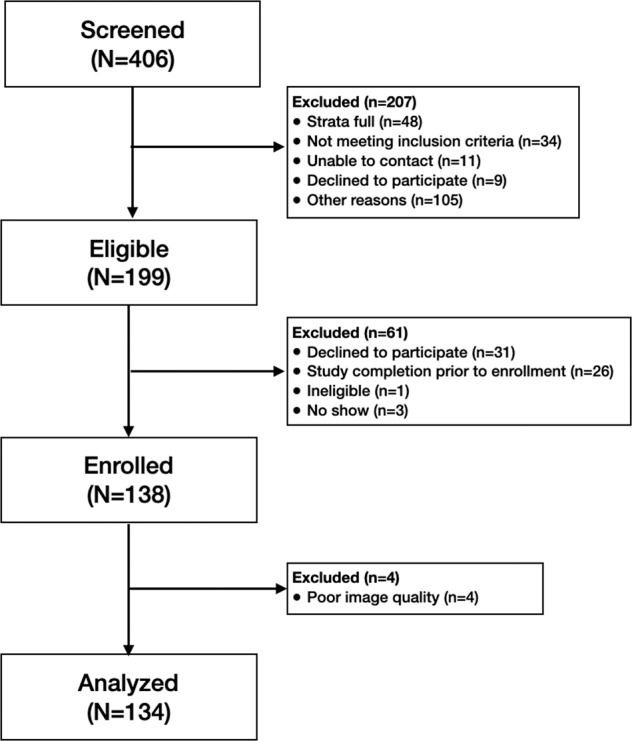
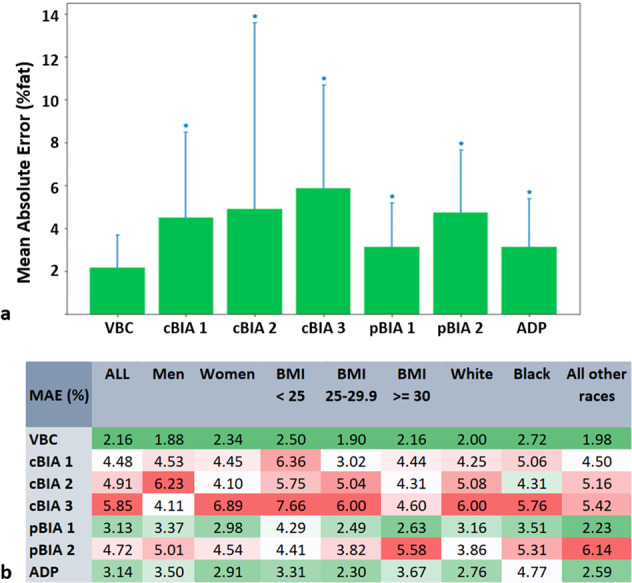
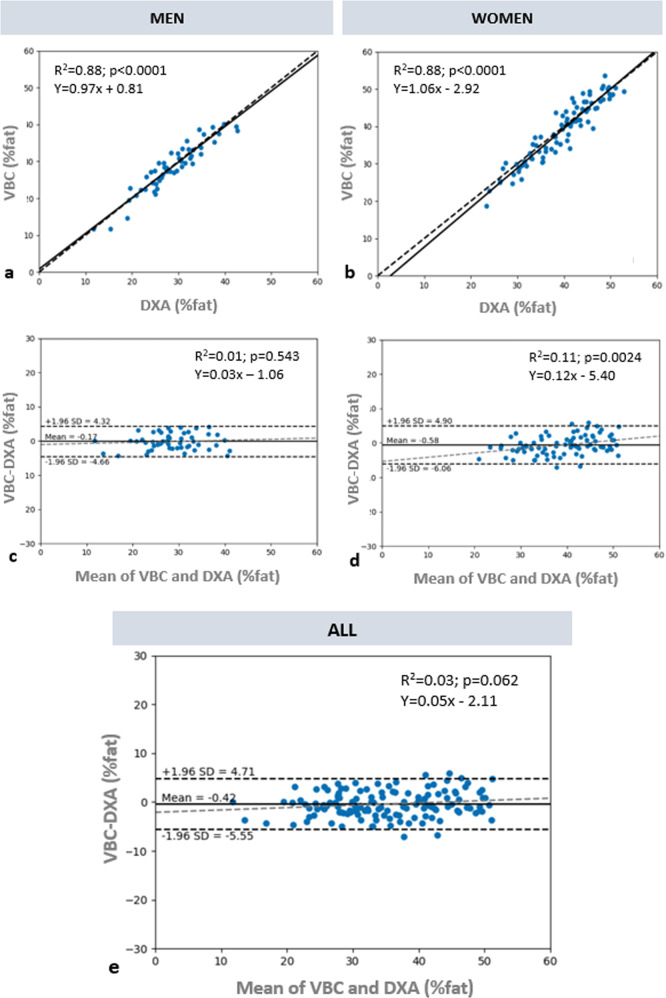
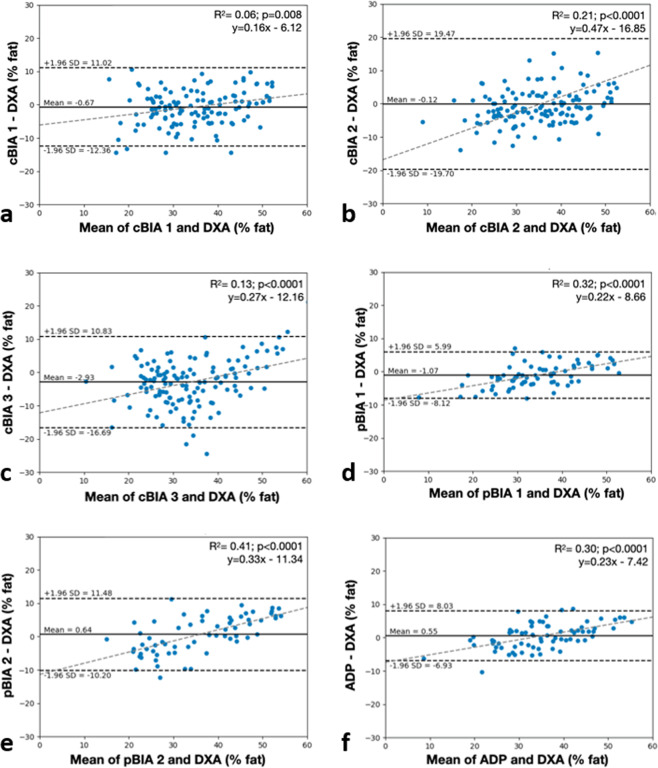
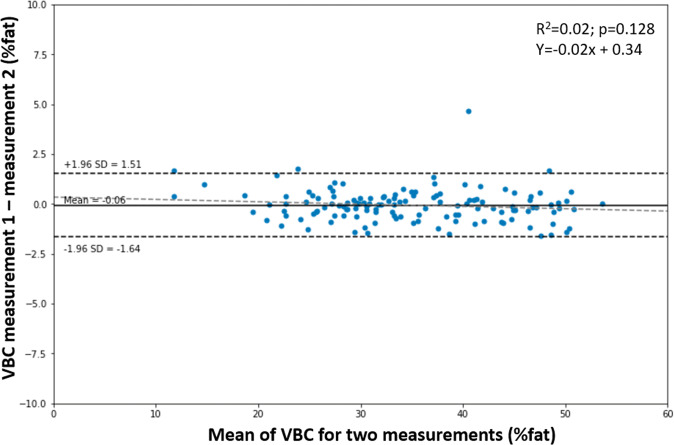
Abstract Body composition is a key component of health in both individuals and populations, and excess adiposity is associated with an increased risk of developing chronic diseases. Body mass index (BMI) and other clinical or commercially available tools for quantifying body fat (BF) such as DXA, MRI, CT, and photonic scanners (3DPS) are often inaccurate, cost prohibitive, or cumbersome to use. The aim of the current study was to evaluate the performance of a novel automated computer vision method, visual body composition (VBC), that uses two-dimensional photographs captured via a conventional smartphone camera to estimate percentage total body fat (%BF). The VBC algorithm is based on a state-of-the-art convolutional neural network (CNN). The hypothesis is that VBC yields better accuracy than other consumer-grade fat measurements devices. 134 healthy adults ranging in age (21–76 years), sex (61.2% women), race (60.4% White; 23.9% Black), and body mass index (BMI, 18.5–51.6 kg/m 2 ) were evaluated at two clinical sites ( N = 64 at MGH, N = 70 at PBRC). Each participant had %BF measured with VBC, three consumer and two professional bioimpedance analysis (BIA) systems. The PBRC participants also had air displacement plethysmography (ADP) measured. %BF measured by dual-energy x-ray absorptiometry (DXA) was set as the reference against which all other %BF measurements were compared. To test our scientific hypothesis we run multiple, pair-wise Wilcoxon signed rank tests where we compare each competing measurement tool (VBC, BIA, …) with respect to the same ground-truth (DXA). Relative to DXA, VBC had the lowest mean absolute error and standard deviation (2.16 ± 1.54%) compared to all of the other evaluated methods ( p < 0.05 for all comparisons). %BF measured by VBC also had good concordance with DXA (Lin’s concordance correlation coefficient, CCC: all 0.96; women 0.93; men 0.94), whereas BMI had very poor concordance (CCC: all 0.45; women 0.40; men 0.74). Bland-Altman analysis of VBC revealed the tightest limits of agreement (LOA) and absence of significant bias relative to DXA (bias −0.42%, R 2 = 0.03; p = 0.062; LOA −5.5% to +4.7%), whereas all other evaluated methods had significant ( p < 0.01) bias and wider limits of agreement. Bias in Bland-Altman analyses is defined as the discordance between the y = 0 axis and the regressed line computed from the data in the plot. In this first validation study of a novel, accessible, and easy-to-use system, VBC body fat estimates were accurate and without significant bias compared to DXA as the reference; VBC performance exceeded those of all other BIA and ADP methods evaluated. The wide availability of smartphones suggests that the VBC method for evaluating %BF could play an important role in quantifying adiposity levels in a wide range of settings. Trial registration : ClinicalTrials.gov Identifier: NCT04854421.
Overview
The claims and statistics of this paper haven’t been checked yet.
Free: it reads the open-access text and checks the first 5 claims that cite a source we can check. Create a free account to check every claim.
Integrity signals
Registry
Cites
Statistics
Figures
Verification
Claims the paper makes
The claims and statistics of this paper haven’t been checked yet.
Free: it reads the open-access text and checks the first 5 claims that cite a source we can check. Create a free account to check every claim.
Claims other papers make about this one
Each is checked against this paper’s own text: does it say what the citing paper says it does?
The cited source says what the claim attributes to it.
In the citing paper
“An automated computer vision method estimates total body fat via visual body composition (VBC) that uses two-dimensional photographs from a conventional smartphone camera and convolutional neural network algorithms; validations were promising versus more burdensome DXA, BIA, and ADP measures [65].”
From Advantages and Limitations of the Body Mass Index (BMI) to Assess Adult Obesity (2024) · cites this paper as [65]
In the citing paper
“Newer technologies, such as visual-based capture using a smart phone, are being developed and validated and may be more widely used in the future [168].”
Self-check
Percentages, sums and reported differences re-computed from the paper’s own numbers.
The self-check needs the paper’s full text.
Citations
Cites
LeCun, Y., Bengio, Y., & Hinton, G. (2015) · Nature · doi:10.1038/nature14539 · Cited by 84,126
Child abuse: Adolescent records vs. adult recall
Femina, D. D., Yeager, C. A., & Lewis, D. O. (1990) · Child Abuse & Neglect · doi:10.1016/0145-2134(90)90033-p · Cited by 8,820
The Disease Burden Associated With Overweight and Obesity
Must, A. (1999) · JAMA · doi:10.1001/jama.282.16.1523 · Cited by 4,780
2013 AHA/ACC/TOS Guideline for the Management of Overweight and Obesity in Adults
Jensen, M. D., Ryan, D. H., Apovian, C. M., Ard, J. D., Comuzzie, A. G., Donato, K. A., Hu, F. B., Hubbard, V. S., Jakicic, J. M., Kushner, R. F., et al. (2014) · Journal of the American College of Cardiology · doi:10.1016/j.jacc.2013.11.004 · Cited by 4,058
Finkelstein, E. A., Trogdon, J. G., Cohen, J. W., & Dietz, W. (2009) · Health Affairs · doi:10.1377/hlthaff.28.5.w822 · Cited by 2,957
Jensen, M. D., Ryan, D. H., Apovian, C. M., Ard, J. D., Comuzzie, A. G., Donato, K. A., Hu, F. B., Hubbard, V. S., Jakicic, J. M., Kushner, R. F., et al. (2014) · Circulation · doi:10.1161/01.cir.0000437739.71477.ee · Cited by 2,735
Health and economic burden of the projected obesity trends in the USA and the UK
Wang, Y. C., McPherson, K., Marsh, T., Gortmaker, S. L., & Brown, M. (2011) · The Lancet · doi:10.1016/s0140-6736(11)60814-3 · Cited by 2,692
(2020) · PubMed · Cited by 2,642
Comparing correlated correlation coefficients
Meng, X.-L., Rosenthal, R., & Rubin, D. B. (1992) · Psychological Bulletin · doi:10.1037/0033-2909.111.1.172 · Cited by 2,472
Body Mass Index: Obesity, BMI, and Health A Critical Review
Nuttall, F. Q. (2015) · Nutrition Today · doi:10.1097/nt.0000000000000092 · Cited by 2,284
Research works printed but not linked: 3
- Sommer I The performance of anthropometric tools to determine obesity: a systematic review and meta‑analysis Sci. Rep. 2020 10 12699 10.1038/s41598-020-69498-7 32728050 PMC7391719 · DOI · Paper page
- Krizhevsky A Sutskever I Hinton G ImageNet classification with deep convolutional neural network Adv. Neural Inf. Process. Syst. 2012 25 1097 1105
- Siri, W. E. 1961 Body composition from fluid spaces and density: analysis of methods. In: Brozek J., Henschel A. (eds) Techniques for Measuring Body Composition. National Academy of Sciences/National Research Council, Washington, DC, pp. 223–224.
Cited by
Advantages and Limitations of the Body Mass Index (BMI) to Assess Adult Obesity
Wu, Y., Li, D., & Vermund, S. H. (2024) · International Journal of Environmental Research and Public Health · doi:10.3390/ijerph21060757 · Cited by 552
“An automated computer vision method estimates total body fat via visual body composition (VBC) that uses two-dimensional photographs from a conventional smart-phone camera and convolutional neural network algorithms; validations were promising versus more burdensome DXA, BIA, and ADP measures [65].”
MethodBrown, T. M., Pack, Q. R., Aberegg, E., Brewer, L. C., Ford, Y. R., Forman, D. E., Gathright, E. C., Khadanga, S., Ozemek, C., Thomas, R. J., et al. (2024) · Circulation · doi:10.1161/cir.0000000000001289 · Cited by 288
Relevance of body composition in phenotyping the obesities
Salmón-Gómez, L., Catalán, V., Frühbeck, G., & Gómez-Ambrosi, J. (2023) · Reviews in Endocrine and Metabolic Disorders · doi:10.1007/s11154-023-09796-3 · Cited by 158
Mozaffarian, D., Agarwal, M., Aggarwal, M., Alexander, L., Apovian, C. M., Bindlish, S., Bonnet, J., Butsch, W. S., Christensen, S., Gianos, E., et al. (2025) · The American Journal of Clinical Nutrition · doi:10.1016/j.ajcnut.2025.04.023 · Cited by 154
“Newer technologies, such as visual-based capture using a smart phone, are being developed and validated and may be more widely used in the future [168].”
Self-citationMozaffarian, D., Agarwal, M., Aggarwal, M., Alexander, L., Apovian, C. M., Bindlish, S., Bonnet, J., Butsch, W. S., Christensen, S., Gianos, E., et al. (2025) · Obesity · doi:10.1002/oby.24336 · Cited by 143
“Based on the human, societal, and financial burdens of obesity, as well as the costs and adherence challenges of GLP-1 therapy, more comprehensive weight management programs and research on their optimal use are needed in healthcare.”
Self-citationUpdates on Methods for Body Composition Analysis: Implications for Clinical Practice
Thomas, D. M., Crofford, I., Scudder, J., Oletti, B., Deb, A., & Heymsfield, S. (2025) · Current Obesity Reports · doi:10.1007/s13679-024-00593-w · Cited by 73
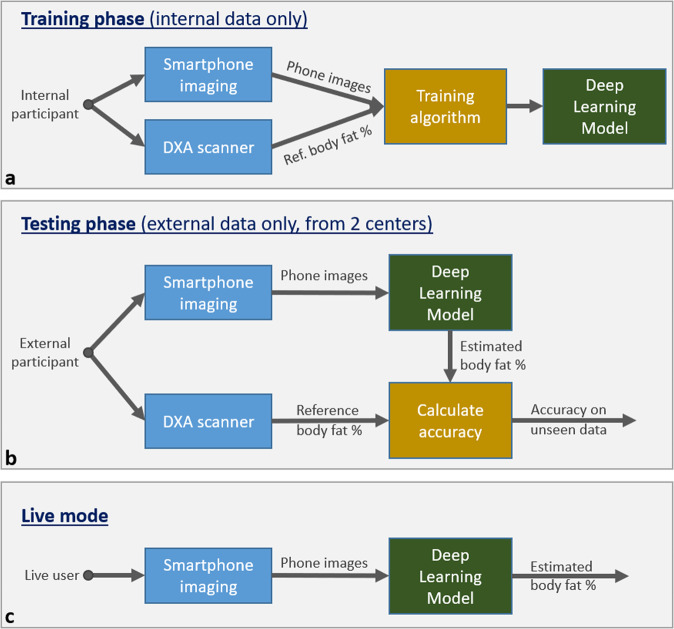
“A third approach used a pre-trained convolutional neural network model (CNN) trained on external 2D images from a front and back smartphone camera picture of each participant standing in an “A” pose [93].”
InfluentialSelf-citationAnthropometric evaluation of a 3D scanning mobile application
Smith, B., McCarthy, C., Dechenaud, M. E., Wong, M. C., Shepherd, J., & Heymsfield, S. B. (2022) · Obesity · doi:10.1002/oby.23434 · Cited by 60
Self-citationBrown, T. M., Pack, Q. R., Beregg, E. A., Brewer, L. C., Ford, Y. R., Forman, D. E., Gathright, E. C., Khadanga, S., Ozemek, C., & Thomas, R. J. (2025) · Journal of Cardiopulmonary Rehabilitation and Prevention · doi:10.1097/hcr.0000000000000930 · Cited by 53
The challenges of assessing adiposity in a clinical setting
Börgeson, E., Tavajoh, S., Lange, S., & Jessen, N. (2024) · Nature Reviews Endocrinology · doi:10.1038/s41574-024-01012-9 · Cited by 49
“Digital image analysis of at least two pictures taken, for example, by a smartphone, can allow good estimates of body adiposity and BMI 74,75 .”
Smartphone prediction of skeletal muscle mass: model development and validation in adults
McCarthy, C., Tinsley, G. M., Yang, S., Irving, B. A., Wong, M. C., Bennett, J. P., Shepherd, J., & Heymsfield, S. B. (2023) · American Journal of Clinical Nutrition · doi:10.1016/j.ajcnut.2023.02.003 · Cited by 43
Self-citationGraybeal, A. J., Brandner, C. F., & Tinsley, G. M. (2022) · Clinical Nutrition · doi:10.1016/j.clnu.2022.09.014 · Cited by 39
Farina, G. L., Orlandi, C., Lukaski, H. C., & Nescolarde, L. (2022) · Sensors · doi:10.3390/s22218365 · Cited by 33
“[26] evaluated the use of convolutional neural networking, a type of machine learning, for analysis of smartphone 2D digital images to estimate %fat from two standing body positions.”
BackgroundMethodInfluentialMozaffarian, D., Agarwal, M., Aggarwal, M., Alexander, L., Apovian, C. M., Bindlish, S., Bonnet, J., Butsch, W. S., Christensen, S., Gianos, E., et al. (2025) · Obesity Pillars · doi:10.1016/j.obpill.2025.100181 · Cited by 28
Self-citationMozaffarian, D., Agarwal, M., Aggarwal, M., Alexander, L., Apovian, C. M., Bindlish, S., Bonnet, J. P., Butsch, W. S., Christensen, S. M., Gianos, E., et al. (2025) · Obesity Pillars · doi:10.1016/j.obpill.2026.100269 · Cited by 41
Self-citationRelationship of Fat Mass Ratio, a Biomarker for Lipodystrophy, With Cardiometabolic Traits
Agrawal, S., Luan, J., Cummings, B. B., Weiss, E. J., Wareham, N. J., & Khera, A. V. (2024) · Diabetes · doi:10.2337/db23-0575 · Cited by 30
Validity and reliability of a mobile digital imaging analysis trained by a four‐compartment model
Graybeal, A. J., Brandner, C. F., & Tinsley, G. M. (2022) · Journal of Human Nutrition and Dietetics · doi:10.1111/jhn.13113 · Cited by 23
Body Composition in Anti-Obesity Medication Trials—Beyond Scales
Agarwal, A. A., Narayan, A., & Stanford, F. C. (2024) · JAMA Internal Medicine · doi:10.1001/jamainternmed.2023.7733 · Cited by 20
Self-citationSilhouette images enable estimation of body fat distribution and associated cardiometabolic risk
Klarqvist, M. D. R., Agrawal, S., Diamant, N., Ellinor, P. T., Philippakis, A., Ng, K., Batra, P., & Khera, A. V. (2022) · npj Digital Medicine · doi:10.1038/s41746-022-00654-1 · Cited by 23
Yi, X., He, Y., Gao, S., & Li, M. (2024) · Diabetes & Metabolic Syndrome Clinical Research & Reviews · doi:10.1016/j.dsx.2024.103000 · Cited by 20
A Women's health perspective on managing obesity
Johnson, V. R., Anekwe, C. V., Bell-Washington, T., Chhabria, S. M., Tu, L., & Stanford, F. C. (2023) · Progress in Cardiovascular Diseases · doi:10.1016/j.pcad.2023.04.007 · Cited by 19
Self-citationAmerican Society for Metabolic and Bariatric Surgery Review of Body Composition
Carter, J. T., Husain, F. A., Papasavas, P. K., Docimo, S., Albaugh, V. L., Aylward, L., Blalock, C. A., & Benson‐Davies, S. (2024) · Surgery for Obesity and Related Diseases · doi:10.1016/j.soard.2024.10.037 · Cited by 18
Prediction of total and regional body composition from 3D body shape
Qiao, C., Rolfe, E. D. L., Mak, E., Sengupta, A., Powell, R., Watson, L. P. E., Heymsfield, S. B., Shepherd, J., Wareham, N. J., Brage, S., et al. (2024) · npj Digital Medicine · doi:10.1038/s41746-024-01289-0 · Cited by 18
“Compared to other smartphone apps that estimate body composition from photographs, we note that they either do not reconstruct 3D meshes 21,24 , or they require strict pose constraints 16,24 .”
Self-citationPalumbo, A. M., Jacob, C. M., Khademioore, S., Sakib, M. N., Yoshida‐Montezuma, Y., Christodoulakis, N., Yassa, P., Vanama, M. S., Gamra, S., Ho, P., et al. (2025) · Obesity Reviews · doi:10.1111/obr.13894 · Cited by 21
Wong, M. C., Bennett, J. P., Quon, B. K., Leong, L. T., Tian, I. Y., Liu, Y. E., Kelly, N. N., McCarthy, C., Chow, D. C., Pujades, S., et al. (2023) · American Journal of Clinical Nutrition · doi:10.1016/j.ajcnut.2023.07.010 · Cited by 19
Self-citationChoudhary, S., Iyer, G., Smith, B. M., Li, J., Sippel, M., Criminisi, A., & Heymsfield, S. B. (2023) · npj Digital Medicine · doi:10.1038/s41746-023-00909-5 · Cited by 15
“Our group has introduced a smartphone application that is highly accurate and reproducible in quantifying a person ’ s anthropometric dimensions, including circumferences, lengths, surface areas, and volumes 15,16 .”
Self-citationRadtke, M. D., Steinberg, F. M., & Scherr, R. E. (2023) · Advances in Nutrition · doi:10.1016/j.advnut.2023.10.004 · Cited by 17
“To better capture the experience of FI on overnutrition in college students, user-prompted technologies, such as phone camera adiposity measurements [84] and wearable dietary monitors for assessing nutrients of concerns for both under-and overconsumption [85], may provide additional objective…”
BackgroundPeng, X., Lin, P., Huang, B., He, Y., & Wang, M. (2024) · Tunnelling and Underground Space Technology · doi:10.1016/j.tust.2024.105922 · Cited by 13
Tinsley, G. M., Rodriguez, C., Florez, C. M., Siedler, M. R., Tinoco, E., McCarthy, C., & Heymsfield, S. B. (2024) · Frontiers in Medicine · doi:10.3389/fmed.2024.1485450 · Cited by 16
“A small number of previous investigations have reported the validity of smartphone-based 3D scanning applications, typically using two photographic images, as compared to reference methods (2, 6, 8).”
BackgroundSelf-citationFlorez, C. M., Rodriguez, C., Siedler, M. R., Tinoco, E., & Tinsley, G. M. (2024) · British Journal Of Nutrition · doi:10.1017/s0007114524002216 · Cited by 11
“While acceptable errors vary based on the specific application being considered, a previous study of smartphone applications for body composition estimation defined an acceptable MAE for BF% to be ≤ 3 % (40) ; however, there is not currently a consensus in the literature.”
Normalized sensitivity of multi-dimensional body composition biomarkers for risk change prediction
Criminisi, A., Sorek, N., & Heymsfield, S. B. (2022) · Scientific Reports · doi:10.1038/s41598-022-16142-1 · Cited by 12
Self-citationPorterfield, F., Shapoval, V., Langlet, J., Samouda, H., & Stanford, F. C. (2024) · Life · doi:10.3390/life14080947 · Cited by 15
“%) from DEXA as well ( p < 0.05 for all comparisons) [36].”
BackgroundResultInfluentialSelf-citationAdvances in the estimation of body fat percentage using an artificial intelligence 2D-photo method
Ferreira, T. J., Salvador, I. C., Pessanha, C. R., da Silva, R. R. M., Pereira, A. D., Horst, M. A., de Carvalho, D. P., Koury, J. C., & Pierucci, A. P. T. R. (2025) · npj Digital Medicine · doi:10.1038/s41746-024-01380-6 · Cited by 11
Obesity: assessment and treatment across the care continuum
Kushner, R. F., & Marla Shapiro, C. M. (2025) · Annals of Medicine · doi:10.1080/07853890.2025.2521433 · Cited by 14
“Recent technological advancements, such as computer algorithms that use smartphone scanning to estimate a person’s percent body fat, called digital anthropometry, could eventually increase the feasibility of body fat percentage as an evaluative tool [20].”
Baumann, S., Stone, R., & Abdelall, E. S. (2025) · Sensors · doi:10.3390/s25196067 · Cited by 15
“While traditional body composition analysis requires clinical-grade tools like DEXA, or sometimes referred to as DXA (Dual-Energy X-ray Absorptiometry), new solutions, such as smart scales and smartphone camera-based assessments, are making this information more accessible for at-home users [9].”
Graybeal, A. J., Swafford, S. H., Compton, A. T., Renna, M. E., Thorsen, T. A., & Stavres, J. (2024) · Journal of Clinical Densitometry · doi:10.1016/j.jocd.2024.101537 · Cited by 10
Graybeal, A. J., Brandner, C. F., Compton, A. T., Swafford, S. H., Henderson, A., Aultman, R. A., Vallecillo‐Bustos, A., & Stavres, J. (2023) · Clinical Nutrition ESPEN · doi:10.1016/j.clnesp.2023.11.021 · Cited by 9
Equations for smartphone prediction of adiposity and appendicular lean mass in youth soccer players
Minetto, M. A., Pietrobelli, A., Ferraris, A., Busso, C., Magistrali, M., Vignati, C., Sieglinger, B. A., Bruner, D., Shepherd, J., & Heymsfield, S. B. (2023) · Scientific Reports · doi:10.1038/s41598-023-48055-y · Cited by 10
“The demonstration of high agreement between the measurements obtained for consecutive avatars confirms previous studies on the clinical application of smartphone-based digital imaging analysis that were performed in healthy adults through different commercially-available tools 19,21–23 .”
ResultSelf-citationStarkoff, B. E., & Nickerson, B. S. (2024) · Nutrition in Clinical Practice · doi:10.1002/ncp.11151 · Cited by 10
Medina‐Inojosa, B. J., Somers, V. K., Lara-Breitinger, K. M., Johnson, L. A., Medina‐Inojosa, J. R., & López-Jiménez, F. A. (2024) · European Heart Journal - Digital Health · doi:10.1093/ehjdh/ztae059 · Cited by 10
Nescolarde, L., Orlandi, C., Farina, G. L., Gori, N., & Lukaski, H. C. (2023) · Nutrients · doi:10.3390/nu15214638 · Cited by 11
Braun-Trocchio, R., Ray, A., Graham, R., Brandner, C. F., Warfield, E., Renteria, J., & Graybeal, A. J. (2023) · Behavior Therapy · doi:10.1016/j.beth.2023.08.009 · Cited by 8
HIT: Estimating Internal Human Implicit Tissues from the Body Surface
Keller, M., Arora, V., Dakri, A., Chandhok, S., Machann, J., Fritsche, A., Black, M. J., & Pujades, S. (2024) · IEEE Computer Society Conference on Computer Vision and Pattern Recognition/Proceedings - IEEE Computer Society Conference on Computer Vision and Pattern Recognition/Proceedings · doi:10.1109/cvpr52733.2024.00334 · Cited by 17
“In recent years, researchers have shown that the shape of the human body surface is related to the internal body composition [36, 43, 48, 72], leading the way towards fast and non-invasive methods for early screening of body-composition-related pathologies.”
Marazzato, F., McCarthy, C., Field, R. H., Nguyen, H. T. N., Nguyen, T., Shepherd, J., Tinsley, G. M., & Heymsfield, S. B. (2023) · European Journal of Clinical Nutrition · doi:10.1038/s41430-023-01396-3 · Cited by 9
“First, advances in computer vision technology are leading to greatly improved capabilities for quantifying a person ’ s body size and shape [1, 2].”
Self-citationModeling health risks using neural network ensembles
Smith, B. M., Criminisi, A., Sorek, N., Harari, Y., Sood, N., & Heymsfield, S. B. (2024) · PLOS ONE · doi:10.1371/journal.pone.0308922 · Cited by 5
Self-citationDiagnosis, staging and management of obesity: a synthesis of contemporary guidelines
Tandar, C. E., Lin, J. C., & Stanford, F. C. (2026) · Nature Reviews Endocrinology · doi:10.1038/s41574-026-01279-0 · Cited by 6
Self-citationGraybeal, A. J., Brandner, C. F., Aultman, R. A., Ojo, D. E., & Braun-Trocchio, R. (2023) · Journal of Racial and Ethnic Health Disparities · doi:10.1007/s40615-023-01799-9 · Cited by 8
Maternal obesity and offspring metabolism: revisiting dietary interventions
Xu, Z., Li, L., Cheng, L., Gu, Z., & Hong, Y. (2025) · Food & Function · doi:10.1039/d4fo06233g · Cited by 5
Increases in adiposity among children and adolescents over time: Moving beyond BMI
Staiano, A. E., & Katzmarzyk, P. T. (2021) · American Journal of Clinical Nutrition · doi:10.1093/ajcn/nqab265 · Cited by 6
Comparing digital anthropometrics from mobile applications to reference methods: a scoping review
da Encarnação, I. G. A., Cerqueira, M. S., Almeida, P. H. R. F., de Oliveira, C. E. P., Silva, A. M., Silva, D. A. S., Heymsfield, S. B., & Moreira, O. C. (2025) · European Journal of Clinical Nutrition · doi:10.1038/s41430-025-01613-1 · Cited by 5
“These mobile applications (Apps), for instance, are designed to estimate body composition and provide anthropometric measurements, utilizing technologies such as arti fi cial intelligence (AI) and its derivatives, including machine learning, deep machine learning and others [13, 14].”
InfluentialSelf-citationDePrenger, M., Morales‐Perez, M., & Lynch, A. (2025) · Nutrition in Clinical Practice · doi:10.1002/ncp.70065 · Cited by 5
“63 Several mobile applications that use this technology have demonstrated validity and reliability when compared with established imaging methods such as DEXA, 63 – 66 BIA, 66,67 and hydrostatic weighing.”
Scataglini, S., Orden, F. V., van den Hoek, E., Stessel, M., & Truijen, S. (2025) · BioMedical Engineering OnLine · doi:10.1186/s12938-025-01480-8 · Cited by 4
Beyond Body Mass Index: Accurate Metabolic Disease‐Risk Phenotyping With 3D Smartphone Application
McCarthy, C., Tinsley, G. M., Ramirez, S., & Heymsfield, S. B. (2024) · Obesity Science & Practice · doi:10.1002/osp4.70025 · Cited by 5
Self-citationAccurate prediction of three-dimensional humanoid avatars for anthropometric modeling
McCarthy, C., Wong, M. C., Brown, J., Ramirez, S., Yang, S., Bennett, J. P., Shepherd, J., & Heymsfield, S. B. (2024) · International Journal of Obesity · doi:10.1038/s41366-024-01614-3 · Cited by 3
Self-citationActive assessment of fitness and performance in a general population
Winslow, B. D., Natarajan, A., Mravca, S., Duong, J. J., Choudhary, S., & Giest, T. (2025) · Frontiers in Sports and Active Living · doi:10.3389/fspor.2025.1552365 · Cited by 3
New advances in body composition assessment with ShapedNet: A single image deep regression approach
Nascimento, N. M. M., de Sousa, P. C., Nunes, P. Y. R., da Silva, S. P. P., Loureiro, L. L., Bittencourt, V. Z., Capistrano, V. L. M., & Filho, P. P. R. (2024) · Pattern Recognition Letters · doi:10.1016/j.patrec.2024.11.029 · Cited by 2
“In terms of results, our method achieves an error in BFP that is 0.43 lower than [12], and 1.41 and 1.98 lower than [2] and [1], respectively.”
InfluentialArtificial Intelligence Applications in Digital Anthropometry 1
Bonilla, D. A. (2022) · OBM Integrative and Complementary Medicine · doi:10.21926/obm.icm.2204056 · Cited by 1
Advancing sarcopenia assessment with wearable and app-based technology: a scoping review
Mehra, A., Perez, J., Krok-Schoen, J., Benzo, R. M., Spees, C., Wang, S.-J., Clinton, S. K., Czerwinski, S. A., & Nickerson, B. S. (2026) · The journal of nutrition health & aging · doi:10.1016/j.jnha.2026.100824 · Cited by 1
“…2D images were compared to DXA and found strong correlations (r = 0.86) among apparently healthy adults (n = 226) [27] and in a separate study demonstrated high overall concordance with DXA among men (concordance correlation coefficient (CCC) = 0.94, n = 52) and women (CCC = 0.93, n = 84) [28].”
InfluentialPoltronieri, T. S., da Silva, B. R., Bennett, J. P., Heymsfield, S. B., Shepherd, J., & Prado, C. M. M. (2026) · Nutrition · doi:10.1016/j.nut.2026.113299 · Cited by 1
Self-citationNovel approaches for assessing dietary intake and behaviours
Langley‐Evans, S. C. (2023) · Journal of Human Nutrition and Dietetics · doi:10.1111/jhn.13146 · Cited by 1
Farina, G. L., Orlandi, C., Gori, N., Nescolarde, L., & Lukaski, H. C. (2023) · Preprints.org · doi:10.20944/preprints202308.0812.v1
Hydration and Fat EstimatesPreprint
Farina, G. L., Orlandi, C., Gori, N., Nescolarde, L., & Lukaski, H. C. (2023) · Preprints.org · doi:10.20944/preprints202308.0812.v2
Challenges With Relying on Body Fat and Weight Values for Obesity—Reply
Narayan, A. P., Agarwal, A. A., & Stanford, F. C. (2024) · JAMA Internal Medicine · doi:10.1001/jamainternmed.2024.2376 · Cited by 1
Self-citationSisohor, J., Ambegaonkar, J. P., Lindsey, B., Shaul, Y., & Martin, J. R. (2025) · medRxiv · doi:10.1101/2025.08.01.25332763
“Majmudar et al. [26] validated a smartphone CVapp using CNNs in 134 adults, comparing it to DXA and multiple BIA devices, including smart scales and the BODPOD.”
InfluentialDevelopment and Validation of a Deep Survival Model to Predict Time-to-Seizure from Routine EEGPreprint
Lemoine, É., Xu, A. Q., Jemel, M., Lesage, F., Nguyen, D. K., & Assi, E. B. (2025) · medRxiv · doi:10.1101/2025.08.12.25333063
Yamamoto, T., Neufeld, E. V., Cho, D., Mardirossian, A., Bright, J. M., & Dolezal, B. A. (2025) · Scientific Journal of Sport and Performance · doi:10.55860/mxok4379
Blaszcyk, W., Büttner, M., Betz, L. T., Riepenhausen, A., Jacob, G. A., Klein, J. P., & Schröder, J. (2025) · medRxiv · doi:10.1101/2025.08.26.25334419
Günalan, E., Tartıcı, G., Aladağ, E., & Çonak, Ö. (2026) · Journal of Nutrition · doi:10.1016/j.tjnut.2026.101454
Validation of digital anthropometric measurements during pregnancy: a longitudinal study
Ramirez, S., Brown, J., Yang, R., Deynzer, M., Lemos, G., McCarthy, C., Dube, S., Virostko, J. M., Janumala, I., Nichols, A. R., et al. (2026) · European Journal of Clinical Nutrition · doi:10.1038/s41430-026-01763-w · Cited by 1
“Ground-truth measurements in engineering applications, including 3D optical technology [18], refers to assessment methods that are known to be accurate and can serve as the “ gold standards ” .”
Self-citationReynolds, T., Gerard, J., Jordan, A., Streby, N., Stoll, B., Bowers, A., Hewitt, A., Bargamian, J., Sapper, T. N., Burdick, T. E., et al. (2026) · medRxiv · doi:10.64898/2026.06.15.26355736
da Encarnação, I. G. A., Cerqueira, M. S., Tinsley, G. M., Ferreira, K. B. D. O., Sales, E. C., Oliveira, W. D. S. S., de Souza, Y. S., Moraes, M. S., dos Santos, F. K., de Oliveira, C. E. P., et al. (2026) · Clinical Nutrition ESPEN · doi:10.1016/j.clnesp.2026.103391
Obesity, Ageing, and Longevity: Overview of Obesity Prevalence, Phenotypes and Paradoxes
Kaur, G. (2026) · Healthy ageing and longevity · doi:10.1007/978-3-032-24097-2_1
Tejera-Perez, C., Torrente, L., Porca, C., Bellido, D., & Crujeiras, A. B. (2026) · Reviews in Endocrine and Metabolic Disorders · doi:10.1007/s11154-026-10070-5 · Cited by 1
Sisohor, J., Ambegaonkar, J. P., Lindsey, B., Wei, Q., Shaul, Y., & Martin, J. R. (2026) · PLOS Digital Health · doi:10.1371/journal.pdig.0000983 · Cited by 1
“However, most prior studies have validated these tools against DXA [20,27,29] with lesser data existing on how a CV app compares with other common methods like BODPOD and BIA or on the test–retest reliability of a CV app .”
InfluentialAlbashrawi, M. A. (2026) · Information Discovery and Delivery · doi:10.1108/idd-09-2025-0235
Park, J., Seo, J., Suh, J.-P., Jin, M., Ha, S.-K., Lee, G., Kang, K. M., Lee, S. Y., Park, H.-S., Hwang, W.-H., et al. (2026) · Precision Agriculture · doi:10.1007/s11119-026-10439-1
“The recent substantial improvements in smartphone camera technology have created the possibility of easy collection of image data in the field without the need for expensive specialized equipment (Majmudar et al., 2022; Nixon et al., 2020 ).”
Metadata
- Authors
- Majmudar, M. D., Chandra, S., Yakkala, K., Kennedy, S., Agrawal, A., Sippel, M., Ramu, P., Chaudhri, A., Smith, B., Criminisi, A., Heymsfield, S. B., & Stanford, F. C.
- Affiliations
- Amazon (United States) (US)
- Pennington Biomedical Research Center (US)
- Harvard University (US)
- Corresponding author
- Majmudar, Maulik D.
- ORCID
- Venue
- npj Digital Medicine
- Published
- 2022-06-29
- Volume
- 5
- Issue
- 1
- Pages
- 79-79
- ISSN
- 2398-6352 (ISSN-L)
- PMC
- PMC9243018
- OpenAlex
- W4283698854
- Cited by
- 75
- References
- 52
- Citations by year
- 2026: 12 · 2025: 18 · 2024: 22 · 2023: 15 · 2022: 7
- FWCI
- 9.60
- Type
- journal article
- Language
- en
- Open access
- gold
- doi.org
- Licence
- cc-by
- creativecommons.org/licenses/by/4.0 (tdm)
- creativecommons.org/licenses/by/4.0 (vor)
- Locations
- npj Digital Medicine (publishedVersion, cc-by)
- medRxiv (acceptedVersion)
- PubMed Central (publishedVersion, cc-by)
- PubMed (publishedVersion)
- DOAJ (DOAJ: Directory of Open Access Journals) (submittedVersion)
- Funders
- National Institute of Diabetes and Digestive and Kidney Diseases (P30DK072476, P30DK040561)
- Topics
- Health Sciences › Medicine › Physiology (medical) › Body Composition Measurement Techniques
- Physical Sciences › Computer Science › Computer Vision and Pattern Recognition › Advanced Neural Network Applications
- Health Sciences › Medicine › Surgery › Body Contouring and Surgery
- Keywords
- adiposity assessment, body fat percentage, smartphone camera, computer vision, convolutional neural networks, body composition measurement, bioelectrical impedance analysis, air displacement plethysmography, dual-energy X-ray absorptiometry, body mass index, measurement accuracy, healthy adults, sex differences
About these checks
Registry, retraction, Cites and statistics results are computed, not judged, with one exception: a printed reference that no index lists is read once by a model before it counts as a citation error. Claims are extracted by a model and kept only when their quote appears verbatim in the text; each cited source is then checked, with a model’s help, for whether it says what the claim relies on. Those verdicts can be wrong — read the claim’s quote and the cited source before relying on one.
Statistics and arithmetic are recomputed, not judged.
Confidence bands are shown only for fields calibrated on our annotated test set. None is calibrated yet, so no band is shown.
What counts as a claim ›How we measure confidence ›How we check this ›
Are you an author, or do you see a problem with this page? Request a review
Data sources
Bibliographic data: Semantic Scholar, OpenAlex, Crossref.
Contains information from the Semantic Scholar Academic Graph Datasets, made available under the ODC Attribution License (ODC-BY 1.0).
Semantic Scholar’s data is described in: Kinney, R., et al. (2023). The Semantic Scholar Open Data Platform. arXiv:2301.10140.
